
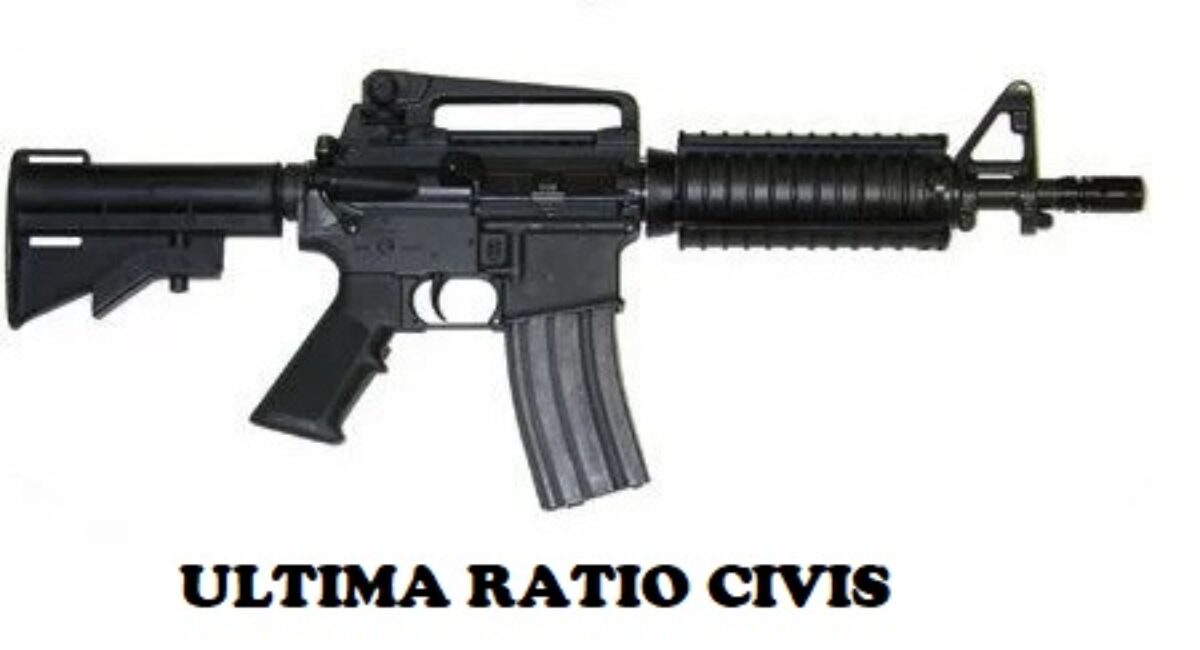

August 8, 2025

Lawsuit: The Regulation Of Untaxed Firearms Under Federal Law Is Unconstitutional
Several Second Amendment advocacy groups, including the National Rifle Association (NRA), have filed a lawsuit to challenge the constitutionality of the National Firearms Act of 1934 (NFA).
President Trump’s One Big, Beautiful Bill erased the NFA’s $200 stamp tax on short-barreled rifles, short-barreled shotguns, any firearm classified by the Bureau of Alcohol, Tobacco, and Firearms (ATF) as “other,” and suppressors starting Jan. 1, 2026. However, “the firearms are still required to be registered and are subject to” regulations designed to enforce the “now-extinct” tax, the lawsuit says. This “regulatory regime” no longer comports with Congress’ constitutional authority, plaintiffs claim. The lawsuit also argues that “the NFA’s regulation of suppressors and short-barreled rifles violates the Second Amendment.”
The National Firearms Act’s registration scheme only exists to ensure that the tax on NFA firearms was paid,” Adam Kraut, the Second Amendment Foundation’s (SAF) executive director, said in a press release. “With Congress removing the tax on silencers, short-barreled firearms, and ‘any other weapons,’ the continued inclusion of these items in the NFA serves no purpose, except continuing to retain an impermissible hurdle to the exercise of one’s constitutional right to keep and bear arms.”
The lawsuit, Brown v. ATF, was filed on August 1 in the U.S. District Court for the Eastern District of Missouri. The plaintiffs are the NRA, the American Suppressor Association (ASA), SAF, the Firearms Policy Coalition (FPC), Prime Protection STL Tactical Boutique, and two individual members of these organizations. They are suing both the ATF and the DOJ. The lawsuit asks the court to declare NFA regulations “relating to making, transferring, receiving, possessing, or otherwise using” the untaxed firearms and suppressors unlawful and to block anyone from enforcing the challenged portions of the law.
Fiocchi America Moved into TKG’s Brands, Hevi Shifting from Oregon to Missouri
News came this week that Fiocchi’s U.S. arm will be moving under the same umbrella of ammo brands maintained by the Kinetic Group.
Formerly part of Vista Outdoor, last year’s purchase of several classic American ammunition brands, including CCI, Federal, Hevi, Remington, and Speer by the Czechoslovak Group, became TKG. As the Czechoslovak Group – which has held a majority stake in Fiocchi since 2022 and quietly became the 100-percent owner of that ammo company in April – the writing was on the wall that its U.S. operations would be consolidated with TKG.
“We’re excited to have Fiocchi of America officially join of our group of world-leading ammunition brands,” said Jason Vanderbrink, Chairman and CEO of TKG.
As part of the shift, Fiocchi America’s Ozark, Missouri, shotshell plant will become “a center of excellence for shotshell products,” and Hevi will move its operations from Oregon to Missouri. Fiocchi is also building a $42 million lead-free primer plant in Arkansas.
“Ozark is just outside of Springfield, Missouri, a fantastic location for ammunition manufacturing, the outdoors, conservation, and support of the Second Amendment. HEVI-Shot will have a great new home here and will continue its 25-year legacy of loading the best steel, tungsten, and bismuth shot for waterfowl and upland hunters,” said Vanderbrink.
Hevi was formed in Oregon in 2000 by a group of hunters frustrated by the performance of steel shot and eager to create better non-toxic loads.
Jankovich: Walmart stabbings show flaw in gun control logic
Last weekend, a man walked into a Walmart in Traverse City and stabbed 11 innocent people in a random, brutal act of violence. The scene was horrifying—but thankfully, everyone survived.
The media covered the initial shock. The politicians issued generic statements. But something’s missing — something that always seems to go missing when the narrative doesn’t fit: no one is talking about “knife control.” Why is that?
A knife was used to commit mass violence — just as we’ve seen before with hammers, axes and even cars. These are real tragedies, carried out without a single bullet fired. And yet, no one is proposing sweeping legislation to regulate or ban knives or to require background checks before buying a truck.
Because deep down, we all know the glaring truth: it’s not the object that commits the violence; it’s the person. But the moment a firearm is involved, the story changes. The headlines explode. Politicians scramble to propose more restrictions. And the blame shifts from the criminal to the tool they used.
Police respond to multiple people being stabbed inside a Walmart Supercenter store near Traverse City, Mich. on Saturday, July 26, 2025.
This double standard isn’t just frustrating, it’s dangerous. It distracts from real solutions, and it deliberately ignores the fact that, in Traverse City, a law-abiding citizen with a firearm stopped the attack before more people were stabbed.
When police arrived at the scene, the alleged attacker had already been restrained, held at gunpoint by a shopper.
That’s right: a proverbial “good guy” with a gun stopped a “bad guy” with a knife. It’s textbook self-defense and the outcome we hope for in moments of crisis.
This is the very reason Women for Gun Rights exists. We believe the Second Amendment protects not just the right to “bear arms” — but the right to defend yourself and others when no one else can. At the end of the day, despite the best efforts of law enforcement, you are your own first responder. Your life, and the lives of others, is your responsibility.
This incident also highlights another uncomfortable pattern that truly undermines the efficacy of gun control. Authorities said the suspect had a history of “assaultive incidents.” In other words, they knew he was dangerous and capable of violence. While shocking to hear, this isn’t an isolated occurrence. Over and over, we’ve seen mass casualty events carried out by individuals who were already on law enforcement’s radar. The signs were there. The threats had been made. Reports were filed. But the system didn’t act.
And yet, every time a tragedy occurs, the focus shifts — not to the failures of intervention, but to restricting the rights of law-abiding citizens. Groups like Moms Demand Action and anti-gun politicians push for Red Flag laws, assault weapon bans and magazine limits, as if taking tools away from the responsible will somehow stop the reckless and violent.
But Traverse City shows the flaw in that logic.
The attacker didn’t use a gun. He used a knife. Would a Red Flag law have prevented it? Would a gun ban have saved those people? Of course not. The answer isn’t to criminalize gun ownership — it’s to crack down on actual criminals, take real threats seriously and enforce the laws we already have against people who have proven themselves violent and dangerous.
This is an important moment in Michigan and across the United States. It’s time to stop pretending the tool is the problem and start focusing on the truth: dangerous people are the threat. And guns, in the hands of the right people, save lives.
Marcy Jankovich is the Michigan State Director for Women for Gun Rights.

“Our Founding Fathers were proud that Americans were trusted with arms because they knew that only when people are armed could they truly be thought of as free citizens.
And that’s where the circle closes.
Those who want to deprive you of your right to keep and bear arms are intending to deprive you of your freedom, period.
Like the criminals their policies encourage, these elitists know that it is always best to disarm victims before you enslave them.”
— Charley Reese
August 7, 2025

Minnesota Supreme Court rules it is legal to possess ‘ghost guns’ without serial numbers
The Minnesota Supreme Court ruled in a split decision Wednesday that it is legal for Minnesotans to possess ghost guns without a serial number because current state law does not clearly restrict it.
Justice Paul Thissen’s majority opinion delves into the intersection between federal law around what firearms require a serial number and the Minnesota legal statute for felony possession of a firearm without a serial number.
It was not a unanimous opinion. Thissen was joined by Justices Anne McKeig, Gordon Moore and Sarah Hennesy. Chief Justice Natalie Hudson wrote the dissent, which was joined by Justice Karl Procaccini. Justice Theodora Gaïtas recused herself from participating in the case.
The case stemmed from a single vehicle car crash in Fridley in 2022. A Minnesota state trooper who arrived on the scene saw a gun magazine inside the car and the driver told the trooper he had a pistol.
The trooper found a black 9 mm Glock 19 without a serial number and identified it as a privately made firearm, which are commonly called ghost guns.
The driver was charged with possessing a firearm without a serial number and filed a motion to dismiss the charge. An Anoka County judge agreed, ruling that state law was “unconstitutionally vague.” The state appealed that ruling; the Court of Appeals reversed the decision and said Minnesota’s legal statute prohibiting possession of a firearm without a serial number “plainly applies to any firearm.”
The Supreme Court disagreed.
The opinion focuses on how Minnesota’s legal statute came to lean on federal law to interpret the phrase “serial number or other identification” and how, in the absence of clearer state laws, the court needs to use federal laws to consider whether the possession of a ghost gun without a serial number is a felony.
80 years ago, today, the beginning of the end of World War 2 started with the atomic bombing of Hiroshima. One would have thought that this one, single bomb, instantly destroying most of the city and killing 80,000 to 100,000 people would have convinced the Japanese government to surrender, but it didn’t, and we had to repeat the demonstration 3 days later on the alternate target city of Nagasaki. Even then, a group of Japanese Army officers attempted a coup to take over the government and continue the war.
That was just how obdurate the Japanese military and government was.


“Any politician who won’t trust you with the weapon of your choice, clearly cannot be trusted with the power he desires over your life.”
– Aaron Zelman and L. Neil Smith
Dad was laid to rest today.
Requiem æternam dona ei, Domine
Et lux perpetua luceat ei
Requiescat in pace.
Amen.
August 5, 2025
Please excuse me, for today I bury Dad.
MILESFORTIS WILL RETURN

Sen. Murphy’s Crushing NFA Tax Proposal is Really a Preview
The firearm industry and gun owners just got a preview of what’s in store should antigun politicians again be able to force through punitive gun control measures.
It’s a daunting – if not egregious – example of just how much contempt some elected officials have for Second Amendment rights.
U.S. Sen. Chris Murphy (D-Conn.) slipped in a proposed amendment to a Defense spending bill that would skyrocket the National Firearms Act (NFA) tax to $4,709. That proposal comes just weeks after Congress reduced the tax to $0 from the previous $200 requirement that was in place since 1934.
Gun control advocates like Sen. Murphy don’t just recoil at the idea of lawful gun ownership. Politicians like him, bought and paid for by billionaire gun control benefactors, absolutely loathe the Second Amendment. And they’re willing to make gun owners pay the price. Literally.
Sen. Murphy slipped his proposed amendment into the U.S. House of Representatives spending bill for Military Construction, Veterans Affairs, and Related Agencies. That bill, H.R. 3944, is being considered in the U.S. Senate. That’s where Sen. Murphy proposed Senate Amendment 2973, which states, “There shall be levied, collected, and paid on firearms transferred a tax at the rate of $4,709 for each firearm transferred.” That’s specific to the tax allowed by the 1934 NFA, so it would apply to tax stamps for suppressors, short-barrel rifles, short-barrel shotguns and the $5 tax on “Any Other Weapon” would increase to $55 from the current $5 tax.
That’s a 4,709 percent increase from what gun owners are expecting to pay now, and a 2,254.5 percent increase from what gun owners were paying when the $200 tax was in effect. Sen. Murphy didn’t feel the need to punish gun owners for exercising their Second Amendment rights when they were paying the $200 tax. It’s only now that the tax is lifted is he reacting to his frustrations that he couldn’t prevent the changes in the One, Big Beautiful Bill.
More importantly, Sen. Murphy is revealing what he – and his antigun partners – will do if they are in a position to force through unfettered gun control policies. Sen. Murphy would punish law-abiding gun owners, and the firearm industry that serves them, with burdensome policies that would price out everyday Americans from lawful firearm ownership.
If Sen. Murphy were to get his way, Second Amendment rights would become a right in name only. It would “only” be for the elite few who could afford the punitive tax. It would be “only” for those the government deems are affluent enough to afford it and it would “only” be a right that would be accessible until the next time gun control elites raise the price and the bar once again.
States Already Doing It
Critics who scoff at this notion that government officials bent on denying Second Amendment rights would twist the law to make lawful firearm ownership unaffordable aren’t just in a squeeze attempting to explaining Sen. Murphy’s proposal to levy nearly $5,000 each and every time a law-abiding citizen wants to purchase a suppressor, short-barreled rifle or short-barreled shotgun. Those critics know they can’t explain away the fact that there are antigun legislatures in the states that are already doing this.
Currently, California adds an 11 percent excise tax on firearms, firearm parts and ammunition. Colorado passed legislation to add a 6.5 percent excise tax on firearm and ammunition sales. Several other state legislatures – including Maryland, Massachusetts, New Mexico, New York and Washington have proposed similar “sin taxes” on law-abiding citizens seeking to lawfully exercise their Constitutionally-protected rights to keep and bear arms.
Firearm and ammunition manufacturers already pay a 11 and 10 percent federal excise tax on firearms and ammunition, which funds wildlife conservation, habitat restoration, public land access, construction of public recreational marksmanship ranges and hunter education in all 50 states. This “user-pays” system has generated over $29 billion, when adjusted for inflation, for conservation through the Pittman-Robertson excise tax since its inception in 1937. The industry asked Congress to have this excise tax used for conservation as wildlife populations at the time were struggling. The Pittman-Robertson excise tax enhances the exercise of the Second Amendment rights and enables passing on the American heritage of hunting and recreational sports shooting to the next generation.
In contrast, Sen. Murphy’s $1,000 tax, like one previously proposed by U.S. Rep. Don Beyer (D-Va.), is unconstitutional because they are transparently intended to suppress the exercise of a constitutional right. Imagine a $1,000 tax on purchasing a book that certain politicians don’t want you to read.
Reps. Darrell Issa (R-Calif.) and Richard Hudson (R-N.C.), along with U.S. Sen. Jim Risch (R-Idaho), introduced federal legislation to keep antigun politicians from pricing lawful gun ownership out of reach for Americans through “sin taxes.” They introduced the NSSF-supported Unfair Gun Taxes Act as H.R. 2442 and S. 1169, respectively.
The bicameral legislation would prohibit states from implementing excise taxes on firearms and ammunition to fund gun control programs.
Pass HPA & SHORT Act
There’s yet another way Congress can prevent Sen. Murphy from running rampant over Second Amendment rights by jacking up taxes. Congress can take up and pass the Hearing Protect Action (HPA), introduced in the House of Representatives as H.R. 404 by Rep. Ben Cline (R-Va.) and in the Senate by Sen. Mike Crapo (R-Idaho) as S. 364 and the Stop Harassing Owners of Rifles Today (SHORT) Act as H.R. 2395 by Rep. Andrew Clyde (R-Ga.) and S. 1162 by Sen. Roger Marshall (R-Kan.). Those bills remain an NSSF priority.
HPA would remove suppressors from the National Firearms Act (NFA) and make them accessible for purchase in the same manner as a firearm. That means no more tax stamp requirement (which is currently $0, but which couldn’t be raised to $4,709 by a future antigun Congress in a reconciliation package), fingerprint and photo submissions, redundant background checks, notification to the chief law enforcement officer and, importantly, no registration with the federal government. Suppressors would be available for purchase at retail with a simple Form 4473 and FBI National Instant Criminal Background Check System (NICS) verification the same way actual firearms are purchased and transferred. Suppressors would be on display right next to choke tubes.
The SHORT Act would do the same for short-barreled rifles, short-barreled shotguns and “any other weapons” that are regulated by the NFA.
The hurdle remains high. It takes 60 votes to clear the filibuster in the Senate. Right now, only 53 senators could be counted on to protect Second Amendment rights. If Sen. Murphy is willing to punish law-abiding American gun owners with thousands of dollars in punitive taxes to put Second Amendment rights beyond their financial means, he assuredly would block HPA or SHORT Act in the Senate. That’s why gun owners must not risk their rights and #GUNVOTE in elections.
The last three Democrat presidents (Biden, Obama, Clinton) were all prolific liars, but there were big differences in their styles of lying.
Biden lied like a three year old with his hand in the cookie jar.
Clinton lied like a charming philanderer. Everybody knew he was lying…
— Cynical Publius (@CynicalPublius) August 4, 2025