Echoes of Joe Biden: James Talarico Says Second Amendment ‘Not Absolute’

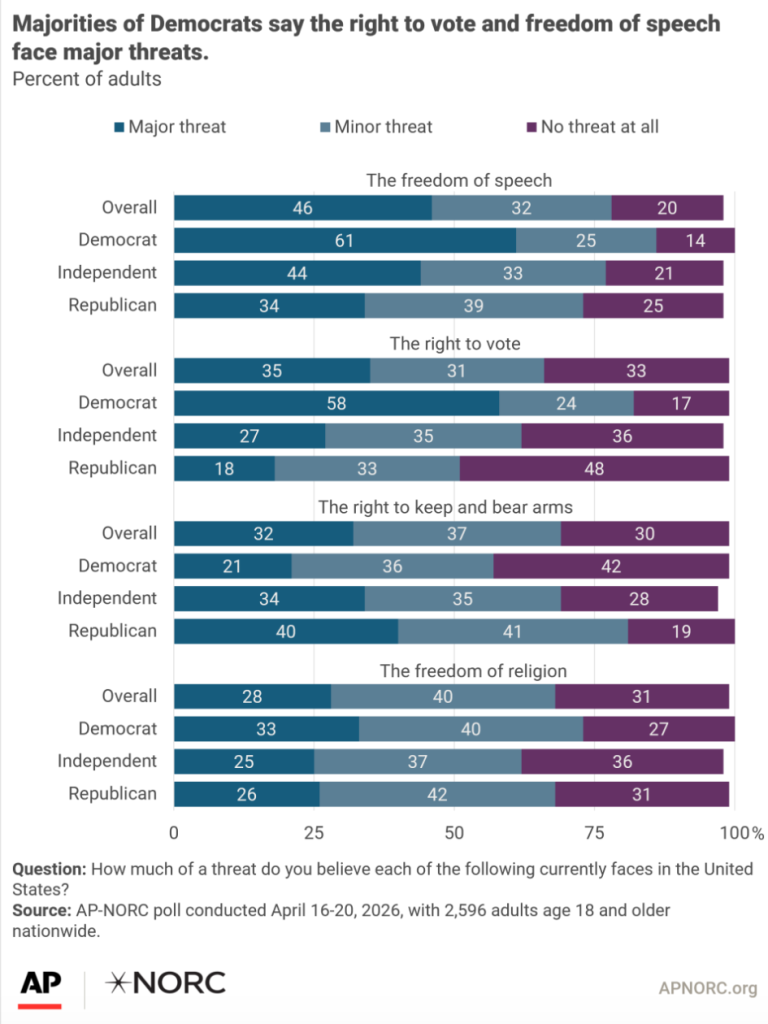
During an appearance on the Unity Over Division podcast, U.S. Senate candidate James Talarico (D) echoed Joe Biden by saying the Second Amendment is “not absolute.”

Talarico said, “I believe in the Second Amendment just as much as I believe in the First. We have a right to bear arms to protect ourselves, our families. We have a right to own weapons for sport or for hunting. But like any freedom in the Bill of Rights, it’s not absolute.”

Breitbart News reported that on February 26, 2020, during a CNN Town Hall, Biden argued that the Second Amendment was not “absolute.”

He followed the Town Hall with a post to X in which he elaborated: “I taught constitutional law for a long time and here’s the deal: No amendment is absolute. There are limits.”

Talarico stressed what he believes are limits on other constitutionally protected rights as well. For example, he told Unity Over Division, “You have a freedom to assemble, to protest, but you need a permit.”

The First Amendment does not mention a need for a permit. Rather, the amendment says, “Congress shall make no law … abridging the freedom of speech, or of the press; or the right of the people to peaceably assemble …”

Democrats on Capitol Hill Introduce Ban on Suppressors

Signaling the agenda should polarity shift in Washington in the coming months and years, a group of House Dems has debuted legislation to outlaw suppressors.

Dubbed the Help Empower Americans to Respond, or HEAR, Act, the proposal would “ban the importation, sale, manufacturing, transfer, and possession of gun silencers or suppressors.”

Saying “Silencers are not tools of self-defense,” HEAR Act sponsor U.S. Rep. Bonnie Watson Coleman, a New Jersey Democrat, argues such devices “have no legal application,” and her proposal is part of “a common sense approach to firearms legislation.”

Continue reading “”

BLUF
There’s no other way to interpret this, and not a single Democrat will distance themselves from Krugman’s comments or condemn them. In fact, they’ll repeat them, as they have countless times in the past.

Paul Krugman Calls for a Purging of the United States, and Guess Who He’s Talking About

Former New York Times reporter Paul Krugman, who worked for the outlet for more than two decades, is clearly grasping for relevance in his retirement and he’s doing so by calling for violence against Trump supporters.

The guy who once said the Internet’s impact on the economy would be no different than the fax machine thinks the country needs a ‘thorough purging’ and he’s targeting MAGA as the group that needs to go.

“We need to de-fang Trump as much as possible and make sure that neither he nor anybody who follows in his footsteps has power after the next two elections,” Krugman said. So they’re already laying the groundwork to claim that whatever Republican succeeds President Trump will somehow be even worse than President Trump, who was literally Hitler, according to Democrats.

Krugman wasn’t finished, however.

“But beyond that, we really need to do a thorough purging of the United States,” Krugman continued, “we need a de-MAGAfication and … I’m not going over the top by using a word that’s very similar to the de-Nazification that we pursued successfully after World War II in Germany.”

Right, and Krugman would probably vote for Graham Platner if he lived in Maine.

Here’s the entire video.

Continue reading “”

Texas Democrat Prime Example of Why We’re Never Giving Up Our Guns

The purpose of the Second Amendment is the defense of this nation. Our Founding Fathers were generally smart men, and they recognized that defending our nation might mean fighting our government. It’s part of why they were largely distrustful of standing armies in the first place and preferred the militia.

But, as things have chanced in the last 250 years, a lot of people figure that the purpose of the Second Amendment has also changed. They think it’s about hunting or, if they’re feeling charitable, about personal protection, and not anything else. It’s why they want to take certain guns from us–at least, that’s the rationale we get from them now, though we know everything is in their sights.

We’re not giving up jack squat, and a Texas Democrat in the midst of a runoff is a prime example of why.

The top Democrat in a southern Texas House race, sex therapist Maureen Galindo, has called for transforming an immigration facility into a “prison for American Zionists” equipped with a castration center.

Galindo’s campaign made a vile pledge that she will introduce legislation to that effect if she gets elected to Congress after baselessly alleging her Dem runoff foe was “being paid to put Jews and Mexicans in concentration camps via Zionist trafficking networks.”

“When Maureen gets into Congress, she’ll write legislation so that all Zionism and support of Zionism is undoubtedly Anti-Semitic, since it’s Zionism harming the Semites,” her campaign wrote on Instagram last week.
“She’ll turn Karnes ICE Detention Center into a prison for American Zionists and former ICE officers for human trafficking. (lt will also be a castration processing center for pedophiles which will probably be most of the Zionists).”

Now, castrating pedophiles is a rare moment of me agreeing with a Democrat on something, but it’s literally every other word she says that’s the problem.

Zionism is simply the idea that Israel has a right to exist as a modern nation. I get that some people disagree with that position, and we’re not here to debate whether it’s the right concept or not. It is what it is, and Galindo is talking about writing legislation to round up everyone who holds a very particular belief, including a whole lot of Jews, and herding all of them into the very camp her party claims are concentration camps.

While she’s not the nominee as of yet–runoff elections are May 26th–the fact that someone this mentally damaged is this close to being the nominee is troubling, especially when you think about Graham Platner in Maine, who is likely to be their nominee for the Senate.

This is a fringe belief, though. I haven’t seen all that many people who agree with Galindo here, and that’s the good news, but I can’t help but acknowledge that I’m also not seeing loud denouncements from party leaders, either.

Regardless, this is someone who thinks it’s perfectly acceptable to round people up based on their political opinions. Right now, it’s “Zionism,” but do you really think it would stop there?

Hell. No.

So, I’m going to hold onto my AR-15s. I’m going to hold onto my standard capacity magazines. I’m going to urge everyone to do the same, and to stand up to these state legislatures that seem to think that this fringe belief being expressed by a fairly promenent Democrat isn’t anything to worry about. I’m sure the years of others talking about going after their political opponents or “breaking the spirit” in the coming years is nothing at all to be concerned about and we won’t need our guns to fend off these monsters.

But I’m keeping it ready just the same.

You want me to give up my guns and trust my government? That’s never going to happen, because there are people in this country who support some truly awful people who want to hurt me and mine, and they’re not going away anytime soon.

The Right They Keep Trying to Qualify

The Second Amendment is the most litigated right in the Constitution right now. That’s not because the doctrine is unclear. It’s because several states have decided the Supreme Court’s rulings are inconvenient and have organized their legislative calendars around working past them.

Three decisions settled the questions that mattered. Heller (2008) established an individual right to keep and bear arms. McDonald (2010) applied it to the states. Bruen (2022) replaced the interest-balancing framework lower courts had used to uphold almost every gun restriction with a historical-tradition test: regulations must be consistent with America’s historical tradition of firearm regulation, and the government bears the burden of proving they are. Those are the holdings. California, New York, and Illinois have spent the years since treating them as starting points for the next workaround.

I’m a Marine Corps OCS graduate with 30 years in institutional investment management. My son graduated from West Point and flies Army aircraft. My brother retired from Army Special Forces as a Green Beret. I’m also a Life Member of the NRA. My family has carried firearms professionally in service to this country. That’s the credential here.

Before Bruen, lower courts evaluated gun restrictions through a two-step interest-balancing test. At step two, courts routinely deferred to the government’s stated public safety interest, and most restrictions survived. Bruen eliminated that deference. Justice Thomas’s 6-3 majority required governments to identify historical analogues to their modern restrictions, regulations from the founding era or Reconstruction period that are relevantly similar in purpose and burden.

The state response wasn’t compliance. California passed new restrictions on carry in expanded ‘sensitive places,’ effectively rebuilding a near-total carry prohibition through categories Bruen had acknowledged as legitimate but hadn’t quantified. New York passed the Concealed Carry Improvement Act days after Bruen was decided, adding dozens of sensitive places and a ‘good moral character’ requirement that functioned as the old discretionary system under a new name. Illinois added similar restrictions. Each law was designed to produce litigation, not to comply.

United States v. Rahimi (2024) gave the states some judicial support. Chief Justice Roberts wrote for an 8-1 majority that Bruen required only a “relevantly similar” historical regulation, not a historical twin. That’s a real qualification that gives regulators more room. It didn’t restore the pre-Bruen deference. The government still has to find historical analogues. Several of the state restrictions enacted after Bruen are still being litigated, and the outcomes aren’t certain.

One gap the Court’s decisions left is the patchwork problem, and it’s one Congress can close directly. A law-abiding gun owner with a valid concealed-carry permit from her home state may find that permit legally worthless the moment she crosses into a state that doesn’t recognize it. The constitutional right doesn’t change at the border. The state’s willingness to honor it does.

The National Constitutional Carry Act (H.R. 645) requires states to recognize valid carry permits issued by other states. The model is driver’s license reciprocity: every state recognizes every other state’s license to drive. No state demands re-licensure when a visitor crosses the border. No constitutional principle places the Second Amendment below the right to drive in the hierarchy of rights that interstate travelers can exercise. H.R. 645 applies the same common sense to a constitutional right that has been affirmed by the Supreme Court three times.

Polling on this question is consistent: support for carry reciprocity routinely exceeds 70% in surveys that cross party lines. The people most burdened by the current patchwork are law-abiding gun owners who travel, precisely the population least likely to be a public safety concern. The argument for H.R. 645 doesn’t require a particular view on gun policy. It requires only recognizing that a constitutional right the Court has repeatedly upheld deserves the same cross-state recognition we give to a driver’s license. We don’t make visitors from other states pass a new driving test. We shouldn’t make them surrender a constitutional right at the border either.

The Founders wrote the Second Amendment for citizens. My brother was a weapons Sergeant in Army Special Forces. My son carries one now as an Army aviator. Both of them took an oath to defend a Constitution that includes the rights they exercised as their profession. The civilian version of that right doesn’t need a cultural argument. Three Supreme Court decisions have supplied the constitutional one.

It’s worth stating clearly: the population most affected by the current patchwork isn’t the population any legislator is actually worried about. Permit holders went through background checks, paid fees, completed whatever training their state required, and carry legally because they’ve done everything asked of them. That population doesn’t become dangerous at a state line, and it wasn’t dangerous before it crossed one. The argument for H.R. 645 doesn’t require defending anyone’s right to break the law. It requires only that Congress treats a constitutionally protected right with the same cross-state respect we give to a driver’s license.

The question is whether the states that disagree with those decisions will eventually accept the answer, or whether they’ll spend the next decade generating litigation designed to look like compliance while achieving the same practical result as defiance.

‘Unprecedented Threat’: IED Discovered Near Dam Considered Critical National Infrastructure

On Tuesday, during routine repair and maintenance at the Converse Reservoir dam in Mobile, Alabama, the divers assessing the dam discovered an improvised explosive device (IED). This is serious and should have gotten more attention than it is currently receiving.

The multi-agency effort included the Mobile County Sheriff’s Office, FBI Bomb Squad, Mobile Police Department Explosive Ordinance Detail, ALEA Bomb Squad and the Daphne Search and Rescue Team.

The Converse Reservoir dam at Big Creek Lake is the municipal reservoir for the County of Mobile. It is the sole water supply for the region, and the main source of drinking water for the city of Mobile and other municipalities. According to the Partners for Environmental Progress, the reservoir provides approximately 60 million gallons of water per day.

The fact that the threat was an IED — something engineered for a specific level of detonation and damage — indicates planning and specific targeting. With the recent IED attacks in New York and the rise of threatened and attempted domestic terrorism incidents across the nation, the fact that an IED was placed in the midst of critical infrastructure is concerning.

WATCH:

Five federal and local agencies is a great deal of manpower deployed for one explosive device. The fact that not much information is being given indicates there may well be more to this story than is being revealed. From what the director of Mobile Area Water and Sewer System (MAWSS) is saying, they are treating this unprecedented threat seriously.

“Our top priority is keeping your drinking water safe,” said Bud McCrory, MAWSS director. “This is an unprecedented threat, and we are fortunate that this device was discovered before it could cause serious damage to our water supply or harm to individuals. We are grateful for the professionalism and competency of our law enforcement partners – as well as the quick thinking of our contractors and divers – in identifying this device and safely destroying it.”

The reservoir and dam are federally designated critical infrastructure. The U.S. Department of Homeland Security has been made aware of the incident.

There have been legal battles going on with MAWSS and fishermen, citizens, and advocacy groups over public access to this waterway. Dependent upon the level placed on this threat and what an investigation uncovers, this could weigh in the direction of restricting the public from the reservoir area. Either way, one hopes that Homeland Security and federal infrastructure security officials are addressing this unprecedented threat and reassessing protections for similar sites nationwide. My first thought is drone surveillance and more consistent security sweeps of the dam’s infrastructure.

Justice Scalia’s majority opinion in Heller had this to say about what arms meant:
The 18th-century meaning [of arms] is no different from the meaning today. The 1773 edition of Samuel Johnson’s dictionary defined ‘‘arms’’ as ‘‘[w]eapons of offence, or armour of defence.’’ Timothy Cunningham’s important 1771 legal dictionary defined ‘‘arms’’ as ‘‘any thing that a man wears for his defence…’’


NY AG Claims Body Armor Isn’t a Second Amendment Right

BUFFALO, NY — A legal battle is brewing in New York over whether law-abiding citizens have the right to purchase and own body armor for personal protection. Attorney General Letitia James has formally requested a federal judge to dismiss a lawsuit filed by the Firearms Policy Coalition (FPC), which challenges the state’s ban on the sale of this defensive gear to most civilians.

The FPC originally filed the lawsuit on behalf of New York residents who simply want the ability to protect themselves. In response, the state is arguing that body armor is a “dangerous and unusual” item that falls outside the protections of the Second Amendment. Attorney General James’s office claims that because modern body armor didn’t exist when the Constitution was written, it shouldn’t be covered.

However, this line of reasoning seems to ignore a key Supreme Court ruling. In the 2016 case Caetano v. Massachusetts, the court affirmed that the Second Amendment isn’t limited to 18th-century technology. Justice Samuel Alito pointed out that even firearms commonly used for self-defense today, like revolvers and semi-automatic pistols, did not exist back then. The court’s logic was clear: new technology doesn’t negate a constitutional right.

The True Purpose of Body Armor

New York’s argument portrays body armor as a tool for criminals, suggesting it turns a person into a “fortified threat” and is part of a “mass shooter’s toolkit.” This perspective overlooks the fundamental nature of body armor: it is purely defensive. Unlike a firearm, body armor cannot be used to inflict harm. Its sole purpose is to stop projectiles and protect the life of the person wearing it, which is the very essence of self-defense. Many everyday citizens, from late night convenience store clerks to people living in high crime neighborhoods, seek this protection for peace of mind.

The state’s ban was enacted following the tragic 2022 mass shooting at a Buffalo supermarket. Now, groups like the National Rifle Association are pushing back, stating that such laws only penalize law-abiding citizens. They argue that criminals, by their very definition, do not follow the law, so a ban on body armor only prevents good people from having another tool to ensure their own safety.

This case is being watched closely, as its outcome could set a precedent for whether states can prohibit citizens from owning defensive gear, raising critical questions about the modern application of the right to self-defense.

SPECIAL REPORT: Everytown using AI to strip away our Second Amendment rights

Last year, the parents of a 16-year-old boy alleged in a lawsuit that ChatGPT encouraged their son to kill himself.

In October 2004, a New York AI system falsely told business owners they could steal tips, fire anyone who complained about sexual harassment and serve food even after it was chewed by rats.

In August 2005, a 56-year-old man killed his 83-year-old mother in her home and then committed suicide. He believed his mother was a secret agent who was poisoning him with psychedelic drugs, and his chatbot agreed and supported his delusions.

In July 2005, an AI system told a user how to break into an attorney’s home and to bring “lock picks, gloves, a flashlight and lube.”

Now, Everytown for Gun Safety is using AI to help them further erode our Second Amendment rights.

What could possibly go wrong?

On Monday, Everytown announced they had created the Everytown Evidence Engine, or E3, an AI system they claimed would help them “harness AI policy to identify gun safety solutions.”

They made the move to AI because “efficient systems for analysis can lead to new questions and new answers in the field of gun violence prevention research.”

How reliable is Everytown’s new AI?

You can judge for yourself.

Claude

Everytown admitted its new EAI system was built using Claude, an AI system designed by the firm Anthropic. Both Claude and Anthropic have had significant problems.

Just four days ago, in a story titled “Anthropic Admitted Claude Code Broke. We Were Right,” a reporter at Medium announced he had found issues with the system.

The reporter’s hard work forced Anthropic to admit that Claude had major problems.

In a story titled “An update on recent Claude Code quality reports,” Anthropic claimed they had fixed everything.

“Over the past month, we’ve been looking into reports that Claude’s responses have worsened for some users. We’ve traced these reports to three separate changes that affected Claude Code, the Claude Agent SDK, and Claude Cowork. The API was not impacted,” Anthropic claimed.

The firm also promised they would “do things differently to avoid these issues,” and that more of their staff would use the public version of the software.

Sky News recently released a damning YouTube video about public interactions with Claude.

The British report discusses how the chatbot tells users what they want to hear.

“What happens when AI starts pulling people away from reality and even encourages them to act on distorted beliefs?” the reporter asked.

The video discusses a recent Canadian research paper that found one of every 1,000 conversations with Claude has the “potential for severe reality distortions.”

“We don’t know why Claude responds as it does consistently,” an expert said.

The researchers also discovered that the number of potentially harmful discussions with Claude was actually growing over time. An Anthropic spokesman admitted they knew that Claude had problems, but they didn’t know why.

“LIMITATIONS”

When Everytown addresses everything that its new Etool cannot do, you have to wonder why anyone would use it.

Even Everytown admits E3’s limitations are simply breathtaking.

“For example, at this time, Edoes not currently weigh all of the factors that could be influencing gun violence such as gun ownership, employment and earnings, strength of policy implementation and enforcement, law-enforcement practices, and many other relevant and granular socioeconomic and demographic characteristics particularly at the county and/or neighborhood-levels,” Everytown wrote.

So, despite its long list of limitations, how does Everytown intend to use its new Etool?

They don’t really say.

“[T]his new tool can provide users with important directions regarding policy effectiveness that can be used for critical decision-making. And it is the hope that future iterations of the E3 will incorporate these kinds of variables and, ultimately, increase its ability to conduct additional types of analyses,” Everytown wrote.

Takeaways

So far, all of Everytown’s critical decision-making has involved how to strip guns from the hands of gun owners. They spend millions annually trying to create more local, state and federal anti-gun laws. Whether their new Esystem will help them remains to be seen.

Alan Gottlieb founded the Second Amendment Foundation more than 50 years ago and serves as its executive vice president. He was struck but not surprised by the problems with Everytown’s new AI system.

Said Gottlieb: “When you are unintelligent, you think any AI system will be better than your own brain. But being unintelligent, odds are you will pick the wrong one. Everytown sure did!”

This Democrat Defending Hasan Piker Says His Extremist Rhetoric Reflects Rising American Frustration

Representative Ro Khanna (D-CA) was asked in a recent interview why he continues to defend left-wing political pundits like Hasan Piker, who is widely known for inflammatory rhetoric, in the aftermath of an attempted assassination targeting top Trump administration officials at the White House Correspondents’ Dinner on Saturday.

Despite acknowledging some of the controversial remarks attributed to Piker, including comments defending the killing of the UnitedHealthcare CEO and praise for Hamas, Rep. Khanna argued that Piker is expressing a broader sense of frustration among Americans, one that he described as important to acknowledge.

“I have said that Hamas is a terrorist organization. Hezbollah is a terrorist organization. I was one of the first people who condemned the shooting of the United Healthcare executive. But millions of people follow Hasan Piker. Why? Because he’s speaking about some of the frustrations,” Rep. Khanna said. “He’s speaking about the fact that people don’t have health care in America.”

“There are a lot of people on the podcast world, etc., who say things that are outrageous or sensationalist,” he continued. “And I push back when you do that. But we have to understand the anger in this country of people who feel they can’t buy a house, they can’t afford gas, they can’t have health care.”

“They’re upset at the system. It’s one of the reasons Trump won twice. And we have to engage while condemning the violence,” he said. “I never engage in approving of violence, approving of the incitement of violence, and I’ll condemn it when I hear it.”

Unfortunately for both Khanna and Piker, murder, theft, and other illegal acts are not the ways in which real Americans choose to effect change in their country.

We effect change the way we learned after the American Revolution, through voting, and through persuading and changing the minds of our fellow Americans, not through violence. The moment that approach begins to falter, we risk watching our system of law and order fade, becoming a mere suggestion rather than a requirement.

Mainstreaming individuals who support or excuse violence, on either side, is reprehensible, and often indicative of an attempt to sow chaos and exploit it.

Now is the time to double down on the American system of governance, not to abandon it in pursuit of revolutionary change, which would not lead to positive reform but rather to an erosion of the American way of life.

Looks like he is one of those ‘refugees’ imported from Somalia.


Minneapolis man sentenced to 8.5 years in prison over support for ISIS.

MINNEAPOLIS — A Minnesota man was sentenced in federal district court to more than eight years in prison Wednesday for supporting the efforts of the Islamic State of Iraq and al-Sham (ISIS), a designated terrorist organization rooted in the Middle East.

A statement from the U.S. Attorney’s Office for the District of Minnesota said 23-year-old Abdisatar Ahmed Hassan, of Minneapolis, was handed eight-and-a-half years in prison, followed by 15 years of supervised release, after he pleaded guilty in September to attempting to provide material support and resources to ISIS.

Court documents show that in 2024, Hassan began collecting and redistributing ISIS propaganda, while obtaining various manuals about sniper-training skills and how to make “highly explosive” materials and ammunition. Officials said Hassan also researched articles online related to gun ranges, weapons and “ISIS-inspired attacks and terroristic acts.”

Prosecutors found Hassan engaged with ISIS media wings and recruiters in Somalia for months before he decided to quit his job and liquidate his savings, cashing in on a one-way ticket from Minneapolis to Somalia in early December 2024. Hassan was actually turned away from that flight after airport officials discovered he lacked the proper travel documents, but just a few weeks later, he was granted the same one-way ticket with the proper documentation.

According to the district attorney’s office, Hassan made his first flight to Chicago, but was stopped and questioned by Customs and Border Control agents, missing his flight to Somalia and later admitting to his ties to the terrorist organization.

Hassan returned to Minnesota and continued to praise ISIS through his social media accounts until being arrested by the FBI in February 2025. A grand jury then indicted Hassan on one count of attempting to provide material support and resources to ISIS.

“The sentence handed down today takes a would-be terrorist off the streets and sends a clear message that the FBI and our partners will unremittingly pursue anyone seeking to join or support a foreign terrorist organization,” said FBI Minneapolis Division Special Agent in Charge Christopher D. Dotson.