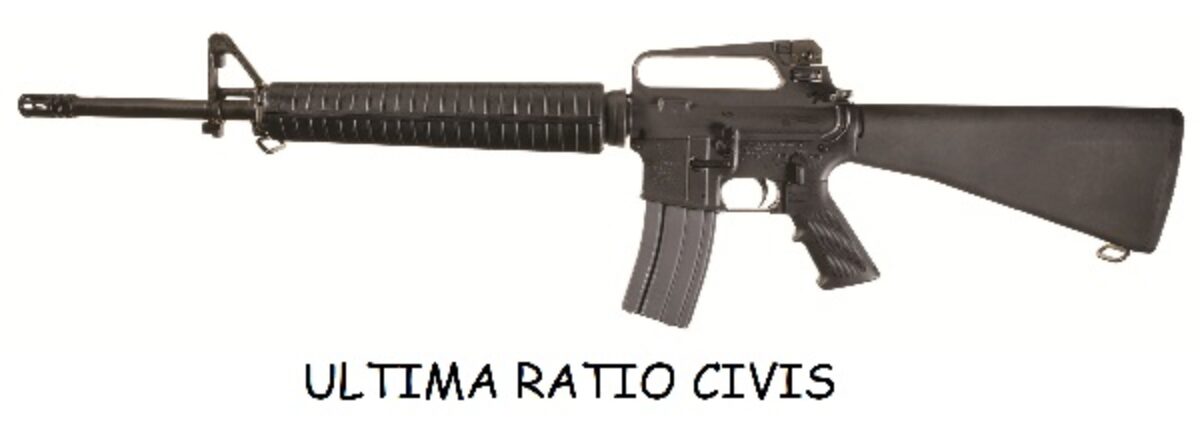
Why? Simple. It’s because like all goobermint, they’re scared to death that the peons may one day get fed up enough with the blatant and open corruption (See – among other’s -Nancy Pelosi’s impossible stock portfolio performance) and decide to take care of business, along with the clear understanding that, while Mao was a murderous dictator, he was very correct when he said that political power grew from the barrel of a gun and that the party should control the guns.


Why Does SCOTUS Hear So Few Second Amendment Cases?
The right to keep and bear arms occupies a curious place in American legal history.

The Second Amendment occupies a curious place in American legal history. It has been sitting right there in the Bill of Rights since those amendments were first added to the Constitution in 1791. Yet it was not until the 2008 case of District of Columbia v. Heller that the U.S. Supreme Court got around to recognizing what many legal scholars had been saying all along: Namely, that the right to keep and bear arms is an individual right, not a collective right, nor a state’s right.

Two years after Heller, in 2010’s McDonald v. Chicago, the Court additionally held that the individual right to keep and bear arms that applied against the federal enclave of D.C. also applied against state and local governments.

But then the Supreme Court sort of went quiet for a while. The next truly major Second Amendment case did not arrive until 2022’s New York State Rifle and Pistol Association v. Bruen, which extended the logic of Heller and McDonald to recognize “an individual’s right to carry a handgun for self-defense outside the home.”

The recent news that the Supreme Court has agreed to hear a new Second Amendment dispute later this term raises the interesting question of why it takes the Court so long to hear so few of these kinds of cases. What gives?

For a persuasive explanation of the Supreme Court’s pre-Heller silence on the Second Amendment, I recommend reading a 1989 Yale Law Journal article titled “The Embarrassing Second Amendment,” written by the liberal law professor Sanford Levinson. “I cannot help but suspect that the best explanation for the absence of the Second Amendment from the legal consciousness of the elite bar,” Levinson wrote, “is derived from a mixture of sheer opposition to the idea of private ownership of guns and the perhaps subconscious fear that altogether plausible, and perhaps even ‘winning’ interpretations would present real hurdles to those of us supporting prohibitory regulation.” In this telling, legal elites basically understood that if the Second Amendment was ever taken seriously, then some (or even many) gun control laws would necessarily fall. So they just declined to take the amendment seriously.

But if that explains some or all of the pre-Heller period, what explains the more recent era? One explanation may be found in an oft-quoted passage from Justice Antonin Scalia’s Heller decision. “Nothing in our opinion,” Scalia wrote, “should be taken to cast doubt on longstanding prohibitions on the possession of firearms by felons and the mentally ill, or laws forbidding the carrying of firearms in sensitive places such as schools and government buildings, or laws imposing conditions and qualifications on the commercial sale of arms.”

I recall several Second Amendment advocates grumbling to me at the time that this passage by Scalia was both unnecessary to the outcome of the case and potentially quite injurious to the broader gun rights cause. Those advocates feared that the gun control side would immediately grab hold of the “sensitive places” exception and run with it, leading to more regulations on guns instead of less.

And the federal courts would, of course, have to deal with Scalia’s language, too. In fact, Justice Brett Kavanaugh, joined by Chief Justice John Roberts, invoked that very language by Scalia in a notable concurrence filed in the Bruen case. “Properly interpreted,” Kavanaugh wrote, “the Second Amendment allows a ‘variety’ of gun regulations.”

Why did Kavanaugh feel compelled to emphasize that particular point in a separate concurrence that managed to garner the support of only the chief justice? I speculated at the time that Kavanaugh “may be signaling to the lower courts that, in his view, many such gun control regulations are presumptively constitutional, and lower court judges should therefore act accordingly.”

In other words, Kavanaugh and Roberts might be less hawkish on gun rights than some of their colleagues. And there might be a small but growing fissure among the Court’s “conservative bloc” over just how broadly the Second Amendment should be interpreted and enforced. That fissure, if it exists, might also explain why the post-Heller Court has not exactly been in a hurry to take up new gun rights cases.

We’ll learn more when the Supreme Court takes up this latest gun rights case, Wolford v. Lopez, in earnest later this term. For now, we’re still left to ponder the Second Amendment’s curious position.

BLUF:
As with the Ad Council, the federal funding these Agree to Agree “funding partners” enjoy isn’t gun control specific. However, taxpayers should be aware that organizations that receive significant federal resources are involved in propaganda to undermine their fundamental rights.

Why are Tax Dollars Funding a Civilian Disarmament Industry Anti-Gun Agitprop TV Ad Campaign?

The idiot box has been living up to the nickname.

In recent months television viewers have been subjected to a series of anti-gun propaganda pieces produced by the Ad Council. Dubbed the Agree to Agree campaign, the ads typically feature a misleading talking point about “children” and firearms followed by an invitation to go to the Ad Council effort’s website where visitors are bombarded with further gun control agitprop. The website even invites visitors to learn about how to secure red flag gun confiscation orders.

The name might suggest an effort to bridge political disagreements, but the campaign’s list of “stakeholder partners” shows it’s a gun control effort through and through. So-called “stakeholder partners” include: Brady: United Against Gun Violence (formerly Handgun Control, Inc.); Giffords (formerly Americans for Responsibly Solutions and the Second Amendment-denying Legal Community Against Violence); Everytown for Gun Safety; and the Johns Hopkins Center for Gun Violence Solutions at the Bloomberg School of Public Health (named for billionaire gun control financier Michael Bloomberg). Handgun prohibition organization Violence Policy Center is not listed, although their longtime benefactor the Joyce Foundation was involved.

The campaign’s headline factoid is the following: “Gun injuries are now the leading cause of death for children and teens ages 1‑17, surpassing car crashes for the first time in two decades.” To justify the claim, the Ad Council cites a report from the Bloomberg School of Public Health.

For decades, gun control advocates and their allies in “public health” have pushed misleading talking points about children and firearms and NRA-ILA has repeatedly called them out for it.

Continue reading “”

Why is Bondi’s DOJ Defending the Biden-Cornyn Gun Back Door Registration Scheme?

In a stunning betrayal of gun owners, Attorney General Pam Bondi recently ordered the Department of Justice to continue defending Joe Biden’s “Engaged in the Business” rule — a backdoor gun registration scheme.

And now there’s a new twist: a federal judge in the Northern District of Alabama just ruled that the ATF overstepped its authority with major parts of this rule, and issued a permanent injunction protecting the named plaintiffs and their members from enforcement.

Despite this rebuke, though, Bondi’s DOJ is pressing forward with defending the rule — even after President Trump ordered a full review of Biden’s gun control agenda earlier this year. This is nothing less than a deliberate attempt to kneecap Trump’s pro-gun agenda.

What the Court Did

The court declared multiple provisions of the ATF’s rule unlawful, including:

  • The claim that there’s no minimum number of guns or sales required to be “in the business.”
  • The presumption of “profit intent” even when no profit is shown.
  • The attack on the “personal collection” safe harbor, excluding firearms kept for self-defense.
  • Presumptions that reselling or advertising firearms automatically makes someone a dealer.

These provisions have now been permanently blocked against enforcement for the named plaintiffs. But here’s the catch: the rest of the country is still exposed. Unless the rule is struck down entirely, millions of gun owners remain at risk of being treated like criminals for private sales.

Cornyn’s BSCA Opened the Door for This

Make no mistake: this entire scheme is the spawn of John Cornyn’s Bipartisan Safer Communities Act, drafted with anti-gun Democrat Chris Murphy. Cornyn handed Biden the legislative keys to create a backdoor registry — and Bondi is keeping it alive.

Pam Bondi has a long history of selling out gun owners. She supported red flag laws in Florida, refused to stop anti-gun ordinances, and repeatedly sided with the political elite over grassroots conservatives. Now, as Attorney General, she’s siding with Biden over Trump, fighting in court to preserve Biden’s gun control legacy.

President Trump must get control of his own AG and force her to follow his pro-gun agenda.

The Fight in the Courts

There is hope, however. In the Fifth Circuit, Texas Attorney General Ken Paxton and Gun Owners of America are suing to stop this same rule. Texas Gun Rights and the National Association for Gun Rights filed a hard-hitting amicus brief in support.

A preliminary injunction is currently protecting gun owners in Texas and several other states. But if Bondi’s DOJ succeeds in salvaging the Biden-Cornyn rule, that protection could vanish, putting every gun owner back in the crosshairs.

As every gun owner knows: registration is the first step to confiscation.


Chris McNutt is president of Texas Gun Rights

Jack Nicholson Nodding GIFs - Get the best GIF on GIPHY

Did Joe Biden’s Doctor Just Confirm a Cover-Up of His Health?

In a move that should obliterate whatever remains of the myth of transparency in Washington, Joe Biden’s longtime physician, Dr. Kevin O’Connor, finally showed up for a interview with the House Oversight Committee—and proceeded to not answer a single question.

But while O’Connor may have refused to talk, his silence said plenty.

According to Committee Chairman James Comer (R-Ky.), O’Connor was asked two simple but devastating questions: “Were you ever told to lie about the president’s health?” and “Did you ever believe President Biden was unfit to execute his duties?”

O’Connor didn’t say “No,” he pleaded the Fifth both times—choosing constitutional protection over basic accountability.

“This is unprecedented,” Comer said. “And I think that this adds more fuel to the fire that there was a cover-up.”

He’s right. When a sitting president’s personal doctor refuses to answer whether he was told to lie to the American people, it’s not just troubling—it’s damning.

This isn’t some minor bureaucratic hiccup or a routine legal maneuver—this is the doctor who, for years, stood between the American people and the truth about Joe Biden’s fitness for office. Now, when given the chance to clear the air, he chooses silence.

Although O’Connor had previously refused to cooperate, somehow, pleading the Fifth now instead of answering those two questions looks worse.

Let’s not pretend this is normal. O’Connor’s refusal to answer even basic questions about Biden’s condition raises the obvious question: What, exactly, is he trying to hide?

Of course, we all know the answer. For years, the Biden White House dismissed legitimate concerns about the president’s health as partisan attacks, hiding behind carefully worded reports from O’Connor. Those glowing annual assessments were the backbone of the cover-up, reassuring the public while Biden visibly declined.

Let’s be clear: O’Connor’s refusal to answer questions isn’t about medical ethics—it’s about political damage control. This is the same doctor who repeatedly vouched for Biden’s fitness while the public watched a very different reality unfold. If there’s nothing to hide, why not answer questions? Why invoke your right not to incriminate yourself?

Comer said it is “clear there was a conspiracy to cover up” Biden’s cognitive decline.

New York Post:

The only question O’Connor did answer before the deposition concluded was confirming his name, according to an Oversight spokesperson, who pointed out that doctor-patient privilege would have allowed the witness to answer at least some questions.

Dr. Jeffrey Kuhlman, who served as physician to the president during Barack Obama’s first term, agreed with that interpretation.

“In my opinion, [the first question] doesn’t involve HIPAA,” Kuhlman told The Post.

As for the second question, Kuhlman advised, “I don’t think that’s covered by HIPAA,” because it “doesn’t sound like that’s specific health information that they’re seeking.”

When asked whether he would answer questions under oath that don’t directly relate to a patient’s health, Kuhlman said: “In my role as a physician caring for a patient, I probably would.”

Dr. O’Connor’s refusal to answer questions about Biden’s health isn’t just a legal tactic—it’s an admission that there’s something worth hiding. The American people have every right to demand answers. The time for stonewalling is over.

Dr. O’Connor’s silence isn’t just suspicious—it’s a warning sign for anyone who cares about transparency in our government.

Let me rephrase this. Supposed I handed you $1 Million dollars in cash to hold and keep safe for me every Monday through Friday from 8 a.m. to 3 p.m. And the place where you work and keep this treasure safe is public property — or at least open to the public. The building is not built like a bank or courthouse. It has no armed guards at all doors or other elevated security — other than a sign warning people about bringing weapons on to the property. Bad people know these facts.

Now let me add that 20 to 25 other people also hand you $1 Million dollars in cash as well, under the same conditions. Which means every Monday through Friday, from 8 to 3, you are holding and taking care of $25 Million. This is your job, you have promised to return the money, safely, to all the people every day at 3 p.m.

Now do you want to be armed?

How close was Iran to the bomb, and how far has Israel pushed it back?

A version of this Editor’s Note was sent out earlier Wednesday in ToI’s weekly update email to members of the Times of Israel Community. To receive these Editor’s Notes as they’re released, join the ToI Community here.

How close was Iran to the bomb, and how far has Israel now pushed it off?

Rafael Grossi, the head of the UN’s nuclear weapons watchdog, the International Atomic Energy Agency, warned a few weeks ago that “they’re not far off,” and also cautioned that Tehran’s obstruction of his agency’s inspectors has meant that the IAEA has not been able to keep track of recent progress by the regime on the various aspects of its program.

Continue reading “”

No why do I not trust this to be really happening?

ATF Changes Policy On NICS “Pre-Crime” Monitoring

The Bureau of Alcohol, Tobacco, Firearms and Explosives (ATF) has changed its policy on monitoring the Federal Bureau of Investigation’s National Instant Criminal Background Check System (NICS).

AmmoLand News first reported the ATF using a NICS monitoring system in 2021 after learning about the system through an inside source. The ATF would use NICS to monitor Americans buying guns. Data in NICS is supposed to be deleted within 24 hours, but the ATF requested that all data be saved for 30, 60, 90, or 180 days. The targets being monitored were not being charged with any crime. The ATF was tracking people who they felt “might” commit a crime in the future or associated with the “wrong” people.

The monitoring outraged many in the gun community who felt that the ATF and FBI were creating a “pre-crime” program. Gun Owners of America (GOA) filed a Freedom of Information Act (FOIA) request to show the use of the system. It turned out that the system was in widespread use and not only for those who “might” commit a federal crime. The ATF was monitoring people who might break California state law by purchasing a long gun that wasn’t legal within the Golden State.

The new policy should prevent some of those violations. Any new monitoring must be approved by the ATF Special Agents in Charge (SACs) and the Deputy Assistant Director (DAD). This change prevents rogue agents from using the system for their own needs. Also, the system may now only be utilized in cases involving suspected violations of federal firearm statutes. This new policy prevents ATF agents from monitoring suspects for states such as California.

The memo reads: “Effective immediately, Special Agents in Charge (SACs) approval and Deputy Assistant Director (DAD) concurrence is now mandatory for all NICS alerts. NICS alerts may only be utilized in cases involving suspected violations of federal firearm statutes. See 28 C.F.R. Part 25. This investigative technique should not be utilized to primarily investigate state firearm laws. A formal memo for approval will be utilized which will require the following information: Field Management Staff (FMS) will also monitor all requests.”

The FMS will notify the SAC and requester of upcoming expirations. This monitoring of expiration dates ensures that the flags are removed at the end of the monitoring. Sources tell AmmoLand News that there have been times when a flag is not removed and left in place. This oversight wasn’t done in malice; it was due to procedures not being followed. The new policy should change that.

The memo reads: “FMS will monitor all NICS flags and notify the SAC and requestor of upcoming expirations. Renewal of the NICS alert requires SAC concurrence and DAD approval. This process will also be documented in a formal memo and processed through FMS. Instructions regarding the maintenance and purging of NICS alert information will be provided by FMS. Any current NICS alert may only be renewed utilizing this process.”

A flag can be renewed, but only for six months. After that time period has expired, any extensions must be approved by the ATF Deputy Director and the Chief Legal Counsel. The idea is to prevent the abuse of the problematic NICS monitoring system. New ATF Deputy Chief Robert Cekada signed the letter.


About John Crump

So what do we know about U.S. Army Secretary Daniel Driscol regarding the 2nd Amendment?


FBI Director Kash Patel replaced as acting ATF boss, Army Secretary steps in
Patel was replaced at ATF by Army Secretary Daniel Driscoll, seven people familiar with the matter told Reuters.

WASHINGTON − FBI Director Kash Patel was removed as the Acting Director of the Bureau of Alcohol, Tobacco, Firearms and Explosives and replaced by U.S. Army Secretary Daniel Driscoll, seven people familiar with the matter said on Wednesday.

Driscoll will continue to serve as Army Secretary while he also oversees the ATF, an arm of the U.S. Justice Department, said three of the sources, who were granted anonymity to discuss personnel matters that were not yet public.

Patel was sworn in as ATF’s acting director in late February, just a few days after he was also sworn in as FBI Director.

A Justice Department official confirmed the change.

It was not immediately clear when Patel was removed from the role. As of Wednesday afternoon, Patel’s photo and title of acting director was still listed on the ATF’s website.

The abrupt change in leadership comes at a time when senior Justice Department officials are weighing whether to merge ATF with the Drug Enforcement Administration as part of an effort to cut costs.