
Some writers have so confounded society with government, as to leave little or no distinction between them; whereas they are not only different, but have different origins. Society is in every state a blessing, but Government, even in its best state, is but a necessary evil; in its worst state, an intolerable one.
— Thomas Paine
May 21, 2026
Protect Minnesota's Executive Director gave an interview to the Star Tribune.
She had something to say about you.
"People who vote on gun rights are a very, very small percentage of the population, and they're already aligned with the right side of the electorate."
She's not… pic.twitter.com/T5BXv02Nsf
— MN Gun Owners Caucus (@mnguncaucus) May 20, 2026
Protect Minnesota’s Executive Director gave an interview to the Star Tribune.
She had something to say about you.
“People who vote on gun rights are a very, very small percentage of the population, and they’re already aligned with the right side of the electorate.”
She’s not worried about you. She’s not worried about your rights.
In her view, you’re already written off; too small a group to matter, too predictable to bother with.
That’s the mentality behind every gun control bill they pushed this session.
They lost. You won. And we’re going to remind her what a “very, very small percentage” can do in November.
Prove her wrong. Join us at https://gunowners.mn/join
Appy Polly Loggies, O my Readers, for the paucity of posting today. I drove AK to and from the eye surgeons today so he could get his detached retina reattached, and was simply worn out.

“Virtually anyone with a clean record and a credit card can build an army in America.”
– Josh Sugarman, Violence Policy Director

May 20, 2026
Tennessee Legislation Expanding Castle Doctrine Protections Awaits Governor’s Approval
The Tennessee Conservative [By Paula Gomes] –
Legislation that lowers the standard for use of deadly force on private property, expanding Castle Doctrine protections, is awaiting Governor Bill Lee’s approval.
Tennessee lawmakers passed HB1802/SB1847, sponsored by Representative Kip Capley (R-Summertown-District 71) and Senator Joey Hensley (R-Hohenwald-District 28), after intense debate.
Shooting someone in the back is not justified under the bill’s protections and Tennessee’s current self-defense standards are not erased by the legislation, still requiring a threat involving serious bodily injury or death.
To fall under self-defense statutes, an amendment clarified that in using deadly force, a person must not be engaged in conduct that would constitute a felony or Class A misdemeanor, such as inviting someone onto your property to sell you illegal drugs, and is present where they lawfully reside.
When the bill passed in the Senate, it did not include the House amendment and had to be returned for concurrence, but the legislation is ready for Lee to take action on, and is slated to take effect July 1st, 2026.
May 19, 1986
U.S. CODE § 922 (o) “the Hughes Amendment” is signed into law by POTUS Reagan, banning the manufacture of new ‘transferable’ machineguns that the general population may possess.
Why does the left hate free speech? Because they don’t know how to talk about the substantive merits when they are challenged. Having submerged themselves in disciplining each other by denouncing any heretics in their midst, they find themselves overwhelmed and outnumbered in America, where there is vibrant debate about all sorts of things they don’t know how to begin to talk about. They resort to stomping their feet and shouting “shut up”… when they aren’t prissily imploring everyone to be “civil.”
–Ann Althouse
May 19, 2026
Which Country Has the Worst Gun-Related Violence? It’s NOT the U.S
By Dave Workman
The nation with the highest total gun deaths—in spite of what you may have read or heard—is not the United States.
According to a report at How Stuff Works, basing its findings on data from the past, it’s Brazil, where more than 49,000 gun-related deaths were reported in 2019. And, as this report noted, “Determining what country has the most gun violence depends on how you measure it, whether by total gun deaths or gun death rates per 100,000 people.
“Globally,” the narrative added, “firearm violence varies widely between countries and is shaped by factors like gun laws, economic conditions and access to firearms. While some nations have the highest total gun deaths, others have the highest rates of firearm homicide.”
The How Stuff Works report acknowledges “The United States stands out among high-income countries for its high rates of firearm mortality. It has one of the highest gun death rates compared to peer countries and leads in civilian gun ownership.
“Nearly two-thirds of firearm deaths are suicides,” the report adds, “while gun homicide rates remain significantly higher than in other high income nations.”
Then, along comes World Population Review, again apparently relying on 2019 data, noting that Mexico has a far higher gun death rate than the U.S. (17.23 per 100,000, opposed to 4.42 per 100,000, with Brazil at 5.81 per 100,000). The data shows Mexico recorded 22,355 homicides for that year, Brazil racked up 12,266 and the U.S. reported 15,186.
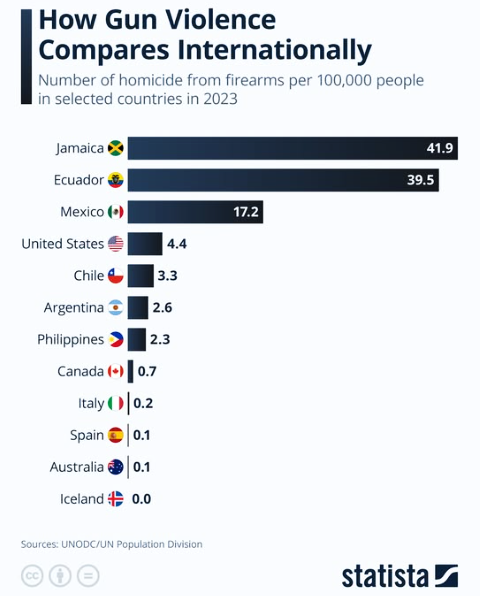
At this point, shouldn’t someone ask if the victims are any less dead in a lower-income nation than a so-called “high-income country.”
FPC WIN: Second Circuit Strikes Down New York Public Handgun Carry Ban
What: The Second Circuit Court of Appeals ruled in Firearms Policy Coalition’s (FPC) Christian v. James lawsuit that New York’s ban on firearms at all publicly accessible private property without the express consent of the owner (also known as the “vampire rule”) violates the Second Amendment. The court however also facially upheld the state’s ban on carry in public parks.
Who: FPC is joined in this case by FPC member Brett Christian and the Second Amendment Foundation. The plaintiffs are represented by David H. Thompson, Peter A. Patterson, and William V. Bergstrom of Cooper and Kirk, PLLC, along with Nicolas J. Rotsko of Fluet.
When: The Court’s opinion was issued on May 18.2026. The case will now be sent back to the district court, which will issue a final order in this case.
Where: The opinion was issued by the Second Circuit Court of Appeals, which is based in New York City and covers Connecticut, New York, and Vermont.
James Comey signals to FBI personnel that he has "great confidence in" at the bureau to wait out the Trump administration:
"I'm urging them, hang on two and a half years, and then we can rebuild these institutions." pic.twitter.com/xIoDY6OTpG
— Western Lensman (@WesternLensman) May 17, 2026
New Jersey’s Demand for Gun Store Sales Records is an Unconstitutional Attack on Gun Owner Privacy
The Attorney General of New Jersey has sent subpoenas to gun dealers in the state demanding production of customer records regarding sales of Glock pistols to New Jersey residents for the last ten years. The subpoenas are in connection to its lawsuit against Glock, Inc. under the state’s public nuisance law.
(NOTE: The claims in the state’s frivolous lawfare against Glock are not relevant to this particular article. But for context, the state is claiming the over 40-year-old design of the gun is too easy to illegally convert into a machine gun. Other states have filed similar lawsuits, and some like California have now banned the sale of Glocks, which are the most popular handguns in the country. These efforts are a way to coverup the failures of leadership in antigun states.) It is not immediately clear why New Jersey needs these records, given the state already maintains a de facto registry for handguns through its pistol permitting system. It could be that the Attorney General wants to make these records public, as under New Jersey law and in a small nod towards respecting privacy, firearm registration records are exempt from public disclosure under the state’s laws.
Regardless of the reasoning for the subpoenas, they are an unconstitutional attack on gun owner privacy. This article takes a brief look at this emerging issue in Second Amendment law to show why New Jersey’s actions are unconstitutional. It is adapted from prior amicus briefing the Second Amendment foundation has done on this issue.
Privacy in Firearms Ownership Has Always Been a Fundamental Component of the Second Amendment Right

To trust arms in the hands of the people at large has, in Europe, been believed…to be an experiment fraught only with danger. Here by a long trial it has been proved to be perfectly harmless…If the government be equitable; if it be reasonable in its exactions; if proper attention be paid to the education of children in knowledge and religion, few men will be disposed to use arms, unless for their amusement, and for the defence of themselves and their country. — Timothy Dwight, Travels in New England and New York, 1823