

July 28, 2026
Civilian Marksmanship Program Announces Sale of M14s
For decades, the Civilian Marksmanship Program has offered military surplus rifles for sale to members of CMP-affiliated clubs. In 2018, the CMP expanded its offerings to include 1911 pistols, and now the non-profit is adding another rifle to its roster: the M14.
In an announcement, the CMP revealed that the rifles will be modified to be “permanently and irreversibly semi-automatic rifles,” and will be “fully compliant with CMP enabling legislation authorizing the transfer and sale of military surplus .30 caliber rifles.”
It’s interesting that the ATF has approved this, since the agency’s position has historically been “once a machine gun, always a machine gun.” Second Amendment attorney Matthew Larosiere put out a video in response to the CMP’s announcement going through the history of the ATF’s position and wondering what the implications will be for other firearms going forward.
In its announcement, the CMP noted that it is “singularly authorized to modify these rifles and make them available for sale to eligible US Citizens,” which may be an indication that the ATF sees this as the exception that proves the rule rather than a move that will require a hard and fast rule change.
I’m curious to learn more about the authorization given to the CMP and the specific language that was used, but the bottom line for those interested in acquiring a select-fire rifle is that the CMP sale of M14s will not greatly expand the number of pre-1986 machine guns available for sale.
CMP has also not said how much the surplus M14s will be going for, or how many will be released in the first offering. As Guns.com’s Chris Edger noted, though, the number of M14s that were produced is dwarfed by the number of M1 Garand rifles that were manufactured for use as the standard rifle for infantrymen.
While over 5 million Garands were produced, only 1.38 million M14s were made by H&R, Springfield Armory, TRW, and Winchester between 1959 and 1965. Of those, at least 479,000 were fed to “Captain Crunch” at Anniston Army Depot by order of the Clinton Administration. Another 321,000 were given away as military aid over the years to countries such as South Vietnam, Estonia, Lithuania, Turkey, Greece, the Philippines, and Ukraine. Partially demilled rifles were long-issued to JROTC units for drill purposes.
Further, the M14 was never fully removed from service and remains in limited use with a variety of units, including the Army’s “Old Guard” on ceremonial duties in the Washington, D.C area, with the Service Academies for drill purposes, with assorted EOD units to deliver disabling fire at distance, and as line throwers and service rifles aboard Navy ships.
Like Larosiere, Edger says the bigger impact may be on the ATF’s “once a machine gun, always a machine gun” policy.
resumably, CMP has cleared the planned conversion of these surplus select-fire M14s with ATF to be “civilian-legal” and non-NFA items, which could be part of the “Special Authorization” mentioned in the press release.
This could open the door to apply the same logic to the millions of surplus 5.56 firearms (M16A1, A2, A4s, etc.) in military storage, provided Congress tweaks the organization’s charter to include that caliber (currently the CMP is only allowed to sell surplus U.S. military .30-caliber and .22-caliber rifles).
Going past CMP, it could signal the end of the once/always standard, which could mean big things in terms of importing and commercial sales of former NFA items.
Congress has already tweaked the CMP’s charter to allow it to sell surplus 1911s, so with some pushing and prodding it’s entirely possible that it could do the same for 5.56 rifles.
The CMP hasn’t said how much the surplus M14s will cost, but my guess is we’re probably looking at somewhere around $3,000 to $3,500. Any more than that and CMP is competing with high-end commercial M14-pattern rifles, and while CMP customers are purchasing a little piece of history too, there is still a practical ceiling for many buyers.
We’ll be keeping our eyes out for any more details, but the CMP’s announcement is significant, both in itself and what it might portend for the future.

To have no proud monarch driving over me with his gilt coaches; nor his host of excise-men and tax-gatherers insulting and robbing me; but to be my own master, my own prince and sovereign, gloriously preserving my national dignity, and pursuing my true happiness; planting my vineyards, and eating their luscious fruits; and sowing my fields, and reaping the golden grain: and seeing millions of brothers all around me, equally free and happy as myself. This, sir, is what I long for.
– Colonel Francis Marion, Continental Army. The ‘Swamp Fox’
July 27, 2026

The person who has had more experience of hardships can stand more firmly in the face of problems than the person who has never experienced suffering. From this angle, then, some suffering can be a good lesson for life.
Tenzin Gyatso, the Dalai Lama
July 26, 2026
‘And do you have a permit for your AR, sir?’
by Lee Williams
It’s hard not to smile or even giggle a little bit when you see how badly President Donald Trump is scaring the country’s paid anti-gun community, especially when you combine the President’s efforts with those of the United States Supreme Court.
No one is feeling this pro-gun heat more than the youngsters working at the Trace, the propaganda arm of former New York City mayor Michael Bloomberg’s gun control empire, who want the public to believe it’s an actual newsroom comprised of actual journalists—a fiction they’ll go to great lengths to maintain.
The Trace kids are extremely busy trying to stop this Second Amendment tidal wave that’s washing across the entire country. They realize that they’re losing, so they’re rabidly coming up with new ideas to counter our coming freedom—and some of their ideas are absolutely crazy.
Two Tracers just released this tome: “New Jersey Just Lost Its Assault Weapons Ban. Here’s Why That Matters for the Rest of the Country.”
The story’s last line is bedeviling. It’s not a quote or taken from any report. It’s completely attributable to the story’s two anti-gun authors:
“If the Supreme Court strikes down assault weapons bans nationwide next year, states could try other strategies, including putting semiautomatic rifles behind a permitting process,” they actually wrote.
Can you actually imagine that?
The highest court in the country says you can legally possess ARs in every state and U.S. Territory, but then some blue state suddenly requires you to obtain a state permit—regardless of the Supreme Court decision?
Do they think that might actually work?
It’s a Second Amendment right, right?
It would be like requiring state permits before allowing someone to read a book or scour the internet, which are rights guaranteed by the First Amendment.
The Trace is redefining desperation.
I’m picturing five-gallon pails of Zoloft, Prozac and Xanax scattered throughout their newsroom, each with a “help yourself” label.
It actually gets even worse. They’ve actually run out of legitimate sources.
The two authors wrote this:
“It’s unclear whether rescinding the bans will cause an increase in gun violence — or mass shootings in particular. Assault weapons have been used in most of the deadliest mass shootings in U.S. history, and studies have found that assault weapons, combined with high-capacity magazines, may increase the death count in mass shootings,” the story claims.
The link takes you to another hilarious medical study, which falsely claimed that “state assault weapons bans are associated with fewer fatalities.” The study based its findings on one particular source: “Data were abstracted from the Gun Violence Archive, an independent online database of US gun violence incidents.”
We’ve nearly written volumes about the faulty data from the Gun Violence Archive—so much so that it’s hard not to laugh every time some academic clod uses it in their “research.” Suffice it to say, the GVA said there were 417 mass shootings in 2019. The FBI says there were 30, because it uses actual data and doesn’t make stuff up.
The two authors actually supported using the GVA’s faulty numbers.
“The Trace uses the Gun Violence Archive’s definition of mass shooting, which includes shootings resulting in four or more injuries or deaths, excluding the shooter,” they wrote.
Trace history
The Trace calls itself “The only newsroom dedicated to covering gun violence.” Its staff refer to themselves as journalists, rather than anti-gun activists who are paid by Bloomberg to write propaganda.
Since the Trace was founded about a decade ago, scores of newspapers, websites and other legacy media outlets have fallen victim to this ruse. What’s left of Gannett’s flagship newspaper, USA Today, has collaborated with the Trace multiple times, and has even allowed Trace activists to produce and edit content, which appeared in the newspaper under a joint byline.
“We have partnered with more than 170 national and local media organizations,” the Trace boasts on its website. “We’re always looking to start new partnerships.”
The Trace is nothing more than the propaganda arm of Everytown for Gun Safety, which is also funded by Bloomberg.
Both nonprofits share the same president, John Feinblatt. In fact, Feinblatt is also listed as the two nonprofits’ principal officer. Federal tax documents show that the Trace and Everytown also use the same phone number, 646-324-8250.
Both nonprofits were incorporated in Delaware, which is known for its stringent corporate privacy laws.
Takeaways
Now that New Jersey-compliant ARs are a thing of the past, and California-compliant ARs may soon follow, we should take a minute to relax, but only one minute, no more.
The Trace and its followers will certainly come up with more whacky ideas, but they live in states whose judges support whacky behavior, especially if it harms the Second Amendment.
We remain in a constant battle for our civil rights, and anything can still go wrong at any time, according to Murphy’s Law.
“I learned that Murphy is alive and well. He’s in every drawer, under every rock and on top of every hill.”
Col. Charlie Beckwith said that. He should certainly know.
Well, he’s 98 – 99% ‘there’.
The AR-15 and the Second Amendment
By David Deming
There is late news from the US Supreme Court. Last June 30, the Court granted certiorari in Viramontes v. Cook County and Grant v. Higgins, consolidating challenges to gun bans in Connecticut and Cook County, Illinois. After years of frustration and denials, the Supreme Court has finally agreed to review and decide if state and local bans on semi-automatic rifles, such as the AR-15, are constitutional.
Many of us can remember a time when the federal courts altogether ignored the Second Amendment and would not concede that it guaranteed any individual right whatsoever. That changed in District of Columbia v. Heller (2008), when the Supreme Court unambiguously concluded that there is an individual right to “keep and bear arms,” and that this right is not established but protected by the Second Amendment. Subsequent cases have clarified and strengthened Second Amendment case law. In McDonald v. City of Chicago (2010), the Court held that the Second Amendment restrains not only the federal government, but also state and local governments.
In Caetano v. Massachusetts (2016), the Court declared that the Second Amendment refers to all modern arms (including stun guns), not just weapons in existence in 1791 when the Bill of Rights was ratified. In New York State Rifle & Pistol Association v. Bruen (2022), the Supreme Court ruled that under the Second Amendment there is a right to carry a handgun in public for self-defense. In Bruen, the Supreme Court also did away with interest-balancing tests and established a history and tradition standard for evaluation of Second Amendment claims.
Under Bruen, any restriction on gun rights must be consistent with our nation’s historical tradition of firearm regulation. Because the US has almost no history of firearm regulation prior to the National Firearms Act of 1934, the unavoidable implication is that almost all gun control laws will eventually be found to be unconstitutional.
Unfortunately, inferior courts, including US District and Appeals Courts, have largely failed to follow Supreme Court guidance or precedent. In Bianchi v. Brown (2024), the Fourth Circuit Court of Appeals upheld Maryland’s ban on AR-15s and other semi-automatic rifles on the grounds that “they are military-style weapons designed for sustained combat operations that are ill-suited and disproportionate to the need for self-defense.” In Bevis v. Naperville (2023), the Seventh Circuit Court of Appeals concluded that “assault weapons and high-capacity magazines” are not protected by the Second Amendment because they “are much more like machineguns and military-grade weaponry than they are like the many different types of firearms that are used for individual self-defense.”
This is utter nonsense. There is no objective definition of what is meant by “military style,” nor is the semi-automatic AR-15 even in use by any military force anywhere in the world. Armed forces use select-fire weapons capable of fully automatic operation. If this sort of reasoning had been applied during the late eighteenth century, citizens would not have been able to own either muskets or rifles and unable to fulfill their obligation of militia service. Furthermore, the Second Amendment is not limited to arms useful for “self-defense.” Indeed, a plausible reading of the militia clause implies that only military weapons are protected! And there are several circumstances in which the AR-15 and other semi-automatic rifles are ideally suited for self-defense. In 2017, a homeowner in Broken Arrow, Oklahoma, used an AR-15 to decisively stop three home invaders. The shooting was ruled a justifiable act of self-defense.
The fact that arms bans remain in effect in several states and municipalities tells us that the Supreme Court has yet to provide clear and unambiguous guidance on specifically what types of weapons fall under the umbrella of the Second Amendment. In Heller the court ruled that the Second Amendment protects weapons that are “in common use,” for lawful purposes, while precluding “dangerous and unusual weapons.” From this, inferior courts, as described above, have concocted the fiction that only weapons in common use for self-defense are protected, not those suitable for sporting activities or militia service. But Heller never concluded that the only weapons protected by the Second Amendment were those useful for self-defense.
In Caetano, Justice Alito emphasized that the phrase “dangerous and unusual” from the text of Heller is a conjunctive test. For an arms ban to be constitutional, a weapon must be both “dangerous” and “unusual,” not just “dangerous.” It should therefore be beyond cavil that any ban on AR-15s is unconstitutional. Not only are they in common use, the AR-15 is the single most popular centerfire rifle sold and possessed in the US. Approximately 20-30 million AR-15s are in civilian hands.
And what are we to make of the term “dangerous” in Heller’s proscription? All guns are obviously dangerous. Kitchen knives are dangerous. Common objects and tools of all types can be dangerous. Baseball bats (which we provide to small children without hesitation) and hammers can be used to murder. So can bricks, sticks, stones, and hands and feet. FBI Uniform Crime Report statistics indicate that every year more murders are committed by means of “hands, fists, and feet,” than rifles of all types, including AR-15s. For the term “dangerous” to have intelligible validity there must be context. “Dangerous” can only mean the danger inherent in a weapon of mass destruction such as a nuclear bomb or poison gas, not an ordinary firearm.
Sometimes I read the comment on social media that all gun laws are unconstitutional under the Second Amendment. I disagree. Anyone who makes this assertion has not considered the consequences. If all gun laws are unconstitutional, the concomitant but absurd implication is that prisoners in jail will be allowed to have weapons. Even from the founding era of the US, it has been common practice to disarm violent felons and people with severe mental illnesses.
In these exceptional instances a person must be afforded due process of law before losing their rights. And I do not believe that the Second Amendment covers weapons of mass destruction that really are “dangerous” and would ordinarily never be owned by an individual. I have no problem with ordinary people possessing machine guns, mortars, hand grenades, or any small arm routinely issued to an infantryman, but individuals should not be in possession of nuclear weapons.
Eventually I do believe that the Supreme Court will rule the National Firearms Act of 1934 to be unconstitutional, and we will have the right again to own machine guns, as we did prior to 1986. The Supreme Court is not there yet, but overturning bans on AR-15s in common use is an important step on the path.
David Deming is a geophysicist and professor of arts and sciences at the University of Oklahoma.
Hunting and Fishing Ban Fails to Make November Ballot
Election officials say it failed two rounds of signature verification.
Initiative Petition 28, an animal rights measure that sought to criminalize hunting, fishing, ranching and pest control in Oregon, has failed to make the November ballot after state election officials say it failed two rounds of signature verification.
Oregon Secretary of State Tobias Read’s office announced the disqualification late Friday afternoon.
The IP 28 campaign submitted 142,784 signatures on July 2. To qualify for the ballot, the petition needed 117,173 verified signatures. That would require 82% of the submitted signatures to be valid. On two rounds of testing, the Elections Division said, sample batches of signatures failed to meet that threshold. (WW reported the first failure on July 16.)
The Elections Division said that just 104,262 of the submitted signatures, or 73.25%, were valid.
The initiative petition, submitted by a Portland substitute teacher, would have classified any killing of an animal in Oregon except in self-defense as a Class A misdemeanor. That would have effectively outlawed hunting, fishing, slaughtering livestock for meat, or killing rats or other pests.
As the initiative, backed by large contributions from animal rights groups, moved closer to the ballot, it became a political liability for Oregon Democrats, who denounced it but still saw Republicans try to tar them with it as election season ramped up.
Shortly after the Elections Division announcement, Gov. Tina Kotek issued a statement saying she was “relieved” by the petition’s failure.
“Efforts to criminalize activities like hunting and fishing are wrong for Oregon,” Kotek said. “I know from conversations with Oregonians across the state that this measure would have done nothing to help them. This is a win for tribal leaders, family farmers, ranchers, and every Oregonian who cares about protecting our lands and wildlife.”
State Sen. Christine Drazan (R-Canby) denounced the initiative and suggested she would buttress Oregon against future attempts. “The people behind IP 28 will be back, and so will the next extremists with another extreme idea,” she said in a statement. “Oregon has paid the price for bad ballot measures before, and we can’t afford to make that mistake again.”
Sorry, Gun-Grabbers, We’ve All Seen Where Those ‘Common Sense’ Proposals Lead.
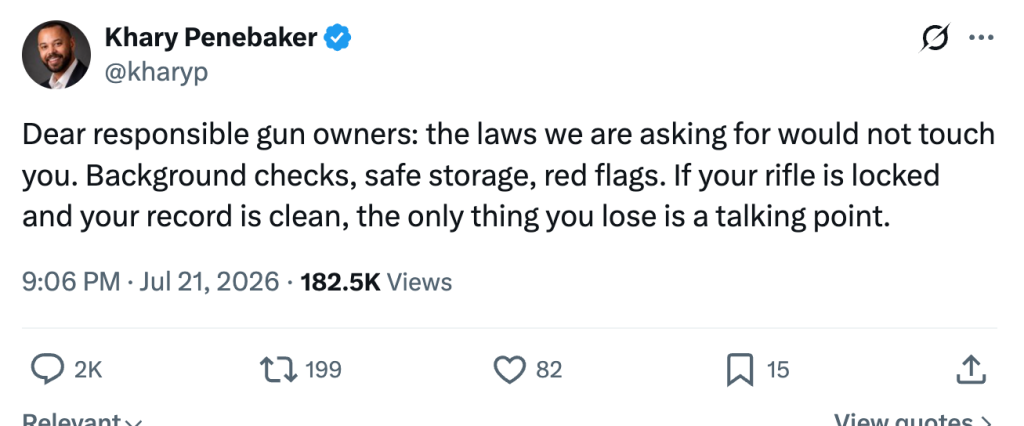
Khary Penebaker describes himself in his X profile as a “Speaker. Advocate. Father. I build things and fight for what matters. Gun violence prevention is personal. Sneakerhead. Round Earther.”
Good to know.
He also ran as a Democrat — very unsuccessfully against a well-established incumbent — for a congressional seat in Wisconsin back in 2016.
Now, after a string of spectacular defeats for the cause of civilian disarmament in America, he seems to have decided that the best strategy is to go back to gun control default settings first principles, trying to sell whoever will listen to him on just a few basic “common sense” ideas that will obviously save lives and of course everyone can get behind that. Because we all just want to be safe. Right?
What guys like Penebaker seem to forget is that this is 2026. Some of us out here live in states where the “common sense” types have been in full control for years. Decades even. That means we know that what he’s selling is a steaming load of bullshit.
California, for instance, has (and this is just off the top of my head):
1. Bans on most common handguns
2. Bans on common rifles unless they have stupid compliance “features” (and now they want to ban those too)
3. Concealed carry permit application fees as high as $2,000 in total expense…and that’s aside from the significant time investment involved including a police interview, a two-day training course, Livescan fingerprinting, gathering personal references, and sometimes even a psych exam in some counties
4. An 11% tax on sales of guns and ammo
5. A 10-day waiting period to buy a gun, even if you already own other guns
6. Bans on carry in many types of public places, even if you went through all the trouble to get an expensive, time-consuming carry permit
There are tons more restrictions, hurdles, and roadblocks the books. Those are just a few examples.
Maybe those on the gun control side, people like Penebaker, would be a lot more successful selling this stuff in 2026 if it were actually true that all they want is a few things like background checks, safe storage, and red flag laws. Maybe.
Byut that isn’t true. It never was. We’re not stupid. We know what’s down that road. We’ve seen what blue states have done and are still doing, even now. Time to re-think your strategy, Khary.
Kostas Moros is Director of Legal Research and Education for the Second Amendment Foundation.

After having thus successively taken each member of the community in its powerful grasp and fashioned him at will, the supreme power then extends its arm over the whole community.
It covers the surface of society with a network of small, complicated rules, minute and uniform, through which the most original minds and the most energetic characters cannot penetrate, to rise above the crowd.
The will of man is not shattered, but softened, bent, and guided; men seldom forced by it to act, but they are constantly restrained from acting.
Such a power does not destroy, but it prevents existence; it does not tyrannize, but it compresses, enervates, extinguishes, and stupefies a people, till each nation is reduced to nothing better than a flock of timid and industrious animals, of which the government is the shepherd.
— Alexis de Tocqueville
July 25, 2026
Don’t DSA the USA, Protect Liberty to Stop Communism
There’s a dark mood creeping into American politics that has even the most die-hard gun control politicians worried. Democrats, typically (but not always) aligned with gun control, are facing the prospect of their political party turning their gaze to complete control.
Enter the Democratic Socialists of America (DSA).
These candidates for political office aren’t your grandfather’s Democrats or even limousine liberals. They can’t even honestly call themselves socialists. They’re cosplaying communists who are shredding any pretense of respect or admiration for the U.S. Constitution.
This is what George Orwell warned of in his novel, “1984.” They want complete and total control of the American government, including openly calling for abolishing of the U.S. Constitution, tearing down the balance of powers between the three branches of government, destroying of Department of War and most ominously, seizing the “resources and production.”
Make no mistake. Controlling the firearm and ammunition industry would be on the top of that list.
Who is the DSA?
The DSA has been making waves by striking out against Democratic candidates in primaries. New York City Mayor Zohran Mamdani is a member of the Democratic Socialists of America. Most notably, disgraced former Democratic candidate for U.S. Senate, Graham Platner, the fabled “oyster farmer” whose scandal-ridden past finally crashed his run for office, is an avowed member of the DSA.
But Platner wasn’t democratic by any means. He was full-on Communist. That was uncovered in his previous online postings, which he attempted to delete. Holding his hand the whole way along was U.S. Sen. Bernie Sanders (I-Vt.). That’s the same Sen. Sanders who honeymooned in Moscow in 1988, while the Communist Soviet Union was still in power.
Platner’s rise and inglorious immolation only emboldened members of the DSA. More candidates are on tickets in New York, Pennsylvania, Colorado, Florida, Michigan and Wisconsin. Democrats, who are notoriously anti-Second Amendment, are suddenly finding themselves having to defend against a communist flank in their own party.
That should concern everyone who believes the U.S. Constitution is the founding document that guides America’s form of government and protects Second Amendment rights. The DSA’s party platform essentially calls to tear it all down. They would burn it to rule over the ashes.
DSA Platform
The DSA’s platform includes abolition of the U.S. Senate (sorry, Sen. Sanders for losing your job), replacing the President of the United States and U.S. Supreme Court with an Executive and Judicial Branch that would be subordinate to what’s left of Congress.
That’s not reforming the U.S. Constitution. That’s complete annihilation of it. The first three articles of the U.S. Constitution set up the federal government’s Legislative, Executive and Judicial Branches. Each branch is co-equal and is a check and balance on the other.
The DSA would give their new form of government complete authority, with the Executive and Judiciary subservient to the authority of what’s left of the Legislative Branch. It’s spelled out in their platform where they call for “a new democratic constitution.”
The DSA platform also espouses seizing control of the means of production. The DSA’s Constitution & Bylaws state in Article II that “We are socialists because we share a vision of a humane social order based on popular control of resources and production…”
Further, in 2018, the DSA explicitly called for the repeal of the Second Amendment, stating, “… the only way to guarantee that we will dramatically reduce acts of violence involving guns is to remove guns from society…” The DSA called for adoption of a 28th Amendment, repealing the Second Amendment and the prohibiting of “manufacturing, transportation or importation in or into any State, Territory, or possession of the United States for delivery or use therein of pump-action, semi-automatic or automatic firearms.”
That’s not just ending an individual right to keep and bear commonly-owned firearms (the DSA would “allow” individuals to maintain ownership of single-shot firearms), it means the DSA would seize control of the firearm and ammunition industry, since the DSA platform calls for “popular control of resources and production.”
That’s full-on communism, which is marked by brutal violence.

“The Constitutions of most of our states assert that all power is inherent in the people; that they may exercise it by themselves, in all cases to which they think themselves competent, (as in electing their functionaries executive and legislative, and deciding by a jury of themselves, both fact and law, in all judiciary cases in which any fact is involved) or they may act by representatives, freely and equally chosen; that it is their right and duty to be at all times armed; that they are entitled to freedom of person; freedom of religion; freedom of property; and freedom of the press.”
– Thomas Jefferson, Letter to John Cartwright, June 5, 1824
July 24, 2026