US should attack Iran in response to attack on our embassy in Iraq

Once again, a U.S. embassy has come under an attack orchestrated by Iranian terrorists – but this time it is our embassy in Baghdad in Iraq rather than in the Iranian capital of Tehran as in 1979, when Iranian revolutionaries captured the U.S. Embassy and held 52 American hostage for 444 days.

Several dozen Iraqi Shiite militia members forced their way into the U.S. embassy compound in Baghdad Tuesday setting fires and causing other damage, angered by weekend U.S. airstrikes that killed members of an Iranian-backed militia in Iraq.

We must maintain control of our embassy in Baghdad. A U.S. official told Fox News that 100 Marines are being sent to the embassy to increase security.

President Trump is wisely standing firm, tweeting Tuesday to explain the American airstrikes and to deliver a sharp warning to the governments of both Iran and Iraq: “Iran killed an American contractor, wounding many,” the president tweeted. “We strongly responded, and always will. Now Iran is orchestrating an attack on the U.S. Embassy in Iraq. They will be held fully responsible. In addition, we expect Iraq to use its forces to protect the Embassy, and so notified!”

The president’s tweet is a welcome display of U.S. resolve, but more than a tweet is needed to show Iran it cannot attack the U.S. embassy with impunity. It’s time for an American military response.


Report: Trump held private, enlisted-only Afghanistan war meetings – ‘No generals or officers, only enlisted guys that have been there’.

Since taking office, President Donald Trump has been meeting with enlisted troops to get a better understanding of how they feel the war in Afghanistan has been progressing.

Trump did not want to meet with higher ranking officers, instead choosing to meet with enlisted troops to get a more candid assessment of the America’s longest-running war, Business Insider reported.
“I want to sit down with some enlisted guys that have been there,” Trump reportedly told advisers, according to Peter Bergen, author of “Trump and His Generals: The Cost of Chaos.”

“I don’t want any generals in here. I don’t want any officers,” he added.

Enlisted members of the military may have been seen as better able to critique the war effort as their roles tend to place them closer to combat and the consequences of a command. Enlisted members are also less concerned with the day-to-day politics that might affect higher ranking officers.

Trump reportedly compared the opinions of senior military officers to those of a restaurant consultant. Rather than taking the advice of the consultant, who would suggest expanding a kitchen for renovations, Trump argued it would be more prudent and cost effective to ask the advice of the waiters who see the day to day operations and can identify the most basic problems in a restaurant’s functions.

One of the first groups Trump reportedly met with were enlisted Navy SEALs who criticized the war and said the war in Afghanistan is “unwinnable.”

“NATO’s a joke. Nobody knows what they’re doing,” the SEALs reportedly told Trump. “We don’t fight to win. The morale is terrible. It’s totally corrupt.”

On another occasion on July 18, 2017, Trump held a White House meeting with four more Army and Air Force senior enlisted service members.

“I’ve heard plenty of ideas from a lot of people, but I want to hear it from the people on the ground,” Trump said at a press conference for the July 2017 meeting.

Following that meeting, Trump reportedly gathered senior military officials to the White House situation room, where he then warned that the enlisted members he spoke with know “a lot more than you generals,” and said that “we’re losing” the war in Afghanistan.

U.S. Army Investigates Cadets Over OK Hand Gestures, Finds No Wrongdoing

The U.S. Military academy has concluded its investigation into cadets who flashed the “OK sign” during a live broadcast of an Army-Navy football game.

The findings of the West Point investigation were that “the cadets were playing a common game, popular among teenagers today, known as the ‘circle game’ and the intent was not associated with ideologies or movements that are contrary to the Army values.”

President Trump Signs Defense Bill Creating Space Force

SPaaaaaaaaaaaaaaaaaaaaace FORCE!

ANDREWS AIR FORCE BASE, MARYLAND — Flanked by two fighter jets and in front of a giant American flag, President Trump on Friday signed the 2020 National Defense Authorization Act that officially created the Space Force, the sixth and first new military branch since 1947.

“For the first time since Truman, we will create a brand new American military service,” Trump said. “You will witness the birth of the Space Force. That’s a big moment and we’re all here for it.”


THE ARDENNES:
BATTLE OF THE BULGE

The Battle of the Bulge, also known as the Ardennes Counteroffensive, was the last major German offensive campaign on the Western Front during World War II, and took place from 16 December 1944 to 25 January 1945.

During most of the eleven months between D-day and V-E day in Europe, the U S Army was carrying on highly successful offensive operations As a consequence, the American soldier was buoyed with success, imbued with the idea that his enemy could not strike him a really heavy counterblow, and sustained by the conviction that the war was nearly won. Then, unbelievably, and under the goad of Hitler’s fanaticism, the German Army launched its powerful counteroffensive in the Ardennes in December 1944 with the design of knifing through the Allied armies and forcing a negotiated peace.

The mettle of the American soldier was tested in the fires of adversity and the quality of his response earned for him the right to stand shoulder to shoulder with his forebears of Valley Forge, Fredericksburg, and the Marne.

This is the story of how the Germans planned and executed their offensive.
It is the story of how the high command, American and British, reacted to defeat the German plan once the reality of a German offensive was accepted.
But most of all it is the story of the American fighting man and the manner in which he fought a myriad of small defensive battles until the torrent of the German attack was slowed and diverted, its force dissipated and finally spent.
It is the story of squads, platoons, companies, and even conglomerate scratch groups that fought with courage, with fortitude, with sheer obstinacy, often without information or communications or the knowledge of the whereabouts of friends. In less than a fortnight the enemy was stopped and the Americans were preparing to resume the offensive.
While Bastogne has become the symbol of this obstinate, gallant, and successful defense, this work appropriately emphasizes the crucial significance of early American success in containing the attack by holding firmly on its northern and southern shoulders and by upsetting the enemy timetable at St. Vith and a dozen lesser known but important and decisive battlefields

Trump Pushes to Allow Troops to Carry Personal Weapons on Bases

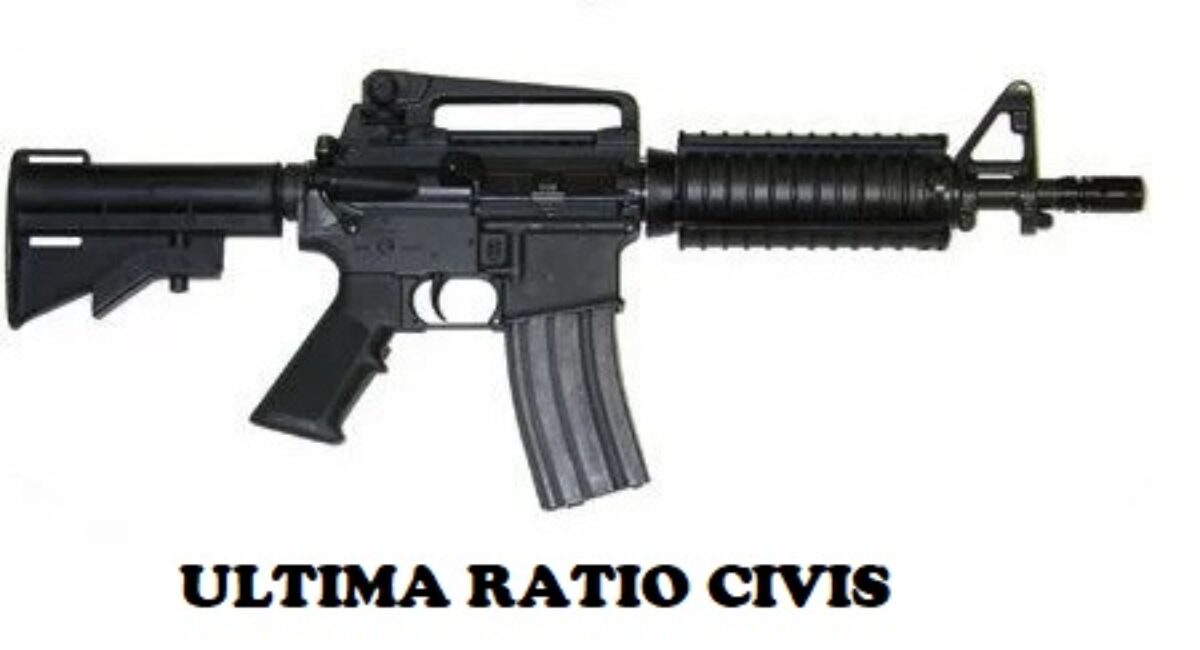
President Donald Trump said Friday that he would review policies that keep troops from carrying personal weapons onto military bases.

“If we can’t have our military holding guns, it’s pretty bad,” Trump said in a wide-ranging speech to the annual Conservative Political Action Committee conference in Maryland, “and I’m going to look at that whole policy on military bases.”

“So we want to protect our military. We want to make our military stronger and better than it’s ever been,” Trump continued in the speech, in which he also renewed his call for allowing trained teachers and military retirees to carry concealed weapons in schools.

Schools and military bases currently are “gun-free zones” that are easy targets for deranged shooters such as the one in Parkland, Florida, who killed 17 at Marjory Stoneman Douglas High School last week, Trump said.Defense Department policy mainly has been that base security is the province of military police. In most cases, troops are required to leave their personal weapons at home or check them at the gate in an effort to prevent accidental shootings and discourage suicides.”We had a number of instances on military bases, you know that,” Trump said in his speech, apparently referring to active shooter episodes.

In making the case for personal weapons on military bases, Trump appeared to be referencing the July 2015 incident in Chattanooga, Tenn., where four Marines and a sailor were killed.

The shootings occurred at a recruiting storefront in a strip shopping mall and at a U.S. Naval Reserve Center some miles away. But Trump said the victims “were on a military base in a gun-free zone.”

The victims were Gunnery Sgt. Thomas Sullivan, 40; Staff Sgt. David Wyatt, 35; Sgt. Carson A. Holmquist; Lance Cpl. Squire D. “Skip” Wells, 21; and Navy Petty Officer 2nd Class Randall Smith, 26.

The FBI and local police said that Muhammad Youssef Abdulazeez carried out a drive-by shooting at the recruiting center and then drove to the U.S. Naval Reserve Center, where he was killed in a shootout with police.

Then-FBI Director James Comey later said that Abdulazeez was “motivated by foreign terrorist organization propaganda.”

“You know the five great soldiers from four years ago, three of them were world-class marksmen,” Trump said in his account of the incident. “They were on a military base in a gun-free zone.”

“They were asked to check their guns quite far away. And a maniac walked in, guns blazing, killed all five of them. He wouldn’t of had a chance if these world-class marksmen had — on a military base — access to their guns,” Trump said.

In his 2015 Senate confirmation hearing to become Army Chief of Staff, Gen. Mark Milley was asked about the Chattanooga shootings and said that “in some cases I think it’s appropriate” for recruiters to carry weapons for self-defense.

He said that arming recruiters was complicated by a patchwork of state laws but “I think under certain conditions — both on military bases and in outstations, recruiting stations, reserve centers — we should seriously consider it.”

Then-Lt. Gen. Milley was commander at Fort Hood, Texas, in April 2014 when Spec. Ivan Lopez opened fire, killing three soldiers and wounding 12 others before killing himself.

Numerous lawmakers then called for allowing troops to carry weapons on base, but Milley said at a news conference that he didn’t support the idea.

“I don’t think soldiers should have concealed weapons on base,” he said.

U.S. Naval Academy graduate died relaying crucial information to first responders.

PENSACOLA, Fla. – A young graduate of the U.S. Naval Academy, whose dream was to become a pilot, is being hailed a hero after he reportedly related crucial information about the identity of the Naval Air Station (NAS) Pensacola shooter to first responders, despite having been shot several times, a family member revealed.

Joshua Kaleb Watson, 23, was confirmed as one of the three victims who were killed Friday morning when Saudi national Mohammed Saeed Alshamrani opened fire on a flight training program for foreign military personnel, Adam Watson revealed in a Facebook post.

In an interview to air Sunday with Fox News’ Chris Wallace, Defense Secretary Mark Esper said all three victims were Americans. Two were members of the U.S. Navy, a senior Pentagon official told Fox News.

Watson’s father Benjamin told USA Today that his son was the officer on deck at the time of the shooting and sustained at least five gunshot wounds before being able to make it out to relay important information about the shooter before succumbing to his injuries.

“Heavily wounded, he made his way out to flag down first responders and gave an accurate description of the shooter,” he told the outlet. “He died serving his country.”

All Secure: A Special Operations Soldier’s Fight to Survive on the Battlefield and the Homefront

One of the most highly regarded Tier One Delta Force operators in American military history shares his war stories and personal battle with PTSD.
As a senior non-commissioned officer of Delta Force, the most elite and secretive special operations unit in the U.S. military, Command Sergeant Major Tom Satterly fought some of this country’s most fearsome enemies. Over the course of twenty years and thousands of missions, he’s fought desperately for his life, rescued hostages, killed and captured terrorist leaders, and seen his friends maimed and killed around him.

All Secure is in part Tom’s journey into a world so dark and dangerous that most Americans can’t contemplate its existence. It recounts what it is like to be on the front lines with one of America’s most highly trained warriors. As action-packed as any fiction thriller, All Secure is an insider’s view of “The Unit.”
Tom is a legend even among other Tier One special operators. Yet the enemy that cost him three marriages, and ruined his health physically and psychologically, existed in his brain. It nearly led him to kill himself in 2014; but for the lifeline thrown to him by an extraordinary woman it might have ended there. Instead, they took on Satterly’s most important mission-saving the lives of his brothers and sisters in arms who are killing themselves at a rate of more than twenty a day.
Told through Satterly’s firsthand experiences, it also weaves in the reasons-the bloodshed, the deaths, the intense moments of sheer terror, the survivor’s guilt, depression, and substance abuse-for his career-long battle against the most insidious enemy of all: Post Traumatic Stress. With the help of his wife, he learned that by admitting his weaknesses and faults he sets an example for other combat veterans struggling to come home.

“The Greatest Failure is the Failure to Try.” Tom Satterly CSM(Ret)

September 2004 Yusufiyah, Iraq

The Blackhawk helicopter hovered in the dark above the house on the outskirts of Baghdad while eighteen Unit operators slid down ropes forty feet to the roof. The small arms fire my troop and helos had been taking since our arrival a few minutes earlier intensified as the last man landed and joined the others.

Directing the assault from a field thirty meters north of the target house, I watched through my night vision goggles as the aircraft began to pull up and away. At that moment, above the fierce barking of assault rifles and machine guns, I heard the all-too-familiar whoosh and saw the red trail of an RPG as it was launched skyward.

The grenade struck the Blackhawk on its rotor blades and exploded. The elite Night Stalker pilots had been through it before and knew they wouldn’t make it to back to base. They aimed for a field five hundred meters from the house to put the injured bird down.

The Blackhawk hit hard but remained upright, intact, and didn’t burst into flames. But the pilot and crew immediately came under heavy fire from the enemy who were running in all directions from the house.

I thought, “here we go again.” Just thinking of the words, I was about to radio over the command station sent a chill through me. “We have a Blackhawk down!”