Monday a big court day for 2nd amendment, gun laws, gun rights

The U.S. Court of Appeals for the Second Circuit, in Manhattan, will hear five second amendment cases Monday.

“My hopes are Monday evening the case is decided and New Yorkers get their gun rights back,” says Oneida County’s assistant pistol licensing officer, Dan Sullivan.

It’s not clear if the judges will rule from the bench, or, reserve decision and issue a written one at a later date. But Sullivan is hopeful for the outcome.

“You’ve got the highest court in the land and you’ve got three federal judges who’ve stated in writing that the carry concealed improvement act is not constitutional, so I’m hoping we get our gun rights back,” says Sullivan.

“I think 70 or 80% of gun owners don’t have a clue what the law is right now,” says Sullivan. “I think there’s an awful lot of people that are carrying like they’ve always carried, and I don’t think they’re doing that out of maliciousness, I think they’re doing that out of simply not knowing what the law is right now”

For now, New York’s Concealed Carry Improvement Act remains intact.

Falls pastor may be headed to U.S. Supreme Court over New York gun law

It’s a case that has already made its way to the United States Supreme Court.

And it’s likely to return there.

But first, Niagara Falls pastor Jimmie Hardaway Jr.’s constitutional challenge to New York’s Concealed Carry Improvement Act (CCIA) faces a Monday morning hearing before a three-judge panel of the U.S. Second Circuit Court of Appeals. The New York City-based court is widely considered one of the most influential appeals courts in the nation.

Hardaway, of Trinity Baptist Church, and Rev. Larry Boyd, pastor of Open Praise Full Gospel Baptist Church in Buffalo, challenged the constitutionality of the CCIA, along with two national pro-gun groups, Las Vegas-based Firearms Policy Coalition and Bellevue, Washington-based Second Amendment Foundation in a lawsuit filed in the U.S. District Court for the Western District of New York. The suit sought to block a provision of the CCIA that bars individuals from bringing firearms into places of worship.

Boyd and Hardaway also sought to have the CCIA struck down in its entirety as unconstitutional.

Hardaway and Boyd have argued in the case that they would suffer irreparable harm, and that their Second Amendment rights would be violated, if the places of worship restriction was not blocked. In an affidavit accompanying the original lawsuit, Hardaway acknowledges that he is a member of the two pro-gun groups involved in the case and that he is licensed to carry a handgun in New York.

“Prior to the enactment and enforcement of the Place of Worship Ban, I would consistently carry a firearm on Trinity Baptist Church’s premises,” Hardaway said in the affidavit. “I would intend to keep carrying for self-defense and to keep the peace at Trinity Baptist Church.”

U.S. District Court Judge John L. Sinatra Jr. conducted an expedited hearing on Hardaway and Boyd’s lawsuit and, just hours after oral arguments in the case, issued a 40-page decision and order that granted a temporary restraining order (TRO) blocking the enforcement of the places of worship restriction.

New York Attorney General Letitia James, whose office defended the CCIA, had sought to remove Sinatra, an appointee of former President Donald Trump, charging that Hardaway and Boyd had engaged in “judge shopping” by having the case directed to Sinatra.

Two weeks later, in a decision and order that followed almost word-for-word and page-for-page his decision on the TRO, Sinatra granted the pastors a preliminary injunction that blocked the enforcement of the places of worship restriction. Weeks later, Sinatra ruled the entire CCIA was unconstitutional.

James appealed Sinatra’s decisions to the Second Circuit and asked the appeals court to block his rulings while they considered them. The attorney general asked the appeals court to overturn, “in each and every aspect,” Sinatra’s rulings.

The Second Circuit judges issued a stay on Sinatra’s decisions, which effectively reinstated the CCIA and the places of worship restriction.

Hardaway and Boyd asked the U.S. Supreme Court to intervene and overturn the stay. They argued that their rights under the Second Amendment had been “indefinitely suspend(ed).”

“Applicants, along with countless others like them, are being irreparably harmed each day this patently unconstitutional law remains in place, eviscerating the right of ordinary, law-abiding New Yorkers to carry firearms in public for self-defense,” Hardaway and Boyd’s lawyers told the high court. “Additionally, this case presents issues of national importance with respect to states that enact laws in explicit defiance of this court’s decisions.”

In January, the court, without any noted dissents, allowed the stay to remain in place while the Second Circuit proceedings continued.

The appeals court panel will hear up to 20 minutes, 10 minutes for each side, of arguments in the case. The case has attracted friend of the court briefs from both pro-gun control and pro-gun rights groups, as well as the attorneys general from a dozen states opposed to the New York law.

In his decision and order, Sinatra wrote that the State of New York had responded to the U.S. Supreme Court’s decision in New York State Rifle & Pistol Association, Inc. v. Bruen by enacting “even more restrictive legislation” than what the high court had declared unconstitutional.

“The court reiterates that ample Supreme Court precedent addressing the individual’s right to keep and bear arms — from Heller and McDonald to its June 2022 decision in Bruen — dictates that New York’s new place of worship restriction is equally unconstitutional,” Sinatra wrote.

During oral arguments in the case, Sinatra appeared dismissive and openly hostile to the arguments being made by lawyers for the state.

“In Bruen, the (Supreme Court) made the Second Amendment test crystal clear: regulation in this area is permissible only if the government demonstrates that the regulation is consistent with the Nation’s historical tradition,” Sinatra wrote in his decisions. “New York fails that test. The State’s exclusion is, instead, inconsistent with the Nation’s historical traditions.”

Hardaway has maintained that his church has an “open-door policy” that carries risk over “who will walk in the door for services.” The pastor also claims that the “horrific murders” of nine parishioners at Emanuel African Methodist Episcopal Church in Charleston, South Carolina, in 2015, has “stiffened (his) resolve to carry for self-defense and to keep the peace at Trinity Baptist strong


Should the Fifth Circuit Reconsider Rahimi En Banc?

The Fifth Circuit’s decision in United States v. Rahimi, which held that the federal statute prohibiting possession of a firearm by a person subject to a domestic violence restraining order violates the Second Amendment, has managed to stay in the news for longer than most circuit court decisions. On March 2, a month after it initially released its decision, the Fifth Circuit panel withdraw its original opinion and substituted a revised version.

The end result is the same, and the updates to the controlling opinion appear to be modest, but Judge Ho significantly expanded his concurring opinion, in which he sets out to “explain how respect for the Second Amendment is entirely compatible with respect for our profound societal interest in protecting citizens from violent criminals.” Judge Ho emphasizes that “[t]hose who commit violence, including domestic violence, shouldn’t just be disarmed—they should be detained, prosecuted, convicted, and incarcerated.”

But because the law at issue in Rahimi “disarms individuals based on civil protective orders—not criminal proceedings,” the panel found no “analogous historical tradition sufficient to support” it. That was especially true, given the way that civil protective orders are used (and abused) in our system, including by a common practice of issuing “mutual restraining orders” in domestic violence cases, a practice that results in the federal prohibition actually disarming domestic violence victims.

Judge Ho’s concurrence also highlights the importance of the Fifth Circuit getting this case right. He notes that before Bruen, circuit courts routinely misapplied Heller despite frequent criticism from the members of the Supreme Court that they were “disfavoring the Second Amendment.” And he correctly recognizes that Bruen was a response to the lower courts’ intransigence: “The Supreme Court has now responded by setting forth a new legal framework in Bruen. It is incumbent on lower courts to implement Bruen in good faith and to the best of our ability.”

Of course, the issue is fraught, so Rahimi has received a lot of attention. Given that it invalidated a federal statute, it seems like a likely candidate for catching the Supreme Court’s attention too. In fact, it appears that the Justice Department views this as a particularly good vehicle to ask the Supreme Court immediately to consider (or reconsider) some of the effects of its decision in Bruen. Attorney General Merrick Garland made a statement over a month ago, vowing to “seek further review of the Fifth Circuit’s … decision,” but there is no indication he intends to seek that review from the Fifth Circuit.

For those of us who believe Bruen got it exactly right, Rahimi may be a bad vehicle for the Supreme Court to flesh out its decision in Bruen. As much as the Justices may try to focus on the bigger-picture legal issues, bad facts make bad law, and Rahimi is full of bad facts. Even if the law that kept him from possessing firearms in this case is unconstitutional—and the panel opinion makes a compelling case that the law lacked support from the founding era—it seems clear that Mr. Rahimi is exactly the sort of person who should be able to be disarmed consistent with the Second Amendment. He was involved in five shootings in two months, including one instance when he “fired multiple shots in the air after his friend’s credit card was declined at a Whataburger restaurant.”

The Fifth Circuit should consider rehearing the case en banc. This would have the advantage of setting the clearest possible precedent to govern future Second Amendment challenges under Bruen and, perhaps just as importantly, permitting other Second Amendment challenges to get to the Supreme Court first. The federal rules of appellate procedure say a case is a good candidate for reconsideration if it “involves a question of exceptional importance.” The issue in Rahimi meets that standard several in different ways.

The Third Circuit recently heard en banc argument in United States v. Range, a case raising the constitutionality of the federal law against felon possession of a firearm—a separate subsection of the same law at issue in Rahimi—and it decided the issue was worth en banc treatment just three days after receiving the petition for rehearing was filed. More recently, the Eleventh Circuit issued a decision in National Rifle Association v. Bondi, holding that a Florida law restricting the Second Amendment rights of 18-to-20-year-olds to purchase a firearm was constitutional under Bruen. That same day, before any petition for rehearing could be filed, a judge of that court apparently called for an en banc poll, because the court entered an order withholding issuance of the mandate.

Under Fifth Circuit Internal Operating Procedures, any judge may initiate a vote to take a case en banc, even without a petition. And since it appears no petition for rehearing is forthcoming from the Justice Department, the judges of the Fifth Circuit should exercise that prerogative here. Rahimi may well wind up at the Supreme Court anyway, but given the importance of the issues, and Judge Ho’s (correct) assessment that Bruen has tasked the courts of appeals with fleshing out its method first, the Fifth Circuit may do well to consider Rahimi as a whole court first.

The Buckeye Institute Urges Court to Overturn New York’s Unconstitutional Gun Law
Mar 14, 2023
Columbus, OH – On Monday, The Buckeye Institute filed an amicus brief in Christian v. Nigrelli with the U.S. Court of Appeals for the Second Circuit on behalf of Project 21, a national network of black political, civic, and business leaders. In its brief, The Buckeye Institute argues that New York’s Conceal Carry Improvement Act violates the right of the citizens of New York, particularly black New Yorkers, to keep and bear arms, which the U.S. Constitution guarantees.

“For decades, African Americans and other racial minorities were the targets of firearms regulations that prevented them from exercising their right to bear arms, regulations that were often enacted with racial animus,” said David C. Tryon, director of litigation at The Buckeye Institute. “But as The Buckeye Institute argues on behalf of its client, ‘Historical regulations designed to oppress racial minorities or show distrust or animus towards “disfavored” groups, cannot be the basis for infringing on the right to bear arms.’”

In New York State Rifle and Pistol Association v. Bruen, the U.S. Supreme Court clearly told New York that it was unconstitutional to deny people their Second Amendment rights by forcing citizens to prove they have a “special need” before they could obtain a license to carry a firearm. In its brief, The Buckeye Institute shows that New York has simply substituted “special need” with “moral character” to deny members of disfavored groups—such as minorities and the urban poor—their constitutional right to keep and bear arms.

Federal Court Issues Flawed Decision Striking Down Missouri Gun Sanctuary Law
The ruling has significant shortcomings and may be overruled on appeal. The Biden Administration’s position in this litigation is wrong for much the same reasons as the Trump Administration was wrong to target immigration sanctuaries.

On Tuesday, federal district court Judge Brian Wimes issued an important ruling striking down Missouri’s Second Amendment Protection Act (SAPA). SAPA is a “gun sanctuary” law that restricts state and law-enforcement cooperation with efforts to enforce federal gun control laws.

Gun sanctuary laws enacted by red states are in large part modeled on immigration sanctuary laws enacted by numerous blue states and localities, in order to limit state cooperation with enforcement of federal immigration laws. During the Trump Administration, the federal government lost numerous lawsuits challenging the legality of immigration sanctuaries (I went over those cases in detail in a Texas Law Review article, and a piece for the Washington Post). Imitation is the sincerest form of flattery, and several red states have decided to imitate the blue states’ success. Courts—including both liberal and conservative judges—were right to rule in favor of immigration sanctuaries, and Judge Wimes should have applied the same principles in the gun context, as well.

Judge Wimes correctly recognizes that “Missouri cannot be compelled to assist in the enforcement of federal regulations within the state.” Longstanding Supreme Court precedent holds that the federal government cannot “commandeer” state officials to help enforce federal law. That precedent played a key role in the Trump Administration’s defeats in various immigration sanctuary cases, most notably in the California “sanctuary state” case, which is closely analogous to the Missouri gun litigation. Judge Wimes could have saved himself a lot of time and effort by simply applying the same logic here.

Instead, the court concludes that SAPA violates the Supremacy Clause of the Constitution (which mandates that constitutionally authorized federal law is supreme over state law) because the Missouri law goes beyond merely refusing to help the feds and actually “regulate[s] federal law enforcement” and  “interfere[s] with its operations.” But, in reality, SAPA does no such thing. Its provisions merely impose constraints on state and local officials. To the extent that may not be true, Judge Wimes should have struck down applications of the law to federal officials, while leaving intact the constraints it imposes on state ones.

Continue reading “”

Bruen’s “chaos” is a much-needed correction

Ahead of four decisions on California gun laws that are expected to soon be released by U.S. District Judge Roger Benitez, the Los Angeles Times is advancing the narrative that the Supreme Court’s Bruen decision is sowing “chaos” in the courts. But as we discuss on today’s Bearing Arms’ Cam & Co, upending the untenable status quo is a good thing, particular given how the judiciary has abused “interest balancing” tests to regularly uphold infringements on a fundamental right.

Reporter Kevin Rector’s coverage of how the courts have dealt with the Supreme Court’s edict that those interest balancing tests are inappropriate is clearly slanted; not only in the front-page story itself, but he promoted his piece on social media.

Yes, SCOTUS has rejected the interest-balancing tests that many lower courts adopted after the Heller decision in 2008, but as Justice Clarence Thomas made clear in Bruen, that was never the appropriate test when it comes to gun control laws”

Since Heller and McDonald, the Courts of Appeals have developed a “two-step” framework for analyzing Second Amendment challenges that combines history with means-end scrutiny. The Court rejects that two-part approach as having one step too many. Step one is broadly consistent with Heller, which demands a test rooted in the Second Amendment’s text, as informed by history. But Heller and McDonald do not support a second step that applies means-end scrutiny in the Second Amendment context. Heller’s methodology centered on constitutional text and history. It did not invoke any means-end test such as strict or intermediate scrutiny, and it expressly rejected any interest-balancing inquiry akin to intermediate scrutiny.

What Rector (and the vast majority of the sources he spoke to) object to is the fact that the Court’s explicit instructions to discard those interest-balancing tests in favor of a text, history, and tradition test puts laws like California’s ban on so-called assault weapons on shaky legal ground. No longer can the courts decide that even though a particular gun control law intrudes on the Second Amendment rights of citizens, it’s okay because the government has an interest in promoting public safety. Now those laws must be justified through the historical record; something that is going to be difficult given that the gun control movement is a fairly modern creation.

“This new ‘history and tradition’ test that the Supreme Court established last June is wreaking havoc on America’s gun laws,” said Adam Winkler, a UCLA law professor who focuses on 2nd Amendment law. “Instead of having a reasonable debate over whether a ban on assault weapons is good policy or not, we have to debate whether a ban on assault weapons has historical antecedents.”

With all due respect to Winkler, the courts aren’t the right venue for a “reasonable debate” on the policy of a gun ban. Legislators can and will continue to debate banning “assault weapons”, but it’s up to the judiciary to determine if those laws are constitutionally sound. And as much as the law professor complains that Bruen is wreaking havoc on gun laws, I’d argue that when appellate courts like the Ninth Circuit refuse to ever find a gun control law unconstitutional the judiciary is wreaking havoc on a fundamental civil right.

The Bruen decision will not lead to every gun control law being overturned, as disappointing as that might be for Second Amendment advocates. Heck, the Court said that “shall issue” concealed carry regimes are presumptively constitutional, and the justices pointed to places like schools, legislative assemblies, and polling places as locations that could likely be labeled “sensitive places” without much legal trouble. But the Court’s opinion should also take an “assault weapons” ban and many other modern inventions of the gun control lobby off the table, at least if judges are willing to abide by what SCOTUS had to say.

As we’ve seen in places like Oregon, though, some judges are still finding new and creative ways to uphold gun control laws by stretching the boundaries of an historical analogue beyond credulity. Bruen may have put the lower courts on notice, but as valuable a course correction on Second Amendment jurisprudence as it might be, it can’t and won’t be the last word for the Court on our right to keep and bear arms.

Federal judge rules Missouri state gun law is unconstitutional
The Justice Department filed a lawsuit in February 2022 over the state law that declared “invalid” several federal gun regulations that don’t have an equivalent statute in Missouri.

WASHINGTON — A Missouri state law that declared several federal gun laws “invalid” is unconstitutional, a U.S. federal judge ruled on Tuesday, handing the U.S. Justice Department a victory in its bid to get the law tossed out.

At issue was a measure Republican Governor Mike Parson signed into law in 2021 that declared that certain federal gun laws infringed on the rights of individuals to keep and bear arms under the U.S. Constitution’s Second Amendment.

U.S. District Judge Brian Wimes in Jefferson City, Missouri, said the state’s Second Amendment Preservation Act (SAPA) violates the U.S. Constitution’s Supremacy Clause, which holds that federal laws take priority over conflicting state laws.

Wimes, an appointee of former President Barack Obama, in a siding with Democratic President Joe Biden’s administration called the practical effects of the Republican-led state’s law “counterintuitive to its stated purpose.”

“While purporting to protect citizens, SAPA exposes citizens to greater harm by interfering with the federal government’s ability to enforce lawfully enacted firearms regulations designed by Congress for the purpose of protecting citizens,” he wrote.

Missouri Attorney General Andrew Bailey, a Republican, in a statement promised an appeal, saying he was committed to “defending Missourians’ fundamental right to bear arms.”

“If the state legislature wants to expand upon the foundational rights codified in the Second Amendment, they have the authority to do that,” he said.

The Justice Department did not immediately respond to requests for comment.

Under the Missouri law, also known as H.B. 85, state or local law enforcement agencies could face a $50,000 fine if they knowingly enforced federal laws that the state measure purportedly nullified.

In a lawsuit filed in February 2022, the Justice Department argued the law had caused many state and local law enforcement agencies to stop voluntarily assisting enforcing federal gun laws or even providing investigative assistance.

It’s only ‘radical’ and causes chaos for the courts who judges don’t really like the idea that securing individual rights is what government is actually all about (see our Declaration of Independence) and hate that a higher court has told them to get back in line.

The Supreme Court’s Radical Second Amendment Jurisprudence is Sowing Chaos in the Lower Courts

In New York State Pistol & Rifle Ass’n v. Bruen, decided last June, the Supreme Court issued one of the most unusual and dangerous opinions in American history. Clarence Thomas’ majority opinion instructed lower court judges to rely exclusively on history and tradition to resolve Second Amendment cases and to completely ignore the government’s asserted safety interests in passing gun control laws. Assuming that a person’s conduct is arguably covered by the Second Amendment’s text, the Justices said, the government can only prevail if it demonstrates that similar laws were enacted in the past.

According to Second Amendment scholar Jake Charles in an excellent new article, since Bruen was decided last June, there have been over 100 state and federal cases challenging gun reform laws. These courts “have received Bruen’s message to supercharge the Second Amendment…. Their collective decisions in the months since the ruling have been scattered, unpredictable, and often internally inconsistent.”

The Court’s exclusive focus on history and tradition in Bruen is a radical departure from how the Court has traditionally decided constitutional law cases. Prior to Bruen, the Justices examined the strength and importance of a constitutional right and compared that to the interests put forward by the government to justify the restriction of that right.

Continue reading “”

Retconning Heller: Five Takes on New York Rifle & Pistol Association, Inc. v. Bruen

New York Rifle & Pistol Association, Inc. v. Bruen was the first significant Second Amendment case that the Supreme Court had heard in over a decade since its decision in District Columbia v. Heller. It was one of the most highly anticipated case of the 2021-22 Term and serves as the first indication of how the addition of Justices Gorsuch, Kavanaugh, and Barrett might alter the trajectory of the Court’s Second Amendment case law.

If Heller could have been characterized as a “minimalist” opinion at the time of its decision and McDonald v. Chicago as an almost overdetermined extension of Heller by its application to the states through incorporation, Bruen tends towards maximalism, dramatically expanding the scope of the Second Amendment and threatening a variety of gun control laws that lower courts had upheld while the Court stayed its hand. Given that there is now a solid majority (if not a super-majority) willing to support a robust Second Amendment, whatever Bruen’s ultimate scope, it is unlikely that the Court will be as quiescent as it was in the decade following Heller.

This essay offers some preliminary observations about both the opinion itself, as well as its likely effects, some of which are starting to manifest. Our first take concerns the question of opinion assignment. Why did Chief Justice Roberts—whose support for the Second Amendment had been suspect—assign the opinion to Justice Thomas?

Takes two and three concern Justice Thomas’s substitution of text, history, and tradition for tiered-scrutiny; and his call for courts to adopt analogical reasoning should the former fail to provide answers to resolve particular cases. In rejecting tiered-scrutiny, Thomas argued that the lower courts had misread the Heller decision itself; that Heller rejected tiered-scrutiny in favor of a textual, historical, and traditional inquiry. In order to make Bruen seem less like an abrupt departure, we argue, Justice Thomas had to “retcon” Heller—reading back into the latter decision the analytical framework adopted in Bruen. We also question how helpful his explanation of the method for analogizing to other extant gun regulations when history and tradition have run out is likely to be to lower courts who have to rehear cases involving dozens of issues delineating the scope of the Second Amendment settled over the last fifteen years since Heller.

Take Four wonders about the status of what we earlier termed “the Heller safe harbor”—the list of “presumptively lawful” regulations that the Court said were not called into question by the decision. Critics at the time questioned whether these could be squared with the self-conscious originalism of the rest of the opinion. This tension is only heighted by Bruen’s text-history-tradition only approach.

Finally, in keep with our longstanding interest in lower court reception of destabilizing, possibly transformative Supreme Court opinions, we look at the reaction of the lower courts, post-Bruen. While approaches differ, a surprising number of these opinions seem to recognize Bruen for the sea-change it portends and are attempting to implement it in good faith. Although as was true with cases like United States v. Lopez and Heller itself, some courts are also trying to avoid the wider implications of Bruen using any available argument, however specious; and we detect in some an “uncivil obedience” intended to raise the Supreme Court’s costs of holding the line laid down in Bruen. A brief conclusion follows.

RESPONSE BRIEF FILED IN MILLER v. BONTA CALIF. ‘ASSAULT WEAPON’ BAN CASE

BELLEVUE, WA – The Second Amendment Foundation and its partners in the case of Miller v. Bonta, challenging California’s ban on so-called “assault weapons,” have filed a responding brief in the case, countering defense arguments and strategies already rejected by federal courts and the U.S. Supreme Court.

“Our reply takes the state to task for going directly against the instructions of the federal court,” said SAF founder and Executive Vice President Alan M. Gottlieb. “The state spent its entire 25-page brief trying to re-litigate the case, essentially arguing for ‘interest balancing’ by the court, which the Supreme Court nixed last year in its landmark Bruen ruling. The only logical conclusion is that the State of California is stalling, trying to delay the inevitable ruling that the ban on semiautomatic rifles is unconstitutional.”

SAF is joined by the San Diego County Gun Owners Political Action Committee, California Gun Rights Foundation, Firearms Policy Coalition and four private citizens, including James Miller, for whom the case is named. They are represented by attorneys George M. Lee at Seiler Epstein, LLP and John W. Dillon at the Dillon Law Group, APC. The case is now before the U.S. District Court for the Southern District of California.

Plaintiffs note in their response brief, “The State’s attempt to ignore this Court’s instructions and introduce last-minute further “expert testimony” offered in other cases on the ‘dangerous and unusual weapons’ question—which has already been settled by this Court—is also a naked appeal to interest balancing and is irrelevant to the question of historical analogues requested by this Court (and required under Bruen). At this point, Defendants are simply padding the record with old (and misplaced) arguments and extraneous declarations.”

“It seems clear to us the state is trying to revive arguments they cannot use because they have no historical evidence to support their gun ban,” Gottlieb observed. “The court shouldn’t tolerate such legal shenanigans, which ultimately attempt to reframe this case into a policy matter, which boils down to whether average citizens ‘need’ a semiautomatic firearm.

“The Supreme Court already settled this,” he continued. “It’s not up to the government to make that choice, it’s up to the American people, and their rights are not subject to public opinion polls or the whims of anti-gun politicians in Sacramento.”

Judge Kozinski’s Full Dissent

KOZINSKI, Circuit Judge, dissenting from denial of rehearing en banc:

Judges know very well how to read the Constitution broadly when they are sympathetic to the right being asserted. We have held, without much ado, that “speech, or . . . the press” also means the Internet, see Reno v. ACLU, 521 U.S. 844 (1997), and that “persons, houses, papers, and effects” also means public telephone booths, see Katz v. United States, 389 U.S. 347 (1967). When a particular right comports especially well with our notions of good social policy, we build magnificent legal edifices on elliptical constitutional phrases—or even the white spaces between lines of constitutional text. See, e.g.Compassion in Dying v. Washington, 79 F.3d 790 (9th Cir. 1996) (en banc), rev’d sub nom. Washington v. Glucksberg, 521 U.S. 702 (1997). But, as the panel amply demonstrates, when we’re none too keen on a particular constitutional guarantee, we can be equally ingenious in burying language that is incontrovertibly there.

It is wrong to use some constitutional provisions as springboards for major social change while treating others like senile relatives to be cooped up in a nursing home until they quit annoying us. As guardians of the Constitution, we must be consistent in interpreting its provisions. If we adopt a jurisprudence sympathetic to individual rights, we must give broad compass to all constitutional provisions that protect individuals from tyranny. If we take a more statist approach, we must give all such provisions narrow scope. Expanding some to gargantuan proportions while discarding others like a crumpled gum wrapper is not faithfully applying the Constitution; it’s using our power as federal judges to constitutionalize our personal preferences.

The able judges of the panel majority are usually very sympathetic to individual rights, but they have succumbed to the temptation to pick and choose. Had they brought the same generous approach to the Second Amendment that they routinely bring to the First, Fourth and selected portions of the Fifth, they would have had no trouble finding an individual right to bear arms. Indeed, to conclude otherwise, they had to ignore binding precedent. United States v. Miller, 307 U.S. 174 (1939), did not hold that the defendants lacked standing to raise a Second Amendment defense, even though the government argued the collective rights theory in its brief. See Kleinfeld Dissent at 6011-12; see also Brannon P. Denning & Glenn H. Reynolds, Telling Miller’s Tale: A Reply to David Yassky, 65 Law & Contemp. Probs. 113, 117-18 (2002). The Supreme Court reached the Second Amendment claim and rejected it on the merits after finding no evidence that Miller’s weapon—a sawed-off shotgun—was reasonably susceptible to militia use. See Miller, 307 U.S. at 178. We are bound not only by the outcome of Miller but also by its rationale. If Miller’s claim was dead on arrival because it was raised by a person rather than a state, why would the Court have bothered discussing whether a sawed-off shotgun was suitable for militia use? The panel majority not only ignores Miller’s test; it renders most of the opinion wholly superfluous. As an inferior court, we may not tell the Supreme Court it was out to lunch when it last visited a constitutional provision.

The majority falls prey to the delusion—popular in some circles—that ordinary people are too careless and stupid to own guns, and we would be far better off leaving all weapons in the hands of professionals on the government payroll. But the simple truth—born of experience—is that tyranny thrives best where government need not fear the wrath of an armed people. Our own sorry history bears this out: Disarmament was the tool of choice for subjugating both slaves and free blacks in the South. In Florida, patrols searched blacks’ homes for weapons, confiscated those found and punished their owners without judicial process. See Robert J. Cottrol & Raymond T. Diamond, The Second Amendment: Toward an Afro-Americanist Reconsideration, 80 Geo. L.J. 309, 338 (1991). In the North, by contrast, blacks exercised their right to bear arms to defend against racial mob violence. Id. at 341-42. As Chief Justice Taney well appreciated, the institution of slavery required a class of people who lacked the means to resist. See Dred Scott v. Sandford, 60 U.S. (19 How.) 393, 417 (1857) (finding black citizenship unthinkable because it would give blacks the right to “keep and carry arms wherever they went”). A revolt by Nat Turner and a few dozen other armed blacks could be put down without much difficulty; one by four million armed blacks would have meant big trouble.

All too many of the other great tragedies of history—Stalin’s atrocities, the killing fields of Cambodia, the Holocaust, to name but a few—were perpetrated by armed troops against unarmed populations. Many could well have been avoided or mitigated, had the perpetrators known their intended victims were equipped with a rifle and twenty bullets apiece, as the Militia Act required here. See Kleinfeld Dissent at 5997-99. If a few hundred Jewish fighters in the Warsaw Ghetto could hold off the Wehrmacht for almost a month with only a handful of weapons, six million Jews armed with rifles could not so easily have been herded into cattle cars.

My excellent colleagues have forgotten these bitter lessons of history. The prospect of tyranny may not grab the headlines the way vivid stories of gun crime routinely do. But few saw the Third Reich coming until it was too late. The Second Amendment is a doomsday provision, one designed for those exceptionally rare circumstances where all other rights have failed—where the government refuses to stand for reelection and silences those who protest; where courts have lost the courage to oppose, or can find no one to enforce their decrees. However improbable these contingencies may seem today, facing them unprepared is a mistake a free people get to make only once.

Fortunately, the Framers were wise enough to entrench the right of the people to keep and bear arms within our constitutional structure. The purpose and importance of that right was still fresh in their minds, and they spelled it out clearly so it would not be forgotten. Despite the panel’s mighty struggle to erase these words, they remain, and the people themselves can read what they say plainly enough:

A well regulated Militia, being necessary to the security of a free State, the right of the people to keep and bear Arms, shall not be infringed.

The sheer ponderousness of the panel’s opinion—the mountain of verbiage it must deploy to explain away these fourteen short words of constitutional text—refutes its thesis far more convincingly than anything I might say. The panel’s labored effort to smother the Second Amendment by sheer body weight has all the grace of a sumo wrestler trying to kill a rattlesnake by sitting on it—and is just as likely to succeed.

BLUF
The “collective right” myth was killed in 2008. It was never really alive. Like a zombie in the movies, it keeps rearing its ugly head in ill-informed arguments about the Second Amendment.

Second Amendment “Collective Rights” Myth: Born Nov 1905 – Killed June 2008

U.S.A. –-(AmmoLand.com)-— The myth of the Second Amendment as a “collective right” and not an individual right, was born in an obscure Kansas Supreme Court case. It was in 1905, as progressive ideology was becoming ascendant in the United States.

Dave Hardy notes, the myth of the Second Amendment as a “collective right” was born with the case of City of Salina v. Blaksley, on November 11, 1905.

What happened there was that the court held that the Kansas guarantee of a right to arms did not cover his actions, because it related only to bearing arms in a militia-type function. This 1905 case was the entire starting point of “collective rights” theory.

The “collective rights” theory did not gain traction for decades. In 1931, the Michigan Supreme Court rejected it in People v Brown:

 When the bulwark of state defense was the militia, privately armed, there may have been good reason for the historical and military test of the right to bear arms. But in this state the militia, although legally existent and composed of all able-bodied male citizens…is practically extinct and has been superseded by the National Guard and reserve organizations… The historical test would render the constitutional provision lifeless.

The protection of the Constitution is not limited to militiamen nor military purposes, in terms, but extends to “every person” to bear arms for the “defense of himself” as well as of the state.

Then in 1939, the Miller case was set up by  Heartsill Ragon. Ragon was an anti-Second Amendment ideologue and a President Franklin Delano Roosevelt (FDR) ally appointed from Congress to the federal judgeship. The case went to the Supreme Court without opposing counsel or briefs. The Supreme Court refused to rule on whether a sawed-off shotgun (having not been presented with any evidence to the contrary) was an arm protected by the Second Amendment.  The Supreme Court decision stated all men capable of carrying arms were protected by the Second Amendment. No opposing views were presented to the court. From Miller:

 The signification attributed to the term Militia appears from the debates in the Convention, the history and legislation of Colonies and States, and the writings of approved commentators. These show plainly enough that the Militia comprised all males physically capable of acting in concert for the common defense.

The Miller decision was muddy, but the context was clear. Individuals were protected by the Second Amendment.

But progressive judges started to ignore and misrepresent the Miller decision as showing the Second Amendment only applied to state militias. In 1942, during the height of World War II, two circuit court decisions added to the flimsy foundation of the “collective right” myth.

In United States v Tot, the Third Circuit held the Second Amendment did not apply to criminals, a finding which can be consistent with an individual rights interpretation. The judge, in one-paragraph dicta, pushed the myth the Second Amendment was a “collective right,” incorrectly citing Miller, and a short historical discussion of the English revolution from 1688-1689, found in Aymette (an anomalous Tennessee case from 1840), and a collection of modern writers. The historical analysis was very weak.

In the First Circuit, in Cases v United States, the three progressive judges went so far as to claim Miller did not apply to military weapons because it was what they wanted to find. From Cases:

Another objection to the rule of the Miller case as a full and general statement is that according to it Congress would be prevented by the Second Amendment from regulating the possession or use by private persons not present or prospective members of any military unit, of distinctly military arms, such as machine guns, trench mortars, anti-tank or anti-aircraft guns, even though under the circumstances surrounding such possession or use it would be inconceivable that a private person could have any legitimate reason for having such a weapon. It seems to us unlikely that the framers of the Amendment intended any such result.

In 1965, Progressive AG, Nicholas Katzenbach, in the Progressive Johnson administration, claimed the “collective right” myth was correct, without evidence. In 1968, President Johnson pushed through the infamous Gun Control Act of the same year.  After 1968, a flurry of circuit court decisions adopted the “collective right” myth, citing Tot, or Cases, or a cursory reference to Miller. The “collective right” myth was now fully formed.

The full-fledged “collective right” myth was in active use and fully formed in the courts after 1968.

It was not adopted at the Supreme Court but was pushed hard in the anti-gun MSM Media.

In the 1970s, the “collective right” myth started being exposed by academics. The myth was so thoroughly debunked in the literature the fact the Second Amendment protected individual rights was referred to as the Standard Model.

In 2004, the Department of Justice rejected the “collective rights” myth and confirmed the Second Amendment protected individual rights.

In the Heller decision published on June 26, 2008, the Supreme Court clearly and precisely points out the “collective rights” myth is false, and shows the reality. The Progressive judges on the Supreme Court generally admitted the rights protected were individual rights, but argued they should be limited by the prefactory clause. From billofrights.com:

Finally, the Court reasoned that the right to own weapons for self-defense was an “inherent” (in-born) right of all people. “It has always been widely understood that the Second Amendment, like the First and Fourth Amendments, codified a pre-existing right. The very text of the Second Amendment implicitly recognizes the pre-existence of the right and declares only that it ‘shall not be infringed.’”

Four of the nine Supreme Court Justices dissented. (They disagreed with the Court’s ruling.) Some of the dissenters agreed that the Second Amendment protected an individual right. However, they argued that the scope of that individual right was limited by the amendment’s prefatory clause. One dissenter agreed that the Second Amendment protected an individual right, but argued that the District law was a reasonable restriction.

This was the death of the myth of the “collective right”. It never was reasonable to believe a pre-existing  “right of the people” would refer only to a right of the states to form militias.

The Heller decision killed any logical claim about the “collective rights” myth. It had been created out of very thin, stone soup.

Continue reading “”

Do what?

Oregon Judge Egan Calls 2nd Amendment Protection Laws Racist & Anti-Semitic

Oregon – The Oregon Court of Appeals [lead by Judge James Egan, Chief Judge at Oregon Court of Appeal] has struck down the Second Amendment Sanctuary Ordinance in Columbia County, an ordinance Oregon Firearms Federation has been defending with Gun Owners of America.

And while that is not a particular surprise, what is a surprise is the scathing, incendiary, and frightening “concurring opinion” from Judge Egan.

In the opening page of his opinion, Egan attacks the ordinance and the people who argued for it saying :

“In other words, Intervenors came before this court and referenced UN mandates, which as explained below is a well documented trope meant to invoke white supremacist, antisemitic fear of a takeover of our country by outsiders and minorities who are manipulated by an elite class of supervillians.

On occasion, however, individual members of the court must call out illegitimate quasi-legal arguments and theories for what they are-viz., antisemitic and racist tropes.”

On page 6 of his screed, he titles one section: “The Antisemitic and Racist Origins of the Ordinance.”

He claims that constitutional sheriffs “embrace racist and white nationalist ideologies.”

Continue reading “”

Just me, but I think the judge wants to rub the Illinois AG’s nose in it.

Federal District Court Judge Orders Illinois to Show Examples of Every Newly-Banned Firearm

Things just got very real for the gun-grabbers behind the Illinois Firearm Ban Act. Last Monday the Illinois Gun Rights Alliance filed for a preliminary injunction to block enforcement of the new gun ban in the Land of Lincoln. On Monday, the US District Court judge issued an order that sets up the Illinois Attorney General for an epic failure.

We got an early Valentine’s Day gift. I say “we” because Guns Save Life where I serve as Executive Director stands as a named plaintiff in the FFL-IL lawsuit. As for the gift, US District Court Judge Stephen McGlynn issued an order requiring the state to provide illustrative examples of each and every item banned under the Illinois Firearm Ban Act.

24 – Feb 13, 2023 – ORDER: Within the response to 16 Motion for Preliminary Injunction, Defendants shall provide illustrative examples of each and every item banned under 720 ILCS 5/24-1.9. Signed by Judge Stephen P. McGlynn on 2/13/2023. (jce)THIS TEXT ENTRY IS AN ORDER OF THE COURT. NO FURTHER DOCUMENTATION WILL BE MAILED. (Entered: 02/13/2023)

Here’s the first of many problems for AG Kwame Raoul: there are so many variations in the guns listed in the ban law that identifying every forbidden firearm will prove, well, difficult at best. After all, there are so many makes, models and variations of America’s favorite rifle that providing illustrative examples of “each and every item” is damn-near impossible.

But wait, there’s more!

The new law also has more general “features” provisions that include far more makes and models of commonly sold firearms used for personal defense. Obviously this will prove to be a challenging endeavor for the guns alone.

And then there’s the entire issue of guns that are prohibited in other sections of the law as well. We’re not even sure the brain trust who drafted the bill understood just how broad the language they used was.

For example, there are the countless guns that can be “readily converted” to illegal configurations and therefore have become illegal to purchase or transfer under the new law. For example, popular shotguns like the Remington 870, the Winchester 1300, the Remington 11XX series and Mossberg 590s have all now become prohibited guns under the law.

That’s correct…many of the most popular pump-action shotguns ever made are now forbidden in Illinois.

Judge McGlynn’s order indicated he wants to see everything that will be banned under the law…including magazines. So…the AG will have to identify examples of every sort of standard and enhanced capacity magazine? The state’s response will look like a catalogue the size of a stack of ten phone books (remember those?).

What’s more, there are also all of the (now illegal) parts that can be used to make these guns “readily convertible” into scary, newly prohibited configurations. This includes parts like springs, pins, parts kits, trigger assemblies, bolt carrier groups, uppers, stocks, flash suppressors, even items like adjustable stocks.

The state’s catalog will look more like the Encyclopedia Britannica (remember those?).

Are you getting the picture yet? It’s doubtful that the state’s response will even begin to scratch the surface of everything that’s covered in the Illinois law. The fun part will be when we hammer their filing and point out dozens (hundreds?) of items they missed.

Tactically speaking, the best thing Gov. JB Pritzker and the Illinois General Assembly could do would be to repeal the “assault weapons” ban law and moot the case. But that would mean eating a huge crow sandwich in front of the establishment media, constituents, and the legislative leaders who ran this bill. To say nothing of killing one of Pritzker’s signature campaign pieces in any future run for President.

If the state doesn’t repeal the law, then the plaintiffs have a good chance of establishing the right to keep and bear America’s favorite rifles and countless other commonly-used firearms for self-defense. We could also establish a precedent protecting magazines, magazine parts, gun parts, transportation issues, and a whole lot more including homemade guns (cough ghost guns cough), and much more.

All because the gun-grabbers wanted to strike a blow against the gun culture in Illinois.


NRA predicts Supreme Court will finally define Second Amendment

A coalition led by the National Rifle Association this week sued to stop the Biden administration’s bid to regulate AR-style “pistols,” an effort that could prompt the Supreme Court to finally define what is allowed under the 231-year-old Second Amendment.

While its suit is specifically aimed at the Bureau of Alcohol, Tobacco, Firearms and Explosives and its flip-flop on regulating and taxing guns, it has the potential to both smoke out the court on what is legal under the Second Amendment and end years of practice by federal agencies and states to make up rules that Congress is supposed to set.

“At some point, the supremes are gonna say, ‘To hell with you. We can’t trust you. We’re gonna strike it. This is what you can do. Anything outside of that you cannot,'” said NRA President Charles Cotton.

Continue reading “”

The class politics of the judiciary.

The terms “Front-Row Kids” and “Back-Row Kids,” coined by the photographer Chris Arnade, describe the divide between the educated upper middle class, who are staying ahead in today’s economy, and the less educated working class, who are doing poorly. The differences in education―and the values associated with elite schooling―have produced a divide in America that is on a par with that of race.

The judiciary, requiring a postgraduate degree, is the one branch of government that is reserved for the Front-Row Kids. Correspondingly, since the Warren era, the Supreme Court has basically served as an engine for vindicating Front-Row preferences, from allowing birth control and abortion, to marginalizing religion in the public space, to legislative apportionment and libel law, and beyond. Professor Glenn Reynolds describes this problem in detail and offers some suggestions for making things better.

Iowa student sues over 2A t-shirt suspension

An Iowa high schooler has filed a federal lawsuit alleging that her school district and a civics teacher violated her First Amendment rights by suspending her for wearing a pro-Second Amendment t-shirt to class; a case that could one day have far-reaching implications for students across the country.

In the complaint, which is the topic of today’s Bearing Arms’ Cam & Co, the student (identified by her initials A.B.) alleges that just two days after discussing students’ rights to free speech in class, teacher Thomas Griffin “removed her from class and suspended her” for wearing a t-shirt promoting the Second Amendment, claiming it was “inappropriate”.

Griffin told his students that, although they had some right to free speech, that right was “extremely limited” when the students stepped on school property. Griffin told his students that their teacher (in this case, him) would decide what was acceptable speech in the classroom. And with respect to clothing—which was at the very core of the Tinker case—Griffin told his students that he would not allow students to wear any clothing that depicts guns, alcohol, or any other “inappropriate material.”

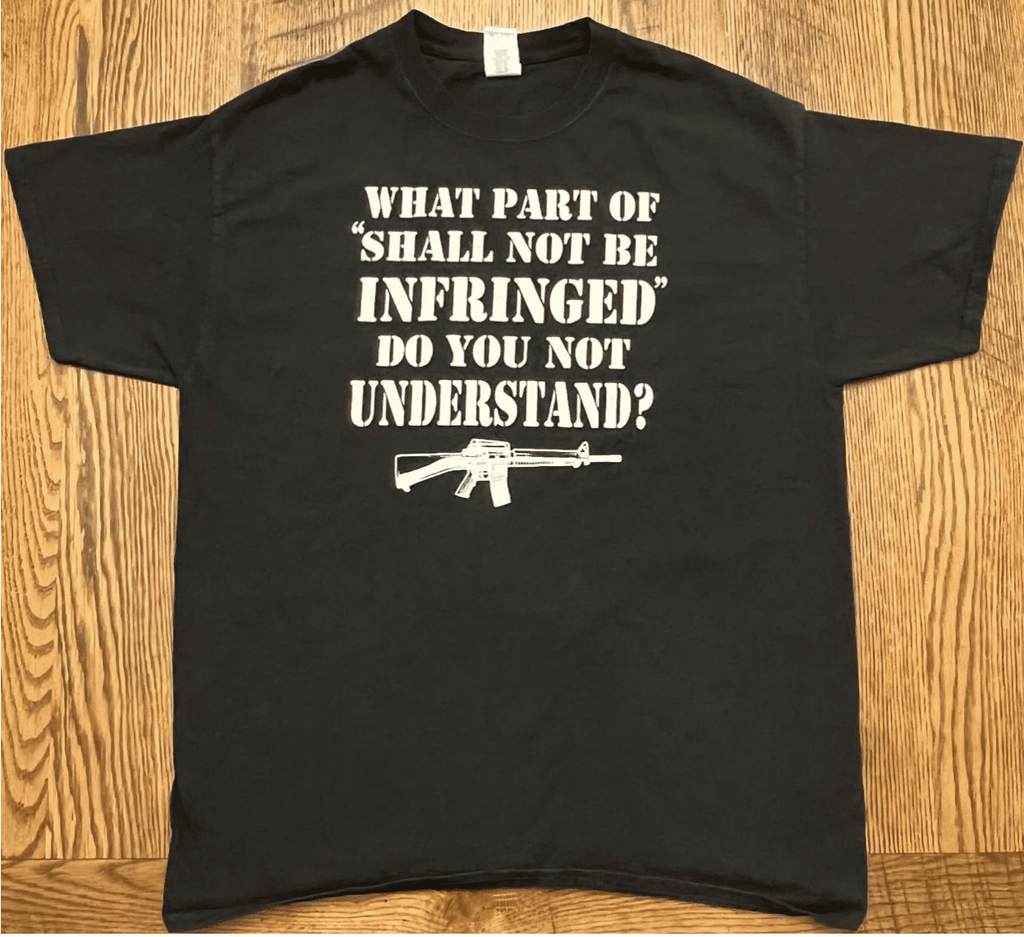
A.B. knew that Griffin was wrong about the scope of the First Amendment, so the next time she had Griffin’s government class, September 1, 2022, she wore a shirt to school that said “What part of ‘shall not be infringed’ do you not understand?” with a depiction of a rifle underneath it.

A.B. had worn the shirt to school before, with no complaints from students, teachers, or administrators. And A.B.’s brother, who graduated from Johnston High School in 2019, had worn the same shirt to school multiple times with no complaints.

Griffin, who teaches the Bill of Rights, knew that shirt was quoting the Second Amendment of the U.S. Constitution, and he knew it was a commentary on gun control efforts. Nevertheless, he claimed that the shirt violated the school’s dress code and he removed A.B. from the classroom, sending her to the school administration office.

A.B. told Griffin she had a right to wear the shirt, which was not causing any disruption in the class—other than any disruption Griffin himself created by removing A.B. from the classroom. But Griffin said she was wrong about the First Amendment and that the administration would back him up.

As you can see, there are no depictions of violence on the shirt worn by A.B., but the school administration did indeed originally stand by Griffin’s actions, suspending her after she refused to change her shirt in order to return to class.

The lawsuit alleges that later that evening, however, A.B.’s mom Janet Bristow received a call from the school district’s superintendent to apologize for their actions, as well as a similar mea culpa from Chris Billings, the Executive Director of School Leadership.

Continue reading “”

“The Framers Weren’t Perfect, but They Weren’t Fools”: Biden Administration Loses Another Gun Rights Case

We recently discussed the ruling of the United States Court of Appeals for the Fifth Circuit striking down a ban on gun ownership by individuals accused of domestic abuse. Now, U.S. District Judge Patrick Wyrick in Oklahoma City dismissed an indictment against Jared Michael Harrison for violating a federal law that makes it illegal for “unlawful users or addicts of controlled substances” to possess firearms. It is only the latest such loss for the Justice Department as the Biden Administration pushes sweeping rationales for limiting Second Amendment rights in the wake of last year’s ruling in New York State Rifle & Pistol Association v. Bruen.

Harrison was arrested by police in Lawton, Oklahoma, in May 2022 after a traffic stop where police found a loaded revolver as well as marijuana.

Under 18 U.S.C. § 922(g)(3), Congress prohibited the possession of firearms by users of substances made unlawful by the federal Controlled Substances Act. The court noted that this provision “is rarely used by prosecutors, as it accounts for only about 5% of prosecutions brought under § 922.”

The Justice Department argued that such a ban was “consistent with a longstanding historical tradition in America of disarming presumptively risky persons, namely, felons, the mentally ill, and the intoxicated.” It is similar to the broad rationale used unsuccessfully before the Fifth Circuit. Indeed, the Justice Department again tried to argue that such bans are allowed because Bruen’s described the plaintiffs in that case as “ordinary, law-abiding, and adult citizens.” It is clearly an argument that the Biden Administration wants to push in cases across the country despite the rather poor reception from the courts. I agree with these judges that the reference is being radically overblown by the Justice Department. Indeed, it cuts against the department’s credibility in arguing for Second Amendment limits.

This latest loss shows the Biden Administration pushing a post-Bruen claim that could find itself back before a skeptical Court majority. Notably, as discussed in the earlier post, a similar issue was addressed by Justice Amy Coney Barrett when she was sitting as an appellate judge. This court also relies on Barrett’s dissent in Kanter v. Barr, 919 F.3d 437, 451–53 (7th Cir. 2019) (Barrett, J., dissenting).

In September, U.S. District Judge David Counts in Midland, Texas also struck down a firearms law that banned individuals under felony indictment from buying guns.

The opinion by Judge Wyrick is very interesting in its comprehensive exploration of historical sources. It also dismantles the Justice Department’s suggestions that marijuana users are both law breakers and threats to society:

“under the United States’ own conception of the historical tradition, such restrictions would only apply to those who are both unvirtuous and dangerous. And as explained above, because the mere use of marijuana does not involve violent, forceful, or threatening conduct, a user of marijuana does not automatically fall within that group.”

I particularly liked this observation from the court about reading discretion into the amendment to bar those deemed untrustworthy by the government:

[I]t would be odd indeed for the Framers to have incorporated such a trojan horse into the Second Amendment. The purpose of enshrining a right into the Constitution is to limit the discretion of a legislature. But if the United States’ theory is correct and all a legislature must do to prohibit a group of persons from possessing arms is to declare that group “untrustworthy,” then the Second Amendment would provide virtually no limit on Congress’s discretion. The Framers weren’t perfect, but they also weren’t fools.

Here is the opinion: United States v. Harrison

An in depth look at the 5th Circuit’s ruling today. Also this was not an en banc ruling, so expect it to go there next.

Fifth Circuit Holds People Can’t Be Disarmed Just Based on Civil Restraining Order

Judge James Ho concurs, adding “I write separately to point out that our Founders firmly believed in the fundamental role of government in protecting citizens against violence, as well as the individual right to keep and bear arms—and that these two principles are not inconsistent but entirely compatible with one another.”From U.S. v. Rahimi, decided today by the Fifth Circuit, in an opinion by Judge Cory Wilson, joined by Judges Edith Jones and James Ho:
 

The question presented in this case is not whether prohibiting the possession of firearms by someone subject to a domestic violence restraining order is a laudable policy goal. The question is whether 18 U.S.C. § 922(g)(8), a specific statute that does so, is constitutional under the Second Amendment of the United States Constitution. In the light of N.Y. State Rifle & Pistol Ass’n, Inc. v. Bruen (2022), it is not.

The court rejected the view that, under Heller and Bruen, legislatures can disarm anyone who isn’t a “law-abiding, responsible citizen[]”:

There is some debate on this issue. Compare Kanter v. Barr (7th Cir. 2019) (Barrett, J. dissenting), abrogated by Bruen, 142 S. Ct. 2111, with Binderup v. Att’y Gen. (3d Cir. 2016) (en banc) (Hardiman, J., concurring in part and concurring in the judgments). As summarized by now-Justice Barrett, “one [approach] uses history and tradition to identify the scope of the right, and the other uses that same body of evidence to identify the scope of the legislature’s power to take it away.” The Government’s argument that Rahimi falls outside the community covered by the Second Amendment rests on the first approach. But it runs headlong into Heller and Bruen, which we read to espouse the second one.

Unpacking the issue, the Government’s argument fails because (1) it is inconsistent with Heller, Bruen, and the text of the Second Amendment, (2) it inexplicably treats Second Amendment rights differently than other individually held rights, and (3) it has no limiting principles….

Continue reading “”