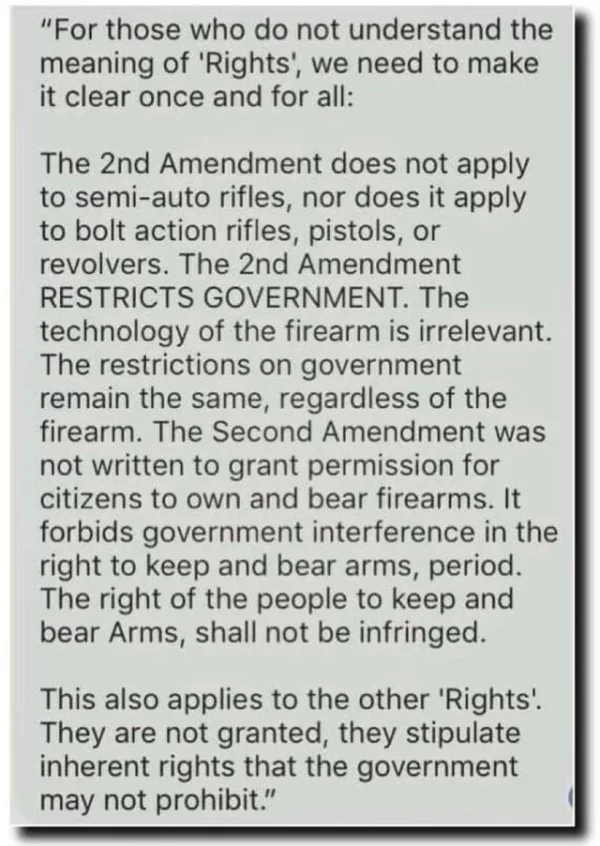

Yes. It took 14 years, Justice Kennedy dying and Justices Gorsuch, Kavanaugh and Barrett being seated to get the job nearly done.
Report: Far More Gun Laws Struck Down in Wake of Bruen Than Heller
The Supreme Court’s latest Second Amendment ruling has delivered more immediate effects than its previous landmark decision.
A revised analysis from Jake Charles, an associate professor at Pepperdine University’s Caruso School of Law, shows dozens of gun-rights claims have already succeeded in federal court since New York State Rifle and Pistol Association v. Bruen was decided in June 2022. The new count, posted on Tuesday, puts post-Breun decisions far ahead of the pace of 2008’s District of Columbia v. Heller, which saw gun-rights advocates achieve relatively little in its immediate aftermath.
“There wasn’t a single successful Second Amendment challenge in the 6 months after Heller,” Charles said in a social media post. “In my research, I found *31* successful claims in the 8 months since Bruen.”
The disparity demonstrates that lower courts may be taking a different message from Bruen than Heller. While Heller established the Second Amendment protects an individual right to keep and bear arms, it didn’t produce an explicit test for deciding future Second Amendment cases and struck down a total handgun ban that was already an outlier. Bruen struck down a concealed-carry permitting regime that was still used by eight states before the case, set down a specific test for deciding gun cases, and chastised lower courts for the test they had been using to decide cases after Heller.
One complicating factor in comparing the results of either ruling is that Heller wasn’t incorporated and applied to the states until 2010’s McDonald v. Chicago. Still, comparing the Charles count to one in a 2018 paper by Duke Law Professor Joseph Blocher and Southern Methodist University associate professor Eric Ruben, it took until 2012 for gun-rights advocates to top 30 wins after Heller. The success rate for Second Amendment claims has also been significantly higher post-Bruen than it was in the first several years after Heller, with Charles finding 14.6 percent of post-Bruen claims succeeding while Blocher and Ruben found fewer than ten percent succeeded in the four years after Heller.
There has been a significant difference in success rates for civil claims compared to criminal claims, which won far less often. Charles also broke out challenges by topic and saw a stark difference in how lower courts have handled different issues. Claims involving carry licensing or defaulting private property to be off limits for gun carry have won every time thus far. Claims over age restrictions, “ghost gun” regulations, and sensitive place bans have succeeded about half the time. In contrast, challenges to commercial regulations, the National Firearms Act, unlawful gun use, sentence enhancements, and bail conditions have failed every time.
Charles, who ran the Duke University Center for Firearms Law before joining Pepperdine, has been critical of the Court’s decision in Bruen. Most of his newly-published analysis focuses on claims the standard it adopted is unworkable and asserts “the Supreme Court may desire to sit as a super-legislature over nationwide gun policy” while imploring ” lower courts, legislators, and citizens” to resist that possibility. He critiques the use of a history-based standard for deciding cases about current firearms regulations and notes areas where lower courts have been at odds on how to implement it in practice.
He cites the increase in victories for plaintiffs making Second Amendment claims as evidence the Bruen standard is degrading gun restrictions across the country.
“The Court’s historical test has the potential to significantly expand the Second Amendment’s scope,” Charles wrote in the analysis. “No matter how compelling the state’s interest, no matter how narrowly tailored its regulation, Bruen’s new method appears to dictate that a modern gun law cannot stand without adequate grounding in the distant past.”
Naturally, gun-rights activists took an opposing viewpoint. The Truth About Guns, a pro-gun publication, echoed language from the Bruen majority to explain the difference in how lower courts have reacted to each ruling.
“It’s no longer a second-class right,” the publication tweeted.
Kostas Moros, a lawyer for the California Rifle and Pistol Association, said the deluge of pro-gun decisions was akin to the release of pent-up demand. He argued Bruen itself was the result of how little effect Heller had on the way lower courts viewed the Second Amendment.
“We are just making up for lost time,” he posted. “If courts had applied Heller in good faith and we had a sort of ‘win some, lose some’ scenario, Bruen probably never would have happened (or would have been limited to just being about carry).”