Gun rights are women’s rights

In 1991, Suzanna Gratia Hupp was having lunch in a crowded cafeteria and had to watch as a gunman executed victims one by one, including her own parents. She reached for her purse to grab her revolver, only to realize it was sitting outside in her car — she’d left it behind to obey Texas gun laws. In her testimony, she later wrote, “The only thing the gun laws did that day was prevent good people from protecting themselves.” If Hupp had been armed, she might have been able to stop George Hennard, who murdered twenty-three people.

In cases like Suzanna’s, it’s easy to see how a gun could be necessary to defend against an armed assailant. However, living in Claremont, California, we rarely think about needing a gun on college campuses. Locked dorms, campus security and tight-knit communities make us feel safe. But that safety won’t extend beyond graduation. Outside the shelter of a college campus, Hupp needed protection and didn’t have it. While anyone could have been in her position, her experience highlights the necessity of access to and training with a firearm. When Hennard opened fire, a defensive gun could have drastically changed the situation. Without one, Suzanna could do nothing but try to escape.

While anyone may need a gun to protect themselves after undergraduate life, women are especially in need of such protection because of our physical weakness when compared to men. Men are, on average, physically stronger than women. Biological differences in muscle mass, bone density and testosterone levels consistently result in greater strength among men. Research shows that even untrained men are stronger than athletically trained women. As a wrestler and judoka, I’ve had a lot of experience with these differences. While I’ve had wrestling wins against boys, almost every male in my same weight class has been stronger than me.

Competing against men in wrestling and judo is difficult, but the stakes are much higher in the real world, where there aren’t any rules to the game.

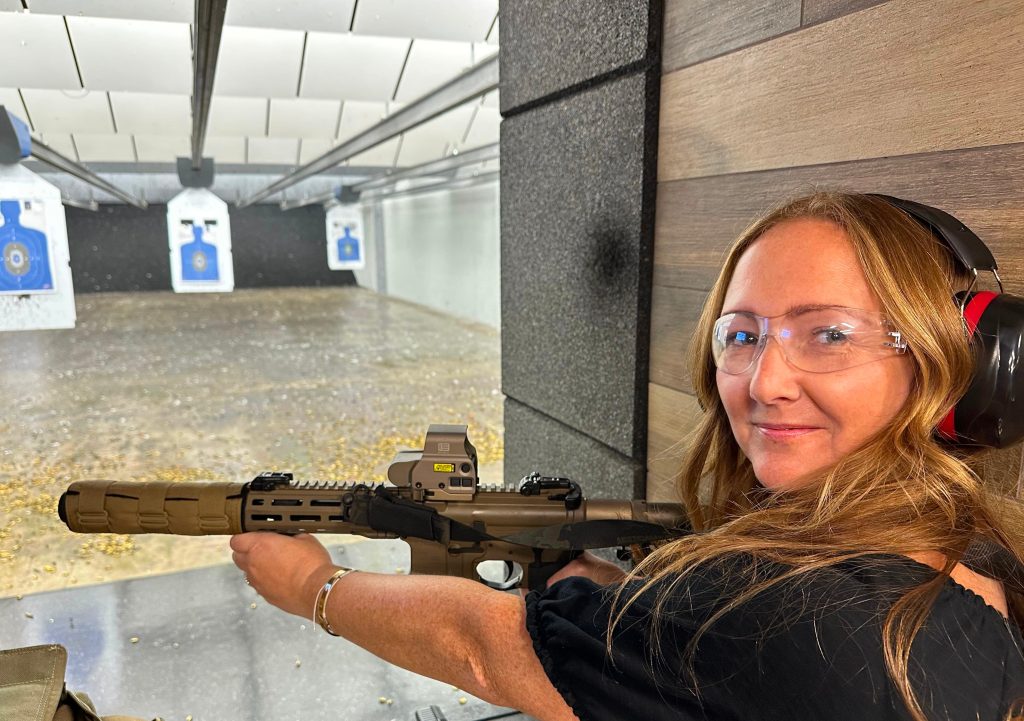
Gun rights are women’s rights because they provide a means for women to defend themselves in a world of physical inequality. I might be able to throw a man in judo while under strict guidelines, but out on the street, there’s no gi to grip, and he may have a punch that I can’t defend against.

Women need access to guns to even the playing field when faced with physically stronger assailants. Consider the 57-year-old woman living in Cape Girardeau, Missouri, who was raped by Ronnie Preyer in October 2008. When this registered sex offender came back five days later to assault her a second time, she used a 12-gauge shotgun to kill him in self-defense. Take Melinda Herman, a Georgian wife and mother who protected her nine-year-old twins while her husband was at work, when Paul Slater, a thirty-two-year-old with an extensive criminal history, broke into her house with a crowbar. She shot him, saving her life and the lives of her children. Similarly, in Richmond, California, eighty-four-year-old Gustava Harvey fired a .38 caliber revolver when an intruder kicked down her door; the gunfire alone caused him to flee.

A gun neutralizes physical strength differences — what matters is not size, but the ability to act. There are numerous accounts of women of all ages protecting themselves, their children and their homes through the use of guns. Without a gun, these stories could have ended very differently. Without a weapon, women are forced to rely on physical strength they do not have; with a gun, they gain the immediate and equal capacity to defend themselves.

Many advocates for gun control believe that more guns inherently increase crime, suggesting that increasing gun ownership among women would be associated with more overall crime. However, there is little evidence to suggest that this would be the case. Women are significantly less likely than men to commit violent crimes overall. Men commit roughly 75-80 percent of violent crime and about 88-90 percent of homicides.

Furthermore, the “guns cause crime” view ignores evidence that firearms are also used defensively, often preventing crimes before they escalate. The Centers for Disease Control and Prevention reported that defensive use of guns is at least as common as offensive use by criminals, and an estimated 500,000 to more than 3 million defensive gun uses occur annually. Defensive gun use, whether through firing or simply brandishing, can deter attackers and stop violence in real time — exactly the way women are most likely to use guns.

Gun control advocates also often argue that if no one had guns, violence during crime would decrease and women would be safer. However, this ignores the reality that certain types of violent crime can worsen in countries with strict gun control. Burglars in the United States are far less likely to target occupied homes than burglars in the United Kingdom.

Research suggests that this is largely due to fear of encountering an armed resident. In the United States, only 13 percent of burglaries occur when people are home, while in England and Wales, this number is 59 percent. Removing guns does not remove violence, and even in countries where guns are strictly regulated, women remain disproportionately victims of physical and sexual violence. Removing guns eliminates one of the few tools women have to effectively resist violence.

Ultimately, guns provide women with a practical and immediate means of self-defense against physically stronger male attackers. The defensive use of firearms can deter crime, interrupt attacks and reduce the likelihood of victimization. Women are statistically less likely to commit violence and are well-positioned to use firearms responsibly for protection.

With 52 percent of women in the United States being single and 56.8 percent of women working in the labor force, women are exercising their independence in an age of increased equality. Thus, being able to protect oneself through self-defense is a condition for equality. As many women at the 7Cs prepare for their careers in the outside world, they must consider how to protect their homes and livelihoods from threats. As Andrea Dworkin wrote, “women have the right to fight back.” I am a woman, and I neither want to be victimized by men or subordinate myself to men for protection. Feminism must include the right to self-defense, and that means supporting women’s access to firearms.

Grace Rutherford PO ’28 believes in the right to protect herself from imminent danger.

Hysteria Reigns Following Hegseth’s Announcement

When I was in the Navy, I lived on base but, like most service members, my social life was off base. At Portsmouth Naval Hospital, at least when I was stationed there, going out the main gate led to a plethora of options. Straight ahead took you toward the bulk of the city. Turning left took you to an old part of the town with historic buildings and one really great pub, among other things. Hang a right, though, and you’d best have your next of kin on standby.

I didn’t have a gun back then, and I kind of wish I did, but with living on base, it wasn’t really much of an option. There were ways to own one, but to carry it anywhere? Forget it.

Later, I worked at Marine Corps Logistics Base Albany as a contractor. I had to drive through some sketchy areas, but carrying a gun to and from work wasn’t an option. I just had to pray that I wouldn’t be one of those unfortunate souls whose luck ran out. Thankfully, I wasn’t, but it was dumb that I had no other options.

Now, things have changed following Secretary of War Pete Hegseth’s announcement on Thursday that bases were no longer gun-free zones.

Unsurprisingly, though, some people are having absolute hysterics about it.

“Troops can now request to carry their own personal firearms on base for personal protection, without having to explain why they need to protect themselves on base,” wrote Reuters chief national security correspondent Phil Stewart.

“If someone is not safe on a military base with armed guards, fences, walls, a personal police force, everyone who comes on base has their id checked, needs a sponsor if non military then we are truly screwed as a country,” wrote California congressional candidate Eric Garcia.

“Hegseth is telling us here that God gave us our legal rights as Americans including gun rights,” wrote USC Center on Communication Leadership and Policy senior fellow Barbara Starr. “He might be interested in some of the military concerns about the relationship between having personal weapons on base and suicide rates.”

“Obsessed with every culture war issue while an actual war is stalled out overseas and his boss just gave a complete belly-flop of a speech on it,” wrote The Atlantic staff writer and former Naval War College professor Tom Nichols.

I swear, it seems Nichols gets more insufferable as the days go by.

Continue reading “”

‘Gun Free’ Zones Herd Citizens Into Physical and Legal Danger.

Never mind the homelessnessdrug use, and routine violence … according to Empire State politicians, New York City’s transit system is a “sensitive place.” As such, law-abiding gun owners are not allowed to carry a firearm for self-defense on trains or buses or in subway or train stations – lest they impose some semblance of order on the anarchic scene.

In New York State Rifle & Pistol Association v. Bruen, the U.S. Supreme Court struck down New York’s discretionary carry licensing regime and made clear that the Second Amendment protects the right to carry outside the home for self-defense. In their opinion, the Court acknowledged that carry may be barred at some “sensitive places,” citing “schools and government buildings,” specifically, “legislative assemblies, polling places, and courthouses.”

Of course, whether banning firearms in these locations is sound policy is another matter. It’s NRA-ILA’s position that government can demonstrate a location is in fact a “sensitive place” by providing weapons screening at all ingress points and armed security to protect those inside.

Needless to say, none of the Court’s enumerated “places” was akin to public transit. And only a delinquent government, like New York’s, allows a city’s subway system to deteriorate into a place for vagrants to domicile and soil with human excrement, while citizens just trying to reach their destinations fear for their health and safety.

Despite the Court’s command, in the wake of the Bruen case an intransigent New York set about prohibiting firearms in all manner of what the state dubiously defined as “sensitive locations.”

Continue reading “”

Cleared in Self-Defense, Charged for Carrying: Michigan Case Shows Why ‘Sensitive Places’ Fail

A licensed concealed carry holder in Michigan is now facing punishment not because prosecutors say he committed a crime in his defensive gun use, but because the state says he was armed in the wrong place when he needed that gun the most. That is exactly why so-called “sensitive places” laws remain one of the most dangerous and constitutionally suspect fronts in the post-Bruen Second Amendment fight.

According to Fox 2 Detroit’s reporting, Genesee County prosecutors determined that 23-year-old Christopher Gill acted in lawful self-defense after being attacked inside a restroom at Ballenger Fieldhouse on the campus of Mott Community College during a day of basketball games. Prosecutors say Gill was confronted by a group, restrained, and punched several times. During the assault, Gill managed to reach into his hoodie pocket, where he had a handgun, and fired one shot through the hoodie, striking Malik Zamir Henderson. Prosecutor David Leyton ruled the shooting was lawful self-defense.

Henderson was charged with gang membership, assault with intent to rob while unarmed, and assault with intent to do great bodily harm less than murder. Gill, by contrast, was not charged over the shooting itself. Instead, he was charged with carrying a concealed handgun in a sports arena, a Michigan law lists a “sports arena or stadium” among the places where a concealed pistol license holder may not carry concealed. For a first offense, Michigan law provides for a civil infraction, a fine of up to $500, and a six-month license suspension; state guidance also says the pistol is subject to immediate seizure if carried concealed in a prohibited area.

That split outcome should get the attention of every gun owner in America. The government’s position here is effectively this: yes, you were lawfully defending yourself against a violent assault, but you still should not have been armed when the attack happened because the legislature had already declared that location a “sensitive place.” That insane theory collapses the moment it meets real life. The danger to Gill did not disappear because he was inside an athletic facility. The criminal assault did not stop because the law supposedly made the venue special.

Continue reading “”

When a ‘Common Sense’ Gun Control Measure Depends on the Fantasy of Competent Government.

In a stunning admission, a Los Angeles County Superior Court has revealed that it failed to report hundreds of thousands of criminal case outcomes to the California Department of Justice—including roughly 147,000 felony convictions.

Let that sink in.

For four decades, criminal records simply weren’t entered into the background check system.

  • No alerts
  • No safeguards
  • No accountability

Just a broken government system quietly failing while politicians demanded…more gun control.

A System That Only Works If Everything Goes Right

Here’s the part they don’t want to talk about…the entire background check system depends on perfect data entry, flawless coordination, and bureaucratic competence at every level of government. And as this case proves—that’s a fantasy.

Because when records aren’t reported:

  • Felons slip through the cracks
  • Background checks return incomplete or inaccurate results
  • And the system politicians claim “keeps us safe” simply doesn’t work

Even federal officials admit the system only functions if it receives “complete, accurate, and timely information” from thousands of agencies nationwide. Clearly, that’s not happening.

The History They Don’t Want You to Know

The federal background check system—known as NICS—was created by the Brady Act in 1993 and went live in 1998.

Since then:

  • Hundreds of millions of background checks have been run.
  • Millions of Americans have been delayed or denied.
  • Tthe system still relies on error-prone government databases.

In fact:

  • Only about 1% of transactions are denied.
  • Many denials are later overturned on appeal.
  • Tens of thousands of justified denials occur each year, but only a tiny fraction are ever prosecuted.

So let’s be clear…this system overwhelmingly burdens law-abiding citizens while failing to consistently stop criminals.

The Real Purpose: A Backdoor Gun Registry

Continue reading “”

Arizona Moves Forward With K-12 Firearm Safety Education Bill

Arizona Senate Bill 1424 has passed the Senate and has passed the House Education Committee and the House Rules Committee. The bill requires school districts and charter schools to provide age-appropriate firearm safety awareness training in all grades, kindergarten through 12th grade.

The instruction is to be objective and not promote firearms ownership or any political position. The instruction is to be limited to accident prevention and personal safety awareness. It is to include guidance on safe firearms storage in homes and vehicles. The instruction is to provide guidance on what to do if a firearm is encountered, including not touching it and notifying an adult.

Inside the bill, there is a long list of restrictions on six things that may not be included in the instruction:

 3. NOT INCLUDE ANY OF THE FOLLOWING:

(a) A LIVE FIREARM.

(b) AMMUNITION OR SIMULATED AMMUNITION.

(c) A DEMONSTRATION THAT INVOLVES HANDLING, OPERATING, LOADING, UNLOADING OR FIRING A FIREARM.

(d) INSTRUCTION THAT IS INTENDED TO TRAIN STUDENTS IN THE USE OF FIREARMS.

(e) A MORAL JUDGMENT REGARDING LAWFUL FIREARM POSSESSION.

(f) AN INQUIRY, SURVEY OR REQUEST FOR INFORMATION ABOUT WHETHER A STUDENT, STUDENT’S PARENT OR MEMBER OF THE STUDENT’S HOUSEHOLD OWNS, POSSESSES OR MAY POSSESS A FIREARM OR ABOUT THE FIREARMS STORAGE PRACTICES OF A STUDENT, STUDENT’S PARENT OR MEMBER OF THE STUDENT’S HOUSEHOLD.

The Arizona Citizens Defense League (AZCDL) supports the legislation.

An advocate for gun storage legislation made the argument that the legislature should pass a bill requiring safe storage of guns instead.  The SB 1424 is considered a partisan bill, supported mostly by Republicans, according to Legiscan.

Fatal firearms accidents have declined greatly since the 1930’s high mark. The number of firearms per person has increased about 3X during that period.

Firearms are among the many hazards children encounter as they grow up. Education, not prohibition, is the surest answer to their safety.

The bill has passed the Arizona legislature, which is narrowly controlled by Republicans. Republicans have a 17-13 advantage in the Senate and a 33-27 advantage in the House. SB 1424 might avoid a veto from Governor Hobbs (D), but it seems unlikely. Governor Katie Hobbs has earned a reputation for the number of vetoes she has given. Governor Hobbs is facing serious re-election challenges. She might sign SB 1424 to claim she is not against rights protected by the Second Amendment.

SB 1424 severely restricts what may be taught to students. This may be necessary to secure passage in a legislature with a very small Republican majority.

The bill is a step toward greater understanding of firearms safety. It makes students more aware of firearms. It has the advantage of not being overtly against the ownership or use of firearms. As “age-appropriate” instruction on firearms safety, later grade levels might include information about the legal status of firearms in Arizona. It is difficult for people to obey the law if they do not know what the law is. Firearms are among the many potentially hazardous items children encounter as they grow up.

It is far better to gun-proof the child than to attempt to create a gun-free environment.

What Are Automated License Plate Readers and Why Are People Worried? ALPRs are AI-powered cameras that automatically track specific cars, and there’s growing backlash against them.

  • Automated License Plate Readers, known as LPRs, are a growing technology used in thousands of communities around the country, though backlash against them is growing.
  • ALPRs are AI-powered cameras used to automatically track specific cars using identifiers like plate numbers, bumper stickers, roof racks, and more.
  • Flock Safety, which is perhaps the most prominent player in the space, has been under considerable pressure over data-sharing concerns.

If you’ve noticed a growing number of little black traffic cameras in your area and wondered what the deal was, we’re here to explain what they are and why they’ve become so contentious. The cameras themselves are known as Automated License Plate Readers, or ALPRs. While there are several ALPR vendors, the most prominent by far is Flock Safety, which sells to more than 5000 law enforcement agencies and more than 1000 private companies, such as HOAs.

License plate readers themselves are nothing new; law enforcement agencies have used them for years, but the more recent emergence of AI-powered cameras is an escalation. That’s because, along with reading license plate numbers, Flock’s cameras record identifiers such as the make, model, and color of every car they see. The cameras can also use things such as a roof rack, bumper stickers, or prominent dents to identify unique vehicles.

While that incredible surveillance power may be enticing to some (namely, law enforcement agencies), pushback from communities concerned about a growing surveillance state is equally passionate. Flock Safety reports that its cameras are used in thousands of towns and cities, but in recent months, there has been significant pushback from communities concerned over privacy infringements and how the ALPRs are being used in connection with Immigration and Customs Enforcement (ICE) arrests.

An NPR story from February detailed how easy it can be for data collected by Flock to be widely shared. Flock maintains that cities control their sharing settings. “Each Flock customer has sole authority over if, when, and with whom information is shared,” the company told NPR. But that doesn’t seem to be the case in reality, with leaders from several cities citing data sharing as a reason for reducing or ending partnerships with Flock.

According to a recent article in the Financial Times, 53 cities in 20 states have either deactivated Flock cameras or rejected bids to use them. The pushback from local authorities is rising, with 38 of those rejections occurring in the past six months.

Despite the pushback from communities, law enforcement agencies have defended Flock. According to the FT, one police department in Texas searched for data from more than 103,000 devices in Flock’s network as part of a homicide investigation. “We’ve been able to solve hundreds, if not thousands, of crimes that otherwise would remain unsolved if it wasn’t for the LPR technology,” a former police chief in Georgia told the outlet.

The FT article points out that privacy activists contest that claim, arguing that there is no independent research proving ALPRs can reduce crime.

BLUF
Honest discussion requires acknowledging the data on who commits these attacks rather than filtering it through political narratives about which threats are acceptable to discuss.
If policymakers and the public want effective prevention, they must start with a clear-eyed assessment of the risks rather than with wishful thinking.

The Terror Threat Americans Aren’t Supposed To Discuss

John R. Lott Jr. is president of the Crime Prevention Research Center

Many commentators claim that Islam does not pose a threat of violence in the United States. Influencers such as Tucker Carlson often repeat this argument. Others, including then-President Joe Biden and FBI Director Christopher Wray, have argued that white supremacists represent the primary domestic threat.

Yet March alone saw multiple terrorist attacks carried out by Muslims. In Austin, a terrorist wore a sweatshirt reading “Property of Allah” during an attack. In New York City, bomb throwers shouted “Allahu Akbar” while throwing a homemade shrapnel bomb. At Old Dominion University, a shooter also yelled “Allahu Akbar” and had previously been convicted of supporting ISIS. Another attacker, whose brother was a Hezbollah terrorist commander, targeted Temple Israel in Michigan, and yet another attack, involving three men of Iraqi origin, targeted the U.S. embassy in Norway. The Austin, Old Dominion, and New York City bombers and the Michigan synagogue attackers were also all foreign-born individuals who were naturalized U.S. citizens.

Terrorist attacks take many forms. For example, the January 2025 truck attack in New Orleans, with an ISIS flag on the truck, left 14 people dead and 47 injured. But let’s focus the discussion on one type of attack that has been extensively studied: mass public shootings. Researchers define a mass public shooting as an attack in which a perpetrator kills four or more people at one time in a public place, excluding crimes such as gang fights or robberies.

Looking at all mass public shootings from 1998 through 2025 reveals several patterns. Muslims commit these crimes at a disproportionate rate. White males commit them at a rate below their share of the population. And most shooters express no clear political ideology.

Continue reading “”

FBI Warns California That Retaliation From Iran May Be on the Way.

Iran has already retaliated with drone strikes across parts of the Middle East. Apparently, the plan for California was already in place, even before the U.S. and Israel launched their initial strikes against Iran on February 28.

Neither the FBI nor the White House has issued a comment on the matter.

ABC claims to have read the alert sent out. It says in part:

We recently acquired information that as of early February 2026, Iran allegedly aspired to conduct a surprise attack using unmanned aerial vehicles from an unidentified vessel off the coast of the United State Homeland, specifically against unspecified targets in California, in the event that the U.S. conducted strikes against Iran. We have no additional information on the timing, method, target, or perpetrators of this alleged attack.

The New York Post describes it as an “army of drones” that could be launched from a vessel off the West Coast of the United States. The post also suggests that California is home to about half a million Iranian dissidents, the largest number of any state in the U.S., but it’s not clear if that’s why it was targeted specifically.

On Wednesday, a reporter asked President Donald Trump if he was concerned about Iranian attacks on American soil. He said, “No, I am not.”

The Office of Intelligence and Analysis at the Department of Homeland Security has said Iran and its proxies could pose a threat through targeted attacks on the US, but a large-scale attack was highly unlikely.

ABC also points out that the Mexican cartels’ use of drones at the U.S.-Mexico border has become an increasing concern for the federal government in recent months.

John Cohen, the former head of intelligence for the Department of Homeland Security, told ABC that he’s concerned about drone attacks from both the West Coast and the border. “We know Iran has an extensive presence in Mexico and South America, they have relationships, they have the drones and now they have the incentive to conduct attacks,” he said. “The FBI is smart for putting this warning out so that state and locals can be better able to prepare and respond to these types of threats. Information like this is critically important for law enforcement.”

This is a developing story. 

Women in South Africa take up guns and martial arts for protection against gender violence

BRONKHORSTSPRUIT, South Africa (AP) — At the command of a female instructor, a line of girls and women, some wearing pink ear protectors, shoot five rounds at a target with 9 mm pistols as they undergo firearm training at a range in the agricultural town of Bronkhorstspruit just outside South Africa’s capital, Pretoria.

The group, some as young as 13 and others up to 65, are looking for ways to protect themselves in a country where gender-based violence is such a critical problem that it was declared a national disaster by the government in November.

“Check your grip, check your line of sight,” shouts Claire van der Westhuizen, the lead female instructor at Lone Operator shooting range, as women with well-manicured nails reload for another round.

The training course is specifically designed for women and offers practice in real-world scenarios like self-defense firing while lying on their stomachs and backs.

Femicide rates in South Africa are among the highest in the world, according to U.N. Women, the United Nations agency for gender equality. A South African study in 2022 found more than 35% of South African women aged 18 and older had experienced physical or sexual violence at some point. In most cases, the perpetrator was an intimate partner.

Joining ‘a family of support’

Sunette du Toit, a working 51-year-old grandmother, was pushed to take up firearm training after surviving a home invasion by five men who tied her up and ransacked her house, she told The Associated Press.

“I was not in a position to defend myself at that point,” du Toit said. “I had to do this (firearm training) for myself to gain my confidence back to be able to move in public, and even in my own house, without feeling vulnerable.”

She called the women’s firearm training group “a family of support.”

Firearms in South Africa are heavily regulated. Anyone who wants to own a gun for self-defense must be over 21 and pass proficiency tests and background checks.

Various self-defense trainings for women are popping up throughout the country.

“Could Be”? I don’t know what you’d call what happened in Austin anything else.


Be Armed and Ready – the Asymmetrical Battlefield Could Be Here at Home

Asymmetrical warfare means applying the strengths you have against an overwhelming enemy’s weaknesses. The goat sex pest mullahs have been utterly humiliated by America’s and Israel’s overwhelming military superiority in conventional forces, with our airplanes, drones, and other systems traversing their airspace at will after we established total air supremacy. Our ships sail the seas, unthreatened and unchallenged, while most of the Iranian Navy morphs into submarines. But that doesn’t mean that they don’t have the capacity to strike back, and that doesn’t mean that we don’t have potential weaknesses. Everybody has weaknesses. Ours is located in the United States itself, our homeland, where we’re at. It’s already happening on a small scale, with open immigration poster child Ngdiaga Diagne shooting up a bar in Texas for Allah. We’re vulnerable here, and you are potentially on the front line of this war.

Time to be ready. Time to be armed. Time to get some.

What’s our vulnerability? Civilians, normal Americans, who Iranian proxy terrorists could murder in heaps. Until Donald Trump came back, we had four years of wide-open borders where every Third World indigent with shoes and a dream was able to sashay into our country, unimpeded and often subsidized by President Eggplant and his Democrat administration.

We know the Iranians have agents in the United States – that’s open source, and everybody gets The FBI is on full alert, now that it protects American citizens again instead of oppressing them. This is not wolf-crying. The Iranian mullahs tried to murder Donald Trump and others and have caused lots of other mischief outside their borders. Now, the Iranian jihadis are not superstars, and they’re not super-geniuses. They are cunning and relatively competent at times in doing what they do, and what they do best is attack innocent civilians.

As we can see, when they come up against soldiers, they die a lot. Well, there are lots of innocent civilians here in the United States, and it is not unreasonable to assume that the Iranian Republican Guard Corps has infiltrated sleeper cells into the United States. Once activated, they have the potential to go on a murder spree unparalleled in American history, one that would make Saturday night in Chicago look like a picnic with the Muppets.

I wrote about this in my bestselling novel, published not long after October 7, because October 7 is the asymmetrical terrorist mass assault template, called The Attack. The Iranian thugs helped plan and approve the Hamas massacre of innocent Israelis (as well as some Americans), which is more of the reason that they’re getting nothing but what they deserve right now.

The idea behind an asymmetrical strike is simple. You send in minimally trained but maximally indoctrinated killers through the open border, and they wait. They wait in small groups, taking no action until activated. It’s not hard for them to get weapons into the United States, and part of the beauty is that you don’t need complex weapons.

The AK-47 family of assault rifles was designed so that Siberian peasants would have an effective weapon system they could operate, even if they came from a village still baffled by devices such as the wheel. You can buy ammunition in the United States, and magazines, and recently, it was not that hard to ship fully automatic weapons across the border. Until Trump closed it, there was no shortage of cocaine, heroin, and fentanyl. The cartels would eagerly assist, for a price paid out of the pallets of cash that Barack Obama and Ben Rhodes dropped on them.

The advantages of this are obvious. Under Biden, nobody was looking for them. We didn’t do any interior enforcement. Now we famously are, and we can only hope that getting Iranian-adjacent illegal aliens out of the country is one of ICE’s top priorities. Of course, neurotic wine women and femboy libs will have a conniption over us deporting these potential terrorists, but we need to do it, no matter how hard they blow their whistles.

Just remember that the killers don’t have to be Iranian. They can be from Chechnya, Egypt, Afghanistan, Turkistan, or some other random -stan. The Iranians aren’t picky about who they work with. Iranians are Shia and Hamas are Sunni, but that didn’t stop them from getting together to murder Christians and Jews. Anybody from the Middle East who’s over here illegally, and some who are here legally, absolutely have the potential of acting for Iran if activated.

We’ve already had jihad murders here, like the Pulse nightclub and San Bernardino shootings. We hear less about them lately because Muslim murderers have had the limelight stolen by trans deviants who’ve gone on killing sprees over their pronoun gripes, but that doesn’t mean they are gone, as totally as real Americans as you and me, Ndiaga Diagnes demonstrated.

The beauty of this scenario for our enemy is that it is a quintessential asymmetrical attack. It takes the weaknesses of the Iranians, like the inability to coordinate forces, lack of logistical and administrative support, the absence of command and control, and paucity of concurrent communications, and turns those into strengths. When those don’t exist, the cells are hard to locate. If you have small groups of fanatics, whose sole purpose is to go to a given location at a given time, and kill everybody they see until they themselves are killed, you don’t need any kind of support.

They are akin to drones – meat drones that their overlords can fire and forget. And since American forces tend to look at the enemy support systems to find weaknesses, which is one of our advantages because we do it so well, you end up neutralizing the American advantage. Americans want to beat the enemy long before there’s an actual gunfight. In this way, against an Iranian enemy, an asymmetrical attack would ensure lots of gunfights, giving Iranian proxies the ability to cause significant casualties where they wouldn’t have the ability to do that otherwise.

In The Attack, thousands of these little cells are activated and strike, murdering scores of Americans before the government is able to form a coordinated response. But, as in reality, in the book, we see what I suspect we would see if the Iranians attempt something like this in real life. What we would see is normal Americans fighting back.

You see, if the homeland becomes a battlefield, we all become soldiers. We have a great counterintelligence team, and the FBI is back to protecting the American people instead of the Democrat elite. Still, they, along with our great law enforcement first responders, can’t be everywhere all the time. We citizens, can. All of us could be face-to-face with the enemy, whether another Ndiaga Diagne at a bar or a bunch of like-minded psychos in a church, a school, a shopping mall, or at a militantly cis-gender hockey game; their goal would be to bring the war to us, and our obligation would be to fight it and win it. But how do normal citizens do that?

You buy guns and ammunition. You train with them. You carry them legally. You get into the mental mindset that bad things can happen, and you need to be ready. Except in the blue states, where they put up hurdles to stop you from defending yourself, your family, your community, and your Constitution. Gavin Hairstyle and his ilk would rather you die than upset the aforementioned neurotic wine women and femboy libs who fear guns and manhood.

This admonition that you must be a warrior too is not some hooah big talk. That’s reality. As everybody knows, except liars and fools, armed citizens have long been able to intervene to stop crimes with their lawfully carried weapons. What we’re talking about here is something even more sinister than some gender goblin with a grudge over his unwanted penis shooting up a preschool; it’s terrorists shooting up everything as part of a plan to commit mass murder as terrorist retaliation against the United States for taking out their pals in Tehran.

You’ve got to be ready. If you can legally carry a weapon on you, you should, and a long weapon in the truck provides you with critical combat options if this goes down. But you should also practice with your guns. And don’t forget the other component of this – medical training and gear to stop the bleeding should you find yourself in the middle of a terrorist attack.

You didn’t ask to be a hero, but you are an American citizen, and that makes you hero-capable. It is your duty as an American citizen to do your best to protect your fellow citizens. If you can fight, you’ve got to be ready within the guardrails of your abilities and the law.

Our great troops are fighting this battle overseas as we speak. There is a non-zero chance we will have to fight this battle in America. Some people will dismiss this warning as silly. Some people will dismiss this as paranoid. They will run when it happens. You need to decide in advance that you won’t.

If it doesn’t come to fruition, that’s more than fine with us. We don’t want a fight, but, dammit, if those b******s start a fight in our home, we need to be ready to finish it.

Suspicion Confirmed; A Lone Wolf Jihadi

Evidence-Free Hackery: Another Highly Respected ‘Expert’ On the Alleged Conflict of Guns and Public Safety

Crucial Concealment Covert IWB holster open carry Dan Z. for SNW

Oh look…a Robert Spitzer op-ed. Let’s take a look and see what kind of brilliant insights this very respected expert has for us. He is, after all, an academic that antigun courts take super-seriously. The article’s headline itself — What Happens When the Second Amendment Collides With Public Safety? — is based on a false premise. The reality is, the Second Amendment right to carry need not ever collide with “public safety.”

Especially in the context of the Pretti shooting, Spitzer seems to implicitly accept the argument made by some administration officials (and Trump himself) that the mere act of carrying at a protest means you are asking to be shot by police.

This fraught political moment has thus found the Trump administration in the uncomfortable position of taking criticism from both liberals who blame heavy-handed federal agent tactics and conservatives who bristle at the administration’s seeming abandonment of public gun carry rights.

On the one hand, civilian gun carry is indeed a right under the Second Amendment according to the Supreme Court’s 2022 decision in the Bruen case where the high court said that individuals have a “right to carry a handgun for self-defense outside the home.” The court proposed no exception for doing so in a public gathering.

Spitzer says carry is indeed a right “according to the Supreme Court.” Interesting. I thought it was because the plain text of the Second Amendment says we have a right to bear arms, which all relevant historical sources confirm is a reference to public carry.

If you ever wondered why an “expert” like Spitzer (and the other usual suspects) always takes the side of the government in gun rights litigation, you can start with the fact that they clearly don’t believe the Second Amendment protects an individual right at all.

On the other hand, the consequences of such action are clear. Public gun carrying, especially in the context of a public demonstration or similar gathering is, no matter the intentions of the carrier, a terrible idea.

I should have included the very next paragraph. He basically concedes carry is a right (because SCOTUS said so), but then says it’s a terrible idea to exercise that right.

Continue reading “”

What to do about Mexican Drug Cartels: Letters of Marque

By Lee Williams

SAF Investigative Journalism Project

Special to Liberty Park Press

The United States Congress still retains full authority to issue Letters of Marque, although none have been issued for more than a hundred years.

A Letter of Marque was actually a simple concept. They allowed private citizens in private warships to attack enemy vessels during wartime. These privateers could then take ownership of whatever plunder they seized—gold, weapons or the captured ships—after an admiralty court ruled in their favor and took a percentage of the profits.

Letters of Marque were used for hundreds of years across the globe, because they allowed a country to enlarge the size of their navy very quickly and cheaply.

The authority to issue Letters of Marque can still be found in Article 1, Section 8, Clause 11 of the United States Constitution: “The Congress shall have Power … to declare War, grant Letters of Marque and Reprisal, and make Rules concerning Captures on Land and Water.”

Congressman Tim Burchett, a Republican from Tennessee, and Senator Mike Lee, a Republican of Utah, who both have extremely solid Second-Amendment credentials, have drafted bills that would revitalize the Letters of Marque, in order to target Mexican drug cartels.

Congressman Burchett described the bill in a phone call Monday morning:

“It allows the president to contract out to privateers and go after the cartels,” he said. “These would be top-tier operators, SEALs, Special Forces, Marine Raiders and commando types. Some are still working as private operators. It allows private citizens to act against the cartels. In President Trump’s first term, when he got [Former Iranian Quds Force Commander Qasem] Soleimani, the Democrats just berated our military leaders because they didn’t ask for their permission. If the Democrats still want us to ask for their permission, we got some real problems. This is constitutionally provided and has been done before. We went after the Barbary pirates. It’s constitutionally provided and within the law. In this day and age, we need it. The constitution grants congress the power to grant these letters.”

Senator Lee’s bill is titled “S. 3567: Cartel Marque and Reprisal Authorization Act of 2025.”

It is described as: “A bill to authorize the President of the United States to issue letters of marque and reprisal with respect to acts of aggression against the United States by a member of a cartel, or a member of a cartel-linked organization, or any conspirator associated with a cartel, and for other purposes.”

It was introduced before the latest outbreak of cartel violence, which has targeted American tourists in Mexico.

It specifies that cartels “present an unusual and extraordinary threat to national security and foreign policy of the United States.”

Senator Lee’s bill would allow “privately armed and equipped persons” to use “all means reasonably necessary” to operate outside our borders and seize any individual and their property who the President has determined to be a member of a drug cartel, or a member of a cartel-linked organization, “who is responsible for an act of aggression against the United States.”

Congressman Burchett was asked if he has discussed his bill with President Trump.

“I have not yet, but I put it out there,” he said. “It is constitutionally sound. We live in dangerous times, and we’ve got American people who need it.”

Hope Isn’t a Plan: Is Your Church a Sitting Duck?

Denial isn’t just stupid—it has no survival value. Acting as though the wolves only hunt other sheep in other pastures?  That’s not faith, that’s wishful thinking. So why then do many Christian churches (along with synagogues) opt not to have safety teams?

Are they counting on God’s divine protection? God helps those who help themselves and standing unprepared for evil to come knocking has real-world consequences for real people.

I’ve been to a handful of churches that have top notch safety teams and like many, I’ve been to churches that not only had multiple unlocked and unmonitored entrances — some dark by the way — that had no safety team at all. Unfortunately, unprepared or ill-prepared is still the norm.  Yes, even at events and major religious holidays that bring crowds.

These unprotected churches are sitting ducks.  At one Christmas Eve service I attended, no one had radios or earpieces. No one, save a dad or three who looked like hard-charging alphas, were anywhere to be seen or found. And those men clearly were on dad duty, not part of a safety and security team.

The greeters? Sweet smiles, zero comms. At that service a few years ago, many in the congregation joined me and slipped in through a shadowy lower-level door from the back parking lot…unmanned, unlocked, and unmonitored. It was a perfect back door through which to stage a nightmare. Before, during and after the service?  The pastor stood exposed like a trophy buck in an open field.

I run with security-minded folks, including some who have done it professionally. When I talked about this one particular church they simply shook their heads in disbelief. “They’re one bad incident from going under,” one said.  Indeed.

When one, with sarcasm in his voice, raised the possibility of a super-professional, Secret Service level team, we all laughed. With open side doors and zero visible presence? That’s not discreet, that’s delusional. Unmonitored, dark entrances and an utter lack of thought about congregants’ safety? That kind of negligence is wishful thinking and can turn peace on earth into last rites.

Why do so many religious institutions still play ostrich? Because facing evil means admitting it exists. As for admitting that guns might be necessary to protect people, that’s clearly too icky for the pearl-clutchers in the congregation who think psalms and lordly vibes are body armor enough. As if lunatics and criminals give a damn about holy water and hymnals.

The only thing that stops bad guys with evil in their hearts is a good guy or gal with a gun.

Continue reading “”

 We’ve Been Running a Huge, Real-World Experiment in the Expansion of Carrying Guns in America…Here Are the Results.

Continue reading “”

BLUF
Draconian restrictions on the right to armed self-defense in public don’t make peaceable and law-abiding citizens safer. They just render them far less capable of defending themselves and others.

Look at the Defensive Gun Uses that Hawaii Wants to Criminalize.

Late last month, the Supreme Court heard oral arguments in Wolford v. Lopez, a case challenging a newly imposed Hawaii law that presumptively bans concealed carry permit holders from any private property open to the public (like gas stations and shopping malls) unless they first get express permission from the owner. Combined with other restrictions, the law has the practical effect of making lawful public carry virtually impossible in Hawaii.

Fortunately, the nation’s highest court appears likely to strike down the new restriction. But there’s still so much work left for the court to do when it comes to protecting the right to keep and bear arms—including, specifically, against infringements by the Hawaiian government. Even without the express permission requirement hanging over their heads, Hawaiian concealed carry permit holders will still be prohibited from exercising their rights in an absurdly long list of “sensitive places.”

These include, among other locations:

  • Any bar or restaurant that serves alcohol, regardless of whether the permit holder imbibes;

  • Any “stadium, movie theater, or concert hall”;

  • Any place at which any sporting event of any level of competition is being held;

  • Any beach, playground, or park, including “any state park, state monument, county park, tennis court, golf course, swimming pool, or other recreation area or facility under control, maintenance, and management of the State or a county”;

  • Any parking area adjacent to the prohibited locations above.

Constitutionally, it’s abhorrent. As a matter of public policy, it’s laughable – and dangerous.

Continue reading “”