How Ukraine Snipers Are Picking off Russian Generals One by One

These are challenging – and suddenly quite deadly — days to be a general leading Russia’s unprovoked invasion of Ukraine.

Outnumbered, outmatched, and outgunned, after three full weeks of combat, Ukrainian forces have managed to stymie Russian advances across the country, which is about nine-tenths the size of Texas.

Even worse for Russian strategies and morale, nearly a dozen senior officers are believed to have been killed, including five generals, along with what intelligence estimates to be about 7,000 Russian dead.

In addition, unconfirmed reports say four more generals have been sacked back in Moscow over the poor showing of what is the world’s third-largest army, but has turned out so far to be the second-best in Ukraine.

Ukrainian forces even pulled off a nervy commando raid damaging an airbase inside Russia. And in next-door Belarus, a band of somebodies has been sabotaging the signal systems on rail lines transporting supplies to the Russian invaders.

This, the largest armed combat in Europe in 77 years, has created as many as an estimated four million refugees out of a 44 million population.

Presumably or hopefully, the Pentagon is up close studying Russian forces, strategies, the tactical preferences of certain senior officers, and the performance/weaknesses of equipment that NATO forces might someday themselves encounter.

But how has Ukraine managed so far to hold off such a superior foreign invading army and, importantly, kill so many senior officers?

A senior U.S. general, now retired, provided some professional insights Sunday. Gen. David Petraeus, former commanding officer of CentComm and allied forces in both Iraq and Afghanistanwarned not to go just by the size of military forces in this conflict:

Everybody wants to say, well, the Russians have, I don’t know, 200,000, and the Ukrainians have 100,000. It’s not so.

The Ukrainians have 100,000, plus every other adult, just about, in the country, all of whom are willing to take up arms or help in some way, even if it’s just jam radio signals or conduct vlogging.

They call Russians in Russia and say, do you know how poorly this is going for you?

Petraeus said the invasion has become “a stalemate, a bloody stalemate” and a war of attrition.

Continue reading “”

Appears the Ukes are TCOB. They may lose in the end, but they’re sure making Putin pay for it.


Did the true number of Russian troop deaths in Ukraine just leak?

I can’t understand how, or why, a pro-Kremlin paper would publish a number like this. As juicy as it is, surely they would have realized how embarrassing it is for their masters and what sort of consequences there might be for revealing it.

I can’t understand either who would have leaked it, as this information must be closely held.

And frankly, given how incompetent the Russians seem and how indifferent they are to loss of life, I’m surprised they’re keeping a count of their own fallen troops to begin with.

But the figure is shocking if true. In less than a month of war, this would easily exceed the number of U.S. KIA in Iraq and Afghanistan, two conflicts that spanned nearly 30 years combined.

The Red Army lost 15,000 men during the Soviet war in Afghanistan. Over 10 years.

As gaudy as the apparently leaked number is, it’s in line with other estimates. Five days ago, sources in U.S. intelligence told the Times they believed 7,000 Russians had been killed — conservatively.

Continue reading “”

It would be an easy conversion, you don’t have to ask how I know.


US Army Seeks a M240 6.8mm Conversion Kit

US Army Seeks a M240 6.8mm Conversion Kit

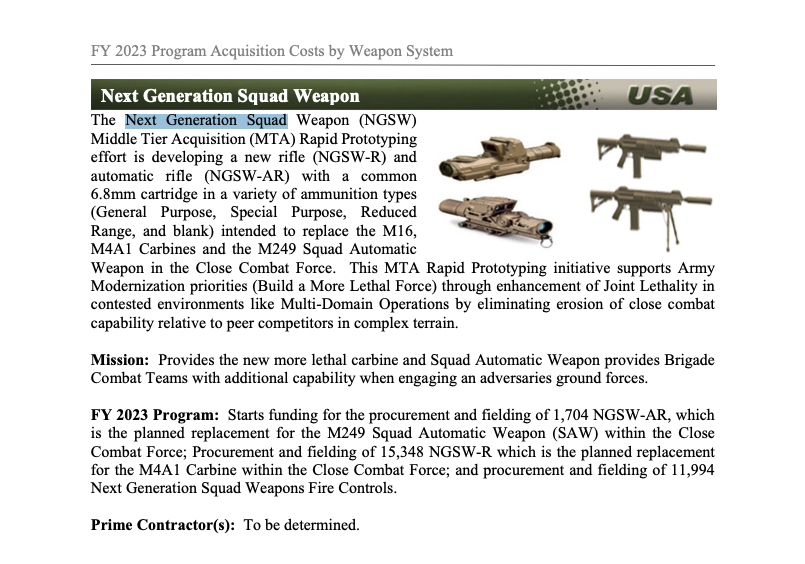
The US Army has released a sources sought notice for a 6.8mm conversion kit for the M240B and M240L machine guns. The kit will convert the weapons from 7.62x51mm to the 6.8mm round which wins the Next Generation Squad Weapon program. The move is essentially market research to find vendors who might be capable of providing kits that include all necessary parts to convert the 7.62x51mm M240s to the new round. This might include barrels, gas systems, action springs and bolt assembly parts.

The US Army’s Army Contracting Command, based at Picatinny Arsenal in New Jersey is conducting the  sources sought notice on behalf of the Project Manager Soldier Lethality (PMSL). The short description of the capability sought states that “the durability, reliability, and function of the M240 weapon platform cannot be significantly compromised with a change in ammunition.” There is no mention of the type of ammunition be it SIG Sauer’s hybrid metal cased round or True Velocity’s polymer cased round. The notice states, in capitals: “A TECHNICAL DATA PACKAGE (TDP) WILL NOT BE PROVIDED IN SUPPORT OF THIS ANNOUNCEMENT.”

US Army Contracting Command state that:

The conversion kit should include all hardware and instructions needed to modify a standard M240B and/or M240L to fire the 6.8mm ammunition. This will include a new barrel assembly and may include changes to the weapon powering through updates to the gas regulator, drive spring, or other means. The barrel assembly may be either of the standard barrel length (M240B) or short barrel (M240L). Information on 6.8mm ammunition type, specifications, and availability should be provided.

US Army Seeks a M240 6.8mm Conversion Kit

M240B in TV 6.8mm (True Velocity)

We do know that True Velocity have demonstrated a capability to convert legacy weapon systems to chamber their 6.8mm TV round. Back in June 2021, they announced that they had successfully converted M40s, M134 Miniguns and the M110 and Knights Armament LAMG to chamber the 6.8mm round.

The notice was launched on 15 March and runs through until the end of the month. Vendors submitting to the notice have been asked to provide information on their ability to scale up manufacturing and production of kits to higher quantities but the notice shouldn’t be considered a request for proposal.

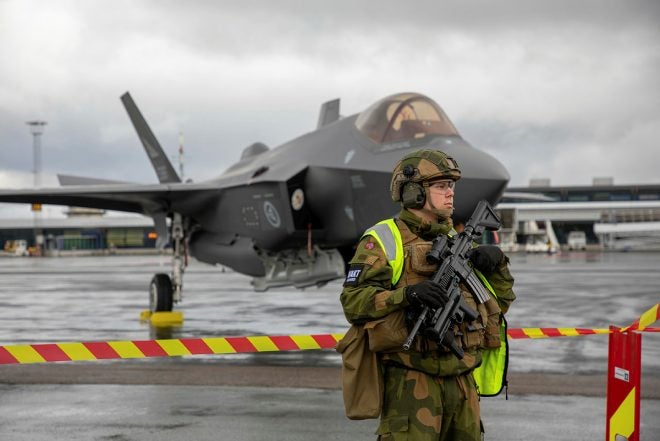
US military aircraft crashes in Norway with 4 on board

A U.S. military plane carrying four people crashed in northern Norway on Friday. Officials said they found “no signs of life” after reaching the crash site hours later.

The U.S. Marines confirmed the crash in a statement on Twitter early Friday evening.

RUSSIAN OFFENSIVE CAMPAIGN ASSESSMENT, MARCH 17:

March 17, 5:30pm ET

Russian forces did not make any major advances and Ukrainian forces carried out several local counterattacks on March 17.[1] Russian forces made little territorial progress and continued to deploy reserve elements—including from the 1st Guards Tank Army and 810th Naval Infantry Brigade—in small force packets that are unlikely to prove decisive. Russian forces continue to suffer heavy casualties around Kharkiv, and Russian attempts to bypass the city of Izyum are unlikely to succeed. Russian forces continued assaults on Mariupol on March 17 but did not conduct any other successful advances from Crimea.

Key Takeaways

  • Russian forces continue to make steady territorial gains around Mariupol and are increasingly targeting residential areas of the city.
  • Ukrainian forces northwest of Kyiv launched several local counterattacks and inflicted heavy damage on Russian forces.
  • Ukrainian forces repelled Russian operations around Kharkiv and reported killing a regimental commander.
  • Ukrainian intelligence reports that Russia may have expended nearly its entire store of precision cruise missiles in the first twenty days of its invasion.
  • Russian forces deployed unspecified reserve elements of the 1st Guards Tank Army and Baltic Fleet Naval Infantry to northeastern Ukraine on March 17.
  • Russia may be parceling out elements of the reserve force that could conduct an amphibious operation along the Black Sea coast to support ongoing assaults on Mariupol, further reducing the likelihood of a Russian amphibious assault on Odesa.
  • Ukrainian forces shot down 10 Russian aircraft—including five jets, three helicopters, and two UAVs—on March 16, and Ukrainian forces continue to successfully contest Russian air operations.

Russian forces face mounting difficulties replacing combat casualties and replacing expended munitions. The Ukrainian General Staff stated on March 17 that Russian forces will begin another wave of mobilization for the Donetsk People’s Republic’s (DNR) 1st Army Corps on March 20.[2] Ukrainian intelligence continued to report Russian forces face difficulties manning both combat and support units and increasing desertion rates.[3] The General Staff further reported that Russian forces are increasingly using indiscriminate weapons against residential areas because they used almost their entire supply of “Kalibr” and “Iskander” cruise missiles in the first 20 days of the invasion.[4] It is unclear if the Ukrainian General Staff means Russian forces have used almost all precision munitions earmarked for the operation in Ukraine or almost all missiles in Russia’s total arsenal—though likely the former.

Continue reading “”

1 I think Putin believed his own propaganda.
2 From this performance, it begs the question if the Russian military ever really was the threat we always believed it was, and spent so much time, effort and money on defending against it. Well, the military/industrial complex sure made a fortune.


BLUF:
Russia—whose economy before the invasion was about the size of Italy’s—may have spread its efforts too thinly and the modernization effort also appears to have been undermined by fraud and corruption, said analysts including Michael Clarke, a former director of the Royal United Services Institute, a London think tank, and now associate director of the University of Exeter’s Strategy and Security Institute, citing estimates that some 25% of the invading force are conscripts.

Weapons systems haven’t performed well and commanders pretended they had capabilities that weren’t there, Mr. Clarke said. Of Russia’s effort to create a “large, modern army,” he said: “The part which is modern is not large, and the part which is large is not modern.”

How Russia’s Revamped Military Fumbled the Invasion of Ukraine
Moscow spent years upgrading its capabilities, only to see the armed forces fail their first major test, confounding earlier Western assessments and giving Ukraine a boost

For over a decade, Russia spent hundreds of billions of dollars restructuring its military into a smaller, better equipped and more-professional force that could face off against the West.
Three weeks into Russia’s invasion of Ukraine, its first big test, the armed forces have floundered. Western intelligence estimated last week that 5,000 to 6,000 Russian troops had been killed, some of them poorly trained conscripts.
The dead included four Russian generals—one-fifth of the number estimated to be in Ukraine—along with other senior commanders, according to a Western official and Ukrainian military reports. The generals were close to the front lines, some Western officials said, a sign that lower ranks in forward units were likely unable to make decisions or fearful of advancing.
Russian troops turned to using open telephone and analog radios following the failure of encrypted communications systems, the Ukrainian Defense Ministry has said, making them vulnerable to intercept or jamming. Russian officers were likely targeted after their positions were exposed by their use of open communications, Western military analysts said.
In the strategically located town of Voznesensk, Ukrainian forces comprising local volunteers and the professional military drove off an attack early this month, in one of the most comprehensive routs Russian forces have suffered since invading Ukraine.
Russia’s failings appear to trace to factors ranging from the Kremlin’s wrong assumptions about Ukrainian resistance to the use of poorly motivated conscript soldiers. They suggest that Russia and the West overestimated Moscow’s overhauls of its armed forces, which some military analysts say appear to have been undermined by graft and misreporting.
The military’s previous outings in staged maneuvers and smaller operations in Syria didn’t prepare it for a multipronged attack into a country with a military fiercely defending its homeland, said Michael Kofman, director of Russia studies at CNA, a nonprofit research organization based in Arlington, Va.
“The failures that we’re seeing now is them having to work with a larger force than they’ve ever employed in real combat conditions as opposed to an exercise,” he said. “These exercises that we’ve been shown over the years are very scripted events and closer to theater than anything else.”

Continue reading “”

“In 36 days of fighting on Iwo Jima during World War II, nearly 7,000 Marines were killed. Now, 20 days after President Vladimir V. Putin of Russia invaded Ukraine, his military has already lost more soldiers…”

“… according to American intelligence estimates. The conservative side of the estimate, at more than 7,000 Russian troop deaths, is greater than the number of American troops killed over 20 years in Iraq and Afghanistan combined. It is a staggering number amassed in just three weeks of fighting, American officials say, with implications for the combat effectiveness of Russian units, including soldiers in tank formations. Pentagon officials say a 10 percent casualty rate, including dead and wounded, for a single unit renders it unable to carry out combat-related tasks…. ‘Losses like this affect morale and unit cohesion, especially since these soldiers don’t understand why they’re fighting,’ said Evelyn Farkas, the top Pentagon official for Russia and Ukraine during the Obama administration… ‘It is stunning, and the Russians haven’t even gotten to the worst of it, when they hit urban combat in the cities,’ [said] Representative Jason Crow, Democrat of Colorado….”

From “As Russian Troop Deaths Climb, Morale Becomes an Issue, Officials Say/More than 7,000 Russian troops have been killed in less than three weeks of fighting, according to conservative U.S. estimates” (NYT).

Quip O’ The Day
“Hope we spend more time on propulsion than on pronouns.”


Moon battle: New Space Force plans raise fears over militarizing the lunar surface.

The battle is on for the moon.
The U.S. military is investing in new technologies to build large structures on the lunar surface. It’s designing a spy satellite to orbit the moon. And it just announced plans for a surveillance network — what it calls a “highway patrol” — for the vast domain between Earth’s orbit and the moon, known as cislunar space. Top military strategists and documents, meanwhile, now consistently refer to this region as a new realm of operations.
The funding is also starting to flow. The government spending bill passed by Congress this week added $61 million for the military to pursue projects in cislunar space.
“That’s basically the first significant chunk of money that we’re putting towards this,” said Space Force Col. Eric Felt, commander of the Air Force Research Laboratory’s Space Vehicles Directorate at Kirtland Air Force Base in New Mexico.
He likened it to “putting the toe into the water, but we think this is an important potential future tech area.”
“From the Space Force’s perspective,” he added, “they don’t know how big of a deal this is going to be in the future, but it could be a big deal.”
The Pentagon maintains these new pursuits, all launched since the creation of the Space Force three years ago, are primarily designed to help secure a growing private space economy and safeguard civilian astronauts. In all, the newest branch believes nation-states and commercial companies will fly nearly 100 missions — both crewed and uncrewed — to the moon between now and 2030.
But space policy and security experts also fear that the armed forces could outstrip NASA in space exploration and thrust what has largely been a peaceful competition into a military contest.
Aaron Boley, co-director of Outer Space Institute at the University of British Columbia, says the Pentagon already plays an outsized role in Earth orbit, where satellites are used to support military operations and global security.
“But once we move to the moon, this should really be driven by civilian organizations to ensure that peaceful purposes are maintained,” he said.
Some leading military strategists, however, say there is simply too much at stake in the space race to leave it to civilians, and that the Pentagon will likely be compelled to take on a bigger role.
China’s space agency has made significant strides in its plan to develop the moon, including landing the first spacecraft on the south pole in 2019. It also plans at least three additional robotic missions, beginning in 2024, to build a lunar base, with missions involving taikonauts to follow.
Proponents for a more muscular U.S. military say they fear China cannot be trusted to pursue only peaceful aims and could use its space program for both economic and military advantage, including a new partnership with Russia to build a moon base.
“Power abhors a vacuum,” said Peter Garretson, a retired Air Force lieutenant colonel and space strategist who is now a senior fellow in defense studies at the American Foreign Policy Council. “You should expect that other actors will act in ways that favor their interests to the exclusion of others.”
“I think we all hope that NASA will rise to the occasion again and be able to perform that traditional exploration role,” he added. “But with the slipping of budgets and slipping the timelines, I think there is some concern as to whether or not NASA is scaling its efforts and will be able to rise to the occasion.”
The Space Force maintains it is interested only in developing the means for “domain awareness,” not exploration.

Continue reading “”

BLUF:
My guess is that the Russian infantry massing around Kiev isn’t even going to enter the city. They know what sort of losses they’d take in urban combat; there’s no reason to think they could outfight the Ukrainians on their own streets. More likely is that they’re going to lay siege to the capital a la Mariupol and wait for a surrender. The outcome of the war may turn on whether Russia is capable of doing that successfully or whether Ukrainian troops outside the city can mount the sort of counteroffensive described above to break the siege. If they can, the Russians will be faced with a scenario in which they can neither starve the Ukrainians into submission nor overpower them in combat. Maybe that’s when Fukuyama’s prediction of morale “vaporizing” comes true.

But it’s also when things would get really dangerous.

Is Russia going to lose?
One way to answer the question in the headline is “It already has.” Even to a rank amateur like me, it was clear by *day three* that Putin was facing a strategic debacle. He misjudged Ukraine’s desire and ability to resist, he misjudged the strength of his military, and he misjudged the west’s willingness to paralyze Russia’s economy with sanctions. “No Russian leader since Tsar Nicholas II has done his country so much harm, so fast, as Vladimir Putin,” David Frum tweeted a few days ago, marveling at how diminished Russian power has been by Putin’s folly in the span of a few weeks.

Nothing that happens in Ukraine from this point will undo that. It’s a fiasco.

But a strategic defeat is distinct from defeat on the battlefield. Even optimists have assumed that Russia would eventually brute-force its way to controlling Kiev and other major Ukrainian cities. The “real” fight for Ukraine would come after that when Russia’s occupying forces and Ukraine’s insurgency would wage a war of attrition. Eventually Moscow would run out of patience and withdraw, but “eventually” could take months. Years. Decades, conceivably.

But what if the optimists were too pessimistic? What if Russia is facing near-term defeat on the battlefield as well?

Realistically, there are three ways in which the Russian army might lose:

Continue reading “”

“Appear strong when you are weak.” ― Sun Tzu, The Art of War


What If Everyone Is Wrong About The Russian Military?

As a kid, the only thing close to as tough as the United States military was those communist bastards they were protecting us from. We were tougher, of course, but since we were the good guys we didn’t even consider invading them. Should they invade us, which we knew they wanted to do, we’d be ready to kick some commie ass! At least, that’s what we told ourselves, mostly to avoid thinking about the complete, total and world-wide nuclear annulation. Times have changed, and so has the Russian military…or has it?

We always assumed they were as strong militarily as we were, but mostly because of parades and their size. Everyone has seen the footage of battalions marching through Red Square, huge intercontinental ballistic missiles rolling along with them in a sea of soldiers and tanks. They sure projected strength and readiness. But maybe they weren’t ready?

All we really had to go on was the Soviet Union’s word, their propaganda videos, and the fact that they could push around so small countries. But maybe they were a super-power based solely on their huge nuclear arsenal?

We never really saw the Soviets take on another organized military, their power was largely acquired through propping up dictators and intimidation – they were very good at disappearing the disloyal and beating up the weak.

We were told they were strong, minus the nukes, mostly because they were big, and that assumption continues to this day. But their actions in Ukraine are not that of a world-class military, not by a long-shot. It’s more like a drunken douchebag indiscriminately launching rockets, quite possibly because they lack anything with precision. We can drop a missile down a chimney with the accuracy of Santa Claus, but what if the Russians couldn’t even hit a brick in a brick factory?

Remember what we were told about the Republican Guard in Iraq? They were the “best of the best.” Pick your Gulf War, when they started the story was about how we’d have no real issues with the regular Iraqi troops, but when we encountered the Republican Guard things would get hairy. They never did. The Republican Guard was as insignificant as the regular army. Both times the people in charge were completely wrong about what we were up against, the RG folded like a cheap tent. Could history be repeating itself with Russia?

Continue reading “”

Putin going to war in Ukraine risked disclosing his military’s real abilities ……and  limitations. The Russian Army isn’t a ‘paper tiger’ but it turns out to not be anything close to ‘as advertised’. Of course, that’s standard military procedure.  ‘The enemy will only tell you where he is strong.’


BLUF:
For Washington, this display of Russian military weakness should be comforting in terms of Moscow’s true military threat to Europe. At the same time though, it exposes the need for a different national security strategy, one that doesn’t imagine Russia as a military equal, and one that doesn’t push Vladimir Putin’s back against a wall.

Shocking Lessons U.S. Military Leaders Learned by Watching Putin’s Invasion.

Russia’s military is weak and backwards.
Vladimir Putin’s invasion of Ukraine produced this paradigm-shifting surprise—one that should transform the West’s view of Russia’s prowess, the threat that the country represents, and the Kremlin’s future in the global arena.
russian invasion ukraine military
Ukrainian tanks move on a road before an attack in Lugansk region on February 26, 2022 .ANATOLII STEPANOV/AFP VIA GETTY IMAGES
After just one day of fighting, Russia’s ground force lost most of its initial momentum, undermined by shortages of fuel, ammunition and even food, but also because of a poorly trained and led force. Russia began to compensate for the weaknesses of its land army with more long-range air, missile and artillery strikes. And President Putin resorted to a nuclear threat—a reaction, U.S. military experts say, to the failure of Moscow’s conventional forces to make quick progress on the ground.
Other military observers are flabbergasted that a Russian invasion force, fully prepared and operating from Russian soil, has been able to move just tens of miles into an adjoining country. One retired U.S. Army general told Newsweek in an email: “We know that Russia has a plodding army and that Russian military force has always been a blunt instrument, but why risk the antipathy of the entire planet if you have no prospect of achieving even minimal gains.” The Army general believes that the only explanation is that the Kremlin overestimated its own forces.
“I believe that at the heart of Russian military thinking is how Marshall Zhukov marched across Eastern Europe to Berlin,” a former high-level CIA official told Newsweek in an interview. Zhukov’s orders were to “line up the artillery and … flatten everything ahead of you,” he says. “‘Then send in the peasant Army to kill or rape anyone left alive.’ Subtle the Russians are not.”
In the short term, Russia’s military failures in Ukraine increase the threat of escalation, including the possibility of the use of nuclear weapons. But in the longer term, if escalation doesn’t worsen and the Ukrainian conflict can be contained, Russian conventional military weakness upends many assumptions that geopolitical strategists—even those inside the U.S. government—make about Russia as a military threat.

Continue reading “”

These are very easy to use. We teach 17-18 year old kids how. And it was purposefully designed to operate like an arcade game.


St. Javelin? Trump’s gift to Ukraine

See the source image

This image of a saint wielding an FGM-148 Javelin anti-tank missile has become an iconic symbol of the Ukrainian resistance to the Russian invasion. When you see video of destroyed Russian tanks and armored personnel carriers, chances are it was a Javelin that did the damage.

The Javelin is quite a sophisticated weapon, so much so that a single missile costs more than $80,000. It is a “fire-and-forget” weapon; once the target is acquired through the sighting system, the missile locks onto the target and as soon as it is fired, the crew can run for cover or change their position. However, because of the missile’s “soft launch” technology, the location of the Javelin crew is not revealed to the enemy forces, who may not even know what hit them, much less where it came from. Besides which, when one of your tanks gets blown up by an armor-piercing missile, your first thought is probably, “Let’s get the hell out of here,” rather than attempting to mount a counterattack.

You’ve seen news about the Russians being “bogged down” because of “unexpectedly” strong Ukrainian opposition? St. Javelin, baby!

The Javelins were, yes, acquired by Ukraine from our former, competent, president. And yes, to be fair, the Biden administration has also sent Javelins and other aid

A US military aid package worth $60 million arrived in Ukraine on June 16, which included Javelin anti-tank missiles and other military aid. Another $350 million in military assistance was greenlit by US Secretary of State Anthony Blinken today.

“We are not confirming quantities, just that we have supplied Javelins and other lethal and non-lethal security assistance,” said an Office of the Secretary of Defense representative in an email response to Coffee or Die Magazine. The representative would not comment on quantities.

They made movie(s) about this.


A Black Hawk helicopter flew for the first time without pilots.

a helicopter with no one on board

February has already been a big month for autonomous flight. For the first time, this past Saturday, and then again on Monday, a specially equipped Black Hawk helicopter flew without a single human on board. The computer-piloted aircraft was being tested as part of a DARPA program called Alias, and the tests took place out of Fort Campbell, Kentucky.

The retrofitted whirlybird was controlled by a Sikorsky-made autonomy system. As part of that system, the helicopter has a switch on board that allows the aviators to indicate whether two pilots, one pilot, or zero pilots will be operating the chopper. This was the first time that a Black Hawk was sent into the air with the no-pilots option, so that the computer system was handling all the controls. While these were just test flights, they hint at a future in which the Army could potentially send an autonomous helicopter on a dangerous rescue mission—and have no one on board it at all.

Continue reading “”

US Defense Database DMED Tracked Exploding Number of Vaccine-Related Injuries

When US Senator Ron Johnson (R-WI) held a hearing on vaccine safety in January this year, a number of DOD whistleblowers stepped forward with alarming data. They shared data from the Defense Medical Epidemiology Database (DMED) which tracks every illness of military members.

The purpose of gathering such data is expressly to spot adverse health trends that could affect combat readiness. It is therefore accurate, complete and designed for early detection.

Lawyer Thomas Renz reported on five years of data during the hearing which showed an alarming rise in medical problems related to Covid vaccines. The whistleblowers stepped forward because their superiors had ignored the problem. Renz plans to pursue the matter in a US federal court.

Arguably, the DMED is the best epidemiological database in the world and since neither Pfizer nor Moderna is able to provide better data, this upward trend related to vaccine injury must be cause for great concern.

In a declaration under penalty of perjury, the three military physicians Samuel Sigoloff, Peter Chambers, and Theresa Long, exposed the 300 percent increase in DMED codes registered for miscarriages in the military in 2021 over the five-year average. The five-year average has been 1499 codes for miscarriages per year, but during the first 10 months of 2021, it shot up to 4 182.

The same trend was seen in spiking cancer cases, from a five-year average of 38 700 per year to 114 645 in the first 11 months of 2021, coinciding with the vaccine. And reported neurological disorders increased by an incredible 1000 percent.

Continue reading “”

BLUF:
As Shijian-21’s recent actions demonstrate, there is a pressing need for the United States to be able to defend its assets in distant orbit. It’s likely we could see similar shows of force in the near term as Space Force responds to other nations’ demonstrations of “killer” satellite capabilities.

A Chinese Satellite Just Grappled Another And Pulled It Out Of Orbit.

A Chinese satellite was observed grabbing another satellite and pulling it out of its normal geosynchronous orbit and into a “super-graveyard drift orbit.” The maneuver raises questions about the potential applications of these types of satellites designed to maneuver close to other satellites for inspection or manipulation and adds to growing concerns about China’s space program overall.

On January 22, China’s Shijian-21 satellite, or SJ-21, disappeared from its regular position in orbit during daylight hours when observations were difficult to make with optical telescopes. SJ-21 was then observed executing a “large maneuver” to bring it closely alongside another satellite, a dead BeiDou Navigation System satellite. SJ-21 then pulled the dead satellite out of its normal geosynchronous orbit and placed it a few hundred miles away in what is known as a graveyard orbit. These distant orbits are designated for defunct satellites at the end of their lives and are intended to reduce the risk of collision with operational assets.

Continue reading “”

When I made my last career move to the Newport News areas back in late ’09, actual construction on the Ford was just beginning.
12+ years later………….


Six Years Late And $2.8 Billion Over Budget Navy’s Costly Carrier Is Ready For Training And Operations

The Navy’s costliest warship finally has all the elevators needed to lift bombs from below its deck so it can deploy on its first operational patrol — more than four and a half years after delivery.

The service has announced that the 11th and final Advanced Weapons Elevator is in place on the $13.3 billion USS Gerald R. Ford and the aircraft carrier is ready for training and operations.

“This is a significant milestone for the Navy, ship and her crew,” Rear Admiral James Downey, the Navy’s program executive officer for aircraft carriers, said in a statement.  “We now have the entire system to operate and train with.” He said the service and the prime contractor, Huntington Ingalls Industries Inc., used “hundreds of craftsmen, technicians and engineers, working around the clock –through multiple underway and holiday periods — to get these advanced systems on line and operational.”

The Navy took delivery of the first in the Ford class of carriers in May 2017, praising the “newest, most capable, most advanced warship” and saying it was “expected to be operational in 2020.” The service didn’t disclose that none of the 11 elevators were operational, much less installed, until Bloomberg News reported the problem in November 2018.

“I recognize the extraordinary effort that it has taken to finish all 11 of these elevators, but this effort should not have been necessary,” Senator James Inhofe of Oklahoma, the top Republican on the Senate Armed Services Committee and the most vocal congressional critic of the Navy on the issue, said in a statement.

The carrier ultimately was delivered “six years late and $2.8 billion over budget,” Inhofe said.

The delay to fix the elevators and resolve other issues “has lengthened a period during which the Navy is attempting to maintain policy maker-desired levels of carrier forward deployments with its 10 other carriers,” the nonpartisan Congressional Research Service said in a report this month.

Inhofe put it more bluntly. He said the delay has forced other ships and crews to deploy “longer and more often,” as well as causing gaps in the Navy’s global “presence when no carrier could deploy, at a time when naval presence and capability could not be more critical for our national security.”

Perhaps the only positive outcome of the weapons elevator delays is “development of what the Navy and the shipyard should have had from the very beginning — a Ford-class plan for the development, building, installation and operational training” that’s now needed to avoid such mistakes on the second ship in the four-vessel class, the USS John F. Kennedy, said Mike Fabey, author of “Heavy Metal: The Hard Days and Nights of the Shipyard Workers Who Build America’s Supercarriers.”

‘Water water everywhere and not a drop to drink’……….

US Navy Seizes 1,400 AK-47s, Over 226K Rounds Of Ammunition From Iranian Ship

U.S. Navy Seizes 1,400 Assault Rifles During Illicit Weapons Interdiction

The U.S. Navy seized over 1,400 AK-47 rifles and 226,600 rounds of ammunition from an Iranian ship bound for Yemen in the North Arabian Sea, the State Department reported.

The seizure occurred on Dec. 20 when U.S. Naval forces identified a stateless fishing vessel, according to the State Department.

U.S. Naval Forces Central Command said the vessel was traveling along a route previously used by smugglers who were trafficking weapons to the Houthis in Yemen in violation of U.N. Security Council Resolutions and U.S. sanctions.

BLUF:
The intentionally muddy writing shouldn’t obscure that this is a plan for a military coup. The Posse Comitatus Act, 18 U.S. Code § 1385, prevents the military from acting as a police force within the U.S. under all but the most limited of circumstances. If the Defense Department is unilaterally planning to take over “any agency that works hand in hand with the military” to ensure progressives remain in power if the next election is contested, then our modern military will have recast itself in the mold of a Third World military junta.

Three Retired Generals Loudly Demand A Military Coup In 2024

Democrats claim that democracy is under attack in America and Democrats must act decisively to protect it. They’ve been trying to end the filibuster, nationalize voting, and pack the Supreme Court. The most ominous “fix,” which hinges on the myth of a “January 6 Insurrection,” sees retired generals argue that the military must purge the ranks of Trump supporters and prepare for a military coup to block a future contested election. This is unconstitutional, illegal, and spells the end of American democracy.

Victor Davis Hanson notes that leftists are loudly worrying about democracy’s end while ignoring all they’ve done to end democracy, such as bringing in millions of illegal aliens, many of whom are being given the vote; destroying centuries-old governing traditions such as the filibuster; packing the court; ending the Electoral College; and more.

If Democrats can kill the Senate filibuster (and Arizona Senator Kyrsten Sinema is the only thing stopping them, not the craven Senator Mitch McConnell), they have the unfettered ability to enshrine vote fraud and pack the Supreme Court. The latter move spells the final—and deeply unconstitutional—progressive rewrite of our Constitution, and ends our constitutional republic.

The wild card in all of this, though, is what would the military do if, in fact, the progressives were able to achieve these goals (or even if they weren’t). Three retired officers have signaled that they want to purge the military of Trump supporters, and then plan a takeover of the military and related federal agencies that coordinate with the military to effect a coup in 2024. Considering the current state of the Pentagon, this may be more than a progressive fantasy.

Thirty years ago, when I was a U.S. Army Infantry Officer, our military was unquestionably a politically neutral, colorblind institution. It was the single most well-integrated institution in our nation and, indeed, was the primary engine integrating our nation.  But progressives have done everything they can to turn the military into a dysfunctional machine warped by racial, sexual, and gender identity divisions. This began with Obama, who injected the toxic myth of white supremacy and the tenets of critical race theory.

In 2019, Kyle Smith explained:

A curious thing happened in the second half of the Obama era: The commander-in-chief began viewing the military less as an entity designed to destroy enemies but [sic] a tool with which to achieve progressive goals. Warriors were turned into social-justice warriors. Men and women with risible-to-nonexistent military records were made heads of the services. Navy Secretary Ray Mabus (who had logged all of two years’ service as a junior officer) named ships after Cesar Chavez and Harvey Milk.

Obama also purged the military of any flag rank officer not reliably progressive, a process Andrea Widburg document at her blog and at American Thinker (here and here). Those who remain today are nothing but progressive race hustlers, such as the odious Secretary of Defense, Lloyd Austin, or traitorous politicians in uniform, such as General Mark “white rage” Milley.

Enter now three retired U.S. Army Generals: Major Generals Paul D. Eaton and Antonio M. Taguba and Brigadier General Steven M. Anderson (“the Three”). In a Washington Post opinion piece, “3 retired generals: The military must prepare now for a 2024 insurrection,” they contend that events in 2020 revealed an incipient military coup and that, to save our nation, the U.S. military must act preemptively—radically and unilaterally. What they write should frighten every American.

Continue reading “”