ESSE SINE METU IN FACIE INIMICI TUI. TUENDAM INOPS ET FACERE NON MALI.
Category: You Can’t Make This Up
The guy had been released on bond from another burglary charge the day before? You literally can’t make this up
And incidentally, Florida has the Baker act where a person can be held for 72 hours for mental evaluation. The Police can do this on their own, but from the article apparently had no info the guy was ‘mental’ and yet, all the family had to do was let the authorities know he was having “problems” …but they didn’t…So it brings up the Question O’ The Day: Why not?
An intruder shot dead by a Port Orange homeowner last Thursday while trying to break into the home was released from jail the day before the shooting where he had been locked up for a previous burglary arrest, court records show.
On Tuesday, Port Orange police identified the intruder as Justin Alvaro Dematos, 46, of Port Orange.
But Dematos’s fiancée said Tuesday that he recently started struggling with mental illness and would get disoriented and lost when he went out for walks and show up at strangers’ homes not knowing where he was.
“I just wanted to clarify that he was having mental problems and his mother was coming from Boston this week to take him to a psychiatrist, but we could not get him help in time,” a tearful Maria Alvaro said in a telephone interview.
Warned twice
Police said that on Nov. 16, Dematos approached a home in the 5900 block of Pelham Drive at approximately 12:05 a.m., and tried to break in.
Barking dogs at the home woke up the residents, who heard Dematos ringing their doorbell, police said.
The homeowner, while inside, verbally confronted Dematos who walked away. He then went to the side of the home and reportedly removed the screen to a bedroom window that had been left slightly open, said Port Orange police detective Michael Wallace.
The homeowner verbally confronted Dematos again, asking him what he was doing on his property but Dematos did not respond Wallace said.
Police said Dematos then attempted to enter the home through the open bedroom window and was shot one time by the homeowner, police said.
California Governor Gavin Newsom (D) implied this week that the inflation pains Americans are feeling this Thanksgiving are simply a lie pushed by conservatives.
“Things you won’t see on Fox News today,” Newsom posted Wednesday on X. “Prices for Thanksgiving are down — from Turkey to air travel.”
Newsom’s post included a chart showing price changes according to Labor Department data. Prices for peas, milk, stuffing, pie crusts, turkey, and cranberries have dropped from last year, according to the chart.
Things you won’t see on Fox News today…
Prices for Thanksgiving are down — from Turkey to air travel.
Average hourly wage is up — almost 4.4% from over a year ago, 18% from 3 years ago. That’s nearly the best 3-year gain in 40 years. pic.twitter.com/Q0MhCzADeY
However, inflation is only just cooling off after spiking during the last few years.
Last year, the average price of a Thanksgiving meal hit a record high. While prices of some items have dipped this year from last year’s record highs, prices are still higher than they were before the pandemic.
This year, the average cost of a Thanksgiving meal for 10 people is $61.17, down 4.5% from last year’s $64.05 average cost, according to a report from the American Farm Bureau Federation (AFBF).
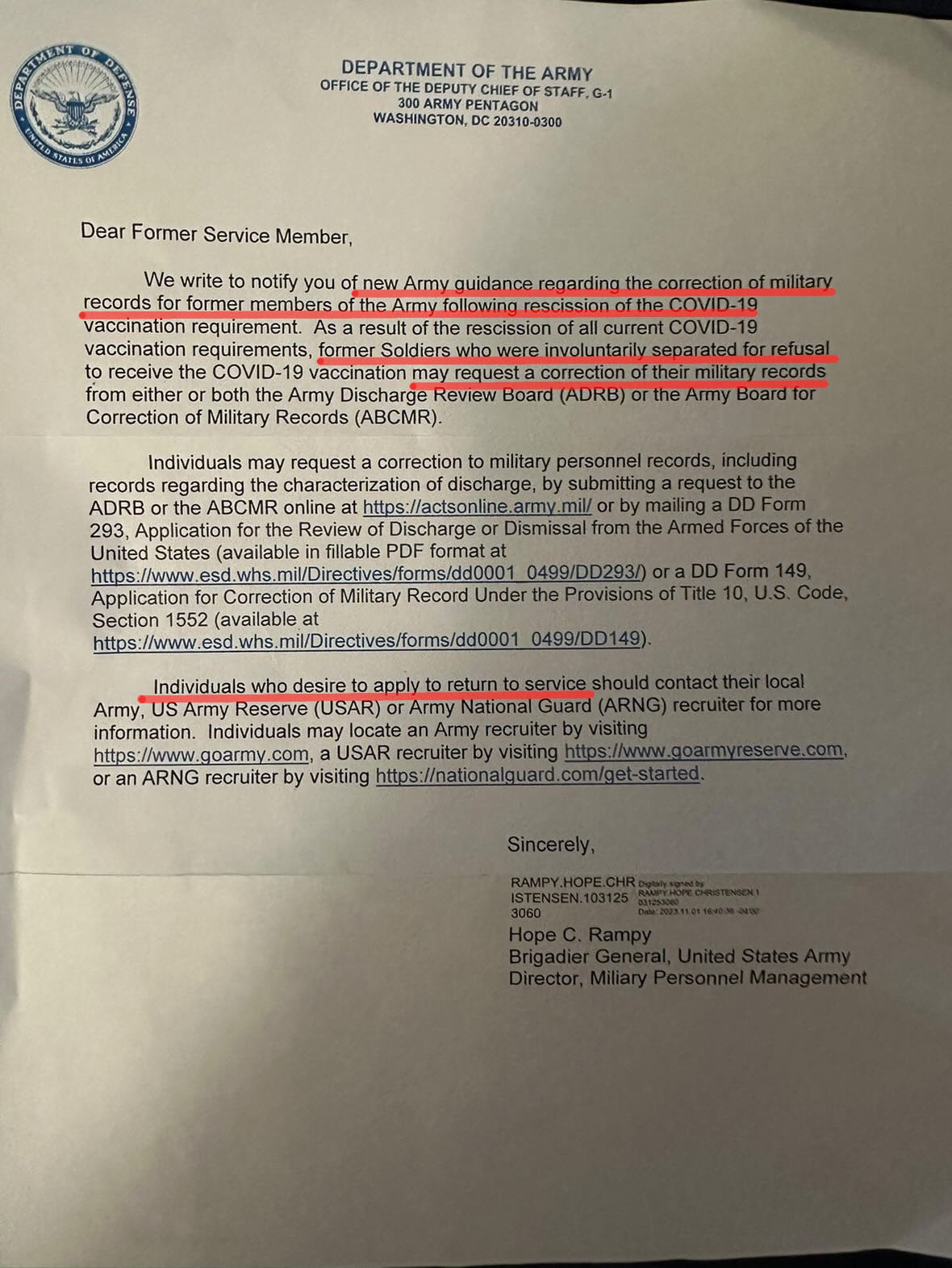
The United States Army is now begging COVID unvaccinated soldiers, who underwent involuntary discharge for their refusal to take the vaccine, to return to service and also permits them to correct their military records!
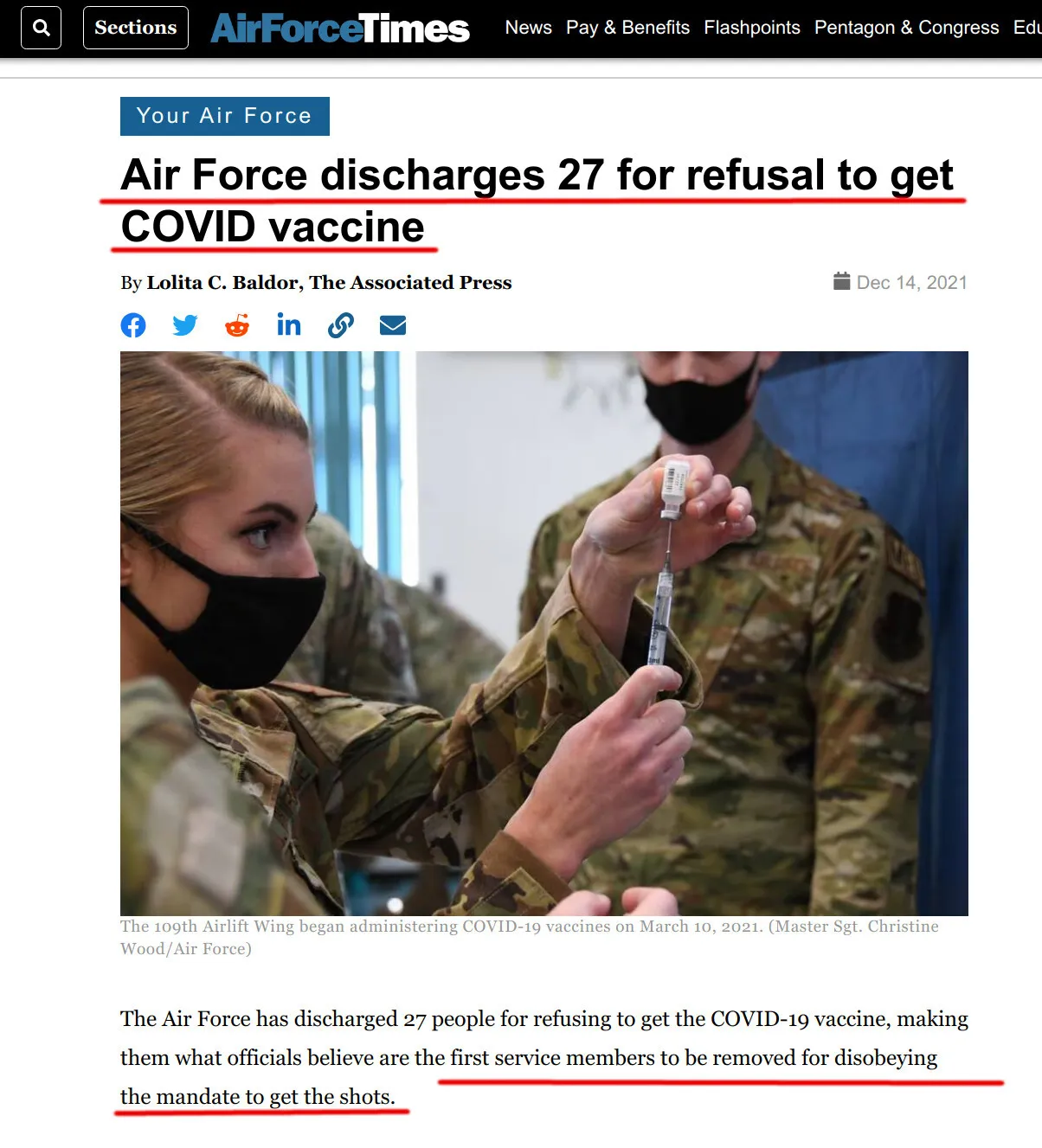
Just two years ago, in a shameful campaign, the Pentagon was gleefully discharging soldiers who refused to take Covid vaccines:
We were assured that these discharges would “not affect military readiness.”
“I can tell you there are no operational impacts across the force for readiness,” Marine Corps Lt. Gen. David Ottignon told lawmakers. “There’s no one community that has signaled an instance where a [leader], an NCO or another enlisted Marine is not present because of that.”
The Marine Corps has, by far, kicked out the most service members: 1,968 total, 20% of whom received an honorable discharge. That amounts to just under 1% of the total force, which stands at about 215,000.
However, the readiness suffered: thousands of service members were dismissed, and potential recruits declined to enlist in the Armed Services, because, guess what, young healthy men loath COVID vaccines.
More than 17,000 service members balked at taking the shots, citing safety fears linked to the vaccine’s speedy development and spurred by misinformation about messenger ribonucleic acid technology, as well as concern over fetal cell lines used in formulation and testing. The more the controversy raged in the news, the more troops asked to skip the shots, Military Times reporting found.
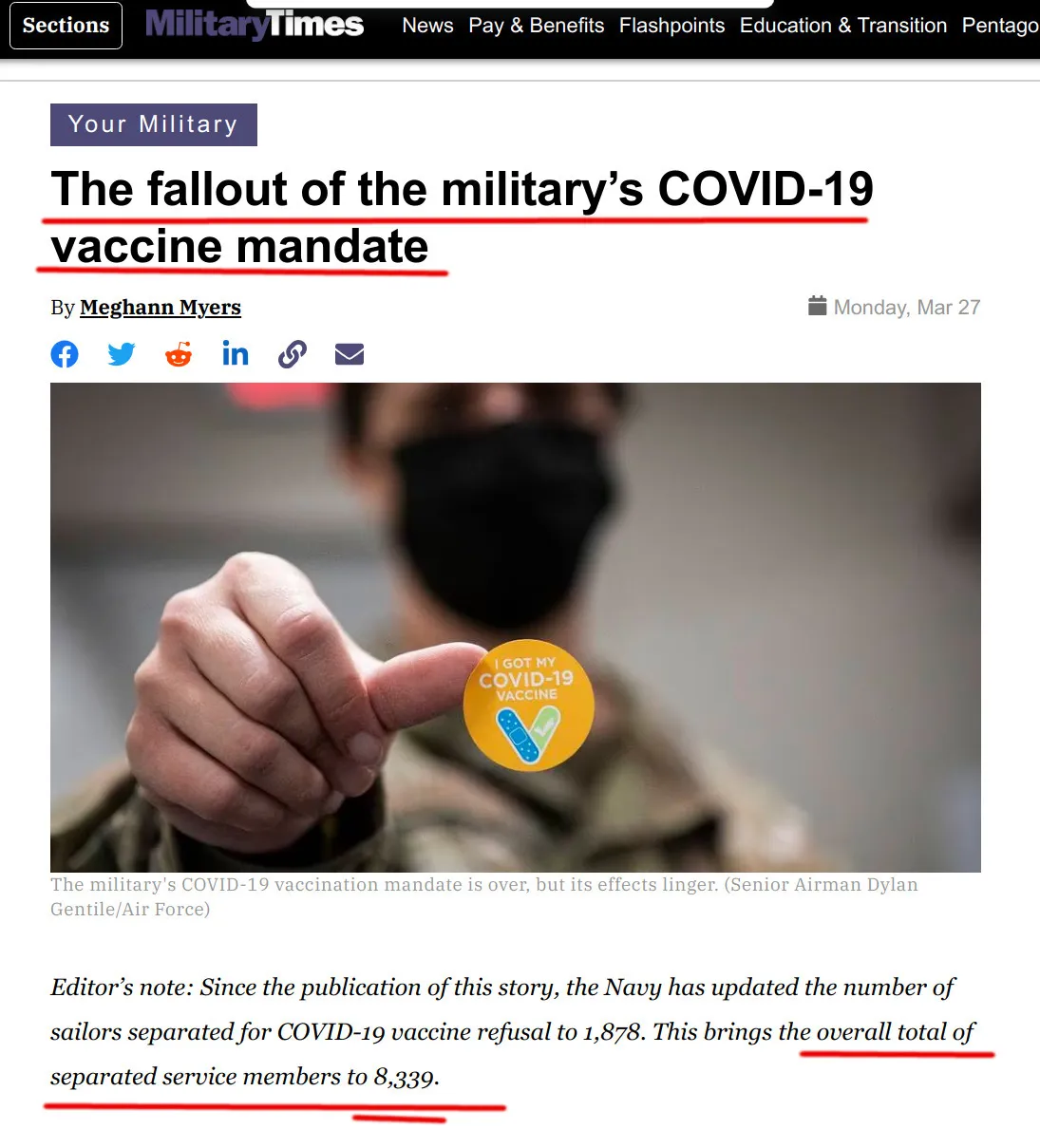
The COVID vaccine mandate removed three times as many servicemembers (8,339, see above) compared to the 2,402 soldiers tragically killed in Afghanistan. The involuntarily terminated soldiers were, of course, the best, the brightest, the healthiest, and most conscientious, who cared the most about their health.
Lt. Col. Terry Kelley, a spokesman for the Army, said that 2,767 soldiers have received “general officer written reprimands” — killing their opportunities for promotions or transfers within the military — and that two battalion commanders as well as four other officers have been relieved of their duties but remain enlisted in the military.
The leadership, sadly, stayed silent. (pictured here is Lloyd Austin)
Puppet SloJoe is merely doing what his puppetmasters (the real people running the goobermint) have told him to do to make living more difficult.
Now, to be honest. If I built a new house, it would be 100% electric. I can power a house with a large enough generator and, properly equipped, all I need is a source of gasoline, ethanol, or even wood gas. Natural gas piped in by a utility company can be cut off at their discretion.
President Biden invoked a Cold War-era law in a surprising move Friday to pour taxpayer funds into domestic manufacturing of electric heat pumps, an alternative to gas-powered residential furnaces.
In a joint announcement with the White House, the Department of Energy (DOE) said the federal government would award a “historic” $169 million for nine projects across 15 sites nationwide in an effort to accelerate electric heat pump manufacturing. The significant level of funding was made possible after Biden utilized the 1950 Defense Production Act (DPA) to increase domestic production of green energy technologies.
“Getting more American-made electric heat pumps on the market will help families and businesses save money with efficient heating and cooling technology,” said Energy Secretary Jennifer Granholm. “These investments will create thousands of high-quality, good-paying manufacturing jobs and strengthen America’s energy supply chain, while creating healthier indoor spaces through home-grown clean energy technologies.”
“Today’s Defense Production Act funds for heat pump manufacturing show that President Biden is treating climate change as the crisis it is,” added John Podesta, the White House clean energy czar. “These awards will grow domestic manufacturing, create good-paying jobs, and boost American competitiveness in industries of the future.”
The term “gun death” is popular among gun control advocates and their politicians who push that same agenda. It’s a simple enough term, too. It’s simply the total number of people killed with a firearm, regardless of who pulled the trigger or why.
It might even be a useful statistic in some cases.
However, when talking about guns and gun control, it’s misdirection at best and a case of lying with facts at its worst.
It’s an effort to lump all such fatalities together to make the issue seem bigger than it is. And it seems folks at the Milwaukee Journal Sentinel got an eye-opener on the topic recently.
Gun deaths are rising in Wisconsin, but the people affected by it might surprise you. The narrative around gun violence is often limited to urban homicides, but the vast majority of deaths by guns are suicides. In fact, a newreport from the Milwaukee Journal Sentinelfinds that suicides make up more than two-thirds of all deaths by guns in Wisconsin.…
“Of 100 gun deaths that [occur] in Wisconsin, roughly 25 of those are homicides. And then there’s another one to 2% that are accidents or police involved shootings,” [Investigative reporter John] Diedrich explains. “The idea that 71 out of 100 gun deaths in Wisconsin are suicides was an eye-opener to me and to our readers.”
Diedrich acknowledges that suicides are, in fact, a mental health issue, but he’s paraphrased as saying that when those issues arise, gun owners have a very deadly means to take their own life.
I don’t dispute that fact. However, starting with that last point, if they already have the means to take their own life, what good would new gun control laws do?
Moving back to the deeper point, that Diedrich was shocked by this, I can’t say that I am. We’ve long known that most of the “gun deaths” cited by anti-gun activists were, in fact, suicides. We know why they do it, too. The truth is that when you look at the total number of homicides year over year and consider them against the total population of the United States, it doesn’t look nearly scary enough.
So, they lump in suicides and accidents and call them gun deaths, all in hopes that no one will dig too deeply.
When they do, they get a bit of a wakeup call.
It’s also why I really think we in the gun community need to step up and deal with mental health. We need to be champions of improvement in mental health efforts and be advocates for those in our lives who suffer from mental illness.
If we can reduce the number of suicides, we reduce the number of gun deaths. We take away the gun control crowd’s ammunition, even if that ammunition is based on what amounts to a lie.
In Milwaukee, at least one journalist has woken up to at least part of that lie. The question is whether he’ll realize the rest of it and do his part to combat the constant flow of misinformation from here on out.
Biden judicial nominee Sara Hill “made history” by being the first Native American woman nominated to serve as a federal judge in Oklahoma
Today, she was unable to explain the difference between a stay order and an injunction when asked by Sen. Kennedy. pic.twitter.com/i6VsjXjvhk
A news crew from the Czech Republic was robbed at gunpoint Sunday evening while in the Bay Area to cover the Asian-Pacific Economic Cooperation (APEC) summit.
The San Francisco Chroniclereported that “Czech TV journalist Bohumil Vostal was capturing what he thought would be a majestic shot — San Francisco’s iconic City Lights bookstore, steeped in the gathering dusk — when three masked assailants approached with guns pointed.”
The suspects were able to get away with over $18,000 worth of equipment before fleeing the scene in a sedan.
Vostal indicated that by taking the equipment, the suspects also managed to take footage which had been shot while the Czech crew traversed San Francisco.
KTVU noted that Bay Area stations “often send armed guards with reporters and photographers” as their crews cover stories in San Francisco.
San Francisco is located in California, the state with the most gun control of any state in the Union.
California has universal background checks, an “assault weapons” ban, gun registration requirements, a 10-day waiting period on gun purchases, a limit on the number of guns a law-abiding citizen can buy each month, a ban on campus carry for self-defense, a ban on K-12 teachers being armed for classroom defense, strict regulations on firearms Democrats refer to as “ghost guns,” strict regulations on firearm marketing practices, a background check requirement for ammunition purchases, and numerous other gun and ammunition controls.
While California is No. 1 for gun control, FBI figures showed the state was also No. 1 for “active shooter incidents” in 2021.
Chicago has become so unpleasant that migrants are fleeing back to Venezuela after being dumped in shelters and refused better paying jobs.
Since August last year, 20,700 migrants have arrived in Chicago from Texas. The Lone Star State’s Governor Greg Abbott sent migrants to Chicago and other Democrat-run cities because of their proud status as ‘sanctuary cities.’ They offer enhanced protection against detention or deportation for undocumented migrants.
Venezuela-born Michael Castejon, 39, and his family have been sleeping on the floors of police stations and shelters after he could not afford to pay rent in Chicago – because his work permit was taking so long to arrive.
The family was renting an apartment through a city voucher program, that gives up to $15,000 for up to six months of rental assistance – but once it ran out, they had to give up their living space.
The dad found a job in construction, and he was getting paid in cash, but it wasn’t enough to sustain his family since they arrived in June.
The parents of a student killed in the shootings at Marjory Stoneman Douglas High School in Parkland, Florida have teamed up with Brady’s former chief litigator to file a “first-of-its-kind” complaint with the Inter-American Commission on Human Rights, alleging that “US gun policy violates basic human rights law” and deprived the Joaquin Oliver of his right to life.
Jonathan Lowy, who left Brady to start the group Global Action on Gun Violence, is spearheading the lawsuit with help from the head of George Washington University Law School’s Civil and Human Rights Clinic, and unlike most litigation involving Second Amendment issues, this one was launched with a slickly-produced ad campaign crafted by Zulu Alpha Kilo.
Lowy, you might recall, is also heading up the Mexican government’s lawsuit against most major U.S. gun manufacturers. While a U.S. District Court judge tossed out the case, the First Circuit Court of Appeals heard arguments over the summer about whether or not to reinstate the suit.
In this case, Lowy and plaintiffs Manuel and Patricia Oliver, who founded the anti-gun group Change the Ref after their son was murdered, aren’t asking a U.S. court to rule that the Second Amendment is a violation of human rights. Instead, they’re taking their argument to an international body that has no real jurisdiction over the United States.
The fact that this lawsuit was launched with its own public relations campaign is telling, because the whole thing looks to be one big PR stunt. The complaint itself is a laundry list of strident anti-gun talking points, including the oft-repeated claim that there is no real right to keep and bear arms protected by the Second Amendment.
The Second Amendment to the U.S. Constitution was understood for over two centuries to only concern the “well-regulated militia” which the Framers intended to protect and therefore mentioned in the text, not private gun ownership.
But in 2008 the Supreme Court of the United States created a new right to handguns for self-defense which was not mentioned by the Second Amendment’s Framers or in the text, and then the Court vastly expanded that right in 2022, requiring historical precedent for gun laws and making public safety considerations of little relevance in determining the constitutionality of gun laws.
These rulings have led courts to strike down numerous gun laws, and may constrain future regulations. The United States appears to be the only nation in the world that has chosen to put gun industry profits over public safety and gun rights over human rights.
See what I mean?
The historical evidence for an individual right to keep and bear arms is overwhelming, as the Heller opinion and a cursory knowledge of U.S. history makes clear. Lowy’s contention that the U.S. has put “gun rights over human rights” may make for a good bumper sticker slogan for gun prohibitionists, it’s another patently absurd claim. Guns don’t have rights (and honestly, I’ve never been a big fan of that phrase for that reason) but people absolutely do, including the human right of self-defense, as my colleague Tom Knighton discussed yesterday. It’s become a standard talking point on the Left that a lack of gun control is a violation of human rights, but strangely these same folks never want to talk about the slaughter of civilians in nations that have very restrictive gun control regimes, or the 20th century death toll in totalitarian nations that disarmed its citizenry.
The petition claims there are several supposed “major flaws in U.S. gun law”, including (but certainly not limited to) a lack of an “assault weapons” ban, no “investigation or vetting of purchasers” beyond background checks; no “universal” background checks for sales by private citizens; no federal “licensing, registration or vetting for firearm purchases”, “no limits whatsoever on how many guns a civilian may purchase, either in one transaction or in any period of time”, and the protections from civil liability found in the Protection of Lawful Commerce in Arms Act.
A teen from Brockton, Massachusetts is facing numerous charges and is being held behind bars without bail after shooting a man who was armed with a knife at the teen’s place of business.
Khamani K. Anderson has been charged with carrying a loaded firearm without a license, unlawful possession of ammunition, and discharging a firearm within 500 feet of a building, but so far hasn’t been charged with any violent offense in connection with the shooting. Meanwhile, the man Anderson is accused of shooting is facing a number of charges of his own, the most serious of which is a count of assault with a deadly weapon.
According to police reports filed in court, [26-year-old Brandon] Theodat, a regular customer who some people had suspected of shoplifting in the past, entered the business on Campanelli Industrial Drive around 11:35 a.m. Sunday.
One store employee told police she overheard an argument between Anderson and Theodat, and that Theodat at one point said words to the effect of, “cam called me a broke [expletive],” court papers said.
An assistant manager told police he overheard the argument at Anderson’s register and told Anderson to walk away as it started to escalate, and as he was informed that Theodat had a knife.
The assistant manager told police Anderson headed to the break room but Theodat followed and refused the manager’s request that he leave the store, records show.
Anderson emerged from the break room with a fanny pack slung around his shoulder, the assistant manager told police, and the manager said he observed Theodat holding a knife as the argument continued by an electronics aisle, according to legal filings.
The assistant manager “stated both ended up to the east of the front door when the customer was approaching Khamani and he heard a gunshot,” the filings said, adding that the assistant manager “showed us where he observed Khamani Anderson when the shot went off, and pointed us towards a bra rack, which is where the shell casing was located.”
Legal filings said the assistant manager didn’t see a gun but did see Theodat “grab his right leg and start limping out of the store.” Anderson left the area.
Police found Theodat still in possession of the knife when they arrived on scene, while Anderson turned himself over to authorities “without incident” on Monday.
In most states, Anderson wouldn’t be facing charges at all (at least for possessing a firearm or ammunition without a license), but thanks to Massachusetts’ incredibly restrictive gun control laws the 18-year-old is looking at a mandatory minimum sentence of 18 months behind bars if he’s convicted of the non-violent, possessory offense. Discharging a firearm within 500 feet of a building, meanwhile, could lead to a fine and several months of jail time, though there is an exception for “the lawful defense of life and property,” which may very well be the case here.
It’s impossible for Anderson to have legally possessed any gun, for self-defense or any other lawful purpose, since Massachusetts requires applicants for a license to carry (which also serves as a license to possess) to be at least 21-years-old. There are several cases percolating around the federal court system challenging gun bans for under-21s, including Reese v. ATF in the Fifth Circuit, which heard oral arguments on the issue on Monday.
I’ll be curious to see if Anderson or his attorney raise a Second Amendment claim at any point in his criminal proceedings (presuming he fights the charges). If the only barrier to Anderson lawfully exercising his right to keep and bear arms is the fact that the state says he’s too young to do so, he has a very good argument that Massachusetts is infringing on his fundamental right to armed self-defense.
Partisan politics in Washington, D.C. are hindering the government’s ability to function effectively.
The investigations into former President Donald Trump and President Joe Biden are causing serious division and tearing the country apart.
A Reuters/Ipsos opinion poll found that roughly half of Americans believe the investigations into Donald Trump are politically motivated.
Republican lawmakers argue that these investigations are necessary to root out corruption, while Democrats make similar claims about Trump.
Rep. Virginia Foxx, (R-N.C) said, “The sequence of events that led to the firing of Viktor Shokin, and the subsequent comments by then-Vice President Biden, raise serious concerns as to what machinations were really at play — and were purposefully concealed from the American people. No matter how you slice Hunter Biden’s involvement, it screams public corruption at the highest levels and must be fully investigated.”
Rep. Clay Higgins (R-Louisiana) added, “The calm, judicious, steady reveal of incredibly condemning evidence that clearly incriminates the Biden crime family will eventually alarm even the most ardent supporters of this WH occupier.”
‘Our president is compromised, he should resign and be forever condemned, and the Democrat Party should begin rebuilding itself.”
“Everything we are uncovering points to Hunter Biden using his name and his father’s position to get rich,” said Rep. William Timmons (R-S.C.).
“It’s bribery — and it is both wrong and illegal. House Democrats, the legacy media, and even top brass at the FBI and DOJ failed to do their job and investigate all the literal and figurative smoke that clouds Hunter Biden. House Republicans will do our job and uncover the truth.”
Beginning on January 20, 2011, then-Vice President Joe Biden wrote a personal letter to Archer to thank him for the business opportunity. The smoking-gun evidence has been analyzed and authenticated.
“What was he thanking you for?” political commentator Tucker Carlson asked.
“It was kind of the beginning of our partnership, and he was thanking me and thanking Hunter,” Archer said. “I think, at the end of the day for bringing this idea of this government regulatory strategic advisory business into the private equity world. And I think he was excited about the prospects for Hunter, and he was just thanking me. I think it was a nice gesture.”
Archer testified at the House Oversight Committee and confirmed that Hunter put his father, then-Vice President Joe Biden, on speakerphone while meeting with business partners at least 20 times. “Archer described how Joe Biden was put on the phone to sell ‘the brand,’” Archer explained in his testimony.
Archer’s testimony is corroborated by Hunter Biden’s texts and emails. In 2019, a text message from Hunter to his daughter revealed that his father, Joe Biden, takes half of Hunter’s business salary stemming from their work together. This illegally and unethically exploited Biden’s power and position while working as vice president in the Obama administration.
New York State declared war on citizens making their own firearms. To crack down on privately manufactured firearms (PMF), the New York State Police (NYSP) are showing up in force at people’s doors. The reason for the informal visit seems to be an inquiry related to purchased pistol parts from the website eBay. Ammoland News has learned from Law Enforcement Sources that the New York Police Department released a “ghost gun” handbook explaining PMFs and how to identify them.
Two weeks ago, NYSP “Ghost Gun” Team members began visiting citizens in the New York City area requesting information about parts purchased from eBay. The parts were purchased from multiple sellers across the auction platform.
Most disturbing, the officers had printouts of everything purchased by the individuals from the website, leading to the question of how the State Police came into possesion the item list.
When the officers show up at New York residents’ doors, they show up in force with between nine and twelve officers. Only two to three officers will speak to the person while the others stand far back in the yard looking bored. The police will ask about the parts and ask to see any firearms that the resident owns. The New York Police are knocking on doors requesting to see the individual’s firearms.
AmmoLand News spoke to several of the residents that the State Police visited. None of the individuals allowed the police to inspect their firearms. The officers would state, “We know what you have.” When the residents still refused to hand over any information, the State Police let them know they could turn in anything violating New York law to the State Police. None of the residents we spoke to were threatened with legal action, and the interactions were between five and fifteen minutes.
Could eBay be handing over private transaction information to the police?
Since the task force had a complete list of the items purchased on eBay, eBay is the most likely source for the information. AmmoLand News reached out to both the New York State Police and eBay, but neither would confirm or deny what information was shared. All interactions AmmoLand News was able to track down are from the greater New York City area. We also have not identified any visits within the city’s five boroughs.
At the same time the New York State Police are going door to door, the New York Police Department (NYPD) released a handbook to identify “ghost guns.”
This guide was leaked to AmmoLand News but is now being widely circulated across the internet.
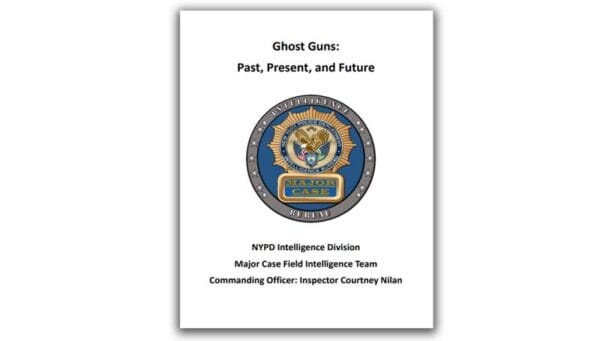
Ghost Guns: Past, Present, and Future NYPD Intelligence Division Major Case Field Intelligence Team
The guide comes from the NYPD Intelligence Division and aims to help officers identify PMFs. Although the intention is to help police identify PMFs, it reads like a “how-to guide” to firearms building. It lists all the parts needed, where to get them, and examples of homemade guns.
The guide lists a gun’s parts and gives an example of a lower receiver. According to the guide, “all lower receivers need to be serialized” because the federal government considers them firearms. Next to this statement is a picture of an 80% AR-15 receiver. The Bureau of Alcohol, Tobacco, Firearms and Explosives (ATF) Final Rule on frame and receiver is very clear on this topic.
The ATF has never and still does not consider 80% AR-15 receivers to be firearms.
The document also incorrectly states that all lower receivers must be serialized under federal law. Once again, the document is incorrect. The ATF says a frame or receiver must only be serialized when transferred. According to federal law, it is legal to have an unserialized firearm unless it previously had a serial number. Many are concerned that these inconsistencies between the law and the guide could lead to false arrests. AmmoLand News contacted the individual contacts listed in the document to see if the misinformation would be corrected, but none responded.
In addition to those retailers, the guide also covers the Ghost Gunner. The Ghost Gunner is a tabletop CNC machine that allows users to mill a firearm. It also lists the sites that sell the device and shows a picture of the founder of Ghost Gunner and Defense Distributed, Cody Wilson. The document references Defcad, which is another Defense Distributed project.
AmmoLand News spoke to Cody Wilson, who found the New York Police Department handbook to identify “ghost guns” document hilarious. He believes it is an excellent advertisement for his company.
“New York has produced the best getting started guide on the market,” Wilson said. “We will be emailing it to all of our customers.”
The document also explains how to 3D print a gun. It breaks down the printers needed, including the Creality Ender 3, and lists the filament types. It also gives an overview of the most popular slicing software. A current bill in the New York Legislature would require background checks to purchase a 3D printer.
The document also lists the most popular sites for downloading “gun CAD” files. Even if someone were to download the files, they would be unable to turn that 3D-printed model into a working firearm without certain parts. Fortunately for the building community, the NYPD documentation lists the parts and links to sites selling everything a person could use to finish the homemade firearm.
Oh No! Crypto!
The documentation touches on Glock switches purchased off of Chinese sites. These are auto sears and turn a regular Glock into a machine gun. In addition to auto sears, the document also worries about importing solvent traps to make suppressors.
The handbook also states they will attempt to get postal data to track shipments. The NYPD will also try to get Micro Center and Amazon data to track 3D printers and supply purchases. The police attend gun shows in other states to follow the selling of firearms parts.
The document also states that many who print guns are involved in cryptocurrency. The NYPD points to several gun-part retailers that accept BitCoin as a payment option. Many non-gun sites accept cryptocurrency as payment.
It also lists items to look for when executing a search warrant. These include packages, pre-paid credit cards, invoices, gun parts, storage locker keys, 3D printers, flash drives, cell phones, and micro SD cards.
The NYPD will offer a one-hour class to officers to help them identify PMFs. The content of the class has yet to be released, but when made available by the department, AmmoLand News will publish it.
Neither the NYPD, NYSP, nor eBay responded to requests for comment for this story.
LEAKED: Ghost Guns: Past, Present, and Future NYPD Intelligence Division Major Case Field Intelligence
“known to the goobermint….”
It’s not like it’s a bug, but a feature. and it is awful convenient
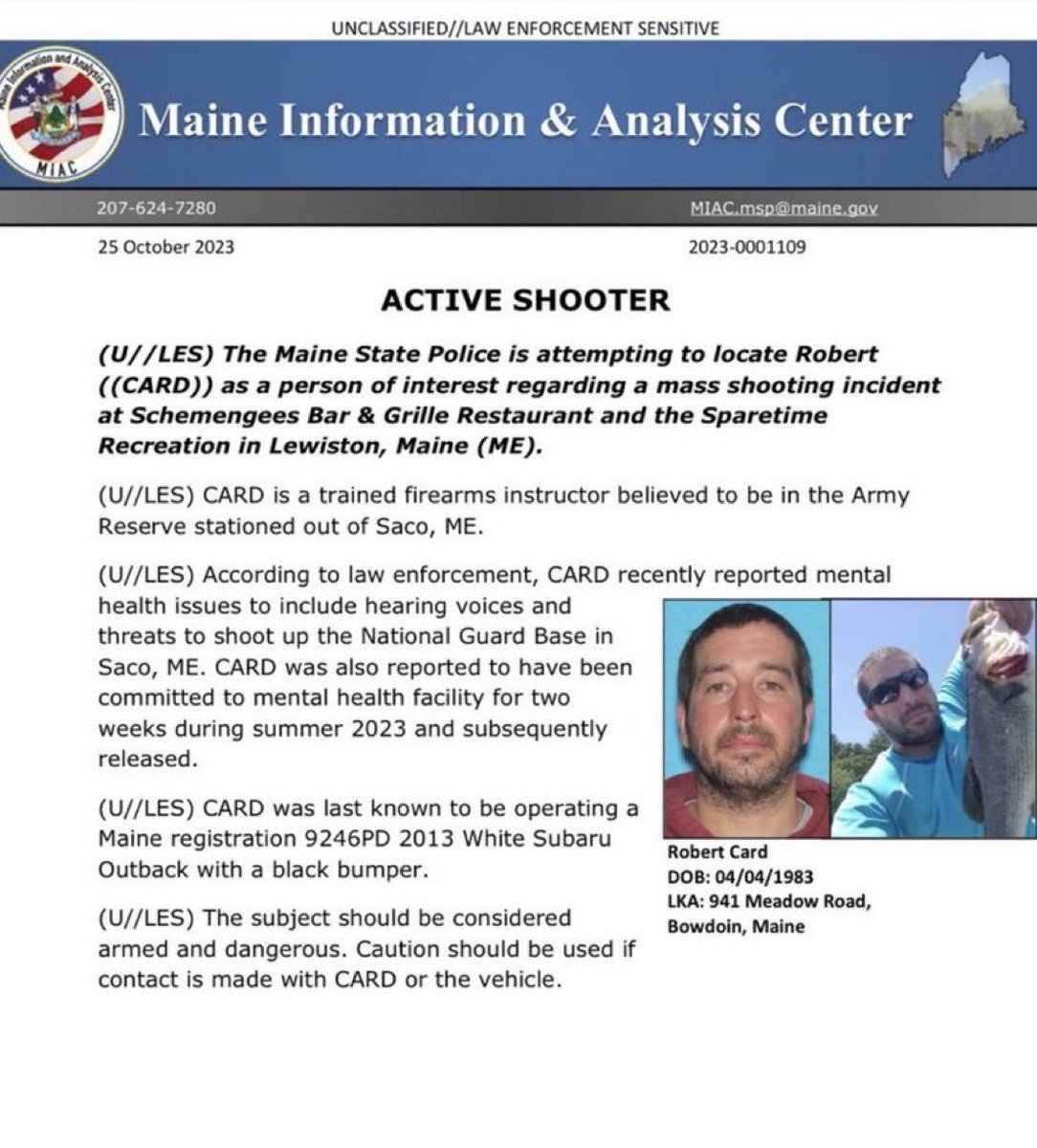
Attorney Mark W. Smith of Four Boxes Diner on YouTube:
#2A So, let me get this straight. Assuming that the bulletin below is authentic, then according to the Maine government, the alleged Maine shooter WORKED for the Government and was apparently known BY THE GOVERNMENT to be having major mental health issues including THREATENING… https://t.co/3tBJxbMnV6