To End Climate Lunacy, Stop Treating Warming & C02 Hysterically

Those who oppose economically destructive “climate” policies – like those promoted by the Biden administration and at the recent United Nations COP27 conference – will continue to fail to stop the advance of these policies so long as they continue to accept the false claim that warming of the planet and carbon dioxide emissions are harmful.

They are not. On balance, global warming and CO2 emission are beneficial.

Before getting to why that is, however, it is crucial to understand why accepting the false climate claim is so harmful.

When the destructiveness of climate policies is shown, the response is that the policies nevertheless are necessary to address what President Biden refers to as the “existential threat” of global warming and increased CO2 emissions.

When it is noted that these climate policies will at most microscopically and insignificantly reduce temperatures and CO2 emissions, climate policy mandarins push for even more draconian policies.

The result has been that since the 1990s, climate policies have become increasingly destructive and wasteful. Even worse, their continued intensification appears unlikely to be stopped until the public and policymakers are persuaded that global warming and CO2 emissions are not harmful. As Margaret Thatcher famously said: “First you win the argument, then you win the vote.”

To win this argument, it is necessary to focus on the scientific facts.

A warming planet saves lives. Analyses of millions of deaths in recent decades in numerous countries, published in the British medical journal The Lancet, show that cooler temperatures killed nine times (July 2021 study) to seventeen times (In May 2015 study) more people than warmer temperatures. The planet’s recent modest warming (by 1.00 degree Celsius on average since 1880, as calculated by NASA) thus has been saving millions of lives.

CO2 emissions do not pollute and instead are environmentally beneficial. In 2017, over 300 scientists, including Richard Lindzen of MIT and William Happer of Princeton, signed a statement that made this point: “carbon dioxide is not a pollutant. To the contrary, there is clear evidence that increased atmospheric carbon dioxide is environmentally helpful to food crops and other plants that nourish all life. It is plant food, not poison.” Every one of us, indeed, also exhales carbon dioxide with every breath.

Since 1920, deaths each year from natural disasters have decreased by over 90 percent. And this happened, data from EM-DAT – The International Disaster Database presented by The University of Oxford show, not only as the planet has warmed, but as world population has quadrupled.

Global warming has not increased hurricanes. A NOAA report, updated on November 28, 2022, states that “there is essentially no long-term trend in hurricane counts. The evidence for an upward trend is even weaker if we look at U.S. landfalling hurricanes, which even show a slight negative trend beginning from 1900 or from the late 1800s.”

The same report sums it up in bold: “We conclude that the historical Atlantic hurricane data at this stage do not provide compelling evidence for a substantial greenhouse warming-induced century-scale increase in: frequency of tropical storms, hurricanes, or major hurricanes, or in the proportion of hurricanes that become major hurricanes.”

Global warming also does not increase land burned by fires. As environmental statistician Bjorn Lomberg has shown using data from the Journal of Geophysical Research: Biogeosciences, Remote Sensing of Environment, and Earth’s Future, the percentage of global land burned per year in 1905-2021 has been declining.

Sea levels are rising – but only by a small fraction of an inch each year. An EPA report updated on August 1, 2022, states: “When averaged over all of the world’s oceans, absolute sea level has risen at an average rate of 0.06 inches per year from 1880 to 2013,” including a slightly increased rate since 1993 of “0.12 to 0.14 inches per year.”

The UN climate models that President Biden, John Kerry, and other climate doomsters use to predict future global temperatures are so speculative and unreliable that they have been unable even to reproduce the 20th century’s temperature changes. This is a key point in the must-read book by Obama Department of Energy Under Secretary for Science Steven Koonin, Unsettled: What Climate Science Tells Us, What It Doesn’t, and Why It Matters.

These kinds of facts should persuade the public and policymakers to stop accepting the false claim that global warming and CO2 emissions are harmful.

When this false claim is no longer widely accepted, policymakers will stop imposing climate policies that particularly impoverish the world’s poor.

They will stop holding international boondoggles like COP27 and that demand vast climate-related foreign aid programs.

They will stop spending hundreds of billions of dollars on domestic climate sinkholes.

And they will stop using purported “social cost of carbon” factors (even though the true social cost of carbon is zero) to regulatorily restrict domestic fossil fuel production, transportation, and use.


Global Warming? Northern Hemisphere Snow Cover At 56-Year High

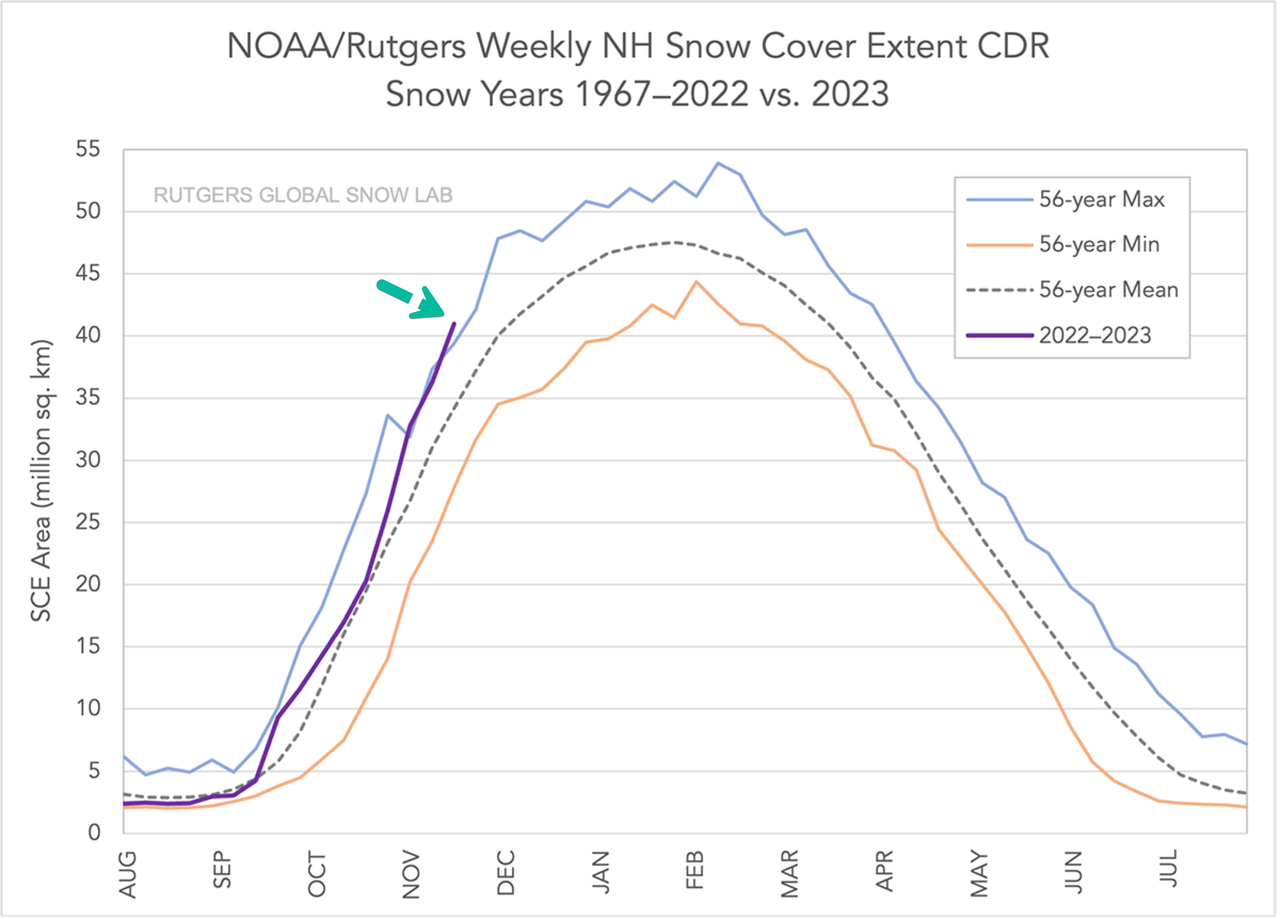
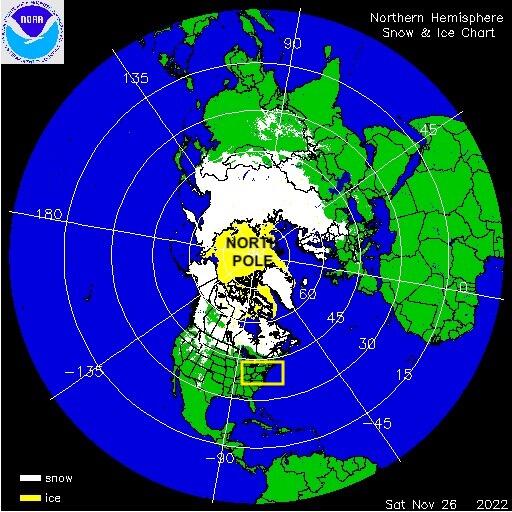
The COP27 climate change conference wrapped up last month. World leaders flew in private jets to Egypt to discuss how fossil fuels were quickly heating the planet to the point of no return, as humanity was doomed if crucial climate change policies weren’t implemented. But while the climate alarmist leaders met in the desert, November’s snowfall across the Northern Hemisphere was running at rates exceeding a half-a-century average. NOAA and Rutgers University released new data that showed snow cover across the Northern Hemisphere reached the highest level since measurements began in 1967 and are currently above the 56-year mean.

Here’s the Rutgers Global Snow Lab snow coverage map across the Northern Hemisphere.

And another from NOAA with more resolution.

“Extensive snow extent early in the season is an indicator of persistent cold as we head into winter proper,” weather blog Severe Weather Europe said.

Most mainstream media outlets overlooked this data because it is an inconvenient truth for the climate change narrative they’re pushing.

A severe winter for the Northern Hemisphere might complicate power grids for western countries that are hellbent on disrupting energy flows by sanctioning Russia, forcing the world into the worst energy crisis in a generation. Since the US and Europe’s natural gas storage facilities have flipped into withdrawal season, the clock starts as storage levels could quickly wind down if temperatures stay below average, which would continue to boost energy prices.

Climate Change Motivates a Reevaluation of Nuclear Energy.

Ironically, the people who profess to care most about climate change have been those who most vociferously reject the technology that can solve it. But this is changing

As world leaders and activists gather in Egypt this week to ruminate about global warming, there are signs that many are willing to look beyond doctrinaire—and heretofore less than fruitful—policies founded on renewable generation sources, such as wind and solar. Whatever the merits of climate change arguments, it is clear that the issue is causing many inveterate opponents of nuclear energy to embrace the technology as the one available that can do something about it.

The influential American Climate Perspectives survey, published in 2021 with addenda out this year by environmental nonprofit ecoAmerica, pointed out that American attitudes about nuclear power are shifting decidedly into the positive column, with the movement most profound on the left. A summary released by the organization along with the report noted that support for nuclear power among Americans grew by 10 points between 2018 and 2021, from 49% to 59%. And while support among Republicans held steady during that time (hovering around 65%), support among Democrats increased sizably over the same period—from 37% in 2018 to 60% in 2021. And this shift seems to be indicative of a worldwide movement of opinion.

Renewables Flicker

Renewable energy sources are perfectly fine technologies for generating electricity at certain scales under particular weather conditions and in localities close to the point of consumption, and they are widely regarded as an essential part of achieving a carbon-free future. But experience shows that there is no way solar and wind power and the attendant battery storage technologies will be able to sustain a modern economy on their own.

According to Frank Hiroshi Ling, chief scientist at the Anthropocene Institute, a clean power and climate technology incubator that cooperated with ecoAmerica on its report, a growing realization that renewables are not up to the task may be spurring a corresponding interest in nuclear energy. “The Democrats traditionally have been the early advocates for renewables,” Ling said. “Yet renewables have not scaled up as quickly as many had hoped. People are learning that there are a lot of limitations to increasing capacity through renewables.”

The challenges of implementing a purely renewable electric grid have been well documented. From a technology standpoint, the key limitation is the intermittency of solar and wind power generation when the sun isn’t shining or the wind isn’t blowing, respectively. On the manufacturing and supply chain side, renewable generation technologies and batteries to support them require a lot of resources, such as rare earth metals, that are not processed in the U.S. and have a train of environmental baggage all their own.

“I would not necessarily call myself pro-nuclear,” Ling said. “But I am looking at all the technologies that we need to achieve stabilization of the planet’s climate. That means we should look at energy systems from the perspective of resiliency, and that means looking at a diversity of mixes. I am also in favor of renewables. But every energy source out there has its drawbacks. Nuclear would address many concerns, but we still have that problem with the public perception.”

Continue reading “”

The Dirty Secrets inside the Black Box Climate Models

The world has less than a decade to change course to avoid irreversible ecological catastrophe, the UN warned today.” The Guardian Nov 28 2007

“It’s tough to make predictions, especially about the future.” Yogi Berra

Introduction

Global extinction due to global warming has been predicted more times than climate activist, Leo DiCaprio, has traveled by private jet.  But where do these predictions come from? If you thought it was just calculated from the simple, well known relationship between CO2 and solar energy spectrum absorption, you would only expect to see about 0.5o C increase from pre-industrial temperatures as a result of CO2 doubling, due to the logarithmic nature of the relationship.

Figure 1: Incremental warming effect of CO2 alone [1]

The runaway 3-6o C and higher temperature increase model predictions depend on coupled feedbacks from many other factors, including water vapour (the most important greenhouse gas), albedo (the proportion of energy reflected from the surface – e.g. more/less ice or clouds, more/less reflection) and aerosols, just to mention a few, which theoretically may amplify the small incremental CO2 heating effect. Because of the complexity of these interrelationships, the only way to make predictions is with climate models because they can’t be directly calculated.

The purpose of this article is to explain to the non-expert, how climate models work, rather than a focus on the issues underlying the actual climate science, since the models are the primary ‘evidence’ used by those claiming a climate crisis. The first problem, of course, is no model forecast is evidence of anything. It’s just a forecast, so it’s important to understand how the forecasts are made, the assumptions behind them and their reliability.

Continue reading “”

I’ll consider that ‘global warming’ may be a crisis when the people who tell me it’s a crisis start to act like it’s a crisis themselves

Four hundred private jets arrived in Egypt during COP27 as climate delegates are accused of ‘hypocrisy.’

Climate delegates were accused of hypocrisy after 400 private jets arrived in Egypt for COP27.

Numerous posts on social media criticised delegates for travelling by private jet to the UN climate summit.

Posts and reports included various estimates for the number of such planes bringing delegates to the gathering in the beach resort of Sharm el-Sheikh.

Climate delegates were accused of hypocrisy after 400 private jets arrived in Egypt for COP27 (File image)

Egyptian sources corroborated widespread claims that some 400 private jets landed during COP27.

Some media cited lower estimates by flight-trackers, though there may have been private flights that were not logged by monitoring services.

One misleading post in Spanish claimed there were as many as 1,500 private jets. It was accompanied by an old photograph of planes from an aviation forum in Las Vegas.

‘More than 400 private jets landed in the past few days in Egypt,’ a source close to the Egyptian aviation authorities, who asked not to be named, told AFP on Thursday.

‘There was a meeting ahead of COP27, and officials were expecting those jets and made some arrangements in Sharm el-Sheikh airport to welcome those planes.’

Continue reading “”

Comment O’ The Day
They’re idiots, and when you put idiots in charge, the result is disaster.

Massachusetts offshore wind project “no longer viable.”

A wind energy company named Avangrid has been in the process of developing a massive offshore wind farm called the Commonwealth Wind project, working with the support of the state of Massachusetts for several years. When completed, it was to be a 1,200-megawatt energy source. A second offshore project from Mayflower Wind was to produce an additional 400 megawatts. But now, the companies behind both of these projects have asked the state to put the plans on hold.

The reason given was that the projects are “no longer viable” under the current conditions and they will be unable to move forward for the time being. But the reason for hitting the brakes has little to do with technology or weather and a great deal to do with the economy. (New Bedford Light)

A major offshore wind project in the Massachusetts pipeline “is no longer viable and would not be able to move forward” under the terms of contracts filed in May. Both developers behind the state’s next two offshore wind projects are asking state regulators to pause review of the contracts for one month amid price increases, supply shortages and interest rate hikes.

Utility executives working with assistance from the Baker administration last year chose Avangrid’s roughly 1,200-megawatt Commonwealth Wind project and a 400 MW project from Mayflower Wind in the third round of offshore wind procurement to continue the state’s pursuit of establishing cleaner offshore wind power. Contracts, or power purchase agreements (PPAs), for the projects were filed with the Department of Public Utilities in May.

As noted above, these wind farms aren’t being put on hold because the wind suddenly stopped blowing offshore. (Though that does happen from time to time.) Nor were the developers running into problems with their turbines, or at least no more than usual. As with so many things in American politics and the industrial sector… it’s the economy, stupid.

The problems being cited by the developers are no doubt familiar to almost all of you by now. They are describing global commodity price increases, sudden increases in interest rates, and supply chain woes that are slowing production and driving up costs. Declining labor force levels are adding additional concerns. All of these factors are combining to make the construction of the project unsustainable.

There’s an obvious bit of irony in seeing the same state and federal government actors who have pushed “green energy” down everyone’s throats sitting on this particular sideline. Those same people whose policies helped drive this collapse in the supply chain and the labor market, along with the spike in the prices of pretty much everything, are now watching as one of their signature “clean energy” achievements falls victim to the conditions they created.

In their brief, the developers suggested possible solutions to get them back on track. These included cost-saving measures and government tax incentives. But the only way these projects ever got off the ground initially was because the government was already massively subsidizing the wind energy industry in general and these proposed wind farms in particular. Wind energy is not profitable in and of itself without huge government subsidies. And now that the economy has largely collapsed over the past two years, those chickens are coming home to roost, assuming they avoid getting chopped up in the blades of a wind turbine like the eagles.

Here’s an exit question for the peanut gallery to consider. Has anyone checked to see how well these turbines would hold up if a category 4 or 5 hurricane blew through? It doesn’t happen often off the coast of the northeast, but I’m sure that the people there still remember Sandy. I did some checking, and the developers claim that those sorts of weather events have been “taken into consideration.” But those towers look rather spindly to be standing tall in 150-mile-per-hour winds. But hey… maybe that’s just me.

When you don’t have facts or reason on your side and don’t care to learn the facts, what’s left?

Infantilization Of The Apocalypse.

Dumping milk onto floors. Hurling food onto walls. Refusing to eatGluing body parts. Throwing paintRefusing to leave. Threatening to pee and poop in your pants. Screaming accusations. Are those the behaviors of a toddler’s temper tantrum? Yes. But they’re also the dominant tactics of today’s climate activists.

Consider the case of Gianluca Grimalda. On October 19, Grimalda, along with 15 other members of a climate activist group called Scientist Rebellion, glued himself to the floor of the visitors center next to a Volkswagon factory in Germany. The VW security guards brought pizza to Grimalda and the other activist scientists, but Grimalda felt disrespected and so he declared a hunger strike in retaliation.

Grimalda immediately expressed outrage at his treatment. “VW told us that they supported our right to protest,” he complained on Twitter, “but they refused our request to provide us with a bowl to urinate and defecate in a decent manner while we are glued, and have turned off the heating.”

Many were quick to point out the childish nature of the protest. “I’m a serious scientist protesting against fossil fuels,” wrote one user. “Now turn the gas heating on and bring me my potty.”

The activists say that such childish tactics were necessary. Grimalda tweeted that he and his colleagues are protesting “until our demands to decarbonise the German transport sector are met.” On Sunday, after climate activists in Germany threw mashed potatoes on a Monet painting, they screamed at the nearby museum-goers. “We won’t be able to feed our families in 2050” because of climate change, they alleged.

But Volkswagen already agreed last year to end the sale of vehicles with internal combustion engines by 2035, and the UN Food & Agriculture Organization (FAO) predicts rising yields under even very high temperatures so long as farmers keep using fertilizer, irrigation, and tractors. That is, yields will continue under climate change so long as farmers don’t take the advice of climate activists.

The activists who keep degrading precious works of art, and themselves, claim to be concerned about food and energy supplies, but in opposing oil, gas and fertilizer production they are actively reducing both. Over the last several months, I have described the demands of climate activists as fanatical and pointed to a large body of evidence suggesting that nihilismnarcissism, and feelings of personal inadequacy are the primary motives.

But nihilism, narcissism, and personal inadequacy alone do not explain why climate activists have chosen temper tantrum tactics. After all, the greatest protest movements of all time engaged in far more grown-up and dignified tactics. Think of the Salt March led by Gandhi, the Montgomery Bus Boycott led by Martin Luther King, and the anti-whaling protests of Greenpeace.

Where protesters in the past asked to be treated like adults, climate protesters today demand to be treated like children. Civil rights activists in the 1950s sat at lunch counters and demanded to be treated like full adults. Notably, it was racist counterprotesters who poured milkshakes over them. Today, it’s the protesters who are spilling milk and throwing food.

Why is that, exactly? Why have Left-wing activists regressed in their tactics?

The people in the protests are themselves apparently dignified people. Grimalda is an economist who works at the Kiel Institute for the World Economy. He has published for the Proceedings of the National Academies of ScienceNature Communications, and other prestigious publications. Why, then, are he and his colleagues acting like babies?

Role Reversal

Racist counterprotesters dump milkshakes over a white social science professor and his black students sitting at the “Whites Only” counter in Woolworth’s store lunch counter in May 1963 in Jackson, Mississippi (left). Climate activists dump soup over Van Gogh’s “Sunflowers” in October 2022 (right).

When the reality of econuttery is finally realized, it gets the boot.

Wind Farm in Germany Is Being Taken Down for Expansion of Coal Mine

In the throes of an energy crisis, a German energy company is moving forward with plans to dismantle a wind farm adjacent to its coal mine in order to expand operations.

The removal of one of the wind farm’s eight wind turbines occurred last week, with two more coming down next year and the rest getting removed by the end of 2023.

Recognizing the “paradoxical” nature of the situation, Germany energy company RWE, which operates the Garzweiler coal mine, said it’s necessary.

“We realize this comes across as paradoxical,” RWE spokesperson Guido Steffen told the Guardian. “But that is as matters stand.”

The expansion comes in tandem with a plan to temporarily return three of RWE’s lignite-fired coal units to the market, a decision that was approved by Germany’s cabinet. The units were previously on standby.

“The three lignite units each have a capacity of 300 megawatts (MW). With their deployment, they contribute to strengthening the security of supply in Germany during the energy crisis and to saving natural gas in electricity generation,” RWE said in September.

“Originally, it was planned that the three reserve power plant units affected would be permanently shut down on September 30, 2022, and September 30, 2023, respectively,” RWE added.

Germany’s cabinet approved the decision to bring back the idled coal units to boost energy supplies, as energy imports remain hindered by the Russia-Ukraine War.  (Fox Business)

The ministry for economic and energy affairs of the state of North-Rhine Westphalia, meanwhile, is urging RWE to reconsider its plans.

“In the current situation, all potential for the use of renewable energy should be exhausted as much as possible and existing turbines should be in operation for as long as possible,” a spokesperson told the Guardian.

Make their behavior more painful than it is rewarding and they will stop.

The Quiet Desperation Of Woke Fanatics.

What’s driving them? And how can they be defeated?

Protesters with “Just Stop Oil” after throwing tomato soup at Van Gogh’s “Sunflowers” in London, October 14, 2022. (Photo Credit: Just Stop Oil.)


“The fiercest fanatics are often selfish people who were forced, by innate shortcomings or external circumstances, to lose faith in their own selves. They separate the excellent instrument of their selfishness from their ineffectual selves and attach it to the service of some holy cause.” 
— ERIC HOFFER, THE TRUE BELIEVER


Over the last few weeks, climate activists in Britain have blocked highways (because cars emit carbon dioxide), poured milk onto the floors of supermarkets (because livestock emits methane), and thrown tomato soup at Van Gogh’s “Sunflowers” (because climate change is more important than art. Or something). The activists are a kind of reboot of the Extinction Rebellion (XR) climate protests in the UK in the fall of 2019.

People in the UK are at risk of dying from natural gas shortages. Still, the climate activists with “Just Stop Oil” think it’s outrageous that their government is desperately trying to produce more natural gas for its people. But without more natural gas, there could be three-hour-long blackouts, which threaten the operation of medical equipment, and thus the lives of vulnerable people.

The various media stunts appeared authentically grassroots but were, in fact, financed by a $1 million grant from a philanthropic group called Climate Emergency Fund, which is funded by their heirs to the Getty and Rockefeller oil fortunes, and founded in 2019. The Board of Directors consists of a who’s-who of climate alarmism including “Don’t Look Up!” film director, Adam McKay, who donated $4 million, New Yorker writer Bill McKibben, and New York Times columnist David Wallace-Wells.

The Fund and their grantees have been cheered on by the Secretary General of the United Nations and much of the mainstream media.Image

A portion of the web page of Climate Emergency Fund.

In a series of recent articles I have argued that what lies behind climate fanaticism and narcissism is an apocalyptic religion born from nihilism. The power of science to explain humankind’s place in the universe (e.g., the big bang, evolution by natural selection) resulted in a dominant narrative coming out of society’s elite institutions for over 100 years that human life has no inherent meaning or purpose (nihilism). We’re just animals like any other.

This depressing story has led the ostensibly secular elite, which are educated and indoctrinated in universities that teach nihilism as unquestioning scientific gospel, to create a new apocalyptic religion (climate catastrophe), complete with a new victim-god (nature), a new reason for guilt (sins against nature), and a path for redemption (renewables and low-energy living). It, and the broader Woke religion, have found intellectual ballast since World War II from Rousseau, Malthus, and Foucault.

But that account only partly addresses the motivations of the fanatics. It doesn’t answer why some people become fanatics and others don’t. It doesn’t explain the specific role of fanatics, particularly in relation to other actors, such as the intellectual architects of the movement, and the institution-builders. Nor does it address how fanaticism ends and what, if anything, can be done to hasten its expiration date.

As such, we need to ask, who exactly are the climate fanatics? And how can their power over Western cultural and political life be reduced?

Continue reading “”

BLUF
Notice how frequently the characters in this melodrama employ rhetoric such as “fighting climate change on the frontlines.” They intentionally frame COVID-19 as a war. And it is – only against you, not against carbon emissions.

Join the other side, the real rebellion – the side of humanity against the technocrat overlords on the digital plantation — by enlisting in a parallel economy/society.

WEF Mafioso Threatens Climate Annihilation, Demands $2 Trillion as Protection Money

WEF transhumanist Yuval Noah Harari – who recently declared that the techno-hell he’s constructing doesn’t need “the vast majority of the population” – has returned to demand that the serfs offer more tribute to their overlords for “climate change.”


CNN news actor Bill Weir, who facilitates the discussion, gets things started by sycophantically slobbering all over Harari’s knob in his introduction, fawning over his supposed genius.

An eager beaver, Weir, a purportedly serious CNN—The Most Trusted Name in News™—”journalist,” gets as giddy introducing Harari as a preteen girl meeting Justin Bieber backstage. It’s very strange, and embarrassing. Weir’s wife surely shudders when he comes home and climbs into bed, with Harari’s stench lingering on his person, and probably a few pubic hairs stuck in his teeth.

In this manner, Weir offers an unintentional, powerful insight into just how influential WEF leadership actually is within the corporate media: the mere opportunity to toss Harari softball questions fills him with childlike excitement.

Weir then introduces, albeit much less enthusiastically, a special guest, the obligatory Climate Change Person of Color©—fresh-faced, barely-legal “climate activist” Vanessa Nakate, who, as Weir explains, “focuses on how the climate crisis is exacerbating gender equality.”

Climate crisis —> gender inequality: imagine connecting those dots! It certainly takes creativity, so credit where credit is due. The girl clearly has a healthy imagination.

Continue reading “”

Here’s the Latest Climate Change Projection That Was Totally Wrong

As if this is shocking news, the global warming Armageddon peddlers were wrong again. How many times have we heard that we’re all going to die if we don’t sacrifice economic growth to reduce global temperatures by an indiscernible amount? Democrats had a full-blown meltdown over the haggling about the latest spending bill when it seemed as if it were on life support. If we don’t pass the inflation reduction act, which quickly became a climate change bill—civilization will end. The New York Times had an op-ed declaring that the Democrats’ spending bill just saved the world.

The latest doomsday scenario to be proven incorrect is related to this past summer’s temperature, which was 1.5 degrees warmer than the 50-year average. Yet, it was way off the 5.4-degree projection cast by Professor James Hansen, one of the godfathers of the global warming hysteria. Hansen is known for his series of congressional testimonies in the 1980s that created public awareness. Steve Milloy used The Washington Post’s tool regarding temperature changes this past summer to expose the shoddy projection.

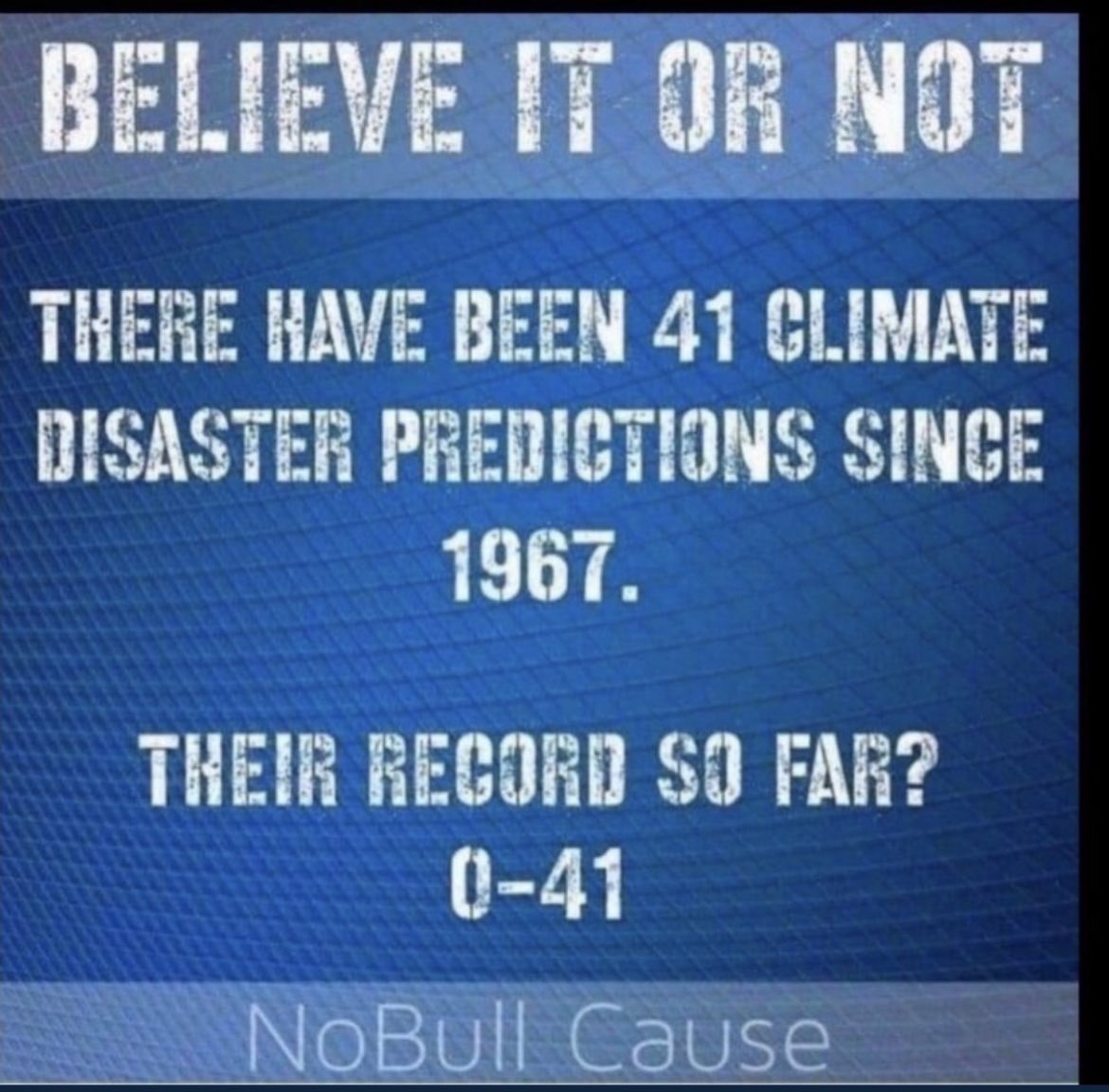
It’s a pattern that cannot be ignored. The climate change prognosticators said in 2007 that the Artic Ice Cap would melt by 2013. In 2013, the ice cap was intact and had grown by 538,000 square miles. That same year, it was the calmest hurricane season in almost 20 years. It was also the quietest tornado season that year in nearly 60 years. To flashforward to the present, the 2022 hurricane season is now the most undisturbed in almost three decades.

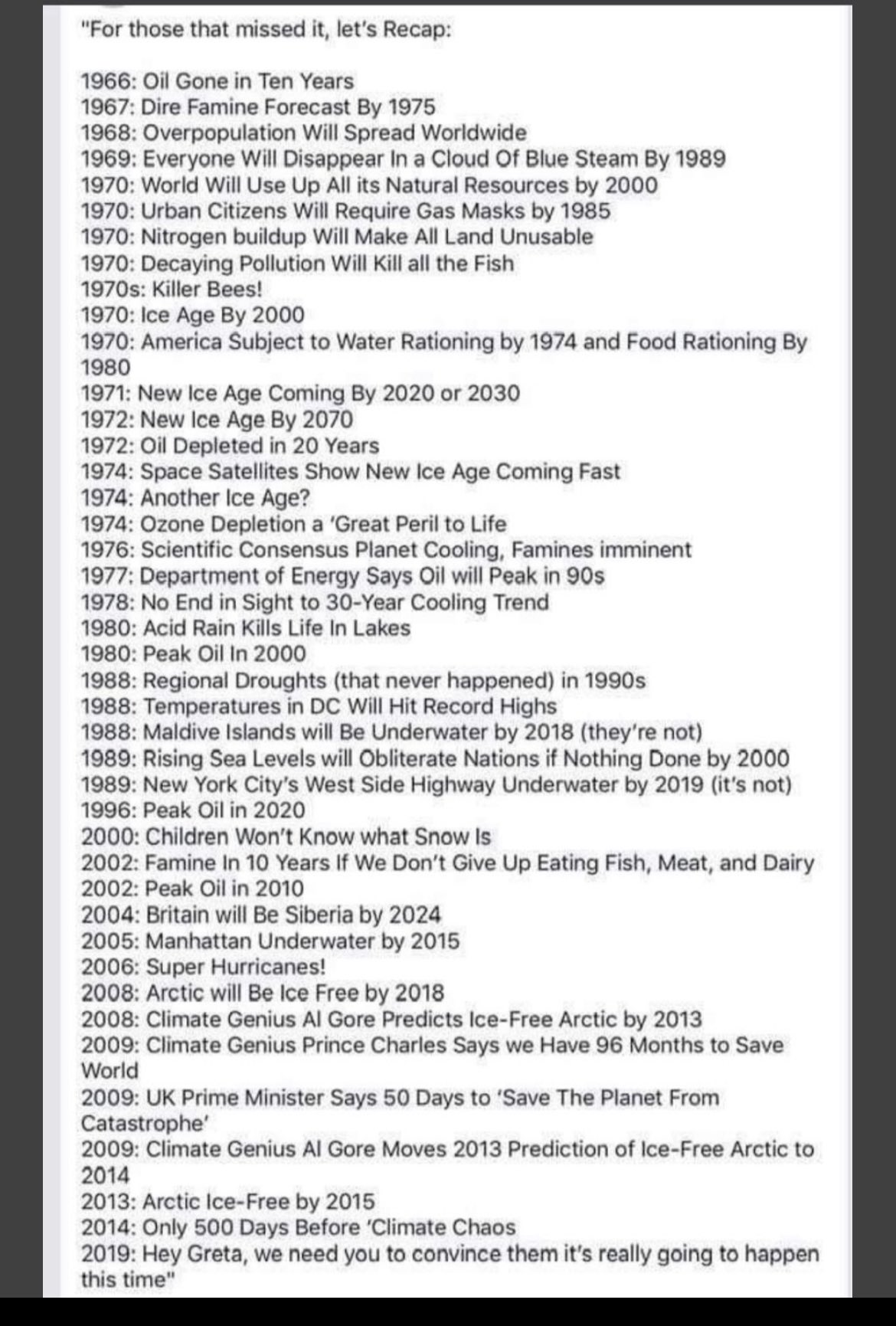
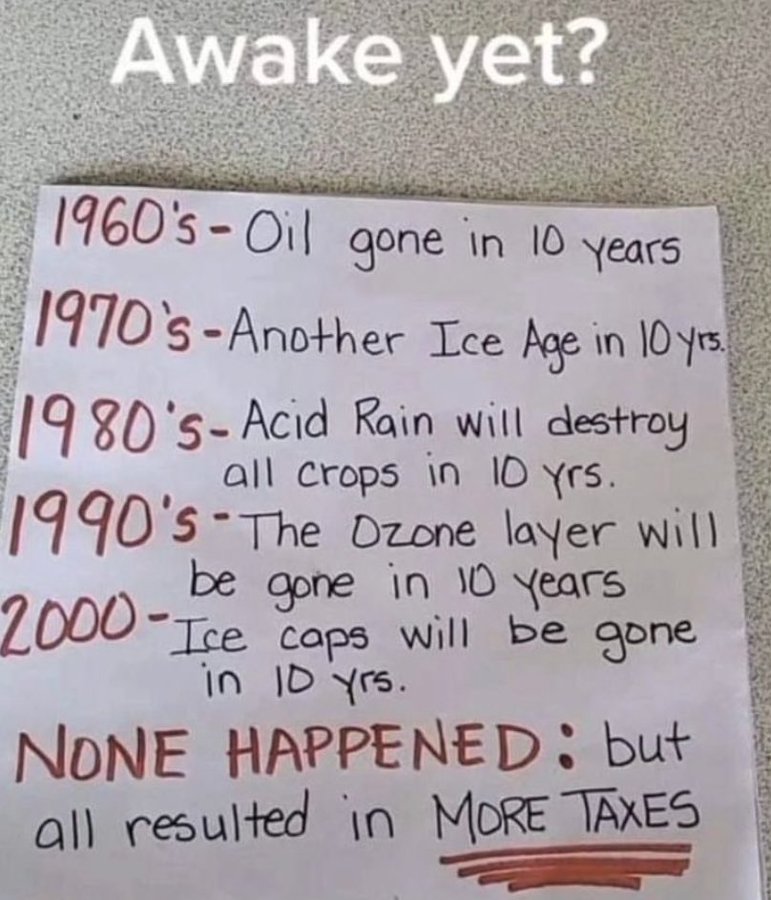
In the 1970s, people who predicted the total annihilation of humanity over global warming thought that ‘global cooling’ would create a massive food crisis as the North American continent would undergo another period of glaciation. That didn’t happen either, but we must listen to them now and waste trillions in economic output and growth to avert disaster. If we don’t heed their warnings, we could all be dead in 12 years or something. In other news, we have another great weekend of football, college, and professional. That’s much more important than anything these green people say since they’ve been wrong about everything.

BLUF
Back in the United States, American Farm Bureau Federation Chief Economist Dr. Roger Cryan estimates that a Sri Lankan-style move would cut domestic grain crop production by about 50 percent within two to four years of implementation, leading to massive price hikes and acute shortages of basic commodities……

Should California – or the nation –  take the path of most destruction and implement restrictions or even fertilizer bans, the social and economic impacts would be catastrophic and could hearken back to the conditions during the Great Depression of the 1930s – except this time there wouldn’t be any bread lines because there wouldn’t be any bread.

From Sri Lanka to Salinas

Ah, Sri Lanka.

In 2020: a beautiful, agriculturally self-sufficient island nation full of tea and tourists and holder of the highest “Environmental, Social, and Governance” (ESG) investor rating in the world.

And then, as part of the larger “green” effort spurred on by international Non-Governmental Organizations (NGOs), woke capital, and, seemingly, a desire to sit at the big table at the various and sundry global initiative conferences, President Gotabaya Rajapaksa banned the use of manufactured fertilizer in order to create a more climate-friendly sustainable farming sector.  In April, 2021, the country went all-organic overnight.

What could possibly go wrong?

By the end of last year, Sri Lanka became unable to feed itself, prices for food (especially rice) and fuel and other daily basics skyrocketed, the tea crop – and the hundreds of millions it earns in international trade – was decimated.  The nation defaulted on its foreign debt, had rolling power blackouts, the tourists are staying away in droves, and Sri Lanka,  already wracked by corruption and COVID, spiraled out of control.

The public’s response?  Even though the fertilizer ban had already been partially rolled back, just last month Rajapaksa’s presidential palace was stormed by thousands of everyday Sri Lankans and he had to flee the country – last word was that he was holed up in Singapore.

(Side note to Nancy Pelosi and Liz Cheney – this is what an actual insurrection looks like:)

It seems Kermit was right – it ain’t easy being green.

But, considering the state’s claim to be the global leader in fighting climate change, can California – with its extremely powerful “climate lobby” that was able to ban the future sales of new gas-powered vehicles, a concept that would have been unthinkable a very few years ago –  be far behind?

California’s commitment to confronting climate change cannot be underestimated., as proven by the 86 different climate partnerships, or “bilateral and multilateral agreements with national and subnational leaders” the state as entered into.  (The list can be found here:  https://www.energy.ca.gov/about/campaigns/international-cooperation/climate-change-partnerships .)

Additionally, a quick tour of state department websites finds numerous examples of “green,” “sustainability,” and “climate” pages and plans; even the state’s prisons get into the act with its climate change plan: https://www.cdcr.ca.gov/green/cdcr-green/climate-change-adaptation/ .

It should be stressed that California is not above shooting itself in the foot when it comes to climate issues. Thursday, the legislature passed a bill mandating 3,200-foot “buffer zones” around all – new and existing – oil and gas wells, a move which would practically eliminate the industry – and its 13,000 jobs – in the state.

Continue reading “”

A reality check on electric school buses.

A recent Denver Post article describes how the Aurora school district added 7 electric school buses to its existing fleet of 151 total.  Sadly the article focused mainly on the politics.  Gov. Polis got in his talking points, the Republican quoted got in his, fun was had, and we all moved on with our day.  Disappointing.  For my taste, sound bites from politicians, particularly those of practiced and savvy career politicians like Polis, hide lots of detail which are important for us to know if we’re to be able to assess the decisions of those we elect.  Without details, without numbers, we’re left with the imprecision of language (fertile ground indeed for politicians).

The best way to summarize the difference between electric and internal combustion buses is that electric likely costs more upfront and less later, while internal combustion is cheaper to buy and likely more to operate.  I’m being careful to qualify my statements here because we don’t have a good handle on costs yet (also “internal combustion” is a large category with different fuels/engines to consider).  Looking into the matter has also convinced me that what you include–and what you don’t–when calculating makes a big difference.  Diesel buses are the standard choice across the country with electrics making steps into the market. Orders for electric buses are going up quickly, but are only about 1% of current rolling stock.

Running the numbers

Analyses of bus costs (electric vs. internal combustion) abound, making it tough to decide whose numbers to rely on, but I chose to analyze those of California’s electric utility (PGE).  Their estimator compares diesel to electric school buses, and should also remove any doubt that I’m trying to shade things; PGE is a big proponent of electric.

From the PGE site, we learn that diesel buses are about $90K to buy and cost about $1.11 per mile to run, including maintenance and fuel.  Electric buses cost $350K (the Post article has them at $375K) and cost about $0.20 per mile, including maintenance and fuel.  Clearly it’s cheaper to buy diesel and to run electric.  The $260K cost differential between the two, however, effectively means that any district wanting to take advantage of lower operating costs is going to need help.  Enter both the federal and Colorado state government to buy down the cost of the electric buses with big subsidies. Colorado and the feds pay 80% of the bus cost, and the district makes up the other 20%.

All the same, there are some things missing from PGE’s estimates.  There is more capital investment to electrics than just their higher purchase price.  Diesel is a known quantity.  Shops have mechanics, tools, and knowledge about how to maintain them.  Electric?  Not so much.  So add in the costs to train your mechanics and buy specialized tools.  Oh, you’ll also need to install chargers.  I couldn’t find numbers on the increase in costs for tools and training, but PGE was helpful enough to give estimates on the chargers and maintenance:  $13,750 per and $1,100 per year respectively.

I’m tempted to continue (increased sales tax costs and hidden costs like out of service time), but I think you get the point.

Continuing with the finances, the last thing to consider is the time it will take us taxpayers to realize the savings on electric school buses.  If you figure an average of 16,000 miles per year (the high end estimate on yearly mileage for a bus), and include only the costs laid out here, the payback on electric is about 20 years.  That number was startling to me because 20 years was the top end, best-case-scenario I could find for the life of the bus batteries.  In other words, right as we’d start to realize the savings, the bus would stop working.

Continue reading “”

Yes.

Is modern environmentalism a pagan religion?

The great Rush Limbaugh used to say that “the modern environmentalists worship the created, not the creator.” I was reminded of that after listening to House Speaker Nancy Pelosi once President Joe Biden signed the fiscally unconscionable $750 billion tax-and-spend Inflation Reduction Act, which gives another $300 billion to the climate change-industrial complex.

Pelosi (D-CA) claimed the wind, solar, and electric subsidies in the Inflation Reduction Act would placate an “angry” planet. “Mother Earth gets angry from time to time, and this legislation will help us address all of that,” the speaker said.

This is a highly revealing statement. Do Pelosi and her Democratic colleagues really believe that spending $300 billion on Tesla subsidies (with batteries made in China), windmills (made in China), and solar panels (made in China) is going to save the planet, stop the rise of the oceans, and lower the global temperature?

This is the same gang in Congress that can’t stop the daily drive-by shootings in our cities, can’t secure the U.S.-Mexico border, can’t come anywhere near balancing the budget, and can’t provide the resources our military needs for our national security.

Even if this additional $300 billion were to work as planned, the Wall Street Journal reports that the impact on global temperatures in the coming decades would be to lower them by 0.001%. So, instead of the global temperature being an average of 59 degrees Fahrenheit, it will be 58.999 degrees. Thank God! We are saved from Armageddon.

But as Pelosi’s quote makes clear, this is about symbolism. It is about ruining the economy as a sacrifice to Mother Earth. Marc Morano, the journalist who runs the Climate Depot website, asks: “Will human sacrifices be next to appease the ‘angry’ Earth gods? Actually, this bill will create human sacrifice by imposing even more suffering from energy deprivation, supply chain issues, good shortages, inflation, debt, and bad science.”

He’s right. The suffering that will occur from this assault on American energy security and reliability could be profound — and it will be the lowest-income people who will be hurt the most. Inflation will rise as energy prices soar. The shortages of energy will cause hardship for many consumers, including food shortages. Europe, which got hooked on the green energy fad, is now rationing energy. In Spain, there are new restrictions on using air conditioning to set the temperature of your store or home at less than 80 degrees — during a heat spell. It’s one of those sacrifices to Mother Earth.

One of the great injustices and ironies of the new law is that it purports to give billions of dollars for “environmental justice” grants to low-income communities and inner cities when it is this group of people who will feel the brunt of the anti-fossil fuel policies. The poor spend three to five times more of their incomes on energy than the rich.

The warmest years in North America are not recent years — instead, they occurred during the 1930s amid the Dust Bowl era. This was before 80% of the carbon dioxide was released into the atmosphere. Back then, tens of thousands of U.S. residents died from extreme weather. But now we have, through modern electric power and technological innovation, major ways to reduce death rates from weather events. The way to save the Earth is through more growth, more innovation, and a richer planet.

That is what Mother Earth wants. That is what America wants. Only 1 out of 20 people rate climate change as the No. 1 problem facing our country. The public wants lower inflation and more prosperity. This law delivers neither.

The God that most of us worship wants us to create peace, prosperity, and light. The god of radical environmentalists will deliver darkness, despair, and decline.

Doomsday Climate Predictions Meltdown: Arctic Sea Ice Extent Reaches 12-Year Mid-August High.

According to Al Gore, based on statements and “science” from “leading climate experts”, the Arctic was supposed to be ice-free in the summer already years ago.

Now that the summer ice melt season in the Arctic will end soon, by the middle of next month, it’s a good time to see how Al Gore’s prediction is faring. To do this we look at the latest from data the National Snow and Ice Data Center (NSIDC):

 Source: NSIDC Arctic Sea Ice Chart

Snowfan here zooms in on the chart for greater detail and reports that for this date, ice extent in the Arctic stands at a 12-year high:

It would be accurate to say that Al Gore’s prediction has turned out to be on par from what you’d expect from a swindling fortune teller reading tea leaves and a crystal ball.