BLUF
Back in the United States, American Farm Bureau Federation Chief Economist Dr. Roger Cryan estimates that a Sri Lankan-style move would cut domestic grain crop production by about 50 percent within two to four years of implementation, leading to massive price hikes and acute shortages of basic commodities……

Should California – or the nation –  take the path of most destruction and implement restrictions or even fertilizer bans, the social and economic impacts would be catastrophic and could hearken back to the conditions during the Great Depression of the 1930s – except this time there wouldn’t be any bread lines because there wouldn’t be any bread.

From Sri Lanka to Salinas

Ah, Sri Lanka.

In 2020: a beautiful, agriculturally self-sufficient island nation full of tea and tourists and holder of the highest “Environmental, Social, and Governance” (ESG) investor rating in the world.

And then, as part of the larger “green” effort spurred on by international Non-Governmental Organizations (NGOs), woke capital, and, seemingly, a desire to sit at the big table at the various and sundry global initiative conferences, President Gotabaya Rajapaksa banned the use of manufactured fertilizer in order to create a more climate-friendly sustainable farming sector.  In April, 2021, the country went all-organic overnight.

What could possibly go wrong?

By the end of last year, Sri Lanka became unable to feed itself, prices for food (especially rice) and fuel and other daily basics skyrocketed, the tea crop – and the hundreds of millions it earns in international trade – was decimated.  The nation defaulted on its foreign debt, had rolling power blackouts, the tourists are staying away in droves, and Sri Lanka,  already wracked by corruption and COVID, spiraled out of control.

The public’s response?  Even though the fertilizer ban had already been partially rolled back, just last month Rajapaksa’s presidential palace was stormed by thousands of everyday Sri Lankans and he had to flee the country – last word was that he was holed up in Singapore.

(Side note to Nancy Pelosi and Liz Cheney – this is what an actual insurrection looks like:)

It seems Kermit was right – it ain’t easy being green.

But, considering the state’s claim to be the global leader in fighting climate change, can California – with its extremely powerful “climate lobby” that was able to ban the future sales of new gas-powered vehicles, a concept that would have been unthinkable a very few years ago –  be far behind?

California’s commitment to confronting climate change cannot be underestimated., as proven by the 86 different climate partnerships, or “bilateral and multilateral agreements with national and subnational leaders” the state as entered into.  (The list can be found here:  https://www.energy.ca.gov/about/campaigns/international-cooperation/climate-change-partnerships .)

Additionally, a quick tour of state department websites finds numerous examples of “green,” “sustainability,” and “climate” pages and plans; even the state’s prisons get into the act with its climate change plan: https://www.cdcr.ca.gov/green/cdcr-green/climate-change-adaptation/ .

It should be stressed that California is not above shooting itself in the foot when it comes to climate issues. Thursday, the legislature passed a bill mandating 3,200-foot “buffer zones” around all – new and existing – oil and gas wells, a move which would practically eliminate the industry – and its 13,000 jobs – in the state.

Continue reading “”

A reality check on electric school buses.

A recent Denver Post article describes how the Aurora school district added 7 electric school buses to its existing fleet of 151 total.  Sadly the article focused mainly on the politics.  Gov. Polis got in his talking points, the Republican quoted got in his, fun was had, and we all moved on with our day.  Disappointing.  For my taste, sound bites from politicians, particularly those of practiced and savvy career politicians like Polis, hide lots of detail which are important for us to know if we’re to be able to assess the decisions of those we elect.  Without details, without numbers, we’re left with the imprecision of language (fertile ground indeed for politicians).

The best way to summarize the difference between electric and internal combustion buses is that electric likely costs more upfront and less later, while internal combustion is cheaper to buy and likely more to operate.  I’m being careful to qualify my statements here because we don’t have a good handle on costs yet (also “internal combustion” is a large category with different fuels/engines to consider).  Looking into the matter has also convinced me that what you include–and what you don’t–when calculating makes a big difference.  Diesel buses are the standard choice across the country with electrics making steps into the market. Orders for electric buses are going up quickly, but are only about 1% of current rolling stock.

Running the numbers

Analyses of bus costs (electric vs. internal combustion) abound, making it tough to decide whose numbers to rely on, but I chose to analyze those of California’s electric utility (PGE).  Their estimator compares diesel to electric school buses, and should also remove any doubt that I’m trying to shade things; PGE is a big proponent of electric.

From the PGE site, we learn that diesel buses are about $90K to buy and cost about $1.11 per mile to run, including maintenance and fuel.  Electric buses cost $350K (the Post article has them at $375K) and cost about $0.20 per mile, including maintenance and fuel.  Clearly it’s cheaper to buy diesel and to run electric.  The $260K cost differential between the two, however, effectively means that any district wanting to take advantage of lower operating costs is going to need help.  Enter both the federal and Colorado state government to buy down the cost of the electric buses with big subsidies. Colorado and the feds pay 80% of the bus cost, and the district makes up the other 20%.

All the same, there are some things missing from PGE’s estimates.  There is more capital investment to electrics than just their higher purchase price.  Diesel is a known quantity.  Shops have mechanics, tools, and knowledge about how to maintain them.  Electric?  Not so much.  So add in the costs to train your mechanics and buy specialized tools.  Oh, you’ll also need to install chargers.  I couldn’t find numbers on the increase in costs for tools and training, but PGE was helpful enough to give estimates on the chargers and maintenance:  $13,750 per and $1,100 per year respectively.

I’m tempted to continue (increased sales tax costs and hidden costs like out of service time), but I think you get the point.

Continuing with the finances, the last thing to consider is the time it will take us taxpayers to realize the savings on electric school buses.  If you figure an average of 16,000 miles per year (the high end estimate on yearly mileage for a bus), and include only the costs laid out here, the payback on electric is about 20 years.  That number was startling to me because 20 years was the top end, best-case-scenario I could find for the life of the bus batteries.  In other words, right as we’d start to realize the savings, the bus would stop working.

Continue reading “”

Yes.

Is modern environmentalism a pagan religion?

The great Rush Limbaugh used to say that “the modern environmentalists worship the created, not the creator.” I was reminded of that after listening to House Speaker Nancy Pelosi once President Joe Biden signed the fiscally unconscionable $750 billion tax-and-spend Inflation Reduction Act, which gives another $300 billion to the climate change-industrial complex.

Pelosi (D-CA) claimed the wind, solar, and electric subsidies in the Inflation Reduction Act would placate an “angry” planet. “Mother Earth gets angry from time to time, and this legislation will help us address all of that,” the speaker said.

This is a highly revealing statement. Do Pelosi and her Democratic colleagues really believe that spending $300 billion on Tesla subsidies (with batteries made in China), windmills (made in China), and solar panels (made in China) is going to save the planet, stop the rise of the oceans, and lower the global temperature?

This is the same gang in Congress that can’t stop the daily drive-by shootings in our cities, can’t secure the U.S.-Mexico border, can’t come anywhere near balancing the budget, and can’t provide the resources our military needs for our national security.

Even if this additional $300 billion were to work as planned, the Wall Street Journal reports that the impact on global temperatures in the coming decades would be to lower them by 0.001%. So, instead of the global temperature being an average of 59 degrees Fahrenheit, it will be 58.999 degrees. Thank God! We are saved from Armageddon.

But as Pelosi’s quote makes clear, this is about symbolism. It is about ruining the economy as a sacrifice to Mother Earth. Marc Morano, the journalist who runs the Climate Depot website, asks: “Will human sacrifices be next to appease the ‘angry’ Earth gods? Actually, this bill will create human sacrifice by imposing even more suffering from energy deprivation, supply chain issues, good shortages, inflation, debt, and bad science.”

He’s right. The suffering that will occur from this assault on American energy security and reliability could be profound — and it will be the lowest-income people who will be hurt the most. Inflation will rise as energy prices soar. The shortages of energy will cause hardship for many consumers, including food shortages. Europe, which got hooked on the green energy fad, is now rationing energy. In Spain, there are new restrictions on using air conditioning to set the temperature of your store or home at less than 80 degrees — during a heat spell. It’s one of those sacrifices to Mother Earth.

One of the great injustices and ironies of the new law is that it purports to give billions of dollars for “environmental justice” grants to low-income communities and inner cities when it is this group of people who will feel the brunt of the anti-fossil fuel policies. The poor spend three to five times more of their incomes on energy than the rich.

The warmest years in North America are not recent years — instead, they occurred during the 1930s amid the Dust Bowl era. This was before 80% of the carbon dioxide was released into the atmosphere. Back then, tens of thousands of U.S. residents died from extreme weather. But now we have, through modern electric power and technological innovation, major ways to reduce death rates from weather events. The way to save the Earth is through more growth, more innovation, and a richer planet.

That is what Mother Earth wants. That is what America wants. Only 1 out of 20 people rate climate change as the No. 1 problem facing our country. The public wants lower inflation and more prosperity. This law delivers neither.

The God that most of us worship wants us to create peace, prosperity, and light. The god of radical environmentalists will deliver darkness, despair, and decline.


Doomsday Climate Predictions Meltdown: Arctic Sea Ice Extent Reaches 12-Year Mid-August High.

According to Al Gore, based on statements and “science” from “leading climate experts”, the Arctic was supposed to be ice-free in the summer already years ago.

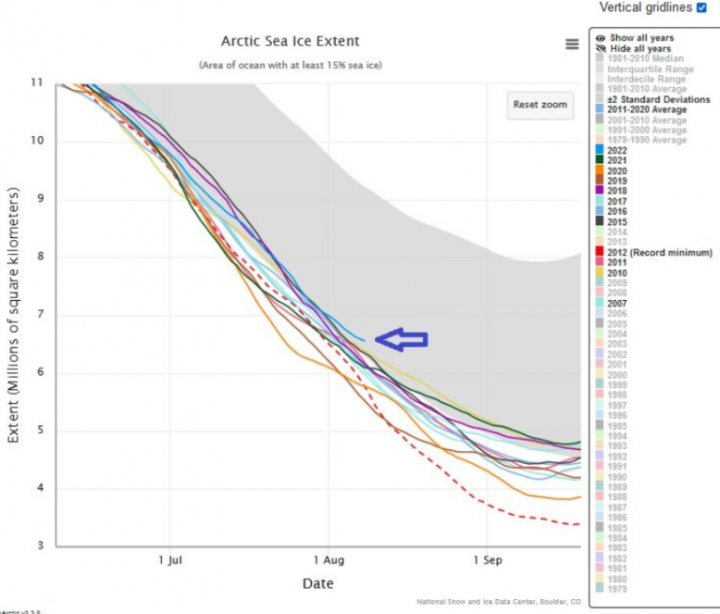
Now that the summer ice melt season in the Arctic will end soon, by the middle of next month, it’s a good time to see how Al Gore’s prediction is faring. To do this we look at the latest from data the National Snow and Ice Data Center (NSIDC):

 Source: NSIDC Arctic Sea Ice Chart

Snowfan here zooms in on the chart for greater detail and reports that for this date, ice extent in the Arctic stands at a 12-year high:

It would be accurate to say that Al Gore’s prediction has turned out to be on par from what you’d expect from a swindling fortune teller reading tea leaves and a crystal ball.

It’s amazing what the prospect for a winter with little to no heat will do


European Commission Declares Nuclear and Gas to be Green.

From Deutsche Welle

The European Commission has labeled nuclear and gas as sustainable. Critics are calling the step “greenwashing” and say it could threaten the bloc’s bid to become climate-neutral by 2050.

One good way to know someone is trustworthy is that they tell you how trustworthy (credible) they are.

In a proposal presented this Wednesday, the EU Commission stated that certain strings remained attached. For example, gas plants could only be considered green if the facility switched to low-carbon or renewable gases, such as biomass or hydrogen produced with renewable energy, by 2035.

Nuclear power plants would be deemed green if the sites can manage to safely dispose of radioactive waste. So far, worldwide, no permanent disposal site, has gone into operation though.

At a news conference in Brussels, Mairead McGuinness, the EU commissioner responsible for financial services, said her institution was not guilty of “greenwashing,” as gas and nuclear were labeled as “transitional” energy sources in the taxonomy. “Our credibility is still strong,” McGuinness added.

Not everyone was happy.

Environmental organizations most certainly see this critically, saying the proposal could jeopardize the EU’s aim to reach climate neutrality by 2050. The Climate Action Network Europe wrote that the EU Commission “sacrifices the scientific integrity of the taxonomy on the altar of fossil gas and nuclear lobbies” and failed to “reorient financial flows towards genuinely climate-positive investments.”

It’s a comprehensive article and well worth a read.

What happens next?

The European Commission’s taxonomy proposal will now be reviewed by the 27 EU member states and by the European Parliament.

As the EU’s executive opted for a delegated act, a type of fast-track legislative procedure, only a total of 20 EU countries, or a majority of EU lawmakers at the European Parliament, would be able to reject it.

While EU states are not likely to turn down the taxonomy, a win in the European Parliament is not yet certain. Parliamentarians from across the political spectrum have expressed anger over the inclusion of fossil gas and nuclear power in the EU taxonomy.

Green lawmaker Rasmus Andresen said he was “disappointed” by the proposal, adding that the Green parliamentary fraction would fight hard to gather a majority against the taxonomy.

German Social Democrat Joachim Schuster told DW he thought it possible that the European Parliament could vote against the act.

And even if lawmakers were to support it, there is another threat looming: Austria and Luxembourg have already threatened to sue  the European Commission over the taxonomy rules.

BLUF:
We’ve moved past the point of simple political disagreement and into the realm of purposeful sabotage in order to obtain a delusional partisan goal. They aren’t even hiding the ball anymore. These people want you to suffer.

They Want You to Suffer.

I don’t think I have to be the one to tell anyone reading this the news — as you are probably already well aware — but things aren’t going well under the Biden administration.

In a sentence I’ve typed way too often over the last year, inflation continues to sit at astronomical levels, gas prices keep increasing, and the border is in shambles. To make matters worse, over the past month, the stock market has crashed, eating away at people’s retirements and investments. Dreams that people had are now going to be on hold for years based on the hope that things will recover, and time isn’t something you can get back.

The response from the White House in the face of so many of their self-inflicted wounds hasn’t been empathy, though. Not that such would mean much, but it would at least give people peace of mind knowing that their leaders aren’t actively rooting for their destruction.

Unfortunately, that’s exactly what appears to be happening. These people want you to suffer.

That’s the President of the United States calling the $5.00 a gallon gasoline that is crushing Americans an “incredible transition.” And lest anyone think I’m misreading him, he means it exactly as it sounds and says as much by citing that we’ll become “less reliant” on fossil fuels in the end.

In other words, this is all intentional.

Continue reading “”

Global Warming Was Going to Destroy Skiing, Then the Snow Fell

Vail, Colorado concluded its skiing season on May 1 a year after the Denver Post warned that “climate change is shrinking the Colorado ski season”.

It’s almost as if some higher power has made a point of mocking doomsday predictions by climate pagans who think the weather can be changed by raising taxes and driving Teslas.

But like a Gore-Tex parka, the climate consensus is impermeable to mere snowfall.

A week after Vail Mountain announced that it was extending its skiing season for “the longest continuous season in Vail Mountain history” just after 9 inches of snow fell in early March, a local news station wondered, “With warmer winters, what will happen to the ski industry?”

It may have to extend to June.

In February 2022, Denver broke weather records to hit the coldest temperature in 109 years. At a balmy -7 degrees, the latest outbreak of global warming plunged the city down to a low that had not been seen since 1899.

Still not done mocking Al Gore, March temperatures at Denver International Airport broke a new low with -3. The last time that happened was 1932. Or back before Gore Sr. had even graduated from law school to begin his family’s long slimy political career.

Talk about an inconvenient truth.

Even as activists and resort owners were crying to the media that the entire skiing industry was about to disappear because there would be no more snow, it snowed for the first 9 out of 10 weeks of the year. That was the most starting snow that there had been in 63 years.

“It’s supposed to snow in Denver — but maybe not quite like it has this year,” a local media outlet reluctantly conceded.

This is what happens when the weather makes a mockery of the climate consensus.

The climate must “hate science”.

Continue reading “”

Observation O’ The Day
The problem with the climate cult isn’t even trying to fix a car while it’s running. It’s trying to fix a car while it’s running and they have no idea how a car runs to begin with. We don’t know enough to “fix” anything. We don’t even know enough to know if anything is wrong. And chances are our influence on the climate is much smaller than they wish to think.–Sarah Hoyt

The Ocean Is Still Sucking Up Carbon—Maybe More Than We Think.

Recent studies looking at carbon-sequestering microbes suggest we still have a lot to learn about the ocean’s biological carbon pump.

By Nancy Averett 3 May 2022

A newly discovered marine microbe has a “mucosphere” that chemically traps other microbes and their nutrients—including carbon. Credit: Nature CommunicationsCC BY 4.0

The ocean plays a critical role in carbon sequestration. Phytoplankton, which live on the warm, light-filled surface, suck carbon dioxide out of the atmosphere for food. They also need nutrients such as phosphorus and nitrogen from colder, heavier, saltier water that upwells into warmer layers. When phytoplankton die, they sink, bringing some of the carbon and other nutrients they consumed with them back to the ocean depths.

Key to this circular process, known as the ocean’s biological carbon pump, is the vertical mixing of the surface and deeper water layers, which occurs through such mechanisms as currents, winds, and tides. However, because higher ocean temperatures cause greater stratification of these layers, traditional scientific models have long predicted that as the planet warms, this process would be disrupted, phytoplankton would be unable to thrive, and the ocean would sequester less carbon.

Now, two studies have shown the limits of such models. One found evidence that phytoplankton may become more efficient as the ocean warms. The other reported the discovery of a new, widely distributed ocean microbe species that also has the potential to sequester carbon.

​​“We often view the response of ocean carbon cycling to global warming as an on-off switch, but these results show it’s a dimmer switch and has some flexibility to take care of itself,” said Mike Lomas, a senior research scientist at Bigelow Laboratory for Ocean Sciences in Maine and lead author of the first study, published in Nature Communications.

Continue reading “”

This Eminent Scientist Says Climate Activists Need to Get Real

The “really” in the title of Vaclav Smil’s newest book, “How the World Really Works: The Science Behind How We Got Here and Where We’re Going,” is doing some heavy lifting. Implicit in the renowned energy scientist’s usage is the idea that most of us are uninformed or just plain wrong about the fundamentals of the global economy. He aims to correct that — to recenter materials rather than electronic flows of data as the bedrock of modern life — largely through examining what he calls the four pillars of modern civilization: cement, steel, plastics and ammonia. (The production and use of all four currently requires burning huge amounts of fossil carbon.)

Which brings us back to that “really.” In the context of Smil’s book, which will be published May 10, the word is also a rebuke to those calling for rapid decarbonization in order to combat global warming. “I am not talking about what could be done,” says Smil, who is 78 and who counts Bill Gates among his many devotees. “I’m looking at the world as it is.”

Continue reading “”

Biden’s Earth Day Remarks Show Just How Much He Is Deteriorating.

I wrote about how Joe Biden’s confusion and delusion went into overdrive when he was in Portland on Thursday.

But if it’s possible, I think it might even have been worse Friday in Seattle, during his Earth Day remarks.

First, we’ll note that it took Biden’s visit to do something about the homeless problem near the Westin Hotel where Biden was staying. Local media reported they removed two homeless camps nearby. According to the mayor’s office, the camps were cleared “to ensure safety” for Joe Biden.

Oh. How nice. It would be nice if they would care about the safety of the residents of Seattle, as the problem has burgeoned out of control. This is just a face-saving temporary measure, unfortunately, as the camps will likely be back. But that was the good part. Then came Biden’s remarks.

He went into word salad on our “natural wonders.” But his word salad is different from that of Kamala Harris, because his brain seems to break mid-sentence, while she just goes on and on, saying essentially the same thing.

He went into that creepy, weird whispering thing, when talking about offshore windmills.

“I don’t want to hear about it anymore, you don’t like looking at them…They’re pretty,” he intoned.

Continue reading “”

Almost 50 Years Ago, Soylent Green Portrayed a Grim Future for 2022

In anticipation of Earth Day 2022, it is a good time to reflect on the upcoming 50th anniversary of the release of the eco-apocalypse movie Soylent Green:

It’s the year 2022. Cumulative effects of overpopulation, pollution, and “climate catastrophe” have caused severe worldwide shortages of food, water, and housing. Scientists confirm oceanographic reports saying the oceans are dying. The food chain is disrupted. Food is becoming scarce, and the temperature is so hot that heat waves have become year-round thanks to climate change aka “global warming.”

Homeless people are everywhere; only half the workforce is employed while the other half is barely making it. Many people are illiterate and few factories are producing new goods.

The homes of the elite are barricaded, with private security. Only the elite can afford air conditioning. Strawberries are now a delicacy at $75 a quart. The situation with food has gotten so bad that people are being harvested off the streets and “recycled protein” is being distributed to the population.

The movie Soylent Green was produced and filmed in 1972 and released in 1973. It is a futuristic tale of doom, describing life in the year 2022.

We are living in that year, and things aren’t anywhere near as bad as the movie portrayed. While some of the items it touched on (self-inflicted thanks to COVID-19, green energy policy, inflation) might be considered climate-caused by “climate activists,” the climate itself is not a catastrophe when you look at real-world data.

For example, March 2022 global temperatures measured by satellite are 0.27°F (0.15°C) and U.S. temperature measured by the U.S. Climate Reference Network, is just 0.38°F (0.21°C) above normal; nearly undetectable fractions of a degree, with little change measured in the United States over the past 17 years.

And when we look at other real-word data, such as crop production and the overall health of the planet, we find things are even less like the predictions of the movie for 2022.

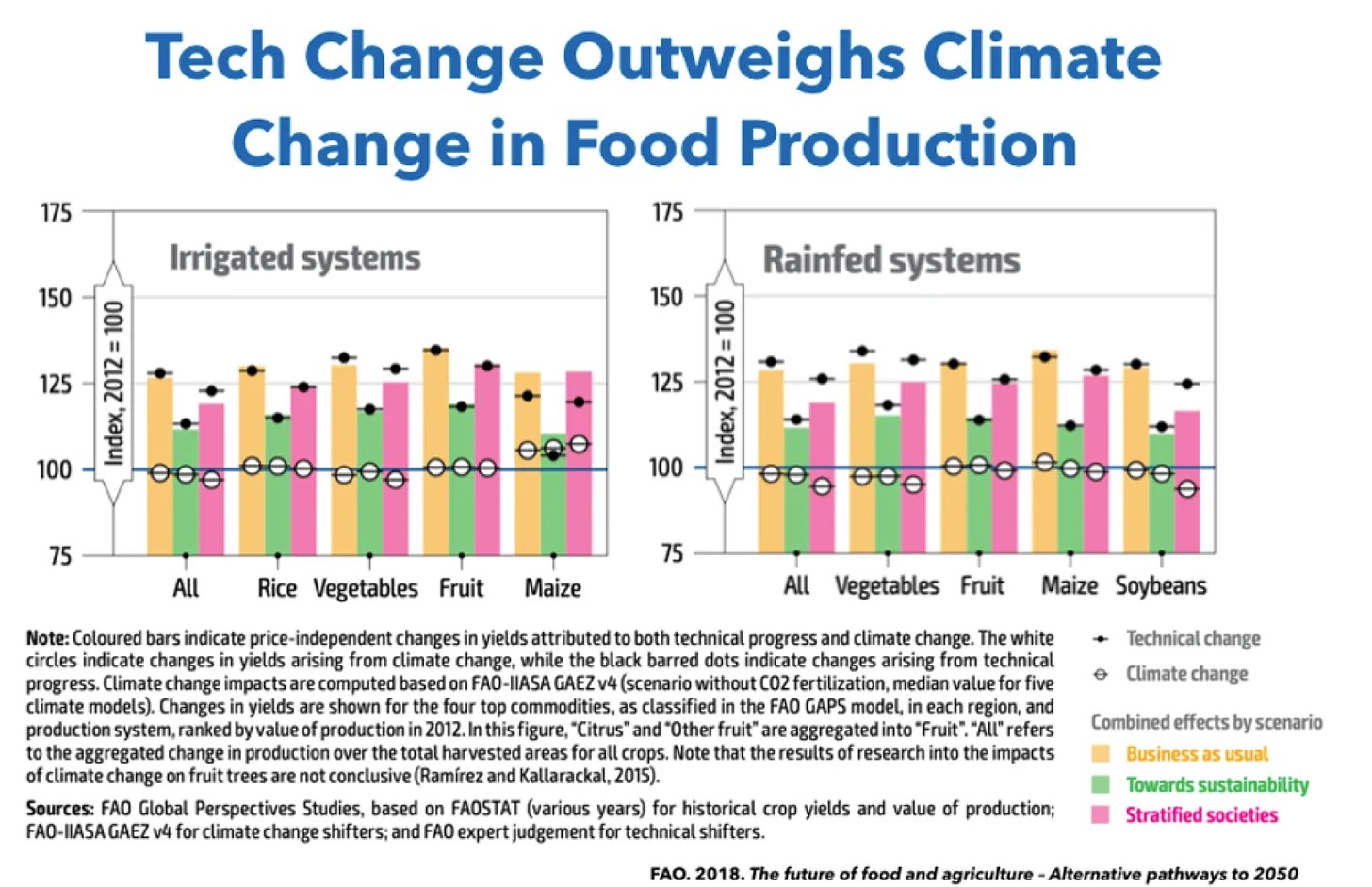
Global Crop production is actually up significantly according to the U.N. Food and Agriculture division. The Earth has actually become greener according to NASA, thanks to increased carbon dioxide in the atmosphere. And, air pollution is down 50 percent or more since 1990, according to the Environmental Protection Agency (EPA).

The EPA added this note to their report: “During this same period, the U.S. economy continued to grow, Americans drove more miles, and population and energy use increased.”

However, the most significant climate related data in 2022 is the fact that “climate related deaths” have plummeted since the movie came out and is now approaching zero. Using data from the International Disaster Databaseclimate scientist Bjørn Lomborg found striking drops in the data. As Lomborg writes, “If we look at the death risk for an individual, the risk reduction is even bigger — dropped almost 99% since the 1920s.”

Two years ago, on the 50th anniversary of Earth Day, there was much to celebrate about our present day due to improvements in our environment since 1970.

In contrast, Soylent Green portrayed a “climate catastrophe” and a grim future for 2022 due to climate change that hasn’t manifested itself in a profoundly negative way. In fact, most of what we experience today that could be considered a catastrophe is self-inflicted.

Runaway inflation and energy restrictive policies enforced by the Biden administration are the real catastrophes affecting Americans today.

In other words, all this globull warming!/climate change!/aaugh! is BS and hysterical ranting from econuts and and shills of corrupt goobermint


Climate Past Far From Settled: 7 Major Temperature Reconstructions Find No Agreement

A new paper published in open access publishing MDPI looks at seven prominent hemispheric and global temperature reconstructions for the past 2000 years (T2k).

The analysis conducted by the authors found that some reconstructions “differed from each other in some segments by more than 0.5 °C” whilst some show negligible pre-industrial climate variability (“hockey sticks”).

Those showing variability would suggest natural factors playing a greater role than those that claim climate had been rather constant over the past 2000 years.

Abstract: Global mean annual temperature has increased by more than 1 °C during the past 150 years, as documented by thermometer measurements. Such observational data are, unfortunately, not available for the pre-industrial period of the Common Era (CE), for which the climate development is reconstructed using various types of palaeoclimatological proxies. In this analysis, we compared seven prominent hemispheric and global temperature reconstructions for the past 2000 years (T2k) which differed from each other in some segments by more than 0.5 °C. Whilst some T2k show negligible pre-industrial climate variability (“hockey sticks”), others suggest significant temperature fluctuations. We discuss possible sources of error and highlight three criteria that need to be considered to increase the quality and stability of future T2k reconstructions. Temperature proxy series are to be thoroughly validated with regards to (1) reproducibility, (2) seasonal stability, and (3) areal representativeness. The T2k represents key calibration data for climate models. The models need to first reproduce the reconstructed pre-industrial climate history before being validated and cleared for climate projections of the future. Precise attribution of modern warming to anthropogenic and natural causes will not be possible until T2k composites stabilize and are truly representative for a well-defined region and season. The discrepancies between the different T2k reconstructions directly translate into a major challenge with regards to the political interpretation of the climate change risk profile. As a rule of thumb, the larger/smaller the pre-industrial temperature changes, the higher/lower the natural contribution to the current warm period (CWP) will likely be, thus, reducing/increasing the CO2 climate sensitivity and the expected warming until 2100.


Too Much Lake Water is Climate Change, Not Enough Lake Water is Climate Change.

The Great Lakes in the north-central U.S. is a perfect example of how leftist green loons think climate change can be blamed for literally everything.

Back in 2013, I was writing for Breitbart News, and at the time, the Great Lakes, especially Lake Michigan, were at near historic lows. And because there wasn’t enough water in the lakes, greenies were running around with their hair on fire because “climate change” had destroyed the Great Lakes permanently.

The water was never going to rise again, they said.

Take this report from Chicago’s public TV station, WTTW, for instance. In a Jan. 24, 2013, article, WTTW bemoaned that the lakes were at “the lowest water levels in history.”

The station warned of climate change:

Last winter was the fourth warmest winter on record. And those warmer temperatures lead to less ice formation and still more evaporation.

“When the lakes are changing that dramatically, that is a change in the climate,” Gronewold said. “Now what is causing the lakes to warm so much? That’s something that’s going to require some additional research.”

Oh, the humanities. It looks bad for the Great Lakes, folks.

Ah, but wait. There’s morel. Things began to change.

An article in 2015 reported that three of the five Great Lakes were recovering their water levels at a near near-record pace. “Faster than ever before.” One headline from the Weather Channel described the changes in Great Lakes’ water levels.

By 2022 the Great Lakes had filled back up, and then the greenies were worried that there was TOO much water. And guess what caused it? Yup. Climate change.

Yes, the culprit was once again “climate change” as an article in getpocket.com insisted, “Experts suspect that climate change is partially driving these shifts, but because of the complex nature of the water, it’s hard to isolate human factors from the rest of the turbulence.”

So, let’s recap. In 2013, climate change was drying up the Great Lakes, and they would never be the same again… then, less than a decade later, the lakes were too high and overfilled with water because of that darned old climate change.

Boy. Is there anything climate change can’t do? Next, will they blame it on Putin, wealthy Americans, oil companies, or the big meat companies as Biden has blamed for everything in recent weeks?

This is a common practice of the climate change hypothesis supporters. For example, they’ve claimed that climate change causes longer days, except when it causes shorter days, high tornado activity was caused by global warming and global cooling. My all-time favorite is when Al Gore blamed a horrible cold snap on climate change. Didn’t they use to call it global warming?

It shows that these green lunatics will trot out mythical climate change for every situation they can’t readily explain. Doesn’t it seem as if these “experts” are no different than Neolithic men shaking rattles and praying to the antler gods to help them explain the weather?

The End of the Climate Change Legend

For many years now, there has been a spirited debate about whether climate change is science, religion or even perhaps a secret route to socialism. That question remains unanswered, but we’ve now discovered with certainty that climate change is a political albatross around the neck of the Democratic Party.

The Left’s spiritual devotion to climate change has been speeding the Democrats over a political cliff this fall with likely unprecedented losses this November. The zero fossil fuels suicide pact was always an economic and political loser. More than 70% of all the energy we produce and consume in America derives from oil, gas and coal. President Joe Biden’s war on these fuel sources was sure to cause severe shortages and $5 a gallon gasoline at the pump. Didn’t Democrats learn their lesson in 1980 when Ronald Reagan won a landslide election against Jimmy Carter that surging inflation and gas prices is a surefire way to infuriate voters?

While Biden keeps saying he is doing “everything I can to lower gas prices,” he’s speaking out of both sides of his mouth — because if your goal is to get people to stop using something, raising its price is a pretty good way to accomplish that. If prices go to $10 or $15 a gallon, you can clear the highways of trucks and cars altogether, and what a wonderful world it will be.

Democrats were so enamored with their Green New Deal delusion that they failed to understand that most people aren’t as hyper-obsessed with climate change as they are. A new poll sponsored by my group, Committee to Unleash Prosperity, found that people are much more concerned about inflation and high gas prices than climate change. Moreover, the poll found that respondents’ average amount they would be willing to pay for the climate change agenda was $55 a year. Sorry, that’s the extra cost we are already spending with two fill-ups at the gas station.

Then there is the increasingly unavoidable reality that the green energy sources they fantasize about are decades away from being technologically feasible to replace old-fashioned oil, gas and coal. Even the Energy Department predicts that even with the trend toward renewable energy, by 2035, we will still be heavily reliant on oil, gas and coal for electricity production, home heating and transportation fuels.

Elon Musk, the leading champion of electric cars, reminded Biden in a recent tweet that in the real world rather than in la-la land, we are going to need oil and gas for many years to come. Today 3% of cars on the road are electric, and 95% use gas or diesel.

This brings us to yet another fatal flaw of the climate change movement. The Biden administration and its radical green allies can’t explain why getting our energy from Saudi Arabia, Iran and Russia makes more sense than Texas, Oklahoma and Alaska.

This strategy is especially pinheaded because the war on oil, gas and coal production is a big loser for the environment and increases global greenhouse gas emissions. That is because America has the strictest environmental standards. Shifting oil and gas production to Russia or Iran and shifting coal production to China and India is causing far more air pollution and greenhouse gas emissions. Chinese President Xi Jinping is busy trying to take over the world economy, and the last thing he or the ruling class in Beijing cares about is climate change.

Finally, Democrats should have learned from the green energy catastrophe of Western Europe. A decade ago, the French, Germans, Italians and others in the European Union moved to a renewable energy future. They slashed much of their oil, gas and coal production, shut down nuclear plants (why?) and subsidized the building of wind turbines and solar panels. It nearly bankrupted Germany as energy prices soared and factories left Europe for America and Asia. A decade later, France is back to building nuclear plants, and Germany is burning more coal than ever before and importing natural gas from Russia. Europe recently redefined natural gas and nuclear power as “clean energy.”

Going green wrecked their economies and submerged these countries deeper into the red. Unfortunately, Americans weren’t paying any attention to that failed experiment. So now Biden is repeating it. The result is likely to be the same. The Democrats’ radical climate change agenda isn’t greening the planet, and it is bankrupting our country. Voters know exactly whom to blame.

The Democrats Are Trying to Hide a Very Dirty Secret About Electric Cars

The Left views electric cars like the Rings of Power. It’s predictable but also pathetic. Driving electric cars saves the environment, says the left-wing drone. It emits next to nothing regarding carbon emissions, except that it does. Do liberals think we don’t know that this whole fad is a con game? Where do you think the energy that powers the batteries comes from? Fairies? Electric cars aren’t as efficient as gas-powered vehicles, but you pay more because…of feelings. Screw that. Green energy is a backdoor to communism from greenies who talk more about controlling the means of production than saving Mother Earth. Clean energy is a grift and political crony project aimed at giving fat cat donors tax breaks. Solyndra forever ruined this industry. I don’t care what anyone says, it’s all a long miserable exercise in subsidizing sub-par products.

Coal is what powers your electric car. Do liberals even know that? The very people who mock states like West Virginia don’t seem to know that these areas allow them to drive their precious, overpriced electric cars (via The Federalist):

To advance their climate agenda and deflect backlash about rising gas prices, Democrats are telling Americans that driving electric cars is for the greater good of the environment, fully knowing the charging stations for these cars are not fossil fuel free.

In reality, one of Tesla’s Supercharger stations was reported to get 13 percent of their energy from natural gas and 27 percent from coal. Power plants burn coal to generate electricity to power electric cars and emit a higher fossil fuel footprint than the left would care to admit.

While these vehicles may be falsely advertised, many who invest in these overpriced cars are able to avoid paying the currently outrageous gas prices. Still, Americans’ growing reliance on electric cars and the batteries they require will increase our dependence on countries such as China for materials.

“Chinese companies, particularly CATL, have secured vast supplies of the raw materials that go inside the batteries,” The New York Times reported in December. “That dominance has stirred fears in Washington that Detroit could someday be rendered obsolete, and that Beijing could control American driving in the 21st century the way that oil-producing nations sometimes could in the 20th.”

By increasing our use of electric cars, the United States will require more lithium batteries and will further rely on China to sustain our supply.

Well, isn’t that peachy. Liberals seem to have the yellow fever when it comes to China, or at least they’re a bit kinky when it comes to their wanting to be dominated by this country. Gas prices began to soar when Joe Biden took a hatchet to the Keystone Pipeline and our own oil and gas industry. That’s just a fact.

With the Ukraine war raging now, and sanctions being slapped on Russia for their invasion, the line the Biden White House is selling right now is ‘if you worried about $8/gallon for gas, you should buy a…$50k+ electric car.’ It’s almost too good to be true. You cannot make it up. The Democrats’ plan to ease gas price pain for a large swath of Americans is to force them to buy vehicles they can’t afford. A part of that is due to liberals being idiots. The other part is that it shows how the Democratic Party doesn’t know working people anymore. It’s all urban-based, rich, over-educated, and very white people making these snide remarks. The professional Left is the Democratic Party—and these people view those who drive pick-up trucks as neo-Nazis.

The dirty little secret is that a lot of fossil fuels are used to power the liberal delusions behind their electric car fetish. The Federalist did a great job sifting through the nonsense.