

Oh well. It's just fertility. Women’s Periods May Be Late After Coronavirus Vaccination, Study Suggests https://t.co/ndQC9QgwMH
— Dr Jordan B Peterson (@jordanbpeterson) January 8, 2022
Category: They Made a Movie About This
“Skynet smiles”
Now, what other dangerous things are hidden within this program, and Amazon ‘isn’t aware of’?
Alexa tells 10-year-old girl to touch live plug with penny
Amazon has updated its Alexa voice assistant after it “challenged” a 10-year-old girl to touch a coin to the prongs of a half-inserted plug.
The suggestion came after the girl asked Alexa for a “challenge to do”.
“Plug in a phone charger about halfway into a wall outlet, then touch a penny to the exposed prongs,” the smart speaker said.
Amazon said it fixed the error as soon as the company became aware of it.
The girl’s mother, Kristin Livdahl, described the incident on Twitter.
She said: “We were doing some physical challenges, like laying down and rolling over holding a shoe on your foot, from a [physical education] teacher on YouTube earlier. Bad weather outside. She just wanted another one.”
That’s when the Echo speaker suggested partaking in the challenge that it had “found on the web”.
The dangerous activity, known as “the penny challenge”, began circulating on TikTok and other social media websites about a year ago.
Metals conduct electricity and inserting them into live electrical sockets can cause electric shocks, fires and other damage.
“I know you can lose fingers, hands, arms,” Michael Clusker, station manager at Carlisle East fire station, told The Press newspaper in Yorkshire in 2020.
“The outcome from this is that someone will get seriously hurt.”
Fire officials in the US have also spoken out against the so-called challenge.
Ms Livdahl tweeted that she intervened, yelling: “No, Alexa, no!”
However, she said her daughter was “too smart to do something like that”.
Amazon told the BBC in a statement that it had updated Alexa to prevent the assistant recommending such activity in the future.
“Customer trust is at the centre of everything we do and Alexa is designed to provide accurate, relevant, and helpful information to customers,” said Amazon in a statement.
“As soon as we became aware of this error, we took swift action to fix it.”
The math behind this is complex, but from my limited understanding, and the explanations of the geeks who actually do understand the math, this is possible.
Scientists Claim to – Accidentally – Create a Warp Bubble
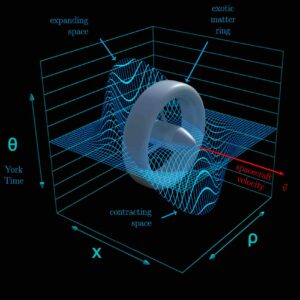
Warp drive pioneer and former NASA warp drive specialist Dr. Harold G “Sonny” White has reported the successful manifestation of an actual, real-world “Warp Bubble.” And, according to White, this first of its kind breakthrough by his Limitless Space Institute (LSI) team sets a new starting point for those trying to manufacture a full-sized, warp-capable spacecraft.
“To be clear, our finding is not a warp bubble analog, it is a real, albeit humble and tiny, warp bubble,” White told The Debrief, quickly dispensing with the notion that this is anything other than the creation of an actual, real-world warp bubble. “Hence the significance.”
THEORETICAL WARP DRIVES AND SCIENCE VISIONARIES
In 1994, Mexican Mathematician Miguel Alcubierre proposed the first mathematically valid solution to the warp drive. More specifically, he outlined a spacecraft propulsion system previously only envisioned in science fiction that can traverse the cosmos above the speed of light without violating currently accepted laws of physics.
That solution was lauded for its elegant mathematics, yet simultaneously derided for its use of theoretical materials and massive amounts of energy that appeared virtually impossible to engineer in any practical way.
Over a decade later, this theory underwent a major shift, when Dr. White, a then NASA-employed warp drive specialist and the founder of the highly respected Eagleworks laboratory, reworked Alcubierre’s original metric and put it into canonical form. This change in design dramatically reduced the exotic materials and energy requirements of the original concept, seemingly providing researchers and science fiction fans alike at least a glimmer of hope that a real-world warp drive may one day become a reality. It also resulted in the informal renaming of the original theoretical design, a concept now more commonly referred to as the “Alcubierre/White Warp Drive.”
Since then, The Debrief has covered a number of physicists and engineers taking their own stabs at designing a viable warp drive, including an entire group of international researchers working on a warp drive that requires no exotic matter. However, like Alcubierre and White before them, the warp concepts of these would-be visionaries all still remain theoretical in nature.
Now, it appears the situation has changed.
Comment O’ The Day
I’m not actually sure that a nation of people who own nothing will be as easy to control as the powers that be seem to believe.
Own Nothing and Love It
An unholy alliance of planners, financiers, and leftists wants everyone to live in mass social housing developments.
From the ancient world to modern times, the class of small property owners have constituted the sine qua non of democratic self-government. But today this class is under attack by what Aristotle described as an oligarchia, an unelected power elite that controls the political economy for its own purposes. In contrast, the rise of small holders were critical to the re-emergence and growth of democracy first in the Netherlands, followed by North America, Australia, and much of Europe.
Today the current class of small holders face a threat from two powerful hegemonies, tech and financial interests, and increasingly intrusive bureaucracies. Both favor policies that would force higher population densities, which would likely raise housing costs and lead to lifetime renting for middle income households who would otherwise own their own homes. These forces—one long associated with the right, and the other the left—share a common agenda, though for different reasons.
Financial interests would reap a steady profit stream by creating a “rentership society,” where potential owners are transformed into tenants, guaranteeing the benefits of increasing land values. Today pension funds and Wall Street firms are buying up single family homes, often at prices too high for the average buyer. For their part, the planning clerisy believes that dense urbanism is socially, economically, and environmentally superior; some even favor a return to public housing, which not long ago lost was rejected as a massively failed experiment.
Uh Oh, They Strapped a Sniper Rifle to a Robot Dog
For years, we’ve been warning that it was only a matter of time — and now, the inevitable has happened.
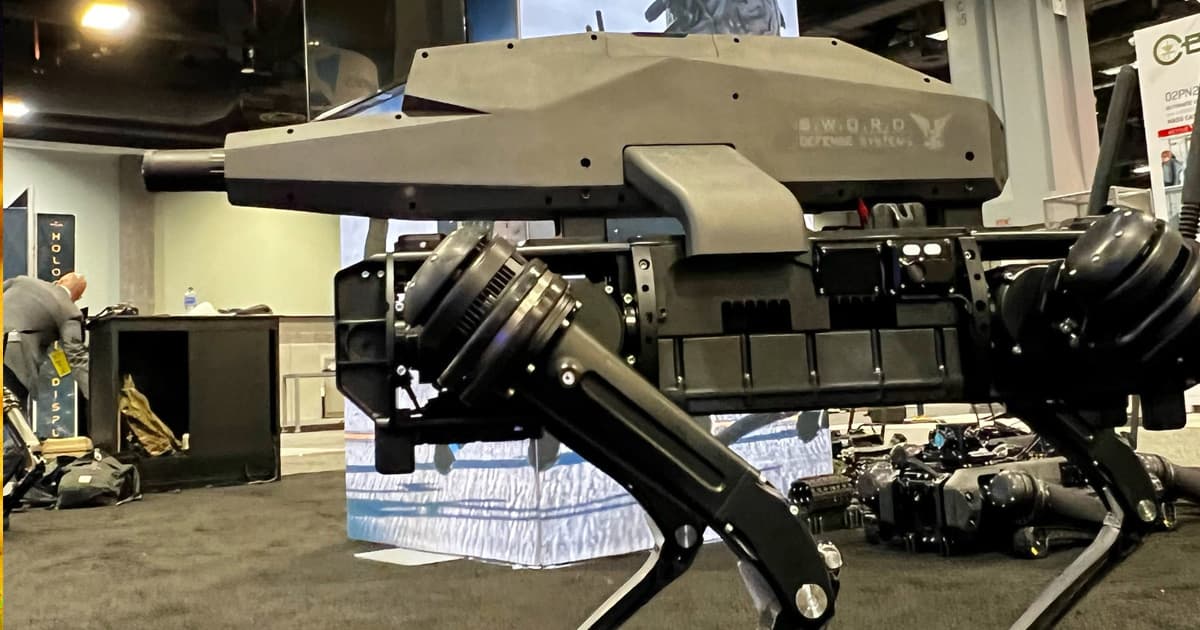
Somebody strapped an honest-to-god sniper rifle to the back of a quadrupedal robot dog.
An image shared on Twitter by military robot maker Ghost Robotics shows the terrifying contraption in all its dystopian glory.
“Keeping our [special ops] teams armed with the latest lethality innovation,” the caption reads.
It’s a nightmare come to life, a death machine designed to kill with precision on the battlefield.
“This is sad,” one Twitter user commented. “In what world is this a good idea? I bet police is salivating at the chance to use these.”
There’s a lot we don’t know about the machine, but according to an Instagram post by Sword International, a gun manufacturer, the machine is called the SPUR or Special Purpose Unmanned Rifle.
“The [SPUR] was specifically designed to offer precision fire from unmanned platforms such as the Ghost Robotics Vision-60 quadruped,” reads Sword’s website. “Due to its highly capable sensors the SPUR can operate in a magnitude of conditions, both day and night.”
We don’t know what level of autonomy the robot has or if it was designed to be fully remotely operated. We also don’t know who the machine was developed for.
The four-legged robot is lugging a sniper capable of shooting 6.5 millimeter Creedmoor cartridges, a rifle ammunition, which was developed with long-range target shooting in mind.
It’s a troubling new development. Any new robot built with the intent to kill should have us worried.
NASA Set To Crash Spacecraft Into Asteroid At 15,000 MPH In Effort To Change Its Course
NASA announced Monday that it will crash a spacecraft into an asteroid as part of an experiment designed to prevent dangerous asteroids from hitting Earth.
The Double Asteroid Redirection Test (DART) will launch Nov. 23 from Vandenberg Space Force Base in California and, using a process known as a kinetic impactor technique, deploy a rocket to hit an asteroid at a speed of 15,000 mph and alter its trajectory, according to NASA.
The test’s obejective is to analyze possible solutions to prevent an asteroid from hitting Earth, and it is NASA’s first mission to test planetary defense technology, according to the space agency.
It will target an asteroid system known as Didymos. The two asteroids are not a threat to Earth but will pass close enough to the planet to conduct the test, according to NASA. (RELATED: Asteroid Flew ‘Close’ To Earth, Estimated To Be Same Size As Great Pyramid Of Giza)
DART will launch toward Didymos using a SpaceX Falcon 9 rocket, NASA’s statement said according to The Washington Post.
SpaceX's launch of the NASA Double Asteroid Redirection Test (DART) mission is planned for Nov. 24 at 1:20 a.m. ET on a Falcon 9 rocket from Vandenberg Space Force Base.
Press release: https://t.co/nSLLmxfo8s pic.twitter.com/KSSNHa9DLX
— Michael Sheetz (@thesheetztweetz) October 4, 2021
When it has a gun rack plus a place to attach a gun mount……….
Will This Jetpack Fly Itself? Startup aims to make piloting a jetpack as easy as flying a drone
Jetpacks might sound fun, but learning how to control a pair of jet engines strapped to your back is no easy feat. Now a British startup wants to simplify things by developing a jetpack with an autopilot system that makes operating it more like controlling a high-end drone than learning how to fly.
Jetpacks made the leap from sci-fi to the real world as far back as the 1960s, but since then the they haven’t found much use outside of gimmicky appearances in movies and halftime shows. In recent years though, the idea has received renewed interest. And its proponents are keen to show that the technology is no longer just for stuntmen and may even have practical applications.
American firm Jetpack Aviation will teach anyone to fly its JB-10 jetpack for a cool $4,950 and recently sold its latest JB-12 model to an “undisclosed military.” And an Iron Man-like, jet-powered flying suit developed by British start-up Gravity Industries has been tested as a way for marines to board ships and as a way to get medics to the top of mountains quickly.
Flying jetpacks can take a lot of training to master though. That’s what prompted Hollywood animatronics expert Matt Denton and Royal Navy Commander Antony Quinn to found Maverick Aviation, and develop one that takes the complexities of flight control out the pilot’s hands.
The Maverick Jetpack features four miniature jet turbines attached to an aluminum, titanium and carbon fiber frame, and will travel at up to 30 miles per hour. But the secret ingredient is software that automatically controls the engines to maintain a stable hover, and seamlessly convert the pilot’s instructions into precise movements.
“It’s going to be very much like flying a drone,” says Denton. “We wanted to come up with something that anyone could fly. It’s all computer-controlled and you’ll just be using the joystick.”
One of the key challenges, says Denton, was making the engines responsive enough to allow the rapid tweaks required for flight stabilization. This is relatively simple to achieve on a drone, whose electric motors can be adjusted in a blink of an eye, but jet turbines can take several seconds to ramp up and down between zero and full power.
To get around this, the company added servos to each turbine that let them move independently to quickly alter the direction of thrust—a process known as thrust vectoring. By shifting the alignment of the four engines the flight control software can keep the jetpack perfectly positioned using feedback from inertial measurement units, GPS, altimeters and ground distance sensors. Simple directional instructions from the pilot can also be automatically translated into the required low-level tweaks to the turbines.
It’s a clever way to improve the mobility of the system, says Ben Akih-Kumgeh, an associate professor of aerospace engineering at Syracuse University. “It’s not only a smart way of overcoming any lag that you may have, but it also helps with the lifespan of the engine,” he adds. “[In] any mechanical system, the durability depends on how often you change the operating conditions.”
The software is fairly similar to a conventional drone flight controller, says Denton, but they have had to accommodate some additional complexities. Thrust magnitude and thrust direction have to be managed by separate control loops due to their very different reaction times, but they still need to sync up seamlessly to coordinate adjustments. The entire control process is also complicated by the fact that the jetpack has a human strapped to it.
“Once you’ve got a shifting payload, like a person who’s wobbling their arms around and moving their legs, then it does become a much more complex problem,” says Denton.
In the long run, says Denton, the company hopes to add higher-level functions that could allow the jetpack to move automatically between points marked on a map. The hope is that by automating as much of the flight control as possible, users will be able to focus on the task at hand, whether that’s fixing a wind turbine or inspecting a construction site.
Surrendering so much control to a computer might give some pause for thought, but Denton says there will be plenty of redundancy built in. “The idea will be that we’ll have plenty of fallback modes where, if part of the system fails, it’ll fall back to a more manual flight mode,” he said. “The user would have training to basically tackle any of those conditions.”
It might be sometime before you can start basic training, though, as the company has yet to fly their turbine-powered jetpack. Currently, flight testing is being conducted on an scaled down model powered by electric ducted fans, says Denton, though their responsiveness has been deliberately dulled so they behave like turbines. The company is hoping to conduct the first human test flights next summer.
Don’t get your hopes up about commuting to work by jetpack any time soon though, says Akih-Kumgeh. The huge amount of noise these devices produce make it unlikely that they would be allowed to operate within city limits. The near term applications are more likely to be search and rescue missions where time and speed trump efficiency, he says.

Finally:
Action on Taliban Hostage Situation With Americans in Mazar-i-Sharif.
But that’s only one (1) of six planes that sitting there.
BREAKING: after weeks of stalemate, Congressional and diplomatic sources confirm to CBS News that a flight has taken off from the Mazar-I-sharif airport in Northern Afghanistan bound for Doha.
— Ruffini (@EenaRuffini) September 17, 2021
Kam Air A340-313 KMF4453 departed Mazar-i-Sharif #Afghanistan pic.twitter.com/34MFoT0Mkk
— Manu Gómez (@GDarkconrad) September 17, 2021
Edgar Allen Poe wrote a story about a party, and Vincent Price starred in a movie version. …The Masque of The Red Death.
Maybe Obammy’s will turn out the same
Obama expecting 700 to attend his 60th birthday party despite COVID https://t.co/eM8oHsrxxZ pic.twitter.com/AUa5lFUepR
— New York Post (@nypost) August 2, 2021
Name of biblical judge found inscribed on 3,100-year-old jug found in Israel
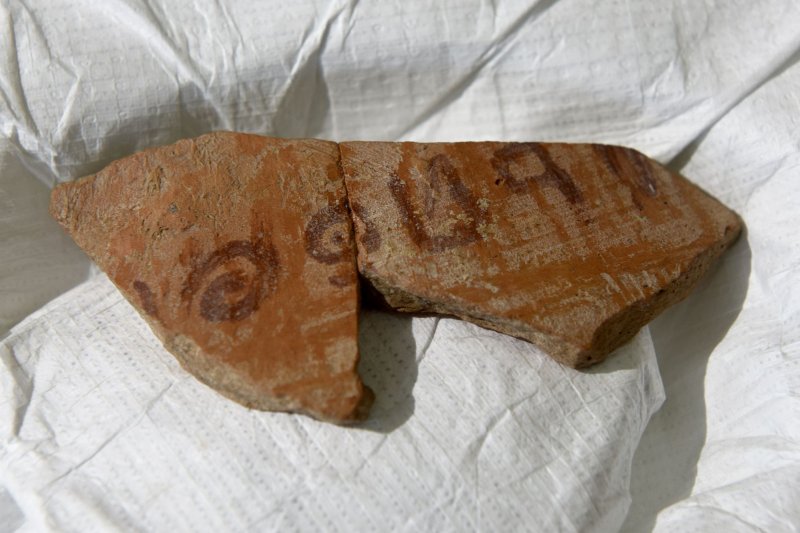
Archaeologists have uncovered a small jug with a rare five-letter inscription, linking the 3,100-year-old ceramic artifact to a biblical judge mentioned in the Book of Judges.
The jug and ancient inscription — the first to feature the name ‘Jerubbaal’ — were found at a dig site in the Shahariya Forest, among Israel’s Judean Foothills, archeologists reported the discovery Monday in the Jerusalem Journal of Archaeology.
“The name of the Judge Gideon ben Yoash was Jerubbaal, but we cannot tell whether he owned the vessel on which the inscription is written in ink,” archaeologists said in a press release.
The inscribed jug, bearing the name Jerubbaal, was recovered from a subsurface storage pit lined with stones. Researchers suspect the small jug likely held a precious liquid, such as oil, perfume or medicine.
Though the jug features only five inscribed letters, close analysis suggests the original inscription was longer.
In the Book of Judges, Jerubbaal is first mentioned as a leading opponent of idolatry.
He’s also credited with leading a successful battle against the Midianites.
“According to the Bible, Gideon organized a small army of 300 soldiers and attacked the Midianites by night near Ma’ayan Harod,” said Yossef Garfinkel and Sa’ar Ganor, lead archaeologists on the project and professors at the Hebrew University of Jerusalem.
“In view of the geographical distance between the Shephelah and the Jezreel Valley, this inscription may refer to another Jerubbaal and not the Gideon of biblical tradition, although the possibility cannot be ruled out that the jug belonged to the judge Gideon,” Garfinkel and Ganor said.
“In any event, the name Jerubbaal was evidently in common usage at the time of the biblical Judges,” they said.
Because the jug and its inscription date to roughly 1,100 B.C., the time of biblical judges, archaeologists suggest the discovery offers proof of the historical accuracy of the Bible.
“As we know, there is considerable debate as to whether biblical tradition reflects reality and whether it is faithful to historical memories from the days of the Judges and the days of David,” according to Garfinkel and Ganor.
“The name Jerubbaal only appears in the Bible in the period of the Judges, yet now it has also been discovered in an archaeological context, in a stratum dating from this period,” Garfinkel and Ganor said.
“In a similar manner, the name Ishbaal, which is only mentioned in the Bible during the monarchy of King David, has been found in strata dated to that period at the site of Khirbat Qeiyafa,” the archaeologists said.
Identical names being mentioned in the Bible, which have been found in other previously recovered inscriptions, they said, ” shows that memories were preserved and passed down through the generations.”
They made a movie about this……….
![Sons Of Liberty [DVD + Digital]](https://images-na.ssl-images-amazon.com/images/I/51rlvG8Z3GL._SY445_.jpg)
Sons of Liberty is an American television miniseries dramatizing the early American Revolution events in Boston, Massachusetts, the start of the Revolutionary War, and the negotiations of the Second Continental Congress which resulted in drafting and signing the 1776 United States Declaration of Independence in Philadelphia, Pennsylvania.
The miniseries is set in the years 1765–1776, prior to start of the American Revolutionary War. It focuses on historical figures and pivotal events between the Thirteen Colonies and Great Britain, particularly the events that led to resistance to the crown and creation of the Sons of Liberty. The actions of the Sons of Liberty were the beginnings of the Continental Army, and these take place mostly around Boston in the Province of Massachusetts Bay.
In the emptiness of space, Voyager I detects plasma ‘hum’
ITHACA, N.Y. – Voyager 1 – one of two sibling NASA spacecraft launched 44 years ago and now the most distant human-made object in space – still works and zooms toward infinity.
The craft has long since zipped past the edge of the solar system through the heliopause – the solar system’s border with interstellar space – into the interstellar medium. Now, its instruments have detected the constant drone of interstellar gas (plasma waves), according to Cornell University-led research published in Nature Astronomy.
Examining data slowly sent back from more than 14 billion miles away, Stella Koch Ocker, a Cornell doctoral student in astronomy, has uncovered the emission. “It’s very faint and monotone, because it is in a narrow frequency bandwidth,” Ocker said. “We’re detecting the faint, persistent hum of interstellar gas.”
This work allows scientists to understand how the interstellar medium interacts with the solar wind, Ocker said, and how the protective bubble of the solar system’s heliosphere is shaped and modified by the interstellar environment.
Launched in September 1977, the Voyager 1 spacecraft flew by Jupiter in 1979 and then Saturn in late 1980. Travelling at about 38,000 mph, Voyager 1 crossed the heliopause in August 2012.
After entering interstellar space, the spacecraft’s Plasma Wave System detected perturbations in the gas. But, in between those eruptions – caused by our own roiling sun – researchers have uncovered a steady, persistent signature produced by the tenuous near-vacuum of space.
“The interstellar medium is like a quiet or gentle rain,” said senior author James Cordes, the George Feldstein Professor of Astronomy. “In the case of a solar outburst, it’s like detecting a lightning burst in a thunderstorm and then it’s back to a gentle rain.”
They made a movie about this…….
British Royal Marines wear jetpacks and fly between ships in new boarding raid drill
Actually they’ve made more than one movie about this…..
Jeff Bezos wants floating colonies in space with weather like Maui all year long.
Jeff Bezos on Thursday restated his ambition to build floating space colonies where people could stay in orbit in excellent climates, with weather like “Maui on its best day, all year long.”
The Amazon founder made the comments at a press conference in Washington, DC, where he unveiled the Blue Moon lander, a giant vehicle designed to deliver payloads — and perhaps astronauts one day — to the surface of the moon.
The lander, created by Bezos’ privately held rocket company, Blue Origin, aims to help establish “sustained human presence” on the moon, Business Insider’s Dave Mosher reported from the event.
Bezos also branched out into his far-flung ambitions to put up to 1 trillion people in space with O’Neill cylinders, a hypothetical technology meant to sustain human life.
That $15 an hour minimum wage?
There’s a difference between ‘can do’ and ‘should do’, and some people, supposedly very smart people, apparently don’t know how to determine that.
Scientists grow human-monkey chimeric embryos in lab.
April 15 (UPI) — After injecting human stem cells into primate embryos, scientists were able to grow and maintain human-monkey chimeric embryos for up to 20 days.
The international research team, including geneticists in China and the United States, detailed their breakthrough in a new paper, published Thursday in the journal Cell.
Scientists suggest human-monkey chimeric embryos can be used to build models for studying human biology and disease.
“As we are unable to conduct certain types of experiments in humans, it is essential that we have better models to more accurately study and understand human biology and disease,” senior study author Juan Carlos Izpisua Belmonte, an expert in pluripotent stem cells who operates a lab at the Salk Institute for Biological Studies in California, said in a news release. “An important goal of experimental biology is the development of model systems that allow for the study of human diseases under in vivo conditions.”
The research builds on previous successes achieved by Izpisua Belmonte and his research partners in China. The team first successfully created human-monkey chimeric embryos a few years ago, keeping them alive for only a few days.
Earthquakes in divers places………
‘Huge’ explosion rocks St. Vincent as volcano keeps erupting.
KINGSTOWN, St. Vincent (AP) — La Soufriere volcano fired an enormous amount of ash and hot gas early Monday in the biggest explosive eruption yet since volcanic activity began on the eastern Caribbean island of St. Vincent late last week, with officials worried about the lives of those who have refused to evacuate.
Experts called it a “huge explosion” that generated pyroclastic flows down the volcano’s south and southwest flanks.
“It’s destroying everything in its path,” Erouscilla Joseph, director of the University of the West Indies’ Seismic Research Center, told The Associated Press. “Anybody who would have not heeded the evacuation, they need to get out immediately.”………
So, Daleks are taking over?
Crime-fighting robot patrols Las Vegas apartment complex
How would you like a robot warning you that you are violating a curfew regulation?
A security robot is helping to transform a noisy northeast Las Vegas Valley apartment complex into a quieter, more peaceful place to live, says a manager.
“Westy” has been patrolling the grounds at the 1,129-unit Liberty Village apartment complex, just outside the southwest corner of Nellis Air Force Base, since October. It is believed to be the first such use of a security robot at a Las Vegas apartment complex.
Officially known as a Knightscope MIN31KS, the human-sized autonomous robot offers a wide variety of security measures including four-camera video recording, facial recognition, license plate reading, verbal warnings, a telephone-like connection with human security officers and a presence that helps deter improper activity.
Something of interest for the folks down south.
How Colombia’s drug cartels almost bought a Soviet submarine.
In 2019, footage of a U.S. Coast Guard interdiction of a homemade drug smuggling submarine took the world by storm, and for good reason. As we watched one of the baddest dudes we’re ever apt to see anywhere outside of a movie pounding on the hatch of the mostly submerged sub, many of us were shocked to learn that drug cartels actually have their own submarines.
What may surprise you more is that these amateur submarines were really a consolation prize for drug smugglers out of Colombia. Their first choice? An actual Soviet Foxtrot-class submarine. What’s even crazier, however, is that the Russians seemed to be more than happy to sell them one.