Judicial Overreach and the Separation of Powers: Why Judges Cannot Run the Executive Branch

The United States Constitution is built on a system of separation of powers, ensuring that each branch of government—the legislative, executive, and judicial—operates within its own clearly defined sphere of authority. Article II of the Constitution explicitly vests executive power in the president, granting him the sole authority to run the executive branch, hire and fire federal employees, and manage the implementation of federal policy.

However, in recent years, judicial overreach has increasingly threatened this fundamental structure. Activist judges have repeatedly interfered with executive decisions, particularly regarding federal employment and budgetary matters, effectively attempting to seize control of the executive branch. This kind of judicial activism is not only unconstitutional but also dangerous to the very principles of self-governance and democratic accountability.

The Executive Power Belongs to the President Alone

Article II, Section 1 of the U.S. Constitution states: “The executive power shall be vested in a President of the United States of America.” This is not an ambiguous statement—it makes clear that executive authority belongs to the President, not to Congress, not to the courts, and not to unelected federal bureaucrats.

Among the responsibilities that come with executive power is the authority to hire and fire federal employees. The president, as the head of the executive branch, is responsible for ensuring that federal employees serve the interests of the American people effectively and efficiently. If an administration determines that certain employees are unnecessary, redundant, or incompetent, it is well within the president’s constitutional authority to dismiss them. No federal employee has a constitutional right to a government job. Employment in the federal government is not a protected right, and courts have no legitimate authority to override the president’s decisions on workforce management.

Despite this clear constitutional framework, we have seen repeated attempts by liberal judges to interfere with the executive branch’s authority by blocking efforts to reduce the federal workforce, demanding that terminated employees be rehired, or even forcing the president to spend taxpayer money on wasteful programs that he deems unnecessary. Such rulings are blatant violations of the separation of powers and represent an unacceptable intrusion into executive functions.

Continue reading “”

What do they want, sponge balls for bullets? These purported scientists are morons with crap-for-brains to think they can sell this.


Gun Control Researchers Should Realize: It’s the Criminal, Not the Bullet’s ‘Case Fatality Rate’

Instead of advocating for prosecutors to get tough on criminals who break the law, keeping them behind bars longer rather than being released with a slap on the wrist, researchers have been keeping themselves busy in a flurry of “research” to tell us what we already know. Firearms are deadly. That is, after all, why law-abiding citizens use firearms for self-defense.

That is why gun rights advocates, Second Amendment supporters and self-defense proponents take firearm education and training so seriously. With great privilege (exercising Second Amendment rights) comes great responsibility.

Several researchers teamed up to publish a recent article in the Journal of American Medical Association (JAMA) titled, “Bullets as Pathogen—The Need for Public Health and Policy Approaches.” The results were not at all earth-shattering – that larger bullets cause more damage than smaller ones – but policy recommendations resulting from the “research” could be far-reaching, if impractical.

“It is past time to address the ultimate cause of injury and death, the bullet, and consider bullet-specific regulations to decrease the burden of firearm injuries in the U.S.,” the authors proclaimed.

Bullets Aren’t Bacteria

Gun control activists in university research departments are increasingly partnering with health care professionals in order to push an agenda of strict gun control as if they’re trying to solve a public health emergency. The Johns Hopkins Bloomberg School of Public Health immediately comes to mind. That institution, funded by staunch gun control activist and hypocrite Micheal Bloomberg – who also bankrolls Everytown for Gun Safety and its propaganda “news” outlet The Trace – just released a report including five policy recommendations and promoted the idea that gun ownership would be better treated as a privilege and not as a right guaranteed by the U.S. Constitution for all law-abiding citizens.

The researchers behind the new JAMA article are pushing more of the same.

“Through examination of the devastating damage of bullets to individuals and society and application of public health principles akin to communicable diseases, we can prevent further injuries, disability and unnecessary loss of life,” the authors wrote.

Continue reading “”

Court upholds Florida gun law that bars people under 21 from buying rifles
Friday’s ruling by the full Atlanta-based appeals court upheld a three-judge panel’s decision and outlined the history of the nation’s gun laws, from its founding to recent U.S. Supreme Court decisions setting guidelines for determining how to apply the Second Amendment.

Saying the restriction is “consistent with our historical tradition of firearm regulation,” a federal appeals court on Friday upheld the constitutionality of a Florida law that raised the minimum age to purchase rifles and other long guns from 18 to 21. [really? What ‘historical tradition?]

The 8-4 ruling by the 11th U.S. Circuit Court of Appeals came after seven years of legal wrangling in the National Rifle Association’s challenge to a 2018 law passed after a mass shooting at Parkland’s Marjory Stoneman Douglas High School that killed 17 students and faculty members.

Nikolas Cruz, who was 19 at the time, used a semiautomatic rifle to gun down the victims at his former school. The NRA filed a lawsuit challenging the constitutionality of the gun-age restriction shortly after the law passed.

Friday’s ruling by the full Atlanta-based appeals court upheld a three-judge panel’s decision and outlined the history of the nation’s gun laws, from its founding to recent U.S. Supreme Court decisions setting guidelines for determining how to apply the Second Amendment. While the law barred people under 21 from buying rifles and long guns, they still can receive them, for example, as gifts from family members.

“From this history emerges a straightforward conclusion: the Florida law is consistent with our regulatory tradition in why and how it burdens the right of minors to keep and bear arms,” Chief Judge William Pryor wrote. “Because minors have yet to reach the age of reason, the Florida law prohibits them from purchasing firearms, yet it allows them to receive firearms from their parents or another responsible adult.”

Judges Adalberto Jordan, Robin Rosenbaum, Jill Pryor, Kevin Newsom, Britt Grant, Nancy Abudu and Charles Wilson joined the majority opinion. Judge Andrew Brasher wrote a dissenting opinion, which was joined by Judges Elizabeth Branch, Barbara Lagoa and Robert Luck.

SCOTUS is going to have to do something about this and slap these silly lower courts down, or things aren’t going to be pretty


Seventh Circuit Panel: SBRs Aren’t ‘Arms’ Protected by the Second Amendment

The Second Amendment protects the right to keep and bear arms. That should mean any weapon used for offensive or defensive acts. The reason was very clear. It was intended for us to be able to maintain a militia that could defend this nation from all enemies, foreign and domestic.

But the Seventh Circuit has decided that short-barreled rifles, or SBRs, aren’t arms covered by the amendment.

(I had to use a screenshot that I linked since X is having issues with the embed codes)

Now, this is a problem for a lot of reasons.

First, let’s talk a bit about the Miller decision. Yes, it’s a Supreme Court decision that lower courts have had to contend with for ages now. However, Miller dealt with a sawed-off shotgun. The Court in that decision said that such a weapon had no militia use, thus it wasn’t covered by the Second Amendment. That was wrong, of course, because that ruling was issued in 1934, so after shotguns had been used so effectively in World War I that the Germans tried to get using them considered a war crime.

Further, Miller himself was dead, so there wasn’t really another side arguing one way or the other in that case.

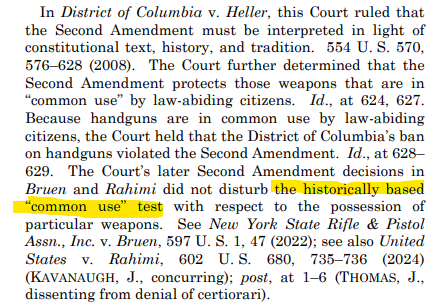
Still, when you look at Bruen, it doesn’t say anything about how you can just decide something isn’t an arm simply because you don’t think it’s useful for warfare.

Of course, then there’s the fact that if SBRs aren’t useful for warfare as a tool of the militia, then why is the standard issue weapon for the United States Army technically an SBR? The M4 has a barrel length of 14.5 inches, which is an inch and a half shorter than what is necessary for a rifle to not be considered an SBR. If SBRs aren’t useful for militia use, then why is it issued to every one of our combat troops and was used in pretty much every firefight out troops saw in Iraq and Afghanistan?

Now, let’s talk about the “step two in our Bruen” thing that’s cut off.

We turn to step two in our Bruen analysis in the interest of completeness. As discussed below, even if short-barreled rifles were “arms” within the meaning of the Second Amendment, historical tradition likely supports regulating them.

The court goes on to argue that Rahimi permits similar but more modern laws can be considered.

Rahimi, 602 U.S. at 692. When the historical laws “address[ed] particular problems” there is a good chance “contemporary laws imposing similar restrictions for similar reasons” are also permissible. Id. The laws do not need to “precisely match”—the contemporary one must only “comport with the principles underlying the Second Amendment….” Id.

Now, I’m not an attorney, but this sure looks like the Rahimi decision seems to suggest that contemporary laws can be applied when the historical laws addressed either that problem or similar ones. In other words, if the Founding Fathers were trying to address drunk people carrying guns, as they did, a more contemporary law seeking to address a similar problem would apply.

Instead, the Seventh Circuit judges just decided to accept contemporary laws as good enough simply because they don’t like the idea of SBRs.

That’s not even getting into the possibility that these judges’ nominations might not even be valid since everything Biden signed looks to have been the result of an autopen and we can’t be sure Biden even knew what was happening in the first place.

MSNBC Panel: Democrats Really FUBAR’d the Moment, Huh?

Ya think?

Give credit to Symone Sanders and Michael Steele for being honest about Democrats’ abject strategic and tactical failures last night. But also consider the fact that they had little choice in the matter, after watching Democrats as a body soil the sheets on national TV.

“Republicans were not coming to play,” Steele noted, as though anything about Donald Trump’s triumphant return after four years of Democrat lawfare suggested anything different. Not to mention that the Democrats had spent the better part of two days leaking plans to organize disruptions to Trump’s speech to Congress, which at one point included noisemakers as well as “bingo signs,” which were every bit as stupid as Sanders and Steele describe. (Wait until the meme-makers get done with them. Those won’t be back.)

But none of the panel truly gets what went wrong for Democrats last night:


Put aside the complaint that Al Green was somehow treated unfairly or differently than Lauren Boebert or Marjorie Taylor Greene. (Take that complaint to Nancy Pelosi, who sat through last night’s speech looking utterly defeated.) Republicans knew better than to stage an organized food fight at a State of the Union or quasi-SOTU event. Why? Because presidents have the tactical and strategic advantage, especially when his party controls Congress.

James Carville used the analogy of Pickett’s Charge recently. For those who haven’t studied Gettysburg, Pickett’s Charge lost Robert E. Lee the battle and the war by ordering an infantry charge on the center of a fortified Union line across nearly a mile of open ground, on the military basis of We’re right and they’re not. Pickett’s forces — some of them — actually made it to the line, but his command was destroyed, and Lee was forced to retreat from then until Appomattox.

That’s exactly what happened last night, and it’s even more inexplicable than Lee’s decision at Gettysburg. The American people rejected Democrats and chose Trump despite four or even nine straight years of exactly this kind of attack on him. Trump triumphed over the ankle-biting as well as the lawfare, and despite the character assassinations Democrats have staged on Trump and his supporters. The last place to use those same strategies and tactics is in a place where Trump easily commands the high ground — cameras, the microphone, and the attention — especially since it has been blindingly clear that he loves doing battle.

Steele suggested that Democrats shouldn’t have shown up at all. That would have been a bad choice too; it would have made them look like absconders rather than responsible legislators, only willing to participate in civic duties when they’re in charge. It still would have been a better choice than what unfolded last night. To answer McCaskill’s question more fully, they should have sat quietly, gotten it over with, and afterward started listening more than talking. Instead, they sounded like unruly radicals, and acted like fools.

If they would stop emoting and start listening, they might understand why a new CBS poll shows that three out of every four viewers approved of Trump’s speech, even though only 51% of the viewers identified as Republicans. It’s because Trump used the speech to position himself on the 80% side of the 80/20 issues Americans care most about:

– 77% support his plan to cut government waste and spending

– 77% back his immigration and border policies

– 76% approve of Trump’s speech

– 76% approve of removing congressmen who interrupted his speech

– 74% say his speech was presidential

– 73% support his stance on Russia and Ukraine

– 68% say it made them feel hopeful and proud

– 68% say he has a clear plan to tackle inflation

– 68% say he accurately described America’s crime crisis

– 63% say he focused on issues they care about

In other words, Trump set a trap for Democrats who couldn’t have telegraphed their foolish strategy and tactics more loudly than if they’d exhumed Samuel Morse himself to do it. And Democrat leadership — not the Boeberts and the MTGs, but party leadership — led them on a Pickett’s Charge right into it, with crazy Al Green waving his walking stick to lead the charge.

Now Democrats look like a party that can’t even break free of their toxic Trump derangement long enough to stand for a child suffering from brain cancer, or a young man whose dream of serving his country through West Point has come true. Democrats are utterly lost because they stand for nothing except raw power to benefit themselves, and only themselves. And without any other real purpose, the only strategy that they can see is to stupidly charge at all times under the military doctrine of We’re right and they’re not.

Maybe they should learn from history rather than trying to edit it.

Thomas Jefferson had some things to say about goobermint gone tyrant:

When tyranny becomes law, rebellion becomes duty.

When once a Republic is corrupted, there is no possibility of remedying any of the growing evils but by removing the corruption and restoring its lost principles; every other correction is either useless or a new evil.

and last, but not in anyway least:
We hold these truths to be self-evident, that all men are created equal, that they are endowed by their Creator with certain unalienable Rights, that among these are Life, Liberty and the pursuit of Happiness.–That to secure these rights, Governments are instituted among Men, deriving their just powers from the consent of the governed, —That whenever any Form of Government becomes destructive of these ends, it is the Right of the People to alter or to abolish it, and to institute new Government,


Rep. Jamie Rankin Beclowned Himself in Opening Remarks at Gun Hearing

Rep. Jamie Rankin isn’t going to be on the Christmas card list of any gun rights group you care to name. He’s a vehement anti-gunner and that’s where his bread is buttered. That’s not going to change.

Which is fine, I suppose. He’s in the minority right now, so all he can do is bloviate and then sit there and be impotent in his gun rights animosity.

But bloviate he shall, and he did.

In opening remarks in a subcommittee meeting on Tuesday, Rankin decided to display his burning stupid for the entire world to see, then sent out a press release with his remarks.

Awfully swell of him, really.

The problem is that my Republican colleagues have completely deformed the Second Amendment. They say it gives you the right to overthrow the government. Our former colleague, Matt Gaetz often claimed that the Second Amendment “is about maintaining within the citizenry the ability to maintain an armed rebellion against the government, if that becomes necessary.”

This purported right to overthrow the government means that the people must enjoy access to munitions equivalent to that of the government’s arsenal. As our colleague, Representative Chip Roy, argues, the Second Amendment was “designed purposefully to empower the people to resist the force of tyranny used against them.” And my friend Representative Lauren Boebert says that the Second Amendment has “nothing to do with hunting, unless you’re talking about hunting tyrants, maybe.”

Despite all of this pseudo-revolutionary rhetoric about how the Constitution provides a right of civil insurrection, the actual Constitution, in a half-dozen different places, treats “insurrection” and “rebellion” not as protected rights but as serious and dangerous offenses against our government and our people.

And yet, our Founding Fathers also made it very clear that when the government became tyrannical, it was the duty of the people to throw off the chains of oppression and fight back, not just with words but with weapons.

I mean, they’d just engaged in their own rebellion, their own insurrection, and thrown off those precise chains. They knew that no government could be created that couldn’t, in time, come to oppress the people. They wanted to prevent that, which includes the right to keep and bear arms.

Continue reading “”

So it’s now obvious, SCOTUS woman judges, even supposedly ‘conservative ones’ are problematic when it comes to goobermint power.
Roberts is just his squishy self.


Supreme Court Rules Against Trump’s Bid to Stop $2 Billion in USAID Funding.

On Wednesday morning, in a 5-4 emergency decision, the Supreme Court upheld a decision from U.S. District Judge Amir Ali that essentially says that Donald Trump can’t withhold $2 billion in USAID money from existing contractors. Chief Justice John Roberts and Justice Amy Coney Barrett sided with the three liberal members of the court. From the ruling:

On February 13, the United States District Court for the District of Columbia entered a temporary restraining order enjoining the Government from enforcing directives pausing disbursements of foreign development assistance funds. The present application does not challenge the Government’s obligation to follow that order.

On February 25, the District Court ordered the Government to issue payments for a portion of the paused disbursements—those owed for work already completed before the issuance of the District Court’s temporary restraining order—by 11:59 p.m. on February 26.

Several hours before that deadline, the Government filed this application to vacate the District Court’s February 25 order and requested an immediate administrative stay. THE CHIEF JUSTICE entered an administrative stay shortly before the 11:59 p.m. deadline and subsequently referred the application to the Court. The application is denied.

Given that the deadline in the challenged order has now passed, and in light of the ongoing preliminary injunction proceedings, the District Court should clarify what obligations the Government must fulfill to ensure compliance with the temporary restraining order, with due regard for the feasibility of any compliance timelines. The order heretofore entered by THE CHIEF JUSTICE is vacated.

Justices Samuel Alito, Clarence Thomas, Neil Gorsuch, and Brett Kavanaugh voted in favor of Trump, with Justice Alito writing the lengthy dissent that begins with:

Does a single district-court judge who likely lacks jurisdiction have the unchecked power to compel the Government of the United States to pay out (and probably lose forever) 2 billion taxpayer dollars? The answer to that question should be an emphatic ‘No,’ but a majority of this Court apparently thinks otherwise. I am stunned.

So, what exactly does this mean? Judge Ali, who was appointed by the Biden administration, ruled that the Trump administration must maintain USAID agreements that were in place before Trump officially took office on January 20. According to The Hill, Ali “found the Trump administration wasn’t complying with his order to resume the unpaid USAID contracts and grants. Last week, Ali demanded the funds be released by the end of the following day.”

Red State’s Susie Moore writes, “SCOTUS temporarily paused that order, but now, since the deadline is past (and moot), rather than vacate it altogether, they’re lifting the pause and sending things back to the district court to sort out further.”

According to NBC, “Specific projects affected by the payment freeze include the installation of new irrigation and water pumping stations in Ukraine; waterworks upgrades in Lagos, Nigeria; the supply of medical equipment in Vietnam and Nepal; and measures to combat malaria in Kenya, Uganda, Ghana and Ethiopia.”

While it’s not great news for Trump, as Moore says, “This isn’t the end of the story on this case — not by a long shot.”

BLUF
Cardinal Dolan may one day discover that he was unwittingly encouraging elements that no one, churchman or otherwise, should have encouraged. By then, however, it could be too late.

Cardinal Dolan Hails ‘Our Islamic Brothers and Sisters,’ Calls Ash Wednesday ‘Our Ramadan’

On Friday, Timothy Cardinal Dolan, the Archbishop of New York, posted on X: “Ramadan starts tomorrow! Ramadan is the season of penance for our Islamic brothers and sisters. Do they ever take it seriously! I tell you that because Ash Wednesday is coming up – that’s kind of like our Ramadan.”

These generous statements were entirely in keeping with the spirit of ecumenism that Pope Francis has advocated so assiduously, and so the cardinal’s words came as no surprise, but their graciousness was no guarantor of their accuracy. Unfortunately, virtually every part of Dolan’s statement was wrong, and some of it was dangerously misleading.

Ramadan is not, first off, exactly a “season of penance.” It does involve self-denial and cultivation of a sense of self-control, although the gorging all night somewhat mitigates the ascetic effect of the fasting all day, the focus is not primarily upon penance. Nobody “gives something up for Ramadan.” Ramadan superficially resembles Lent in that it is a season for Muslims to redouble their efforts to please Allah, but in Islam, this takes on a radically different form from efforts to please God in Christianity. (Note for those who need it: yes, “Allah” is the Arabic word for God — actually “the God,” and yes, Arabic-speaking Christians do use the word, although some, notably Copts, shy away from doing so because of its association with the God of the Qur’an. I am using it here to refer to that God.)

The highest form of service to Allah, according to Islam’s prophet Muhammad, is jihad, which principally involves warfare against unbelievers. A hadith has a Muslim asking Muhammad: “Instruct me as to such a deed as equals Jihad (in reward).” Muhammad replied, “I do not find such a deed.” (Bukhari 4.52.44)

So what better way to increase one’s devotion to Allah than by waging jihad? Every Ramadan, therefore, we see an increase in jihad attacks. This is hardly something that Cardinal Dolan should be celebrating, but of course, he is certain that Islam is a religion of peace, and that anybody who tells him otherwise is just an “Islamophobe.”

Continue reading “”

Colorado Democrats Eyeing Ammo Restrictions in Addition to Semi-Auto Ban

While the constitutional abomination known as SB 3 has rightfully been getting a lot of attention as it makes its way through the Colorado legislature, it’s far from the only assault on our right to keep and bear arms under consideration in Denver this year.

On Thursday, a bill barring adults under the age of 21 from purchasing ammunition cleared a House committee, and could be up for a vote on the House floor as early as next week.

Though multiple courts around the country have shot down age-based restrictions that deny under-21s from keeping, bearing, and buying firearms since the Supreme Court’s decision in Bruen back in 2022, anti-gunners in the Rocky Mountain State have been empowered and emboldened by the Tenth Circuit Court of Appeals, which declined to block the state’s law banning firearm purchases to under-21s last November.

In their decision overturning a preliminary injunction against the age-based prohibition, the appellate court bizarrely concluded that age-related purchasing restrictions fall outside the scope of the Second Amendment, leaving the door open to Colorado imposing a ban (however unlikely) on adults of any age purchasing firearms. As the Duke Center for Firearms Law (which typically loves it when courts uphold gun control restrictions) elaborated at the time of the decision:

After determining that at least one plaintiff had standing to challenge the restriction, the panel outlined the Bruen framework and the threshold textual step of determining whether the regulated conduct is protected by the Second Amendment.  The panel found initially that the plaintiff with standing was part of the “people” with the right to keep and bear arms and that the plaintiff intended to purchase a protected “arm.”

 However, the panel then noted the Supreme Court’s assessment in Heller that certain types of regulations are “presumptively lawful”—and it placed this inquiry in Bruen “step one,” implying that at least some of these laws simply don’t touch on “keeping and bearing” and thus don’t implicate protected conduct.  

While noting that Heller’s “presumptively lawful” paragraph was dicta, the panel nevertheless found itself “bound by Supreme Court dicta almost as firmly as by the Court[’s] outright holdings.”

It’s an utterly absurd decision, given that the right to keep and bear arms is rendered meaningless without the the ability to acquire one. The same goes for ammunition.

Without ammo, a firearm is a paperweight, or maybe a club. Either way, it’s absolutely useless for its intended purpose. But the Tenth Circuit has taken the position that  “laws imposing conditions and qualifications on the commercial sale of arms are lawful extends equally to laws imposing conditions and qualifications on the commercial purchase of arms.” The court went on to say that even under the Bruen test Colorado’s law is likely to withstand constitutional muster because setting the age to purchase a gun at 21 is “consistent with both scientific evidence on brain development and historical regulatory practice.”

Other courts have held that laws prohibiting members of the political community from exercising their Second Amendment rights cannot stand, and though the age of majority might have been 21 in 1791 and 1868, today it’s 18, which makes these under-21 gun bans inconsistent with the national tradition of gun ownership.

If HB 1133 does become law I’m sure it will face a legal challenge, but unfortunately, the Tenth Circuit’s illogic holds sway in Colorado. As a result, anti-gun lawmakers can feel at least somewhat confident that the appellate court will green light their ammo restrictions just as it’s allowed the ban on under-21s buying guns to take effect.

Yale Law Prof Backs Vance’s Claim: DOGE-Blocking Judge Violated Constitution

A Yale law professor says Vice President J.D. Vance is right: the federal judge who blocked the Department of Government Efficiency (DOGE) from exposing wasteful spending by the Treasury Department violated the U.S. Constitution.

On Saturday, Judge Paul Engelmayer sided with 19 pro-waste state attorneys general who filed a lawsuit against the President Trump-created, Elon Musk-led DOGE seeking to prevent scrutiny of how Treasury is spending taxpayer dollars.

Judge Engelmayer issued a temporary injunction preventing DOGE and Treasury officials from examining Treasure expenditures – and declared that the Democrats have a strong case for a permanent ban.

However, as Vice President Vance wrote on X.com (formerly Twitter), judges don’t have the legal authority to dictate the actions of generals, prosecutors and the president:

“If a judge tried to tell a general how to conduct a military operation, that would be illegal.

“If a judge tried to command the attorney general in how to use her discretion as a prosecutor, that’s also illegal.

“Judges aren’t allowed to control the executive’s legitimate power.”

In his response, Yale Law Prof. Jeb Rubenfeld agreed with Vance and explained how Judge Engelmayer violated the Constitution with his ruling:

“JD is correct about this, and his examples are exactly right. Where the Executive has sole and plenary power under the Constitution–as in commanding military operations or exercising prosecutorial discretion–judges cannot constitutionally interfere.”

intranet image

Following the ruling on Saturday, Musk called for Judge Engelmayer to be impeached for being “a corrupt judge protecting corruption.”

Vance and Yale Law Prof​​

The Final Two 9th Circuit Gun Decisions of 2024

Yesterday, Monday, December 30, 2024, the 9th Circuit Court of Appeals published its final two decisions in cases involving guns.

The first decision involved the Federal law that permanently disbars persons convicted of misdemeanor domestic violence from possessing firearms, and the second involved a dispute over what constitutes an arrest when police see a handgun on the floor of an automobile in a state where that is legal.

The first decision is well written and meticulous and leaves no question as to why the three-judge panel reached its decision, a decision they would rather have gone the other way were it not for binding prior precedents.

The second decision does not explain why it reached its conclusion, and more importantly, the decision does not explain how future three-judge panels and district court judges are to comply with what is now a binding circuit precedent. Moreso, given that the facts laid out in the decision do not justify the panel’s conclusion under already binding prior 9th circuit precedents.

First, the well-written decision by 9th Circuit Court of Appeals Judge Morgan B. Christen. She is certainly no friend of the Second Amendment, but if there were a candidate for the most intelligent Court of Appeals judge, she would be the one to bet on. The case is US v. Michal Blake DeFrance No. 23-2409.

The first three paragraphs of the opinion summary succinctly describe the case’s what and why, but I will take a stab at an even simpler explanation. In short, if one is convicted of a state law crime of domestic violence, and that state law crime is broader than the Federal definition, even if the state has never prosecuted someone under the broader definition, then the conviction does not qualify as a crime of domestic violence under Federal law. Not even if the crime one committed, such as beating one’s wife or girlfriend, does qualify as a crime of domestic violence under Federal law. You can view the oral argument below.

You can read the opinion (and concurrence) at this link.

The second case is US v. Larry Send In. The opinion is by Judge Gould and was joined by 9th Circuit Court of Appeals Judge Bumatay and District Court Judge Michael Seabright, the latter of whom is no friend to the Second Amendment.

A fun fact about the Fourth Amendment is that from 1833 to 1961, it did not apply to the states. That did not mean police could stop, search, and/or arrest anyone they wanted. Under American common law, which we inherited from English common law, one could use force, including deadly force, to resist an unlawful arrest. That was the rule in California until 1957 when the California legislature repealed that centuries-old common law right. The California Supreme Court upheld the repeal in 1970.

Incorporating the Fourth Amendment right against the states in 1961 means the courts have had far more opportunities in 64 years to poke holes in the right. The decision in this case is yet another hole punched in the right.

Another fun fact is that California once had a bright-line rule. If you were stopped by the police and not free to go, you were under arrest.

The Federal Courts invented the notion that one can be stopped and handcuffed without it being an arrest. It is a “detention,” in which cases often turn on whether or not the detention was lawful and, in this particular case, at what point an arrest occurs. The California Supreme Court has abandoned its bright-line rule for the murky waters of the Federal Courts.

Of course, police forces as we know them today did not exist in the United States until the early 20th century. Before World War II, most arrests were made by private citizens, and private citizens likewise made most criminal prosecutions.

It was not until the 1970s that the US Supreme Court gave prosecutors and judges “absolute immunity” from civil prosecution in the Federal Courts, but I digress.

Under modern Fourth Amendment jurisprudence, judges look to the totality of the facts in making their decisions. In this case, the district court judge suppressed the gun found in Mr. In’s car, but the panel reversed. Why? I don’t know. Professor Shaun Martin at the University of San Diego School of Law doesn’t seem to know either. He wrote about the case on his blog.

When you read the decision, keep in mind that lying to a police officer is not in and of itself a crime, and Mr. In’s lying to police about having a gun in his car was not probable cause for an arrest, according to the panel. Indeed, none of the facts of the case viewed in isolation or the totality of the circumstances constituted probable cause for an arrest, and if Mr. In had, in fact, been arrested instead of detained for officer safety, then the gun would have been suppressed.

Neither police officer safety nor public safety is a magic talisman. But despite this decision conflicting with prior circuit precedents, it is doubtful that an en banc petition will be granted in this case. There are just too many judges in the 9th Circuit Court of Appeals who don’t care a fig about the Fourth Amendment, especially when the case involves guns.

You can view the oral argument below.

You can read the opinion at this link.