

Category: Safety
4 TIPS FOR GUN OWNERS TO BEAT BOREDOM WHILE AT HOME
While the Coronavirus pandemic has left many of us stuck indoors, that doesn’t mean that we can’t still dedicate some time to our favorite activity — guns. We at Guns.com have gathered together a handful of activities for you to pass the time.
1. CATCH UP ON READING
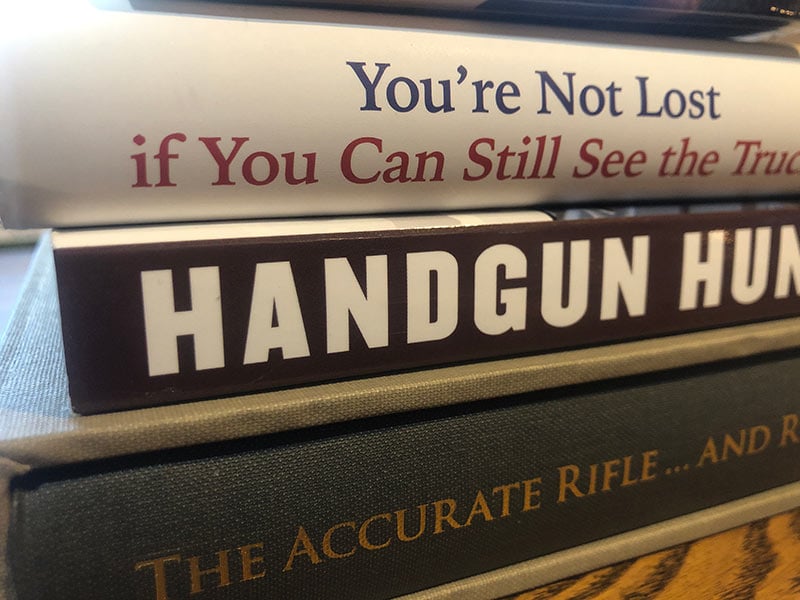
Brush up on some reading with gun themed books. (Photo: Kristin Alberts/Guns.com)
Practicing social distancing has given many of us time to catch up on reading we might perhaps ignore the rest of the year. If you’re 2020 goal is to be a bit better read, brush the dust off your favorite books or download some new ones to your preferred electronic device. Some of our favorites include The Dry Fire Primer by Annette Evans, Handgun Hunting by Kat Ainsworth and You’re Not Lost if You Can Still See the Truck by Bill Heavey.
2. INVEST IN DRY FIRE PRACTICE

Using a laser pistol like a SIRT, pictured in the hands of trainer Rob Pincus, is a great way to train at home. (Photo: Jacki Billings/Guns.com)
Just because you can’t head to the range doesn’t mean those skills have to deteriorate. Break out that laser trainer pistol or unload your current firearm and put in some dry fire reps. Simple drills can include malfunction drills, reloads, drawing from concealment and trigger press — but remember, carefully inspect your gun prior to any manipulation to ensure it is unloadedand free from ammunition. We also suggest removing all ammunition from the training area just to be sure no rounds accidentally make their way into the firearm.
3. CLEAN YOUR GUNS AND ORGANIZE YOUR STASH
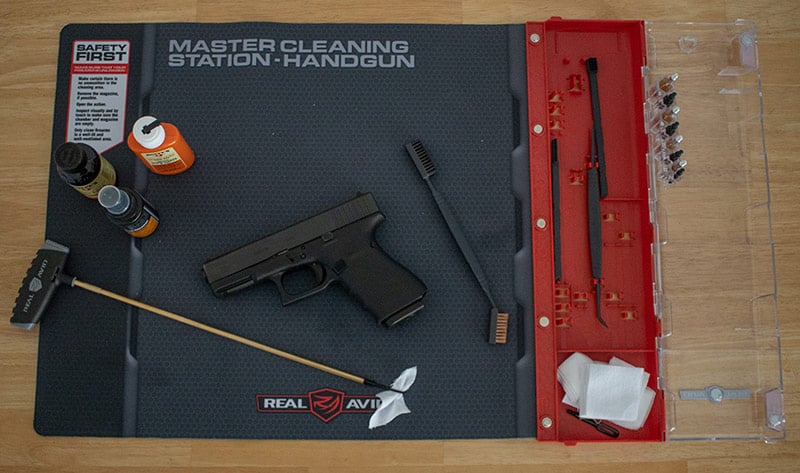
Caring for guns is a great way to maintain firearms and pass the time. (Photo: Jacki Billings/Guns.com)
Take advantage of the time home to do a little spring cleaning and organize your stash. Now is the perfect time to break out the CLP and ready guns for your next hunt or range visit. With a little cleaner, some gun oil and some spare cloth you can clean up any gunk and make sure your guns are functioning properly. Once your done cleaning, invest some time organizing guns and gear.
Whether you choose to focus on prettying up the gun safe or you want to rearrange a favorite range bag, take stock of what you have and make sure to organize it in a way that fits your range or hunting flow. You can even take it a step further by making a list of items you want or need in the future like ammunition, targets, extra mags and even guns that are on your mind.
4. EDUCATE YOUR FAMILY

According to the NRA, the Eddie Eagle program started in 1988 and has taught over 30 million youth the basics of firearm accident prevention (Photo: Chris Eger/Guns.com)
If your family isn’t already on the up-and-up when it comes to gun safety practices, now is a great time to get them involved. For younger kids, the NRA’s Eddie Eagle or NSSF’s Project ChildSafe offers fun learning tools to educate little ones on the importance of gun safety. Making sure that everyone understands what to do if they see a gun in addition to covering safe handling practices keeps family members safe. While you’re at it, now is a good time to evaluate how you store guns and make sure that little ones don’t have access.
If you want to continue the education with fun books for the kiddos, check out some of our favorite gun oriented books for youth by some of our favorite authors.
The Lies the Gun Control Industry Tells
65 of 108 (the real number) are suicides, 1 are unintentional, 1 are undetermined, 2 are police shootings. 39 are actual homicides, 80% of which are gang related. I’m no mathematician but looks to me like we have a suicide and gang issue, not a gun issue. https://t.co/3pX8fdX4uH https://t.co/wln86OkM9q
— Colion Noir (@MrColionNoir) June 8, 2019
By Will
Gun control might not be an oft-discussed topic recently, but I think that it is an important one. Why? Because the gun control lobby is lying to us. Still. Like with other “pandemics,” such as the topic of the moment, Coronavirus, our friends on the left use fear and very misleading numbers as the basis of their arguments.
Rather than objectively looking at the evidence, they cherry-pick data and then misuse or misrepresent it. The most distorted among these are gang violence and suicides.
Gang Violence
“Gun violence,” as it’s currently known, is a problem in America. I completely agree with that and think that there are potential solutions to it. However, law-abiding gun owners are overwhelmingly responsible individuals. Aside from an insignificant minority, they don’t commit crimes.
On the other hand, gun-related gang violence is a massive problem in America. Those (illegal) gun owners frequently use firearms to commit crimes. Those gang-related shootings, homicides, and other forms of violence show up in the general gun violence data. In response, many on both the left and the right propose gun control as a response.
But gun control won’t work. It’s only relevant to the law-abiding gun owners. The ones who don’t use their weapons to commit crimes. Gang members, on the other hand, don’t care about the law. They’re criminals. So it doesn’t matter to them that certain types and classes of weapons are made illegal. They’re breaking the law anyway.
Gun violence — crimes involving the use of firearms — could be limited by focusing on reducing gang membership. Education and policing reforms could be very effective at cutting down the number of gangs, and gang members in America. Then we would certainly see a drop in gun violence.
As the tweet at the top shows, many homicides are gang-related killings. So are many so-called “mass shootings.” While those incidents are tragic, including gang-related gun crimes with more traditional mass shootings and homicides is misleading.
Because most homicides are gang-related, gun control will be ineffective at cutting the homicide rate, and the only ones who think otherwise are people who don’t understand that the gun control lobby is lying to them. Instead, these laws will only punish law-abiding gun owners. That shouldn’t happen; the Second Amendment rights of all law-abiding gun owners should be respected.
Suicide
Suicide is a horrible tragedy. I firmly believe that societies should do every reasonable thing that it can to cut down the suicide rate around the world. But gun control is not a rational response to suicide.
Most people who commit suicide are people who technically should be allowed to own a firearm. Although they are often depressed, they have done nothing wrong. It would be a gross violation of civil liberties to prohibit the sale of firearms to anyone who seems depressed. Not only would that be ineffective, it, like all gun control attempts, would punish the innocent along with the guilty.
Furthermore, it is not the role of government to get involved in the lives of law-abiding citizens. That is a cure worse than the disease because of how much it would limit individual liberty and our right to privacy.
Controlling the availability of firearms to law-abiding citizens is morally wrong and would most likely have a limited effect on suicide rates.
So, what can be done? The mental health system should be reformed. Concerned friends and family members should be able to report people who they think are struggling so that those people can be checked out.
Having a professional work with those who are struggling with suicidal thoughts could be effective, but the patient and doctor have to be connected. Setting up a report line and allowing concerned friends and family to submit names could be a great way to connect patients and doctors.
Additionally, those involved with treating patients who have suicidal tendencies should rely on more personal care and fewer pills. Medicines have their place. But many psychoactive drugs have dangerous and unpredictable side effects on the mental health of those taking them.
These are powerful tools, but can also be quite dangerous. Doctors and psychiatrists should work with their patients in person to help them through their problems rather than relying on pills.
Suicide is a complex problem. I don’t have all the answers; I probably don’t have any good answers or solutions. But what I do know is that gun control won’t work and that when people say it will, they only think that because the gun control lobby is lying to them.
As with gangs, those who want a gun will always be able to get one. We should focus on patient care, not restricting individual rights for society as a whole.
Conclusion
Suicide and gang violence are complex topics. They are also responsible for the overwhelming majority of firearm-related homicides. Too many people die from such “gun violence.” That is an issue that needs to be addressed in a variety of ways.
But gun control will not fix either problem, and restricting law-abiding citizens’ access to firearms is both unconstitutional and immoral. Gang members will always be able to get weapons. Those who really want to commit suicide will find a way to do so.
However, if more gun control is put in place to try and fix those issues, then everyone will be punished. That makes it not only an ineffective policy, but also an immoral one that will lead to the deaths of innocents.
We need to be on the lookout for these attacks by an emotional, reactionary minority on our Second Amendment rights. Gun control laws have proven to be ineffective time and again. To pretend otherwise is both dishonest and dangerous.
The gun control lobby is lying to us. It wants us to believe not only that gun violence rampant in America (it’s not), but also that gun control is an effective solution to the violence we do have. Don’t listen to the braying gun control crowd. Their ideas don’t work. They will only restrain your freedom and your liberty.
Antis Talk ‘Gun Safety’ During Pandemic, NRA Teaches It Online
Even before the beginning of the coronavirus pandemic panic, when people began rushing to gun stores—many for the first time—gun prohibition lobbying groups have been preaching against allowing such businesses to operate, and against buying firearms, while the National Rifle Association has taken a different, and decidedly proactive approach.
This NRA email says it all: “In response to the growing number of first-time gun buyers during the coronavirus outbreak, the National Rifle Association’s Education & Training Division is pleased to announce the launch of four new online gun safety courses.”
According to the NRA message, the courses include:
- Gun Safety Seminar
- NRA Basic Pistol Shooting Course – Distance Learning
- NRA Basic Rifle Shooting Course – Distance Learning
- NRA Basic Personal Protection In The Home Course – Distance Learning
Each course, lasting from one to eight hours, is available at NRAInstructors.org.
In a recent statement, Alan Gottlieb, chairman of the Citizens Committee for the Right to Keep and Bear Arms, welcomed all the new gun owners to the shooting fraternity.
“We encourage all new gun owners to seek competent training,” Gottlieb said. “Learn to handle your new firearms safely, and remember it’s up to all of you to protect your rights. It’s sad and at the same time uplifting that so many Americans will no longer be fence-sitters. They’re joining the ranks of gun owners and will soon understand, if they don’t already, why so many of their friends, neighbors and even family members have remained so zealous in their efforts to protect the rights you now hope to exercise and enjoy.”
Likewise, Joe DeBergalis, executive director of NRA General Operations, says in the NRA email, “The NRA recommends that all new gun owners seek professional training at the range, but that doesn’t mean you can’t get a head start on learning the basics of firearm safety at home. New gun owners, old gun owners, it doesn’t really matter. Taking one of these classes moderated by a certified NRA instructor can only make you safer, and that’s our primary goal.”
“These courses will provide an option for first-time gun owners who don’t have the ability to take an NRA certified instructor-led class at their local shooting range at this time,” DeBergalis, continued. “While there is no replacement for in-person, instructor-led training, our new online classes do provide the basics of firearm safety training for those self-isolating at home.”
By contrast, the Michael Bloomberg-supported Everytown for Gun Safety lobbying group has been urging people to pressure the Trump administration and Department of Homeland Security to reverse course and declare gun stores “non-essential.” This, even after admitting in an email blast, “It has been reported that gun sales have been going way up…A flood of guns at this precarious moment compounds the risks of death and serious injury during this incredibly stressful time.”
But the NRA is doing something about that, and CCRKBA has counseled all of these new gun owners to take advantage of available safety training.
Second Amendment activists have frequently argued “If you’re not teaching gun safety, you’ve got no business preaching about gun safety.” Translation: Firearms instructors provide genuine gun safety training, while so-called “gun safety” organizations are gun prohibition lobbying groups in disguise.
There is a considerable difference between just telling people to lock up their firearms and support a ban on so-called “assault weapons,” and actually providing competent instruction on the safe handling of firearms, whether they are handguns, shotguns or semi-auto modern sporting rifles.
It is important for new gun owners to be able to tell the difference between the two.
This has got to be feeling just like a big fat burr under the saddle
Bloomberg to Gun Culture: “Help Me!”
Thank you, Michael Bloomberg, for finally admitting that gun owners are correct.
Oh, I’m certain that he didn’t mean to do it; after all, the non-opinion piece titled You Just Panic-Bought a Gun. Here’s How to Handle It Safely was written by Alain Stephens, not Bloomberg himself, but as it was published in Bloomberg’s anti-gun organ The Trace on March 20th, and as Bloomberg is its owner and publisher, that means he owns, in every sense of the word, what it says.
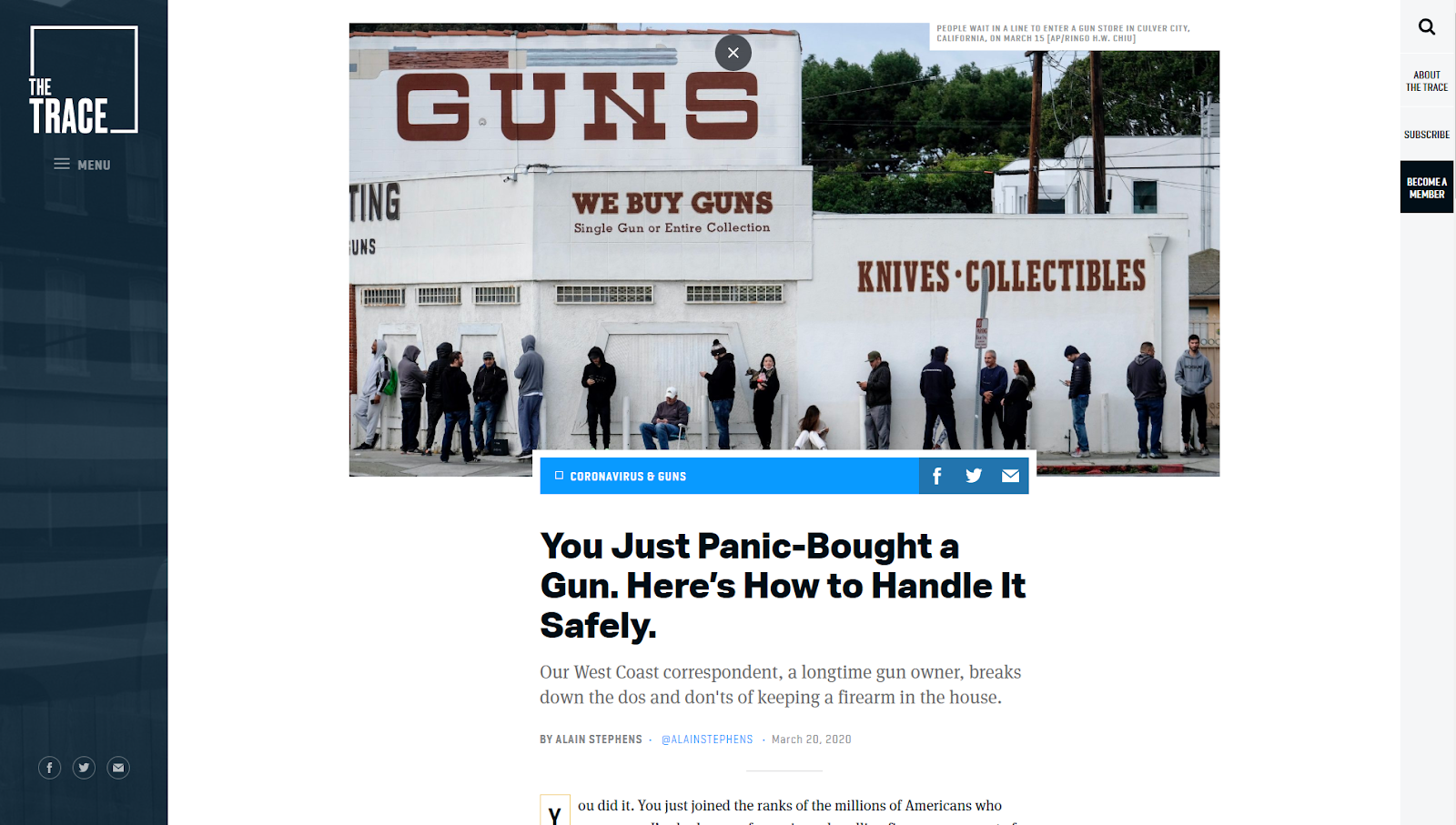 |
| https://www.thetrace.org/2020/03/you-just-panic-bought-a-gun-coronavirus-safety/ |
I imagine that galls Bloomberg terribly, since he has told us for nearly two decades that no one needs a gun. Now, despite his best efforts, his anti-gun magazine is acknowledging the awkward truth that people want guns to protect themselves and their families in a crisis where the police may be late to arrive (if in fact they arrive at all, given how many city police departs are stretched to the breaking point with many officers out sick) and so in acknowledgement of that fact, The Trace is reluctantly giving these new gun owners advice on how to safely handle their new firearm.
The irony of this situation is that neither The Trace, nor any other anti-gun organization, nor even Michael Bloomberg himself has experience in this regard. His position has always been abstinence-only when it comes to firearm education, and like an abstinence-only parent who discovers that his child is having premarital sex, his choices have become “Ignore the situation and hope it goes away” and “Accept reality and seek advice from a professional.” As ignoring the situation almost always leads to unfortunate consequences like unplanned teenage pregnancies or negligent discharges which result in injury or death, Bloomberg, has decided – most likely unintentionally, and almost assuredly to his great gall – to take the mature course of action and seek the advice of experts.
Unfortunately for Bloomberg, those experts whose advice he has sought are precisely those people whom he and his various anti-gun organizations (Everytown, Moms Demand Action, March for our Lives, et al.) have vilified. After the article’s obligatory references to “numerous studies” about the inherent dangers of gun ownership, the first given piece of firearms safety advice are the Four Rules of Gun Safety:
- Treat all guns as if they are loaded.
- Never let the muzzle of the firearm point at anything you are not willing to destroy.
- Don’t place your finger near the trigger until you are ready to fire.
- Always identify your target – and what lies in front of and behind it.
Accompanying these rules are a link to the blog of Springfield Armory, a manufacturer of semi-automatic weapons including the much-maligned AR-15 rifle, a firearm which Bloomberg would dearly love to make illegal.
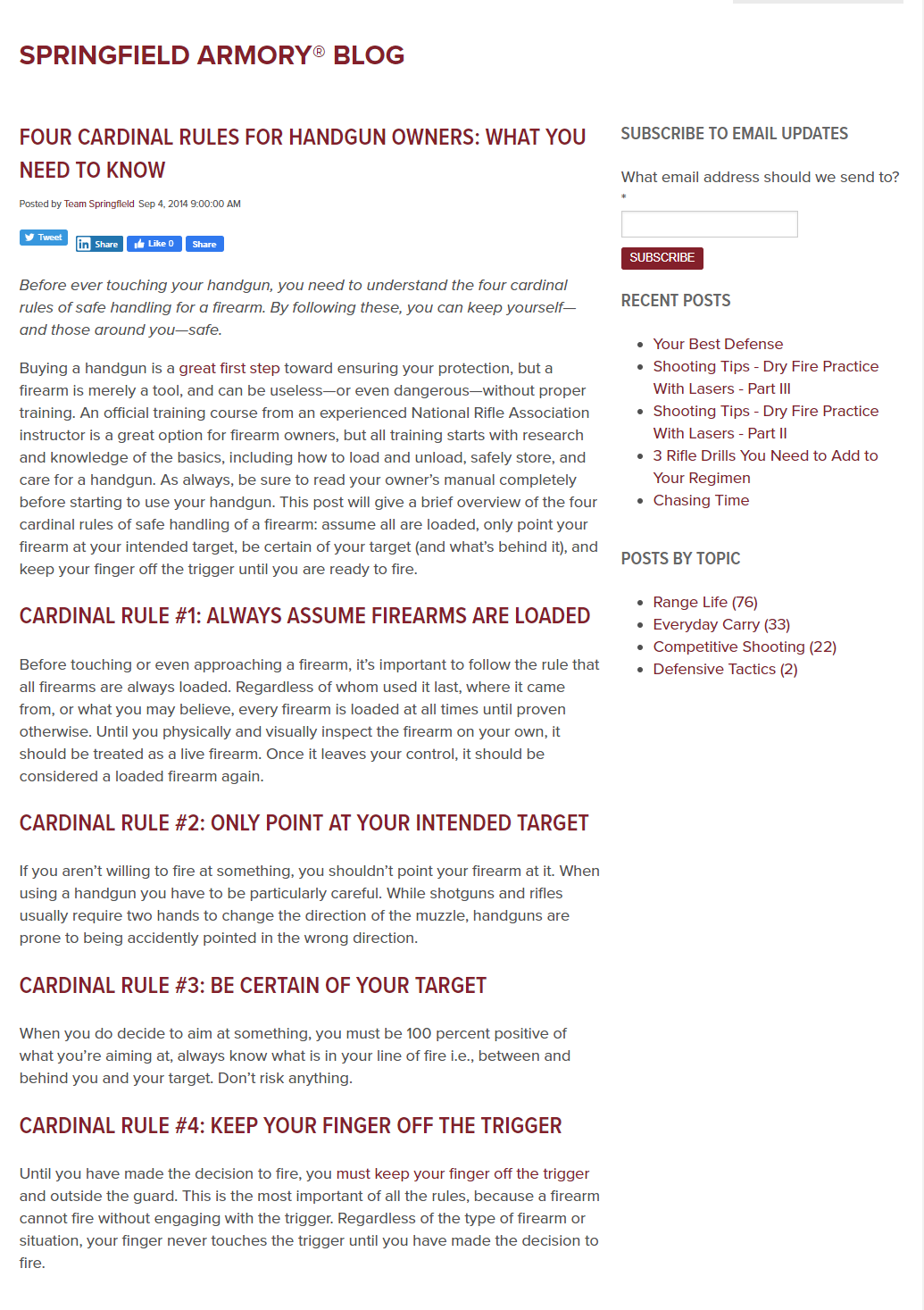 |
| https://blog.springfield-armory.com/four-cardinal-rules-for-handgun-owners-what-you-need-to-know |
What’s more, in that same blog post Springfield Armory is quoting Colonel Jeff Cooper, the man who not only created the Four Rules but was also a member of the Board of Directors for the National Rifle Association. Yes, you read that correctly: an article in Bloomberg’s anti-gun The Trace just went to the NRA for help. Isn’t it curious that, after years of calling the NRA and its members awful people who value guns over safety, the very first piece of firearm safety instruction comes from the NRA? Thank you, Michael Bloomberg, for admitting that the NRA actually teaches firearm safety.
Oh, but the hits don’t stop there. Not only is there a link to an instructional YouTube video titled How to Use an AR-15 by Lucky Gunner (the ammunition drop-shipping company which was sued by the Brady Campaign after the Aurora, CO shooting), there are also links to other YouTube videos made by the Tactical Rifleman and Legally Armed America channels. Thank you, Michael Bloomberg, for endorsing the instructional content of YouTube gun channels.
This whole article has been a parade of amazement, but the part of it which left me most amazed was that its paragraph on safe storage did not take the opportunity to state that firearms and their ammunition must be stored separately. I don’t know how this tacit admission that it’s a terrible idea to keep your self-defense firearm locked up separately from the ammunition needed to operate it ever made it past the editors, but it did, and I find myself worrying about the future career prospects of The Trace’s editor-in-chief.
Unfortunately this article, and therefore Michael Bloomberg, never actually took that final step of admitting that in a self-defense situation the time needed to retrieve ammunition kept separately from a firearm can result in the death of innocents, but given all of the other admissions in this article I’ll gladly forgive this oversight. I will also take this opportunity to state for the record that if your self-defense weapon is a pistol kept properly holstered on your body, not only can you keep it loaded and ready to deploy to defend yourself or loved ones, but you are also keeping it safe and out of the hands of your children, thereby negating the need to lock it up during the day.
Thank you, Michael Bloomberg, for admitting that guns keep us safe, that citizens can responsibly own the AR-15, that firearm education is necessary, and that gun owners were right all along. Now it is up to you to decide if you wish to keep to this new philosophy or revert back to your abstinence-only worldview once this crisis has passed. As you do so, please keep in mind that many new gun owners will be doing the same, and now that they have skin in this particular political game they may no longer be as receptive to your old views as they once were. Bear that in mind, lest you alienate a now-growing segment of your readership.
Why Owning A Gun Is A Completely Rational Insurance Policy Against Danger
Owning a gun is like keeping a spare tire in your trunk, a first aid kit at home, or an emergency savings account. We hope never to use them, but we’re glad we have them.
The social and economic uncertainty surrounding the Wuhan coronavirus pandemic has Americans understandably concerned about their personal safety. In March 2020, the FBI reported the highest monthly number of firearms background checks ever recorded: 3,740,688. Compared to March of the previous year, Americans bought 1.1 million more guns in a single month. Ammunition is also flying off the shelves, with sales in some states increasing more than 4,000 percent.
Many recent first gun-buyers are people who were previously either ambivalent or even opposed to gun ownership. Several such people have reached out to me with questions about which gun they should buy. Many fellow firearms instructors report the same experience.
It’s easy to see why Americans are worried. While we live in a generally high-trust society, catastrophes can easily disrupt the delicate social order on which that trust depends. As it is sometimes said, we are all only nine meals away from anarchy.
Desperate people do desperate things. Economic goods are human goods, and while the current lockdowns are necessary to contain the pandemic, they carry real human costs. Many of these costs — joblessness, homelessness, mental health issues, and drug abuse — lend themselves easily to criminal behavior.
Always Be Prepared
Am I saying society is on the brink of collapse? No, we are far from an apocalypse. The point is simply that the world is and has always been a risky place, so it makes perfect sense to be proactive and prepared. When things are peaceful and prosperous, we often don’t pay attention to danger because things are going so well. But in times of great social and economic stress, we are more attuned to things that might go wrong.
Having a disaster plan isn’t as foreign as some might think. We routinely make decisions aimed at mitigating risks. We purchase insurance, maintain emergency savings, and get flu shots. We keep spare tires, jumper cables, flashlights, and fire extinguishers handy, and buy extra supplies just in case we might need them.
Unless you happen to be naively optimistic, you’re already a “prepper.” Even if you’re relatively “lucky,” you can bet something catastrophic will eventually befall you sometime in your life. Better to be prepared than to be caught off guard.
Prepping for improbable events isn’t necessarily irrational; it is often wise. Consider this: In 2017, more than 2.7 million people were injured in 6.4 million car crashes. With 327 million people in the United States, this means the baseline probability of you getting injured in a car accident each year is slightly over 0.8 percent.
Now, a 0.8 percent chance might be perceived as pretty good odds. After all, that’s a 99.2 percent chance you won’t be injured. But .8 percent of 327 million still comes out to 2.7 million people each year, which is no small number. Are you willing to bet you’ll never be one of those unlucky few? Probably not.
Although your chances of getting into an accident are small, consider what you stand to lose if you do get injured. Making preparations, such as buying insurance or carrying road flares, isn’t irrational, despite statistical improbability.
The Odds of Violent Crime Are Higher than You Think
With that point in mind, let’s look at the odds of violent criminal victimization. In 2018, 3.3 million people ages 12 and older were victimized in 6 million violent crimes. There were 23.2 violent victimizations per 1,000 U.S. residents ages 12 and older, meaning 2.3 percent of Americans 12 and older were victims of violent crime in 2018. This is much greater than the baseline odds of injury from motor vehicle accidents, for which preparation is rational.
If you have a 1-in-50 baseline chance of being violently victimized each year, wouldn’t it be rational to take prudent measures to protect yourself? I think so.
That is exactly why millions of ordinary Americans own guns. Firearms are extremely effective in preventing injury and do not require a great deal of effort to use and keep around. Guns are a perfectly reasonable, cost-effective, safe, and convenient form of risk mitigation.
Owning a gun is like keeping a spare tire in your trunk, a first aid kit at home, or an emergency savings account. We hope never to use them, but we’re glad we have them. None of this indicates paranoia. Carrying a gun is similar to carrying insurance, except it’s better: You actually get to collect the benefits without having to incur serious harm.
Insurance against national catastrophe makes pretty good sense when you consider the past few hundred years of failed states, civil wars, and less-than-ideal regimes. Among other things, the track record of state-sanctioned citizen slaughter, vigilante violence, and racial conflict shows that when societies do go bad, they tend to go extremely bad. Think of the hundreds of sovereign nations that no longer exist due to war and internal strife.
Police, of course, serve a valuable public function. But most police responses come after crimes have already been committed. Less than half of all personal crimes are even reported to police. Moreover, in times of crisis, police are stretched thin. At the time of writing this, 17 percent of the New York Police Department is out sick, and many police departments are not performing arrests or even responding to “minor” crimes.
All this highlights the need to be self-reliant. Ultimately, we are our own last line of defense. We may delegate some of our protection to civil authorities, but the natural right to protect ourselves is inseparable from our humanity.
Gun Owners Aren’t Paranoid, They’re Smart
Some people believe you’re more likely to harm yourself or someone else with a gun than to use it in self-defense, but that isn’t the case. The findings of more than 19 surveys specifically designed to measure the number of defensive gun uses all confirm that defensive uses are vastly more common than criminal uses. A small sampling of these can be viewed on the Active Self-Protection YouTube channel, which has collected several hundred video clips of successful civilian self-defense encounters.
The often-heard charge that gun owners are paranoid and fearful is just naive psychoanalysis unsupported by credible research. Indeed, a recent study has found that gun owners report lower levels of fear and victimization than those who don’t own guns. If anything, there is a lot of irrational fear directed toward firearms as inanimate objects, something famed firearms instructor Jeff Cooper calls “hoplophobia.”
To all the new gun owners out there: Welcome to the Second Amendment community. We’re glad you’ve decided to take the protection of yourself and your loved ones seriously. Get training, be responsible, and be prepared.
Gun Law Reform in Bolsonaro’s Brazil, Homicides Drop Precipitously
In December, 2018, in an article published by the Wall Street Journal, this pronouncement was made. From the wsj.com:
Now, Brazil is set to embark on an experiment that will determine what happens when you loosen gun restrictions in a country battling an overpowering wave of gun crime.
Homicides in Brazil were at historic highs in 2017. They dropped a bit in 2018, as candidate Bolsonaro ran on reform of the gun laws to allow self-defense, and reform of the law to get tough on crime. The homicide numbers dropped from 59,000 in 2017, to 51,000 in 2018. President Bolsonaro was elected in October of 2018.
After taking office on 1 January 2019, President Bolsonaro issued his first decree reforming some of Brazil’s extreme gun laws on 15 January 2019. The drop in Brazil’s homicide rate accelerated.
Gun control in Brazil has a long history. By 1997, restrictions on gun ownership were deemed as “severe” by the Wall Street Journal. From the wsj.com:
In Brazil’s violent cities, where 90% of the murders are committed with guns, ownership restrictions have become so severe that Taurus has branched out into motorcycle helmets, bulletproof vests, and auto parts.
(snip)
Brazil’s 1997 law, which requires gun owners to have unblemished police records and pass rigorous psychological and shooting-proficiency tests, has slashed Taurus’s sales to private individuals by more than 80% in the past two years, Mr. Murgel says. Taurus has sought to make up for that with an aggressive push into motorcycle helmets and increased gun sales in the U.S., where Taurus’s advertising spending is up threefold this year.
Early in the Bolsonaro presidency, a Brazilian lawyer predicted the homicide rate would drop. From ammoland.com:
César Mello, asked that I include information that early reports are showing a 25% drop in Brazil’s homicide rate, in the first quarter of 2019. If this trend continues, 16,000 lives will have been saved in the first year of President Bolsonaro’s time in office.
The rate reduction was not quite that high. Only 10,000 lives were saved. From wtop.com:
Brazil had 41,635 killings in 2019, down 19% from the prior year and the least number of homicides since 2007, when the so-called Violence Monitor index was launched. It is a partnership between the non-profit Brazilian Forum of Public Security, the University of Sao Paulo’s Center for the Study of Violence, and news website G1, which published the data Friday.
“IN OUR GOVERNMENT HOMICIDES, VIOLENCE AND FALLACIES FALL!” an exultant Bolsonaro wrote on his Twitter account, sharing the G1 news report. “Our government extends a strong embrace to all the security agents of the country. Brazil continues on the right path.”
When translated to homicide rates, the rate dropped 17% in 2018, then 23% more in 2019. The population of Brazil in 2019 was 210 million. The rate of homicides per 100,000 was 19.83. That is less than 2/3 of the homicide rate in 2017, which was 30.8.
Brazil has not had a homicide rate this low since 1995, before the highly restrictive gun law of 1997 was passed.
When the NYTs did an article on the reform of Brazil’s gun laws during the Bolsonaro administration, somehow, the reduction in the Brazilian homicide rate was not included. The article was published on 31 March, 2020. From the nytimes.com:
During Mr. Bolsonaro’s first year in office, the government issued more than 200,000 licenses to gun owners. The federal police, which issues licenses for self-defense, approved 54,300 permits in 2019, a 98 percent increase from the previous year. The army, which grants permits to hunters and collectors, issued more than 147,800 new licenses in 2019, a 68 percent increase.
The only mention of homicides in the NYTs article is this:
In Brazil, a country of more than 209 million that has one of the highest homicide rates in the world, the right to bear arms is not a constitutional guarantee, as it is in the United States. The gun rights movement has long been on the losing side of policy debates.
Will the Brazilian homicide rate continue to drop? We will find out over the course of the next few years. Leftist academics are already finding excuses as to why the reform of Brazilian gun laws made no difference.
They had predicted homicides would rise as the reforms were implemented.
They used to say an anti-gun liberal was merely a conservative who hadn’t been mugged yet. Now it seems to be one who hadn’t had the cluebat of being their own First Responder upside their head.
I’m One of Those Anti-Gun People Who Just Bought His First Firearm
Ilya from Michigan writes . . .
If you’d have met me three weeks ago, you’d unequivocally know my stance on guns. I was not only against the ownership of AR-15s, I was in the minority of folks who thought all private gun ownership should be illegal.
I’m still in a bit of disbelief that there is a dangerous weapon in my house: one that more frequently contributes to accidental deaths, violent homicides, and suicides, rather than the romanticized personal protection experiences.
What happened? The world changed overnight and my opinion…evolved.
I’ve always been a strongly opinionated person, but I pride myself on the idea that my beliefs are loosely held. Strong opinions are great, but what you don’t want is to be egotistically blinded by them. I don’t want to be held hostage by a belief that is no longer valid, given new information.
My views before
I live a pretty privileged existence. My family lives in one of the most affluent communities in Michigan. Everyone in the neighborhood leaves their doors open with bikes on the front lawn. Rarely do we worry about anything being stolen, let alone violent crime. I wasn’t born with this privilege, but worked really hard to get where I am.
Circumstances shape people’s understanding of the world, and my situation highly influenced my views on gun ownership. There was no argument, be it constitutional, personal protection, safety, hunting, or anything else that would change my mind and stop me from logically deconstructing your argument.
Guns are used in more than 20,000 suicides, 10,000 homicides, and just under 1,000 accidental deaths in the US each year. Yes, one can argue that people kill people, not guns. But I’d argue that access to firearms makes it much easier to accomplish the act. I believed that at the national scale, guns were a danger to our society. I wanted no part of this.
How my views have changed
For months, I heard the news of a novel virus spreading in China, which had the potential to turn into a global pandemic. This happens regularly, with Cov-2, H1N1, Ebola, MERS, etc.
We read about it in the newspapers, hear about people dying in other countries, watch coverage of civil unrest, and then we hit the off button and get back to our 21st century privileged American lives. It’s not that we aren’t worried or believe that this can’t happen to us; rather, we’ve never experienced anything similar to this. Our imagination can only take us so far. We think it’s “them”. This will just go away.
Then [it] got real. Countries started shutting down. Stay-home orders were being issued. Supply chains were disrupted and people were hoarding daily necessities.
Cracks in our supply chain became evident and we started experiencing shortages reminiscent of the former Soviet bloc. Companies were going out of business or downsizing. People were losing their jobs at an unprecedented rate.
I’m not a prepper. I’ve never left a store with more food or supplies than what’d I’d typically consume in a few days. I don’t overreact. But the supply disruptions, along with economic uncertainty, started to worry me.
Are we, as a country, prepared? Am I prepared?
We model our future preparedness based on past worst-case scenarios. My grandmother, who lived through WWII in Eastern Europe, stashed every penny away for what she called “the dark days.” The worst days she can recall in her life’s experience.
But as one of the best minds in risk assessment, Nassim Taleb, notes, you can’t prepare for the worst-case scenario based on past events, because the worst-case scenario hasn’t happened yet.
At about the same time, I was chatting with friends who are gun owners and they mentioned the long lines at gun shops. People were buying out all of the guns and ammo. But instead of my typical reaction of “guns are bad and those people are crazy,” my mind started wondering about all of the tail risk possibilities during this event.
What happens when food supply chains fail? What if my area becomes unsafe? Do I need to learn how to hunt? With what? Will civil unrest break out?
People will do anything they can to ensure the survival of themselves and their families. Our preparedness models are based on past assumptions of stability and civil obedience. But we’re in an uncharted territory.
The question I asked myself: What do I need to do to feel safe and protect my family?
I called my friend, who advised me that for personal protection, I should get a handgun. The next day, I walked into a store I never thought I’d set foot in. The line was long. I patiently waited while periodically watching the Fox News station on TV.
The store employees were all armed — very stern, but also very nice. I’ve never felt as safe around so many firearms. That’s when I filled out the background check form and I bought my first gun.
Everytown Law: It’s Totally Constitutional To Close Gun Stores Right Now
For years, Everytown for Gun Safety has presented itself as a moderate “gun safety” group that isn’t interested in stripping Americans of their rights, but is only in favor of “commonsense gun safety” regulations. Now they’re exposing that lie all by themselves. In a time of uncertainty, and during an emergency, Everytown is doing everything it can to prevent Americans from acquiring firearms and ammunition. There’s nothing common sense about that. Their position has nothing to do with gun safety and everything to do with keeping as many Americans as possible unarmed and defenseless when more Americans than ever before are choosing to exercise their Second Amendment rights.
Go look in a mirror and you will see who your real ‘First Responder’ is.
Coronavirus Clobbers Cops and Suddenly Second is First Fallback
Reports are surfacing in several jurisdictions about the number of police officers testing positive for Coronavirus, underscoring the importance of the Second Amendment among people who might have been indifferent about the right to keep and bear arms…until now.
Over the weekend, TIME magazine reported that “about 700 New Jersey police officers have tested positive for the coronavirus.” Acting State Police Supt. Col. Patrick Callahan said more than 700 officers have been quarantined at home.
However, the Philadelphia Inquirer subsequently reported that Callahan had “overstated” the number. The newspaper noted that “while 1,272 officers had been ‘quarantined,’ the actual number of those testing positive was 163. In addition, it said that 1,435 officers were ‘out for other reasons,’ but did not elaborate.”
The Sun reported Monday “Almost 5,000 (New York) cops are currently out sick as the coronavirus crisis continues to ravage New York with fears looming of disorder on the streets. The number of police officers out sick on Sunday amounts to nearly 14 per cent of the 36,000-strong force.”
The Associated Press reported “More than a fifth of Detroit’s police force is quarantined; two officers have died from coronavirus and at least 39 have tested positive, including the chief of police.”
The story also revealed “Nearly 690 officers and civilian employees at police departments and sheriff’s offices around the country have tested positive for COVID-19, according to an Associated Press survey of over 40 law enforcement agencies, mostly in major cities. The number of those in isolation as they await test results is far higher in many places.”
Altogether, these reports reinforce the argument made over the weekend by Alan Gottlieb, founder and executive vice president of the Second Amendment Foundation, which has filed a lawsuit in New Jersey to reopen gun shops and shooting ranges. He says the same principle applies nationwide, where police manpower shortages might translate to problems for the public, despite official insistence they have things under control.
“This is exactly why the Foundation lawsuit to force New Jersey to re-open gun stores during this emergency is so important,” Gottlieb said. “People need to be able to obtain the means of self-defense in times such as these. This is why the right to keep and bear arms is essential.
“The Second Amendment wasn’t written for duck hunters,” Gottlieb added. “The right to keep and bear arms is enshrined in the Constitution to assure every citizen has the means to defend himself or herself when help may not arrive in time, or maybe not arrive at all.”
Since the COVID-19 outbreak began more than two weeks ago, anecdotal reports of citizens rushing to gun stores to purchase firearms and ammunition have surfaced, suggesting many people were buying guns for the first time. The Second Amendment in essence became their first fallback.
Alarming to gun owners from one coast to the other has been the widespread shut downs of police agency services including fingerprinting for concealed carry license or permit applications. Some agencies are accepting renewals only, deciding to suspend new permit applications. This has already resulted in one lawsuit in North Carolina, filed by SAF, the Firearms Policy Coalition and Grass Roots North Carolina.
Several other lawsuits are under consideration, Gottlieb hinted in a telephone conversation late last week.
NSSF GRATIFIED TO SEE FIREARM ACCIDENTS REACHING RECORD LOW LEVEL
NEWTOWN, Conn.—The National Shooting Sports Foundation® (NSSF®) is pleased to report that unintentional firearm fatalities reached their lowest level ever, according to the latest data from the National Safety Council’s just-released Injury Facts Report 2018.
NSSF, as the trade association for the firearm industry and leading proponent of safe gun handling and storage, applauded the report, which shows fatal firearm accidents at their lowest level since record keeping began in 1903. The firearm industry has for the last two decades provided more than 100 million firearm locking devices with new firearms sold and through its award-winning Project ChildSafe® program—the largest and most comprehensive firearm safety program in the country. The industry’s educational materials are widely distributed to gun owners by firearm manufacturers, retailers, instructors and others nationwide.
“As an industry that prioritizes firearm safety, it is extremely good news to see this record decline in gun-related accidents,” said Joe Bartozzi, NSSF’s President and CEO. “It’s gratifying to know that our industry’s gun safety efforts, including our long-running Project ChildSafe firearm safety education program, are contributing to helping save lives.”
With approximately 100 million gun owners in the country, the data demonstrates that firearms can be safely owned and used and accidents prevented as long as secure storage guidelines are followed. “Securely storing firearms when not in use is the No. 1 way to help prevent accidents, thefts and misuse,” said Bartozzi.
The National Safety Council data showed that for 2018 there were 458 firearm fatalities, accounting for less than 1 percent of unintentional fatalities from all principal causes. In the last two decades (1998-2018) accidental firearm deaths have declined by 47 percent. “Even one accidental firearm fatality is one too many,” said Bartozzi. “We’re aiming for zero, and this is great progress.”
With reports of many people purchasing their first firearm due to safety concerns over the COVID-19 pandemic, Bartozzi reminds new gun owners to use the safety device that came packaged with their new firearm when their gun is not under their direct control, to strongly consider using an additional safety device such as a lock box or lockable gun case, and to take advantage of the many gun safety resources at ProjectChildSafe.org, such as this video on the 10 commandments of firearm safety.
Also, with so many children at home because of COVID-19-related school closures, Bartozzi encourages parents to take time to have “the talk” with their kids about gun safety and to use tools such as the McGruff on Gun Safety videos and a video on how parents can talk to their children about gun safety on the Project ChildSafe website.
Learn more at ProjectChildSafe.org.
“You can’t shoot a virus” The Crap-For-Brains Sheriff said. What-An-Idiot. He knows what people are buying guns for; Self Defense. It’s just that he can’t stand the fact the people are realizing that ‘the authorities’ aren’t going to be there when things go from bad to worse and they will have to be their own First Responders.
LA County Sheriff halts efforts to close gun stores after county counsel intervention.
LOS ANGELES – The Los Angeles County Sheriff told FOX 11 on Tuesday night that enforcement efforts to close down local gun stores have been suspended after intervention from the county’s legal counsel.
Sheriff Alex Villanueva told FOX 11 reporter Bill Melugin that county counsel Mary Wickham issued an opinion that gun stores can be classified as essential businesses under the Governor’s statewide executive order.
Sheriff Villanueva everything is now in “limbo”, and added he reached out to the Governor’s office to get clarification on how gun stores should be classified, but never got a response.
Up until the legal opinion, Villanueva said a majority of gun shops were complying with his order to close down.
The Sheriff maintained that he believes gun stores should not be open to the general public right now because he feels there are too many first time buyers making panic purchases of guns they don’t know how to operate and they aren’t familiar with California’s strict laws.
“You can’t shoot a virus,” Villanueva said.
West Virginia: Gov. Justice Protects Second Amendment
Governor Jim Justice’s recent Executive Order No. 9-20 designates “firearm and ammunition suppliers and retailers” under “Essential Businesses and Operations,” exempting them from being shut down during this state of emergency. In doing so, Gov. Justice reaffirms that the Second Amendment is the law of the land while other jurisdictions are using the pandemic as an excuse to strip Americans of their fundamental right of self-defense.
In addition, Gov. Justice signed House Bill 4955 into law today. It reduces the current $75 fee for a LCDW to $25 and eliminates the fee for honorably discharged military veterans. West Virginia already allows law-abiding adults to carry a handgun to defend themselves without first having to pay fees or obtain government permission, but that ends at the state line. Many West Virginians still choose to get a LCDW in order to exercise their right to carry in other states that recognize West Virginia’s permit. This fee reduction helps ensure that West Virginians of any financial means are able to defend themselves when traveling.
Yes, You Need a Gun During the Virus Scare..and After
You want to have a gun before you need it.
Advocates of armed defense have been saying that for decades, though recent events underlined their point.
Last month, sentencing reforms in some states effectively decriminalized theft under about $900. We saw stores stripped by flash-mobs of shoplifters.
Police refused to investigate a “misdemeanor” crime even though the total loss may be tens of thousands of dollars.
Those sentencing revisions also let more serious criminals out of jail without bail.
The revolving door of injustice spun pretty fast after that. Last week, some cities let convicted thugs out of jail because of a flu virus. States closed gun shops and promise to arrest you if you leave your home. Police in some cities refuse to respond to theft in progress due to risk from public contact. Yes, you need a gun.. and a lot more.
These recent headlines highlight an obvious fact. These events let us see that we are on our own. If we’re attacked, the police arrive after we’ve gotten to safety, after we’ve made the call to 911, and if law enforcement has personnel available to help us. It is up to us to defend ourselves and those we love until the police arrive.
That realization changed last week, but only by a matter of degree. Now we’re in the middle of a virus scare and police may or may not respond to our calls. Today, law enforcement in many cities are refusing to come to the scene of the crime if the criminal threat is gone. As you’d expect, crime increases when criminals are not pursued, arrested, jailed, charged, and prosecuted. Today, you are at a greater risk, but you were never completely safe.
Many people wanted to believe that they’d be safer if they were unarmed. Our experience with armed citizens says otherwise, and so do the recent headlines. Many people who were only vaguely aware of self-defense now see the need for a personal firearm. I’m sorry, but for many of you it is too late to become armed defenders.
First, you’d need a gun. Some states said that gun shops were “non-essential businesses” so they were told to close their doors. We’ve seen panic buying that emptied store shelves. If you wanted a gun, now you’re too late.
You thought you needed a gun, but you also need a holster, ammunition, and cleaning supplies for that firearm. Some states require a permit before you may buy a gun. Some states also stopped processing those firearms purchase permits. If you’re not ready now, then you’re too late.
You want to protect yourself and your family, but two thirds of aggravated assaults happen away from home. That means that you might need a permit to legally carry a firearm outside your front door as you walk to the mailbox. States that disregard the right of self-defense have stopped processing those concealed carry permits.
The advocates for armed defense have been warning you about these infringements for years, and now you’re too late.
You thought that owning a gun would make you safer, but a firearm is useless without the skills to use it. Fortunately, defending your family from thugs coming up the stairs doesn’t take a lot of skill. Unfortunately, it takes a lot of skill to defend your family from several thugs converging on your family between the parked cars in the grocery store parking lot at night. If you haven’t developed the skill then you’re depending on luck, and there are usually several attackers.
How did you get here? The public receives the public policies for which they voted. Now, you’re paying the price with your family’s safety. I hope you’re one of the lucky ones and no one is hurt.
I like that you want to defend your family. Now defend the right to do so. The right of honest citizens to keep and bear arms should not be infringed. This virus scare will pass, but the infringements on your rights of armed defense will remain.. until you remove them. Don’t wait until November. Secure your rights before you need them. Become politically active now, or the rights you lost will be lost forever.
Americans are flocking to gun stores because they know the only reliable self-defense during a crisis is the #2A.
Carletta Whiting, who’s disabled & vulnerable to #coronavirus, asks Dems trying to exploit the pandemic: Why do you want to leave people like me defenseless? pic.twitter.com/wDeEYHqzOU
— NRA (@NRA) March 21, 2020
Iowa State Senator Celsi is a demoncrap. Need I explain more?
Research on firearms contradicts senator; guns used in defense are a deterrent
State Sen. Claire Celsi’s anti-gun column, published in the Register’s community editions on March 17, is filled with distortion.
Her biggest whopper is that “the rate of suicides in the United States is 10 times higher than any other country on Earth.” In fact, the United States annual suicide rate typically ranks in the 30s.
She claims that the proposition that good guys with guns stop crime is a fantasy. In fact, successful defensive use of guns is more common than their use in crime. The National Academies of Science found: “Defensive use of guns by crime victims is a common occurrence …. Almost all national survey estimates … of annual uses range from about 500,000 to more than 3 million …in the context of about 300,000 violent crimes involving firearms in 2008. … Studies that directly assessed the effect of actual defensive uses of guns (i.e., incidents in which a gun was “used” by the crime victim in the sense of attacking or threatening an offender) have found consistently lower injury rates among gun-using crime victims compared with victims who used other self-protective strategies.”
Celsi misleads by lumping together all firearms deaths, as if accidents, homicides and suicides were the same thing, to write that “rates of death from firearms among ages 14 to 17 are now 22.5% higher than motor vehicle-related death rates.”
In fact, an apples-to-apples comparison shows that the 2018 accidental death rate from firearms among ages 14 to 17 is 0.23 per 100,000, while the accidental death rate for motor vehicles for that group is 6.48 per 100,000. The rate of death for firearms accidents among ages 14 to 17 is actually 96% lower than motor vehicle-related accidental deaths rates.
The unintentional firearms fatality rate, now 0.15 per 100,000, has declined over 94% since records began to be kept in 1903. Fatal gun accidents rank as one of the lowest causes of injury.
While the number of privately owned guns increased 92%, from 185 million guns in 1993 to 357 million in 2013, the firearms homicide rate decreased by 49%. Firearms homicides increased from 2015 to 2017, but decreased in 2018, a trend expected to continue for 2019.
There is an increase in suicides, but the problem is far more complex than the presence of firearms. The Centers for Disease Control and Prevention confirmed that, while the number of suicides increased from 1999 to 2014, the percentage of suicides committed with firearms decreased during the same period. Assuming that each of the 24,432 firearm suicides in 2018 involved one firearm per suicide, those 24,332 guns represented less than one-hundredth of 1 percent of the 357 million firearms in America.
As for Celsi’s proposition that “good laws will keep us safer,” economist John Lott found “stricter gun laws are associated with more total deaths from homicides and suicides.”
If someone living in one of those states with strict gun control laws is so far behind the 8-Ball that they’re trying to buy a gun now, well….stupid is not too mild a word to use about them.
No Cops to Save You, but Too Bad You Couldn’t Get a Gun to Protect Yourself
You might not have wanted a gun before, but now you do. You’ve seen the empty shelves in grocery stores. You read in the news that some police departments are taking longer to respond because of the outbreak of the Wuhan virus.
Some police departments are conserving their resources and only responding to critical incidents in progress. The whole situation sounds unbelievable until you read that unarmed shoppers in California were robbed of their groceries. That is why many people decided they suddenly needed a gun for self-protection. Some gun stores reported a five-fold increase in sales.
The Federal National Instant Background Check system reported processing three times the number of applications compared to a year ago.. if you could get a gun at all. Many citizens who wanted to buy a gun ran into our bizarre gun-control scheme and were disarmed. That wasn’t all they learned.
These gun buyers discovered that buying a gun legally wasn’t as easy as they thought. After you’ve passed your state and federal background checks, then the gun buyer must wait an additional ten days if you’re a resident of California. You’ll wait an additional 14 days if you live in Hawaii. In theory, there is only a six month wait to get a permit to purchase a gun in New Jersey, but New Jersey stopped processing applications. There, the good guys are disarmed by gun-control.
Lots of new gun buyers found out that the mainstream media lied to them. They discovered that you can’t buy a gun online. They found out that democrat politicians lied when they said it is easier to buy a gun than to buy a book. These new gun buyers crashed head-first into the 23 thousand firearms regulations we have in the US. That system isn’t easy for anyone.
In theory, these regulations prevent a known criminal from getting a gun. In practice, the bad guys get their guns the same way they get their drugs; the criminals get their guns illegally. These thousands of regulations disarmed the honest citizen who wants to obey the law.
How does disarming the honest citizens make us safer?
Millions of new gun owners and their families are now asking themselves that very question.
The practice and theory of gun-control are wildly different. Gun control laws are not designed to do what the politicians say they do. Gun-control laws are designed to put a politician in front of a camera while he reads a glowing press release. The politician slaps a wonderful sounding title on more regulations that don’t stop crime any better than the last ink-on-paper did. The news media nods with approval and refuses to ask for evidence that this charade really works. The media stays silent because their job depends on being invited to the next press release.
When this political-theater is presented to us in the news, most of us didn’t ask how gun-control was supposed to keep us safe. For millions of us, that changed last week. Today, more of us are asking that question as the recent wave of want-to-be gun owners were disarmed.
Gun-control has never stopped crime. Gun prohibition was designed to stop you from protecting yourself while pretending to make you safe. Now that you’re threatened, you are supposed to go pay a politician for an exemption, or pay so the police will protect you after you were denied the tools of self-defense.
That scheme is tried and true. It is as old as politicians and prohibition. Many citizens didn’t believe that gun-control worked that way until they saw it with their own eyes.
Now they know.. and so do you.