
“One of the sad signs of our times is that we have demonized those who produce, subsidized those who refuse to produce, and canonized those who complain.”
— Thomas Sowell
Category: Quote O’ The Day
If you don’t understand why the Electoral College exists, you are the reason the Electoral College exists.
Today the taxing power, rather than chattel slavery, is the instrument by which the parasitical element of the population subsists. And that element, which includes politicians, panics at the slightest reduction in the state’s power to plunder. Once you start liberating taxpayers, even a little tiny bit, nobody knows where it may end. —Joseph Sobran
Can our form of government, our system of justice, survive if one can be denied a freedom because he might abuse it?
— HARLON CARTER
Chris Martz –
Never take climate activists seriously who oppose nuclear power.
I see the liberty of the individual not only as a great moral good in itself (or, with Lord Acton, as the highest political good), but also as the necessary condition for the flowering of all the other goods that mankind cherishes: moral virtue, civilization, the arts and sciences, economic prosperity. Out of liberty, then, stem the glories of civilized life. –Murray N. Rothbard
Revealingly, the central function of the Constitution as law–the supreme law–was to impose limitations not on the behavior of ordinary citizens but on the federal government. The government, and those who ran it, were not placed outside the law, but expressly targeted by it. Indeed, the Bill of Rights is little more than a description of the lines that the most powerful political officials are barred from crossing, even if they have the power to do so and even when the majority of citizens might wish them to do so.
― Glenn Greenwald
The German High Command will at once issue orders to all German military, naval and air authorities and to all forces under German control to cease active operations at 23.01 hours Central European time on 8 May 1945…
— German Instrument of Surrender, Article 2,
Republics decline into democracies and democracies degenerate into despotisms. -Aristotle
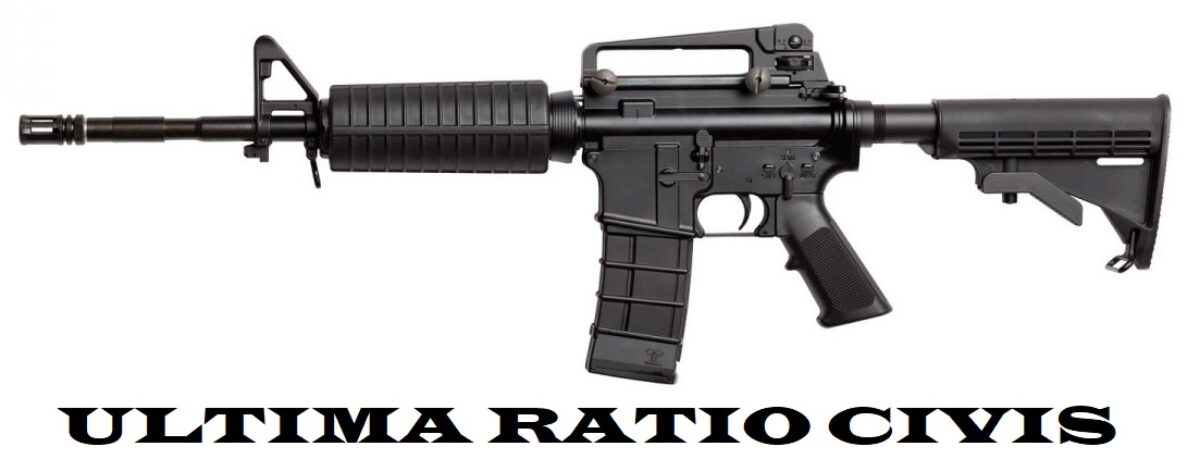
If you have a gun, you have a fighting chance. It’s as simple as that.
– AWR Hawkins
A government that intended to protect the liberty of the people would not disarm them. A government planning the opposite most certainly and logically would disarm them. And so it has been in the twentieth century. Check out the history of Germany, the Soviet Union, Cuba, China and Cambodia.
-Charlie Reese
“Safety is something that happens between your ears, not something you hold in your hands.” – Jeff Cooper
If you don’t defend your own family, who is going to do it? The cops?
– Tony Moon; THE rooftop Korean from the 1992 Rodney King riots.
Every member of the State ought diligently to read and to study the constitution of his country and teach the rising generation to be free. By knowing their rights, they will sooner perceive when they are violated, and be the better prepared to defend and assert them. – U.S. Chief Justice John Jay
In all history the only bright rays cutting the gloom of oppression have come from men who would rather get hurt than give in.– Jeff Cooper
A nation can survive its fools, and even the ambitious.
But it cannot survive treason from within.
An enemy at the gates is less formidable, for he is known and carries his banner openly.
But the traitor moves amongst those within the gate freely, his sly whispers rustling through all the alleys, heard in the very halls of government itself.
For the traitor appears not a traitor; he speaks in accents familiar to his victims, and he wears their face and their arguments, he appeals to the baseness that lies deep in the hearts of all men.
He rots the soul of a nation, he works secretly and unknown in the night to undermine the pillars of the city, he infects the body politic so that it can no longer resist.
A murderer is less to fear.
– Marcus Tullius Cicero (42BC)
If you believe in so-called “Gun Control”, then you believe that the Second Amendment, ratified in 1787, specifically and exclusively refers to the National Guard, which was created 130 years later, in 1917.
If you believe in so-called “Gun Control”, then you believe that the National Guard, federally funded, with bases on federal land, using federally-owned weapons, vehicles, buildings, and uniforms, punishing trespassers under federal law, is a “State” militia.
If you believe in so-called “Gun Control”, then you believe that private citizens shouldn’t have handguns because they are not “military weapons,” but private citizens shouldn’t have assault rifles because they are military weapons.
If you believe in so-called “Gun Control”, then you believe that “Assault Weapons” have no purpose other than to kill large numbers of people. The police need assault weapons. You do not.
No free government was ever founded, or ever preserved in its liberty, without uniting the characters of the citizen and soldier in those destined for the defence of the state. . . . Such are a well regulated militia, composed of the freeholders, citizen and husbandman, who take up arms to preserve their property, as individuals, and their rights as freemen.
– “M.T. Cicero” 1788
“It was staged.”
“Damn, he missed.”
-same peopleIt’s like Holocaust deniers who lament that Hitler didn’t finish the job.
— Joel Engel (@joelengel) April 26, 2026
“…The right of the people peacefully to assemble for lawful purposes existed long before the adoption of the Constitution of the United States. In fact, it is and always has been one of the attributes of a free government.
It `derives its source,’ to use the language of Chief Justice Marshall, in Gibbons v Ogden, 9 Wheat., 211, `from those laws whose authority is acknowledged by civilized man throughout the world.‘
It is found wherever civilization exists. It was not, therefore, a right granted to the people by the Constitution… The second and tenth counts are equally defective. The right there specified is that of `bearing arms for a lawful purpose.’ This is not a right granted by the constitution. Neither is it in any manner dependent upon that instrument for its existence.”
– U.S. v. Cruikshank (1875)