Is it Wednesday already? Pardon me, I left my calendar in March.
If today’s headline about election-stealing seems a bit over the top and incendiary, I can assure you that it was most intentional. Democrats and their flying media monkeys make outlandish claims like that about conservatives and Republicans all the time and are never held accountable for them.
These are, after all, the lunatics who are referring to the presence of federal officers in burning riot cities as a portent of “martial law.”
Well, more than one can play the hyperbole hysteria game. And when one is hurling outlandishness at Democrats, history tells us that there is a greater likelihood that it will be true (see how I’m warming up to this so quickly?).
At present, the Democrats are attempting to unseat an incumbent president by devising a plan where their candidate doesn’t have to be seen in public for most of the general election campaign. They’re desperate to keep Joe Biden hidden until as many early and mail-in votes as possible are cast for him because they know that the first time he’s on his own in public he’s going to pull down his mask and start sniffing strangers, all the while barking, “Barack likes me!”
On the rare occasions when the idiot in the basement is let off-leash by his wife and handlers, he’s babbling about President Trump trying to “steal” the election. He keeps saying it, too, most recently at a virtual fundraiser hosted by one of the celebrities Hillary Clinton thought would wish her to victory.
“This president is going to try to indirectly steal the election by arguing that mail-in ballots don’t work. They’re not real. They’re not fair,” Biden said.
In each one of these “steal the election” rants, Biden immediately rambles on about mail-in ballots. Again, that’s all they’ve got and they know it. That’s where the real election-stealing can happen and it’s not going to be done by the Republicans.
The Democrats have shown — especially in the Trump era — that most of what they throw at the Republicans is just a bunch of twisted political psychological projection. Continue reading “”
The Seattle-based Alliance for Gun Responsibility, a billionaire-backed gun prohibition lobbying group, has done Evergreen State conservatives—especially gun owners—a huge favor by publishing its “2020 Legislative Score Card.”
That this information is available right before the Aug. 4 primary election is no small thing. One glance up and down the list tells gun owners who not to vote for in state legislative races, and the formula is easy.
If a politician gets a “0%” Voting grade, vote for him or her. Politicians rating “100%” should get an immediate rejection, and their opponent should get the gun owner vote. In between, any politician earning a rating below 50% deserves a look, while anyone popping above 50% should be considered overdue for replacement. Continue reading “”
His team’s problem is, if he does debate, it will be over as well, due to his dementia, and they know it. Between a rock and a hard place doesn’t begin to describe their problem.
And, he’s got 10 minutes for a softball ‘interview’ by a local TV guy in Phoenix – that looks like it was prescripted so SloJoe could read off a TelePrompter and printed answer sheet- but no time for Chris Wallace?
Again, we know why: Wallace has just enough ethics left to not provide his list of questions in advance and Biden’s team knows it would turn out to be a disaster for Joe if he has to speak without assistance.
It was the commentary of author Thomas Friedman that got me asking if this is a legitimate tactic: could the Biden Team seriously be considering the idea that they could keep presumptive Democratic presidential nominee Joe Biden off the debate stage? Could they really keep him from debating President Donald Trump going into November?
Nevermind that failing to debate Trump will cost Biden the election, Freidman’s idea was farcical, as are many of the things now written in the New York Times (like the 1619 Project, which its author now admits is a flight of fancy.) Friedman wrote:
First, Biden should declare that he will take part in a debate only if Trump releases his tax returns for 2016 through 2018. Biden has already done so, and they are on his website. Trump must, too. No more gifting Trump something he can attack while hiding his own questionable finances.
And second, Biden should insist that a real-time fact-checking team approved by both candidates be hired by the nonpartisan Commission on Presidential Debates — and that 10 minutes before the scheduled conclusion of the debate this team report on any misleading statements, phony numbers or outright lies either candidate had uttered. That way no one in that massive television audience can go away easily misled.
Tax returns? The Supreme Court has already ruled on this. Twice. Besides, no one who is fence-sitting on this race cares about tax returns (though, if we can also see Hunter Biden’s returns, maybe this could get really interesting!) As to his second point? Ok! Fact check away! But does Freidman not understand the double-edged sword of immediate fact checking? Has he never heard Joe Biden speak? Or, more accurately, fail to speak?
But what if this idea isn’t farcical? What if this is an actual idea in the minds of the political Left? Oh, sure, the Left could blow off the idea, and complain that I’m bringing up a red herring. But it’s not. A red herring is the Left asking, “Will Trump Leave Office?” if he loses the election. Recently, it’s been a litany of nonsense-merchants filling minutes on cable news and 280 characters on Twitter – with no proof – on how Trump is not going to accept the election results, or about how Trump is using law enforcement in Portland as a test run for fighting off election results in November.
Clearly, the only two people in recent memory who haven’t accepted election results are Stacey Abrams and Hillary Clinton. But what of Trump’s answer to Chris Wallace of Fox News, when he wouldn’t say that he would accept the election results? Well, that was a bunk question from Wallace. Should anyone accept results they don’t have yet? Should they accept results where fraud is alleged? Should they accept results where tampering is questioned? Of course, the answer is no. You go back, re-check, recount and confirm that the votes of the citizenry were honored and properly counted. When Trump said, “I have to see,” it was clear to rational people that those circumstances were the ones he was referring to. Or, he recognized the question as garbage and decided to give Wallace palpitations.
But back to this idea of Biden not debating. It started with Freidman, but it was clearly backed by the New York Times. And if tax returns are the first thing on their list, it seems very obvious that the Old Gray Narrative is telling Joe Biden not to debate Donald Trump.
Americans don’t reward cowardice all that much. They aren’t into those who hide from danger, or the truth. Biden has been hiding in his basement. Sure, coronavirus made it easy to do, but the Biden Team accepted their basement arrangement far too easily. Everyone has noticed that he’s hiding, including him! When Wallace interviewed President Trump, Trump said that if Joe Biden had to do an interview like this, he’d be, “on the ground crying for mommy.”
Would he? Well, we don’t know. Wallace – who graciously credited Trump for appearing on the show and answering tough questions – noted that Biden was invited, but declined. He didn’t decline being the first guest on Joy Reid’s new MSNBC show (Reid, it should be remembered, wrote anti-gay posts about then-Florida Governor Rick Scott, claimed she was hacked, never fully apologized for lying about not being hacked, never fully apologized for her comments that would have gotten a conservative fired on the spot and was rewarded with a prime-time slot on television.)
Ok, you go where the interview is easy (and Reid’s interview wasn’t just a softball, it was an unpacked snowball.) It makes sense that Biden stuck with the friendly confines. But his campaign thinks they can get disaffected Republicans. Wouldn’t more of them be watching Fox News than MSNBC? Sure, they may hate Trump. But that doesn’t mean they’re settling in for a night with Rachel Maddow.
Biden purposefully skips hard interviews. Biden avoids hard questions. His team cuts off anyone and everyone, ending interviews with their candidate aggressively:
Sure, he has time constraints. But Biden can’t find ten minutes for Chris Wallace? Meanwhile, President Trump is getting asked questions from Dave Portnoy of Barstool Sports! (Don’t laugh, Portnoy is a smart guy and has an army of devoted followers. And there is no doubt Trump reached Americans he never would have reached without that conversation.)
My bet, for reasons clear to all of us, is that Biden’s Team is afraid of what will happen on a debate stage. My bet is that all of Biden’s admissions that he can, “…hardly wait” to debate Trump are a lie. They know Joe doesn’t have the acuity to handle 90 minutes of debate. Please note that I am not a doctor, and I am not diagnosing Joe Biden. I’ve just heard him talk, and he can’t verbalize four sentences without falling apart. You’ve heard the same. You believe the same. And, my bet is, so does the Biden Team.
The problem is what I mentioned earlier: Failing to debate Trump will cost Biden the election. Specifically, it will cost him the Midwest. Pennsylvania, Wisconsin, Ohio, Michigan: The fence-sitting voter will not vote for the guy who is afraid to debate. The Biden Team can claim tax returns or Covid-19 or the weather or the chupacabra for their reason not to show up, but none of those reasons work. None will be accepted. None will be tolerated.
Trump could pull a Trump and decide not to debate because the network or the moderators are against him. But he hasn’t done that yet. In fact, he’s pushing to add debates to the three already on the schedule. Trump sees what we see: Biden can not handle the debate stage once, let alone four times.
However many debates there are, there has to be at least one. America will not accept a debate-less election. America expects those who want to lead this nation to stand up in front of them and make their case. On this there is no debate for Joe Biden: Show up, and you might lose. Fail to show up, and you definitely will.
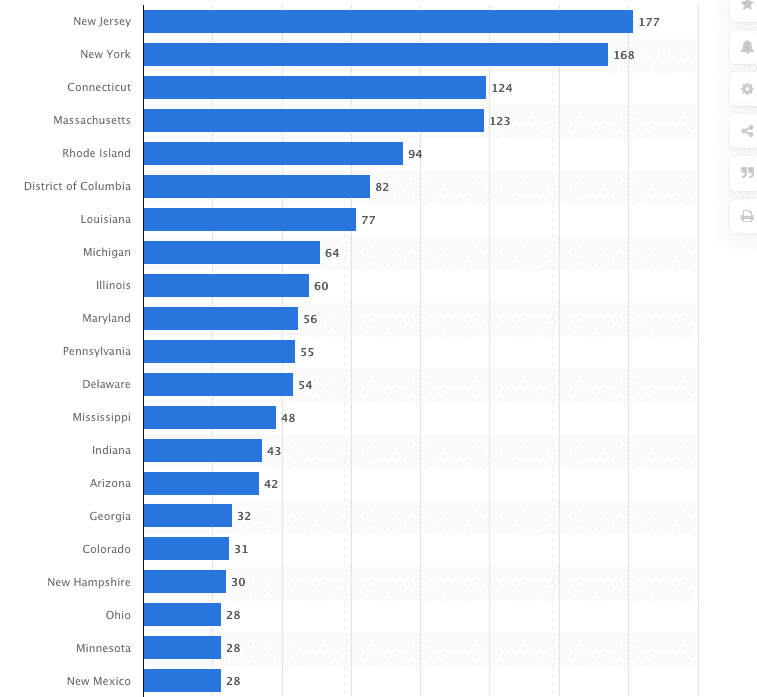
Now if you listen to the lame stream media, you’d think otherwise but in reality, the top 6 state’s administrations are what party?
Can you say DEMONCRAP?
I thought you could.
The convention was originally scheduled for Charlotte, N.C., but Trump canceled that event after that state’s governor couldn’t guarantee that the president could have large in-person events without a mask mandate. The president said they’ll do a “relatively quick” event in North Carolina on Aug. 24 to handle the nomination.
“We’ll have a very nice something,” he said. “We’ll figure it out. It’ll be online. It’ll be a little bit different.”
Funny how personalizing things can concentrate one’s mind
Meals for hungry, COVID casino, NY bars revolt: News from around our 50 states
5 Beloved Restaurants Debuting New Menu Items While Cutting Others
San Francisco Chronicle logoVandals cover Oakland Mayor Libby Schaaf’s home in graffiti
A group of people vandalized Oakland Mayor Libby Schaaf’s home early Tuesday, spray-painting graffiti, splashing red paint on the walls and setting off fireworks that targeted the house before dawn, according to neighbors and a spokesman for the mayor.
Oakland City council members failed late Tuesday night to take millions more in funding away from the Oakland Police Department, even though it appears many residents are demanding it.
The council was evenly split on the vote over a proposal by members Dan Kalb and Sheng Thao that would have reduced the police budget by another $2.75 million.
Mayor Libby Schaaf broke the tie by voting “no” on the proposal.
Their internal polling must be horrible if Der Gretchenführer is back on the list.
In June, Michigan Gov. Gretchen Whitmer (D-MI) was reportedly out of the running to be Joe Biden’s running mate, but Biden told a Michigan TV station Tuesday that she’s back under consideration.
Are you still considering Gov. Gretchen Whitmer as a potential vice presidential candidate?” WOOD TV reporter Rick Albin asked.
“Yes,” Biden replied.
That is an apparent reversal from June, when WWJ reported:
Prominent Democrats with knowledge of the process say Biden’s vetting committee has narrowed the choices to as few as six serious contenders after initial interviews.
One notable exclusion from that short list — Michigan Gov. Gretchen Whitmer.
Politics are real. Politics sets priorities between competing public interests. The process is never perfect. It gets ugly when existing political interests work against your individual rights.
Let’s take an easy example first. Suppose you want to gather people together and voice your opinions. The government says you need a permit for a public gathering. The rationale is that we don’t want several groups trying to use the same space at the same time. Now you learn that there is a permit process, a required interview, and an application fee. The bureaucrats say they are busy and schedule your interview for nine months from now due to Covid-19. Clearly, your right of free speech has been infringed. Continue reading “”
The President has challenged a Democrat to a dual. Personally, I’m still confused by Joe Biden’s presidential nomination.
What’s his party thinking? With all due respect to my elders, Joe’s obvious medical issue doesn’t make for a very in-command Commander-in-Chief.
As I covered previously, Vice President Mike Pence believes something’s afoot — of the “Trojan horse” sort. Are the most radical elements of the American Left waiting to pull strings tied to Joe’s Geritol’d joints?
If so, how will they reach that day of political puppeteering? How might Biden perform in a debate against Donald “The Animal” Trump?
I can’t imagine it happening, but Trump’s at the ready.
Yesterday, we asked whether President Trump will make Joe Biden’s war on the suburbs an issue in this campaign. Today, Stanley Kurtz reports that Trump already has.
In a speech Wednesday in Atlanta on “Rebuilding America’s Infrastructure,” the president emphasized his determination to eliminate President Obama’s radical and legally baseless rule on Affirmatively Furthering Fair Housing (AFFH). Trump stressed Biden’s determination to “hold hostage billions in federal Surface Transportation Grants for states and localities unless the states and local suburban communities abolish single-family zoning rules.”
Holding this money hostage is Biden’s special contribution to the war on the suburbs. It goes beyond the already oppressive AFFH rule. As Stanley explains:
Under the original rule, localities could at least opt out of their HUD grants — and thus out of federal control — even if at the cost of millions of dollars. But what suburb can afford to cut itself off from state road repairs? With that addition, Biden’s plan truly constitutes a war on suburban independence.
When Ron Tims checked his mail Wednesday he found something addressed to Cody Tims. Cody doesn’t get much mail. Cody is a cat. He died 12 years ago. The family keeps his ashes in a green container.
Carol Tims says she understands that in this election year there’s a huge push to get people to the polls.
“There’s a huge push but if they’re trying to register cats, I’m not sure who else they’re trying to register. I’m not sure if they’re trying to register dogs, mice, snakes,” said Tims.
The Secretary of State’s Office says the application did not come from their office. They say third party groups often use mailing lists to get names and addresses. They released a statement saying:
“Third-party groups all over the country are targeting Georgia to help register qualified individuals. This group makes you wonder what these out-of-town activists are really doing. Make no mistake about it, this office is dedicated to investigating all types of fraud.”
Just a FYI to pass along to any gun owners that may still be undecided.
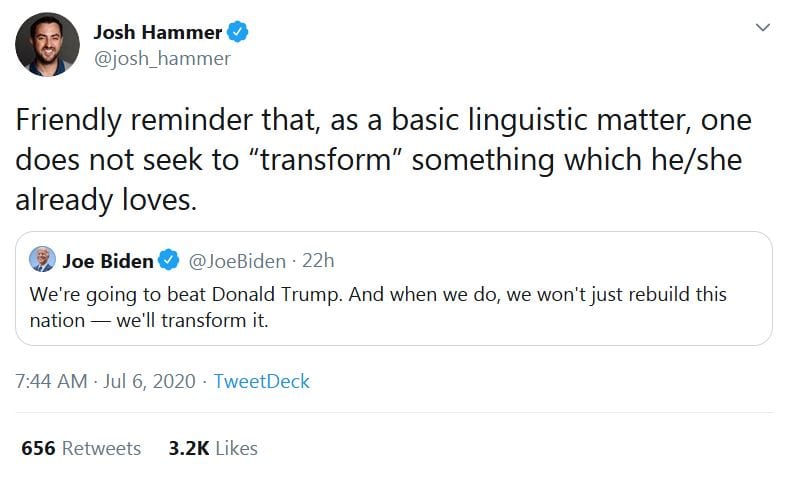
Democratic nominee Joe Biden vowed on Twitter Sunday that if he is elected president, his administration “won’t just rebuild the nation — we’ll transform it,” raising questions from critics about what exactly will be transformed and how he plans on accomplishing it.
We're going to beat Donald Trump. And when we do, we won't just rebuild this nation — we'll transform it.
Those on the left say the former vice president has spent more than 40 years in the federal government without solving any major issues, Fox News reported.
His critics on the right, however, fear Biden will take direction from those on the far-left of the Democratic Party. Who Biden chooses for his running mate will be an early indicator of which direction his administration will lean.
When asked by Fox News for a comment regarding his vague tweet, Biden’s campaign sent a link to his website, which listed several of his policy points and plans.
Wide availability of free coronavirus testing
Emergency paid leave as a “decisive economic response”
An agenda for the black community
Criminal justice reform
An initiative for gun violence
Biden also appears to have some issues that need further explaining ahead of the 2020 presidential election on November 3, including his position against defunding the police — which Politico has called one of the Black Lives Matter movement’s “boldest proposals.”
The figuring is that Kanye will pull most of his votes from demoncraps.
Just when you thought 2020 couldn’t get any weirder, rapper Kanye West declared his candidacy for US president.
The unlikely challenger to Donald Trump – of whom he has been a vocal supporter – and Joe Biden, chose American independence day to make the surprise announcement on Twitter, triggering a social media storm.
“We must now realize the promise of America by trusting God, unifying our vision and building our future,” West wrote. “I am running for president of the United States.” Continue reading “”
President Trump congratulated Lauren Boebert late Tuesday night after the pro-gun businesswoman defeated Rep. Scott Tipton, who represented his Colorado district for five terms in Congress.
“Congratulations on a really great win!” Trump tweeted. Trump’s tweet linked to a post from her Twitter account from back in May where she described herself as a tough fighter against socialism and advocate for the Second Amendment.
The record-breaking gun sales during the coronavirus pandemic could bolster candidates that support the Second Amendment in 2020 and alter the course of American gun politics for the foreseeable future.
Several of the country’s leading gun-rights groups are working to convert many more first-time owners into new gun-rights voters in the run-up to the 2020 election. Amy Hunter, a spokeswoman for the National Rifle Association, said that the group’s success could change the political landscape at the local, state, and national level.
“The NRA believes voters who recently purchased guns for self-defense will join other Second Amendment voters and be an even more formidable voting bloc,” Hunter told the Washington Free Beacon. “They’re educated, passionate, and they know anti-gun politicians are the biggest threat to their fundamental right to self-defense.”
New buyers are learning for the first time how public policy shapes their ability to exercise their rights. Larry Keane, spokesman for the industry’s National Shooting Sports Foundation (NSSF), said that firsthand experience can change how voters look at gun control and Second Amendment legislation.
Last fall, I told presidential candidate Beto O’Rourke, “Hell no, you won’t take away our guns!” which quickly became a national rallying call to protect our Second Amendment rights.
When Gov. Polis and Denver’s liberal legislature passed the National Popular Vote Compact, I volunteered months of my time and effort to make sure we could stop the Democrats from stealing our votes for president and giving them to California.
This November, for the first time since 1932, Colorado voters will have the opportunity to repeal a law because of a citizen-led effort that generated 229,000 signatures across the state. I am proud of the effort and proud to have become the second-largest signature gatherer in the state.