


Category: You Can’t Make This Up
CRIME Resident shoots an armed man during Miami Gardens home invasion, police say
A resident shot and wounded an armed man who broke into his Miami Gardens house Monday morning in what police are calling a home invasion. The man shot was one of three men who entered the residence at 3035 NW 204th Terrace around 11:45 a.m., police said.
Armed with a rifle, he opened the bedroom door before the resident grabbed a gun and fired, striking him in the arm, according to police.
The other two men fled. Miami-Dade Fire Rescue paramedics took the wounded man to HCA Florida Aventura Hospital.
Police, who said the alleged intruder’s condition was unknown as of Monday afternoon, have not released his name.
The shooting remains under investigation, and police did not immediately respond to follow up questions asking if the resident will face charges.
Update
Man acted in self-defense when he shot robber inside Miami Gardens house: police
A man who shot an intruder as he entered his home armed with a semi-automatic rifle Monday morning acted in self-defense, Miami Gardens police concluded.
And the man shot is now in jail facing attempted murder and home invasion charges, per his arrest report.
Around 11:40 p.m., Miami Gardens police say 18-year-old Ezekiel Manthon Leatherwood and three other men walked up to a woman sitting in her car in front of a house, at the 3000 block of NW 204th Terrace. They were armed, wearing masks and all-black clothing.
They demanded money from the woman and then forced her to let them inside the house, according to the report. A man in the house, who police did not name in Leatherwood’s arrest report, heard the woman scream and grabbed his gun, the report states.
Leatherwood kicked in the bedroom door armed with what police say was an AR-15-style rifle. When the door opened, the man, who is the woman’s boyfriend, opened fire, hitting Leatherwood in the arm, the report reads.
The other three men ran out of the house. The man held Leatherwood at gunpoint until police arrived. Before cops got there, the other men, who were near the front door, yelled at the man, demanding that he let Leatherwood go.
In response, police said the man fired shots at the men, who got into a car and drove off.
Miami-Dade Fire Rescue paramedics took Leatherwood to HCA Florida Aventura Hospital to be treated for the gunshot wound. Police eventually arrested and booked him into Turner Guilford Knight Correctional Center.
Police said in their report that Leatherwood made an admission, but his statements were redacted.
As of Tuesday, a judge had not set bond on the charges.
I wonder why their Supreme Court didn’t simp0ly throw the whole case out of court and dismiss the charge. Of course, we have to remember that lawyers live on ‘billable hours’ and judges are mostly lawyers too.
Self-defense law applies to bedrooms, Arizona Supreme Court says
Arizona law allows anyone to protect themselves from an uninvited person entering their home, and according to the Arizona Supreme Court, that also includes bedrooms.
A Pima County jury found John Brown guilty of attacking a neighbor with a microphone stand after the neighbor and his girlfriend entered his room. Though Brown lived with his girlfriend, the two had separate rooms. His girlfriend had invited the neighbor, someone Brown had previously gotten into a fight with. Brown left the two of them alone and locked himself in his bedroom. His girlfriend broke open the lock, and the neighbor tried to enter the room when Brown attacked him.
At trial, Brown asked that the jury be educated on state law that allows a person to claim self-defense if they attack someone entering their residential structure uninvited. The judge denied the request, ruling that his bedroom was not a “residential structure” and that the neighbor had been invited over to the home by another person living in the home.
After being found guilty, the judge sentenced Brown to five years in prison. Brown appealed the ruling, and after losing the appeal, he asked the Arizona Supreme Court to review the case.
Five out of six justices disagreed with the Pima County court’s decision not to let the jury consider the residential self-defense argument.
In an opinion written by Justice James Beene, the court decided that the way the state law is written, Brown’s bedroom should have been considered a residential structure.
Three things make any space a legally recognized residential structure, according to the justices:
The space must be a structure, movable or immovable, permanent or temporary, and adapted for human residence. It should be enclosed and have sides and a floor.
The structure also must be a place for lodging, meaning that it is a place where someone can rest or sleep.
The structure also needs to be separately securable, meaning that the entry point can be locked or secured.
Beene explained that Brown’s room fit all these points, and because he locked the room, it could be said that any person breaking into the room was uninvited.
The Arizona Supreme Court vacated Brown’s verdict and sent the case back to Pima County Superior Court for a new trial.
If it was never clear you, by now it should be that government, as a whole and no matter the fundamentals of how and why it was formed (cf. The Declaration of Independence, Constitution and Bill of Rights), has always been really hesitant to give free and unfettered access to the implements that make it so much easier for the unwashed masses to do away with a tyrant goobermint that sees them as mere peons.
Federal Judge Says Gun Law Unconstitutional, But Allows Feds to Largely Keep Enforcing It
Five years ago, Second Amendment Foundation, Firearms Policy Coalition, Louisiana Shooting Association, and several individual plaintiffs filed a lawsuit challenging the federal ban on handgun sales to adults between the ages of 18 and 20. In late 2022, U.S. District Judge Robert R. Summerhays dismissed the complaint, ruling that young adults have no Second Amendment right to purchase the most common firearm for self-defense, but that decision was overturned by a panel of the Fifth Circuit Court of Appeals in January of this year.
Since then, the plaintiffs and the DOJ have been arguing over the scope of the relief that should be granted, given that the appellate court found the law in question is unconstitutional. That alone should have favored a judgment from Summerhays that covered as many 18-to-20-year-olds as possible. Instead, on Tuesday, Summerhays rendered a judgment that leaves the unconstitutional law in place for almost everyone.
In a press release, SAF Executive Director Adam Kraut said the “practical effect of this order is almost laughable if it wasn’t so frustrating and didn’t impact the Second Amendment rights of thousands of individuals.”
“What the court has done here is say that this law is unconstitutional, but in order for an 18-year-old to avoid having their constitutional rights trounced by it today they must live in one of only three states in the nation and have been the member of SAF at age 13. And even then, they’re only covered if SAF discloses their membership to the government under duress. We’re currently examining our options in relation to the relief granted and will vigorously defend our members’ right to free association and privacy of such.”
The Firearms Policy Coalition is similarly incensed, stating in a release:
Rather than uphold the Constitution and binding Supreme Court precedent, the Court regurgitated the Trump Administration’s self-serving demand to wipe away the Fifth Circuit’s ruling against the government’s unconstitutional ban and continue denying millions of peaceable adults their right to keep and bear arms.
To be clear: FPC has never provided a list of its members to the government—and never will.
Our legal team is already taking action to urgently address this appalling order. We will commence appellate proceedings as necessary to protect our members and effectuate the Fifth Circuit’s decision in our favor. Further updates will be provided as the case proceeds.
The descriptions of Summerhays’ judgment aren’t hyperbolic. Here’s the text of the order so you can see for yourself.
The Court enters declaratory judgment, as described in paragraph 3 below, with respect to (a) Caleb Reese, Joseph Granich, Emily Naquin, and (b) individuals and federally licensed firearms importers, manufacturers, dealers or collectors who were members of Firearms Policy Coalition, Inc., Second Amendment Foundation, or Louisiana Shooting Association at the time this action was filed on November 6, 2020.
The Court hereby declares that 18 U.S.C. §§ 922(b)(1) and (c)(1), and their attendant regulations, are unconstitutional and violate the Second Amendment to the United States Constitution to the extent those provisions prevent the sale or delivery of handguns and/or handgun ammunition by and to persons identified in paragraph 2 on account of the buyer being 18 to 20 years old.
The Bureau of Alcohol, Tobacco, Firearms and Explosives, its Director, the Attorney General of the United States, and their officers, agents, servants, employees, and all persons in active concert with them and who have actual notice of this Judgment are hereby enjoined, within the jurisdictional boundaries of the United States Court of Appeals for the Fifth Circuit (i.e., Mississippi, Louisiana, and Texas), from enforcing the provisions referenced in paragraph 3, to the extent those provisions prevent the sale or delivery of handguns and/or handgun ammunition by and to persons identified in paragraph 2 on account of the buyer being 18 to 20 years old.
Within twenty-one (21) days of issuance of this Judgment, those Plaintiffs identified at paragraph 2(b) shall provide to Defendants a verified list of their members as of November 6, 2020.
Summerhays’ order basically parrots the judgment proposed by the DOJ, which is another problem. President Donald Trump’s executive action to protect the Second Amendment states, in part, that:
… the Attorney General shall examine all orders, regulations, guidance, plans, international agreements, and other actions of executive departments and agencies (agencies) to assess any ongoing infringements of the Second Amendment rights of our citizens, and present a proposed plan of action to the President, through the Domestic Policy Advisor, to protect the Second Amendment rights of all Americans.
(b) In developing such proposed plan of action, the Attorney General shall review, at a minimum:
…
(v) The positions taken by the United States in any and all ongoing and potential litigation that affects or could affect the ability of Americans to exercise their Second Amendment rights;
The judgment proposed by the DOJ (and accepted by Summerhays) is completely contrary to Trump’s order for the DOJ to protect the Second Amendment rights of all Americans.
Donald Trump wasn’t in office when oral arguments in Reese v. ATF took place before the Fifth Circuit last fall, and had only been in office for ten days when the Fifth Circuit overturned Summerhays’s original decision and declared the ban on handgun sales unconstitutional.
Trump issued his executive order on protecting the Second Amendment in early February, and DOJ decided not long after that it would not appeal the Fifth Circuit’s decision to the Supreme Court. That was in accordance with the president’s order, but at some point between February and July, when the DOJ submitted its proposed judgment to the court, the agency adopted a position that runs counter to Trump’s executive action.
What makes this even more frustrating is that the proposed judgment was written, at least in part, by attorneys within the DOJ’s Civil Rights Division, which has been taking historic actions to protect the right to keep and bear arms. In just the past couple of months the division has weighed in against “assault weapon” and “large capacity” magazine bans and sued the Los Angeles Sheriff’s Department over delays in issuing concealed carry permits. It’s bizarre, then, to see the DOJ take the position that, even though this law is unconstitutional, it can continue to enforce it against virtually everyone except the named plaintiffs in Reese.
We’ll be talking more about this case with FPC”s Brandon Combs on today’s Bearing Arms Cam & Co, and I encourage you to tune in and check out what he has to say. Thankfully, this isn’t the only case dealing with young adults and their 2A rights in the legal pipeline, and the Supreme Court has the opportunity to grant cert to similar challenges coming out of the Fourth and Eleventh Circuits later this fall. There’s a clear split in the appellate courts on the issue, and hopefully SCOTUS will soon provide young adults the relief denied to them by Summerhays.
🚨 JUST IN: Chicago Mayor Brandon Johnson CONFIRMS officers were told to stand down after a terror attack on federal immigration agents. pic.twitter.com/XekUxmQ8Sg
He said their top priority is protecting the right to "PROTEST" rather than rounding up illegal alien criminals.…
— Eric Daugherty (@EricLDaugh) October 6, 2025
Gavin Newsom quoting Pericles couldn’t be more perfect.
As I’m sure Gavin already knows, Pericles was basically responsible for the fall of Athens.
He brought in a bunch of refugees within the city walls. The overcrowding and contaminated waters spread the plague, killing him… pic.twitter.com/md0f3VHHI4— Kevin Dalton (@TheKevinDalton) October 3, 2025
🚨 JOY REID WARNS AMERICA OF DANGEROUS MAGA PLANS: "They want to take us back to no income tax, no regulations, earn as much as you want, and leave it to your children with no taxes."pic.twitter.com/6zKFY1KR8p
— Eric Daugherty (@EricLDaugh) September 30, 2025
John Brennan says after a thorough review of his own actions, he’s concluded that “I just don’t see any case against me."
Well, that settles it then. pic.twitter.com/9ycyn7i93G
— Western Lensman (@WesternLensman) September 27, 2025
Rep. Crockett: "Doin a crime don't make you a criminal" pic.twitter.com/p1zXbGJIJw
— End Wokeness (@EndWokeness) September 18, 2025
Hirono: "You are requiring applicants to be able to do a certain kind of pull ups, which a lot of woman cannot because of physiological differences."
Kash: "If you wanna chase down a bad guy and put him in handcuffs, you better be able to do a pull-up."pic.twitter.com/bdh6OdEqDh
— Greg Price (@greg_price11) September 16, 2025
The position of the Left on any given issue, at any given moment, is determined by how that issue can be weaponized against their opponents, for political power. pic.twitter.com/9otKpQ8TJc
— BlindFaithBook (@BlindFaithBook) September 8, 2025
*cough* Declaration of Independence *cough*
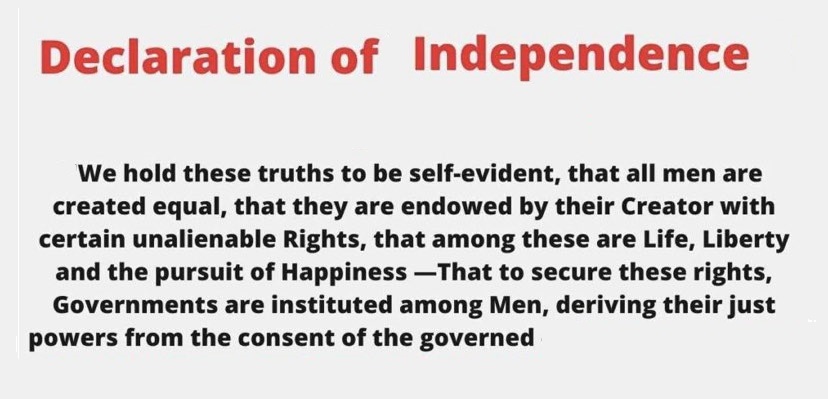
This moron is the type of domestic enemy we swear oaths to defend the nation against. And he’s a Senator.
Since he doesn’t agree with the quotation, even though he may reside in the U.S. and even have been born here, he is not an American since these are some of the fundamental first principles the nation was founded on.
FOUNDING: Senator Tim Kaine made a full throated rejection of our founding principles outlined in the Declaration of Independence. pic.twitter.com/Dt0XlOllHI
— @amuse (@amuse) September 4, 2025
Defending yourself is a human right. Any government which denies you the right to defend yourself is anti-human. https://t.co/eEbS5NObx4
— Possum Reviews (@ReviewsPossum) September 4, 2025
D.C. Activist Criticizes Trump for Putting Blame on Individual Criminals
Even the BBC has admitted that violent crime has fallen in Washington, D.C. since Donald Trump’s declaration of an emergency in our nation’s capital, but some local activists insist that the surge in law enforcement, including federal officers and members of the National Guard, is political theater at best, and perhaps even counterproductive.
When President Donald Trump announced his federal takeover of Washington, D.C., he conjured images of a dystopia where “caravans of mass youth rampage through city streets” to justify his heavy-handed response.
But those who study and work on preventing youth crime in the district say the president is acting on a caricature of the city, and his decision to flood the streets with soldiers will do little to solve the issue.
Nick Wilson, senior director for Gun Violence Prevention at the Center for American Progress, called Trump’s crackdown “political theater that is disconnected from what we’re seeing here in D.C.”
Wilson would prefer things like a national ban on so-called assault weapons, universal background checks, and a host of other gun control laws that are already in place in Washington, D.C. In fact, as we reported yesterday, federal agents have been actively enforcing some of D.C.’s draconian laws, including multiple arrests for possessing a firearm without a license. You’d think Wilson would be thrilled to see those arrests, and maybe he is, but even the staunchest gun control activists can’t publicly praise Trump without risking condemnation from their fellow liberals.
The dumbest comment in the Time article comes from a local community activist, who is incensed that Donald Trump is trying to hold criminals responsible for their actions.
Tia Bell, who founded a gun violence prevention nonprofit aimed at young people in the city, says Trump’s villainization of D.C.’s youth misses the point.
“It’s a misalignment, because the blame is on the individual and not the systems and structural violence,” she says. “Our youth are angry—they feel like the media perpetuated a lot of narratives about them that led to this blame and criminalization.”
The media made me do it is one hell of an excuse for committing a violent crime, isn’t it?
You know a really good way to not get blamed for violent crime? Don’t commit one.
Even if you believe that there are root causes like poverty and broken families that can exacerbate crime, it’s still individuals who are committing violent carjackings, home invasions, and street robberies. These individuals may feel empowered and emboldened to commit these crimes because of D.C.’s lackadaisical approach to juvenile crime and truancy, and if Bell wants to fix those broken systems I’m with her 100%, but the fact remains that most juveniles in D.C., even those living in the most adverse environments possible, aren’t out there robbing, raping, and carjacking D.C. residents and visitors.
It’s a disservice to those kids to decide that individuals shouldn’t be held accountable for their own actions. In fact, I’d argue that, no matter how good Bell’s intentions might be, by casting crime as the product of “systems and structural violence” or media narratives, she’s essentially telling juveniles who aren’t breaking the law that there’s something wrong with them, not the juvenile offenders.
I’ve expressed my own concern about Trump’s crime crackdown leading to arrests for simply possessing a gun without a license, which contradicts his stance in support of permitless carry, but Bell’s concern is that Trump hasn’t taken a public health approach to gun violence, “addressing it like a ‘disease.’”
Bell believes the problem in D.C. cannot be solved with more guns.
“Federal violence cannot end violence in the communities—only we can,” she says.
I have no problem, at least in theory, with community violence intervention efforts that seek to reduce crime without putting more people behind bars for possessory gun offenses. The issue, though, is that while Bell might believe in a “public health approach” to “gun violence”, that approach all too often involves treating gun ownership itself as a disease that needs to be eradicated. Bell might not like the surge in law enforcement on the streets, but I doubt she’d be in favor of repealing D.C.’s draconian laws surrounding gun ownership either.
If these activists want to question Trump’s heavy-handed approach to fighting crime, they should at least be willing to do the same when Democrats turn our right to keep and bear arms into a criminal offense. Somehow, though, their “public health” approach always leaves plenty of room for putting more gun control laws on the books.
You can not make this crap-for-brains up.
Delegate at the DNC: “Republicans and fellow citizens who profess to be active Christians, I remind them that DEI is the very foundation of the Christian church.” pic.twitter.com/YwgpTEEUYR
— TheBlaze (@theblaze) August 26, 2025
ATF says concealed carry ‘puts everyone involved at risk’
When will the ATF’s civil rights violations end?
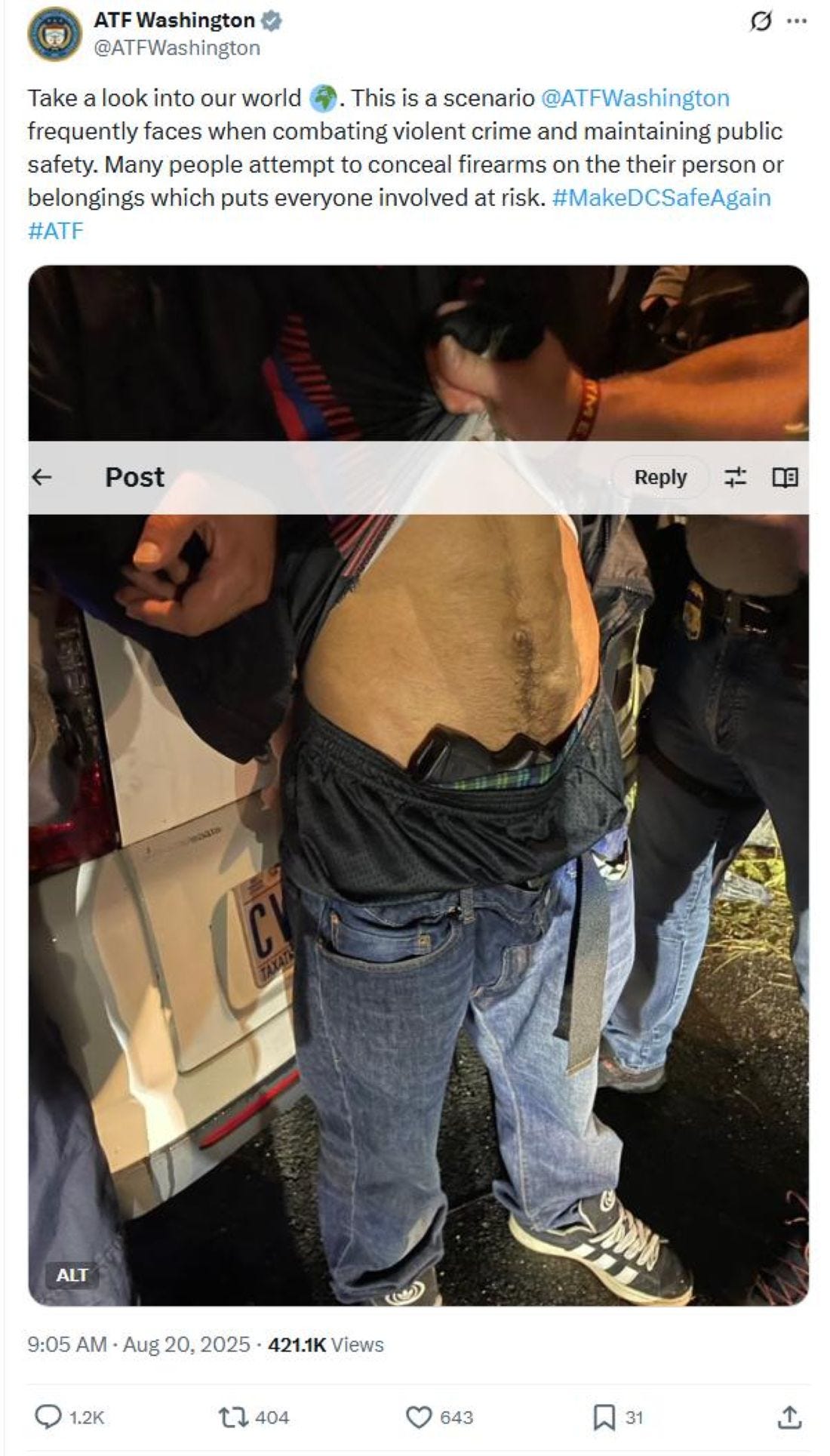
by Lee Williams
The millions of law-abiding Americans who have chosen to carry a concealed firearm are putting “everyone involved at risk,” the ATF announced this week in a post on X.
“Take a look into our world. This is a scenario @ATFWashington frequently faces when combatting violent crime and maintaining public safety. Many people attempt to conceal firearms on their person or belongings which puts everyone involved at risk. #MakeDCSafeAgain #ATF,” the ATF posted.
As you can imagine, ATF’s message received hundreds of overwhelmingly negative responses including many that are not fit to reprint.
“Concealed carry is not the issue—you are. Millions of law-abiding citizens carry concealed every single day without incident. Concealed carry saves lives. Disarming people and vilifying them on social media doesn’t,” Ammoland News posted.
Noted Second Amendment scholar and attorney Mark W. Smith asked a prominent Justice Department civil rights attorney in a post on X to “speak with the Washington ATF field office about the Second Amendment and the Bruen decision. I suspect their social media person lacks the relevant knowledge.”
Aiden Johnston, director of federal affairs for Gun Owners of America, tweeted “Try reading Heller, McDonald, Bruen, and the Second Amendment again, tyrants.” In his tweet, he added a picture of the Bruen decision.
The Firearms Policy Coalition tweeted simply: “Your existence puts everyone at risk. AMIRITE?”
“Times have changed. This isn’t 1934,” firearms trainer and author Ranjit Singh posted.
The ATF posted their tweet at 9:05 a.m., Thursday.
Twenty-seven hours and thirty-seven minutes later, the ATF “corrected” their post.
“EDIT-Take a look into our world. This is a scenario @ATF Washington frequently faces when combatting violent crime and maintaining public safety. Many CRIMINALS attempt to conceal firearms on their person or belongings which puts everyone involved at risk. #MakeDCSafeAgain,” the ATF posted.
Takeaways
Most gun owners will not buy ATF’s response, changing “Many people …” to “Many CRIMINALS …”
The reasons for this is simple: We all know too well that the ATF has never understood the massive difference between law-abiding gun owners and criminals.
To the ATF, everyone who owns a firearm is a criminal. This has become their modus operandi. They treat every single gun owner as a criminal.
If you need proof, look at the ATF’s recent history. Look at how they treated Patrick “Tate” Adamiak, Mark “Choppa” Manley, Russell Fincher or Brian Malinowski.
The ATF sent their SWAT teams to raid the homes of all four men, but not a single illegal item was found, even though Adamiak is serving a 20-year sentence for made-up crimes, and Malinowski was shot and killed in his home by ATF Agent Tyler Cowart.
That the ATF actually views concealed-carry as a crime is not a surprise. What is surprising is that no one has done anything about it, at least not yet.
It is definitely time for President Donald J. Trump to end the ATF.
But, or course it’s a deceitful scam.
Gun Control Group Now Offering Firearms ‘Instruction’
The term “gun safety” has different meanings depending on where you stand on the Second Amendment. For those who despise our right to keep and bear arms, “gun safety” translates to “gun control”, and the best way to practice gun safety is to not own a gun at all. T
Those of us who respect and appreciate the Second Amendment, though, “gun safety” means being safe and responsible around firearms. It doesn’t have nearly the negative connotation that “gun control” has, which is precisely why anti-gunner Michael Bloomberg named his group Everytown for Gun Safety, not Everytown for Gun Control.
According to National Shooting Sports Foundation senior vice president and general counsel Larry Keane, Everytown is now trying to move into the realm of actual gun safety, by launching a new firearms training initiative.
The program was recently outlined at the National Conference of State Legislatures, and NSSF staff had a first-hand view of what the gun control group is pushing; a broad initiative called “Train Smart”, which includes a “Gun Ownership 101” class… and eventually, a full eight-hour training course.
Everytown’s “Train Smart” initiative will also host “Raise Standards in Your State” classes, which isn’t even an attempt to hide their efforts to convince people to press for permits and licenses, and instructor certifications, which amazingly can now be provided by the newest firearm training program in town.
Lastly, if those aren’t enough, Everytown’s “Train Smart” plans to offer a “Train Smart Gun Safety & Marksmanship” class, which ought to be hoot, since the gun control group has yet to shoot straight on anything they say. That’s going to be an eight-hour class to teach people how to handle and use firearms responsibly and serve as a role model for others. Topics covered in this class are the same as the other two shorter classes, except they’ll also talk about suicide prevention, de-escalation tactics, pistol marksmanship and… wait for it… “and much more.”
There’s no word if those classes will include any range time – or that any gun range would want to host Everytown to do it.
As Firearms Policy Coalition’s Rob Romano pointed out, the goal here seems to be to force gun ranges to host these Everytown courses, and to force would-be gun owners to get their mandated instruction from a group that doesn’t believe you have a right to keep and bear arms.
We’ve already seen states like California move to disqualify classes taught by NRA certified firearms instructors from satisfying training requirements and substituting state certified instructors instead. It’s not hard to imagine lawmakers in Sacramento (and Trenton, Boston, Albany, and other blue-state capitals) mandating that folks have to go through training taught by Everytown instructors before they can purchase or carry a firearm.
In fact, by making their pitch to attendees at the National Conference of State Legislatures conference, Everytown is already laying the groundwork for their plan to force their way into gun stores and ranges. There’s a reason why the anti-gun group wanted to let state-level lawmakers know about their new offerings; so they can start making laws that mandate attendance in an Everytown taught “gun safety” course before you can exercise your Second Amendment rights.
The biggest problem Everytown will face is coming up with instructors who are willing to work with them. As Keane notes, right now there’s no word on whether the group’s eight-hour course will include any range time, but I’m betting that it won’t. In order to satisfy the training requirements they’ve helped to put on the books in states like Illinois, New York, and Massachusetts, though, Everytown will need instructors who provide range instruction, not just anti-gun talking points. My guess is that it’ll be far easier to get anti-gun legislators to sign on than actual firearm instructors, but that could end up being a feature, not a bug, if it means that it becomes much harder to get access to the training required to bear arms in public or even keep a gun in the home.
Read the whole thing. The deadhead’s friends and family treat him like some sort of hero, and complain about intended victims being armed.
Dad of 20 was shot and killed when he tried to rob someone getting off the bus, cops say
D’Anthony Reaves, 44, had 12 biological children and eight stepchildren
An Atlanta father of 20 was fatally shot last month while allegedly attempting an armed robbery, police say.
On July 19, D’Anthony Reaves, 44, was killed outside the Greyhound bus station on Forsyth Street around 5:30 a.m. He was shot twice in the face and once in the arm, according to police.
In a Wednesday update, Atlanta homicide detectives said their investigation determined the case should be classified as a felon killed by a private citizen. Police said Reaves was in the middle of an armed robbery when he was shot.
Reaves was shot by someone getting off a bus, his family told WSB-TV. The Independent has contacted Atlanta police for comment.
Reaves was a father to 12 biological children and eight stepchildren, ranging from ages 10 to 31. Ten of them attended his funeral at North Avenue Missionary Baptist Church in Atlanta on August 2, which boasted a line of mourners stretching to the parking lot.
“Seeing everybody come out as one big community was really nice, and we really appreciate all the extra support because we’re gonna need it,” Sha’Miracle Brown, one of Reaves’ daughters, told Fox 5 Atlanta, adding that their father was well known across Atlanta communities.
“My dad was like a crazy dancer, but I will always remember the music standpoint. Because some of us make music, all of us are musically inclined, and some of us play instruments. So my dad passed that musical gene down to all of us,” Brown said.
“He loved his kids. You could ask anyone, any single person, and they would say we were his pride and joy. I don’t think there’s a room we could walk into that he did not mention us or our accomplishments or our accolades.”
Reaves’ family plans to start a foundation to support his children and help fathers leave the streets and rebuild their lives.
“We’re fixing to open up the D’Anthony Reaves foundation so we’ll be able to serve his kids so they’ll be taken care of,” Deoinetea Hightower Reaves’ brother told the outlet. “We got the Power for the Fathers represented for him as well, where we help the fathers get off the street and get their lives back together.”
Hightower added that he is pushing Greyhound to end its policy allowing guns across state lines and urging Georgia Governor Brian Kemp to tighten gun laws to keep firearms away from young people.
Further details about the shooting were not available.
Make it make sense: Gun grabbers come out against fighting crime
A gun control nonprofit that wants to disarm Americans has come out against President Donald Trump’s Washington, D.C., crime crackdown.
The Brady Campaign to Prevent Gun Violence, known these days as Brady: United Against Gun Violence, issued a lengthy statement on Monday condemning Trump’s ongoing D.C. crime crackdown.
The statement began by describing the one-day Jan. 6 riot as “the worst outbreak of mass violence in recent District memory.”
Recall that only one person died during the riot: Rioter Ashli Babbitt. Meanwhile, 99 people have been murdered in D.C. this year alone.
The statement continued by using possibly falsified crime data to claim violent crime in D.C. “has fallen precipitously since 2023 and were at a 30-year low the day the president returned to the Oval Office.”
Hilariously, the statement attributed this alleged low to the Biden administration’s otherwise widely panned policy decisions.
According to the White House, the reality is that “D.C.’s murder rate is roughly three times higher than that of Islamabad, Pakistan, and 18 times higher than that of communist-run Havana, Cuba.”
The statement from Brady president Kris Brown concluded with her suggesting that Trump’s federal police are the ones “endanger[ing]” D.C. residents, not the hordes of violent criminals running the streets.
“We cannot allow the president to suggest that federalized police is an appropriate response to any and all challenges; or that federalized police do not further endanger the public, especially Black and Brown communities who live and work in or visit D.C.,” it read.
So, in other words, the same people who want to disarm Americans, thus making them prey to criminals, also want to effectively disarm the police, making residents even more prey to criminals. It makes no sense, especially when you factor in how the locals actually feel.
Last year, dozens of business groups with offices in D.C. penned a letter to Mayor Muriel Bowser expressing “deep concern about the alarming increase in violent crime across our city.”
“D.C. is quickly becoming a national outlier in rising crime, and the trends are alarming,” the letter read. “Our organizations are primarily based in the downtown business district, where there have been horrifying acts of violence.”
“Innocent people in neighborhoods across the city have been targeted in robberies, carjackings, and seemingly random acts of violence,” the letter continued.
D.C. Police Union Chairman Gregg Pemberton has also raised concerns about the city’s violent crime epidemic.
“We stand with the President in recognizing that Washington, D.C., cannot continue on this trajectory,” he said in a statement. “Crime is out of control, and our officers are stretched beyond their limits.”
He reiterated this during an appearance this week on Fox News’ “America Reports“:
As for Brady, last year it also came out against self-defense, arguing that guns “are rarely used successfully in self-defense.” The stunning claim prompted a fact-check from Breitbart.
“Academic work by Florida State University criminologist Gary Kleck shows that, at a minimum, guns are used to protect life and property at least 760,000 times a year,” the fact-check reads.
2 years ago today, a historically illiterate Al Sharpton asked the following:
Can you imagine if James Madison or Thomas Jefferson tried to overthrow the government? pic.twitter.com/r8A8Nexyk1
— Steve Guest (@SteveGuest) August 3, 2025