

Category: Observation O’ The Day



BUY THIS BOOK! READ THIS BOOK!!
TELL YOUR PASTOR TO READ THIS BOOK!!
IF YOU HAVE CHILDREN IN SCHOOL- and you have not yet gotten them out of that indoctrination center and started homeschooling them – TELL YOUR PRINCIPAL, SUPERINTENDENT AND SCHOOL BOARD TO READ THIS BOOK!!
First 30 Seconds: The Active Shooter Problem
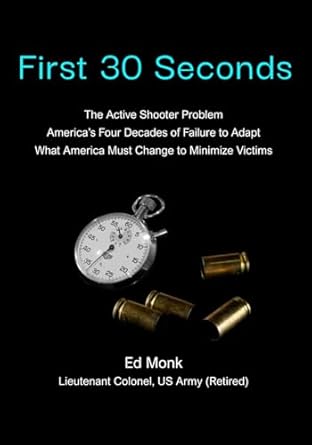
America has been failing for over 40 years at understanding, planning for, and responding to Active Shooter attacks. So, we continue to see attacks end in high victim-counts. America fails because we:
– do not base plans on TIME & MATH
– like plans that are easy to type, easy to drill, and do not “trigger” anyone
– recommend and adopt “best practices” that are not best
– adopt plans that work flawlessly every day there is no attack, but fail during attacks
– desperately want a non-violent solution to an extremely violent problem
– allow emotions and political agendas to distract us
The author served as an active-duty US Army officer for over 20 years. Throughout this career, planning to give and receive deadly violence was a common, required task. Ten days after his Army retirement, he began teaching public high school, where violence was never allowed, discussed, or planned for. He was STUNNED when school leaders told him the school’s planned response during an Active Shooter attack was to gather in groups and wait to see if the killer or cops got to you first.
This experience started his study of the Active Shooter problem. This book is about what he found.
Read Ed’s no-nonsense, blunt analysis of the Active Shooter problem. Using TIME & MATH analysis, he clearly shows the ONLY response that has a high expectation of minimizing victims in future attacks.
This is UNLIKE any discussion of the Active Shooter problem you have heard from any source. It disproves MANY long-held myths and assumptions, including that we should rely on RUN HIDE FIGHT, Lockdown Drills, and 911 response. It is a wake-up call for America, the “leaders” of our schools, churches, and businesses, and our elected officials.
America has failed at this for 40+ years. It’s time to end the failure.
“Ed Monk is today’s leading expert on thwarting mass murderers. His recommended strategy is by far the most effective, as proven in cases where the defenders did what Monk suggested.” — Massad Ayoob

I’m going to put it bluntly.
They thought they wanted this. They thought they could keep pushing and they would break us. They thought they had the upper hand.
They pushed too far and they have taken us to the point of no return.
Now, they are realizing they didn’t want this. They are realizing we wont be broken. They are realizing they don’t have the upper hand.
The ball has been returned to our court, and we’re better at the game than they are. The game that they wrote the rules for.
So good luck ever getting the ball back again.
We’re done playing fair.
Welcome to the new version of the game.
Our game.
Watching all the cable snews programs, I’ve noticed that the demoncrap talking heads are suddenly all so conciliatory and calling for calm & peaceful contemplation as they decry Kirk’s assassination.
It only took me a minute or two to figure it out. And it was confirmed when one of them actually said he was scared. Well, they are scared.
They’re scared that the conservatives will finally get the cluebat and realize that it’s not hyperbole that the left sees anyone disagreeing with them as more than just political opposition and actual enemies (Hitler/Nazi/Fascist right a bell?) and to mix metaphors; we are like a light switch, with when it’s flipped to “on”, we’ll raise the black flag and when we begin cutting throats, we won’t stop.
Looking for black people in this video. Not finding them.
See, in DC the worst crime is in predominantly black neighborhoods. 41% of the DC population is black.
So where are all the black people in this “protest”?
I’ll tell you why there are so few: DC’s black population is the primary beneficiary of Trump’s incredibly effective crackdown on DC crime.
These “protesters” are all white Democrat self-appointed “elites” who live in crime-free Northwest DC (or the DC suburbs) in their $2mm+ homes.
White Democrats feel a congenital need to virtue signal, even if it means killing black people. Then they go home in their lululemon yoga pants, Allbirds loafers and Subaru Forester, where they open a $200 bottle of wine and celebrate themselves over all the “good” they did today.
Sickening.
JUST NOW: Protesters flood the streets of DC to protest President Trump's federal takeover.pic.twitter.com/9I5FoXXpLb
— Resist the Mainstream (@ResisttheMS) September 6, 2025
Without a gun, you are at the whim of every armed criminal you meet. You are, in fact, his slave. Stay armed (and stay free).
— AWR Hawkins (@AWRHawkins) August 24, 2025
Look, we tried the no tariff way for the last 40 years. The result is $37 trillion in debt, a $2 trillion deficit, a massive welfare state, an open border as companies rush to hire illegals to lower costs, hollowed out cities across the country, families that need two incomes or…
— unseen1 (@unseen1_unseen) August 10, 2025
The last three Democrat presidents (Biden, Obama, Clinton) were all prolific liars, but there were big differences in their styles of lying.
Biden lied like a three year old with his hand in the cookie jar.
Clinton lied like a charming philanderer. Everybody knew he was lying…
— Cynical Publius (@CynicalPublius) August 4, 2025
Just a reminder that when it’s a Republican, pleading the 5th is a tacit admission of guilt.
Inbox: top Jill Biden aide Anthony Bernal pled the 5th today.
According to Comer’s office,
“Bernal pleaded the Fifth when asked if any unelected official or family members executed the duties of the President and if Joe Biden ever instructed him to lie about his health.” pic.twitter.com/eRMRZIDyXx— Alex Thompson (@AlexThomp) July 16, 2025

Military Arms
@MAC_Arms
Here’s my take on the Epstein files scandal. I have no evidence of this, only my gut instincts.
The list that we were told existed before it didn’t exist likely contained the names of some very powerful people in government on both sides of the aisle along with unelected bureaucrats and political donors.
This scandal threatened to completely disrupt our government and shake what little trust people have in it to the ground. No one on either side of the aisle wants that, this potentially threatens both parties equally.
Why isn’t Hakeem Jeffries on CNN screaming foul right now? Pelosi? AOC? Crickets. I scanned their X profiles and I see no mention of this news, not yet anyway. If Trump farts, within minutes the usual suspects are all over social media and traditional media screeching. We’re over 12 hours into this “news” and again… nothing.
Also keep in mind that the real power brokers in DC aren’t elected. Many were likely on that list too, and they definitely don’t want their names in lights. Many of them exist in the shadows and this would drag them into the light.
Oh two huh. But one 2A case each term is too much to ask? https://t.co/ZVlYIinfiV
— Kostas Moros (@MorosKostas) July 3, 2025
This is the closest anyone has ever gotten to undoing much of the NFA. I don’t get how gun rights groups are responsible for the GOP refusal to fire or overrule the Parliamentarian (which affected much more than just this issue). They clearly pushed for that, hard. Given they… https://t.co/gfU9SdEXKN
— Kostas Moros (@MorosKostas) July 1, 2025
This is the closest anyone has ever gotten to undoing much of the NFA. I don’t get how gun rights groups are responsible for the GOP refusal to fire or overrule the Parliamentarian (which affected much more than just this issue). They clearly pushed for that, hard. Given they couldn’t get it, they took the consolation prize of zeroing the tax, which itself would be the only blow against the NFA that has ever landed. That isn’t selling anyone out.
Nobody was “gaslit.” The plan was originally just to zero out the tax. Progun groups pushed for (and got) scrapping of registration too in the House’s bill. They took a big swing, but got screwed by the Democrat Parliamentarian and the GOP’s refusal to stop her. I’m not mad at them for trying.
You should be demanding of the groups you support, I don’t begrudge anyone that. But at the same time, I think a lot of grifters who have never accomplished anything of note are taking cheap shots right now with bs accusations.
In the future, the current practice of mutilating young children to feed their parents’ egos will be looked upon with the same disgust as we now view the Tuskegee Experiment and the lobotomization of sexually active young women in bygone decades.
But at the moment there are still sentient beings–including, sadly, three SCOTUS justices–who believe that destroying the lives of young children is a worthy political cause.
Shameful.
@SCOTUSblog
NEW: In U.S. v. Skrmetti, a closely watched case on a Tennessee law barring certain medical care for transgender minors, the court holds that Tennessee’s law can remain in place.
No place on the planet has ever in history been better for white progressive women with BS college degrees than America in 2025, and there’s no place in time they hate more. – Margot Cleveland
This is a "No Kings" protest in Atlanta. What do you notice? In a city that is predominantly Black, I think I counted 5 black people in this video.
Democrats flooded Black communities across the country with illegal aliens. And now they are protesting Trump removing them???… pic.twitter.com/KNQDqo1PCw
— The 🐰🕳️ (@TheHoleTweet) June 14, 2025