

Category: Rights
NSSF DENOUNCES U.S. SENATE CONFIRMATION OF OPERATION CHOKE POINT ARCHITECT TO FDIC
WASHINGTON, D.C. — NSSF®, The Firearm Industry Trade Association, condemned the U.S. Senate’s confirmation of Martin J. Gruenberg as Chair and Member of the Board of Directors of the Federal Deposit Insurance Corporation (FDIC). Gruenberg led the FDIC from 2011-2018, during which the Obama administration conducted the illegal Operation Choke Point scheme to deny banking services to firearm businesses. NSSF opposed his confirmation in the strongest terms as he has already demonstrated a lack of respect for the law and unparalleled disdain for the Constitutionally-protected firearm and ammunition industry.
“The Senate’s confirmation of Martin Gruenberg is a flagrant disregard for his role in illegally using the levers of government to force discriminatory banking policies on the firearm and ammunition industry,” said Lawrence G. Keane, NSSF’s Senior Vice President and General Counsel. “His culpability in shepherding this illegal operation was not only previously investigated by Congress but was also highlighted by Senate Banking Committee Republicans. Mr. Gruenberg’s leading role in creating, administering and punishing the firearm industry through illegal means simply because he, President Barack Obama and former Attorney General Eric Holder found this industry politically-disfavored clearly disqualified him from being reconfirmed to a position of public trust.”
Under the Obama administration, an initiative called “Operation Choke Point” was launched by the Federal Deposit Insurance Corporation (FDIC) and Department of Justice (DOJ) to stop financial institutions from offering services to some regulated industries in an attempt to choke off banking services. This operation, which represented an abuse of the agencies’ statutory authority, was first aimed at non-depository lenders (so-called payday lenders) but expanded to ammunition and firearms sales, tobacco sales and pharmaceutical sales, among other industries.
The goal of the operation was to coerce banks, third-party payment processors and other financial institutions into closing or denying business accounts of clients that the FDIC has classified as “high risk” or as a “reputational risk” for the financial institution. According to a House Committee on Oversight and Government Reform investigation, the FDIC, “equated legitimate and regulated activities such as coin dealers and firearms and ammunition sales with inherently pernicious or patently illegal activities such as Ponzi schemes, debt consolidation scams, and drug paraphernalia.”
The FDIC included federally licensed firearm retailers and other companies in the firearm and ammunition industry – some of the most heavily regulated businesses in the country – on this list of risky businesses without any evidence or justification. In fact, in its guidance to banks, the agency “justified itself by claiming that the categories had been previously ‘noted by the FDIC.”
Working with the DOJ, the FDIC guidance targeting the law-abiding firearms industry and others was included on DOJ subpoenas. This sent a message to banks that they were to remove those clients from their services or risk a federal investigation.
“No one wants to take your guns”………….
Incrementalism in Action: Anti-Gun Governor Targets Lawfully Registered Firearms for Seizure
There are two absolutes in gun control strategy, and both were on display recently when Gov. Ned Lamont (D-CT) proposed to renege on a promise twice made to the state’s law-abiding gun owners: that they could keep their newly-banned firearms if they registered them with the state.
Connecticut has passed two bans on so-called “assault weapons,” one in 1993 and then an expanded version in 2013.
Each time, the law affected common and popular semi-automatic firearms already owned by law-abiding residents of the state. And each time, the state assured those gun owners that their lawfully-acquired guns would be “grandfathered” under the law if the state were apprised of who owned them and where they were kept.
This led to the sad and ominous spectacle of gun owners who were under no individual suspicion of wrongdoing queing up to report their own identity and constitutionally-protected property to police. As a news report noted, “The application requires information such as the individual’s name, address, telephone number, motor vehicle operator’s license, sex, height, weight and thumbprint, as well as information about the weapon, including the serial number, model and any unique markings.” It was eerily similar, in fact, to the information used when booking someone for a crime.
Meanwhile, some well-meaning but naïve gun owners thought they were simply doing their civic duty by complying with the mandate. “If they were trying to make them illegal, I’d have a real issue, but if they want to just know where they are, that’s fine with me,” one registrant told a local news station.
Readers of this website and other NRA publications knew better, however, as the Association has warned for years of the aforementioned absolutes: that gun control advances incrementally and that firearm registration leads to firearm confiscation.
Following a gubernatorial debate in November, Lamont told reporters: “I think those assault-style weapons that are grandfathered should not be grandfathered.” He continued, “They should not be allowed in the state of Connecticut. I think they’re killers.”
Pressed for specifics on how he would go about enforcing his proposal or recovering the 81,849 “assault weapons” registered with the state, Lamont did not provide details. “Start by making them illegal,” he said. “I think that would be a big difference. That is what you start with.”
In other words, without any explanation of how his plan would work or promote public safety, Lamont is proposing to make tens of thousands of state citizens who complied in good faith with the registration requirements into criminals, with their guns summarily declared contraband and subject to seizure. To make matters worse, the authorities would already know who and where those citizens are.
Lamont ludicrously claimed that the grandfathered guns themselves are “killers,” but he provided no evidence that their owners are. He did not cite statistics, or even examples, of lawfully registered “assault weapons” that were later used in crime. Meanwhile, registered or not, semiautomatic long guns of the types banned in Connecticut are rarely used in homicide, as we have noted time and again, including here, here, and here.
Despite these facts, Lamont seems intent on executing his plan to reclassify peaceable Connecticut residents lawfully exercising their constitutional rights as felons. His example illustrates very clearly what the reassurances of gun control advocates are worth and how anyone who thinks its safe to rely on such reassurances will be in for a rude awakening.
Indeed, the month after Lamont announced his intentions, an editorial in the Connecticut Mirror argued that constitutional assurances the right to keep and bear arms will be protected should themselves be repealed. “It is time to talk about repealing the Second Amendment,” the author insisted. But he made it clear that his plan wasn’t necessarily an alternative to incrementalism but a potential aid to it. “[T]he very existence of a loud argument about the larger issue of repeal will make those incremental proposals seem more moderate, and therefore ultimately more achievable,” the editorialist wrote.
Second Amendment advocates are often faulted for opposing supposedly moderate, “common sense gun safety laws” that fall well short of a comprehensive ban on all types of firearms. But the savvy ones know that punishing law-abiding people for exercising their constitutional rights does not stop criminals, and today’s accommodation for the good guys with guns is tomorrow’s “loophole” that will eventually close around their necks. This is even more so when the authorities already know who owns guns and where those guns are kept.
It’s simple: The object of gun control is the outlawing and seizure of firearms from law-abiding citizens.
But don’t just take our word for it.
Ask Gov. Ned Lamont.
Judge Blocks California Fee-Shifting Statute That Targets Gun Lawsuit Plaintiffs (and Lawyers)
From Miller v. Bonta, decided today by Judge Roger Benitez (S.D. Cal.):
“It is cynical.” “It is an abomination.” “It is outrageous and objectionable.” “There is no dispute that it raises serious constitutional questions.” “It is an unprecedented attempt to thwart judicial review.” Such are the Intervenor-Defendant Governor’s expressed views regarding the fee-shifting provisions of a Texas law (S.B. 8) and, at least by implication, of California’s § 1021.11. It is “blatantly unconstitutional,” says Defendant Attorney General Rob Bonta. {To his credit, given the obvious, the Attorney General has refused to defend § 1021.11.} For the reasons that follow, as they may apply to S.B. 8, but apply clearly to § 1021.11, § 1021.11 is declared unconstitutional. Therefore, Defendants are permanently enjoined throughout the state from enforcing or taking any action to seek attorney’s fees and costs pursuant to § 1021.11.
[A.] Texas S.B. 8 (§ 30.022) and California S.B. 1327 (§ 1021.11)
I’ve always said that if demoncraps didn’t have double standards, they wouldn’t have any standards at all.
Democrats’ double standard on constitutional amendments
Ballot measures to impose new gun control laws? Democrats love ’em, even when the courts question their constitutionality. But when Republicans turn to voter referendums and constitutional amendments to strengthen the Second Amendment, as they’re doing in Montana, Democrats declare an “existential crisis” is at hand.
Thanks to the midterm elections, Republicans in the state now enjoy a supermajority in both legislative chambers as well as the governor’s office. That gives them the numbers (on paper, anyway) to start the ball rolling on amending the state’s constitution, and several lawmakers are already looking at one area they say is in desperate need of reform: the unfettered power given to the state’s Board of Regents in establishing rules and policies governing public colleges and universities in Montana.
Just to clarify.
This requirement isn’t for concealed carry. It’s to simply BUY a firearm.
I think this monstrosity isn’t going to make it through the court system, but it does illuminate just how mindless a lot of people are, which isn’t a new thing, as the Framers recognized the malady even back then when they demanded a Bill of Rights.
Measure 114’s live fire training component leaves trainers in limbo
While Oregon’s new voter-approved gun control measure is getting worked out in the courts, there remains uncertainty among local gun shops and firearms instructors in Central Oregon.
Sharon Preston, owner of Ladies of Lead in Redmond — and an instructor who specializes in self-defense training for women — says there are a lot of questions that still have not been answered about the implementation of Measure 114.
Preston says business has been through the roof. But she says she’s had to stop firearm sales, not knowing what is next with the measure. But she says selling guns is only part of what she does.
“Selling guns is a very small portion of my business. I do it as an added value to my clients, so it’s educational based gun sales. But my main focus is always going to be in training,” said Preston.
She’s been forced to find alternatives as 114 is in limbo.
“I’ve heard too many stories in this store from women, locally. The brutality and violence they have been through, survived through. They want a tool that will allow them to live their lives large again, and they’re not going to be able to get on. That’s why I’m switching to crossbows, pepper ball guns, tasers, knives,” Preston said.
Preston’s biggest concern with the measure lies in the required live fire training — meant to prove shooting proficiency. As of now, she says no guidelines have been spelled out as to how the state will facilitate the training courses. And no one knows who will be authorized by the state to lead those courses.
And there are other unanswered questions.
“They don’t know how many rounds we have to shoot, at what distance we have to shoot, at what target we have to shoot. They don’t know what firearm we can use. So there’s so many questions out there,” said Preston.
The next hearing on Measure 114 will be held Tuesday at Circuit Court in Harney County. Those who support the measure will be able to argue against the temporary hold set in place by Judge Robert Raschio.
Key House Republican says gun rights bills will be on 2023 to-do list
Key backers of the gun rights amendment Iowa voters have just added to Iowa’s Constitution say they’ll introduce a series of gun-related proposals in the 2023 Iowa Legislature. House Republican Leader Matt Windschitl of Missouri Valley has been involved in gun-related issues since he was elected to the House in 2006.
“There are multiple different things we’ve been trying to get done to restore freedoms in Iowa and we’ve not been able to get across the finish line on some of those things,” Windschitl said this afternoon. “I’m not at a point right now where I’m going to discuss publicly what all of those items are, but you can expect us, after this victory, and restore freedoms to Iowans that never should have been taken away.”
Windschitl and others gathered in the statehouse this afternoon for a ceremony to mark passage of the amendment.
“Iowans now have the best protections for their fundamental right to keep and bear arms of any state in the nation,” Windschitl said.
The amendment got a majority of votes in 97 of Iowa’s 99 counties.
“Iowans have made their voice loud and clear,” Windschitl said. “Our liberties we prize and our rights we will maintain.”
That last sentence is the state motto, adopted in 1847, the year after Iowa was recognized as a state. Secretary of State Paul Pate said the gun rights amendment was added to the state constitution on December 1st when statewide election results were certified.
“On November 8, Iowans voted overwhelmingly to amend the Constitution, enshrining in it the right to bear arms,” Pate said. “In fact, 65% of Iowans supported the adoption. Congratulations to all of you for your hard work and the efforts to secure its passage.”
Richard Rogers of the Iowa Firearms Coalition lobbied for the amendment as well as recent state laws on the use of weapons and gun permits.
“However, each and every improvement in the law was subject to being reversed, or worse, by the next or any future legislature,” Rogers said during the ceremony. “Now, with the ratification of this freedom amendment, as we call it, such a course will be much more difficult.”
This is the 49th amendment added to Iowa’s Constitution. It goes beyond the wording of the Second Amendment to the U.S. Constitution and says Iowa courts must evaluate any lawsuits challenging Iowa gun laws by the toughest legal standard.
Quote O’ The Day
The eight-point boost in favorability between now and then could be the result of people in those states recognizing that living under a shall-issue carry regime is not an apocalyptic scenario but, rather, business as usual as it had been in most of the country.
Analysis: The Popularity of the Bruen Decision Should Not Come as a Surprise
You wouldn’t know it from the reaction of political leaders in states affected by the decision, but the Supreme Court’s holding in New York State Rifle and Pistol Association v. Bruen is very popular among the American public. That’s because a decades-long cultural shift towards concealed carry had already succeeded well before the justices ever took up the case.
A Marquette University law school poll released this week found 64 percent of Americans have a favorable opinion of the Supreme Court’s holding that the “Second Amendment protects the right to possess a gun outside the home.” By contrast, 35 percent say they oppose the decision, with only 16 percent saying they’re strongly opposed.
That such a substantial majority gave a warm reception to the concept of public concealed carry rights should not come as a shock. For nearly all of the country, the Court did little more than affirm the status quo.
When the decision was handed down, three-quarters of the population lived in a state where law-abiding adults faced only limited barriers to carrying a concealed firearm for self-defense. They could do so in 25 of those states without even needing to obtain a government-issued permit.
A tandem of shifting cultural practices and state legislation made that possible. Beginning in 1987 with Florida’s adoption of “shall-issue” concealed carry permitting, where state officials can’t subjectively deny permit applications, a revolution in liberalized gun carry laws began to sweep the country.

They’re welcome to secede apply for statehood.
Manitoba joins Alberta and Saskatchewan in opposing the expansion of the Liberal gun ban to include hunting rifles and shotguns. Amendment G-4 of #C21 bans a massive list of common hunting guns 🇨🇦 #HuntingGunBan #oppose #WorkOnCrime pic.twitter.com/wVZRcNv6f5
— Tracey Wilson (@TWilsonOttawa) November 28, 2022
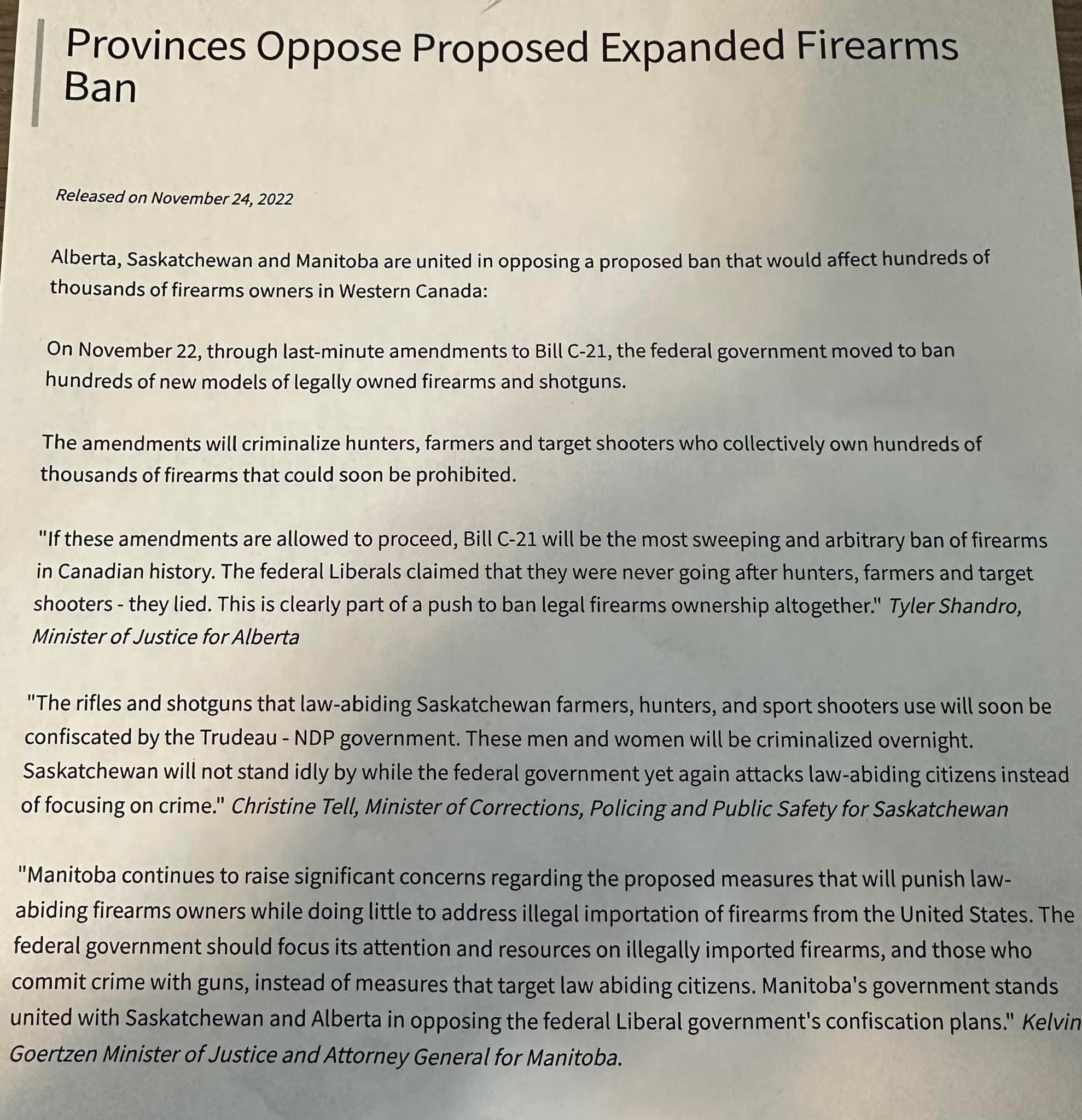
Well, they’re welcome to apply for admittance.
As Canada Prepares to Confiscate Guns, Some Provinces Rebel Against the Policy
Under Prime Minister Justin Trudeau, Canada’s government is coming for people’s firearms. There will be a mass gun confiscation program, as his administration banned some 1,500 firearms with a freeze on handgun sales for the time being. Gun control advocates up north have long advocated for a handgun ban, which could be the next step amid Trudeau’s anti-gun crusade. It’s estimated that some 150,000 legally registered firearms are scheduled to be seized by the government. The rash of new gun laws comes after the 2020 Nova Scotia mass shooter, which left 22 people dead. The shooter, Gabriel Wortman, was later killed by police.
These new anti-gun measures were proposed but not passed until after the 2021 Canadian federal election, where Trudeau’s government hung onto power. One of their promises is to enact stricter gun control laws. The rough draft of the proposal called for a voluntary gun buyback policy, a fancy word for confiscation. Now, fresh off an election win, it’s a mandatory act, though some provinces will not assist in the effort. Trudeau’s gun seizure agenda has led to a further straining of relationships between the capital, Ottawa, and the rest of the country it would seem (via Washington Post):
After a gunman rampaged across rural Nova Scotia in 2020, killing 22 people in Canada’s worst mass killing, Prime Minister Justin Trudeau banned some 1,500 makes and models of “military-grade” assault-style firearms and pledged to buy them back from owners.
Now, as Canada’s Liberal government prepares to launch the first phase of the mandatory buyback, several provinces and territories say they won’t help.
The most strident opponents, including the United Conservative Party government in Alberta, are suggesting the Royal Canadian Mounted Police “refuse to participate.” Tyler Shandro, the province’s justice minister, declared the buyback was not “an objective, priority or goal” of the province or its Mounties. Alberta, he said, is “not legally obligated to provide resources for it.”
Marco Mendicino, Canada’s public safety minister, has cast Alberta’s “reckless” position as a “political stunt.” But Saskatchewan, Manitoba and New Brunswick have also balked at using “scarce RCMP resources” for the program.
“New Brunswick’s bottom line is this: RCMP resources are spread thin as it is,” said Kris Austin, the province’s public safety minister. “We have made it clear to the government of Canada that we cannot condone any use of those limited resources, at all, in their planned buyback program.”
The dispute is one of several that’s inflaming tensions between Ottawa and the provinces. Alberta and Saskatchewan, long estranged from the capital, recently introduced bills to seek greater “sovereignty” for their provinces and to fight what they see as federal “intrusion.”
Yukon’s government said it supports Trudeau’s gun-control proposals and is committed to finding a balance between counteracting the adverse impacts of illegal firearms and respecting hunting rights. But Tracy-Anne McPhee, the territory’s justice minister, has told Mendicino that its RCMP lacks the “administrative, personnel or the financial resources” to participate without additional support, a spokeswoman said.
I like the Second Amendment sanctuary attitude some of these premiers have taken. Still, sadly, without an explicit right to bear arms, that’s codified like the one in our Bill of Rights—I think there will be some chilling videos of Canadian federal police officers showing up at people’s homes and taking their private property. And somehow, there will be a slew of liberal writers defending how the government taking the property of law-abiding citizenry is essential to the health of a democracy. That’s not healthy—that’s cancer.
“Saint Benitez” delivers another win to gun owners (and legal smackdown to California AG)
U.S. District Judge Roger Benitez, affectionately known as “Saint Benitez” among Second Amendment activists for his string of decisions striking down California gun control laws (decisions that have, unfortunately, largely been stymied by Ninth Circuit Court of Appeals judges), has unleashed his latest opinion on California Attorney General Rob Bonta in two cases that deal with a weaselly attempt by Gov. Gavin Newsom and state lawmakers to make it financially risky to challenge the state’s gun laws in court.
Shortly after the state of Texas passed their anti-abortion law allowing abortion providers to be sued by private citizens and the Supreme Court declined to block it from taking effect, Newsom declared his intent to fire a responding shot in the culture war; this one aimed at the Second Amendment.
SCOTUS is letting private citizens in Texas sue to stop abortion?!
If that's the precedent then we'll let Californians sue those who put ghost guns and assault weapons on our streets.
If TX can ban abortion and endanger lives, CA can ban deadly weapons of war and save lives. https://t.co/N5Iur9PEUZ
— Gavin Newsom (@GavinNewsom) December 12, 2021
Not long after the Supreme Court issued the Bruen decision, Newsom and his legislative allies approved SB 1327, which not only allows California residents to bring their own lawsuits against companies that violate California gun control laws, but imposed a new fee shifting standard on plaintiffs who challenge any of the state’s gun control measures: unless the plaintiffs are successful on each and every complaint they allege, they’re responsible for paying 100% of the state’s attorneys fees. If, on the other hand, the plaintiffs do manage to meet that impossibly high bar, the state is not obligated to pay a dime of their costs.
Two lawsuits were immediately filed in the wake of SB 1327’s enactment; Miller v. Bonta, brought by the Second Amendment Foundation and the Firearms Policy Coalition, and South Bay Rod & Gun v. Bonta from a coalition including the Citizens Committee for the Right to Keep and Bear Arms (where, in full disclosure, I serve as an unpaid board member), Gun Owners of California, Second Amendment Law Center, and the California Rifle & Pistol Association.
On November 28th, Judge Benitez held a hearing on a request for an injunction in the cases. The arguments from the plaintiffs were quite simple; in fact, they were able to throw Bonta’s own words back in his face, since the California AG had previously filed an amicus brief in the challenge to the Texas abortion law on constitutional grounds. Bonta is now forced to defend the very practice he declared unconstitutional just a few months ago, and his chief argument was a weak one: his claim that he won’t enforce the law unless or until the Supreme Court has officially ruled on the constitutionality of the Texas abortion statute. That stance, he argued, should be enough to moot both of these cases, but in today’s ruling Judge Benitez rejected Bonta’s defense in no uncertain terms.
The American court system and its forum for peacefully resolving disputes is the envy of the world. One might question the wisdom of a state law that dissuades gun owners from using the courts to peacefully resolve disagreements over the constitutionality of state laws.
The law at issue here is novel. As four concurring Justices recently said in a Texas case with similarities, “where the mere ‘commencement of a suit,’ and in fact just the threat of it, is the ‘actionable injury to another,’ the principles underlying [Ex parte] Young authorize relief against the court officials who play an essential role in that scheme. Any novelty in this remedy is a direct result of the novelty of Texas’s scheme.” Whole Woman’s Health, 142 S. Ct., at 544-45 (citations omitted). The same principles authorize relief against the state officials here.…
If Defendant Attorney General committed to not enforcing § 1021.11 and entered into a consent judgment binding himself, his office, his successors and district attorneys, county counsel, and city attorneys, it might be a closer question. Again, this does not prevent future Attorneys General or other state statutes from being enacted and enforced. But that is not this case. In this case, the commitment of non-enforcement is conditional. The Defendant Attorney General says that his cessation of enforcement in a seeming case of tit-for-tat will end if, and when, a purportedly similar one-sided fee-shifting Texas statute is adjudged to be constitutional. Certainly, that condition may or may not occur. In the meantime, the statute remains on California’s books. And the actual chilling effect on these Plaintiffs’ constitutional rights remains. Therefore, the case is not moot.
Bonta’s attempt to avoid having to defend the indefensible has failed, and both Miller and South Bay Rod & Gun will now move forward. In response to Benitez’s decision, Second Amendment Foundation founder Alan Gottlieb declared that “California cannot be permitted to use the law to suppress constitutional challenges to its increasingly radical gun control schemes”, and today’s decision is a key step towards a broader decision consigning SB 1327 to the dustbin of history.
DON’T BELIEVE GIVING UP RIGHTS PROVIDES SECURITY
New York Time columnist David Brooks is reminding America why they shouldn’t put faith in opinion writers pontificating from their metropolitan ivory towers.
Brooks recently said America would be a much safer country if Americans would simply give up their freedoms and become more like Europe. If America wouldn’t hold onto the individual right to keep and bear arms spelled out in the Second Amendment, and affirmed by the U.S. Supreme Court, he argues it would be a much safer place.
In his estimation, giving up the ability for self-defense and defense of loved ones would make crime just go away.
“That would take a gigantic culture shift in this country. A revamping of the way we think about privacy, a revamping of the way we think about the role government plays in protecting the common good,” Brooks said during a segment on PBS’ “Newshour.” “I think it would be something. I think it would be good not only to head off shootings, but good to live in a society where we cared more intimately about each other. And I would be willing to give up certain privacies for that to happen.”
That’s certainly out of the mainstream of how the rest of America views lawful firearm ownership. There were over 21 million background checks for the sale of a firearm in 2020, the most ever in a single year. Last year, Americans submitted to 18.5 million background checks. In 2022, background check figures are headed for the third strongest year on record. During the week up to and including Black Friday, the FBI’s National Instant Criminal Background Check System (NICS) tallied over 711,000 background checks, with over 192,000 on Black Friday alone. That was the third busiest day for FBI’s NICS ever.
The Plan: Give Up
Just how would America achieve this utopia that Brooks imagines? Just give up, he said. Give up your rights. Give up your freedoms. Submit to an Orwellian state that provides you with all your needs. He admits this wouldn’t be easy.
“But for many Americans that would just be a massive cultural shift to regard our community and regard our common good in more frankly a European style,” Brooks explained. “I think it would benefit our society in a whole range of areas, but it’s hard to see that kind of culture change to a society that’s been pretty individualistic for a long, long time.”
America broke away from European-style rule for a reason. The Founding Fathers rejected the British crown’s demands to give up guns then. Based on background checks for gun sales, America continues to reject calls for strict gun control. A recent Gallup poll found that support for more gun control dropped nine points from 66 percent to 57 percent in an October survey.
Failed Disarmament
The argument that individuals should surrender their gun rights has been tried elsewhere with predictable results. Gun owners that complied with gun seizures find themselves unable to protect themselves while criminals that ignore the law are empowered. A recent report from ABC News in Australia showed that criminals find it easier now to obtain illicit firearms than before the multiple amnesty periods when government officials collected firearms from Australians. New Zealand instituted their own gun confiscation program and crime spiked. New Zealand Prime Minister Jacinda Ardern ushered in Draconian gun control, including confiscation, and the country and crime hit new peaks.
The only ones left with guns were the criminals. That’s a lesson that Canada’s grappling with now as Canadian Prime Minister Justin Trudeau is eyeing his own gun confiscation scheme and banning the transfer of any handguns. Some Canadian provinces are rejecting the heavy-handed measures. Sadly, history is replete with examples of regimes that took away its citizens firearms only to become tyrannical and turn their citizens into defenseless subjects. Those that fail to learn the lessons of history are doomed to repeat them. Our Founding Fathers in the Declaration of Independence expressed their fear of a tyrannical government and enshrined our right to keep and bear arms for self defense in the Bill of Rights for a reason.
Brooks is wrong to think that ridding ourselves of rights and lawful gun ownership would reduce crime. The answer to rampant crime is more law enforcement. The changes needed to safeguard America’s communities don’t begin with turning our backs on freedoms. It starts with holding elected officials in The White House, Congress, state capitols and district attorneys responsible for not enforcing the law and failing to hold criminals accountable.
Brooks’ notion is a devil’s bargain. Americans know it. Surrendering freedom has never resulted in anything less than creating a society of victims.
BLUF
Biden may have directly named Elon Musk at that press conference, but his threat was aimed at every household in America.
Biden’s not-so-subtle lurch toward dictatorship
In the wake of the midterm elections, President Joe Biden was asked during a rare press conference, in reference to Twitter’s new owner, whether he thought Elon Musk was a threat to national security. With a pause and a smirk, the president said that topic was “ worthy of being looked at. ”
With those words, Biden made it clear that if you even seem to oppose his politics, your private life will be under the direct scrutiny of the state. Despite his constant prattle about saving our democracy, Biden seems to think he’s running an authoritarian police state.
In truth, the federal government already maintains entities that review acquisitions such as Musk’s for anything from foreign influence to anti-competitive business practices. After many months in which Musk’s negotiations to purchase Twitter happened in full public view, Treasury Secretary Janet Yellen said last week that she sees no basis for the government to investigate that purchase.
Despite Musk’s having followed the law, Biden, on a whim, wants to change the game. Suddenly, and after years of Twitter and other social media having significant foreign investors, a normal and transparent voluntary transaction is a potential “threat to national security.”
Biden signaled his desire to strip off the veneer of the rule of law and use the power of the presidency as a dictator would—by his whim and without respect for the rules that everyone else must abide by.
How Gun Control Creeps In
Olympian Gabby Franco reflects on Venezuela’s downfall and the need to protect American freedom.
Venezuela is surrounded by paradisiacal turquoise waters in the north and an enigmatic rainforest in the south. There are no seasonal natural disasters—no hurricanes, tornados, blizzards or wildfires—such as there are in various areas of the United States. But an idea that the government should be given so much power that it could take away every right of the individual citizen—even their right to self-defense—did lead to the country’s ruination.
As a former citizen of Venezuela who became a U.S. citizen, I am now hearing many of the same things I heard in Venezuela from certain anti-Second Amendment politicians. I was an Olympic shooting competitor representing Venezuela and am now a lawful gun owner here in America. I don’t want to see this right being threatened again.
It has been eye-opening to visit and meet people from all walks of life throughout the U.S. While many Americans constantly fight to preserve our freedoms, it is alarming how many take those freedoms for granted. That is why I always share my experiences in Venezuela before and after socialist Hugo Chávez took power. My dreams as a young woman, Olympic athlete and college student ended because of the socialist ideas that hypnotized not only the poor but also the educated and powerful. To revive my dreams, I had to leave my country.
Venezuela was once a place where people could find jobs, prosper, dream about their future and, with hard work, succeed, despite social and political issues. My parents were born in a rural town where there were not even flushing toilets until the late 1950s. My mom became a high-school teacher, and my dad was a machinist who dreamed of owning a machine shop. They married in the late 1970s and lived on my mom’s salary for several years as my dad built his business. They showed my siblings and me that dreams are possible with hard work and dedication.
During that time, law-abiding Venezuelans could own firearms and apply for a concealed-carry license. My father was an avid hunter who filled up the freezer with venison, duck, rabbit and any other animals he deemed tasty. Children could go to the gun range with their parents to practice the shooting sports. I was 10 years old the first time my dad took my two sisters and me to the gun range. I needed my dad’s help to load the old Feinwerkbau M65 air pistol we used. But that day changed my life, and I have loved the sport since.
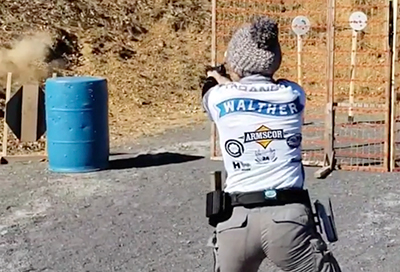
Gabby Franco is shown here shooting in a 2-gun competition at Shadow Hawk Defense in Hedgesville, W.Va., in 2021.
The shooting sports drastically changed my perspective. At first, it seemed like it might be easy to hit the one-centimeter bullseye at 10 meters. My mind constantly raced, however, and I realized my mindset was the most-significant asset I had to learn to control. Maintaining a steady mind was as important as keeping a steady aim. Part of that mental training was understanding that dedication, sacrifices and rewards were part of my athletic life. I trained approximately four to five hours a day, six days a week, for about seven years until I retired in 2002. I missed school parties, school trips and even my graduation ceremony; however, I finally became a member of the Venezuelan National team, and, at 16 years old, I won my first international medal at the 1997 Bolivarian Games in Peru.
Everything seemed to go in a great direction until I learned that elections have serious consequences. I became aware of how avaricious leaders and elites can pulverize the dreams of hard-working citizens.
Hugo Chávez took power in 1999 and ruled the country via executive orders from the beginning. The terrible implications of his actions were palpable, as he aimed to take farmland away from its owners. Chávez did not waste time in pushing his socialist agenda, influenced by Fidel Castro, seeding hatred and envy amongst Venezuelans. I remember one time a person on a motorcycle stopped next to my dad’s SUV and spat on it. It was a symbolic gesture showing his hatred toward us for having a good vehicle. What this man did not know is that my parents were born poor but rose through their will and dedication.
Hugo Chávez’s actions did not go by unnoticed. A Cuban friend, whom I’ll call Jose, warned many of us at the gun range about Venezuela’s future under Hugo Chávez. These warnings were, as Gabriel Garciá Márquez wrote, a “chronicle of a death foretold.” It was indeed a hard pill to swallow for many, who often replied with something like: “That would never happen here. Venezuela is the richest country in the region. Venezuela is not an island like Cuba.”
Crime is uncontrollable, making Venezuela one of the most-dangerous countries in the world—in part because of its strict gun control … .
However, I listened to my Cuban friend and relied on lessons I learned in the shooting sports to make my decision. You see, shooters learn to control negative thoughts, fears and disappointments during setbacks in competitions. Such a constant exposure made me understand that moving forward amid doubts is possible. I learned that sacrifices and fear of the unknown are part of my journey toward success, even if that means leaving everything behind. I was on the peak of my shooting career. I had participated at the 2000 Olympic Games in Sydney, Australia. I was a gold medalist at the subsequent Bolivarian and South American Games, and I was an Olympic hopeful for the 2004 Olympic Games in Athens; however, there was no future in the “new socialist Venezuela,” and fear of the unknown would not stop me from seeking a better way of life.
Nonetheless, leaving Venezuela was a difficult decision. My parents and I argued and cried, and I became distant as they failed to change my mind. It was as if they thought Chávez was a temporary nightmare in Venezuela’s history and could not see the real threat. Breaking their hearts was never my intention, but my decision to move to the United States was made. Staying in a socialist state was against my beliefs.
Why fear is a terrible justification for gun control
“I shouldn’t have to be afraid to go out of my house,” someone will say, usually while trying to voice their opposition to some aspect of gun rights. Gun control advocates often make similar claims, citing their own fear as a reason why they oppose or support some measure or another.
And their fear may certainly feel very real to them.
However, fear is a terrible justification for gun control.
Now, being scared is a powerful motivator. It’s why people do all kinds of things, even if they don’t want to do it otherwise. It’s why scary horror stories of what happens when you don’t do something are such great motivators.
But it’s still an emotion.
When fear is used as an argument to justify some bit of legislation, one should remember that it can also be used to oppose that same bill. After all, one person’s fear may be quite different from another. While some feared armed gunmen in the wake of a mass shooting, others fear being unarmed in the face of a violent criminal.
So now what you’re looking at are warring fears.
I fear being unable to defend my family from an attacker. Is my fear somehow less than the fear that drives many to call for gun control?
“But your fear is irrational. You’re not likely to be attacked,” some might argue, and they’re not wrong. Statistically, I’ll never have to draw my weapon in self-defense at any point in the future. But if that’s the deciding factor, then their fear of being attacked is equally irrational, isn’t it?
And that’s kind of my point.
You see, fear is usually used as a justification for gun control because it’s powerful. Advocates for Second Amendment restrictions want people to be terrified because it’s irrational.
They understand that if you simply use the probability of being the victim of a violent crime is actually pretty high. For example, the probability of being the victim of being robbed is one in 667. Your odds of being the victim of other crimes are also pretty low.
If we’re rational about it, then the debate becomes a different matter. People who are thinking rationally look at this low probability and the fact that criminals obtain firearms through non-lawful means and recognize that gun control isn’t a viable solution to the problem. Some have differing opinions, of course, but as we’ve seen, when there’s little reason for people to be afraid, they tend to support gun rights to a greater degree.
Which is why fear is so well-used.
That doesn’t make it a great idea. That fear pushing some for gun control can and should be used to push for gun rights. We need to propel stories of those who were disarmed when they needed their guns the most at the same time as holding up stories like the Greenwood Park Mall.
Again, it’s because fear is a two-way street.
Yes, it’s a terrible way to promote anything, but that’s because it can be used against that thing. It’s well past time we showed gun control advocates just why it’s a bad idea.
Ohio state senator’s new gun bill drops red flag provisions, adds new restraints
In a last-minute change, Ohio state Sen. Matt Dolan, R-Chagrin Falls, has stepped back from his plan to establish a so-called red flag law in Ohio. In its place, Dolan proposed a restriction on future gun purchases after a person is deemed a threat to themselves or others.
Dolan described the changes as a way to better tailor the bill’s impact.
“Talking with the advocates, both on the mental health side law enforcement side, a couple of things became clear. One is that we’re stigmatizing mental illness,” Dolan explained. “Number two is we weren’t capturing the right people.”
Weapons under disability
The measure now hinges on “behavioral risk assessments.” Those reviews consider behaviors like suicidal tendencies, grievance collecting, or making threats. It also weighs contextual factors like whether a person has been through a “personal catalyst event.”
“The idea is we want to make sure that we create a system where they have an assessment done, so we get to the person help,” Dolan said. “And if that assessment reveals that there they are a violent threat, that they are prohibited from getting firearms.”

State Sen. Matt Dolan, R-Chagrin Falls. Official photo.
[So nice when pictures are added for positive ID, isn’t it?]
Under Dolan’s bill, an assessment which determines a person is at risk of hurting themselves or others would be a disability for the purposes of acquiring, having, carrying or using a firearm.
Analysis: The Supreme Court Probably Won’t Save Non-Violent Felons’ Gun Rights
A federal appeals court has upheld the ban on non-violent felons owning guns using some questionable reasoning, but don’t expect the Supreme Court to intervene.
The Third Circuit found the ban is consistent with the nation’s historical tradition of gun regulation in the United States, as required by the Supreme Court’s standard in New York State Pistol and Rifle Association v. Bruen. The Third Circuit took something of a scattershot approach to justifying its decision, relying on evidence with varying degrees of
In 1995, Bryan Range was convicted of defrauding the government out of $2,458 in food stamps. He never served a day in prison. However, his non-violent crime was punishable by up to five years in jail. So, under the Gun Control Act of 1968, he has been barred from buying or even possessing guns for life.
The Third Circuit said this permanent prohibition has several historical analogues. It started by citing 17th and 18th-century English bans on gun ownership by disfavored religious groups, especially Catholics. While those bans did survive to the early American republic, the Court argued they demonstrated that the tradition of disarming people based on their inclusion in a group perceived as dangerous, even if they haven’t committed any violent crimes, is deeply rooted.
It went on to cite a handful of bans on disfavored racial groups owning guns during the founding era as evidence this idea was popular in America as well.
“The earliest firearm legislation in colonial America prohibited Native Americans, Black people, and indentured servants from owning firearms,” the court’s per curiam opinion reads. “Likewise, Catholics in the American colonies (as in Britain) were subject to disarmament without demonstrating a proclivity for violence.”
The Third Circuit did not invent this line of thinking. Justice Amy Coney Barrett cited the concept in her Kanter dissent, although she came to the opposite conclusion about the constitutionality of gun bans for non-violent felons. But it would be rather disturbing if the legal underpinning for some of the nation’s most significant gun laws, which continue to be disproportionately enforced against minorities, were justified by explicitly bigoted historical laws.
Frankly, I doubt the Supreme Court would actually buy this analysis, given how thoroughly it has rejected racist gun laws from America’s past in its Second Amendment rulings thus far. Instead of viewing them as viable historical analogues for understanding the limits of Second Amendment protections, it has used them as examples of infringements on Americans’ gun rights that help illuminate the expansive nature of those protections.
Natural Law, Scripture and the Right of Self Defense
Now that Republican leaders have fended-off the widely anticipated Red Wave, Left-leaning politicians who are keen on relieving Americans of their constitutional rights can pursue their previously unspoken agenda.
Gun control wasn’t a big issue in the midterm elections, largely because most Americans don’t like it. But now that the dust has settled, the American Left is free to seek more gun control.
Congressional Democrats and the Biden administration are emboldened to renew their efforts to impose gun control. In Oregon, new gun restrictions are being celebrated by the Left because people must now receive permission from the government before being allowed to purchase a firearm for self defense or sporting. Regrettably, this law was widely promoted by a number of churches and synagogues in the state.
The authoritarian Left in America hates the Second Amendment. One of their arguments theorizes that our gun rights should be eliminated because AR-15s were not available to the Continental Army at the Battle of Yorktown, just muskets and bayonets.
Extending this logic to the First Amendment, perhaps we should ban cable news and Facebook because they too did not exist in the mid-18th century. I’m not convinced that would be proper but it might be kind of fun to do it for a couple of weeks just to see what happens.
We’re led to believe that our Second Amendments rights are a freakish aberration in our Constitution, that guns are the root of much evil. In truth, the principles behind the Second Amendment are really old. Ancient, in fact.
In his 1754 treatise on The Absolute Rights of Individuals, the distinguished English jurist William Blackstone wrote of “the natural right of resistance and self-preservation,” and the importance of “the right of having and using arms for self-preservation and defence (sic).”
Blackstone’s writings were designed to improve upon the 1689 English Bill of Rights, which included the right for some people to bear arms, though it was not a universal right.
Before legal and political thinkers specified the right to bear arms, scholars and theologians were promoting the concept of the right of self defense and the right to resist tyrants. During the Great Reformation, Martin Luther, Philip Melanchthon and others affirmed the right of self defense, which was a very scary idea for 16th century European theocrats.
In affirming self preservation, the Reformers did not contemplate the people defending themselves with strongly worded letters to Rome protesting public disembowelment. They presumed people would be armed with weapons of the day.
The Magna Carta did not guarantee the right to bear arms but it did provide the right of resistance should the king not abide by its terms. This also presumes the right to bear arms. It’s no coincidence that when King John signed the Magna Carta in 1215, the English nobles who attended the ceremony carried swords.
The Dooms of King Alfred required Anglo-Saxon landowners to provide men, ready to fight, in defense against the 9th century Viking raiders who frequented England’s shores. Like the Magna Carta, Alfred also presumed the men of his kingdom would be armed.
This acknowledgement of self defense as a God given right isn’t limited to the Anglo-Saxon or European traditions. Going back as far as 124 BC, Chinese Emperor Han affirmed the right of people to arm themselves, “to prevent tyranny and to punish evil.”
Ancient as these civic traditions of self defense are, most are predated in scripture. The Gospel of Luke records Jesus Christ telling his disciples before his betrayal, “Let the one who has no sword sell his cloak and buy one.” Whether Jesus meant this literally or figuratively is subject to debate but the underlying wisdom is unambiguous: be prepared because the future is dangerous.
Biblical Christianity doesn’t merely permit us to defend ourselves, it demands we defend our families. Paul’s first letter to Timothy reads, “If anyone does not provide for his relatives, and especially for members of his household, he has denied the faith and is worse than an unbeliever.”
This involves more than providing food and shelter; it also means protecting our loved ones from assault, rape, and murder. Apparently, some of Oregon’s so-called faith leaders are not familiar with this New Testament passage. More’s the pity.
By comparison, men’s fellowship at the church I attend in Texas includes presentations from local theologians and Bible scholars, group discussions on church doctrine, study of scripture, prayer, and range time with pistols and rifles.
When modern politicians seek to relieve us of our Second Amendment rights, they are contradicting millennia of common law, natural law and scripture. They are embracing the policies of tyrants who know that unarmed people are docile subjects rather than free citizens.
If we are denied the right of self defense, it’s only a matter of time until we’re denied others.
The Government Can’t Fix Social Media Moderation & Should Not Try
Washington, DC – -(AmmoLand.com)- Despite their increasingly bitter differences, Democrats and Republicans generally agree that content moderation by social media companies is haphazard at best. But while Democrats tend to think the main problem is too much speech of the wrong sort, Republicans complain that platforms like Facebook, Twitter, and YouTube are biased against them.
The government cannot resolve this dispute and should not try. Siding with the critics who complain about online “misinformation” poses an obvious threat to free inquiry and open debate. And while attempting to mandate evenhandedness might seem more consistent with those values, it undermines the freedoms guaranteed by the First Amendment in a more subtle but equally troubling way.
Under a Texas law that the U.S. Court of Appeals for the 5th Circuit declined to block last week, the leading social media platforms are forbidden to discriminate against users or messages based on “viewpoint.” The “censorship” that Texas has banned includes not just outright removal of content and cancellation of accounts but also any steps that make posts less visible, accessible, or lucrative.
That means platforms are obliged to treat all posts equally, no matter how objectionable their content. With narrow exceptions for speech that is not constitutionally protected, Facebook et al. are not allowed to favor tolerance over bigotry, peace over violence, or verifiably true historical or scientific claims over demonstrably false ones.
While such neutrality is constitutionally mandatory for the government, imposing it on private actors violates the First Amendment right to exercise editorial discretion.
The companies that challenged the law cited a line of Supreme Court decisions recognizing that right in a wide range of contexts, including a newspaper’s selection of articles, a utility’s control over the content of its newsletter, and a private organization’s vetting of participants in a St. Patrick’s Day Parade.
Even assuming those cases established a general right to exercise editorial discretion, the 5th Circuit said that is not an accurate description of what social media platforms are doing when they decide that certain posts are beyond the pale. Because they rely heavily on algorithms, do not review content before publication, and take action against only a tiny percentage of messages, Judge Andrew Oldham declared in the majority opinion Facebook et al. “are nothing like” a newspaper.
Writing in dissent, Judge Leslie Southwick objected to that characterization. While “none of the precedents fit seamlessly,” Southwick said, a social media platform’s right to curate content is analogous to “the right of newspapers to control what they do and do not print.”
That right has never been contingent on whether editors do their jobs thoughtfully, consistently or fairly. As the U.S. Court of Appeals for the 11th Circuit observed when it blocked enforcement of Florida’s social media law in May;
“private actors have a First Amendment right to be ‘unfair’ — which is to say, a right to have and express their own points of view.”
Oldham rejected the argument that social media companies are expressing a point of view when they make moderation decisions based on “amorphous goals” like maintaining “a welcoming community” (YouTube), fostering “authenticity, safety, privacy, and dignity” (Facebook), or ensuring that “all people can participate in the public conversation freely and safely” (Twitter). Yet the conservatives who want the government to restrict moderation decisions take it for granted that social media companies have an ideological agenda — one that is hostile to people on the right.
If social media platforms pursued that agenda more explicitly and systematically, Oldham’s argument implies, the government might be obliged to respect their decisions. The more proactive and heavy-handed they were, the stronger their First Amendment claim would be.
Should the Supreme Court resolve the split between the 5th and 11th circuits by endorsing Oldham’s reasoning, platforms that want to escape Texas-style regulation might decide that broader and tighter content restrictions are the way to go. By trying to mandate a diversity of opinions, the government could achieve the opposite result.