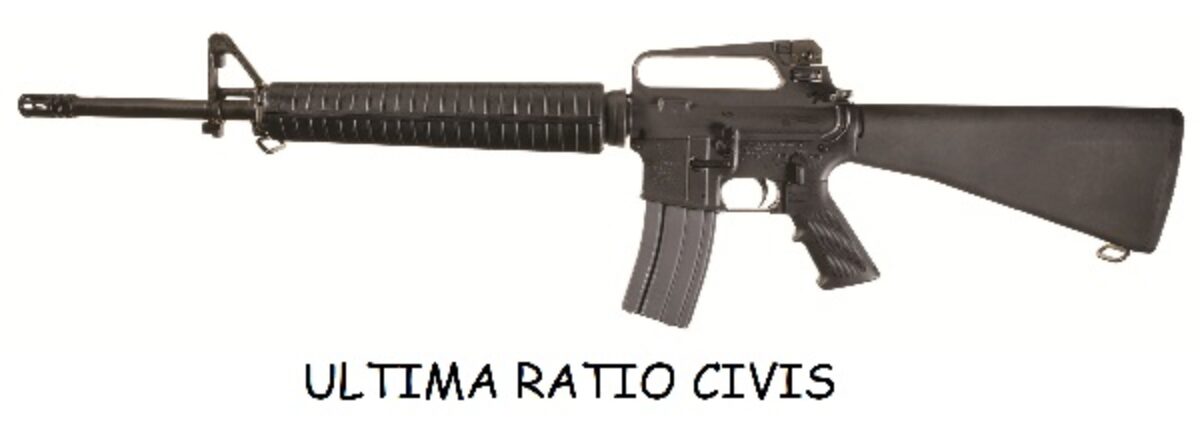
The gun industry is one of the most regulated industries in the nation. A firearm can’t go from Point A to Point B without a mountain of paperwork, for example. About the only industry that can compete with it regarding the amount of regulation they deal with is the pharmaceutical industry.
But a lot of people seem to think that the gun industry is unregulated.
Now, this is usually not a big deal. It doesn’t take much to show just how wrong people who think that actually are. We can usually show them how regulated guns actually are.
Occasionally you’ll find someone who should know better but, apparently, doesn’t. An example is this guy who seems to think that toy guns are regulated more than real firearms. He also thinks that should change.
What if the United States regulated real firearms as stringently as they regulated toy guns for children?
Cavataro argues that empowering the CPSC to regulate guns would increase their safety without encroaching on politically charged issues such as gun access and prevalence.…
Cavataro notes that subsequent efforts to introduce product safety regulations have fallen short because product safety measures for firearms are often seen as “gun control.” Cavataro contends that this characterization is misleading. Instead, he distinguishes between product safety measures, which seek to protect firearm users from dangerous mishaps, and gun control efforts, which seek to regulate the possession and use of guns.
Wrong.
What we’re seeing here is a call for a bureaucracy to oversee the gun industry, ostensibly to maintain safety standards, which might be fine for many if we could trust the bureaucracy to end there. After all, making sure you guns work as they’re supposed to wouldn’t be a bad thing, if you’re inclined to believe the government can do that job properly.
But the reason people call these efforts “gun control” isn’t due to a lack of understanding or mischaracterization. It’s because we know damn good and well where such a body would eventually take their regulatory efforts.
Think for a moment how the ATF started as a revenue collection agency and now is deciding what is legal and what isn’t. We’ve seen federal agencies try to say their ability to regulate waterways included mud puddles.
Now think about the GOSAFE Act for a second. This is, in essence, an attempt to regulate the gun industry. It’s not through a regulatory body, which means it has to battle through Congress to become law.
And a lot of people are opposed to it.
Yet if we had a regulatory body over the gun industry, the defeat of such a bill would only be part of what’s necessary. We’d then have to defeat that regulatory body when it attempted to put similar rules in place.
We call it gun control not because we don’t understand but because we understand all too well what will happen.
That’s not going to change.
The Supreme Court has held that the Second Amendment protects arms in common use for lawful purposes. But what does the phrase “in common use for lawful purposes” actually mean?
The anti-gunners want to define “in common use” very narrowly to mean only the actual firing of a gun in self-defense. They argue that because firearms are rarely fired in self-defense, they aren’t “in common use” and, thus, can be banned. That’s a trap and one we must work hard to avoid falling into. Firearms are prolific in America and are commonly used every day for countless lawful purposes beyond the actual firing of a gun in self-defense.
Firearms Are “Used” To Deter Bad People From Doing Bad Things
Let’s begin with a very basic principle: the “use” of a firearm extends beyond firing a gun in self-defense. In District of Columbia v. Heller, the U.S. Supreme Court held that the Second Amendment protects “arms ‘in common use at the time’ for lawful purposes like self-defense.” Self-defense is simply an illustration of a type of “lawful purpose”; it is not the only lawful purpose of a firearm as the anti-gunners would like the lower courts to find.
But even in the self-defense arena, firearms are commonly used as a deterrent (i.e., brandishing) without being fired. In the 2021 National Firearms Survey, Professor William English of Georgetown University found that in 81.9% of defensive gun uses, the gun is not fired.
A police officer patrolling Times Square may never fire his handgun at a perpetrator, but its mere presence helps ward off potential criminal activity. The same can be said for the firearm that rests on your nightstand, which acts to deter a criminal from attempting to burglarize your home.
Think of a firearm like a fire extinguisher. A fire extinguisher is in “use” merely by being present in the home. A homeowner does not need to depress the handle of a fire extinguisher to put out a grease fire to “use” a fire extinguisher. Similarly, you would never argue that a life insurance policy isn’t in “use” because the insured is still living. Or that a homeowner insurance policy was not being used because no claim for a loss had yet been submitted. Americans purchase firearms, fire extinguishers, and insurance policies for the same reason – as a means of protection just in case. Contrary to the arguments advanced by the anti-gunners, a firearm is being “used” for self-defense even when it has never been fired.
Thus, the first item we can add to the list of lawful purposes for which Americans use their guns is the two-sided coin of self-defense: either firing in self-defense or merely keeping (or brandishing if needed) a gun as a deterrent to prevent against future harm.
Firearms Are “Used” For Hunting, To Prevent Animal Attacks, And for Pest Control
The “use” of firearms is not restricted to self-defense against violent criminals intending to do us harm. Firearms are also used for hunting, for example. Whether it’s big game, small game, varmints, birds, trophies, or simply sustenance, hunting is both a sport and a valuable means of obtaining sustenance engaged in by millions of Americans across the country. And hunters use a wide variety of firearms. Whether it’s a modern firearm such as an AR-15, a 30-06 Springfield, or an older firearm such as a black powder musket, hunters employ many different types of guns.
Another important lawful use of firearms concerning hunting is the prevention of animal attacks. I have written more comprehensively about this elsewhere, but the danger of animal attacks was top of mind for our Founding Fathers who drafted the Second Amendment. This is especially important for people who live in remote places in the American West where wild, dangerous animals roam free.
Relatedly, many American gun owners today use their firearms for pest control: pest control not only preserves one’s land and livestock, but it may also become necessary to prevent a violent attack. Whether it’s coyotes, feral hogs, prairie dogs, rats, groundhogs, or crows, pest control can come in many forms. Packs of feral hogs demonstrate not just the necessity of semiautomatic weapons but large capacity magazines as well: feral hogs are extremely fast and can be overwhelming, and as a result, modern firearms and capacities are necessary to keep them under control.
Firearms Are “Used” For Sport In Competitions, To Train, And By Civilian Law Enforcement
Shooting competitions have a long and storied history in American culture, and they are yet another way Americans lawfully use their firearms. Examples abound: the International Practical Shooting Confederation (IPSC); the United States Practical Shooting Association (USPSA), fast draw competitions, the Camp Perry National Matches, the Police Pistol Combat competitions, and the Civilian Marksmanship Program, to name a few. There are also competitions across the country for minors to acquaint them with firearms and their proper usage.
Another use of firearms is firearm training. The Seventh Circuit Court of Appeals has specifically said in Ezell v. City of Chicago (2017) that the Second Amendment protects a right to train with firearms. Firearms training is another lawful use of firearms in the United States.
Relatedly, firearms are “used” by civilian law enforcement, which includes civilians who might be deputized into service for a variety of reasons. It’s not unusual for citizens to sometimes be deputized as a reservists to help protect their town—such deputization is necessary in wide-ranging areas with little police presence.
History and Craftsmanship
Historical shooting activities are another use of firearms in the United States. There are many groups that engage in Revolutionary War and Civil War reenactments that use many types of historical firearms and replicas. We see an example of this every Sunday during the NFL season when the New England Patriots score a touchdown; the Patriots Militia fire their muskets at Gillette Stadium in their Revolutionary War garb.
While some people are interested in history, others enjoy gunsmithing and craftsmanship. Americans engage in gunsmithing as a hobby or even professionally, and many others also like to make their own firearms, whether modern or historical. Sometimes, you can use weapon parts kits or even 3-D printing to accomplish those goals. There are also all sorts of experimentation and improvement that go on with firearms, such as designing new cartridges, chambers, or other things. People also customize their firearms and even use them as home décor above the mantle and throughout their homes.
When it comes to Second Amendment analysis, we must remember that firearms are commonly used by Americans for lawful purposes far beyond the rare occasion when someone fires a gun in self-defense. The anti-gunners are working hard to define “in common use” narrowly to further restrict our rights to keep and bear arms. So, next time you hear the phrase “in common use,” make sure to remember the myriad ways Americans use their firearms in the modern age.
“The staff who have been selected and trained will remain anonymous, and with God’s help this layer of protection will never need to be deployed. We expect no changes to the day to day experiences of students and staff,” the superintendent of Siouxland Christian School, located in Sioux City, Lindsay Laurich said in a letter to the school community last week, which was provided to Fox News Digital.
The school is not detailing how many staff members will be armed while on campus, or their identities, “in order to protect the staff who are taking this courageous responsibility,” Laurich told Fox News Digital. She added that the school had been considering the policy for a year before the official announcement last week.
“I would just add that we have been working on this plan for over a year. However, we felt that this was a necessary step that was needed for our school community,” Laurich said.
It’s now been a week since the deadline passed for Illinois gun owners to register their now-banned “assault weapons”, and the big question at the moment is which agencies, if any, are actually enforcing the new law. We’ve seen plenty of sheriffs and some state’s attorneys publicly say that they won’t be arresting or charging anyone for non-compliance, and as my colleague Tom Knighton reported on Friday, the Illinois State Police has said much the same; they won’t be actively looking for those they know have guns but failed to register them, though if a state trooper finds someone in possession of an unregistered firearm they may still make an arrest.
The state police are also keeping the registration portal open just in case any gun owner feels like registering after the deadline has come and gone. Maxon Shooting Supplies owner Dan Eldridge says he’s not even sure if that’s allowed under the text of the Protect Illinois Communities Act, and wonders if registering after the deadline opens gun owners up to criminal liability.
It sounds like a terrible idea to us. It is not obvious from where the ISP derives the authority to modify the Act’s language, which was passed by the General Assembly and signed by the Governor.
The department says it won’t pursue criminal charges against late affadavits, but does this prevent an anti-gun Cook or Lake County state’s attorney from doing so?
Put these failures, sloppy work product, and mis-steps together, and it’s easy to see that nobody knows with complete certainty what and when registration affidavits must be filed. Even those tasked with enforcement don’t seem to understand the requirements of this act.
The Office of the Lake County State’s Attorney posted a notice on itsfacebook page warning law-abiding citizens that they must register their assault weapons and high-capacity magazines by December 31.
The Governor ison camerawarning law-abiding citizens that they must register their automatic and semi-automatic rifles and magazines.
There is no requirement to register magazines, and the act does not mention full-auto. Yes, if a full auto is a selective fire device, the semi-auto capability would require registration, but it’s obvious that these politicians have no idea what they are talking about.
Even the Illinois State Police website warns that “individuals who possessed assault weapons, high-capacity magazines, and other devices listed in the Act before it took effect are required to submit an endorsement affidavit through their Firearm Owner’s Identification Card account by JANUARY 1, 2024,” though the statute only requires owners of those magazines to submit an affidavit if one has been transferred to them after the deadline had passed.
If the people who wrote the law and the agencies tasked with enforcing it don’t even know the details of the Protect Illinois Communities Act, how can the average Illinois gun owner possibly be expected to be aware of all of the intricacies in the legislation? That confusion may be one reason why compliance with the registration mandate has been so low (Maxon estimates about 4.2% of gun owners have submitted their affidavits to the state police), but Maxon believes there’s a large amount of civil disobedience taking place as well.
Nearly every county sheriff and most of the county State’s Attorneys have stated that they will not enforce this Act. Residents of those counties have little incentive to register.
The act is highly offensive to otherwise law-abiding Illinois gun owners. It is a mess of legislation put into law:
by individuals who know little to nothing about firearms
who are willfully ignorant of the difference between lawful ownership and criminal misuse of firearms
and who abused (again) the proper process for introducing and debating bills, jamming this through in the middle of the night on the last day of the 102nd General Assembly.
“The British follow all the laws, good and bad, the French ignore all the laws, and the Americans follow the good ones and ignore the bad ones”
Non-compliance with unjust laws: It’s as American as apple pie.
So long as Illinois gun stores like Maxon Shooter’s Supplies aren’t selling these now-banned arms, Gov. J.B. Pritzker and other anti-gunners in Illinois will still consider PICA a win even if the lack of compliance with the registration mandate makes a mockery of their latest anti-2A effort.
The legal battles to have the gun and magazine ban (along with the accompanying registration requirement) declared unconstitutional are continuing to play out in federal court, and there’s a strong likelihood that U.S. District Judge Stephen McGlynn, who denied a request for an injunction against the registration mandate shortly before it took effect, will revisit the issue before long and hopefully put the mandate on ice while the litigation runs its course.
Either way, I don’t see any signs that hundreds of thousands of Illinois gun owners will be registering their banned arms now that the deadline has passed, even if the Illinois State Police is encouraging them to do so.
One of the signals this is bogus research is the way Everytown graded Washington State, where the Citizens Committee is headquartered. Washington is position ninth on the list, and is described as ‘making progress.’ The state has adopted increasingly restrictive gun laws in recent years, and the number of homicides has more than doubled since 2014, according to FBI data and statistics from the Washington Association of Sheriffs and Police Chiefs. Seattle just set a new homicide record in 2023. If that’s what Everytown calls ‘making progress,’ we would be better off going back to living in caves.
The only conclusion one can draw is that Everytown is far more interested in restricting the rights of honest citizens than it is in reducing violent crime or taking violent criminals off the street.
The big tell in almost antigun organizations claims is when they refer to “Gun Violence” statistics and completely ignore criminal violence committed by thugs using other types of weapons and unarmed violence..
“Gun violence” includes justified shootings in self defense by police and/or private citizens, and people who committed or attempted suicide with a gun. And, most importantly, it ignores sky high violence rates against people unable to defend themselves by exercising their specific enumerate right to keep and bear arms.
One could ask, as I have done many times, if the shift was intentional or negligent. I have never received a straight answer. This tells me it is intentional.
These people are deliberate liars. Respond and prepare appropriately.
Californians with a gun-carry permit can lawfully carry a gun in most areas of the state once again.
A three-judge panel on the Ninth Circuit Court of Appeals removed a stay applied to a lower court ruling against California’s SB2, which created a near-total ban on gun carry in the state. The action reinstates the lower court ruling that found the law violated the Second Amendment rights of those with gun-carry permits.
“The administrative stay previously entered is dissolved,” the panel wrote in May v. Bonta. “The emergency motion under Circuit Rule 27-3 for a stay pending appeal and for an interim administrative stay is denied pending further order of the court.”
The administrative move, like the one that preceded it, has a huge practical effect. The stay allowed the state to implement dozens of expansive “gun-free” zones at the beginning of the year, including one on every piece of private property unless the owner explicitly authorizes gun carry. The cumulative effect of the new “sensitive places” restrictions added up to an effective ban on gun carry.
Undoing the stay practically undoes enforcement of those new zones as the case against them proceeds on appeal. California Attorney General Rob Bonta (D.) did not respond to a request for comment on the order. However, gun-rights advocates celebrated the stay being dissolved.
“The right to carry in California was unconstitutionally eliminated for almost a week,” Kostas Moros, a lawyer for plaintiffs California Pistol and Rifle Association, told The Reload. “We are relieved the status quo has been restored, and Californians with CCW permits, who are among the most law-abiding people there are, can resume carrying as they have for years.”
The panel’s actions reinstate the preliminary injunction issued against the law by U.S. District Judge Cormac J. Carney in December. Carney found SB2 “unconstitutionally deprive” permitholders “of their constitutional right to carry a handgun in public for self-defense.” He further accused California of intentionally ignoring and undermining the Supreme Court’s decision in 2022’s New York State Rifle and Pistol Association v. Bruen, which established carrying a gun for self-defense is protected by the Constitution.
“SB2’s coverage is sweeping, repugnant to the Second Amendment, and openly defiant of the Supreme Court,” Carney, a George W. Bush appointee, wrote. “The law designates twenty-six categories of places, such as hospitals, public transportation, places that sell liquor for on-site consumption, playgrounds, parks, casinos, stadiums, libraries, amusement parks, zoos, places of worship, and banks, as ‘sensitive places’ where concealed carry permitholders cannot carry their handguns. SB2 turns nearly every public place in California into a ‘sensitive place,’ effectively abolishing the Second Amendment rights of law-abiding and exceptionally qualified citizens to be armed and to defend themselves in public.”
The panel could still reconsider part of the stay before arguments in the case are actually heard. Those arguments are currently scheduled to occur in April.
In a Dec. 22 press release, the Attorney General’s Office trumpeted the fact that it had successfully defended the state’s assault weapons ban in federal court.
In Bruen, the Supreme Court refined the Second Amendment jurisprudence it had previously laid out in District of Columbia v. Heller and McDonald v. Chicago, clarifying that it believed that appellate courts had gone astray in interpreting Heller.
Since Heller, the appeals courts had developed a “two-step” framework for analyzing Second Amendment challenges, combining history with means-end scrutiny, which the Bruen court said was one step too many. The proper test should involve drawing analogies to the country’s history of firearm regulation alone, the Supreme Court ruled.
The court stressed that it was attempting to create “neither a regulatory straightjacket nor a regulatory blank check.” As courts were engaging in “analogical reasoning,” they need only find “a well-established and representative historical analogue, not a historical twin,” Justice Clarence Thomas wrote for the six-member majority in Bruen.
Since that ruling, courts in Massachusetts and elsewhere have begun fleshing out the standard, often prompted by cases filed by emboldened gun rights advocates. Recent weeks have not only seen U.S. District Court Chief Judge F. Dennis Saylor IV’s denial of the plaintiffs’ motion for a preliminary injunction in Capen but a Superior Court judge similarly rejecting a post-Bruen challenge to Massachusetts’ ban on anyone under the age of 21 obtaining a license to carry a handgun outside their home.
Meanwhile, gun rights advocates are celebrating a Lowell District Court judge’s decision to dismiss a charge of carrying a firearm without a license that a New Hampshire man had been facing for bringing the weapon he was licensed to carry in his home state across state lines.
Bruen has also revived a challenge to the state’s “gun roster” in the federal case Granata, et al. v. Campbell, et al., and spawned a new lawsuit challenging gun license delays of six months or more in Boston in White, et al. v. Cox.
That is the motto of Faith Sample, whose new business, She Shoots Back, is teaming up with National Rifle Association to host an event entitled “Refuse To Be A Victim.”
The self-defense class, which will be held Saturday, Jan. 13, was borne out of a desire to equip everyone with basic safety methods.
“‘Refuse To Be A Victim’ teaches methods to avoid dangerous situations and prevent criminal confrontations,” said Sample. “Seminar participants will be presented with a variety of common-sense crime prevention and personal safety strategies and devices that may be integrated into their personal, home, automobile, telephone, technological and travel safety.”
“Refuse To Be A Victim,” which has been a mainstay of self-defense prevention since 1993, focuses on basic habits and steps that can be taken to reduce being the victim of a crime.
The class will not contain or train on firearms, instead focusing on preventing situations rather than confronting them.
The class is open to both men and women, and there are sections dedicated to people of all ages, as well as parents.
Sample said that she teaches many similar techniques through She Shoots Back, which was established in 2023. “There have been times in my own life, and in the life of loved ones when either ignorance or inability has led to devastating results,” Sample said. “I have since spent many hours in training and research to be able to teach others what they can do to either prevent or deal with a victimizing situation.”
Part of learning to deal with such situations is being armed, which Sample includes as one of her many classes. “I learned how to shoot and carry a firearm after these initial experiences and after ten years have finally decided that continuing training and becoming an instructor was something I could do to make a difference,” she saId.
Sample stated that her gun classes are catered toward women in an effort to foster a comfortable environment. Some of the women she teaches come from unstable or violent backgrounds, and need a safe space to learn to protect themselves.
“Domestic violence is more prevalent than you think,” she said. “It can be fostered through generations, and it takes strong people to seek help and break such cycles. What every woman needs on hand to protect herself is, in my opinion, a determination to succeed and a listening ear to the inner voice that lets you know when something isn’t right.”
Sample, who also works as a teacher and has children of her own, said she hopes She Shoots Back will be part of solution to end cycles of violence.
“I think the most important thing we should take from this is that we should never just look the other way or accept abuse. We should always recognize the worth of every human soul and that includes our own. No one deserves to be a victim.”
Refuse To Be a Victim will take place at the Gene Moss Building on Jan. 13 from 10 a.m. to 2 p.m. Tickets are $40 and proceeds will be donated to the Saline County Safe Haven. Those who sign up by Wednesday, January 10 will receive a booklet with their training. For tickets and more information on She Shoots Back, please visit https://sheshootsback.com/nra-refuse-to-be-a-victim/.
A federal judge is allowing a challenge to New York’s assault weapons ban to proceed after he denied a motion to dismiss the lawsuit Thursday.
Two people supported by gun rights advocacy groups sued New York officials in December 2022 over the state’s ban on assault weapons, saying the law was “infringing the right of law-abiding, peaceable citizens to keep and bear commonly possessed firearms for defense of self and family and for other lawful purposes.” U.S. District Judge Kenneth Karas sided with the individuals bringing the lawsuit in a ruling released Thursday, denying state officials’ motion to dismiss the case.
Attorneys for New York officials filed a motion in the Southern District of New York to dismiss the complaint in May, arguing that the court does not have the jurisdiction to address the plaintiffs’ claims. The state officials’ legal team said the individuals “fail to establish that any injury-in-fact is traceable to the assault weapons ban” because they do not say they hold a license required to buy a semiautomatic rifle.
Karas dismissed the defendants’ arguments in the ruling.
“While there may be serious questions about Plaintiffs’ exemption argument, the Court need not address that question here because Plaintiffs adequately allege standing under Defendants’ interpretation of the statute,” Karas wrote.
“Put simply, Defendants have failed to explain how invalidating the Assault Weapons Ban would have no effect on the ability to obtain licenses for those same weapons,” Karas added later in the ruling.
The attorneys for the state officials also contended that the lawsuit should be dismissed because the individuals have not proved that they have “suffered an injury-in-fact.” Karas also pushed back on the argument, saying that the individuals “have also demonstrated that they face a credible threat of enforcement if they follow through with attempting to acquire assault weapons.”
CLEVELAND, Ohio (WOIO) – Contrary to concerns from some local leaders, a new study shows a decrease in gun crimes across six of Ohio’s eight largest cities following the implementation of the state’s “constitutional carry” law.
The research, conducted by the Center for Justice Research (CJR) in partnership with Bowling Green State University, analyzed data from June 2021 to June 2023, covering a year before and after the law went into effect in June 2022.
It focused on crimes involving firearms, verified gunshot-detection alerts, and the number of officers struck by gunfire.
The findings revealed:
Overall Decline: Across all eight cities, the rate of gun crimes decreased.
Significant Drops: Parma experienced the most significant decline (22%), followed by Akron and Toledo (both 18%).
Mixed Trends: Dayton and Cincinnati saw increases in gun crime rates (6% and 5%, respectively).
“This is not to downplay the very real problem of gun violence in our cities,” noted Ohio Attorney General Dave Yost, who commissioned the study. “But the key takeaway here is that we need to focus on criminals, not responsible gun owners.”
He acknowledged concerns expressed by several mayors before the study, stating, “I genuinely did not know what the study would find. I thought it would be useful either way.”
CJR Director Melissa Burek, a Doctor of Criminal Justice, led the research.
She emphasized the importance of examining the impact of policy changes: “This study helps us understand the complex picture of crime rates and policy implementation. It’s valuable data for informing future decisions.”
The findings add to the ongoing debate surrounding permitless carry laws, challenging concerns that such laws would lead to a surge in gun violence.
While proponents highlight responsible gun ownership and increased self-defense, critics argue it removes valuable safety measures like background checks and training.
Further research and analysis are needed to fully understand the long-term implications of Ohio’s permitless carry law and its impact on various factors influencing crime rates.
When Oregon voters passed Measure 114, it was hailed as a victory for gun control. To be fair, they weren’t wrong. The egregious infringement on people’s rights was as clear as day.
What’s more, any attempt to point out the unconstitutionality of the law were met with claims that it was the will of the people–because segregation was perfectly acceptable because most people in the South supported it or something.
That sparked off the legal fight, one that many people were confident the law would survive. Why they thought that is beyond me, but I’m biased.
It seems, though, that my understanding of whether or not Measure 114 was constitutional or not comes a lot closer to what the most recent hearing on the matter found.
A state court ruling against Oregon’s gun control policy, Measure 114, is going to stand after an expected final hearing about the matter today in Harney County Circuit Court to consider more arguments against the Court’s original case finding.
Harney County Circuit Court Judge Robert Raschio today said he expects the court’s judgment in the case to reflect language he used in his opinion letter about the case, saying Measure 114 is unconstitutional by Oregon’s Constitution.
He had set a January 2, 2024, hearing about his pending ruling against Measure 114 after defendants made more arguments in filings with Harney County Circuit Court after Raschio issued his written legal opinion, ruling November 21, 2023, that Oregon’s gun control policy, passed November 2022 by referendum as Measure 114, violated the state’s constitution.…
Judge Raschio denied that motion, before stating the Court’s judgment language would reflect his Opinion Letter Granting a Permanent Injunction in the case.
He opened that letter with, “The Harney County Circuit Court is issuing a Permanent Injunction under Oregon Revised Statute 28.020 declaring 2022 Ballot Measure 114 unconstitutional thereby permanently enjoining its implementation.
The court finds the plaintiffs have shown their rights to bear arms under Article l, § 27 of the Oregon Constitution would be unconstitutionally impaired if Ballot Measure 114 is allowed to be implemented. Dovle v. City of Medford, 356 Or. 336 (2014). Based upon a facial constitutional evaluation of Ballot Measure 114, the measure unduly burdens the plaintiffs’ right to bear arms. State v. Christian, 354 Or. 22 (2013).”
And, the truth of the matter is that Measure 114 does all that and more if you’re looking at the Second Amendment, but the court found that it violated the right as protected under Oregon’s constitution.
Section 27. Right to bear arms; military subordinate to civil power. The people shall have the right to bear arms for the defence [sic] of themselves, and the State, but the Military shall be kept in strict subordination to the civil power[.]
Plain and simple, people have the right under Oregon’s constitution. There doesn’t seem to be anything expressly permitting gun control, though it lacks that whole “shall not be infringed” thing we see in the Second Amendment.
The measure requires things like universal background checks and magazine bans as well as a gun licensing requirement.
Interestingly, while “the will of the people” seemingly supported the law, it should be noted that only six of 36 Oregon counties actually voted in favor of it. These counties were also the most urban in the state. Shocking, I know.
The passage of Measure 114 is a prime example of the urban/rural divide on guns.
In this case, though, the urban counties thought they could foist this abomination onto the rural ones and have just found out that it’s not that simple. Constitutionality matters.
The deadline for Illinois gun owners to register their banned “assault weapons” with the state police has come and gone, and contrary to the predictions of Gov. J.B. Pritzker it looks like there was no last-minute flood of registrations. According to the latest figures from the Illinois State Police, about 15,000 FOID holders had registered one or more firearm, “large capacity” magazine, or other device named in the Protect Illinois Communities Act as of late last week; about double the number that the ISP had previously reported, but still fewer than one percent of the nearly two million Firearm Owner ID card holders in the state.
Not everyone who possesses a valid FOID card ones one or more of the guns banned under the Protect Illinois Communities Act, but my guess is that the vast majority of them own either a firearm covered under PICA or a “large capacity” magazine that’s supposed to be registered with the state police. Compliance with the registration looks to be almost non-existent, which raises the question of how, exactly, the new ban will be enforced going forward.
In November, state police said it is up to prosecutors in the state’s 102 counties to enforce the law, but it’s unclear what penalties would be in store for those who fail to register their weapons. Penalties can vary for illegal weapons. Carrying or possessing unauthorized assault weapons could result in a misdemeanor, with one year in jail or a fine of up to $2,500. Manufacturing, selling, or purchasing an unauthorized weapon could constitute a felony and result in up to 10 years in prison and a fine of up to $25,000.
Kane County Sheriff Ron Hain explained that his deputies won’t be going door to door to find residents who may have a FOID card and “asking to see all of their weapons.” He said the law works more during high-profile investigations.
“However, if we are investigating a criminal organization and we do come across firearms that are in violation of the assault weapons ban, we will certainly use this new law to enhance criminal charges against them,” Hain said.
While some sheriffs like Hain say they’ll enforce the law if there are more serious charges attached, other sheriffs and even some state’s attorneys have indicated they have no plans on enforcing the law at all, much to the chagrin of gun control advocates, anti-gun politicians, and their allies in the media.
My wife has watched way too many sappy Christmas rom-coms over the holiday break. It’s one of her guilty pleasures, even though she knows from the get-go how the story is going to play out. Girl meets guy under improbable circumstances, there’s immediate friction with an undercurrent of attraction, they get together, there’s a huge blowup, and yet they manage to reconcile and live happily ever after. The characters and the locations may change, but the story is basically always the same.
The Ninth Circuit Court of Appeals is like the Hallmark Channel of the judicial system, at least when it comes to gun control fans. No matter what law is being challenged or how egregiously it violates our Second Amendment rights, lawsuits in the Ninth Circuit seem to follow the same script: gun owners sue, a judge agrees that the law is likely to be unconstitutional and grants an injunction, only to have it stayed and eventually overturned. Sometimes we get a plot twist and a three-judge panel will uphold the injunction, but inevitably that decision is overruled by an en banc review. No matter how improbable or untenable the decision may be, anti-gunners are assured of a happy ending in the Ninth.
Not once in the fifteen years since the Heller decision was handed down has the Ninth Circuit ultimately concluded that a gun control law goes too far and abridges a fundamental right, and though it’s still fairly early the appellate court looks to be keeping that streak alive by allowing California’s new “gun-free zones” to take effect today after a rare Saturday ruling to grant an administrative stay of Judge Cormac Carney’s injunction halting enforcement of the new bans in supposedly sensitive places… including virtually every publicly accessible business that doesn’t specifically post signage welcoming concealed carry holders.
Gun sales have been blocked for much of December in Hawaii’s largest city.
That’s what the Hawaii Firearms Coalition, a local gun-rights group, claimed in a statement on Wednesday. It said the Honolulu Police Department (HPD) has advised gun purchase or carry permit applicants they won’t process them without a currently-unattainable training certification. And it’s unclear when those permits might become available again.
“It has been brought to our attention from multiple sources that the Honolulu Police Department, under the guidance of Police Chief Logan, is no longer processing ANY firearms permit applications or concealed carry applications until after the new year, and he has the ability to verify or certify instructors,” the group posted on social media. “The department requires all applications submitted after December 18th to provide proof of instruction by a certified/verified instructor before processing their application.
“The problem?????? He hasn’t certified or verified any instructors.”
The Honolulu Police Department did not return multiple calls seeking comment on the situation.
No matter how much you hate the ATF, it’s probably not enough.
Besides the fact that a name like “Bureau of Alcohol, Tobacco, Firearms, and Explosives” should be the name of a retail outlet, there’s the fact that they don’t just try to regulate the industry. They actively oppose your right to keep and bear arms.
We’ve seen numerous cases of the bureau trying to infringe on people’s rights, even violating the law in some cases in order to do so.
The way Jeramy Wilburn sees it, he only messed up once. The poor decision-making of a child shouldn’t determine one’s freedoms for the rest of their life, he argues.
The 34-year-old Allen Park resident was known for making YouTube videos about gun safety. He’s also a fan of sport shooting and until this past November was free to partake.
Then the Alcohol, Tobacco and Firearms agency took away his firearms because of a past domestic violence conviction which happened years ago. This, despite having the conviction expunged in 2022.
Wilburn’s conviction was a misdemeanor in 2008. As punishment, the judge put him on probation and ordered him to take a domestic violence class – no jail time. And in February 2022, that one mistake was wiped from his record.
Wilburn’s record was expunged. Legally speaking, it was like his conviction never happened. It was wiped from his record.
Unfortunately for him, though, the ATF seems to feel otherwise.
But, in a federal lawsuit brought by Wilburn and Morris, the two argue that isn’t the case. They argue Wilburn should be allowed to possess a firearm. But the feds say Wilburn could still be convicted of domestic violence again.
“It’s unfair for them to say he should be forever barred, forever prohibited from carrying a firearm just because he potentially could get a second offense,” said Morris.
Honestly, this is a terrifying argument that, if allowed to stand, could eventually set a precedent for all kinds of other problems.
Could Wilburn be convicted of domestic violence again? Hypothetically, sure. The fact that he’s gone 15 years without doing so suggests what happened was isolated and he’s unlikely to do so again, but it’s also largely irrelevant.
We don’t punish people based on what they might do, only what they’ve done in the past.
Had the conviction not been expunged, that would be one thing, but it was. His record was wiped clean. This is essentially him getting his rights restored, only that probably wasn’t an option since he only had a misdemeanor charge.
Yet let’s understand that taking his guns because he might be convicted of domestic violence again isn’t all that different from deciding you or I can’t have guns because we might get convicted for domestic violence at some point in the future.
They don’t have the authority to do this, which is why Wilburn is taking the ATF to court. I’m glad he’s doing so and I pray that he doesn’t have to wait too long to get his guns back. They never should have been taken from him in the first place based on the facts we know.
So no, it’s probably not possible to hate the ATF enough.
EXCLUSIVE —Left-wing activist organizations are at the forefront of shaping public policy through lawsuits in places where their aligned political candidates are unlikely to win.
A new Alliance for Consumers report obtained by the Washington Examiner shows how groups such as the anti-gunEverytown for Gun Safety or climate change activist group EarthRights International sue companies to advance their policy preferences to circumvent the legislative process.
These organizations often represent local governments in “public nuisance” lawsuits, which are used to claim that the public is generally harmed by the existence of something, such as tobacco, in order to obtain favorable public policy outcomes and massive settlements.
“Public nuisance lawsuits have almost nothing to do with helping consumers, but a lot to do with pushing a left-wing agenda,” Alliance for Consumers executive director O.H. Skinner told the Washington Examiner. “There’s been growing attention to the political donations that these lawsuits help drive toward left-wing candidates.
“More attention needs to be paid to the public interest groups and shadowy nonprofit funding networks, like Arabella Advisors, who staff, finance, and promote these cases,” Skinner continued. “That is what we have done with this report, and we think it illustrates clearly what these lawsuits are really about and why they are a threat.”
The report, which Alliance for Consumers sent to every Republican governor in America on Wednesday, highlights several organizations involved with public nuisance claims that are aimed at altering or circumventing the policy decisions made by those elected to decide them.
Everytown for Gun Safety, a group founded by former New York City mayor Michael Bloomberg to limit gun rights, has been active in trying to change public policy on guns, including by using its Victory Fund to start a “Demand a Seat” initiative to get its trained activists to run for political office. This year, the group boasted that 17 of its candidates won elections in Virginia alone.
The group launched Everytown Law to focus on being “the largest and most experienced team of litigators in the country dedicated to advancing gun safety in the courts and through the civil and criminal justice systems.”
Everytown has been active in filing lawsuits against gun manufacturers for “contributing to the violent crime epidemic,” as it did when representing Kansas City, Missouri, in a public nuisance complaint in 2020 against the Nevada-based Jimenez Arms and other manufacturers and distributors.
It also represented the city of Chicago when it sued an Indiana gun store because its sales of firearms have “created, exacerbated, and sustained a public nuisance that causes harm to the health, safety, and well-being of Chicago residents.”
The legal wing of the activist organization also trains government lawyers on how to defend limitations to the Second Amendment, and it files direct challenges to laws protecting the right to own and use guns, such as Stand Your Ground laws, which offer some protection for the use of lethal force in self-defense.