
“If you know the enemy and know yourself, you need not fear the result of a hundred battles. If you know yourself but not the enemy, for every victory gained you will also suffer a defeat. If you know neither the enemy nor yourself, you will succumb in every battle.”
— Sun Tzu
September 25, 2025
Be Not Afraid: Fear, Guns, and Gun Policy
here’s something about fear that makes people do very different things, even if their fear is over the same source. It’s why some people stick their heads in the sand while others prepare for disasters. It’s why some people try to change the world and others just dig in and try to survive in it.
And let’s be real here, the subject of fear is a big part of the gun debate, whether we like it or not.
That’s especially true when people let their fears dictate what policies they back, especially when they’re trying to decide what anyone is allowed to do.
This came up because of an op-ed at an independent student publication at Auburn University. I don’t particularly like picking on college students, but sometimes, they offer up tidbits of what others are thinking, and their arguments need to be addressed. This particular op-ed seems to talk a lot about gun control, of course, but there’s a reason I’m talking about fear.
It’s because the author started it.
The heavy emotions I felt receiving my high school diploma this past May came in distinctly differing ways.
I felt a deep sense of accomplishment for myself and my closest friends. I felt as though a suffocating weight was lifted off of my chest, opening a portal for unlimited success. I felt as though I would never return to Huntsville and live the same simple and carefree life. I would never roam the halls of the high school or put my keeper gloves on for soccer practice.It was this breakneck speed of time passing that pried my fingers from holding on. An era of childhood was closing in front of my eyes, and I didn’t know how to react to it. As I took in the occasion, feeling gracious for the memories and sentimental for the time I would never get back, for a brief moment, I thought to myself, “I survived.” I survived a part of life that many children and young adults don’t each year.
Now, let’s understand that school shootings are rare. While the current hotness for anti-gunners is that firearms are the leading cause of death in children, it still should be noted that child deaths aren’t super common, either.
In other words, if you’re born in this country, you’ve got a really, really great chance of reaching adulthood. So long as you stay in school, you’ll graduate. There’s really no reason to fear that you won’t survive beyond the media hype trying to convince people that they won’t.
Yet, what I find funny is that this person, who claims they were so relieved to survive to graduate, then had the gall to write this:
What are pro-gun activists so scared about as they leave their house that forces them to conceal carry a life-ending weapon? What does it say about our nation that people feel such a strong need to always protect themselves? Why are people so willing to look past all of this tragedy for their own convenience of owning a gun? Why are we time and time again allowing unstable citizens and children access to buy these guns or access them without stricter security measures?
American gun violence in schools blows every other first-world nation out of the water in terms of how often they occur and the amount of deaths that result.
American non-gun violence blows every other first-world nation out of the water in terms of how often it occurs, especially when compared to those nations’ total rates.
And the vast majority of that violence is carried out by people who cannot lawfully access guns, but do so anyway.
I find it funny, though, that the author has decided to question our courage by opting to carry a gun when he was relieved just to survive high school, when there wasn’t really a great chance he wouldn’t.
The truth is that most of us aren’t really afraid. We have concerns that bad things can happen, but we believe that it’s better to be prepared for the unlikely than to simply trust probability to protect us.
Look, I’ve had people in my sights twice. Once because I was afraid for my own life, and once for the life of another. I’m glad I didn’t have to pull the trigger either time. I’m already outside of the probability range for most people, so you’ll excuse me if I go about my day with a gun on me out of concern that the laws of probability aren’t finished screwing with me. I’m not afraid most of the time. The gun is for when there’s a reason to be afraid.
Yet let’s understand that while the author makes a thing about asking what we’re afraid of, his entire approach to the issue of guns is governed my his own fears. He cites fatal shooting statistics around college campuses after lamenting K-12 school shootings, and I get the concern. Colleges are prime targets for bad people, but not because there aren’t enough gun laws. It’s because college campuses are gun-free zones.
Fear governed the creation of gun-free zones. Fear expanded them onto college campuses. Fear governs the calls for gun control throughout the nation, all while anti-gunners ask us what we’re afraid of.
When I’m carrying, the answer is, “Nothing.”
It’s a lot easier to be not afraid when you have the means to meet the threat. It’s a lot easier to have no fear when you’re prepared for whatever dangers you might encounter.
Sure, fear will pop up then, but that’s a different matter. Everyone else is just as afraid. I’m just in a position to do something about it.
I’m not counting on a law that will be ignored to protect me.
NRA files brief in challenge to federal suppressor registration mandate
The National Rifle Association, American Suppressor Association, and Independence Institute filed an amicus brief Sept. 17, urging the Fifth Circuit Court of Appeals to grant rehearing en banc (in full court) in a challenge to the National Firearms Act’s registration requirement for suppressors.
George Peterson was indicted for possessing an unregistered suppressor under 26 U.S.C. §§ 5841, 5861(d), and 5871, and alleges that the NFA’s prohibition on unregistered suppressors violates the Second Amendment.
Here in Ohio: House bill would let certain officials carry concealed firearms in government facilities
On Aug. 27, 2025, a three-judge panel of the Fifth Circuit upheld the prohibition. The court reasoned that registration requirements are the equivalent of licensing schemes, and because the U.S. Supreme Court has indicated that shall-issue carry licensing schemes can be constitutional, registration requirements for individual arms are also constitutional. The court declined to apply the test for Second Amendment challenges set forth in the NRA’s landmark Supreme Court victory, NYSRPA v. Bruen.
Our brief urges the Fifth Circuit to rehear the case en banc because the panel decision contradicts Supreme Court case law and sets a troubling precedent. The brief warns that by upholding the registration requirement for suppressors while assuming they are protected arms, the decision implies that the government may require the registration of all arms — and without needing to satisfy the Supreme Court’s test for Second Amendment challenges. The brief then provides various examples throughout history, including from England, Germany, France, Australia, and New York City, to prove that registration often leads to confiscation, and confiscation often leads to tyranny. A regulation with such serious constitutional implications, our brief concludes, must be subject to the Supreme Court’s Second Amendment test.
The brief was filed in United States v. Peterson.

“You cannot hope to make progress in areas where you have taken no action.”
– Epictetus
September 24, 2025
The UN Chief stated that the People and Businesses that will NOT comply with a Global Governance are “narrow-minded…”
Shut up, Psychopath. No one voted for this garbage.
WE MUST END THE UNELECTED DICTATORSHIP OF THE U.N.
pic.twitter.com/luMYNFodfw— Liz Churchill (@liz_churchill10) September 24, 2025

Oft Evil Will Shall Evil Mar
Charlie Kirk’s Assassination and a New Great Awakening
The title to this essay is a line from Tolkien. But I’m also reminded of two distinct lines from Star Wars, paired:
If you strike me down, I shall become more powerful than you can possibly imagine.
I dunno, I can imagine an awful lot.
Charlie Kirk was a powerful force. He went from campus to campus and he talked to people. Generally when he was debating, he would put his microphone down, to reassure his partner that he wasn’t going to talk over them. He was respectful, and he was highly effective. He played a major role in winning over Gen Z to the conservative side. That’s why he was killed — murdered. He was murdered not because he was “hateful,” or “extreme,” but because he was effective.
But now, even dead, he’s beating them, worse than he ever did when he was alive.
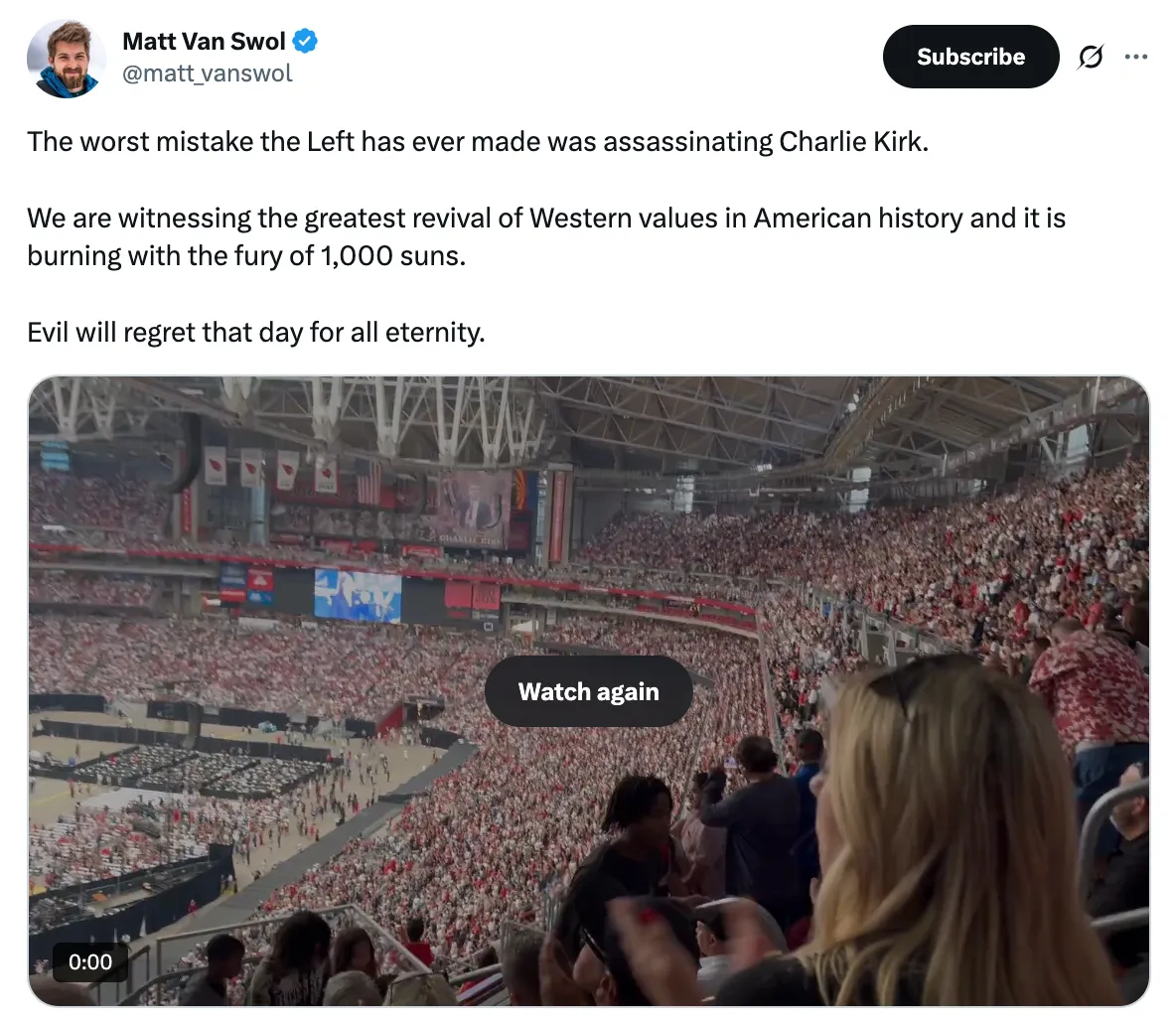
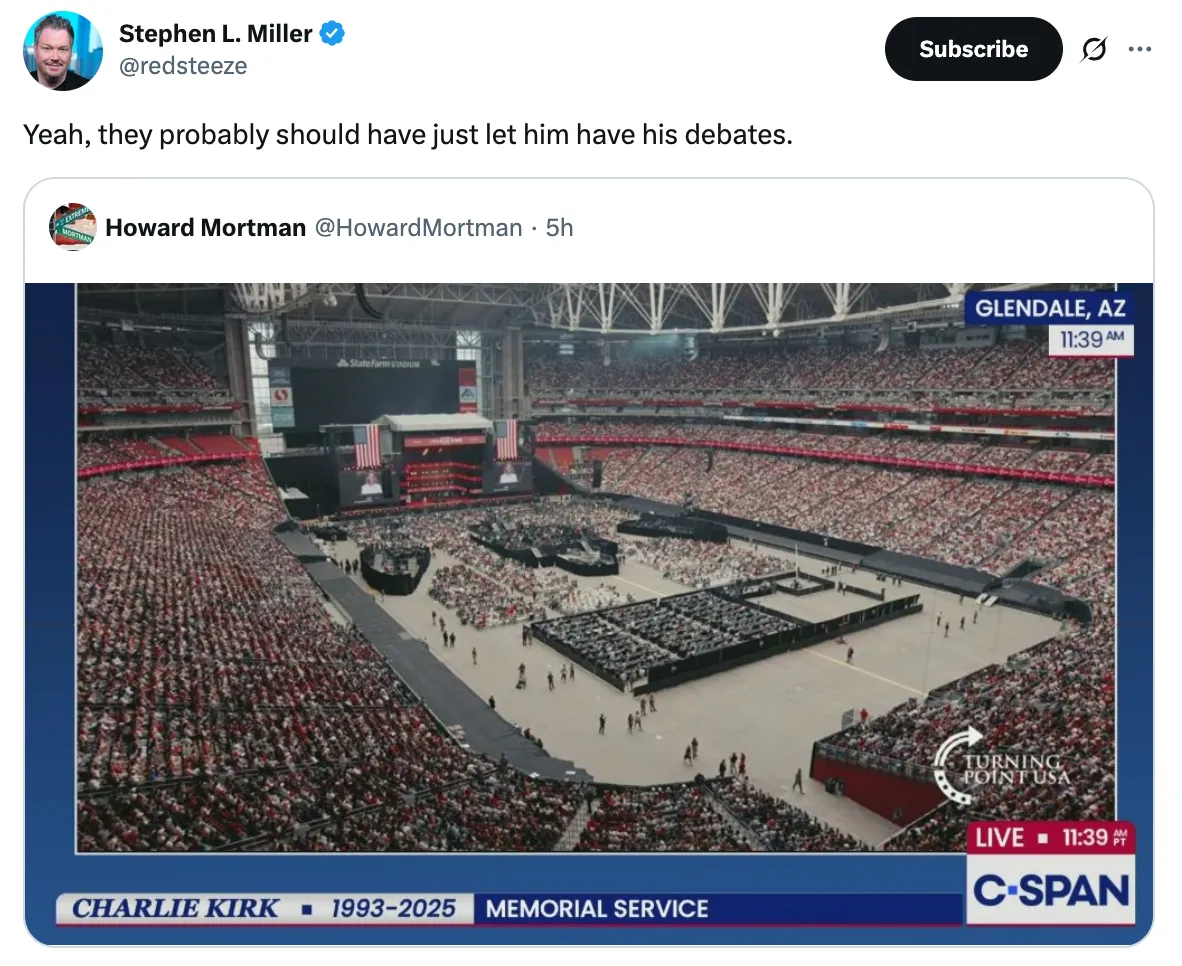
For all the fear of “Christian Nationalism,” a shallow, largely fictitious bogeyman for years, the murder of Charlie Kirk has effectively called it into being as a force.


(Ron Coleman, by the way, is an observant Jew.)
Trump couldn’t, and wouldn’t, have called Christian Nationalism into being himself. (Though, to be honest, it’s currently in a form FDR or Truman would have been comfortable with, if not Obama.) But Charlie Kirk’s murderer did. Christianity has historically advanced martyr by martyr. The way to kill Christianity is to ignore it. But the left can’t do that, of all things.
For one thing, leftism has the instinct to extirpate all potential rival power centers. And at a more fundamental level, since leftism was (to invoke Tolkien again) created in mockery of Christianity, as the Orcs were created in mockery of the Elves, there’s a fundamental hatred there that can’t be tamped down for long.
That hatred isn’t really returned by its objects. But if you get people’s attention, well, you may not like what comes next.


Why are they afraid? Erica Kirk today offered forgiveness.

Her full eulogy is here. On the other hand:

Forgiveness doesn’t mean avoidance of responsibility, or of consequences in this world.
But the real — and most hated — consequence won’t be FBI raids, and RICO prosecutions against the leftist groups that organize and finance terror, though those are likely to happen. It will likely be in another Great Awakening. There have already been signs of a religious revival among the young, both here and even in Europe. My University of Tennessee colleague Rosalind Hackett has been predicting for some time that the big religious force of the 21st Century is going to be militant Christianity, not militant Islam.
Tyler Robinson played a major part in helping to move that prediction closer to reality. I hope he reflects on that, in whatever time he has left.

“If you want the present to be different from the past, study the past.”
– Baruch Spinoza
I don't care what anyone says about Jimmy Kimmel. The man saved my life.
I had spent 6 weeks in a coma after a terrible accident. When a visitor to my hospital room turned on Jimmy Kimmel,
I had to get up and change the channel.— Clinton (@614clinton) September 23, 2025
CCL holder shoots, kills man trying to break into West Side apartment
CHICAGO (WGN) – A man was shot and killed by a concealed carry license holder while trying to break into a West Side apartment Saturday morning, according to Chicago police.
Sources close to the investigation said a 33-year-old man was kicking the back door of an apartment, threatening a woman and her children inside. The resident called police and a relative, a 28-year-old woman, who was able to get there quickly.
Police said the incident happened in the 3400 block of West Monroe Street just before 7 a.m. Saturday in East Garfield Park.
The man allegedly continued trying to get into the apartment, breaking a bedroom window and threatening to kill the family inside, sources told WGN-TV. The 28-year-old relative, who has a valid CCL, fired toward the man, hitting him multiple times.
According to police, the suspect in the attempted break-in was transported to Mt. Sinai Hospital, where he was pronounced dead. The CCL holder was taken to Area Four for questioning, and no charges have been announced.
Police said the incident appears to be domestic-related.
BUY THIS BOOK! READ THIS BOOK!!
TELL YOUR PASTOR TO READ THIS BOOK!!
IF YOU HAVE CHILDREN IN SCHOOL- and you have not yet gotten them out of that indoctrination center and started homeschooling them – TELL YOUR PRINCIPAL, SUPERINTENDENT AND SCHOOL BOARD TO READ THIS BOOK!!
First 30 Seconds: The Active Shooter Problem
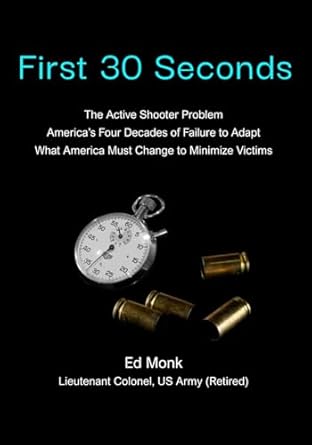
America has been failing for over 40 years at understanding, planning for, and responding to Active Shooter attacks. So, we continue to see attacks end in high victim-counts. America fails because we:
– do not base plans on TIME & MATH
– like plans that are easy to type, easy to drill, and do not “trigger” anyone
– recommend and adopt “best practices” that are not best
– adopt plans that work flawlessly every day there is no attack, but fail during attacks
– desperately want a non-violent solution to an extremely violent problem
– allow emotions and political agendas to distract us
The author served as an active-duty US Army officer for over 20 years. Throughout this career, planning to give and receive deadly violence was a common, required task. Ten days after his Army retirement, he began teaching public high school, where violence was never allowed, discussed, or planned for. He was STUNNED when school leaders told him the school’s planned response during an Active Shooter attack was to gather in groups and wait to see if the killer or cops got to you first.
This experience started his study of the Active Shooter problem. This book is about what he found.
Read Ed’s no-nonsense, blunt analysis of the Active Shooter problem. Using TIME & MATH analysis, he clearly shows the ONLY response that has a high expectation of minimizing victims in future attacks.
This is UNLIKE any discussion of the Active Shooter problem you have heard from any source. It disproves MANY long-held myths and assumptions, including that we should rely on RUN HIDE FIGHT, Lockdown Drills, and 911 response. It is a wake-up call for America, the “leaders” of our schools, churches, and businesses, and our elected officials.
America has failed at this for 40+ years. It’s time to end the failure.
“Ed Monk is today’s leading expert on thwarting mass murderers. His recommended strategy is by far the most effective, as proven in cases where the defenders did what Monk suggested.” — Massad Ayoob
September 23, 2025
Hakeem Jeffries threatens that a Democrat-led DOJ will to go after people working with Trump if Democrats regain power.
Then, in the same breath, says that Trump is destroying the credibility of the DOJ. pic.twitter.com/ekVYSC5Pz3
— Western Lensman (@WesternLensman) September 22, 2025

DOJ Takes Troubling Position in Second Amendment Case
The case Reese v. ATF challenges the prohibition on 18-to-20-year-olds from purchasing handguns. Victorious at the Fifth Circuit, they’re now working towards a final judgment at the district court level, but the Department of Justice has taken a position that’s not sitting well with Second Amendment advocates.
After the U.S. Fifth Circuit Court of Appeals delivered an opinion on Reese v. ATF, the case was remanded for final judgment to the District Court for the Western District of Louisiana. The circuit court concluded that “the Second Amendment includes eighteen-to-twenty-year-old individuals among ‘the people’ whose right to keep and bear arms is protected.” The plaintiffs filed an important brief on Friday in support of their proposed judgment.
The government ended up exhausting their timeline to appeal the case to the U.S. Supreme Court. When remanded back to district court, both the plaintiffs and the government filed proposed judgments because “a good faith attempt to reach agreement with Government” failed.
The plaintiffs are proposing the government be enjoined from enforcing prohibitions on the sale of handguns to all eighteen-to-twenty-year-old members. The government is requesting that the law be enjoined only “with respect to the identified and verified persons described” in the proposed judgment. In short, the government essentially wants the order to apply only to the individual plaintiffs, not every member of the associations who are part of the lawsuit, which include the Second Amendment Foundation, Firearms Policy Coalition, and Louisiana Shooting Association.
“The laws challenged in this case prevent 18-to-20-year-old adult Americans from acquiring handguns or handgun ammunition in the ordinary commercial market. The Fifth Circuit has held that those laws and their supporting regulations are unconstitutional under the Second Amendment,” the filing states. “And now the Government has taken the position that even so, Plaintiffs should be entitled only to illusory relief and the Government should be free to continue to enforce these unconstitutional restrictions against Plaintiffs’ affected members as though they never brought and won this suit.”
The 19-page brief goes on to explain why the final judgment should not give deference to the government by delivering what would amount to an as-applied opinion. Given the amount of time it takes to bring such cases to completion, many plaintiffs are mooted out by coming of age before there are any final judgments—something the government incorporated in their proposed order.
“What’s at stake now is the scope of the injunction–meaning, which young adults will be able to exercise their rights,” said Second Amendment Foundation’s Director of Legal Operations Bill Sack. “Although it chose not to appeal the Fifth Circuit’s ruling, it is now the ATF’s position that the scope of relief should be so narrow as to cover literally no one. That position is contrary to well-settled law. SAF sued on behalf of its members, and the relief SAF won in the Fifth Circuit flows to those very members. All SAF members should be covered by this injunction.”
“SAF’s victory in this case rightly applies to all of our members, and that is precisely what this brief makes clear,” said SAF founder and Executive Vice President Alan M. Gottlieb. “The government cannot continue to trounce on the Second Amendment rights of young adults by trying to avoid the practical effectiveness of an injunction mandated by a federal circuit court.”
The Firearms Policy Coalition had some harsh words for the Department of Justice. FPC said the government’s brief was full of “brazen arguments” and that “the DOJ is working to push all effective, cause-driven organizations … out of court altogether, and force people to pursue their rights through slow, complex, and expensive class-action lawsuits.” FPC alleges that these moves are all part of a new government ploy.
“The DOJ’s cynical scheme to undermine associational standing and relief for our members is nothing but an attempt to put constitutional accountability out of the reach of ordinary Americans,” Firearms Policy Coalition President Brandon Combs said in a statement. “The federal government, having lost on the merits, is now trying to rig the process. But we will not be deterred. While the government has placed FPC and our members in its crosshairs, we are proud to expose and oppose this dangerous strategy as we pursue a world of maximal liberty for all peaceable people.”
We’re allegedly living at a time when the most pro-Second Amendment administration is in power. The government yielding by allowing the clock to run out on appealing to the High Court certainly was a win, but not if in the next breath they’re saying that the relief the plaintiffs are seeking should be grossly limited. The Fifth Circuit was clear when it said that 18-to-20-year-olds are part of “the people,” there should be no further argument—yet here we are.