

August 23, 2025
Tennessee’s “intent to go armed” and “parks” statutes declared unconstitutional
On August 22, 2025, a three-judge panel (the “court”) in Tennessee declared Tennessee’s intent to go armed statute unconstitutional. The court also declared Tennessee’s statute that prohibits carrying firearms in parks to be unconstitutional.
Tennessee’s “intent to go armed” statute is contained in Tenn. Code Ann. § 39-17-1307(a)(1) which provides “A person commits an offense who carries, with the intent to go armed, a firearm or a club.” The statute makes it a criminal offense to carry any firearm at any time and at any place, including a person’s on property or in their own home, “with the intent to go armed.” Thus, an officer would have reasonable cause to believe a crime is being committed just by observing a person carry or wearing a firearm – even in their own yard. That reasonable cause justifies an officer in stopping, detaining, questioning, charging or arresting the individual for that crime. The statutes do provide certain affirmative defenses, such as the individual had a handgun permit or that they were in their own home, but those defenses do not shield the individual from being stopped, questioned or arrested. Indeed, Tennessee law currently puts the burden on the individual to raise and demonstrate those defenses at trial.
Recognizing the statute’s function, the court’s ruling stated “As such, the Going Armed Statute criminalizes conduct within the scope of the Second Amendment as discussed above. Such conduct is presumed to be constitutionally protected—in other words, this statute is presumed to
be unconstitutional—unless Defendants can demonstrate that regulation of carrying a weapon with the intent to go armed is within the historical tradition of this nation.”
Turning to the arguments by Defendants Gov. Lee and Attorney General Skrmetti, which the court rejected, the court stated “Defendants’ arguments to the contrary are unpersuasive because they make no defense of nor even address the constitutional infirmity at the heart of the statute—the criminalization of the constitutional right to bear arms. . . . Defendants do not satisfy their flipped burden under Bruen and have in no way demonstrated a plainly legitimate sweep for proscribing in toto, subject to narrow exceptions in subsequent subsections, the right to bear arms.”
In striking down the intent to go armed statute as violating both the 2nd Amendment and the Tennessee Constitution, the court concluded by stating “this Court holds that the Going Armed Statute violates the Second Amendment to the United States Constitution and therefore also violates Article I, Section 26 of the Tennessee Constitution. With respect to the Going Armed Statute, Plaintiffs’ Motion for Summary Judgment is hereby GRANTED….”
The Plaintiffs also asked the court to declare Tennessee’s “parks statute,” Tenn. Code Ann. § 39-17-1311(a), unconstitutional. That statute makes it a crime for individuals to carry weapons prohibited by Tenn. Code Ann. § 39-17-1302(a), a statute which Tennessee’s Attorney General asserts includes everyday handguns and other commonly owned firearms. The court, adopting much of its analysis regarding the intent to go armed statute, also found the parks statute to be unconstitutional.
In the effort to defend the park’s statute, the state (Attorney General Skrmetti’s office) had argued that Tennessee’s parks (including its greenways and recreational areas) were “sensitive places.” However, the court likewise rejected this argument by the defendants.
Finally, the Defendants asserted that should the court rule in favor of the Plaintiffs that the determination that these statutes are unconstitutional should be limited and protect only the Plaintiffs and not all Tennesseans. The court likewise rejected that request by the Defendants. Instead, the court stated “Plaintiffs here have vindicated their constitutional rights. No government official, or the public for that matter, has a legitimate interest in the enforcement of unconstitutional laws. Tennesseans that are not party to this action may unintentionally benefit from the protection of their constitutional rights, but no right of theirs could be prejudiced by the relief sought by Plaintiffs. Accordingly, we do not limit the scope of the declaratory relief sought by and now granted to Plaintiffs.”
This lawsuit was brought by three individuals who are members of Tennessee Firearms Association and in which Gun Owners of America and Gun Owners Foundation are organizational plaintiffs. All plaintiffs were represented by John Harris, who is also the executive director of the Tennessee Firearms Association. The defendants were Governor Bill Lee and Attorney General Jonathan Skrmetti in their respective official capacities in addition to several state commissioners, a district attorney and a sheriff.
Efforts by the Tennessee Firearms Association to repeal these statutes in the Legislature have been rejected repeatedly by the Republican controlled Tennessee Legislature. Those blockades were one of the motivations for bringing this court challenge.
ATF says concealed carry ‘puts everyone involved at risk’
When will the ATF’s civil rights violations end?
by Lee Williams
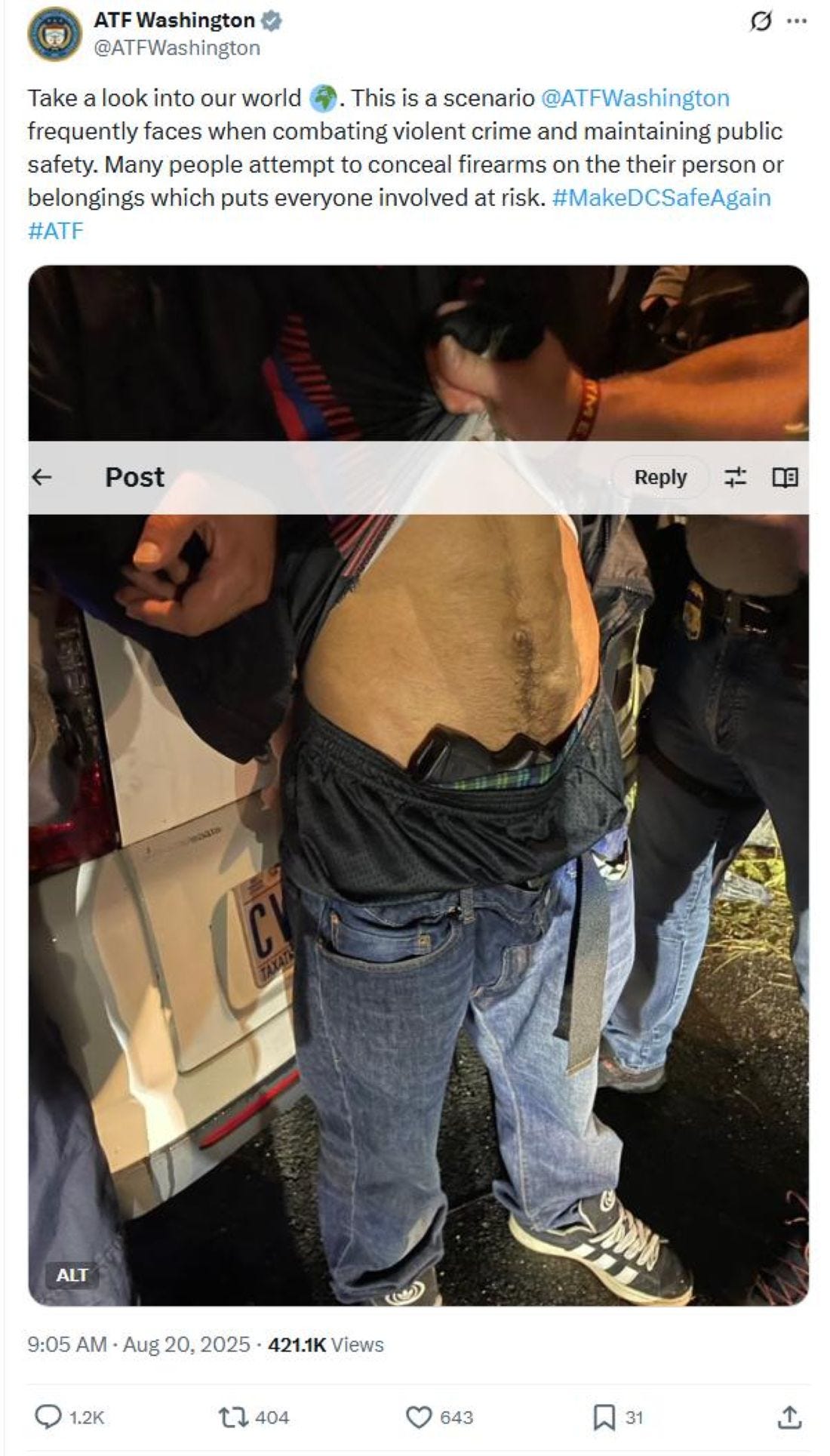
The millions of law-abiding Americans who have chosen to carry a concealed firearm are putting “everyone involved at risk,” the ATF announced this week in a post on X.
“Take a look into our world. This is a scenario @ATFWashington frequently faces when combatting violent crime and maintaining public safety. Many people attempt to conceal firearms on their person or belongings which puts everyone involved at risk. #MakeDCSafeAgain #ATF,” the ATF posted.
As you can imagine, ATF’s message received hundreds of overwhelmingly negative responses including many that are not fit to reprint.
“Concealed carry is not the issue—you are. Millions of law-abiding citizens carry concealed every single day without incident. Concealed carry saves lives. Disarming people and vilifying them on social media doesn’t,” Ammoland News posted.
Noted Second Amendment scholar and attorney Mark W. Smith asked a prominent Justice Department civil rights attorney in a post on X to “speak with the Washington ATF field office about the Second Amendment and the Bruen decision. I suspect their social media person lacks the relevant knowledge.”
Aiden Johnston, director of federal affairs for Gun Owners of America, tweeted “Try reading Heller, McDonald, Bruen, and the Second Amendment again, tyrants.” In his tweet, he added a picture of the Bruen decision.
The Firearms Policy Coalition tweeted simply: “Your existence puts everyone at risk. AMIRITE?”
“Times have changed. This isn’t 1934,” firearms trainer and author Ranjit Singh posted.
The ATF posted their tweet at 9:05 a.m., Thursday.
Twenty-seven hours and thirty-seven minutes later, the ATF “corrected” their post.
“EDIT-Take a look into our world. This is a scenario @ATF Washington frequently faces when combatting violent crime and maintaining public safety. Many CRIMINALS attempt to conceal firearms on their person or belongings which puts everyone involved at risk. #MakeDCSafeAgain,” the ATF posted.
Takeaways
Most gun owners will not buy ATF’s response, changing “Many people …” to “Many CRIMINALS …”
The reasons for this is simple: We all know too well that the ATF has never understood the massive difference between law-abiding gun owners and criminals.
To the ATF, everyone who owns a firearm is a criminal. This has become their modus operandi. They treat every single gun owner as a criminal.
If you need proof, look at the ATF’s recent history. Look at how they treated Patrick “Tate” Adamiak, Mark “Choppa” Manley, Russell Fincher or Brian Malinowski.
The ATF sent their SWAT teams to raid the homes of all four men, but not a single illegal item was found, even though Adamiak is serving a 20-year sentence for made-up crimes, and Malinowski was shot and killed in his home by ATF Agent Tyler Cowart.
That the ATF actually views concealed-carry as a crime is not a surprise. What is surprising is that no one has done anything about it, at least not yet.
It is definitely time for President Donald J. Trump to end the ATF.
Sheriff Jim’s latest
Owning a gun is only the beginning.
When Jeff Cooper was working on the lesson plans that have become the curriculum at Gunsite Academy, he developed the Combat Triad. These were three equal elements that combine to make us a harder target against criminal attack. They are Marksmanship, Gun Handling and Mindset. These are the three areas that give us the life-saving skills to overcome violent encounters.
Marksmanship begins with a person obtaining a defensive firearm that is compatible to his particular needs. We have to realize that accurate shooting is not a skill that we are born with. Rather, it comes from getting training to develop the necessary skills and then continual practice to keep those skills fresh. In short, we have to learn to hit targets at various distances and to do so as accurately as possible. A friend of mine said that we have to remember that there is a lawyer attached to every bullet that we fire. In other words there are a lot of reasons that it is important to develop the skill level that allows you to hit your target and not endanger non-combatants.
Gun handling first requires us to learn to handle our defensive handgun safely at all times; see the above comment about a lawyer attached to every bullet that we fire. Beyond that, we must learn to make a fast draw stroke, find our sights and get on target quickly. But gun handling also involves learning quick reloading and effectively dealing with any malfunction that is characteristic of the chosen firearm. Different guns may be run differently and maintained differently; it is up to the user to know these things about his chosen defensive tool.
Mindset has to do with spotting trouble and knowing effective ways to deal with it. The best pistol shot that you know of is in trouble if he doesn’t understand how to recognize a serious problem and have a plan for dealing with that problem. If I see the potential criminals while they are still a ways down the street, I am keeping an eye on them and have already spotted close cover options and several exits, I am way ahead of the game. Mindset consists of alertness, ways to avoid trouble and ways to deal with it effectively if it is forced upon us. Through mindset we learn to use the skills developed in marksmanship and gun handling to their greatest advantage.
We need to continually remind ourselves that this whole process is not a “one and done” kind of deal. Instead, it is an ongoing education and ongoing practice deal. What we were taught or what we could do 20 years ago is really of little value if we haven’t kept up with our training and practice. So it is important to continually think of our defensive skills in terms of the combat triad. Marksmanship, Gun Handling and Mindset – the recipe for survival.
Federal Judge Issues Permanent Injunction on California’s Ban on Non-Resident Carry
The Firearms Policy Coalition is hailing a federal judge’s permanent injunction against the state’s ban on non-resident carry, which allows FPC members to file an application for a permit to carry in any of the state’s 58 counties.
U.S. District Judge Cathy Ann Bencivengo issued the permanent injunction on Thursday, several weeks after she concluded that the state’s ban on non-resident carry was unconstitutional.
Defendant Attorney General Rob Bonta; Defendant’s officers, agents, servants, employees, and attorneys; and any other persons who are in active concert or participation with Defendant, are hereby permanently enjoined from enforcing California Penal Code sections 26150(a)(3) and 26155(a)(3) as to CCW applications submitted by Plaintiff Firearms Policy Coalition’s members who are not residents of California, including the named Individual Plaintiffs.
That’s pretty simple and succinct. And as FPC notes, that’s also pretty much the exact opposite of what Bonta was asking for.
In a statement, FPC elaborated on Bonta’s request.
The State of California had asked the Court to issue a complex injunction requiring applicants to submit a sworn statement declaring intent to carry in a specific county within the next 12 months and limiting applications to that county — along with five pages of additional conditions and qualifications. But the Court agreed with FPC, which asked the Court to enter a straightforward injunction simply blocking enforcement of the ban altogether.
“People do not lose their right to keep and bear arms when they visit California. With this injunction, they can finally protect themselves and their families while in the Golden State,” said FPC President Brandon Combs.
FPC members will be able to apply in whatever county they wish, without having to provide any sort of sworn statement or notarized declaration of intent, which is exactly how it should be. California residents may be forced to apply for a carry permit in the county where they live, but it makes no sense for non-residents to be funneled into one particular county… particularly given the lengthy wait times and excessive fees that are found in some of the state’s most populated counties.
Appeals Court Backs Florida Medical Marijuana Patients in Gun Rights Battle
Atlanta, GA – A federal appeals court has delivered a major win for medical marijuana patients and gun rights advocates, ruling that the federal government cannot automatically strip gun rights from Floridians who legally use cannabis for medical reasons.
The Ruling
On Wednesday, a three-judge panel of the 11th U.S. Circuit Court of Appeals rejected the government’s argument that medical marijuana patients should be treated like drug addicts or dangerous individuals. Writing for the panel, Judge Elizabeth Branch stated:
“When viewed in the light most favorable to the plaintiffs, the allegations in the operative complaint do not lead to the inference that the plaintiffs are comparatively similar to either felons or dangerous individuals—the two historical analogues the Federal Government offers in its attempt to meet its burden”.
Branch emphasized that plaintiffs Vera Cooper and Nicole Hansell, who disclosed their medical marijuana use on federal gun purchase forms, “cannot fairly be labeled as dangerous people solely due to their medicinal marijuana use”.
The court concluded:
“Appellants cannot be considered relevantly similar to either felons or dangerous individuals based solely on their medical marijuana use. Accordingly, the Federal Government has failed, at the motion to dismiss stage, to establish that disarming Appellants is consistent with this Nation’s history and tradition of firearm regulation”.
The ruling vacated a lower court dismissal and sent the case back for further proceedings.


To all those yammering for gun confiscation:
Go get the guns from the criminals first. You know, like a test run.
August 22, 2025
The NRA’s Plan to Become More Effective
For a long time, the National Rifle Association was the 800-pound gorilla in the gun rights movement. While they were never alone in the fight for the Second Amendment, they were the big guns.
Recent years have seen the NRA lose a little something. Wayne LaPierre’s shady moves, coupled with legal issues, forced the NRA to take a step back and defend itself to such a degree that it almost seemed at times like they weren’t doing anything for gun rights.
I know that they were, mind you, but not like they had been.
So, when I saw the president of the NRA decided to talk about making the organization more effective, I thought it was something we should talk about.
Your new NRA leadership team is making great progress in reimagining the National Rifle Association and actively building a foundation and vision to carry us into the next 150 years.
Gun owners—and all American citizens—need a strong NRA. No other organization can do what the NRA does for our members, gun owners, the nation and the free world. Our strength comes from our membership, volunteers, donors, supporters, volunteer Board of Directors, great staff and outstanding leadership teams. Add incredible programs and our decades of successful Second Amendment advocacy, and time and time again, the NRA has held strong by putting freedom first.
NRA has two primary leadership positions: the Executive Vice President/Chief Executive Officer (Doug Hamlin), who oversees the day-to-day operations of the association, and the President, who presides over the Board of Directors and handles related functions.
…
This year for the first time, your officers collected additional background information on our Board members and used those details of members’ knowledge, experience and passion to help in assigning committee appointments. We then applied a test to gauge their past integrity and abeyance of the New York non-profit responsibilities of duty of obedience, duty of loyalty and fiduciary responsibility toward committee assignments.
Also, this year the officers recruited 110 general NRA members, based on their specific knowledge and expertise, to serve as non-Board members on various committees, which will increase the committees’ overall effectiveness.
Additionally, for the first time in decades, your new officers are fundamentally changing how the Board operates. We are adopting a comprehensive new leadership paradigm for the Board to become more engaged in formulating the policies for the coming years. A few committees have been structurally consolidated, while others are coordinating joint meetings to create synergy and reduce cost. I’m also holding virtual town-hall Board member meetings to keep the Board engaged and up to date between regularly scheduled meetings. The governance committees are now holding monthly meetings to provide proper fiduciary oversight. Leadership also just held the Board’s first-ever committee chairman retreat in early August at the chairmen’s own expense. Your officers communicate with the NRA EVP weekly and visit NRA headquarters in Fairfax, Va., several times each month.
Now, let’s understand that this is mostly inside baseball stuff, but on the same token, they’re also promising steps. If the internal organization isn’t working correctly, the organization can’t be as effective as it should be.
I’m mostly baffled that there was never really an attempt to collect background information on board members so they could be utilized in the best possible ways.
Also, seeking out non-board members with specific areas of expertise is another wise decision, as there are those who aren’t interested in running for election to be board members but who would like to help and have relevant skillsets that can be brought to bear on various issues.
While this doesn’t look like much to many people, I’m sure, the truth is that I see these as promising developments.
The NRA took it on the chin, and not just from the state of New York. A lot of gun rights supporters lost trust in the NRA because of what all LaPierre did with the organization’s money, and what they saw as a failure to defend our right to keep and bear arms sufficiently.
However, what’s quoted above, plus the interactions I had with NRA officials at the annual meeting in Atlanta earlier this year, all indicate that the people who remain have no interest in any such thing happening again. They want to protect our gun rights and will work toward that end, not personal enrichment. They want safeguards put in place so that it never happens again.
These are all great signs.
Yet I’ll also acknowledge that the proof is in the pudding. We need to see action beyond some internal changes that might look good, but are meaningless if nothing happens outwardly to advance the NRA’s mission.
Petro Opposes Right to Carry Guns in Colombia
Colombia’s President Gustavo Petro spoke yesterday during a Cabinet meeting about the ongoing debate over the right to carry guns among civilians. Petro repeated what he has previously stated on other occasions, expressing his support for keeping weapons solely in the hands of public security forces and not in civilian possession.
This is a recurring debate during election periods in Colombia, a country where violence is cyclical and the notion of self-defense resurfaces in political campaigns. While the conservative opposition makes legal gun ownership one of its key banners, the ruling party maintains that the state should monopolize the use of force, arguing that arming the population only fuels the cycle of violence.
Petro calls for a gun-free civilian population
During a Cabinet meeting held Yesterday, Tuesday, Aug. 19, Petro weighed in on the debate over the right to carry guns in Colombia. The President stressed the need to move toward a country where civilians are unarmed. In his remarks, he pointed out that Colombia must remain consistent with the principle that weapons should be monopolized by the state and not by private citizens.

The Constitution is a written instrument. As such, its meaning does not alter. That which it meant when it was adopted, it means now. —
SOUTH CAROLINA v. US, 1905
August 21, 2025
92 Ohio school districts now allow staff to carry blasters
Ohio has been doing this since 2022, a year that saw 22 school districts arm their staffs after the passage of a new law allowing the practice. Fast-forward to 2025 and that number is 92.
The main argument for arming these teachers is that in rural areas like Eastern Ohio where Benjamin Logan Local School District is located, it takes too long (about 10-15 minutes) for police to arrive during an active shooter situation. With armed staff, this isn’t as much of a problem.
These armed staff members are required to take basic firearms training before they can carry in school.
Believe it or not, 30 states allow school staff to carry firearms.
From Newsweek:


Here’s what the comments look like on Twitter when it comes to the above report on Benjamin Logan:

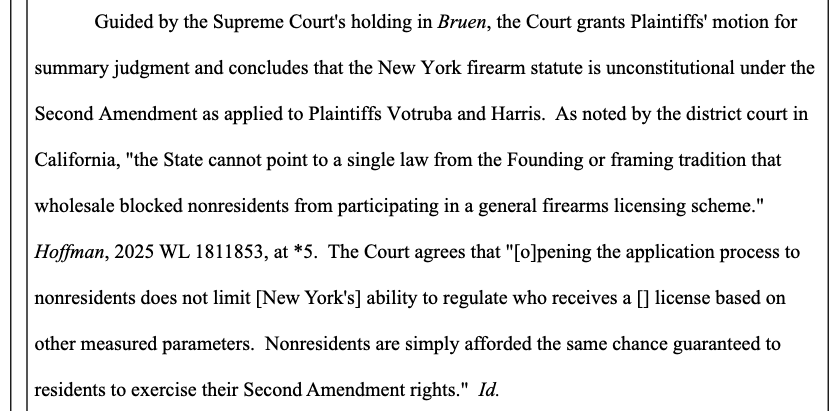
LEGAL ALERT: A New York federal judge has ruled that the state’s non-resident carry ban violates the Second Amendment. https://t.co/RRJzOx8VsV pic.twitter.com/EnEXCjFbuz
— Firearms Policy Coalition (@gunpolicy) August 20, 2025


Allowing riflery training while decrying gun violence doesn’t send a mixed message any more than does supporting a wrestling team while opposing schoolyard brawls.
— a CHICAGO TRIBUNE editorial 1999
August 20, 2025