


May 14, 2026
FDA Doctors Linked Child Deaths to COVID Vaccines – Biden Admin Stayed Silent
While the Biden administration was telling parents the COVID vaccines were safe for their children, its own FDA doctors were quietly reviewing files on 96 dead kids and concluding that some of them had probably been killed by the shots.
They wrote it up. They classified it as new safety information under federal law. And they never told the public.
Sen. Ron Johnson (R-WI) released the records this week, referenced in a May 11, 2026, letter directed to Health and Human Services Secretary Robert F. Kennedy Jr. Investigative journalist Catherine Herridge was first to report them.
“The key document is a December 5, 2025, FDA memorandum. It covers 96 pediatric deaths following COVID-19 vaccination reported to VAERS, the Vaccine Adverse Event Reporting System, a federal database where patients and doctors report side effects following vaccination. FDA medical officers reviewed every case, including autopsy reports, death certificates, and medical records, and classified seven as “possibly” or “probably” related to the vaccine. Five of those seven deaths involved myocarditis.
The agency concluded those fatal cases constituted “new safety information” under federal law, information that was never added to the vaccine’s warning label. Not while the Biden administration was mandating the shots. Not while it was pressuring parents. Not while it was dismissing anyone who raised concerns as an anti-vaxxer.
The children were mostly boys. Median age: 13. Age range: 7 to 16. Every death occurred between 2021 and 2022, the height of the government’s vaccination campaign targeting children. All seven probable and possible cases involved the Pfizer-BioNTech vaccine. These were not statistics. These were children with autopsy reports and death certificates that FDA doctors reviewed, flagged, and quietly shelved.
Those 96 deaths are almost certainly a fraction of the real toll. An HHS-commissioned Harvard study found that fewer than one percent of vaccine adverse events are ever reported to VAERS. As of March 2026, VAERS is reporting 39,077 deaths worldwide following COVID-19 vaccination. The FDA memo itself does not extrapolate from that figure, but the systematic underreporting it acknowledges means the true scope of pediatric harm may never be fully known.
The underreporting was only part of the problem. The system was also deliberately broken.
Why Does Capital One Consider Lawful Gun Sales to be a ‘Prohibited Industry’?
Capital One, the corporate banking giant, has an advertising tagline that asks, “What’s in your wallet?” For one Maryland gun shop, the answer to that question appears to be a banking giant that ignores a White House executive order and dismisses Treasury Department regulations that forbid banking discrimination.
Capital One Financial Corporation has been in business since 1994 and the McLean, Va., international banking giant with over $475 billion in assets boasts that it offers credit cards, auto loans, checking and savings accounts and commercial banking services. That is, unless the customer happens to be a firearm retailer.
Just ask Jonathan Bennett, owner of United Gun Shop in Rockville, Md. Bennett tried using Capital One’s payment platform, administered by Melio Payments, for business and billing transactions. The firearm retailer had previously used the payment platform without issue. That changed on April 11, 2025, when Bennett met with Capital One after services were cancelled without notice. That cost Bennett’s business $75,000 in damages and disrupted services.

According to reporting by The Daily Wire, Bennett was surprised to learn that his business — legally selling firearms to law-abiding citizens — was considered to be in a “prohibited industry” by the big bank.
Bennett’s not rolling over on the illegal de-banking. He’s making Capital One and Melio Payments answer in court. His lawsuit alleges the two banking service providers blocked United Gun Shop from “making future payments” before disabling the business from completing payment transactions.
Lord give me the confidence of Giffords being wrong about every prior prediction they've made, and yet still making more predictions https://t.co/kxyop9O2Dq
— Kostas Moros (@MorosKostas) May 13, 2026

Good Guy with Gun Helped Stop Cambridge Shooter
A former Marine “who was legally carrying a gun” helped Massachusetts State Police stop and apprehend a man shooting at cars in Cambridge, Massachusetts, on Monday, according to Police1.
Breitbart News reported that the alleged attacker, 46-year-old Tyler Brown, opened fire on cars on Cambridge’s Memorial Drive around 1:30 p.m. CBS News noted that Brown was allegedly shooting at “passing cars” before being shot numerous times by a Massachusetts State Trooper.
On Tuesday, WHAS 11 pointed out that the officer did not act alone. They noted, “A State Trooper and a Marine veteran were nearby, jumping into action and shooting the suspect.”
NBC 10 observed that a witness said the former Marine came to her car at some point during the ordeal and shielded her so she could escape.
The witness said, “A man came, went around his car and pulled open my car door and made like a barricade. He had a gun and he told me to run, and I ran and then I just ran as fast as I could.”
Two individuals suffered life-threatening wounds from Monday’s attack.
Grassroots Judicial Report—May 13, 2026
By Tanya Metaksa
What’s New —SCOTUS—Patrick Tate Adamiak v. United States of America: Docket No. 25‑1190: Current certiorari petition before U.S. Supreme Court; Fourth Circuit’s ruling: The Fourth Circuit issued an unpublished per curiam opinion in United States v. Patrick Adamiak, No. 23‑4451 (4th Cir. 2025): U.S. District Court: Hawaii: Ninth District (United States District Court for the District of Hawaii); Justin Arnold, Bryan Garland, James Grell, Andrew White v. Hawaii County, non-residents can apply for Right-to-Carry permit in Hawaii.
SCOTUS
The U.S. Supreme Court meets on Thursday, May 14, to discuss cases. All 5 Second Amendment cases that have been relisted many times are on the list. Decisions will be announced on Monday, May 18, 2026.

Today the taxing power, rather than chattel slavery, is the instrument by which the parasitical element of the population subsists. And that element, which includes politicians, panics at the slightest reduction in the state’s power to plunder. Once you start liberating taxpayers, even a little tiny bit, nobody knows where it may end. —Joseph Sobran
May 13, 2026
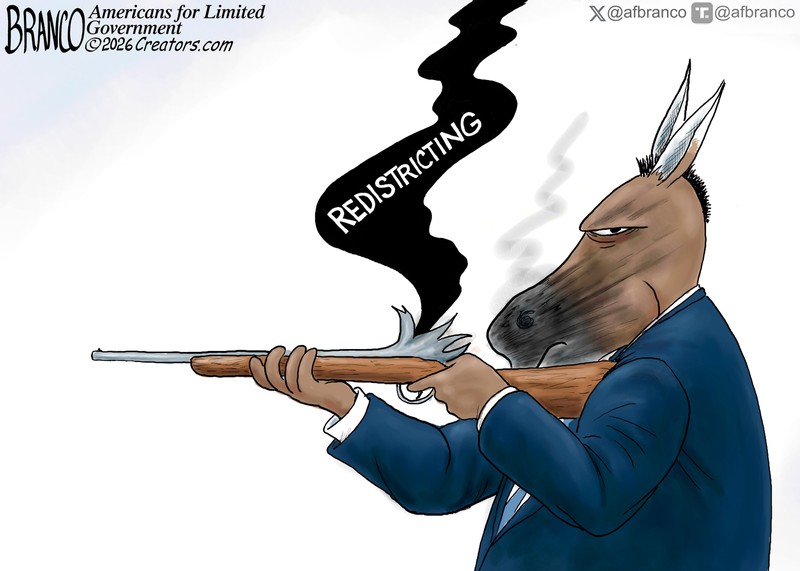
Missouri High Court Smacks Down Redistricting Challenge – and Referendum End Run
We’ve got some big news out of the Show-Me State on Tuesday with Missouri’s Supreme Court ruling in not one, but two redistricting-related cases — in both instances issuing a decision that effectively locks in place the 7R-1D map (pursuant to HB 1, passed by the state legislature in September 2025) for the 2026 midterm elections, constituting a pickup of one seat for Republicans.
The Missouri Supreme Court rules the new 7R-1D map doesn’t violate the state constitution and will be in place for the 2026 midterms. pic.twitter.com/2NZFLP4PLk
— Politics & Poll Tracker 📡 (@PollTracker2024) May 12, 2026
The court heard oral argument in both cases on Tuesday morning and issued unanimous decisions in both cases on Tuesday afternoon, making it clear that courts are not political map-drawing commissions — and that referendum activists don’t get to suspend laws merely by dropping boxes of signatures at the secretary of state’s office.
Here’s what was decided today:
First, in the consolidated cases of Healey v. Missouri and Wise v. Missouri, the challengers sought to have the 2025 map declared unconstitutional on the basis that it violated the compactness requirement of Article III, Section 45 of the state’s constitution. Specifically, they contended that the new configuration of the state’s 4th, 5th, and 6th Districts (in and around the Kansas City area) violates the requirement.
Old map for comparison: https://t.co/M6xgfaftyR pic.twitter.com/NFIWZljjCP
— Susie Moore ⚾️🌻🐶 (@SmoosieQ) May 12, 2026
But as the court notes in its decision:
The map “is assumed to be constitutional and will not be held unconstitutional unless the plaintiff proves that it clearly and undoubtedly contravenes the constitution.”
The Democrats have been screaming that Jim Crow is back! Just to test it out, I went outside to see if I now have less rights as a black man. I started humming a negro spiritual and set out on my way.
Got on a bus. Sat in front. No one said anything to me. Took it one stop and then did the walk of shame back to my truck.
Went to a restaurant. Sat at the counter. The nice man behind it asked me if I wanted a menu. I informed him this was just a test and he passed. The look of confusion on his face let me know the Democrats hadn’t informed him I can’t sit at restaurant counters.
Looked for separate bathrooms and water fountains. Couldn’t find a single one. Got immediate side eye from an older black woman when I asked her if she’d noticed any separate water fountains or bathrooms. Her answer wasn’t Christian.
Tried looking for a freedom march so I could join it and see if I’d get hosed or dogs turned on me. No marches. I did see someone with a Pomeranian dog, though, but it didn’t attack me.
So… based on my evidence, Jim Crow is still dead. The Democrats lied.
BLUF
There will be no peace in Gaza or Israel until Hamas is no longer a factor.
This Is the Face of Evil: Sickening New October 7 Report Leaves No Doubt
Most people can’t really understand evil.
Evil is a word too many people toss around far too casually. Too many people use it to describe political opinions they disagree with, for instance, especially in today’s toxic political environment. But once in a while, we have real evil thrust into our faces, and we are required to look at it, to comprehend it, and to deal with it. One such event happened right here in the United States, on September 11th, 2001. And another took place in Israel, on October 7th, 2023.
Now, a new report has been released detailing the atrocities Hamas committed on October 7th, 2023, and we are once more forced to look at it, to understand what happened, to look into the face of evil, and to understand what must be done about it.
Warning: This report presents those atrocities in disturbing detail.
Among the mutilated and butchered bodies of young women slaughtered on October 7, it was their colourful, polished nails that many of the morgue staff remember.
Bright, beautiful, shiny, pink manicures glistening amid the pervasive ‘grey and green’ of death were often the only reminder of who these girls had been just hours earlier.
Because Hamas-led terrorists had not just executed these women. They had ‘deliberately and systematically’ defiled them, as the most comprehensive account of the atrocity released by The Civil Commission today shows.
The terrorists shot their eyes, their faces and their breasts, and even targeted their most intimate parts, to destroy their beauty and rob their loved ones of a final goodbye.
Women were stripped, bound, stabbed, shot and burned. They were executed both during and after rape amid an orgy of violence in which 1,200 people were killed and 250 taken hostage.
Heads were decapitated. Pelvic bones shattered. Even after death, sexual assault continued.
There’s a great deal more in the Daily Mail’s coverage. While I will not reproduce the worst of it here, it’s important reading nonetheless. Have some antacid on hand before reading the entire piece; you’ll need it.
This image alone, this image of young people, mostly young women, fleeing a music festival, speaks volumes; the look of terror on the faces of young people who, moments before, were enjoying sunshine, music, the company of friends, young people who had nothing to do with Gaza, who had never raised a finger in anger against anyone in Gaza or anywhere else.
This is the result of evil. The atrocities committed on the day were evil. The people who committed them are evil, and in the acts described, they show that they have utterly abandoned their humanity. They attacked the innocent: Men, women, children, infants, the elderly, the unarmed and defenseless. They did this, they planned and conducted this attack targeting the innocent, because they are not only evil but cowards.
In the weeks following this attack, we saw the Israeli Defense Forces (IDF) counterattacking in Gaza. It’s difficult for us to imagine the rage that must have filled the hearts of the young men of Israel who went into Gaza to hunt down the monsters of 10/7. It’s even more difficult to understand how the IDF showed the restraint they did, carefully evacuating non-combatants, using “roof knocker” explosives to warn anyone in a building that was about to be dropped. But Israel did this because they are not evil, protestations from useful idiots on the American left notwithstanding. Israel did this because they are a civilized people, and even when dealing with savages, they showed restraint.
Evil is real. It’s out there, every day. To fight it, we have to first strip away all of our illusions; we have to look at evil, bare, shocking, unmitigated, real, and see it for what it is. In Gaza, it’s called Hamas. This full report illustrates that evil with sickening clarity.
As I said at the time and still say today: There will be no peace in Gaza or Israel until Hamas is no longer a factor.
Massachusetts Gun Laws No Match for Repeat, Violent Felon Who Targeted Boston-Area Drivers
It’s not easy to own a gun in Massachusetts, at least not legally. If you don’t mind breaking the law, though, it’s absurdly simple: steal a gun, buy a gun on the black market, have someone else buy a gun for you, or build your own, to name a few options.
Authorities still haven’t said how 46-year-old Tyler Brown got ahold of the gun he used to randomly fire at motorists on Cambridge’s busy Memorial Drive on Monday afternoon, but he did in clear violation of Massachusetts gun laws… and was aided by one of the state’s soft-on-crime judges.
Five years ago, Brown copped a plea deal after he engaged in a similar random shooting spree, firing more than a dozen rounds at responding officers. Brown was already on probation for a 2014 assault and batter with a dangerous weapon charge, and ended up pleading guilty to a number of charges for the 2020 shooting; including armed assault with intent to murder.
Despite his violent past and present, a judge sentenced Brown to just five-to-six years in prison. That’s about half the time prosecutors were asking for.
One of the officers involved in that 2020 attack wrote in a victim impact statement saying: “I am a firm believer that when Mr. Tyler Brown gets out, he will hurt, or worse, kill someone,” the officer said. “Probation apparently means nothing to Mr. Tyler Brown, nor does the value of life.”
Brown was still on probation when he opened fire at motorists on Monday, leading drivers to ditch their vehicles as they ran to find cover.
Gunman Tyler Brown allegedly fired 50 to 60 rounds indiscriminately from an assault-style rifle as he erratically walked down Memorial Drive in Cambridge around 1:20 p.m., Middlesex County District Attorney Marian Ryan said during a press conference.
At 1:06 p.m., Cambridge police received a 911 call from Boston police, who said an individual acting erratically and in possession of a rifle was in Cambridge, Ryan said.
Massachusetts State Police and Cambridge police arrived as Brown was actively firing down the road at stopped cars, authorities said.
According to Ryan, a Massachusetts State Police trooper was the first law enforcement officer to respond, and he was aided by an armed citizen; a yet-to-be-identified Marine who the D.A. says was licensed to carry a gun. The pair engaged Brown, who had already shot two people by that point, and were able to stop his attack with multiple shots of their own.
That’s right. None of the state’s draconian gun laws prevented this crime, but an armed citizen was able to stop it thanks to the fact that they were exercising their right to carry.
This should be a wakeup call to Massachusetts residents, if not the Democrat lawmakers who have complete control over the state legislature. Voters were promised that the state’s recent overhaul of its gun laws (which include brand new restrictions on “assault weapons,” new training mandates for would-be gun owners, and a host of restrictions on the right to keep and bear arms) would prevent incidents like this from ever taking place. Instead, we saw just how impotent those laws are when it comes to violent offenders… and the importance of being able to shoot back when a murderous madman is intent on gunning down innocent victims.
The Anti-gun movement’s goal is total civilian disarmament. They don’t care about your rights, they ignore the thousands to hundreds of thousands of people who use firearms to save their lives each year. 90% of “gun deaths” are suicide & gang violence that legislation won’t affect. – Tony Simon
Can our form of government, our system of justice, survive if one can be denied a freedom because he might abuse it?
— HARLON CARTER
May 12, 2026
