

DOJ Warns Virginia It Will Sue Over AR-15 Ban, Gun Control Bills
For years, gun owners have watched blue-state politicians pass one unconstitutional restriction after another while the federal government mostly stood on the sidelines. That may be changing.
In a April 10, 2026, letter to Virginia Governor Abigail Spanberger, Assistant Attorney General Harmeet K. Dhillon put the Commonwealth on formal notice: if Virginia enacts a slate of anti-gun bills now sitting on the governor’s desk, the U.S. Department of Justice Civil Rights Division is prepared to sue.
That is the federal government warning a state executive, in writing, that certain proposed gun-control measures appear to violate the Second Amendment and will trigger litigation if signed into law.
The biggest target named in the letter is SB 749, which DOJ says would force Virginia law enforcement agencies to participate in “a practice of unconstitutionally restricting the making, buying, or selling of AR-15s and many other semi-automatic firearms in common use.”

For some reason I’m thinking a country that kills its own citizens by the thousands for defying them & screams “Death to America” may not possess the ability to “Negotiate in good faith”. Excuse me for my lack of optimism
April 11, 2026

Interesting point of view.
The Virginia Democrats’ gun legislation is reactionary, not progressive
The United States is an empire, with the most powerful military in the world. It’s also one of only two nations in the world with the right to bear arms enshrined in its founding legal documents, the other being Guatemala. The Second Amendment is considered by many to be the amendment that safeguards all other rights.
Nevertheless, many people have seen the Second Amendment as harmful due to the presence of powerful firearms, such as semi-automatics, in the hands of U.S. civilians. They point to tragedies, especially mass shootings, as justification for regulating firearms.
They see the “well-regulated militia” statement as a caveat that limits what firearms we can possess, claiming that “weapons of war” shouldn’t be in the hands of civilians. They see those who believe in these so-called weapons of war being in the hands of civilians as inherently taking a normatively right-wing standpoint.
For the sake of testing this argument, we can acknowledge that the right to bear arms shouldn’t be infringed only within the context of where there’s a well-regulated militia in the context of the necessity of the security of a free state. In that case, we must also understand what follows if we investigate the premise that the state itself has refused to self-regulate. When the state refuses to self-regulate, we can come to the conclusion that the civilian populace being armed to counter the unregulated militia becomes, in a sense, the regulation of the unregulated militia.
To those who call themselves progressive and also call themselves pro-gun control or pro-gun ban, I ask you to consider your thought process. Is the U.S. government a well-regulated militia when it’s enabling Israel’s genocide in Gaza? Is it a well-regulated militia when it’s engaging in wars to further the longstanding goals of American imperialism that benefit the richest and most powerful, such as in the 2003 invasion of Iraq and the current war in Iran? Is the U.S. government a well-regulated militia when it violates Americans’ constitutional rights, prioritizes corporate interests and targets people based on race?
To me, the answer is no, in all of these cases. Nevertheless, gun-control advocates seem to believe that the government and military is more entitled than the civilian populace, which does not engage in these acts. The irony, to me, is that many within the gun-control advocacy sphere also happen to oppose at least one or more of the aforementioned operations. I join them in opposition to these actions, but I find their belief in disarming the populace to be self-defeating.
Gun Rights Orgs Align Behind Harmeet Dhillon to Replace Pam Bondi as Attorney General
With Pam Bondi out as Attorney General, no-compromise gun rights groups are already making their preference crystal clear: Harmeet Dhillon is the choice. And unlike the usual political jockeying in Washington, this push isn’t coming from establishment insiders, it’s coming from grassroots organizations that have spent years fighting the gun confiscation agenda head-on.
Bondi’s Exit Opens the Door for Real Change
For many gun owners, Bondi’s tenure represented a familiar frustration. While running the Department of Justice, her record was seen as a mixed bag at best, with lingering defenses of federal gun control policies and a lack of urgency in dismantling the anti-gun bureaucracy embedded throughout DOJ. That’s why her removal is being viewed not as a setback, but as a long-overdue opportunity.
Why Harmeet Dhillon Is the Clear Upgrade
Harmeet Dhillon represents something very different. She has built a reputation as a legal fighter who . . .
- Treats the Second Amendment as a civil right
- Has taken on anti-gun policies in court
- Has helped shift DOJ toward going on offense, not just playing defense
Gun rights groups like the National Association for Gun Rights and Texas Gun Rights are rallying behind her because they see someone who won’t manage decline, but will actively push to restore rights.
A Legal Team Already Aligned
Dhillon’s potential elevation wouldn’t happen in a vacuum. White House Chief Counsel Dave Warrington and Harmeet Dhillon both left Dhillon Law to join the Trump administration at the same time, signaling a coordinated effort to place strong constitutional attorneys in key roles.
Barry Arrington, former Chairman of the Texas Gun Rights Board, recently stepped down to join the DOJ’s Second Amendment Section. These aren’t isolated moves. They’re part of a broader shift — one that suggests the executive branch is finally beginning to take the Second Amendment seriously at a structural level.
Not a Silver Bullet, But a Major Step Forward
At the same time, gun rights leaders are making it clear: replacing the Attorney General alone isn’t a silver bullet. The Department of Justice is still packed with layers of the entrenched bureaucracy, thousands of anti-gun holdovers, and institutional resistance to reform
But here’s the difference: Harmeet Dhillon has already been working to dismantle that system from within. And if she moves up, whoever steps into her current role in the Civil Rights Division would be positioned to continue that work — potentially with fewer obstacles.
Texas Gun Rights President Chris McNutt didn’t mince words:
Gun owners don’t need another Attorney General who’s going to ‘manage’ the Second Amendment’s decline. We need a proven fighter, and that’s exactly what Harmeet Dhillon has been inside the DOJ. President Trump has a real opportunity here to appoint someone who will take the fight directly to the gun confiscation agenda and start cleaning house.
The Push Is On
With momentum building, groups like NAGR and TXGR are actively encouraging President Trump to make the call. Because for gun owners who have watched too many “Republicans” fall short, this moment is about more than just filling a position.
It’s about whether the Department of Justice will finally have leadership willing to defend the Second Amendment without compromise.
Why do you carry a gun? Because carrying a cop is too heavy.
April 10, 2026
Homeowner, shoots, kills male suspect inside South Side residence
CHICAGO (WLS) — A male home invader was shot and killed inside a residence on the South Side Monday morning, Chicago police said.
The shooting took place at about 1:30 a.m. in the 2200-block of East 103rd Street.
Officers responded to the scene and found a person shot in the chest and pronounced dead at the scene, police said.
A 33-year-old man inside the residence told officers that the unidentified person entered his home and charged in his direction, police said.
The man fired his gun and shot the home invader in the chest, police said.
Area Two detectives are investigating.
On this day in 1865, Robert E. Lee surrendered to Ulysses S. Grant.
Lee showed up dressed in his best, looking like a dignified gentleman. Grant was covered in mud after riding all morning.
Before anything was signed, the two men spoke about their shared service in the Mexican War — a reminder that Confederates and Union soldiers were nonetheless countrymen tied by mystic chords of memory.
Grant did not create terms of surrender to humiliate the South. Grant and Lincoln understood that to unify the nation, you could not imprison half of it. Confederates were allowed to keep their sidearms and personal horses.
When Grant learned that Lee’s men were quite literally starving after having not eaten for days, he ordered 25,000 rations sent to them immediately. Lee said this would have “a very happy effect” on his men.
When Lee rode away after signing terms of surrender, Union soldiers cheered. Grant forced them to stop, reminding Union soldiers that Confederates were “now our countrymen” and there would be no cheering over their downfall. (In fact, days later when actual ceremonial surrender occurred, Union Gen. Josh Chamberlain reportedly ordered his men to salute passing Confederates as a sign of respect)
Lee also worked diligently to stop Confederates from waging guerrilla warfare, encouraging them to set their arms aside and return home and in peace. He was a titan in his own right.
If the spirit of 1865 had been driven by the urge to shame and punish, the Union would not have lasted. So many people today misunderstand that and as such, they try to rewrite America history.
God Bless America.
Maine: Federal Appeals Court Upholds 3-Day Waiting Period Law For Firearm Purchases
A federal appeals court has ruled that Maine’s law requiring a three-day waiting period between firearm purchases and taking possession of a gun to be constitutional.
On April 3, a three-judge panel of the Boston-based 1st Circuit Court of Appeals reversed last year’s decision by Maine’s chief federal judge that blocked enforcement of the law on Second Amendment grounds. In a nutshell, the circuit court ruled that the law is a “burden on, but not an infringement of, the Second Amendment right to keep and bear arms.”
In what seems to be strained logic, the court ruled that the law regulates conduct before a person keeps and bears arms, thus not infringing upon actually keeping and bearing arms.
“We agree with the Attorney General’s view that laws regulating the purchase or acquisition of firearms do not target conduct covered by the Second Amendment’s ‘plain text,’” the court wrote in the case Beckwith v. Frey. “The Amendment’s plain text guarantees an individual’s ability to keep and bear arms, which means to have a carry guns. The Act does not address this conduct. Rather, the Act imposes a limitation in some circumstances on when a person can acquire a firearm after the person purchased it. The act thus regulates conduct that occurs before a person keeps or carries a gun.”
Of course, anti-gun supporters of the law cheered the court’s ruling as a major step for so-called “gun safety.” Continue reading “”
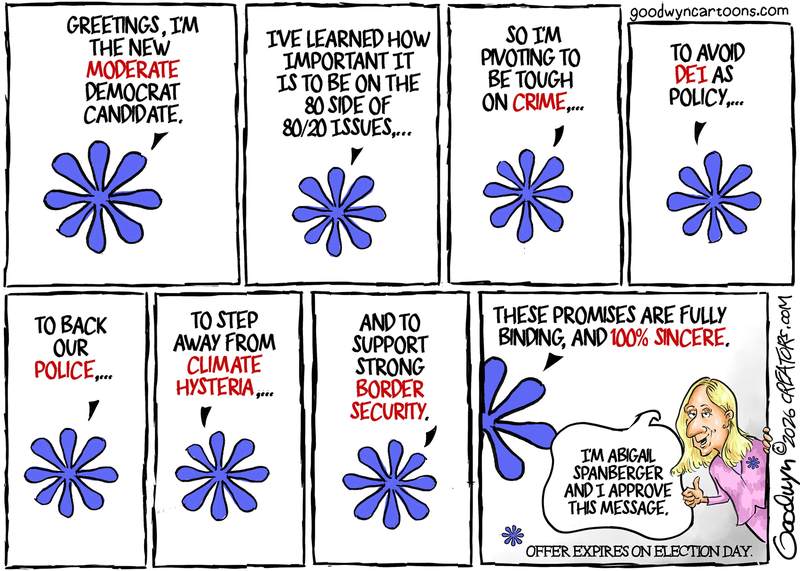
There Are No ‘Moderate’ Democrats When it Comes to Gun Rights.
Virginia’s Gov. Abigail Spanberger is determined to make her mark in the Old Dominion. She campaigned for office as a moderate Democrat, but Virginians are learning quickly that they’ve been hoodwinked. The reaction is astounding.
A recent poll conducted by George Mason University and The Washington Post found that Gov. Spanberger earned the highest disapproval rating from Virginians of any governor since 1994. Forty-six percent of Virginians disapprove of Gov. Spanberger’s job performance, just three months into the job. To put that into perspective, Gov. Spanberger won by 15 points in her race against former Lt. Gov. Winsome Earle-Sears. Her performance is also a glaring contrast to former Virginia Gov. Glenn Youngkin’s 53-39 job approval rating at the same point in his administration, according to Fox News.
Chief among those headwinds are two issues that the firearm industry is tracking very closely. First, Gov. Spanberger is expected to sign into law SB 749, which would unconstitutionally ban the purchase of Modern Sporting Rifles (MSRs), or the AR-15-style semiautomatic rifles — the most common rifle in America — as well as semiautomatic shotguns used for hunting and home defense and many pistols and standard capacity magazines. Gov. Spanberger is also considering a bill, HB21, that would attempt to circumvent the bipartisan Protection of Lawful Commerce in Arms Act (PLCAA) to allow frivolous lawsuits against firearm industry members for the criminal misuse of firearms by remote third parties.
Add to that, Gov. Spanberger is backing a referendum effort to gerrymander the Congressional districts in Virginia that would bring a new hyper-partisan Virginia congressional delegation to Congress. If successful, it would change Virginia’s 11 Congressional districts that are currently comprised of six Democrats and five Republicans to 10 Democrats and just one Republican.
Body language almost always tells the true story… https://t.co/OOsiwk1C5i
— John Ʌ Konrad V (@johnkonrad) April 9, 2026

When people get used to preferential treatment, equal treatment seems like discrimination. – Thomas Sowell