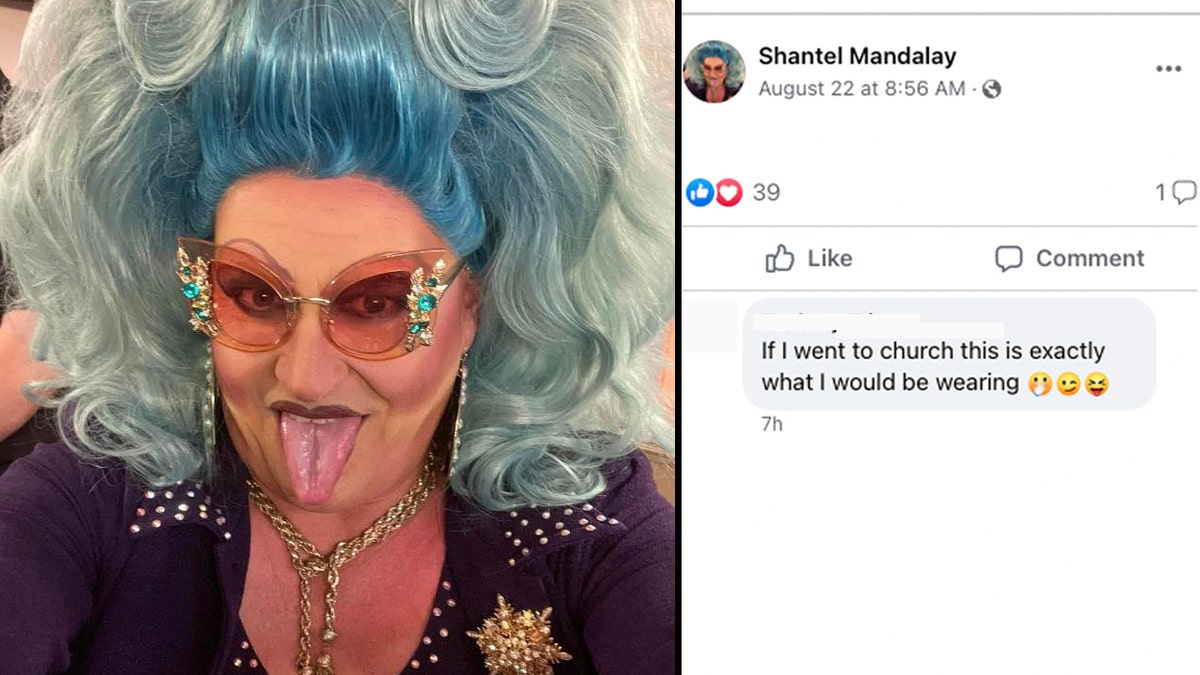
Fox News reports that the Western Heights School District in Oklahoma City, Oklahoma, has installed a drag queen as principal of the John Glenn Elementary School. Fox has confirmed that the new hire, Shane Murnan, is “a drag queen who goes by the name of Shantel Mandalay.” Although Mandalay’s Facebook account has since been deleted, the article provides screenshots of him in his full drag glory.
According to Fox, Murnan was employed as a drag queen at a venue called “The Boom.”
Gun violence has been declared a public health emergency in New Mexico following the death of an 11-year-old boy.
New Mexico Governor Michelle Lujan Grisham made the announcement following the death of a young boy in a shooting on a highway. Albuquerque Police Chief Harold Medina confirmed in a press briefing that a boy was killed and a second woman was taken to hospital in critical condition. They were attacked while traveling westbound on Avenida Cesar Chavez near University Boulevard. Neither of the victims have been named.
Declaring a public health emergency, Lujan Grisham shared a statement lamenting the death of the boy and the earlier unrelated killing of a five-year-old girl in the area. “Today, I join the family of an 11-year-old boy in mourning his violent death yesterday. And I mourn the loss of a 5-year-old girl murdered in her bed last month,” the statement read.
“These are disgusting acts of violence that have no place in our communities. As a mother and grandmother, I cannot fathom the depth of these losses, and their effects will be felt by families, friends and communities forever.”
She said new measures need to be brought in to end gun violence in the state and called for a meeting to determine what steps can be taken to reduce harm caused by guns. Lujan Grisham continued: “The time for standard measures has passed. Today I am declaring gun violence a public health emergency in New Mexico.”
The executive order signed by Lujan Grisham stated the “rate of gun deaths in New Mexico” had increased by 43 percent from 2009 to 2018, compared to an 18 percent increase nationwide. It also said guns are the leading cause of death for children and teenagers in the state.
In her comments, the governor urged New Mexicans to take action against gun violence, saying: “To my fellow citizens: get loud. Step up. Demand change: from your neighbors, from your friends, from your communities, from your elected leaders. Enough is enough.”
Lujan Grisham’s actions were met with derision from New Mexico House Republican Minority Leader Ryan Lane, who accused her of politicizing the death to “push her anti-gun agenda.” Lane said in a statement: “The Democrat’s policies have created and exacerbated the crime crisis that is literally killing New Mexicans daily. It is unacceptable that it has taken this long to notice the number of everyday New Mexicans that are being affected by criminal violence.”
Newsweek has contacted Gov. Lujan Grisham via an email form on her website for comment.
___________________________________________
You know, concealed means concealed, but as I don’t live in NM……
ALBUQUERQUE, N.M. (AP) — New Mexico Gov. Michelle Lujan Grisham on Friday issued an emergency public health order that suspends the open and permitted concealed carry of firearms in Albuquerque for 30 days in the midst of a spate of gun violence.
The Democratic governor said she is expecting legal challenges but felt compelled to act in response to gun deaths, including the fatal shooting of an 11-year-old boy outside a minor league baseball stadium this week.
The firearms suspension is tied to a threshold for violent crime rates that only the Albuquerque area currently meets. Police are exempt from the temporary ban on carrying firearms.
Lujan Grisham said the restrictions “are going to pose incredible challenges for me as a governor and as a state.”
“I welcome the debate and fight about how to make New Mexicans safer,” she said at a news conference, flanked by leading law enforcement officials, including the district attorney for the Albuquerque area.
A federal judge on Wednesday ordered the state of Texas to remove barriers from the Rio Grande, which Gov. Greg Abbott had put in place to deter migrants from entering his state illegally.
The Biden administration filed a lawsuit against Abbott in July, arguing that he had failed to obtain the federal government’s permission to place the buoys on the border between the U.S. and Mexico, CBS News reported.
In his 42-page preliminary injunction order, Judge David Ezra, a Ronald Reagan appointee, directed the state to remove the barriers from the river by Sept. 15.
Ezra wrote that Abbott needed permission to place the floating barriers in the Rio Grande because they obstructed a U.S. navigable waterway in violation of federal law.
The judge also pointed out that the water barrier raised international relations issues with Mexico, which are in the purview of the federal government.
“Mexico vigorously denounces the presence of the barrier, expressing its hope for expeditious removal of the barrier as the first topic at the August 10, 2023, meeting between Foreign Secretary Alicia Barcena and Secretary of State Anthony Blinken,” Ezra said.
Joe Biden is a man who likes his ice cream and routinely needs the White House to clean up his messes. He could be in diapers at this point, too. Who knows? If he is, I’m sure the White House is doing everything possible to keep that under wraps.
But I digress. According to a new book by Franklin Foer, staff writer at The Atlantic and former editor of the New Republic, Joe Biden feels like his White House staff is babying him, and he’s not particularly happy about it.
The book recalls the incident where Biden riffed after the conclusion of a speech about Russia’s invasion of Ukraine, making a statement that appeared to call for Putin to be overthrown. “For God’s sake, this man cannot remain in power,” Biden said. According to Foer’s account, the White House was walking back the statement by the time Biden had reached his motorcade.
“Suddenly, the press wasn’t marveling at his rhetoric or his diplomatic triumphs; it was back to describing him as a blowhard lacking in self-control,” Foer writes in his book, and Biden was deeply upset over the media coverage of the gaffe and “left for home, ending his triumphalist tour, feeling sorry for himself.” The president “resented his aides for creating the impression that they had cleaned up his mess.”
“Rather than owning his failure, he fumed to his friends about how he was treated like a toddler,” Foer writes.
Naturally, the White House disputed this story when Fox News White House correspondent Peter Doocy asked about it.
“President Biden is the oldest president in U.S. history. Why does White House staff treat him like a baby?” Doocy asked.
White House Press Secretary Karine Jean-Pierre might have needed a diaper of her own when she got that question, as she was none too pleased by it.
“No one treats the President of the United States, the Commander-in-Chief, like a baby,” she insisted before adding that it was “a ridiculous claim.”
Doocy then quoted the book and asked, “Was John [F.] Kennedy ever babied like that?”
“So, look, I’ll say this,” she began. “There’s going to be a range — always — a range of books that are — about every administration, as you know — that’s going to have a variety of claims. That is not unusual. That happens all the time. And we’re not going to litigate those here. That’s something that we’re not going to speak to.”
PETER DOOCY: "Why does White House staff treat [Biden] like a baby?"
JEAN-PIERRE: "No one treats the President of the United States, the Commander in Chief, like a baby. That's ridiculous. That's a ridiculous claim." pic.twitter.com/J3T4nXUaSZ
When the young paste-eaters at Michael Bloomberg’s anti-gun propaganda factory, known as the Trace, team up with the stodgy window-lickers at the Gun Violence Archive to produce a story about the utility of the AR-15 platform as a modern self-defense tool, it’s hard not to get too excited.
It’s like watching two freight trains headed toward each other on the same track. You know the results are going to be cataclysmic. None of these halfwits have ever heard a shot fired, much less one fired in anger, or especially one fired to good effect. They know less about what makes a reliable home defense weapon than I do about man-buns, skinny jeans, or avocado toast.
We have debunked the Trace and the Gun Violence Archive so often it’s getting old. The kids at the Trace masquerade as legitimate journalists when, in fact, they’re nothing more than highly paid anti-gun activists. The GVA purports to track gun crimes and maintain a list of mass shootings, but their data is collected from media, and even social media sources, and their stats are so inflated they’d have you believe a mass shooting occurs nearly every time someone draws from a holster. When the two anti-gun nonprofits combine for a story, it’s bound to be something as bereft of facts as it is poorly written, and to that standard their most recent collaboration does not disappoint.
The story was written by one of the Trace’s senior fabulists, Jennifer Mascia, who is “currently the lead writer of the Ask The Trace series and tracks news developments on the gun beat.” Mascia has also led the Trace’s hilarious we’re journalists, not activists, propaganda campaign on social media.
Mascia claims her story was a response to a reader’s question: “Many gun owners claim to buy assault-style rifles for defense. So how many documented cases are out there where someone actually defended themselves with an assault-style rifle?”
Mascia reportedly searched the GVA’s data for “assault weapon,” which she said the GVA defines as “AR-15, AK-47, and all variants defined by law enforcement.” Of course, there’s no mention of whether the weapons were capable of select-fire and, therefore, actual assault weapons. She started with 190 incidents, which she whittled down for various reasons. The results: “That left 51 incidents over a nine-and-a-half-year span in which legal gun owners brandished or used an AR-style rifle to defend life or property. That averages out to around five per year.”
To be clear, I trust Mascia’s findings about as much as I trust the GVA data that produced the results. The whole story is GIGO – garbage in, garbage out.
It is noteworthy that the firearms “expert” whom Mascia found to further beclown herself – who wrote in a CNN story that the AR is the last gun he’d recommend for self-defense – is none other than former Washington D.C. police officer Michael Fanone. He’s the officer who cried a lot before the January 6 Commission – the one with the beard who cried a lot, if that helps jog your memory.
“I’m more familiar with the gun than most people: I own one. And one thing I know for sure is that this weapon doesn’t belong in the hands of the average civilian,” Fanone wrote of the AR platform in the CNN story.
The network must have liked the cut of his jib. Fanone is now a CNN contributor and hawking a new book: “Hold the Line: The Insurrection and One Cop’s Battle for America’s Soul.” (Nancy Pelosi highly recommended it.)
Since he’s so afraid of the AR platform, I can’t help but wonder what weapon Fanone, or for that matter, Mascia, would recommend for home defense. If I had to guess, it probably has two barrels, a wooden stock and exposed hammers.
I’m somewhat familiar with the AR myself, which is why I trust it to defend my hearth and home. It’s light, accurate, and deadly, which is exactly the point, and something we should stop making allowances for.
Despite the exhortations of Bloomberg’s activists or crybaby ex-cops, an AR-15 is exactly what I want when The Bad Man comes a-calling.
This judge has it backwards and I’d say purposefully. The goobermint has to submit evidence that the weapons are not in common use for self defense, (impossible by the way, so that’s why the judge pretzeled it) not the plaintiffs
For the second time in less than a month, a federal judge has upheld Connecticut’s assault weapons ban by denying an injunction seeking a temporary halt to the enforcement of the ban as part of a lawsuit challenging the state’s gun laws.
In a 14-page ruling issued earlier this week, U.S. District Judge Janet Bond Arterton said the assault weapons banned by the state are not “commonly” used for self-defense, which would classify the firearms as protected under the Second Amendment.
“Plaintiffs are correct that the Second Amendment provides them with the freedom to choose a firearm . . . ‘that is not dangerous and unusual’ and that is normally used for self-defense,” Arterton said. “However, until they submit evidence that supports a finding that the assault weapons in the challenged statutes meet those requirements, they cannot show a likelihood of success on the merits of their Second Amendment claim.”
She had denied a similar injunction requested by the National Association for Gun Rights, which is also suing state officials to revoke the ban, on Aug. 3. Her ruling this week marks the third time since June that Arterton has upheld the state’s assault weapons ban.
Attorney Cameron Atkinson, one of three lawyers representing the plaintiffs, three people including two former state correction officers and two gun rights advocacy groups, said they will appeal the most recent ruling.
“The District Court did exactly what the Supreme Court told it not to do (in other rulings),” Atkinson said Wednesday. “We’re very confident that the ruling will be reversed on appeal.”
When the young paste-eaters at Michael Bloomberg’s anti-gun propaganda factory, known as the Trace, team up with the stodgy window-lickers at the Gun Violence Archive to produce a story about the utility of the AR platform as a modern self-defense tool, it’s hard not to get too excited.
It’s like watching two freight trains headed toward each other on the same track. You know the results are going to be cataclysmic. None of these halfwits have ever heard a shot fired, much less one fired in anger, or especially one fired to good effect. They know less about what makes a reliable home-defense weapon than I do about man-buns, skinny jeans or avocado toast.
We have debunked the Trace and the Gun Violence Archive so often it’s getting old. The kids at the Trace masquerade as legitimate journalists when in fact they’re nothing more than highly paid anti-gun activists. The GVA purports to track gun crimes and maintain a list of mass shootings, but their data is collected from media and even social media sources, and their stats are so inflated they’d have you believe a mass shooting occurs nearly every time someone draws from a holster. When the two anti-gun nonprofits combine for a story, it’s bound to be something as bereft of facts as it is poorly written, and to that standard their most recent collaboration does not disappoint.
The story was written by one of the Trace’s senior fabulists, Jennifer Mascia, who is “currently the lead writer of the Ask the Trace series and tracks news developments on the gun beat.” Mascia has also led the Trace’s hilarious we’re journalists, not activists, propaganda campaign on social media.
Mascia claims her story was a response to a reader’s question: “Many gun owners claim to buy assault-style rifles for defense. So how many documented cases are out there where someone actually defended themselves with an assault-style rifle?”
Mascia reportedly searched the GVA’s data for “assault weapon,” which she said the GVA defines as “AR-15, AK-47, and all variants defined by law enforcement.” Of course, there’s no mention whether the weapons were capable of select-fire and therefore actual assault weapons. She started with 190 incidents, which she whittled down for various reasons. The results: “That left 51 incidents over a nine-and-a-half-year span in which legal gun owners brandished or used an AR-style rifle to defend life or property. That averages out to around five per year.”
To be clear, I trust Mascia’s findings about as much as I trust the GVA data that produced the results. The whole story is GIGO — garbage in, garbage out.
It is noteworthy that the firearms “expert” whom Mascia found to further beclown herself — who wrote in a CNN story that the AR is the last gun he’d recommend for self-defense — is none other than former Washington D.C. police officer Michael Fanone. He’s the officer who cried a lot before the January 6 Commission — the one with the beard who cried a lot, if that helps jog your memory.
“I’m more familiar with the gun than most people: I own one. And one thing I know for sure is that this weapon doesn’t belong in the hands of the average civilian,” Fanone wrote of the AR platform in the CNN story.
The network must have liked the cut of his jib. Fanone is now a CNN contributor and hawking a new book: “Hold the Line: The Insurrection and One Cop’s Battle for America’s Soul.” (Nancy Pelosi highly recommended it.)
Since he’s so afraid of the AR platform, I can’t help but wonder what weapon Fanone, or for that matter, Mascia, would recommend for home defense. If I had to guess, it probably has two barrels, a wooden stock and exposed hammers.
I’m somewhat familiar with the AR myself, which is why I trust it to defend my hearth and home. It’s light, accurate and deadly, which is exactly the point, and something we should stop making allowances for.
Despite the exhortations of Bloomberg’s activists or crybaby ex-cops, an AR is exactly what I want when The Bad Man comes a-calling.
Sept. 11, 2023, will mark 22 years since the terror attacks on our nation. Two planes flew into the World Trade Center towers, another into the Pentagon, and another, likely headed for the U.S. Capitol Building or the White House, crashed in a field in Pennsylvania.
In the years since that dark day in America’s history, presidents have typically sought to mark the anniversary at events in New York, Pennsylvania, Virginia, or the White House.
Well, all but one, anyway. According to a report from The Hill, Joe Biden will be in Alaska on the 22nd anniversary of the 9/11 terror attacks to participate in a memorial ceremony there. Adding insult to injury, Joe Biden has sent Kamala Harris and her husband to attend a commemoration ceremony in New York City.
While 9/11 was a national tragedy, the decision to be in Alaska has many baffled. Joe Biden couldn’t be further away from New York, D.C., or Virginia and still be in the United States unless he was in Hawaii. Given his recently botched response to the wildfires in the Aloha State and the sour reception he got from locals, he certainly wasn’t going to go there.
When you consider how much effort goes into choreographing every move the president makes for the purpose of public relations, Biden’s absence from any of the three traditional observation sites or even the White House strikes many as odd.
One possible explanation is that they’re giving Kamala Harris an opportunity to shine, but I’m not buying that. I’ve never believed that Biden really wanted Harris as his running mate, and there have long been reports of tension between the Biden and Harris teams. So there’s little reason to believe that she’s being primed to take his place as the de facto nominee for the Democratic Party in the event he drops out, which many people are predicting is inevitable.
My theory is that it’s related to his botched withdrawal from Afghanistan, the most consequential moment of his presidency. Afghanistan sent his approval ratings underwater, where they have stayed ever since.
Biden ignored the advice of his military advisors and lied about the situation on the ground because he wanted to have a victory photo-op for the 20th anniversary of the 9/11 attacks. As a result of Biden’s hubris, 13 American service members were killed in a terrorist attack at Kabul Airport, and the Taliban quickly took over the country, erasing all the progress we and our allies made in a twenty-year war.
One thing is for sure: Biden has to make some sort of public appearance on that day, and his location on the anniversary of 9/11 is no accident. He’s definitely trying to hide.
In our modern world, there are a lot of people who offer up their opinions on a variety of topics they know nothing at all about.
To some degree, I think we all do it, though many of us at least try to get informed before we speak on something we previously had no knowledge of.
Take guns, for example. Many have come to the idea that what we really need is “bullet control.” After all, if bad guys can’t get ammunition, they can’t shoot up their neighborhoods or anywhere else. A few places have tried it. California for example, has been giving it a try and so far, no one’s really seen any difference. New York is about to give it a go.
But one intrepid letter writer to the Baltimore Sun thinks he knows what we need to do. We should serialize bullets.
With ghost guns and the number of Baltimore youths getting access to guns growing in general, what’s the one thing they all require? Ammunition. So while the guns themselves can’t be easily tracked, it would seem the common item they all require is ammunition. So why can’t Maryland, and really all states, require ammunition manufacturers to code all bullets to be micro-encoded to identify the ammunition and dealers who sell the ammunition to identify every person to whom it is sold (”Man fatally shot in Canton carjacking was loving uncle, husband,” Aug. 25)?
Now, let’s understand we serialize guns and have for decades, yet that doesn’t seem to do much to keep guns out of the hands of criminals, but if we put a serial number on a bullet, that’ll change everything.
Wow. Just…wow.
The letter writer does acknowledge that it would take a while to work through current ammunition inventories before this serializing would actually do much good, so I’ll give him credit for that, at least, but other than that, it’s clear this is someone who doesn’t understand firearms all that much. It should be noted that the author doesn’t claim the idea originated with him. He probably came across it elsewhere, but this is still an idea concocted by someone who has no clue what they’re talking about.
First, the process of just trying to put a unique serial number on each and every bullet produced is going to be problematic in and of itself. I mean, look at some of the rounds out there and look at how tiny they are. Putting any kind of serial number would be tricky by itself. Making it so serial numbers can be put on a variety of rounds would also be an interesting engineering feat, I’d imagine.
Now, let’s say we do this. Now we have serial numbers on the bullets themselves, but where on the bullet? Too high on the round and it’s easily removed. Too low on the round and just seating the slug may damage the serial number, to say nothing of the round being fired causing even more damage.
And let’s not forget what happens when a round hits a target, for a second. Depending on what kind of bullet and what kind of medium is struck, the round is likely to experience varying degrees of damage. Will that obscure the serial number?
Even if everything works perfectly, it ignores some other harsh realities such as people loading their own including making their own bullets, stolen ammo, and so on.
See, the letter writer, like a lot of anti-gunners, thinks they understand the issue and have a proposed solution when all they’re doing is betraying their own ignorance. For this guy, all ammo comes from a store and this is an easy solution that could be implemented at the drop of a hat. He doesn’t understand anything else, nor does he likely care to. Yet he’s also indicative of a deeper issue with the gun control side.
For them, they read a few news articles–often only from heavily biased sources such as The Trace or even the mainstream media–and are convinced they understand the topic at hand, all because those articles quote supposed experts. Those same experts would be hard-pressed to actually articulate the pro-gun arguments in any detail, of course, but for the anti-gunner on the street, that’s irrelevant.
Then they’re convinced they know the topic and they think of crap like serializing bullets, blissfully unaware of how stupid they sound.
David Hemenway, a Professor of Health Policy at Harvard University’s Injury Control Research Center, has been a proud proponent of anti-gun “research” for many years. Rather than relying on criminologists and experts in law enforcement to diminish violent crime where firearms are used, Hemenway long-ago jumped on the anti-gun bandwagon of trying to frame the discussion about gun-control from an approach of addressing it as a “public health” issue—as if there is some sort of vaccine that could be developed to stop violent criminals from being violent criminals.
One might consider him simply misguided, or perhaps he has just bought into what many on the far left do whenever faced with something they wish to control; frame it as a “public health” crisis.
But with Hemenway, it may be that he just hates guns and law-abiding gun owners, and all of his “research” he claims supports his radical theories is guided predominantly by confirmation bias. And who better to offer support for the theory that this particular anti-gun researcher just hates guns and gun owners than Hemenway himself?
A recent interview with Hemenway was posted by the online outlet Undark, a relatively obscure digital magazine with ties to any number of media outlets that hold extreme anti-gun views. Publishing partners include outlets that have shown anti-gun bias such as HuffPost, Mother Jones, NPR, Salon, and Slate. It should come as no surprise that Undark would give Hemenway a platform for his anti-gun views.
And even so with these multiple cuts, he slurring words together like he’s doped up (which is likely) and they included captions, just to make sure he could be understood. They believe we’re so stupid we’ll believe this BS.
The craziest thing is, these are the clips that made the cut. LMAO!! They must have worked on this for days and days to get enough snippets that were watchable.
These are the clips that made the cut! 🤯unbelievable
Vice President Kamala Harris reacted to Saturday’s shooting in Jacksonville, Florida, by pushing gun control that would not have prevented the attack.
Harris released a statement Sunday noting the shooting was racially motivated and will be investigated “as a possible hate crime and act of domestic violent extremism.”
She closed her statement by saying, “Every person in every community in America should have the freedom to live safe from gun violence. And Congress must help secure that freedom by banning assault weapons and passing other commonsense gun safety legislation.”
It should be noted that Jacksonville Sheriff T.K. Waters pointed out the shooter was armed with two guns, a Glock pistol and an AR-15 style rifle. If the rifle had been denied him, he would still have had the pistol and the attack would not be hindered.
Additionally, universal background checks constitute another piece of “commonsense gun safety legislation” that Democrats are pushing. But the Jacksonville shooter bought his guns “legally,” which indicates he passed background checks for them at retail.
Moreover, Florida has a red flag law, which is often pushed by Democrats as a way to prevent shootings. But the Washington Post noted Waters saying, “There was no criminal arrest history. There is nothing we could have done to stop [the shooting suspect] from owning a rifle or a handgun. There were no red flags.”
Liberals only want one thing … and it’s disgusting.
Alright, well technically it’s three things — but they all fall under the same umbrella of the broader liberal world view.
In her analysis of the GOP debate Thursday evening, Laura Ingraham made a tongue in cheek comparison of Republican and Democrat campaign platforms. “Okay, here’s what the Democrats’ platform is,” she quipped, “pot, porn, Planned Parenthood.”
Liberals in the corporate media and online mocked the comments as orchestrated conservative hysteria making mountains out of a mole hill. They used the typical gas-lighting ploy of “it’s not happening, but it’s good that it is.”
Gisele Fetterman — the activist wife of Sen. John Fetterman who wheeled him across the finish line in Pennsylvania — gave away the game when she responded to the comment, apparently without a hint of irony, to say she’s in.
Of course, liberals love all three things. They are all natural out-growths of the New Left movement of the 1960s. The student hippies who steeped in “free love” and psychedelic drugs grew up to become tenured professors, legal activists, bureaucrats, and government officials — the counterculture of yesterday is now the dominant culture in America.
Liberals today are ideologically obligated to reject the possibility of any downsides to rampant drug use or hyper-sexualization. To reject pot, porn, or Planned Parenthood is to reject individual liberation — the ultimate goal of the modern liberal project.
Any law, norm, or tradition that kept you from pursuing your desires was bad. The powerful used the rules of society to keep the masses in line, while they exploited them at every turn.
The New Left said society must be re-made to help people realize their authentic selves. Narcissistic self-fulfillment was recast as a revolutionary act against an unjust system. Pursuing your desires became the highest — the only — moral good.
If you’re thinking like a liberal, smoking a joint isn’t just like having a beer after work. It’s a way to open your mind — to free your creativity and think about things in new ways. It’s liberating in a way that goes far beyond just being against the government having a say in what you ingest.
The New Left thought pot would liberate the masses from the slog of bourgeois life. Today’s left is banking on the opposite. They know pot makes you fat, lazy, and stupid — and hope that if they give you more of it you won’t notice or care as they destroy the country around you. But still, support would crater if they said this out loud, so they stick to the moral posturing.
The same goes with porn and Planned Parenthood. Sexual rules were designed by straight, white men to keep women under control — how many times have you heard this from a girl with purple hair?
Liberals defend porn as a way for women to reclaim a position of power in the patriarchy. Sure, a handful of women get rich and famous as porn stars, but countless more are trafficked, exploited, and abused. As a generation of young men grows up incapable of understanding sex outside of porn, it’s hard to argue that women are better off.
But in the liberal world view, this harm gets overlooked in the name of liberation. Do any disgusting thing you want for the world to see. If you enjoy it (and consent) no one has any right to stop you. All sexual acts become morally equal when there’s no universal standard to judge them against.
If porn frees women from oppressive norms, abortion frees them from biology itself. The modern woman shouldn’t be constrained by the natural functions of her body. If being a mother stops you from pursuing your desires — being a Girl Boss, drinking on a Tuesday night, or just sleeping around more — then drive on down to your local Planned Parenthood. The obligation to that clump of cells comes second to the obligation to yourself.
But like pot, this now serves to enslave more than liberate.
The cult of abortion worship has convinced millions of women that the best thing they can do is trade marriage and children in for a corner office and some cats. Porn normalizes hook-up culture and promotes sexual dysfunction in men and women. It’s hard to settle down when you’re never satisfied. You become a compliant cog in the liberal machine.
When you have a spouse and children, you think about the future of the country because you have a stake in it. When you’re just worried about your job or your date on Friday, you lose sight of what really matters.
Karl Marx wrote that religion is the opium of the masses. For today’s liberals, it’s just pot, porn, and Planned Parenthood.
“Only the police should have guns”
(You ever notice that all the gun control laws the demoncraps want always exclude the police?)
A gunman who killed three people Wednesday night at a beloved local bar in Trabuco Canyon and wounded six others — including his estranged wife — was a former police officer, according to officials.
The Orange County Sheriff’s Department identified the gunman as John Snowling, a retired Ventura police sergeant. When John Snowling, 59, came to Cook’s Corner, his target was his wife, who was a regular at the bar on Santiago Canyon Road. He fired on her and then began “shooting randomly,” Sheriff Don Barnes said Thursday afternoon.
Snowling entered the bar around 7 p.m. Wednesday during its weekly $8 spaghetti night — a family-friendly event — armed with two handguns, Barnes said. The retired cop walked up to his wife and immediately shot her once, wounding her, then shot the woman with whom she was dining. That woman, who has not been identified, later died.
There was no conversation or argument that preceded Snowling opening fire on his estranged wife, Barnes said.
“Mr. Snowling … then started randomly shooting at patrons within Cook’s Corner,” Barnes said. “That progressed to the outside area.”
At one point, Snowling returned to his truck in an upper parking lot, where he was confronted by a man from the bar — whom Snowling also shot, Barnes said. That man, who also has not been identified, later died.
When deputies arrived — within two minutes of the first 911 call — they found Snowling in the parking lot, Barnes said. The former cop began firing at deputies, hitting multiple law enforcement vehicles.
A gunfight ensued, and “it was gunfire from those deputies that ultimately took the life” of Snowling, Barnes said. Orange County Dist. Atty. Todd Spitzer said seven deputies opened fire, firing at least 75 shots.
After the shooting, deputies recovered four weapons Snowling had brought to the scene: two pistols, a revolver and a shotgun, Barnes said. All were acquired legally.
Barnes identified one of the men who was killed as John Leehey, 67, of Irvine. He did not identify the two others who were killed, as officials have not yet notified next of kin.
The six people who were injured in the shooting were taken to Providence Mission Hospital in Mission Viejo on Wednesday night. Two were in critical condition — a man shot in the chest and a woman shot in the jaw, according to James Chisum, a spokesman for the hospital. The woman, believed to be Snowling’s estranged wife, Marie Snowling, was transferred overnight to UC Irvine Medical Center, Chisum confirmed Thursday.
The four other victims, all men, were stable, Chisum said. One was released from the hospital late Wednesday, and two others with minor injuries were expected to be released Thursday. A fourth man, shot in the arm, was likely to have surgery Thursday.
No children or deputies were injured in the shooting.
The Sheriff’s Department confirmed that Snowling’s wife was among the injured.
Mark Johnson, pianist for the Orange County band that was performing at the bar Wednesday night, said two members of the M-Street Band “were hit and were hospitalized but stable.” Johnson, drummer Brian Lynch and singer Debbie Johnson said in a video that guitarist Ed Means and bassist Dave Stretch were in the hospital. Lynch said they were “all going to be OK.”
Officials declined to identify the other injured victims.
Barnes said investigators were still searching for a motive. Snowling, who used to share a home with his wife in Camarillo, was most recently living in Ohio, Barnes said. He recently traveled back to Southern California, and it wasn’t immediately clear if he followed his estranged wife to the bar or found out she was going there, Barnes said.
On Thursday morning, heavily armed Orange County sheriff’s deputies surrounded Snowling’s home in the Camarillo neighborhood of El Capitan Place, not far from Adolfo Camarillo High School.
Deputies ordered any occupants to exit as they prepared to serve a search warrant. Two vehicles were in the driveway, but no one exited.
It wasn’t immediately clear what deputies seized or hoped to find in the search.
Snowling worked for the Ventura Police Department from 1986 to 2014, rising to the rank of sergeant, according to a department spokesman. He served as the president of the city’s police union in 2008 and 2009, records show.
In December 2022, Marie Snowling filed for divorce, writing that she had been estranged from her husband for two years, court filings show.
The couple had been married almost 32 years when they separated in November 2020, her attorney wrote, citing “irreconcilable differences” as the reason for the split. The case file contains no allegations of acrimony or abuse.
In February, John Snowling was served with the divorce papers in Newark, Ohio, records show. He had yet to respond to his wife’s petition.
His attorney, Tristan Tegroen, told The Times he was shocked by the shooting Wednesday, given how measured and fair the divorce proceedings had been so far.
Tegroen noted he is accustomed to rancorous divorces, but said with the Snowlings, “there was nothing like that — nothing at all.” As the lawyers in the case went about identifying and valuing their assets, Marie Snowling did not seek a restraining order against her husband, raise accusations of abuse or say she was fearful of him, he said.
Tegroen did not get the sense that any one issue had prompted the split, only that the two felt their marriage had run its course. “John was living in Ohio and she was here, and they were living apart,” he said.
“Honestly, this came as a horrible shock to me,” Tegroen said. “There was nothing on the radar to suggest he might do this.”
Marie Snowling’s lawyer, Kenneth Henjum, said his team was awaiting further information about her condition.
“The Snowling family is in shock at the events from last night and are requesting their privacy,” Henjum said in a statement.
John Snowling, then a Ventura police officer, patrols the Pacific View Mall in Ventura in 2000. Snowling, who retired in 2014, was identified as the gunman in Wednesday night’s mass shooting in Trabuco Canyon.
(Carlos Chavez / Los Angeles Times)
James Goldsmith, 68, lived two doors down from the Snowlings in Camarillo for more than two decades. Marie Snowling had moved out to live with her sick mother in Orange County a few years ago, he said, adding that he knew the couple had been going through “marital issues” but never heard any shouting or saw the police come by due to domestic disputes.
“John was always kind of a standoffish kind of person,” Goldsmith said. “He wasn’t the most personable guy, not that I can say that there was anything really negative. He wasn’t the type of neighbor that you’d get the warm fuzzies from.”
He described Marie Snowling as an “absolute sweetheart.” She was the more social one of the couple, according to Goldsmith.
Goldsmith didn’t know whether Marie had a new partner but said she often posted on Facebook about her life after filing for divorce.
“I think she wanted to have friends and live life, and that’s why I think she made the move that she did,” Goldsmith said. “It’s sad that he couldn’t allow that and let her live her own life.”
Snowling had recently purchased a house in Ohio and was staying there most of the time, Goldsmith said. He most recently saw Snowling come back a few months ago to do some maintenance work on the house, he said.
Marie Snowling had moved to a mobile home community in Orange, where she’d recently become a manager, a job her late mother previously held, residents told The Times.
On Wednesday night, neighbor Mary Talian watched out her window, waiting for Snowling to come home. Talian, 82, knew her neighbor was at Cook’s Corner because Marie often talked about the bar’s spaghetti night.
“She loved to be around people, around music, and she loved to go out,” Talian said.
“Marie would always take my calls,” Talian said, adding that Snowling would often check on her and pick up her groceries. “That’s how I knew that something was wrong last night, when she didn’t call back.”
Snowling was the perfect fit to manage the mobile home park, said Talian’s daughter, Carol Franke.
“The first words out of her mouth are always, ‘How are you?’ or ‘How are the kids?’ She never talked about herself,” Franke said. “Marie celebrated other people’s wins. That’s just who she is.”
John Snowling, right, and Ventura police partner Sam Arroyo on patrol at Ventura’s Pacific View Mall in 2000.
(Carlos Chavez / Los Angeles Times)
Denise Craft, another neighbor in Orange, described Marie Snowling as nice and personable. Craft knew about Snowling’s divorce and how her estranged husband had taken custody of their dog.
Marie Snowling had recently confided in her that her that John Snowling was being very sweet lately, but she didn’t know why.
“I told her to be cautious about that,” Craft, 59, said.
Geoffrey Kagy, 52, a regular at Cook’s Corner, said his girlfriend, Jacqueline Bass, was at the bar without him Wednesday night — but around 7:30 p.m. she suddenly sent Kagy a volley of text messages. The first said “911,” followed by “Help” and “Omg.” She’d been inside Cook’s Corner when the gunman opened fire.
When they spoke by phone, Kagy said, “she just kept saying how she was running and that she saw somebody shoot.”
At about 7:07 pm Wednesday, a dispatcher on the radio channel for local California Highway Patrol troopers said: “Male came in and started shooting. Eight shots were fired. White male. Plaid shirt and jeans. Still shooting. Possibly active shooter.”
Emergency dispatchers reported hearing gunshots in the background of radio traffic as multiple deputies arrived at the bar, Orange County Undersheriff Jeff Hallock said at a late-night news conference Wednesday.
In a video posted to Facebook by Betty Fruichantie, a friend of Marie Snowling’s, first responders are seen putting victims on gurneys to be taken to the hospital. Fruichantie wrote that the gunman fired “4 or 6 shots” at her but missed.
In the video, Fruichantie pans to a woman being wheeled away on a stretcher.
“Oh my God, Marie,” she says.
Fruichantie mentioned in Facebook comments that she was sharing a table with Marie Snowling before the shooting and later learned that the gunman was her friend’s estranged husband.
“He shot her in the face,” she wrote. “They transported her to the ER.”
Cook’s Corner, which sits at the juncture of El Toro, Santiago Canyon and Live Oak Canyon roads near O’Neill Regional Park, is a popular haunt among local riders who want to avoid freeway congestion and enjoy the winding route to get there, and it’s become a spot where families gather for an inexpensive weeknight dinner.
Orange County Supervisor Don Wagner said he was devastated by the shooting, and that it happened at an establishment that had become a cornerstone of the community.
“You hear Cook’s Corner, ‘Oh it’s a biker bar,’ and in many ways it is. You go out there you’ll see motorcycles galore … because it’s really fun to ride your bikes out there,” Wagner said. “But the truth is that it’s a family spot.
“It will be forever sad — there’s no other word for it — that such a happy place will now go forward under the shadow of what happened last night,” he said.
Gus Gunderman, 60, stopped by Cook’s Corner on Wednesday evening for a bite to eat and left just minutes before the shooting started. The bar was filled with patrons sipping beers as the band prepared for its set. On the patio, families sat devouring large plates of spaghetti and salad.
Gunderman ordered a burger and a soda, not remembering it was all-you-can-eat spaghetti night. Looking back, he’s grateful for that decision.
“Had I ordered spaghetti I would have gotten another plate or more salad, and then I would have been in the thick of it,” Gunderman said. “It’s a tragedy.”
Orange County sheriff’s deputies monitor the scene after the shooting.
(Genaro Molina / Los Angeles Times)
In the four decades he’s frequented the eatery, Gunderman said he’d never once felt unsafe.
“I’ve never even seen a fight there. This could have happened anywhere,” he said. “It has nothing to do with motorcycles or motorcycle culture.”
News of the shooting brought concern from local officials and residents.
An aerial view of investigators on the scene at Cook’s Corner.
(Allen J. Schaben / Los Angeles Times)
“I’m heartbroken by the news of yet another mass shooting tonight, this time at Cook’s Corner, a historic bar in the heart of Orange County,” state Sen. Dave Min (D-Irvine) said in a statement. “My heart breaks for the families and loved ones of the victims.”
In a statement Thursday, Gov. Gavin Newsom said he “mourns for the victims of last night’s horrific shooting.”
He also urged Californians to utilize the state’s red flag laws, especially in instances of domestic disputes, which can temporarily remove firearms from someone who poses a threat to themselves or others.
“We must continue to strengthen, defend, and use these laws,” he said. “If you see red flags, say something — and in doing so, save lives.”
Orange County Supervisor Katrina Foley echoed the governor’s call for people to proactively respond to threats, stalking or domestic violence.
“It’s disturbing to learn that another domestic dispute led to another mass shooting,” Foley said. “We must do more to prevent senseless acts of gun violence and protect survivors.”
“Our hearts weigh heavy with the distressing incident at Cook’s Corner,” Ventura Police Chief Darin Schindler said in a statement. “Our deepest condolences are with the families of the victims, the survivors, [and] the Orange County deputies who swiftly responded to the scene.”
Ventura County Fire Capt. Brian McGrath said the Snowlings’ son, Patrick, works for the department as a firefighter. “We are doing everything we can for him in his time of need,” McGrath said.
Spitzer said his heart was “broken into a million pieces for the people who know and love Cook’s Corner … and for the people who were subjected to this unspeakable act of violence.”
First responders attend to people at the shooting scene.
(OnScene.tv)
On Thursday morning, Erwin Lima stood outside the police tape blocking the two-lane road that leads to Cook’s Corner. The Victorville resident has worked weekends detailing motorcycles at Cook’s Corner for more than 15 years and drove there hoping to learn anything he could about the condition of his co-workers and friends.
“I couldn’t believe it when I started getting calls,” said Lima, 54. “My body just shut down.”
Marie Snowling frequented the bar most weekends for the live music, Lima said. Sometimes it would get so crowded that she’d bring her own chair so she’d have somewhere to sit.
“Everywhere now is shootings: schools, bars, church,” he said.
This American doesn’t care.
I’m not safer driving to work vs taking the train but I’m still not taking the train. This notion of “safety” as a general state of being is an illusion that neurotic people obsess over. Being safe is a series of actions taken to mitigate unnecessary risk in an inherently dangerous environment or undertaking.
You can exercise gun safety by actions you take when handling a gun, you can take safety precautions when driving a car by being alert, using a seatbelt, etc but nobody on earth lives in a perpetual state of inherent safety. We never have and we never will.
This is a lie sold to people by the media and the powerful in order to accumulate more power at the expense of our rights and liberties and it needs to be called out.
Large portions of the American public still believe false claims of all kinds about guns, the COVID-19 pandemic and reproductive health, a new survey from the Kaiser Family Foundation shows.
Though the poll found that percentages of Americans who believe that false claims are “definitely” true is small, the portion who think they are “probably” true is substantial. Overall, between half and three-quarters of the country belong to what KFF CEO Drew Altman called the “muddled middle,” saying that the false claims were “probably” either true or false.
Perhaps most striking of the poll’s findings is the incorrect belief, held by many Americans, that guns make them safer. Sixty percent of Americans believe it’s true that armed school police guards have been proved to prevent school shootings. Eighteen percent of respondents thought the claim was “definitely” true and 42% believed it “probably” true.
Amid recruiting shortfalls, the U.S. military is planning a policy change that would make it easier for applicants to qualify for service.
Military applicants taking the Armed Services Vocational Aptitude Battery could soon be allowed to use calculators to help them pass the timed test, which measures aptitude and helps determine the positions in the military one is qualified for.
“We are taking a systematic approach, which will assess the impact of calculator use, and we are developing a way forward for calculator inclusion,” a Pentagon official told Military.com.
The change in the Armed Services Vocational Aptitude Battery, orASVAB, could help relieve an ongoingrecruiting slump, which is attributed to many young Americans not scoring high enough to qualify for enlistment. It would also put the ASVAB on par with how test-taking has evolved in the past decade, with calculators being widely used in math classes and on college entrance exams such as the ACT and SAT. […]
The [recruiting] shortfalls are due to an amalgamation of issues — but at the forefront is a shrinking pool of qualified young Americans, 17- to 24-year-olds, who are eligible to enlist. Many of those applicants are being turned away due to poor performance on the military’s aptitude exam.
Last year, the Army launched its Future Soldier Preparatory Course, a two-track camp for applicants who came just shy of the service’s standards for academic performance or body fat.
There, soldiers have 90 days to come into compliance. The Army can graduate about 12,000 soldiers from that course into basic training, making up much of the recruiting deficit it saw last year with enlistees who otherwise wouldn’t have qualified for service.
The academic track — applicants who struggle to hit education standards necessary for entrance — makes up the lion’s share of that course. (Military.com)
When the use of calculators for the test will be allowed remains to be seen, but already, the move is facing backlash for being yet another example of the “dumbing down” of the military.
Lower scores on the ASVAB test come at a time when the average ACT score fell in 2022 to its lowest levels in 30 years.