

Category: Crap For Brains
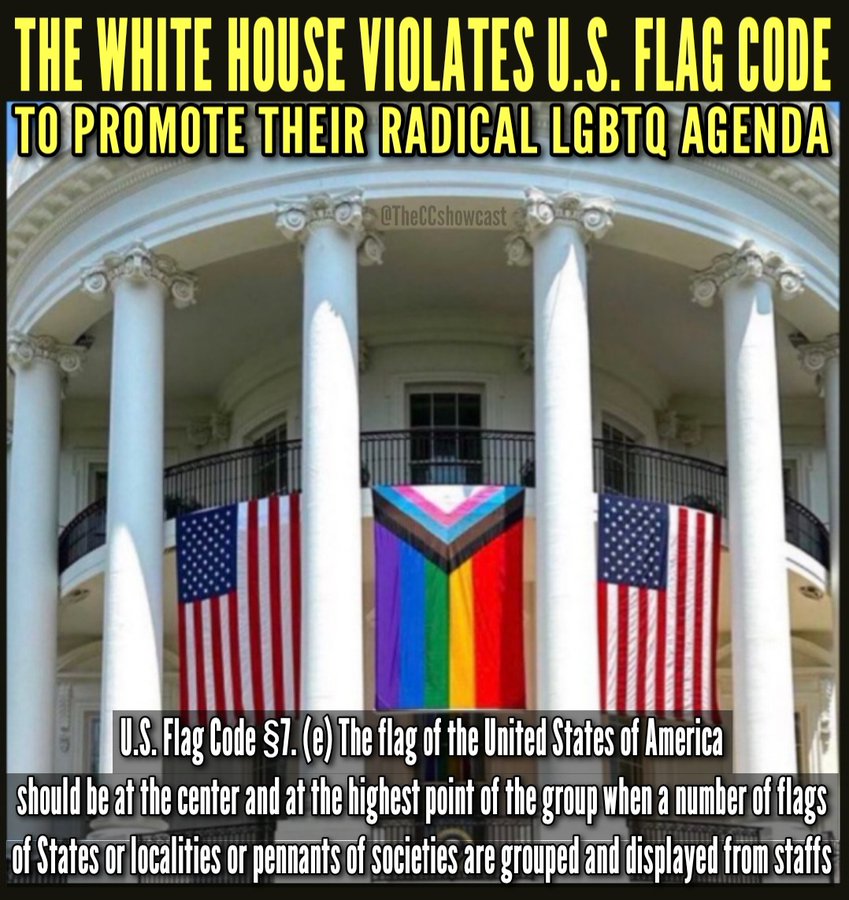
This is why no one has respect for today's "journalists."
— Mayor of Ancappalachia (@jaynarchy) June 12, 2023
Now They’re REALLY Serious: Biden Taps VP Harris to Lead Administration’s Gun Control Messaging
Media reported the president assigned Vice President Kamala Harris, widely panned as “one of the worst VPs in history,” to be the “leading voice” on gun control and charged her with making those issues front and center for the campaign.
Election Day 2024 is “just” about 500 days away.
Success! NYC’s Drug Paraphernalia Machine Cleaned Out in One Night.
If it were a Broadway show, it would have received rave reviews. “A Hit!” “NYC Scores Big in New Debut! “Boffo!” “A Must-See!” “Five Stars and Two Thumbs Up!” “All of Gotham Is Talking!”
Alas, we aren’t talking about the latest play or musical to grace the Great White Way. Nope. We’re talking about the machine that dispenses free drug paraphernalia to users in New York City. But to be fair, it was received extremely well by the target demographic. The machine in question was installed on Monday in Brownsville, Brooklyn. It offers crack pipes, drug test strips, condoms, and Narcan. And lip balm. Patrons can also get tampons and gum.
By 1:00 P.M. Tuesday, a drug prevention program worker was hard at work restocking it. That same worker suspected that it might need to be restocked at least twice a day. For the most part, users were happy with the new amenity. Evelyn Williams told the New York Post, “Yes, I love it. They put it in yesterday, and it’s empty already.” She added, “We have a lot of addicts and heroin users over here. They should re-stock it immediately!” Another man rode by on a bike, gave a thumbs up, and said simply, “Yeah!”
Not everyone was impressed. The paper reported that 56-year-old Minoshi Calpe groused that the crack pipes were not quite up to her standards. She said she preferred the Pyrex pipes, and that the ones in the vending machine had no resale value since they were already available for free. She stated, “The crack pipes are a little too thin now. And every time I pull on [the newer ones], it was burning my lips. I was like, ‘Hell, no! I like my lips too much for this.’”
The machines cost around $11,000 without the contents. In the future, the city may also offer syringes for injection drugs. Charming.
The people in charge of the cluster-**** that has become New York City will undoubtedly tout this as an act of compassion. Actually, this is an act designed to help bureaucrats launder money through the system. And it has the added bonus of increasing poverty, death, and disease. And it should also contribute to the number of citizens getting accosted and assaulted on the streets and pushed onto subway tracks.
I know that Mayor Eric Adams recently gave a speech touting the values of patriotism. It was a nice speech from someone who may view himself as center-left. But a good speech is not going to help a city that is so complicit in its own demolition. If Adams wants to say anything, he should start with admitting that New York City has a left-wing problem. That is, as after all, the first step to recovery.
Grandstanding:
(from the notion of performing to crowds in the grandstands)
the action of behaving in a showy or ostentatious manner in an attempt to attract favorable attention from spectators or the media:
Political posturing:
also known as “kabuki theatre”
the use of speech or actions to gain political support through emotional or affective appeals, especially to describe politicians suspected of acting insincerely to please their supporters.
Yeah, I think he’s seriously considering running for President if SloJoe goes into vapor lock, or falls, misses his head and breaks something vital.
He knows this is going nowhere, but it’s good political fodder for the demoncrap base in case the opportunity arises.
Newsom proposes constitutional amendment to restrict gun rights
Newsom says a constitutional amendment is needed to enact commonsense gun safety laws supported by the American people
California Democratic Govern. Gavin Newsom wants to change the Constitution to curb gun rights.
Fed up with inaction on gun control, Newsom unveiled a proposed 28th Amendment to the Constitution on Thursday that would implement “commonsense” gun safety measures he claims have widespread bipartisan support.
“Our ability to make a more perfect union is literally written into the Constitution,” Newsom said Thursday. “So today, I’m proposing the 28th Amendment to the United States Constitution to do just that. The 28th Amendment will enshrine in the Constitution commonsense gun safety measures that Democrats, Republicans, Independents, and gun owners overwhelmingly support – while leaving the Second Amendment unchanged and respecting America’s gun-owning tradition.”
Newsom’s proposal comes after federal courts have delivered a series of victories for gun rights activists, led by the Supreme Court’s landmark decision last year striking down a century-old New York law that made it difficult to obtain a license to carry a concealed handgun.
The Democratic governor’s proposed 28th Amendment would not abolish the Second Amendment, which establishes a right to bear firearms for personal self-defense. However, it would raise the federal minimum age to purchase a firearm from 18 to 21; mandate universal background checks to purchase firearms; institute a waiting period for all gun purchases; and ban “assault weapons.”
Newsom’s proposed amendment would also affirm that Congress, states and local governments can enact additional gun control measures.
The Constitution can be amended by either Congress or a convention of states under Article V.
Congress can pass a proposed amendment with a two-thirds vote in both the House and Senate, sending it to the states for ratification. With Republicans in control of the House and a 51-49 Democratic majority in the Senate, there is virtually no chance that a constitutional amendment restricting gun rights will have enough support to pass through Congress.
Instead, Newsom is calling for an Article V convention of states to convene and draft his proposed amendment. Two-thirds of the state legislatures must pass a resolution calling for such a convention before it can convene to consider an amendment to the Constitution. If such a convention adopts a proposed amendment, it then heads back to the state legislatures for ratification.
Three-fourths of the states must ratify a proposed amendment for it to be added to the Constitution – a rare and difficult feat that has only been accomplished 27 times in the nation’s history.
Newsom said he will campaign to build grassroots support and lobby other state legislatures to move forward with an Article V convention. A news release from his office included supporting statements from California lawmakers in the state Assembly and Senate.
Gun rights groups were quick to condemn Newsom’s proposal as an attack on the Second Amendment.
“We’ve always warned those who cherish their God-given liberties that the ultimate goal of anti-gunners was the abolishment of the Second Amendment,” said Erich Pratt, senior vice president of Gun Owners of America (GOA).
“While they often try to hide behind legislative proposals and hush open talk of abolishing the Second Amendment, here we have a potential future presidential candidate now coming out and openly admitting what they’ve wanted to do all along,” Pratt said. “GOA will strongly oppose this proposal as we work to protect and restore the Second Amendment rights of all Americans.”
LEGAL ALERT: A judge has denied the motion for preliminary injunction in our lawsuit challenging Washington's "assault weapon ban," saying that the banned firearms "allow a shooter to fire as fast as they can pull the trigger, unlike previous guns." https://t.co/pE8vgg2puP
— Firearms Policy Coalition (@gunpolicy) June 6, 2023
A “compromise” from the gun prohibitionists – you can’t own one, but maybe you can borrow one
Earlier today we reported on the first few hours of the supposed-to-be massive protest outside the Colorado state capitol in Denver, where the group Here 4 The Kids is holding a sit-in to pressure Gov. Jared Polis into signing an executive order banning gun sales and possession in the state. While organizer Saira Rao predicted 25,000 or more would be on hand early Monday morning, the Colorado Sun reports the number was closer to 250 people, and though a few folks have trickled onto the capitol grounds since then there’s nowhere near 25,000 in attendance.
The Sun did manage to speak with a few supporters of the flagrantly unconstitutional executive order proposed by Rao, and it’s fascinating to see how deep the delusion runs with some of these folks, starting with Rao herself.
“Yes, it is in violation of the Second Amendment, and what we are saying is, as a decent human being, at some point, you have to decide that the right to life and our children’s’ right to life must trump anybody’s right to bear arms,” Here 4 The Kids co-founder Saira Rao said Friday.
“The people who have been elected to office have to choose if they will choose children’s lives over guns,” said Rao, a former lawyer who unsuccessfully challenged U.S. Rep. Diana DeGette in the 2018 Democratic primary and then moved to Virginia. “That’s the fundamental choice. And if he’s saying he will not, he is making a choice that will put him on the wrong side of history.”
Change doesn’t happen without major shifts, she said. Americans had to amend the Constitution to abolish slavery, which was considered radical and unthinkable to many in 1865, at a time when slavery was the foundation of the American economy, she said.
“Imagine if people were just like, ‘We can’t do it.’ Indeed, they can, and they did, and now we have the 13th Amendment, which abolished slavery,” Rao said.
Rao’s not trying to amend the Constitution. She’s trying to get Polis and other Democrat governors to ignore it, which isn’t going to go well. As we’ve seen from states like New York and California, anti-gun Democrats would prefer to pay lip service to the Second Amendment while violating the fundamental right to keep and bear arms rather than explicitly rejecting the right altogether, which would cause even courts that have been traditionally hostile to our Second Amendment rights to step in put a halt to their attempt at prohibition.
Nearly 30% of people under 30 support government surveillance cameras in every home: poll
‘Young people seem more willing to prioritize safety over ensuring robust freedom’
Roughly three in 10 Americans under 30 favor “the government installing surveillance cameras in every household to reduce domestic violence, abuse, and other illegal activity,” according to the results of a new Cato Institute survey.
“We don’t know how much of this preference for security over privacy or freedom is something unique to this generation (a cohort effect) or simply the result of youth (age effect),” Cato reported. “However, there is reason to think part of this is generational.”
Cato conducted its 2023 Central Bank Digital Currency National Survey of 2,000 Americans in collaboration with YouGov from February 27 to March 8. It included a wide swath of ideologies, ages and other demographics.
One question asked: “Would you favor or oppose the government installing surveillance cameras in every household to reduce domestic violence, abuse, and other illegal activity?” Overall, most respondents were against the idea:
Strongly favor 6%
Somewhat favor 8%
Neither favor or oppose 10%
Somewhat oppose 7%
Strongly oppose 68%
While the younger generation tends to favor the idea, support declines with age, “dropping to 20 percent among 30–44 year olds and dropping considerably to 6 percent among those over the age of 45,” Cato reported.
“… It is also possible that increased support for government surveillance among the young has common roots with what Greg Lukianoff and Jonathan Haidt describe in the Coddling of the American Mind: young people seem more willing to prioritize safety (from possible violence or hurtful words) over ensuring robust freedom (from government surveillance or to speak freely).”
The survey results also found that, when broken down by ethnicity and ideology, minorities and the center-left are more open to government surveillance than other categories.
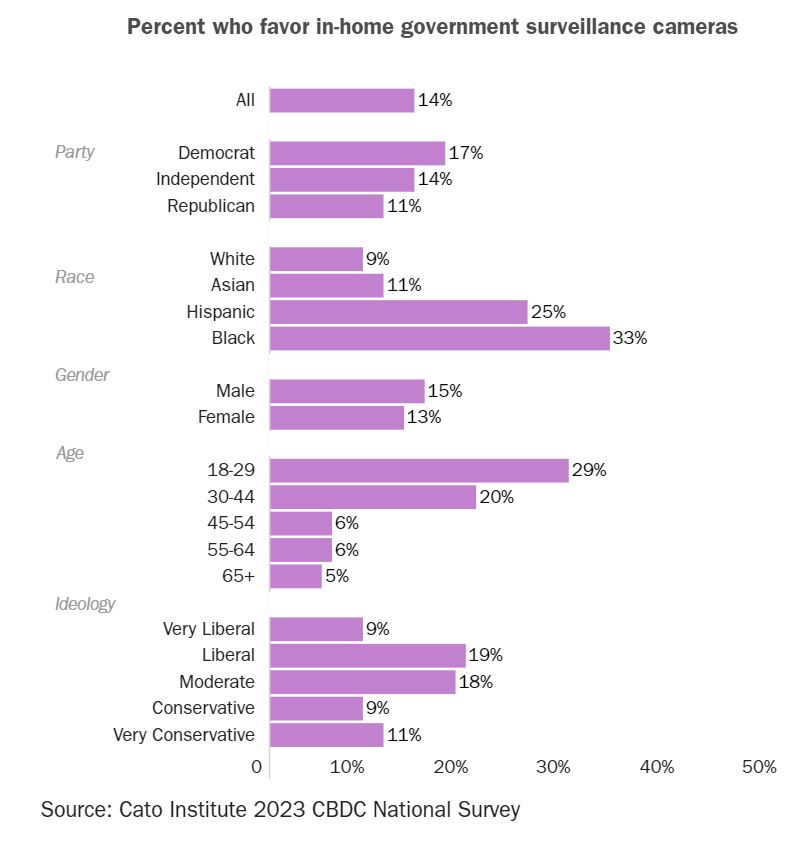
“African Americans (33 percent) and Hispanic Americans (25 percent) are more likely than White Americans (9 percent) and Asian Americans (11 percent) to support in‐home government surveillance. Democrats (17 percent) are also more likely than Republicans (11 percent) to support it but not by a wide margin,” Cato reported.
The libertarian think tank pointed out that it asked the question about home surveillance as part of its survey on Central Bank Digital Currencies “to see whether there is a relationship between opinions on the government issuing a central bank digital currency and government installing cameras in homes.”
“It appears that the two opinions are correlated. Interestingly, more than half (53 percent) of those who support the United States adopting a CBDC are also supportive of government surveillance cameras in homes, while only 2 percent of those who oppose a CBDC feel the same,” the institute reported.
“This suggests there may be a common consideration that is prompted by both issues. Likely, it has to do with willingness to give up privacy in hopes of greater security.”
The margin of error for the survey is plus or minus 2.54 percent.
Oregon’s magazine ban, pistol purchase permitting scheme set for trial
Oregon’s narrowly-approved Measure 114 has been on hold for the past several months thanks to a circuit court judge’s injunction, but a separate federal lawsuit is set to go to trial next week, and gun owners are hoping that the ballot initiative will be struck down entirely by the courts.
U.S. District Judge Karen Immergut declined to issue a temporary restraining order of her own shortly after the law was approved by less than 51% of voters last November, ruling that the magazine ban was presumptively constitutional on the theory that the magazines aren’t likely protected by the Second Amendment in the first place, but even if they are, banning them is okay because its meant to address “unprecedented societal concerns” about mass shootings. Now she’s set to preside over a five-day trial that will delve more deeply into the constitutional questions surrounding Measure 114’s ban on commonly-owned magazines, with the state of Oregon and Measure 114’s defenders arguing that the bans are a life-saving necessity and opponents maintaining that the ban is a violation of our fundamental right to armed self-defense.
Immergut last week denied each side’s motions to rule in their favor without a trial.
“The record contains genuine disputes of material fact, which would benefit from full development through trial,” she wrote.
She said she’ll consider whether large-capacity magazines “constitute a dramatic technological change from earlier firearms capable of firing more than 10 rounds.”
Immergut also noted that she’ll take up the constitutionality of the gun permit requirement under Measure 114, but she likely won’t consider how it will be applied in reaching her opinion.
Measure challengers contend the permits will deprive law-abiding citizens of guns because state police haven’t yet hired sufficient staff to handle the anticipated increase in background checks required to obtain a permit.
“Evidence about future implementation is not ripe for determination in this trial,” Immergut said.
Based on Immergut’s previous ruling, it seems pretty clear that she’s looking for ways to justify the ban, and as Reason’s Jacob Sullum noted shortly after she declined to issue a TRO, she seems willing to twist the words of the Supreme Court in order to do so.
The FPC cites a couple of real-life cases that suggest magazine capacity can be crucial in fending off armed home invaders. More generally, it notes that shots fired in self-defense often miss their target, even when fired by trained police officers. Measure 114’s exemption for police officers recognizes that fact, the FPC says, and “the average Oregon citizen has just as much right as a police officer to defend herself with standard capacity magazines.”
For Immergut, however, the crucial point is that situations where Oregon’s magazine limit would impair self-defense are “exceedingly rare.” In effect, she is suggesting that arms are not covered by the Second Amendment unless the government agrees that they are “necessary”—and not for “lawful purposes” generally but for self-defense in particular.
Immergut even questions whether “large capacity magazines” are “in common use” for “lawful purposes,” which seems undeniable given how many law-abiding Americans own them. “Plaintiffs have not shown that magazines capable of accepting more than ten rounds of ammunition are firearms in ‘”common use” today for self-defense’ and thereby covered by the plain text of the Second Amendment,” she writes.
The Supreme Court has said that the central component of the Second Amendment is self-defense, but nothing in Heller, McDonald, or Bruen suggests that only arms that are in common use for self-defense are protected. If so, that would set up a bizarre standard that would allow for single shot bolt action hunting rifles to be banned, while protecting the handguns that were the primary target of gun control activists for decades.
While self-defense may be at the heart of the Second Amendment, the text plainly (and simply) refers to the right to keep and bear arms. Unless the state of Oregon can come up with longstanding historical analogues to banning commonly-owned arms (which they’ve so far been able to do), the state’s ban should be overturned by Immergut. I’m not all that confident the judge will apply the Bruen test appropriately and fairly, especially given her initial opinion, but unless she’s engaging in some anti-gun activism from the bench it shouldn’t be a close call to find in favor of the plaintiffs when the trial concludes next week.
BLUF
My hat is off to the commies. They found a weak portion of the nation and convinced them that submission is strength and not cowardice. Your blue-haired, trans-pansexual sister-in-law will proudly move into a pod she shares with an “undocumented” Honduran serial rapist while calling you a bigot for not complying.
The Democrats’ Greatest Achievement: Convincing Idiots That Tyranny Is Virtue
I have to give it to the progressives Marxists–they sure know how to play the long game.
The far lefties have spent decades demonizing conservatives, Republicans, and white Christians as hateful, racist, terrorists, hell-bent on oppressing minorities, and, lately, guilty of taking down our American democracy, while at the same time assuring their minions they are morally superior to these same liberty-embracing crowd.
OPINION-O-RAMA! Many leftists are self-hating cowards who need to feel supreme over a group of people, and those people would be you and I. But what do I know? I’m just a former self-hating coward leftist who used to look down on people like you until a friend — whom I’ll call a true son of liberty — shook the stupid out of me.
Leftists, desperate to feed their cowardice — rather than starve it to death and replace it with courage — eat up their phantom supremacy by swallowing whatever self-righteous balderdash their Democrats masters throw at them, even if that means slowly stripping away their own freedoms.
Those at the top of the Democrat hate pyramid have learned they can thrust tyranny on their myrmidons if they just thinly disguise it with a bogus sense of virtue. The weak are easy prey.
Die-hard leftists will trip over themselves in a desperate attempt to out-virtue signal their Bolshie friends, and if that means cutting off their noses to spite our Constitution-loving faces, so be it.
[California) SENATE PASSES BILL TO EFFECTIVELY BAN NEW PISTOL SALES IN CALIFORNIA
A measure that greatly expands the mandate for firearms technology that isn’t on the market won easy approval in the California state Senate last week.
California Sen. Catherine Blakespear’s SB 452 passed on a 29-10 vote on May 24 and goes to the state Assembly for further consideration. The Encinitas Democrat argues that the bill “simply puts to use readily available technology to help law enforcement catch criminals” by banning all sales or transfers of any semiautomatic pistol after July 2027 unless it has been verified as having a microstamping-enabled action.
Despite Blakespear’s assertions that microstamping, a process that etches unique identifiers on expended cartridge cases, is available, no such guns are in production.
Anywhere.
In 2013, Kamala Harris, then the California attorney general, put the state’s long-dormant microstamping requirement into effect, requiring new pistols certified for commercial sale be able to mark expended brass with a microscopic array of characters, which identify the make, model, and serial number of the pistol upon firing.
Since then, the state’s roster of approved handguns has shrunk, with only legacy semi-autos – which were grandfathered – and revolvers currently listed. For example, the roster contains no approved Generation 4 or Generation 5 Glock handguns, all of which debuted after 2013. Likewise, the SIG P365, one of the most popular carry pistols in the country, cannot be found on the list.
Larry Keane, general counsel for the National Shooting Sports Foundation, one of the groups currently challenging the 2013 law, told Guns.com previously that the state is experiencing a “slow motion handgun ban as fewer and fewer models are allowed to be sold in the state. California is to handguns what Cuba is to cars; only old models are available.”
Blakespear’s legislation, backed by anti-gun groups such as Brady and Everytown, would effectively close off access to even these legacy guns by creating a separate and distinct restriction on the sale or transfer of any semi-automatic handgun by a licensed dealer unless it is capable of microstamping.
However, the state has seen its current law in troubled waters, with a case brought against it drawing heat from a federal court earlier this year. That court, in the case of Boland v Bonta, saw the California DOJ hit with a preliminary injunction as the case proceeds.
“The microstamping provision requires handguns to have a particular feature that is simply not commercially available or even feasible to implement on a mass scale,” U.S. District Judge Cormac J. Carney’s order reads.
Meanwhile, SB 482, which is co-sponsored by California Gov. Gavin Newsom, is now in the Assembly, where Dems hold an overwhelming 3/4 (62-18) majority.

Guest opinion: Todd Buchanan: Do we really need assault weapons for self-defense?
We just passed the first anniversary of the massacre at Robb Elementary School in Uvalde, Texas. One month following that horrific event, in the case of New York State Rifle and Pistol Association, Inc. v. Bruen, the Supreme Court set a new, restrictive standard for Second Amendment cases.
No longer will it suffice to demonstrate that a gun regulation is narrowly tailored to address a compelling governmental interest. Instead, it must be shown to be consistent with the national tradition of gun regulation.
This was an innovation, though Justice Thomas, in the majority opinion, asserted that the 2008 case of District of Columbia v. Heller had established the precedent by expressly rejecting “means-end scrutiny” in Second Amendment cases. Justice Alito had first made that claim in his plurality opinion in McDonald v. Chicago in 2010.
Everytown is staffed by the stupid.
It was illegal for a 15 year old to have that gun. The part to make it fully auto was also illegal. It was illegal for him to take it on school property. It was illegal for an adult to give it to him. Child endangerment is illegal.
That was just a small sample of existing laws…
— Currermell (@currermell) May 27, 2023
New Jersey Politicians Enact Largest Gun Ban in U.S. History
When Governor Murphy and the New Jersey Democrats rushed a flurry of gun laws through the legislature last June of 2022, one of the laws rammed through was under the guise of banning guns with no serial numbers.
This law banned millions of rifles, shotguns, handguns, hunting guns, target shooting guns, military surplus guns, and virtually ALL muzzleloaders, black powder guns, antique guns, air guns and BB guns.
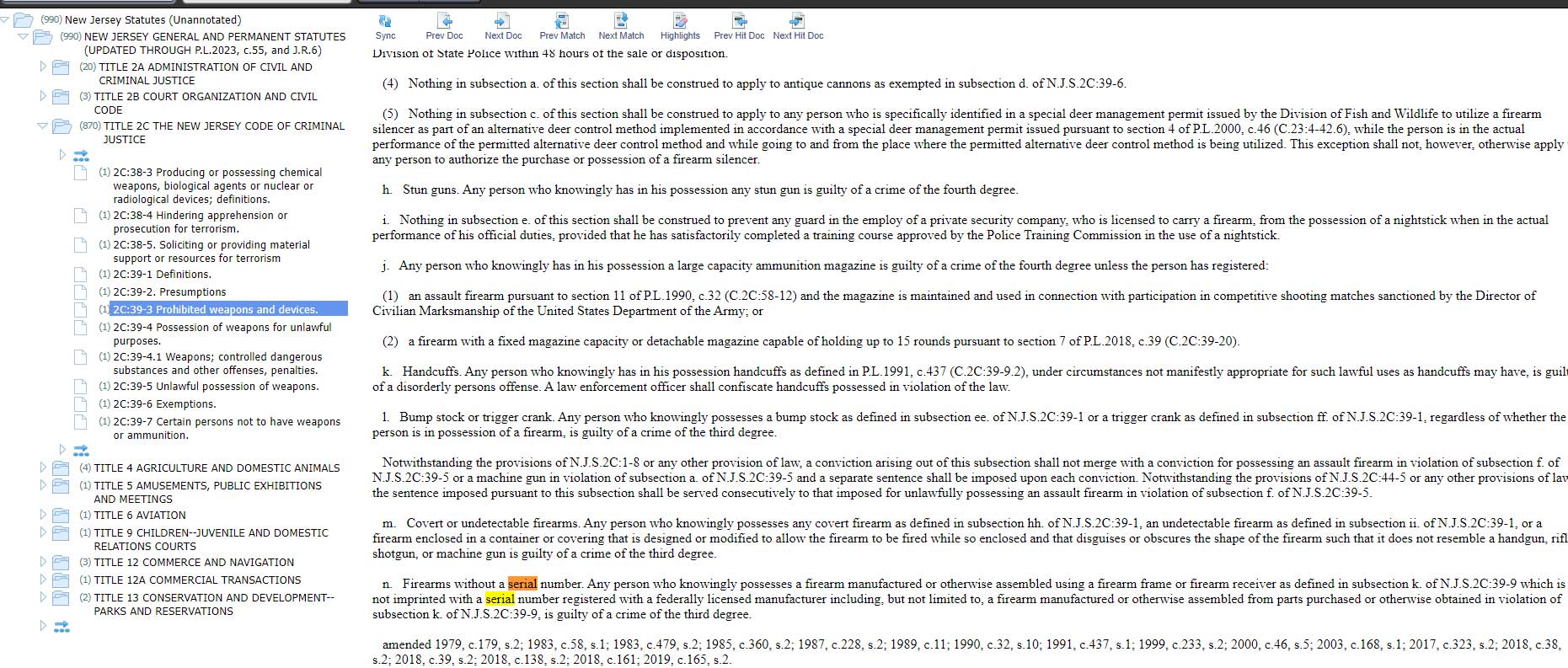
There are NO exceptions and there is NO grandfathering. This was the largest gun ban ever passed in the history of the United States.
The law bans ALL firearms with a “…firearm frame or firearm receiver …which is not imprinted with a serial number registered with a federally licensed manufacturer…”
The term “firearm frame or firearm receiver” means the part of a firearm that provides housing for the internal components.
For ANY firearm to be legal in New Jersey, it must now meet two criteria established by this law:
CBS News shows why no one should take the media seriously
We here at Bearing Arms have no pretension of being unbiased. As a result, you folks reading this have an idea of where we stand on issues. For those who agree, that’s why you’re here. For those who don’t, you know to filter things through the appropriate lens.
But places like CBS News still want you to think they’re unbiased.
That gets harder and harder every single year. Especially with headlines like this: “Texas senator continues to call for common sense gun safety laws”
Now, let’s start by noting that a Texas state senator continuing calls for gun control is newsworthy to some degree, especially in light of the Uvalde anniversary.
The subject matter is arguably appropriate and as this is labeled as “local news” on the CBS News site, it makes sense. Yet that label also presents a bit of a problem.
See, one of the first things you need to do if you’re going to at least pretend to be neutral is leave your editorializing out of the headline.
For anti-gun folks, they don’t see an issue. Pro-Second Amendment folks, though, can see it plain as day. The phrase “common sense gun safety laws” isn’t an official term rooted in neutrality. It’s the exact way gun control organizations frame the laws they’re trying to push onto the American people.
Had the reporter for CBS News put the phrase in quotations, then he’s just repeating what the senator may have said. Instead, it’s presented to the world as if this is an established fact. I hate to break it to him, though. It’s not.
Take the policy measures mentioned in the piece:
At a 45-minute news conference Gutierrez hosted at the Capitol earlier this month he said, “Every time something happens it’s something else and he’s got a solution for this that’s not related to the common denominator which is guns.”…
In an interview with CBS News Texas earlier this month, Gutierrez told me none of his gun safety bills received a hearing in the Senate, including a raise the age bill, universal background checks, and red flag laws. “It’s very clear here the Republicans’ position on gun reform they don’t want to try.”
Raising the age to buy an AR-15 only looks like it might prevent something bad from happening in a case like Uvalde, but the truth is that most people in that age group who buy those rifles do so because they want something they can use to defend themselves. Raising the age limit won’t stop bad people from getting guns–how many mass shooters have we seen who were too young to own any firearm?–but it will stop these law-abiding adults from owning guns.
That’s just common sense.
Universal background checks only look like a common sense gun measure because the media has done such a near-universal job of making them look like one. They don’t discuss how this doesn’t actually impact black market gun sales, it only inhibits law-abiding citizens transferring guns to one another. That’s literally all it does.
Red flag laws have tons of problems, problems which the media refuses to challenge proponents on. Besides the oft-cited due process concerns, there’s the simple fact that you’re saying someone is too dangerous to exercise their constitutionally protected rights but is just fine walking around on the streets.
Where’s the common sense there?
CBS News editorializing these policy measures as common sense doesn’t change the fact that they’re not. All it does is make it impossible to take anything else they say seriously on the issue of guns.
Their lack of neutrality is clear; so clear that even those on the fence about whether the media is biased should be able to see it for themselves.
Want to know why the polls look to be against us? It’s because the entire media apparatus is doing stuff like this.
This is why the media will never understand gun owners
Most people who read stuff here are either gun owners or know someone who owns a gun. At the very least, they’re sympathetic to having one.
Not counting the hate readers, of course.
The media, however, is full of people who don’t own guns, don’t know anyone they know has them, and perhaps more importantly, don’t want to know anyone who is a firearm owner.
And yet, they routinely write crap like this:
The story of a Pennsylvania church blessing AR-15s made the rounds on traditional and social media last week. The ceremony at the World Peace and Unification Sanctuary ministry in rural Newfoundland, PA, was widely ridiculed as bizarre and out of touch, but once you take away some of the theatrics, how different are these worshippers really from millions of Americans and the NRA?
The answer, it turns out, is not that much.
WhoWhatWhy went to Newfoundland twice last week, attended the gun-blessing ceremony and saw some things that the rest of the media seems to have missed.
Now, the church in question is the Unification Church, whose members are often called “Moonies” after the founder, Rev. Hyung Jin (Sean) Moon.
Observation O’ The Day:
Well, maybe it’s that ‘lizard sized brain’ you say you have that inhibited your intellectual development past moron level. What a hypocrite of an editor, sitting behind your desk, using rights protected by the 1st amendment to denigrate rights protected by the 2nd.
As Judge Alex Kozinski of the 9th Circuit put it:
The Second Amendment is a doomsday provision, one designed for those exceptionally rare circumstances where all other rights have failed—where the government refuses to stand for reelection and silences those who protest; where courts have lost the courage to oppose, or can find no one to enforce their decrees. However improbable these contingencies may seem today, facing them unprepared is a mistake a free people get to make only once.
Fortunately, the Framers were wise enough to entrench the right of the people to keep and bear arms within our constitutional structure. The purpose and importance of that right was still fresh in their minds, and they spelled it out clearly so it would not be forgotten.
From my cold dead hand: Gun groups perpetuate militia myth to keep whatever arms they dream of
About the Second Amendment: I have questions.
I cannot wrap my lizard-sized brain around the notion that the reason for people to keep and own guns is to protect against tyranny.
Spare me the historical discourses about the establishment of the Second Amendment, because I realize a bunch of a rag-tag colonists rose up against the lobsterbacks and sent the British running.
That was when the average firearm for both sides could take more than a minute to load one bullet or any other trash you could find to pack down the barrel. Saying Americans should still own any gun or as many as they want isn’t the same as saying we rose up once with muskets, swords and cannons. One is set against a historical backdrop when dysentery and smallpox killed as many soldiers as bullets. Today’s backdrop is set against a scene of unspeakable firepower often used against innocent citizens, many times kids at school.
One was in defense of an entire country; the other, killing for the sake of killing – and quickly.
Everyone has accepted that the primary reason for accepting guns everywhere is because of the concept that those same firearms may be needed to fight against a tyrannical government.
Few, though, really question how sound that rationale is.
You see, I am all for keeping my guns for a lot of different reasons, but I’d rather say it’s for self-defense before tricking myself that I am just a soldier-in-waiting for the government to go full-tyranny on the country.
Like Vermont has a problem.
Vermonters, lawmakers await decisions on contentious gun reform bills
MONTPELIER, Vt. — One year after the tragic school shooting in Uvalde, Texas, Vermont lawmakers looked back on firearm-related bills passed in the 2023 session that they believe will make Vermont a safer state.
One of those will implement a mandatory 72-hour waiting period from the time you purchase a gun to when it enters your possession.
“When somebody has the impulse to buy a gun and use it for a sinister purpose like maybe a school shooting or something like that, or if they intend on harming themselves, those 72 hours can be so vital,” Rep. Conor Caser, Executive Director of GunSense Vermont, said.
Some believe the bill violates the Second Amendment and is unconstitutional. Gov. Phil Scott has not said he will veto the bill but has expressed strong concerns in recent weeks.
“I don’t doubt that if this goes into law that there will be a constitutional challenge,” said Scott.
However, the governor is expected to sign off on a bill that strengthens penalties on straw purchases and the defacing of serial numbers on firearms, which lawmakers believe will reduce crime in and out of state.
“They go in and buy them [guns] and then trade them for drugs, and the folks who can’t possess obviously have the firearm. And we’ve seen them used in crimes in other states,” Sen. Richard Sears said.
It remains clear that lawmakers will not agree on the policies of all the bills, but both sides of the aisle say the fact that three firearm reform bills made it to the governor’s desk this session is something they have never seen before.
“Passing three is a first, I must say, but the dynamics have changed also in the last 15-20 years. The makeup of the body, the numbers in the body, you’ll see on most of those bills they are predominately supported by Democrats,” Rep. Patrick Brennan, a Republican, said.
Sears believes public tragedies such as what happened in Uvalde also played a role.
“I think Vermonters’ views of firearms have changed dramatically due to the mass shootings we’ve seen in other states such as Uvalde a year ago,” Sears said.
Most bills passed by the Senate and House within the last two weeks of the session, including the two firearm bills, have still not officially made it to the governor’s desk as the legislative council finishes the process of looking them over.
Once they do, Scott will have five days to make a decision on whether to sign them or not.