

Job Biden will announce his 2024 intentions when Joe Biden is told to announce his 2024 intentions. #PuppetPresidency
— Tony Morocco (@AJMorocco) April 10, 2023
Category: Crap For Brains
No one believes this
Bower: No One Needs Guns Today Because We Have Police and the National Guard.
Republicans won’t vote for gun control legislation for three main reasons: They receive hefty campaign contributions from NRA and gun manufacturers. They’re afraid of being voted out of office by their gun-loving constituents. They honor Second Amendment rights above all other Constitutional rights.
…The Constitution was written at a time when there was no police force. There was no National Guard. It stands to reason citizens were given the right to keep and bear arms; if threatened, they were the militia. Today, if we need protection, we call the police. If government officials determine a crowd is getting too threatening, they send in the National Guard. They don’t call on individual citizens to come out and lend help with their guns.
Doing nothing about gun violence is unacceptable. There have been 130 mass shootings just since Jan. 1. The number one cause of death of American children and teens is gunshot wounds. Sixty-three percent of Americans want more gun controls. Republicans always fall back on the excuse that gun violence is a mental-health problem; which by the way, they don’t fund adequately. They call for more security to barricade children inside their school buildings. Republicans’ lamest excuse for inaction? “We’ve already done about all that can be done.” …
The idea that guns are carried openly on the streets in several red states is obscene. Iowa doesn’t even require a permit to open carry. I saw a photo recently of a guy with an AR-15 strapped across his back while standing in line to buy a can of pop at a convenience store.
This is just sick
— June Bower in Column: This Is a Republican Problem
Study makes bizarre leap about guns and lethality of shootings
There’s always going to be some anti-gun study floating around. We’ve seen that time and time again, and the media will always be happy to report on that study with nary a word of criticism about, well, anything.
In fact, it’s almost amusing how little criticism these studies get.
The latest, in fact, doesn’t actually make a whole lot of sense. Why? Because it implies that guns have somehow become more lethal.
A new study has found that fatalities from gun violence in the U.S. have increased over time, with more victims dying at the scene of a shooting before they can be transferred to medical treatment facilities.
The research, which was published Wednesday in the Journal of the American Medical Association, examined gun violence incidents from 1999 to 2021, including firearm deaths due to assaults, unintentional injuries and unknown intent.
Using data from the U.S. Centers for Disease Control and Prevention, researchers discovered the proportion of deaths at the scene increased from about 52% in 1999, to almost 57% in 2021.
Nearly 49,000 people died from gun violence in the U.S. in 2021, according to the CDC.
The research letter summarizing the study said this increase in fatalities was likely due to several factors, including higher guns sales, social isolation during the COVID-19 pandemic, and a “lack of new federal firearm legislation.”
Now, the good news is that this study didn’t count suicides. That’s actually surprising because it’s a handy way to skew findings in an anti-gun direction. So it seems the numbers are pretty accurate.
Where I have a problem, though, is their findings. Higher gun sales and lack of regulation don’t make guns more lethal. In fact, during the time period the study looked at, there weren’t really any advancements in firearm technology that would account for any such thing.
We also know that so-called assault weapons started becoming popular prior to this time period as a result of the 1994 Assault Weapon Ban, so it’s unlikely that would play a role. The researchers do try to blame larger capacity magazines, which might play a role–if you can put more rounds on target, the chances of killing someone are increased–but I don’t see how they figure they made that case.
In fact, they seem to suggest they didn’t even really look at that sort of thing when they note, “Further investigation of the temporal and geospatial distributions of prehospital deaths, weapons used, patterns of injury, and variations by race and ethnicity and age is needed to guide effective interventions.”
So they reached a conclusion as to why this was a problem when they don’t know any of that other stuff?
I don’t know, seems a little sketchy, which is why I say this study kind of doesn’t make any sense.
Yet again, though, they seem to just know the problem is the lack of federal gun control laws while not comprehending literally anything else? Yeah, no wonder people are growing to distrust research more and more.
It’s only too bad no one in the media will look at these studies twice.
BREAKING: Another Would-Be Trans Mass Shooter Arrested
William Whitworth, a 19-year-old male who claims to be female and goes by the name “Lilly,” has been arrested in Colorado Springs, Colo., after threatening various local schools. Whitworth has been charged with two counts of criminal attempt to commit murder in the first degree, as well as criminal mischief, menacing, and more. His case, following so soon after Audrey Hale, a woman claiming to be male, murdered six people at a Christian school in Nashville, once again raises the question: wouldn’t we be better off treating this “transgender” business as mental illness rather than coddling and celebrating people who suffer from these delusions?
KRDO in Colorado Springs reported Thursday that Whitworth made “threats involving schools in Colorado Springs Academy District 20.” This was where he himself went to school between 2014 and 2016; KRDO adds that “they attended both in-person and the district’s Homeschool Academy.” Whitworth did not have an accomplice; KRDO is referring to him as “they” because Whitworth himself apparently prefers to be referred to in the plural; after all, the demons said long ago, “My name is Legion, for we are many” (Mark 5:9). Curiously, however, KRDO begins referring to Whitworth as “she” and “her” later on in its report.
It is a peculiar manifestation of the madness of our age that even as a mentally ill individual plots to act upon his mental illness by murdering people, those who report on this fact still treat his mental illness as if it were perfectly normal and even torture the English language in order to accommodate it. Apparently, no one at KRDO had the vision or wisdom or simple guts to say, “Hey, this trans kid was just planning to kill people, maybe we shouldn’t coddle him and pretend that he’s in his right mind by referring to him according to the pronouns of his delusion and fantasy.” No one would have dared.
Nevertheless, all was clearly not sane or well at the Whitworth household. Police were first called out to visit the Whitworths last Friday, when they received reports that the sister of the reporting party had “threatened to shoot up a school,” had “anger issues,” and had spoken the day before about “school shooting.” When deputies arrived at the house, according to their report, “someone at the door” told them that “someone inside” was “very upset and punched holes inside the walls,” but nonetheless initially refused to let them in. Eventually, they were let in, however, and found “two holes that appeared to be punch marks in the wall,” as well as a door off its hinges. In a bedroom, they encountered the reporting party’s “sister.” It was “Lilly,” that is, William Whitworth.
When the deputies asked Whitworth if he was planning to shoot up a school, he nodded. When they asked him why he would do such a thing, Whitworth replied: “Why does anyone do it?” He was then asked if he planned this massacre at Timberview Middle School, which he had attended, and he nodded again. Asked why he picked that school, he mumbled: “No specific reason.” He added that he also planned shootings at local churches.
The deputies eventually found Whitworth’s manifesto, which he himself dismissed as “schizophrenic rants.” Asked if he was schizophrenic, he answered: “I hope not.” Well, it may not be that, Whitworth, but it’s something, and all the people who told you that “transgender people” were beautiful and courageous and stunning and brave and not at all mentally ill share responsibility for bringing you to this point.
Authorities also found floor plans of the school and directions for how to build a detonation device. They also found a copy of The Communist Manifesto (well, well, well), a list of weapons and 3D printer instructions, hit lists, and a list of various public figures, including conservative YouTuber Lauren Southern, whom Whitworth described as “Pathetic,” and Donald Trump, whom Whitworth dismissed as a “Con-mam” (sic). “Bad cops,” said Whitworth, were “useless garbage.”
William “Lilly” Whitworth, in sum, is yet another Leftist “trans” would-be mass murderer in a society whose leaders steadfastly ignore the existence of such people and blame their victims. Old Joe Biden, Merrick Garland, and the rest are virtually certain to ignore Whitworth as well since he doesn’t fit their narrative about how “white supremacists” constitute the greatest terror threat the nation faces today. Or if they pay any attention to him at all, it will be to affirm their solidarity with the “transgender community” and scold patriotic Americans once again for daring not to believe that men can become women. William Whitworth isn’t the only mentally ill person in this scenario.
Don’t worry about reading the article as it’s standard leftist bilge the DailyKos produces daily. Simply savor reading the headline that they’re coming to the realization their beloved gun grabbing dreams are being smashed on the rocks of reality.
No federal assault weapons ban will pass. And the Supreme Court could soon overturn all state bans
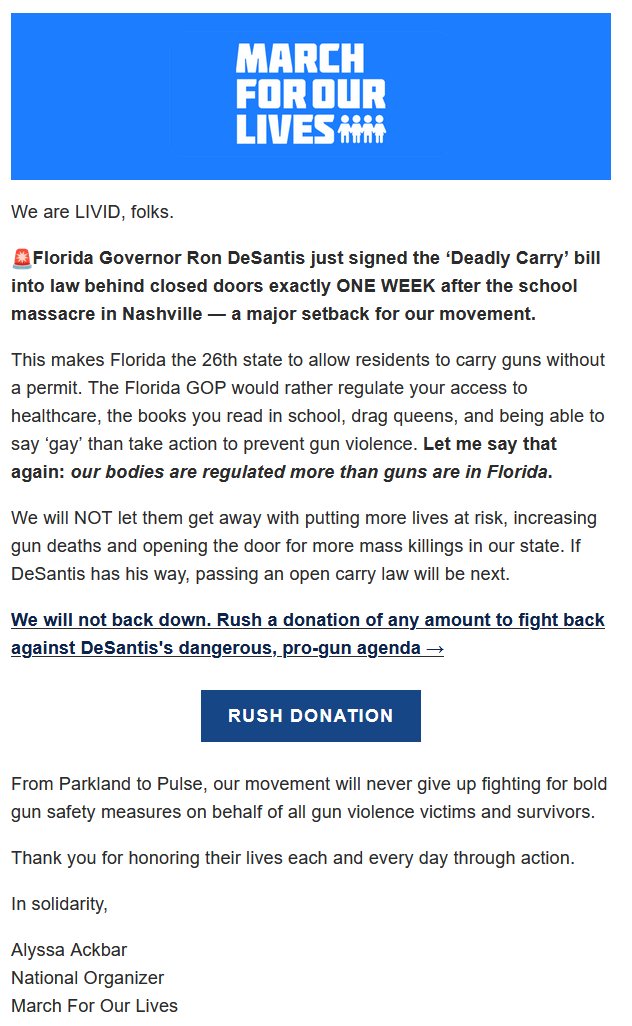
The new gungrabber term for permitless carry – “DEADLY CARRY”
Eeeeeeeeeeeeeeeeeeeeeeeeeeeeeeee.
2 Georgia men killed — one electrocuted, the other in explosion — during theft at power station
GAINESVILLE, Ga. — Two Georgia men are dead after attempting to steal copper wire from a power substation, Gainesville police told CBS News.
The men have been identified as Shane Joseph Long, 45, and Christopher Blair Wood, 44.
Police responded to the power station after getting a call from someone at a nearby business saying there was an explosion, CBS News reported. Both firefighters and police made their way to the explosion where they found the two men dead.
An investigation revealed the two men were thieves attempting to steal copper wire and other electrical components, police said.
Lieutenant Kevin Holbrook told CBS News that one of the men was killed by electrocution and the other man could have been killed by the transformer explosion.
Autopsies are still being conducted to determine the cause of death.
CBS News reports that nationwide, power stations have been reporting a rise in copper wire or metal theft. Holbrook the robbers sell the wire to scrap yards or third-party individuals.
Profits from these sales are generally low, Holbrook told CBS News.
Actually, It Is ‘Blah, Blah, Blah’
One pernicious development of these parlous times has been the rise of various cults that ape the trappings of Christianity while being fundamentally and unalterably opposed to its moral tenets. Case in point, the Marxist Suicide Cult masquerading as heroic do-gooderism that goes by the name of “climate change,” by which these solipsistic lunatics mean “man-made climate change.”
The argument that the climate is changing is prima facie false, because there is no argument. The climate is always changing. An hour in any major art gallery immediately illustrates that. Start with the Dutch paintings from the Little Ice Age, such as Brueghel’s Hunters in the Snow from 1565 if you doubt me. Note also that the old city of Alexandria, in Egypt, which was founded by the Macedonian Greek Alexander the Great c. 331 B.C., and once ruled over by Cleopatra, is now under water. Man had nothing to do with either.

All gone now.
In fact, to say that puny human beings can affect the climate is arrogance of the highest order when one considers the size of the Sun and the vastness of even our little solar system at the edge of the Milky Way galaxy. “An ant in the afterbirth,” as Mr. Dolarhyde famously put it.
In the roughly five thousand years of recorded human history, there has been one period in which we have had a real taste of our climate’s potential for moodiness, beginning around the start of the fourteenth century and lasting for hundreds of years. During this epoch, often known as the Little Ice Age, temperatures dropped by as much as two degrees Celsius, or 3.6 degrees Fahrenheit…. This was also the period between the end of the Middle Ages and the birth of the modern world.
The effects of the Little Ice Age were global in scale. In China, then as now the most populous country in the world, the Ming dynasty fell in 1644, undermined by, among other things, erratic harvests. In Europe, rivers and lakes and harbors froze, leading to phenomena such as the “frost fairs” on the River Thames—fairgrounds that spread across the river’s London tideway, which went from being a freakish rarity to a semi-regular event. (Virginia Woolf set a scene in “Orlando” at one.) Birds iced up and fell from the sky; men and women died of hypothermia; the King of France’s beard froze solid while he slept… in 1588, the Spanish Armada was destroyed by an unprecedented Arctic hurricane, and a factor in the Great Fire of London, in 1666, was the ultra-dry summer that succeeded the previous, bitter winter.
And then a warming trend began, continuing into our day: high culture flourished, science advanced along with the arts, and a longer growing season helped fuel a rise in population. This, of course, is not good enough for the ninnies, hysterics and bed-wetters who are convinced We’re All Going to Die if we don’t immediately reverse these civilizational advances (which, remarkably, seemed to have passed the entire southern hemisphere by), tear down our offending infrastructure, cease having babies (but import other people’s babies), reduce our mobility, and ban everything that “pollutes” our precious air and water, even at the cost of a grotesque and unnecessary reduction in living standards: 1565, here we come again!
Analysis: A Legal Template for Upholding AR-15 Bans is Emerging
A federal judge upheld Delaware’s “assault weapons” ban this week using reasoning likely to resonate with other courts inclined to reach the same outcome.
On Monday, Federal District Judge Richard G. Andrews, an Obama appointee, found the state’s ban on AR-15s, AK-47s, and similar firearms–along with its ban on magazines that hold more than 17 rounds–is constitutional. He did so despite finding the guns were “in common” use for lawful purposes.
“[I] conclude that the prohibited LCMs, like the prohibited assault long guns, are in common use for self-defense and therefore ‘presumptively protect[ed]’ by the Second Amendment,” Judge Andrews ruled in Delaware State Sportsmen’s Association v. Delaware Department of Safety and Homeland Security.
That probably left a lot of people doing a double-take. But Judge Andrews came to his conclusion after arguing AR-15s and the like weren’t common during the founding era and represented a technological advancement that is responsible for a uniquely modern problem: mass shootings. Because of this, he argued Bruen allowed him to look for historical analogues that show a history of regulation instituted for the same purpose and using the same means.
He ruled there was such a tradition.
“I find that the LCM and assault long gun prohibitions of HB 450 and SS 1 for SB 6 are consistent with the Nation’s historical tradition of firearm regulation,” he wrote. “Plaintiffs have therefore failed to demonstrate a likelihood of success on the merits of their Second Amendment claim.”
He pointed to the proliferation of late 19th Century Bowie knife and Billy club bans, plus later machinegun bans, as evidence governments have previously banned the sale of weapons they believe are associated with especially dangerous criminal behavior. He further argued banning a subset of weapons was a relatively minor burden and one that was similar to his historical examples.
“[B]oth sets of regulations impose a ‘comparable burden,” he wrote. “Indeed, the burden that the challenged regulations impose is slight.”
Judge Andrews isn’t the only, or even the first, one to use this concept to save a ban. District Judge Karin Immergut, a Trump appointee, denied an attempt to block Oregon’s magazine limit under the same basic framework. While she went further and said she didn’t need to do a Bruen analysis at all because ammunition magazines aren’t protected by the plain text of the Second Amendment, she did the analysis anyway, and it came out along the same lines as Judge Andrews’ argument.
It’s likely other courts will adopt this framework as well.
Other courts, namely the Ninth and Fourth Circuits, have previously shown they don’t believe AR-15s or similar guns should be sold to civilians. The old two-step balancing test of the pre-Bruen era was explicitly about whether the argued public safety impact of banning the guns was enough to overcome the infringement on the right of Americans to have them. Any court that upheld an “assault weapons” ban before 2022 essentially said “yes.”
So, given the opportunity to review the law again, it’s fair to think they may want to find a way to reach the same conclusion. That’s especially true if the path to that answer appears to at least plausibly fit within the Supreme Court’s new test.
Of course, Judge Andrews’ reasoning has some serious flaws. For one, it seems to be making the same mistake in the eyes of the Court that the two-step test did: going one step too far.
Reading Heller, McDonald, and Bruen provides the impression that any class of firearms considered to be in “common use” for lawful purposes, such as self-defense, is inherently protected by the Second Amendment and can’t be banned by the government.
“The traditional militia was formed from a pool of men bringing arms ‘in common use at the time’ for lawful purposes like self-defense,” The Court wrote in Heller.
“Indeed, that is precisely the way in which the Second Amendment’s operative clause furthers the purpose announced in its preface. We therefore read Miller to say only that the Second Amendment does not protect those weapons not typically possessed by law-abiding citizens for lawful purposes, such as short-barreled shotguns. That accords with the historical understanding of the scope of the right[…].”
That Judge Andrews finds AR-15s and the other banned guns in common use for the purpose of self-defense and then proceeds on to further analysis is unlikely to be what The Court had in mind. It seems relatively clear SCOTUS doesn’t believe it is possible to ban any gun that is in common use for lawful purposes. So, the detour into comparing modern “assault weapons” bans to 19th Century Bowie knife or Billy club bans will likely be unpersuasive should it ever make its way up to The High Court.
It also suffers from the lack of a limiting principle. Judge Andrews argues that the self-loading, semi-automatic technology found in AR-15s and the other banned guns didn’t become popular until after the Civil War. And their adoption led to the rise of mass shootings (never mind that semi-automatics were becoming common about 100 years before the onset of modern mass shootings).
But there’s nothing in Judge Andrews’ line of reasoning that wouldn’t prevent the same argument from being applied to all semi-automatic firearms or an ammunition magazine of essentially any size. That includes semi-automatic handguns, which the Supreme Court has already ruled can’t be banned.
Still, even if the prospects for success on appeal to the Supreme Court are dim for this argument upholding AR bans, it will likely proliferate in some of the most important circuits because it at least attempts to follow the Bruen steps while still maintaining the bans. And, even if the weaknesses are as serious as they appear, pointing them out will only matter if the Supreme Court actually takes up a case involving them. After all, the two-step test The Court excoriated in Bruen was the defacto review standard on gun cases for a decade because of SCOTUS inaction.
Whatever ends up happening, expect to see Judge Andrews’ legal reasoning pop up anytime a gun or magazine ban is upheld.
Yes, that's one of the main problems I see with it as well.
— Stephen Gutowski (@StephenGutowski) April 2, 2023
In 1986, Florida passed “shall issue” concealed carry legislation, kicking off a decades-long trend across the country that has continued to this day. At the time, Florida’s adoption of shall-issue language was a very big deal and a huge change to the “may issue” status quo, and gun control advocates did their best to drum up the public’s fears; predicting “Wild West shootouts” over parking spaces and a descent into a dystopian hellscape. As the NYTimes breathlessly reported in 1987 as the “shall issue” law took effect:
Only Florida has a law ”in which a license to carry a concealed gun is given by the state,” said Sarah Brady, vice-chairman of Handgun Control Inc., a Washington-based lobbying group. ”We believe that this kind of decision should be made on a local level where people know one another rather than applying to a state office.”
Attorney General Robert A. Butterworth noted this month that the law, passed overwhelmingly by the Legislature in the spring, ”has left the area of unconcealed manual possession of a firearms totally unregulated.”
This gap has created ”the possibility of openly armed youth gangs hanging around street corners and gunmen parading through a shopping mall,” the Attorney General wrote in a letter urging that the law be amended in the current special legislative session.…
”It was about time for Florida to have such a law,” said Richard M. Manning, a National Rifle Association official who pushed for the legislation.
He is counting the days until the law goes into effect Thursday. So too is Mrs. Brady and other gun control supporters, and they are worried about what will happen in Florida. Widepread weapons possession ”is not the best way to handle the increase of violence,” said Mrs. Brady, whose husband, James S. Brady, the White House press secretary, was shot in an assassination attempt against President Reagan. ”We are the only civilized nation in the world without a good gun law and we are the most violent in the West.”
A funny thing happened after “shall issue” went into effect: crime dropped, and not just by a little bit. Between 1987 and 2019, Florida’s violent crime and homicide rates declined by more than 50%, and the state now has around 2.5-million active concealed carry licenses.
But in the wake of the Florida legislature sending a permitless carry bill to Gov. Ron DeSantis, anti-gunners are dusting off their old arguments and once again deploying them in a campaign of fearmongering. Here’s a portion of Miami Herald columnist Fabiola Santiago’s hyperbolic response to the passage of HB 543 headlined “Permitless carry and gun sanctuary cities. Visit Florida at your own risk – it’s a blast!”
This is a state where people aren’t required to register guns like they do cars or house alarms. There’s no paperwork, no background check involved when gifting or privately selling guns. Only in gun shop and gun show sales do buyers undergo basic scrutiny.
And now, not even first-time gun users will be required to learn how to use a gun, online or in a gun range, to carry a concealed gun around the rest of us.
Their new right puts the rest of us at greater risk of dying as a result of their incompetence.
The permitless carry bill, CS/HB543, now heads to Gov. DeSantis, a fan of even worse, open-carry. He will be all too giddy to sign it into law. He was the bill’s chief proponent, although, hypocritically so — the governor doesn’t want guns at his events.
Remember, he got caught asking the city of Tampa to ban firearms at his election party — and to take the blame for it so he didn’t have to?
DeSantis had nothing to worry about.
“Historic NRA Win: Constitutional Carry Passes in Florida,” the organization boasted in a press release sent, in its own words, “moments” after the vote. They’ll shower DeSantis with funds for his likely presidential run.
But for the safety at major events — like spring break in South Beach — the new law foreshadows new trouble.
Although there’s talk that it could be possible to fence in an event, call it a private party and prohibit guns — like at DeSantis’ election event — “the gun law passed by the Legislature allowing concealed weapons with no permit or training will make 2024 in South Beach a nightmare,” said Stuart Blumberg, a 77-year resident of Miami Beach and founder of the Greater Miami and the Beaches Hotel Association.
Agreed, said Michael Grieco, a former Miami Beach commissioner and ex-state Rep. , a criminal defense attorney who carries a concealed weapon: “It’s just going to exacerbate the problem. I’m a Democrat and gun-owner, and this bill passed scares the crap out of me. As a father who drives his kid to school every week,” he said, pausing, “now anyone can just go buy a gun with only some nonsensical, lighthearted background check.”
Umm, that was the case before HB 543 was approved by lawmakers.
The bill doesn’t make any changes to the purchase or sale of firearms. It simply states that those Floridians who would be eligible to obtain a concealed carry license can carry a concealed firearm without the need for a government-issued permission slip. All those prohibited from possessing or carrying a firearm today will still be forbidden from doing so when the law takes effect on July 1st.
To opponents of Florida’s permitless carry bill, it’s the 1980s all over again. But while Florida was at the forefront of the “shall issue” movement almost 40 years ago, it’s far from an early adopter of permitless carry. When DeSantis signs HB 543 into law, Florida will join 25 other states in recognizing the right to bear arms without paying hundreds of dollars in fees and costs to do so. None of the doom-and-gloom predictions from anti-gunners have come to pass in those states, and not one has seen fit to repeal its permitless carry law after deciding it was a mistake.
In fact, I’ve got a story that should put Fabiola’s fears to rest. It comes from the constitutional carry state of Ohio; specifically the city of Toledo, which has not had a firearm-involved homicide since early February, when a 15-year-old boy was shot and killed inside his home. In fact, as of March 31st Toledo has only reported six homicides this year, well below where the city was at this point in 2021 and 2022, before constitutional carry took effect. The true number is likely even lower; one incident involved a man shot and killed by Toledo police, another fatal shooting is probably going to be ruled a justifiable homicide given that it was a burglar who was shot, while the family of the 15-year-old says he was the victim of an accidental shooting and not an intentional act of violence.
I’m not exclusively crediting constitutional carry for the plunge in homicides. Crime is complicated, and there are undoubtably a number of factors at work. But it’s clear that permitless carry, by itself, does not lead to an automatic rise in shootings or gun-involved murders any more than “shall-issue” concealed carry led to more crime in Florida in the decades after it was enshrined into law. Most violent criminals aren’t legally walking around with guns to begin with, so the new law will be of little note or use to them. What’s most important is that law enforcement sticks to the tactics and strategies that are most effective in reducing violent crime; focusing on the most violent and prolific offenders instead of casting a wide net of gun control laws over the general public.
The current doomcasting over Florida’s permitless carry law is nothing more than a rehash of decades-old arguments that have been proven false time and time again. The attempts to scare the pants off the public will only intensify between now and July 1st, but gun owners should keep calm and look forward to the day when they can carry on their person without having to get a permission slip from the state beforehand.
Yes, his opponent is a carpet bagging RINO, but still, Pennsylvanians knew exactly what they were voting for.
Fetterman Does First Post-Depression Interview and Raises a Multitude of Questions
John Fetterman has finally been released from the hospital after suffering from a reported bout of severe depression. The Pennsylvania senator has long been at the center of controversy surrounding his ailing health, largely centering on the massive stroke he had prior to the 2022 election.
Since then, Fetterman has deteriorated in ways that would have led to immediate calls for his resignation were he not a member of the Democratic Party. He can’t speak properly, he can’t understand others properly, and he relies on a closed captioning device to communicate.
It’s good to be a Democrat, though, and the press has been rushing to cover for him since day one. That continued on Friday with an interview with CBS News that did nothing but raise a multitude of questions.
Six weeks after entering Walter Reed National Military Medical Center for inpatient treatment for depression, Sen. @JohnFetterman shares his struggle with depression, his health, and more in an intimate interview with Jane Pauley this "Sunday Morning." pic.twitter.com/3o2926I48B
— CBS Sunday Morning 🌞 (@CBSSunday) March 31, 2023
For starters, is this guy a US senator or not? I’m not trying to downplay his condition. Quite the contrary, but the Senate is not a place to battle depression, much less serious health issues that leave one unable to communicate. The question at hand isn’t how brave Fetterman supposedly is. It’s whether he can do his job, and he obviously can’t. That should be the top issue for every single person who interviews him. Instead, they lavish him with praise while helping him hide his actual condition. It’s dystopian.
Past that, a lot of people noticed where Fetterman’s eyes were going during the interview. Not only is reading the questions on some kind of monitor just off-screen (which CBS News is careful to not show), but he’s pretty clearly also reading his answers. His eyes stay glued to the screen the entire time, with only passing glances at the interviewer herself.
There were also 11 different editing cuts in the 45-second clip that CBS News released. Let me say that again. There were 11 cuts in under a minute.
Those edits weren’t just made for promotional purposes. They were cuts all made during a single question. Why? Because Fetterman takes time to read his monitor and often loses his train of thought. CBS News, instead of being honest with its audience, is trying to hide that fact.
Does that sound like something an honest press would do? If this were a Republican, would they be bending over backward to cover up just how bad things are? We all know the answer to that. Fetterman is not fit to be a US senator. It was easy for anyone to see during the campaign, and he’s even worse off now. Truly, there is nothing the Democratic Party won’t do to hold onto power.
Ultra-ultra crap-for-brains o’ the day
Op-ed claims Founding Fathers would want gun control
I’m a big believer in the Constitution, including the Bill of Rights. It’s why I’m a Second Amendment advocate. The way I see it, our Founding Fathers put together a document that did a pretty good job of limiting the government and securing our rights.
Too bad it’s ignored, such as the push for gun control.
But with frightening regularity, there comes someone who seems to act like they held a séance with the Founding Fathers and knows that their past words in support of the Second Amendment and the right to keep and bear arms would go out the window.
The tragic shootings in Nashville, with children and staff at the Covenant School being killed, demands action from Congress. But so many times we have seen Congress do nothing after gun violence.
If America’s Founding Fathers could have traveled in time to today, they would be horrified to see these mass shootings in our schools and communities. They would also be shocked that the Congress has done so little to stop these tragedies.
The Founding Fathers, if they could have foreseen the terror of today, would surely have revised the Second Amendment. They would urge us to implement gun control today.
There must be some limitations on the right to bear arms of the Second Amendment. There must be gun control including banning assault weapons. As the late Supreme Court Justice Antonin Scalia once wrote “Like most rights, the right secured by the Second Amendment is not unlimited.”
First, while I respect the late Justice Scalia, he wasn’t a Founding Father. Injecting his comment, one often taken drastically out of context, isn’t making the case.
The author here, like so many others, claims the Founding Fathers wouldn’t have supported the right they literally fought and bled for if they could see the bad things happening today.
Yet they offer no evidence for such a claim. Nothing in their writings of the time suggested they were in favor of forfeiting the right to keep and bear arms simply because people could do bad things.
In fact, that claim flies directly in the face of something one of our Founding Fathers said explicitly. Thomas Jefferson said, “I prefer dangerous freedom over peaceful slavery.” That tells me that yes, he’d look at what we see today, and while he would mourn those lost lives, there’s little reason to believe he’d suddenly want to restrict people’s rights.
The Buckeye Firearms Association has a very handy list of other pro-gun quotes from our Founding Fathers, none of which suggest even a hint of support for the idea of gun control.
See, what the author has done is convince himself of a fiction, that the Founding Fathers are whatever he wants to believe them to be. Further, since so many of us look to them for guidance on matters of policy, he somehow hopes he’ll suddenly be the one to trick us into supporting gun control.
That’s really not how it works. You can’t just say, “They’d support me,” then just expect people to shrug and accept it.
Let’s also remember that in the time of the founding, private parties owned artillery and equipped their own private warships–letters of marque were a thing, after all–which could lay waste to people in numbers even the much vilified AR-15 couldn’t.
If they were willing to trust the American people with that, then just why would you assume they’d suddenly support gun control? The fact that you just really, really want them to isn’t enough.
Yet this is what passes for reasoning, apparently.
Missouri bill to ban federal “red flag” laws, funding killed by Republican senator
JEFFERSON CITY — A Missouri bill that would ban federal funds and programs from being used in the state to enforce “red flag” gunmeasures was killed by a committee Wednesday.
Republican Sen. Bill Eigel of Weldon Spring filed the legislation, Senate Bill 10, in response to a recent plan from the U.S. Department of Justice to distribute dollars to states to administer “red flag” laws and other crisis intervention programs related to gun violence.
But the legislation failed to pass out of committee after a Republican joined Democrats in voting it down, citing a school shooting in Nashville this week that killed three students and three adults.
Sen. Lincoln Hough, a Springfield Republican, joined the two Democrats on the committee to vote against the legislation. Three other Republicans — Sens. Rick Brattin, Rusty Black and Mike Bernskoetter — voted in favor of the bill, but did not reach the majority of votes required. The fourth Republican on the committee, Sen. Mike Cierpiot, did not vote.
“I think it’s a little disheartening, quite frankly, to even be having this sort of conversation given what happened two days in Nashville,” Hough said prior to the vote. “But I’m more than happy to go ahead and have a vote right now.”
Bernskoetter, the chairman of the committee, responded that “I told (Eigle) I would have a vote on it and I’m having a vote on it.”
Eigel has said the legislation “builds on” a 2021 law that nullified federal gun statutes in Missouri, which is currently facing litigation and has been decried by members of law enforcement.
“The federal government, the Biden administration, is trying very hard to try to use federal dollars to be sent into the state of Missouri to incentivize the creation of these red flag databases,” he said at a hearing in February.
In a Twitter post Wednesday after the vote, Eigel alleged that Hough and Cierpiot had “coordinated and vote to derail” the bill, calling it a “dark day for supporters of (the Second Amendment).”
Wednesday’s vote marks the second consecutive session Hough has joined with Democrats in committee to vote down legislation relating to guns. He and another Republican voted with Democrats last year to kill legislation that would have expanded legal immunity for those who shoot and kill someone in self-defense. That bill was dubbed the “Make Murder Legal Act” by an association of county prosecutors.
Karine Jean-Pierre Responds to Question About Gun Confiscation With an Alarming Answer
When faced with a relatively easy question about President Joe Biden’s position on gun confiscation policies, White House Press Secretary Karine Jean-Pierre wouldn’t give a straight answer.
Invoking repeatedly failed candidate Robert Francis O’Rourke’s 2019 presidential debate promise that “hell yes, we’re going to take your AR-15, your AK-47,” a reporter asked Jean-Pierre, “Does the president support not just banning the sale and manufacture of semi-automatic weapons but further than that, confiscation?”
It’s a straightforward question: Does President Biden think legally owned firearms should be confiscated by the federal government? But Jean-Pierre wouldn’t say “yes” or “no” in what should be an easy answer.
Instead, Jean-Pierre ignored the question and retreated to the usual Democrat talking points about “weapons of war” that “should not be on the streets across the country in our communities, they should not be in schools, they should not be in grocery stores, they should not be in churches — that’s what the president believes.”
Jean-Pierre went on to claim Biden “has done more than any other president the first two years” to address what Democrats say is a crisis of “weapons of war” in America. “Now it’s time for Congress to do the work,” Jean-Pierre said. “And he’s happy to sign, once that happens, he’s happy to sign that legislation that says, ‘ok we’re going to remove assault weapons, we’re going to have an assault weapons ban.'”
Even though Karine Jean-Pierre wouldn’t say whether Biden supports gun confiscation for “assault weapons,” President Biden’s record on the subject is not a winning one, nor is Democrats’ obsession with eradicating “assault weapons” — a purposefully non-specific term usually paired with other buzzwords such as “military style” — a policy goal that’s been shown to limit instances of violence in which the perpetrator uses a firearm.
As we at Townhall have repeatedly noted, Biden’s frequent claim that the “assault weapons” ban he worked on as a U.S. senator was effective just doesn’t pass muster. Biden and his administration’s claim that it’s possible to get the specter of “assault weapons” off America’s streets is one this administration employs frequently while attempting to take advantage of tragedies. “But according to data provided by the Department of Justice, the ban cannot be credited with reducing violence or mass shootings,” Katie noted after Biden repeated the claim last May. Here’s what the DOJ found:
A 2004 Department of Justice funded study from the University of Pennsylvania Center of Criminology concluded the ban cannot be credited with a decrease in violence carried out with firearms. The report is titled “An Updated Assessment of the Federal Assault Weapons Ban: Impacts on Gun Markets and Gun Violence, 1994-2003.”
“We cannot clearly credit the ban with any of the nation’s recent drop in gun violence. And, indeed, there has been no discernible reduction in the lethality and injuriousness of gun violence, based on indicators like the percentage of gun crimes resulting in death or the share of gunfire incidents resulting in injury,” the summary of the report on the study’s findings states. “The ban’s impact on gun violence is likely to be small at best, and perhaps too small for reliable measurement. AWs [assault weapons] were used in no more than 8% of gun crimes even before the ban.”
If banning “assault weapons” didn’t reduce gun violence, nor reduce the lethality of gun violence, then passing a new ban or going as far as confiscating such firearms — something Karine Jean-Pierre wouldn’t rule out this week — won’t make a difference either and will only further infringe on the rights of Americans.
Federal District Judge Wimes Creates Novel Excuses to Rule 2A Protection Act Unconstitutional
U.S.A. –-(AmmoLand.com)-— On March 6, 2023, federal Judge Brian C. Wimes ruled the Missouri Second Amendment Protection Act was unconstitutional, claiming the Act violates the Supremacy clause of the US Constitution, invalidates federal law, and violates the doctrine of “intergovernmental immunity”.
On June 12, 2021, Governor Parson signed the Missouri Second Amendment Protection Act (SAPA). The act prohibits state and local officers from cooperating with Federal agents to enforce certain federal laws, mostly to do with firearms.
The Federal court system has long held states cannot be compelled to use their resources to enforce federal laws. States are not required to explain why they do not wish to use those resources to enforce federal laws. They have the power to refuse to do so. To hold otherwise is to collapse the power-sharing between states and the federal government into a monolithic entity controlled by the federal government. This doctrine is known as the anti-commandeering doctrine.
Judge Wimes appears to be nullifying the anti-commandeering doctrine by claiming Missouri must use state resources to investigate and prosecute federal law. Refusing to do so, Judge Wimes claims, is “obstructing” federal law enforcement, which is somehow a violation of the supremacy clause and intergovernmental immunity.
From the opinion:
SAPA is an unconstitutional “interposit[ion]” against federal law and is designed to be just that. Id. Section 1.410(5) states the Missouri General Assembly’s declaration that the Supremacy Clause “does not extend to various federal statutes, executive orders, administrative orders, court orders, rules, regulations, or other actions that collect data or restrict or prohibit the manufacture, ownership, or use of firearms, firearm accessories, or ammunition exclusively within the borders of Missouri . . . .” Mo. Rev. Stat. § 1.410(5). However, the Missouri General Assembly’s assertion that the Supremacy Clause does not extend to acts of Congress does not make it so. To the contrary, 15 “[t]he law of congress is paramount; it cannot be nullified by direct act of any state, nor the scope and effect of its provisions set at naught indirectly.” Anderson, 135 U.S. at 490.
SAPA does not prevent agents of the federal government from investigating, arresting, prosecuting or convicting residents of Missouri who violate federal law. It prevents agents of the state and local governments from assisting federal agents in doing so. Judge Wimes claims the anti-commandeering doctrine does not apply by quoting reasons in SAPA for the purpose of the law. But the purpose of state law has not generally been an issue in anti-commandeering doctrine. The Constitutionality of laws is based on what the law does, not what the law claims the purposes of the law are.
Poor Huffpo.
[Heller and McDonald] allowed opponents to wage new battles against longstanding gun laws. When District Judge Roger Benitez overturned California’s 34-year-old assault weapons ban two years ago, he pointed to Heller, saying that under the decision, “it is obvious that the California assault weapon ban is unconstitutional.”
Because the Heller ruling applied to guns in common use, the sheer volume of semi-automatic rifles in America protects them under the Second Amendment, according to Mark Oliva, a spokesperson for the National Shooting Sports Federation.
“There are currently 24.4 million of these rifles in circulation today,” Oliva said. “To put that into context for you, there are more of these rifles in circulation today than there are F-150s on the road.” …
Eight more states have laws similar to California’s assault weapons ban that could be affected if the Supreme Court ultimately weighs in.
The expectation that these laws may be doomed is already complicating the politics of passing new ones like them.
In New Mexico, Democratic Gov. Michelle Luján Grisham has repeatedly urged the legislature to send her an assault weapons ban to sign this session, but lawmakers tabled the effort — partly over concerns that it wouldn’t withstand scrutiny in federal court.
“There’s absolutely no point to passing new laws which federal courts will strike down and which are clearly going to be deemed unconstitutional,” state Sen. Joseph Cervantes, a Democrat, tweeted last month.
With those lawsuits still playing out, the future of gun policy remains in flux. But that legal panorama makes it hard to imagine clear lanes for reform in the near future.
“We’re in a very difficult spot with that Bruen ruling,” said Miranda Viscoli, co-president of New Mexicans to Prevent Gun Violence. “Even though it was only about concealed carry, it’s just made everybody afraid who wants to pass common sense gun violence prevention legislation.”
— Roque Planas and Paul Blumenthal in How the Courts Are Strangling Gun Reform
Nashville shooting: White House presses GOP on assault-style weapons ban
President Joe Biden is seeking to put pressure on congressional Republicans to pass an assault weapons ban after three children and three adults were killed during a school shooting in Nashville, Tennessee.
“He wants Congress to act because enough is enough,” White House press secretary Karine Jean-Pierre told reporters Monday. “How many more children have to be murdered before Republicans in Congress will step up and act to pass the assault weapons ban?”
Schools should be “safe spaces for our kids to grow and learn and for our educators to teach,” Jean-Pierre said, adding Biden had been briefed on the situation and that the White House is coordinating with the Justice Department and local officials. She defended Biden’s gun-related executive orders and the Bipartisan Safer Communities Act, which incentivized states to introduce so-called red flag laws.
“I don’t have the data” on the effectiveness of Biden’s unilateral action, the press secretary said.
Biden will address the shooting at a small-business event Monday afternoon, she added.
Six people are dead, as well as the shooter, after a 28-year-old woman opened fire with two assault-type rifles and a handgun Monday morning at the Covenant School, a private Christian school in Nashville.

This is what happens when pronouns are a higher priority than logistics
U.S. Weapons Stockpile Disaster Limiting Our Ability To Deter China In Taiwan
It’s so bad now, even the New York Times is reporting about it.
In late January we reported that U.S. military weapons stockpiles were so low that various commentators were describing the shortages as “uncomfortably low,” “insufficient,” “precarious,” and “dangerous” due to the large quantities of these weapons we had given free of charge to Ukraine: U.S. Weapons Stockpiles “Uncomfortably Low” Due To Arms Shipments to Ukraine:
To date, the U.S. military has provided a “staggering” amount of military hardware and munitions to Ukraine in its defense against Russia’s invasion, amounting to more than $27 billion. This U.S. support has included over 1 million rounds of 155 mm howitzer ammunition. It has also included 8,500 Javelin anti-tank missiles, 32,000 anti-tank missiles of other types, 5,200 Excalibur precision 155 mm howitzer rounds, and 1,600 Stinger anti-aircraft missiles, among many other weapons systems and munitions.
[T]he Heritage Foundation’s Center for National Defense concludes that “[t]he fact that only a few months of fighting in Ukraine consumed such a large percentage of U.S. Stingers and Javelins suggests that the DOD’s plans, and the stockpiles that result from them, are insufficient.” Even the Washington Post has conceded the seriousness of the situation, noting that “[s]tocks of many key weapons and munitions are near exhaustion,” and citing a…CSIS report that concludes that “the U.S. defense industrial base is in pretty poor shape right now [and] we don’t make it past four or five days in a war game before we run out of precision missiles.” The National Defense Industrial Association (NDIA) describes the state of U.S. weapons stockpiles as “precarious.”
The U.S. Naval Institute describes them as “dangerous” due to their low inventory levels. Even a U.S. Department of Defense official quoted by the Wall Street Journal admitted that munitions stockpiles are “uncomfortably low” in that they are “not at the level we would like to go into combat.” This official explained that the only reason the issue isn’t “critical” is because “the U.S. isn’t engaged in any major military conflict” at the moment.
The key problem, of course, as we reported, is that the administration’s official position is that, in the words of Chairman of the Joint Chiefs of Staff Army General Mark Milley, “we will continue to support [Ukraine] all the way” and “[w]e will be there for as long as it takes to keep Ukraine free,” despite the obvious impact of such support on U.S. weapons’ stockpile levels.
And one of the side issues, although of critical seriousness, is that this arms largesse to Ukraine severely impacts our ability to come to Taiwan’s aid in case of an invasion by China, as we reported:
Fred Guttenberg goes full retard.

Not sure you're helping your argument pic.twitter.com/TAN6dcFDzb
— Rob Romano (@2Aupdates) March 25, 2023

