
Chicago Mayor Brandon Johnson: Putting people in prison is racist, unholy and doesn’t lower violent crime rates.
Please stick with this message, Democrats. pic.twitter.com/1cNsImGxJS
— Western Lensman (@WesternLensman) August 25, 2025

Chicago Mayor Brandon Johnson: Putting people in prison is racist, unholy and doesn’t lower violent crime rates.
Please stick with this message, Democrats. pic.twitter.com/1cNsImGxJS
— Western Lensman (@WesternLensman) August 25, 2025
Let’s check in with the democrat mayor of Minneapolis and learn about how “assault rifles” work.
Oh, apparently they can “reel off 30 clips in conjunction with a magazine before a person even needs to reload” 🤡
These are the people who want to make “common sense gun laws” to… pic.twitter.com/9OqTOHuBN4
— Mrgunsngear (@Mrgunsngear) August 28, 2025
FPC Blasts Fifth Circuit’s Flawed Suppressor Ruling
NEW ORLEANS (August 27, 2025) – Firearms Policy Coalition (FPC) today condemned a badly flawed decision issued by Fifth Circuit Court of Appeals in United States v. George Peterson, an FPC-backed criminal appeal challenging the federal government’s unconstitutional National Firearms Act (NFA) firearm suppressor rules:
Once again, the Fifth Circuit has wrongly upheld the National Firearms Act in a dangerously flawed opinion that tramples the Constitution and disregards our nation’s history. Suppressors are unquestionably “arms” under the plain text of the Second Amendment. Nothing in our nation’s history of arms regulation supports the government’s unconstitutional taxation and registration mandates. Indeed, the federal government’s NFA scheme is not just dangerous to liberty, it is blatantly unconstitutional. FPC will continue to stand with Mr. Peterson and his counsel as they weigh every option in the fight ahead to put an end to the NFA and its unconstitutional regulations on suppressors and other protected arms. Individuals who would like to support Mr. Peterson’s appeal, our Brown v. ATF NFA challenge, and dozens of important cases to eliminate unconstitutional federal, state, and local laws should join our FPC Grassroots Army at JoinFPC.org.
D.C. Activist Criticizes Trump for Putting Blame on Individual Criminals
Even the BBC has admitted that violent crime has fallen in Washington, D.C. since Donald Trump’s declaration of an emergency in our nation’s capital, but some local activists insist that the surge in law enforcement, including federal officers and members of the National Guard, is political theater at best, and perhaps even counterproductive.
When President Donald Trump announced his federal takeover of Washington, D.C., he conjured images of a dystopia where “caravans of mass youth rampage through city streets” to justify his heavy-handed response.
But those who study and work on preventing youth crime in the district say the president is acting on a caricature of the city, and his decision to flood the streets with soldiers will do little to solve the issue.
Nick Wilson, senior director for Gun Violence Prevention at the Center for American Progress, called Trump’s crackdown “political theater that is disconnected from what we’re seeing here in D.C.”
Wilson would prefer things like a national ban on so-called assault weapons, universal background checks, and a host of other gun control laws that are already in place in Washington, D.C. In fact, as we reported yesterday, federal agents have been actively enforcing some of D.C.’s draconian laws, including multiple arrests for possessing a firearm without a license. You’d think Wilson would be thrilled to see those arrests, and maybe he is, but even the staunchest gun control activists can’t publicly praise Trump without risking condemnation from their fellow liberals.
The dumbest comment in the Time article comes from a local community activist, who is incensed that Donald Trump is trying to hold criminals responsible for their actions.
Tia Bell, who founded a gun violence prevention nonprofit aimed at young people in the city, says Trump’s villainization of D.C.’s youth misses the point.
“It’s a misalignment, because the blame is on the individual and not the systems and structural violence,” she says. “Our youth are angry—they feel like the media perpetuated a lot of narratives about them that led to this blame and criminalization.”
The media made me do it is one hell of an excuse for committing a violent crime, isn’t it?
You know a really good way to not get blamed for violent crime? Don’t commit one.
Even if you believe that there are root causes like poverty and broken families that can exacerbate crime, it’s still individuals who are committing violent carjackings, home invasions, and street robberies. These individuals may feel empowered and emboldened to commit these crimes because of D.C.’s lackadaisical approach to juvenile crime and truancy, and if Bell wants to fix those broken systems I’m with her 100%, but the fact remains that most juveniles in D.C., even those living in the most adverse environments possible, aren’t out there robbing, raping, and carjacking D.C. residents and visitors.
It’s a disservice to those kids to decide that individuals shouldn’t be held accountable for their own actions. In fact, I’d argue that, no matter how good Bell’s intentions might be, by casting crime as the product of “systems and structural violence” or media narratives, she’s essentially telling juveniles who aren’t breaking the law that there’s something wrong with them, not the juvenile offenders.
I’ve expressed my own concern about Trump’s crime crackdown leading to arrests for simply possessing a gun without a license, which contradicts his stance in support of permitless carry, but Bell’s concern is that Trump hasn’t taken a public health approach to gun violence, “addressing it like a ‘disease.’”
Bell believes the problem in D.C. cannot be solved with more guns.
“Federal violence cannot end violence in the communities—only we can,” she says.
I have no problem, at least in theory, with community violence intervention efforts that seek to reduce crime without putting more people behind bars for possessory gun offenses. The issue, though, is that while Bell might believe in a “public health approach” to “gun violence”, that approach all too often involves treating gun ownership itself as a disease that needs to be eradicated. Bell might not like the surge in law enforcement on the streets, but I doubt she’d be in favor of repealing D.C.’s draconian laws surrounding gun ownership either.
If these activists want to question Trump’s heavy-handed approach to fighting crime, they should at least be willing to do the same when Democrats turn our right to keep and bear arms into a criminal offense. Somehow, though, their “public health” approach always leaves plenty of room for putting more gun control laws on the books.
I blame insane people like Nebraska Senator Machaela Kavanaugh for the trans shooting. pic.twitter.com/aeCnbtdg0E
— Matthew Nichol (@MatthewNichol5) August 27, 2025
You can not make this crap-for-brains up.
Delegate at the DNC: “Republicans and fellow citizens who profess to be active Christians, I remind them that DEI is the very foundation of the Christian church.” pic.twitter.com/YwgpTEEUYR
— TheBlaze (@theblaze) August 26, 2025
John Cornyn learns not to mess with Texas
“Don’t mess with Texas” is a homespun aphorism that expresses a genuine sentiment. Texans, and to a slightly lesser degree, Wyomingites, are independent cusses. They’re proud of their states and their beliefs, and pushed too far don’t whine about why government isn’t making things right. They handle it themselves and vote the useless weasels out at the next electoral opportunity.
One such weasel is long-serving Texas Senator John Cornyn. Once thought a reliable Republican, he forgot which state he represents and stepped on a known Texas land mine: gun control. In Texas, weakness on the Second Amendment and cruelty to animals are two things among many guaranteed to provoke political death. Cornyn was thought among the most untouchable politicians in Texas until he went wobbly during the Biden’s Handler’s years and crossed the aisle to pass a 2022 gun control bill, the “Bipartisan Safer Communities Act (BSCA).” Cornyn wasn’t the only line crosser, but he crossed a Texas line, which Texans don’t forget or forgive. The Garland DOJ bragged about it in 2024:
June 25 marks the second anniversary of the enactment of the Bipartisan Safer Communities Act (BSCA) – a landmark law focused on reducing and protecting communities from gun violence. The Justice Department has pursued a cross-department approach with the new tools provided in BSCA, from enhanced background checks to grantmaking.
Accordingly, Cornyn is being primaried by Texas AG Ken Paxton, who has been leading Cornyn in the polls. As one might imagine, the media are doing all they can to try to negate Paxton’s lead. Both are Republicans, but they hate Paxton more:
The TSU poll shows Paxton leading Cornyn in a two-person Republican primary race by 5 percentage points. A similar poll conducted by TSU in May found Paxton leading by 9 percentage points.
“Cornyn has substantially narrowed the gap both related to our prior surveys but especially related to many of the surveys that were circulating earlier in the summer that had him down by 10, 15, 20 points or so,” said Mark Jones, a Rice University political scientist who co-directed the study.
Paxton has a variety of personal and professional issues dogging him, but that anyone could be so far ahead of Cornyn is a reflection of how ticked off Texans are. This kind of politically convenient memory lapse isn’t helping:
Cornyn apparently forgot the Internet, including his own website, is forever:
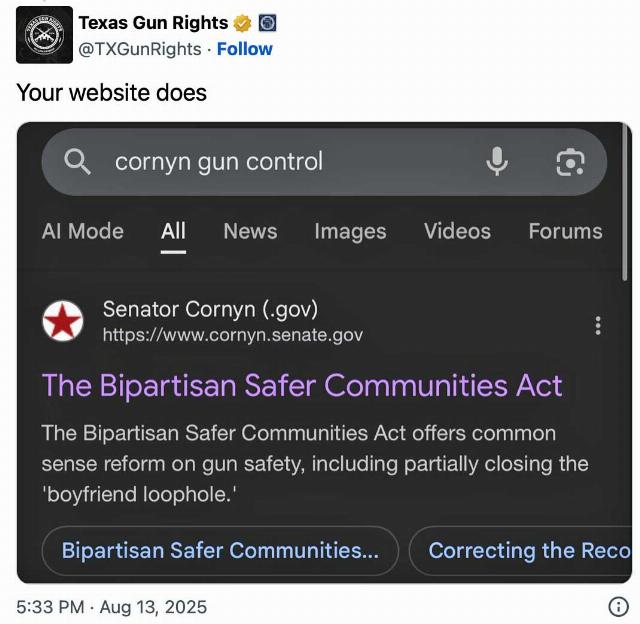
Shooting News Weekly’s headline is pertinent: “Is John Cornyn Cognitively Impaired Or Is He Just Lying About His Role in Passing Biden’s Gun Control Bill?”
I can’t vouch for cognitive impairment, but lying? As Texans might say: yup. They’re not fond of that either.
Texas Senator John Cornyn shocked gun owners across the country this week after denying any involvement in helping pass Biden’s signature gun control bill—the Bipartisan Safer Communities Act (BSCA)—despite his well-documented leadership role in getting it across the finish line in 2022. [skip]
The backlash was immediate and fierce.
“Perhaps at 73, Cornyn is starting to share more than just policy blunders with Biden,” said TXGR President Chris McNutt. “That creeping forgetfulness might explain why he’s also in denial about those abysmal polls showing AG Paxton wiping the floor with him. Texas Gun Rights is happy to remind Cornyn — and all pro-gun Texans — of his blunders.”
Just how mad are Texans at Cornyn? This mad:
Cornyn was booed by more than 8,000 delegates at the 2024 Texas GOP convention, and now faces rising grassroots opposition heading into the 2026 Republican primary. Both Texas Gun Rights PAC and National Association for Gun Rights PAC have already endorsed Paxton for U.S. Senate.
“Gun owners don’t forget betrayal,” said McNutt. “And they’re ready to make sure Cornyn never forgets 2026.”
Plenty can happen between now and the mid-terms, but Cornyn damned well knows how badly he screwed up and he’s fiercely backpedaling, trying to look like a solid Republican. Texans aren’t going to forget, and it looks like they’re not in a forgiving mood. If Trump endorses Paxton, Cornyn is likely toast and it will be his own fault.
BREAKING! Federal court rules it's ok to ban books as long as there are other books which can be purchased! Oh. Wait. My mistake. It actually said that about guns. The Bill of Rights is so darn confusing, isn't it? 🙄
— Tom Gresham (@Guntalk) August 23, 2025
Petro Opposes Right to Carry Guns in Colombia
Colombia’s President Gustavo Petro spoke yesterday during a Cabinet meeting about the ongoing debate over the right to carry guns among civilians. Petro repeated what he has previously stated on other occasions, expressing his support for keeping weapons solely in the hands of public security forces and not in civilian possession.
This is a recurring debate during election periods in Colombia, a country where violence is cyclical and the notion of self-defense resurfaces in political campaigns. While the conservative opposition makes legal gun ownership one of its key banners, the ruling party maintains that the state should monopolize the use of force, arguing that arming the population only fuels the cycle of violence.
During a Cabinet meeting held Yesterday, Tuesday, Aug. 19, Petro weighed in on the debate over the right to carry guns in Colombia. The President stressed the need to move toward a country where civilians are unarmed. In his remarks, he pointed out that Colombia must remain consistent with the principle that weapons should be monopolized by the state and not by private citizens.
It no longer feels paranoid to wonder if the UK government uses foreigners to subjugate their own people.
— Stephen Green (@VodkaPundit) August 13, 2025
2 years ago today, a historically illiterate Al Sharpton asked the following:
Can you imagine if James Madison or Thomas Jefferson tried to overthrow the government? pic.twitter.com/r8A8Nexyk1
— Steve Guest (@SteveGuest) August 3, 2025
Well, he’s nothing but a stooge, grandstanding again.
Murphy Tries to Re-Impose (and Hike) NFA Taxes After Congress Zeroed Them Out
We’ve been reporting on a rider inserted in the House Financial Services and General Government appropriations bill that would force Washington, D.C. to recognize valid concealed carry permits from all U.S. states and territories (as well as end the District’s “no guns allowed” policy for public transportation, but pro-gun Republicans aren’t the only ones trying to use the appropriations process to change gun laws.
Murphy’s trying to insert a rider into the Military Construction, Veterans Affairs, and Related Agencies appropriations bill with language to undo the NFA reform included in the OBBB and instead raise the transfer tax on NFA items from $200 to $4,709 for each transfer.
As Brady indicates, the nearly $5,000 that Murphy wants to impose essentially indexes the original $200 transfer tax imposed in 1934 to the rate of inflation over the past 90 years. Still, that’s much higher than what we’ve heard proposed from other anti-gun Democrats in Congress, who’ve talked about tripling the $200 tax once they have hte numbers to do so.
And therein lies the problem for Murphy. He can propose any kind of tax increase he wants, but he basically has zero chance of seeing his proposal included in the MCVARA appropriations bill (which has already passed the House). The Republican majority that voted to zero out transfer taxes on suppressors, short-barreled firearms, and “any other weapons” a couple of weeks ago isn’t going to turn around and vote in favor of dramatically hiking the taxes instead.
Murphy’s offered a couple of other amendments to the appropriations bill as well.
Amendment 2972 would require the Secretary of Veterans Affairs to issue a quarterly report on “the number of veterans who should have been reported to the national instant criminal background check system… if such reporting by the Secretary was permitted, and of those veterans, the number of suicides by firearm that occurred in the previous quarter”.
That amendment is a response to another rider that would extend the VA’s prohibition on submitting the names of those veterans who’ve had a fiduciary appointed to handle their affairs to NICS.
A temporary provision in the Consolidated Appropriations Act of 2024 and its extensions (including the Full-Year Continuing Appropriations and Extensions Act of 2025) prohibited the VA from making these NICS reports without a judicial finding. That provision, though, is set to expire on September 30 unless Congress includes similar language in this year’s appropriations bill.
And Congress has included that language. Section 412 of the MCVARA bill states:
None of the funds made available by this Act may be used by the Secretary of Veterans Affairs under section 5502 of title 38, United States Code, in any case arising out of the administration by the Secretary of laws and benefits under such title, to report a person who is deemed mentally incapacitated, mentally incompetent, or to be experiencing an extended loss of consciousness as a person who has been adjudicated as a mental defective under subsection (d)(4) or (g)(4) of section 922 of title 18, United States Code, without the order or finding of a judge, magistrate, or other judicial authority of competent jurisdiction that such person is a danger to himself or herself or others.
Murphy’s also offered an amendment that would simply strike that language from the appropriations bill so that veterans who’ve had a fiduciary appointed to help manage their financial affairs to be deemed a prohibited person without a judicial finding of dangerousness.
I doubt those amendments are going to fare any better than Murphy’s attempt to jack up NFA taxes by more than 2,000 percent, but gun owners should still be in contact with their Senators to encourage their opposition; both to these amendments and any others that would negatively impact our Second Amendment rights that might be introduced by anti-2A senators.
In Re the preceeding:
From the dissent:
“By the majority’s reasoning, any regulation of sales of ammunition is presumptively unlawful, unless the state can produce an identical historical twin,” – Judge Bybee
Yes you moron, they’re literally following Bruen: A law must have an analogue to the Founding Era. Does he think that the Founders were too stupid to have thought of restricting ammunition? That they couldn’t conceive of erecting barriers around it?
There’s no way that judge is that stupid. He’s trying to legislate from the bench and carry water for the demoncraps. No other explanation is possible, and that’s reprehensible.
Well, apparently we were misled earlier.
The partisan hack demoncrap appointed parliamentarian says that a tax law (so specified as such by the writes back in 1934 and so ruled as such by SCOTUS themselves isn’t a tax law that can be dealt with under reconciliation.
Breaking 2A News: WTF? Senate Parliamentarian rules Congress cannot remove suppressors or short barrel rifles/shotguns from NFA. This smells rotten. The NFA is clearly a tax subject to the reconciliation process.
— Mark W. Smith/#2A Scholar (@fourboxesdiner) June 27, 2025
Lurch is at it again.
“You cannot bomb away the memory of how to make a bomb,” says former Secretary of State John Kerry
Um, actually, you can—by ‘bombing away’ those who know how to make a bomb. When you do that, the memory of how to make a bomb goes into eternity with them.
— Darrell B. Harrison (@D_B_Harrison) June 24, 2025
Plus the physical plant needed too
Well, that’s definitely not ‘good behavior’……
Impeach: A Judge Decides to Ignore the Supreme Court on Deportation Ruling
The Supreme Court ruled that Trump’s deportations to third-world countries can continue without limited notice, blocking an injunction by a little judge who sought to wrest immigration policy away from the executive. The high court slapped down Judge Brian Murphy’s order, but like James Boasberg, another disgrace to the bench, he’s ignoring the ruling.
This isn’t normal. While the president can remove people under the Alien Enemies Act, these judicial insurrectionists tried to claim that due process had to be applied. That’s ludicrous; none of the illegals Obama deported had court dates. It’s another episode of the judicial coup against the Trump administration. Deputy White House Chief of Staff Stephen Miller said to be prepared for fireworks over what they will do to hold this little judge accountable.
What Trump’s Critics Still Don’t Understand About Iran.
We are assured that it’s not the group that calls itself an Islamic State because our political leaders and our media have told us so. It’s the same with Boko Haram. They regularly slaughter Christians, women and children included. Spokesmen for Boko Haram say that they represent Islamic teaching, but no: our leaders have assured us that that is not the case. “No religion,” said Obama, “condones the killing of innocents.”
Has the former president contemplated the glorious history of Islam and the glittering deeds of Mohammed? We have it on the highest—and for Muslims, the only—authority that the Prophet regularly slaughtered innocents. Consider, to take just one example,the siege of Medina in the year 627, then home to a Jewish tribe. After a couple of weeks, the inhabitants surrendered unconditionally. Mohammad then had the 600-800 men butchered and sold the women and children into slavery.
“We are not at war with Islam,” our leaders tell us. “We are at war with people who have perverted Islam.”
The impolitic question is, where are all those unperverted Muslims? In the common rooms of American universities? Maybe. In our cities and suburbs? Perhaps. But I think we can agree that it is not (to make an arbitrary and woefully incomplete list) the people behind such actions as
Islam, or a perversion of Islam? At some point, as Hillary Clinton might put it, what difference does it make? As we contemplate the future of Iran, I would suggest pondering the possibility that, even if “we are not at war with Islam,” Islam may well be at war with us.
From past history, this is not unexpected
Gov. Josh Stein vetoes bills addressing immigration enforcement, gun control
RALEIGH, N.C. (QUEEN CITY NEWS) — Gov. Josh Stein vetoed three bills Friday, two dealing with immigration enforcement and the other loosening of gun control.
Stein shot down Senate Bill 50, which aims to allow concealed carry without a permit……
Mexico Parrots Democrat Lawfare Despite SCOTUS PLCAA Rejection
It shouldn’t come as a surprise to anyone that anti-Second Amendment groups run by the Democrat party have been working closely with Mexican officials to attack American gun rights and subvert the U.S. Constitution. This collusion with a foreign government recently set the stage for the Supreme Court’s rejection of our southern neighbor’s $10 billion lawsuit which aimed to cripple the American firearms industry by seeking an outrageous judgement against Smith & Wesson and other U.S. gun manufacturers. But Mexican President Claudia Sheinbaum, ever willing to blame her own country’s abject failure and corruption on others, another strategy on loan from Democrat cohorts, has decided to push forward with an almost identical lawsuit, this time targeting gun dealers and distributors in Arizona.
Nobody knows more about abusing the U.S. judicial system than Democrats, and all the big names came out to bat for Mexico in its failed Supreme Court challenge of the Protection of Lawful Commerce in Arms Act (PLCAA), a federal law enacted in 2005 providing firearms and ammunition manufacturers, distributors, dealers, and importers broad immunity from civil lawsuits arising from criminal or unlawful misuse of their products. In both cases, the Mexican government, aka the legal arm of the narco-terrorist drug cartels, claims its damages stem from the illegal trafficking of firearms by the same cartels they work with and take bribes from under their normal course of business.

