
As is pointed out below, the SpaceX Falcon rocket will do more launches and carry more payload to orbit this year than the Space Shuttle did in its entire history https://t.co/a0GzXBMRcL
— Elon Musk (@elonmusk) October 24, 2025

As is pointed out below, the SpaceX Falcon rocket will do more launches and carry more payload to orbit this year than the Space Shuttle did in its entire history https://t.co/a0GzXBMRcL
— Elon Musk (@elonmusk) October 24, 2025
AWS outage reminds us why $2,449 Internet-dependent beds are a bad idea
This week’s Amazon Web Services outage had some people waking up on the wrong side of the bed.
A Domain Name System (DNS) resolution problem affected AWS cloud hosting, resulting in an outage that impacted more than 1,000 web-based products and services and millions of people.
Perhaps one of the most avoidable breakdowns came via people’s beds. The reliance on the Internet for smart bed products from Eight Sleep resulted in people being awoken by beds locked into inclined positions and sweltering temperatures.
As spotted by Dexerto, the AWS outage caused smart mattress covers from Eight Sleep to malfunction. These “Pod” mattress covers connect to a physical hub, and users can set the covers to temperatures between 55° and 110° Fahrenheit via a companion app. Eight Sleep also sells smart mattress bases that let people control their bed’s elevation with the app. As of this writing, the Pods’ MSRPs range from $2,449 to $3,249, and the base has a $1,950 MSRP. Eight Sleep also sells its Autopilot feature through an annual subscription that starts at $199. Autopilot is supposed to help automatically set Eight Sleep devices to users’ optimal sleeping conditions. Pod purchases require a one-year subscription to Autopilot.
Pods have on-device buttons for controlling the temperature without a phone, but the devices require an Internet connection for the adjustments to work. That limitation led to disturbing wake-up calls during the AWS outage as Eight Sleep smart beds became uncontrollable.
As one user on Reddit said:
I woke up too hot in the middle of the night last night and kept double-tapping like a maniac to adjust the temp[erature] down since I wasn’t getting any haptic feedback. I only found out why after I got up in the morning.
It would be somewhat understandable that Autopilot stops working because Eight Sleep’s backend is down but not being able to even adjust the temperature locally is ridiculous and completely unacceptable for such a high-end (and expensive) product.
A person on X wrote: “Would be great if my bed wasn’t stuck in an inclined position due to an AWS outage. Cmon now.”
Some users complained that malfunctioning devices kept them awake for hours. Others bemoaned waking up in the middle of the night drenched in sweat.
Even more basic features, such as alarms, failed to work when Eight Sleep’s servers went down.
Eight Sleep co-founder and CEO Matteo Franceschetti addressed the problems via X on Monday:
The AWS outage has impacted some of our users since last night, disrupting their sleep. That is not the experience we want to provide and I want to apologize for it.
We are taking two main actions:
1) We are restoring all the features as AWS comes back. All devices are currently working, with some experiencing data processing delays.
2) We are currently outage-proofing your Pod experience and we will be working tonight-24/7 until that is done.
On Monday evening, Franceschetti said that “all the features should be working.” On Tuesday, the company started making an offline mode available that works over Bluetooth when Eight Sleep’s servers are down, The Verge reported today.
“During an outage, you’ll still be able to open the app, turn the Pod on/off, change temperature levels, and flatten the base,” Eight Sleep co-founder Alexandra Zatarain told the publication.
Eight Sleep users will be relieved to hear that the company is making their products usable during Internet outages. But many are also questioning why Eight Sleep didn’t implement local control sooner. This isn’t Eight Sleep’s first outage, and users can also experience personal Wi-Fi problems. And there’s an obvious user benefit to being able to control their bed’s elevation and temperature without the Internet or if Eight Sleep ever goes out of business.
For Eight Sleep, though, making flagship features available without its app while still making enough money isn’t easy. Without forcing people to put their Eight Sleep devices online, it would be harder for Eight Sleep to convince people that Autopilot subscriptions should be mandatory. Pod hardware’s high prices will deter people from multiple or frequent purchases, making alternative, more frequent revenue streams key for the 11-year-old company’s survival.
After a June outage, an Eight Sleep user claimed that the company told him that it was working on an offline mode. This week’s AWS problems seem to have hastened efforts, so users don’t lose sleep during the next outage.
Litigation Highlight: Plaintiffs File Second Amendment Challenge to Federal Ban on Mailing Firearms
In mid-July, two gun-rights groups and an individual plaintiff wishing to mail a handgun to her father filed suit in federal court in Pennsylvania alleging that the federal ban on mailing firearms through the U.S. Postal Service violates the Second Amendment. This federal restriction dates to 1927—as the complaint notes, it was the first federal gun control law[1] and pre-dates the National Firearms Act by almost a decade. The lawsuit, which is still in its early stages, implicates tricky questions surrounding legislative intent and how historical tests can account for technological innovation.
Filed on July 14, the Pennsylvania case is captioned Shreve v. United States Postal Service. The plaintiffs ask the court to strike down 18 U.S.C. § 1715, which provides that “[p]istols, revolvers, and other firearms capable of being concealed on the person are nonmailable and shall not be deposited in or carried by the mails or delivered by any officer or employee of the Postal Service.” The law contains exceptions for guns mailed in connection with military or law enforcement service and for “customary trade shipments” in which firearms are conveyed from manufacturers to dealers. The statute only applies to the United States Postal Service. Knowing violations of the ban constitute a federal crime.
Shreve, a Pennsylvania citizen, would like to mail a handgun to her father as a gift and is permitted to do so under state law. The two organizational plaintiffs, Gun Owners of America and Gun Owners Foundation, each assert standing because “some of the[ir] members . . . also wish to use the U.S. Postal Service to mail their lawfully owned handguns and other concealable weapons for private, lawful purpose.” The plaintiffs assert that they cannot use private courier services—such as UPS or FedEx—because “private common carriers have prohibited the practice [of mailing guns] for several years.”
The plaintiffs in Shreve argue that the conduct of mailing firearms is protected because, “if the Second Amendment’s plain text did not cover such ancillary acts as shipment or receipt, the government could ban these acts outright, crippling Americans’ access to firearms.” They emphasize that, while “the U.S. Postal Service traces its lineage to 1775, . . . at no point did the Founders ever criminalize the mailing of handguns as the challenged statute does now.” The complaint further argues that exceptions to the federal ban—including for official weapons shipped by government agencies, commercial transactions, and long guns—belie any purported public safety objective. Plaintiffs frame the 1927 statute largely as a response to “anti-gun media sensationalism” that “did little – if anything – to curb violent crime.” Thus, the complaint concludes, the law “is inconsistent with Founding-era historical tradition [and] violates the Second Amendment.”
2A Rights Face a New Threat: Ideological Gatekeeping by Crypto Companies
By Larry Keane
Congress recently passed the GENIUS Act, a measure designed to bring stability and accountability to the digital asset market by providing a legal framework for U.S. dollar–backed stablecoins. Lawmakers wanted to encourage innovation while protecting consumers and reinforcing America’s leadership in financial technology. While Congress debated how to make stablecoins safer and more transparent, one of the industry’s largest players was quietly writing its own rules, creating a system that treats lawful firearm purchases as a prohibited activity.
Circle Internet Group, issuer of the U.S. Dollar Coin (USDC), hid a clause deep in its published terms of service that bans consumers from using USDC to purchase “weapons of any kind, including but not limited to firearms, ammunition, knives, explosives, or related accessories.”
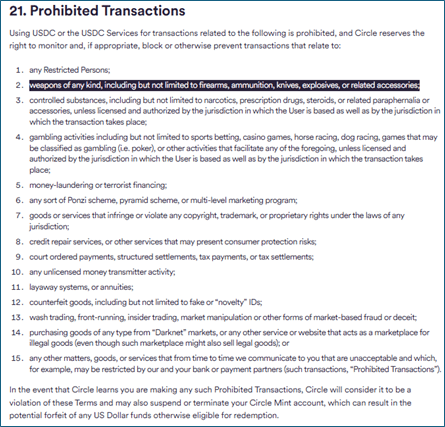
This is not consumer protection; it’s ideological enforcement. This is the same sort of financial discrimination that NSSF has fought against and is finally seeing changes with the Trump administration. For America’s firearm owners and retailers, Circle’s rules about how their cryptocurrency can be used should sound alarm bells.
Firearm ownership is a constitutional right. By imposing this blanket prohibition, Circle is effectively inserting its own political views into the marketplace and restricting lawful consumers and businesses from exercising their rights guaranteed under the Second Amendment. This isn’t a question of public safety or financial integrity; it’s a matter of principle. And in this case, those decisions reflect clear political leanings. Circle’s Chief Executive Officer, Jeremy Allaire, is a major donor to Democratic candidates and causes. Federal Election Commission records show that Allaire has contributed thousands of dollars to Democratic state parties and members of Congress, including U.S. Rep. Jake Auchincloss (D-Mass.), a staunch supporter of gun control legislation. While private citizens are entitled to their political opinions, those opinions should not dictate whether Americans can exercise their Second Amendment rights within the digital economy.
Circle provided NSSF with a statement attempting to clarify their position. It appears to [have] been a rushed statement given the grammatical error in the first sentence. Their statement came shortly after NSSF posted on X about Circle’s policy.
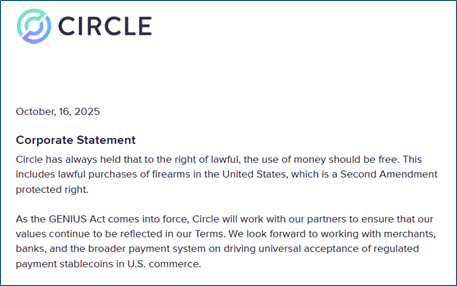
While it appears that Circle is willing to revisit its policies, as former President Ronald Reagan wisely said, “Trust, but verify.” The firearm industry has seen far too many examples of financial institutions and payment processors quietly introducing “risk management” policies that end up discriminating against lawful firearm businesses and owners. Circle’s statement is encouraging, but words alone are not enough. The proof will be in the policy changes – and in whether those changes ensure that Second Amendment commerce is treated fairly within the digital economy.
Say Goodbye to Glock, Say Hello to Glock V
It’s official, Glock is relaunching most of its pistol lineup before the end of the year. I received an email this morning from Glock stating the following:
The GLOCK V Series is Coming
Yesterday, a retailer NOT affiliated with GLOCK Inc. made premature statements concerning the availability of certain GLOCK pistols.
The individuals making these representations are not authorized to speak for GLOCK.As part of GLOCK’s commitment to future innovations, we are making necessary updates to our product line to align with upcoming offerings.
Our dedication continues to be with maintaining the highest level of quality, reliability, and accessibility that you expect from GLOCK. The GLOCK V Series is here to establish a baseline of products while simplifying our processes.
Commercial models of the Glock V will include:
And then there will be some that are distributor-exclusive:
Note that compact models, such as the Glock 43, 43X, and 48 seem to be excluded from this relaunch. There is also no mention of many of the existing MOS models or of the recently released COA models.
The Marlin® Trapper Series Model 1894™ in 10mm Auto is launching in conjunction with Hornady Manufacturing Company’s new LEVERevolution 10mm Auto ammunition. This first-of-its-kind lever-action rifle blends Marlin’s legendary craftsmanship with the versatility of 10mm Auto, setting a new standard for lever-action innovation.
Already known for its power and versatility as a semi-auto pistol cartridge, 10mm Auto delivers even greater performance when paired with a rifle-length barrel. The Trapper Series Model 1894 in 10mm Auto boasts an increased velocity of up to 250 fps compared to its pistol counterpart.
The Trapper Series Model 1894 is a short, quick-handling carbine rifle ideal for small-to-medium game hunting, self-defense and plinking, making it an excellent companion to your 10mm pistol. Like other models in the Trapper Series line, it features a cold hammer-forged, 16.17” threaded barrel and receiver-mounted Skinner Sight™ system that provides rapid target acquisition. Additionally, the stainless steel receiver, lever, magazine tube and barrel feature an attractive non-glare, satin finish.
In addition to the great features for which the Trapper Series line is known, this new model also has an upgraded fire control system. The sear is now e-nickel Teflon-plated and the sear notch geometry in the hammer has been improved to create a smoother and more consistent trigger feel. Plus, in response to consumer feedback, the sear and trigger system have been redesigned to eliminate the trigger “flop.”
Optimized for lever-action rifles, the LEVERevolution 10mm Auto ammunition features a 150 grain FTX bullet that delivers great accuracy, making it a great option for any hunter. While engineered for lever-actions, the round is a great choice for revolvers and semi-auto platforms as well.
This collaboration underscores Ruger and Hornady’s shared commitment to innovation, performance and delivering products that enhance the shooting experience for customers everywhere.
Virginia Judge Tosses State’s ‘Universal’ Background Check Law
Five years ago Virginia Democrats enacted a “universal” background check law (along with several other gun control measures) after the took complete control of state government for the first time in several decades.
Now Gun Owners of America has won an injunction barring enforcement of that statute.
Twenty-Fourth Judicial Circuit Judge F. Patrick Yeatts issued his opinion on Thursday afternoon, declaring that there was no need to “embark on an analysis as to whether Virginia’s background check requirements comport with the “\’historical tradition of firearm regulation’ in the United States.
In exercising judicial restraint, the Court finds it improper to resolve the question of firearm regulation through the lens of Bruen. Instead, the inherent as-applied constitutional deficiencies of the Act require that the court strike the statute in its entirety.
Not to get too into the weeds here, but the statute in question originally imposed background check requirements on all gun purchasers over the age of 18. There’s a conflict, however: Virginia law allows 18-year-olds to purchase and possess handguns, while federal law does not. So, any 18-to-20-year-old attempting to buy a handgun, even from a private party, still had to go through a NICS check and would be denied.
Yeatts previously granted an injunction as it applied to those young adults, but today he ruled that the law must be thrown out in its entirety based on a prior case know as Ayotte. If you want to geek out on the legal underpinnings behind Yeatts’ decision you can read his opinion here, but the short version is that at the moment the background check requirement on private transfers seems to be null and void.
A note of caution, though. Because this wasn’t decided on Second Amendment grounds, Yeatts left open the door for lawmakers to remedy the technical deficiencies that led to him striking down the statute.
The Court also observes that it is feasible to create a system where all individuals are treated equally in obtaining a background check. For example, Nevada law requires all firearm sales and transfers, with limited exceptions, to go through a background check conducted by a federally licensed firearms dealer (FFL). The FFL conducts the background check through the Nevada Department of Public Safety’s (DPS)Point of Contact system. This system interfaces with the National Instant Criminal Background System (NICS) to determine the eligibility of the buyer to possess a firearm-regardless of age. While Virginia has not adopted such a system, whether due to cost or other reasons, Nevada demonstrates that it is possible to implement a uniform approach.
The statute as it stands, cannot remain intact. If the legislature wishes to rewrite the law to create a system that does not impose disparate treatment based on age, it may do so. At that time, a court might rightly address the question of whether it is constitutional to require a background check to obtain a handgun through a private sale. Now is not that time.
Nevada’s law prohibits sales of handguns to adults younger than 21, so running NICS checks on private party sales involving under-21s doesn’t create a conflict with state law. I don’t know if this was his intention or not, but it seems to me that Yeatts is essentially inviting the Virginia legislature to institute a ban on handgun sales to under-21s, although I’d argue that would absolutely create a system that imposes disparate treatment based on age.
If Democrats once again regain a governing trifecta in next month’s elections we may very well have to deal with an attempt to raise the age to purchase handguns, along with a host of other anti-2A actions. For now though, Gun Owners of America has succeeded in taking down Virginia’s “universal” background check law, and that’s good news for Second Amendment advocates across the Old Dominion.
Glocks, Guns, & Government Overreach: How California Keeps Missing the 2nd Amendment Express
California’s recent surge in gun control legislation, especially Assembly Bill 1127, which effectively bans Glock and Glock-style handguns, reveals a troubling pattern of the state enacting laws that conflict with the Second Amendment, the intent of the Founding Fathers, and established Supreme Court rulings. This relentless legislative push threatens the constitutional rights of California citizens and demands urgent corrective action.
The Second Amendment protects the individual right to keep and bear arms. Landmark Supreme Court cases like District of Columbia v. Heller (2008) confirmed that this right includes possessing firearms for lawful self-defense. The Court emphasized that the right to self-defense is central to the Amendment and that restrictions cannot apply to weapons “in common use.” California ignores this legal precedent.
In New York State Rifle & Pistol Association v. Bruen (2022), the Court reaffirmed this position, ruling that gun regulations must reflect the historical understanding of the right at the time the Amendment was adopted. States must justify any restrictions based on this historical framework, especially when banning firearms like Glocks, which are essential tools for lawful self-defense.
Again, California ignores this legal precedent.
Newsom Signs Glock Ban Bill Into Law
California Gov. Gavin Newsom has been calling himself a Second Amendment supporter for several months now, but if anyone had any doubts about his lack of sincerity those can now be put to rest. On Friday afternoon the governor signed AB 1127 into law, which will outlaw the sale of Glock handguns in the state starting in January.
In addition to AB 1127, Newsom also signed legislation that will require sales of gun barrels to go through an FFL and a background check, as well as AB 1078, which replaces California’s “1-in-30” handgun rationing law (which is already on hold thanks to a lawsuit) with a “3-in-30” law. The bill, however, states that California will return to its previous one-gun-a-month scheme if it’s ultimately upheld by the courts.
As you can imagine, gun control activists are thrilled to see California become the first state in the nation to outlaw the sale of some of the most popular pistols in the country, and they’ll be making a major push for other blue states to adopt similar bans in the months ahead. From Everytown for Gun Safety:
“We applaud Governor Newsom and state lawmakers for putting California at the forefront of the fight against DIY machine guns, which are just as scary as they sound,” said John Feinblatt, president of Everytown for Gun Safety. “It speaks volumes about the gun industry’s fixation on profits that only a new law can force it to take the most basic steps to prevent mass carnage.”
“Governor Newsom, state lawmakers, and California volunteers continue to prove that the days of putting gun industry profits over our lives are long gone,” said Angela Ferrell-Zabala, executive director of Moms Demand Action. “DIY machine guns should never have had a pathway onto our streets, and today, we’re taking a big step to get them out of our communities. Our movement will keep fighting to hold reckless gun manufacturers accountable — because they shouldn’t get to profit off our tragedies.”
AB 1127 theoretically allows for Glock to change the design of its Gen 3 model to block the installation of illegal switches, but even if the company could take that step CalDOJ would view the redesigned pistol as a new firearm subject to the state’s handgun roster, and it would be rejected due to a lack of a magazine disconnect feature. That’s the reason why newer Glock models haven’t been approved for sale in California, though the Gen 3 was previously grandfathered in to the roster.
The NRA is already vowing to sue Newsom over the ban.
My guess is most of the other national Second Amendment groups will soon be filing suit as well, and we’ll probably see a coalition or two combining forces to take on the new laws.
So far there’s been no word from Glock on the new legislation, which is part of a broader effort to prohibit the sale of the popular handguns. The cities of Chicago, Baltimore, and Seattle are also suing the company, claiming the gunmaker is willfully allowing the illegal conversion of their pistols into full-auto machine guns through the installation of illegal switches. New York also has a similar Glock ban bill pending in the legislature, and now that Newsom has signed AB 1127 into law that could start moving as well.
The gun control lobby can’t ban handguns outright, so their new strategy is to go after the most popular pistols on a piecemeal basis. In the short term, Glock sales will likely skyrocket in California, but unless AB 1127 is stayed via an injunction those sales will come to a screeching halt once the new law takes full effect.
Working with high explosives is always hazardous
Prayers for the living and the dead.
Multiple people dead, at least 13 missing after bomb factory explosion in Tennessee.

Multiple people were killed and at least 13 remain unaccounted for following a “devastating blast” at a Tennessee bomb factory Friday morning, according to officials.
The massive explosion was reported around 7:45 a.m. local time at the Accurate Energetic Systems plant at the Hickman-Humphreys County line, west of Nashville.
Humphreys County Sheriff Chris Davis confirmed to reporters there were “some” fatalities and that there are people still missing, but did not provide numbers
At least 13 people are missing after a major explosion at a Tennessee bomb factory Friday morning.
The blast impacted “one whole building” of the property, he said. The factory is located miles away from any residences and businesses.
“We’re trying to take as much time as is needed right now. We’re prioritizing people that are involved, their families and trying to be very compassionate toward them,” he said.
At least 13 people remain unaccounted for, Hickman County Mayor Jim Bates told ABC News.
Nineteen employees were inside the building at the time, and every one remains unaccounted for, Humphreys County EMA Director Odell Poyner told WKRN.
Officials said the main concern at this time is the possibility of a secondary explosion.
Security footage from a residence 21 miles away captured the moment a single deafening “boom” can be heard echoing through the area that was strong enough to shake the ground and the camera, according to News Channel 5.
The Bureau of Alcohol, Tobacco, Firearms and Explosives [ATF] has been called to the scene.
Authorities have requested people avoid the area and investigators are expected to be on site for several days, officials said.
CZ and Colt Canada taking part in Canadian Gun Confiscations?
I love it when activist judge with a political agenda get slapped by SCOTUS and have to publicly reverse themselves.
Federal Judge Dismisses Lawsuit Blaming Gun Company for Mass Shooting
A Brady-backed lawsuit against Century Arms blaming a Romanian gun company and a U.S. firearms distributor for the 2019 mass shooting at the Gilroy Garlic Festival in California has finally been dismissed by a federal judge, almost a year after he ruled the case could move forward.
U.S. District Judge William Sessions refused to dismiss the suit in late 2024, arguing that the Protection of Lawful Commerce in Arms Act didn’t shield Romarm S.A. and Century Arms because the plaintiffs had “plausibly pled an aiding and abetting theory that satisfied the predicate exception to PLCAA’s liability bar.”
The predicate exception, according to the Supreme Court’s unanimous decision in Smith & Wesson v. Mexcio, requires that defendants “knowingly violated a State or Federal statute applicable to the sale or marketing” of firearms, and the violation “was a proximate cause of the harm for which relief is sought.”
The plaintiffs in the case stemming from the Garlic Festival shooting had argued that Romarm and Century Arms had aided and abetted the shooter’s illegal gun possession in California by selling the WASR-10 that was used in the attack in states where the arm is perfectly legal to own.
Sessions originally accepted that claim under the dubious reasoning that the defendants “knew that California-based criminals were buying guns in Nevada with the illegal intent of transporting them into California,” yet “flooded the Nevada market with guns and employed marketing and pricing strategies with the intent of encouraging or facilitating such transport, not merely with indifference that such transport occurs,” which in turn “aided the commission of illegal gun possession in California.”
But in Smith & Wesson v. Mexico, the Supreme Court stated that any aiding-and-abetting claims that aren’t based on a specific violation of state or federal law “must be backed by plausible allegations of pervasive, systemic, and culpable assistance.” After that decision was handed down Romarm and Century Arms asked Sessions to reconsider his decision, and now the judge has reversed himself and dismissed the case.
The issue for reconsideration, in light of Smith and Wesson, is that none of those findings are particular to the specific incident in this case. The shooter was a Nevada resident at the time of purchase, so his purchase was presumptively legal. Plaintiffs have not alleged with any specificity that Defendants advertised or marketed their products in any way that encouraged the shooter to take his legally purchased firearm across the border to California where it would be illegally possessed.
The oversupply argument similarly fails, as applied to the shooter, because he was a Nevada resident. No matter how many surplus guns were distributed in Nevada beyond what the Nevada market could bear, the fact that the Plaintiff was a part of the Nevada market who was not engaged in some sort of broader trafficking scheme is a flaw in that reasoning.
Put another way, the firearm at the center of this case was not part of an excess supply allegedly flooded into Nevada with the goal of attracting California residents for the simple reason that the shooter was a Nevada resident. So, while Defendants’ act in manufacturing the firearm and marketing it in Nevada may have aided the commission of some illegal gun possession in California, it does not follow, on the facts pled, that they aided the shooter’s illegal gun possession in California “beyond providing the good on the open market.”
It seems to me that Sessions could and should have dismissed the case even before SCOTUS handed down its unanimous decision throwing out Mexico’s lawsuit against Smith & Wesson and other U.S. gunmakers, but the fact that he allowed the case to move forward under such specious claims just demonstrates the importance of the Supreme Court’s decision that helped lay out the scope of the Protection of Lawful Commerce in Arms Act’s protections.
Sessions, a Clinton appointee who’s served on the bench since 1995, still argued in dismissing the case that “it may well be true” that “Defendants’ acts aided the commission of illegal gun possession in California” in other instances, but the plaintiffs haven’t plausibly proved that to be the case here. That statement was completely superfluous and unnecessary, and appears to telegraph Session’s willingness to punish companies in the firearms industry for the third-party actions of criminals whenever possible.
In this case, thankfully, Sessions couldn’t get around the plain language of the Supreme Court’s opinion in Smith & Wesson v. Mexico. If it weren’t for that unanimous decision penned by Justice Elena Kagan, though, Brady’s junk lawsuit would still be an ongoing threat to the lawful commerce in arms.
The flag installations have begun at Steak n Shake.
Every Steak n Shake is getting the tallest and biggest American flag that local governments will allow!
Steak n Shake proudly supports American values and traditions. 🇺🇸 pic.twitter.com/w19csgwy5H
— Steak 'n Shake (@SteaknShake) October 4, 2025
Federal Judge: Biden ATF Rule on Firearms Sales Cannot Be Used Against NRA Members
On Tuesday, U.S. District Court Judge Corey L. Maze “permanently [blocked] federal authorities from enforcing multiple provisions of the ATF’s [‘engaged in the business’ rule],” according to Rocket City Now.
ATF’s engaged in the business rule became final on April 10, 2024. The rule is designed to expand the occurrences of point-of-sale background checks by counting certain private sales as business sales, thereby requiring the transfer to be handled via a National Instant Criminal Background Check System (NICS) background check.
As the rule prepared to be finalized, Breitbart News noted that then-ATF director Steven Dettelbach could not could not define a precise threshold for when private citizens are considered “engaged in the business” of selling guns. The ambiguity put law-abiding gun owners on edge, as they could not ascertain when they might be in violation of the rule and when they might not.
A lawsuit, Butler v. Garland, resulted, later to be augmented to Butler v. Bondi.
In the case, “Plaintiffs argue that Congress requires a person buy or sell multiple firearms before he can be deemed to be engaged the firearms’ business, and ATF exceeded its authority by roping in persons who sell or offer to sell only one firearm.”
Maze agreed with the plaintiffs, noting that the “ATF exceeded its authority when it interpreted the [the Gun Control Act of 1968] to possibly prohibit a single purchase or sale or a single offer to purchase or sell a firearm.”
Maze pointed to case law, summarizing: “Congress decided that a person is not engaged in the business of dealing in firearms unless he deals firearms ‘as a regular course of trade or business’… Regular means repeated or often. So regular business requires more than one firearm transaction involving a single firearm. Because the Final Rule says single transactions involving one firearm may be prohibited in some cases, it exceeds ATF’s statutory authority.”
He continued to examine phrases in the ATF’s final engaged in the business rule, showing again and again how the “ATF exceeded its authority,” ruling: “The court will enter a separate order that PERMANENTLY ENJOINS the Department of Justice, ATF, Acting ATF Director Daniel Driscoll, and Attorney General Pamela Bondi from enforcing these aspects of the ‘Engaged in the Business’ Final Rule against Plaintiffs Don Butler, David Glidewell, and any member of the NRA.”
Coalition Of Gun Rights Groups Challenge Big Banks Over Gun Industry Debanking History.
A group of gun-rights organizations is calling some big banks onto the carpet for their systemic history of debanking and otherwise discriminating against companies in the firearms industry.
According to a report at Foxbusiness.com, the Second Amendment groups are accusing some financial institutions of “revisionist history” in their attempts to whitewash past discrimination against gun and ammo manufacturers and retailers.
The six groups—NRA’s Institute for Legislative Action (NRA-ILA), the American Suppressor Association (ASA), Second Amendment Foundation (SAF), Gun Owners of America (GOA), National Association for Gun Rights (NAGR) and the Citizens Committee for the Right to Keep and Bear Arms (CCRKBA)—sent a letter to the heads of JPMorgan Chase, Bank of America and the Bank Policy Institute confronting them over their anti-gun history.
“As the unified voice of the Second Amendment community and millions of gun owners across America, we write today to address your ongoing debate about the future of banking,” the letter stated. “As you know, our industry faced relentless attacks and discriminatory treatment for decades. We have been shut out of mainstream financial institutions including by your banks and those your represent. The assault on gun manufacturers, retailers and aligned organizations has been a brazen and ideologically driven campaign to undermine the Constitutionally protected right of all Americans to keep and bear arms.”
Recently, the big banks had “come clean” and stated that they would no longer discriminate against gun industry members. And in August, President Donald Trump signed the Executive Order Guaranteeing Free and Fair Banking for All Americans.
President Donald Trump has reversed a Biden-era regulation banning the exportation of civilian firearms to foreign countries
Trump Can (and Should) End Semi-Auto Import Ban Right Now
My first “evil black rifle” was an AK that I built from a kit. Yeah, I know, an evil “ghost gun,” though the term was still years away from becoming uttered, much less mainstream. A gunsmith friend told me to get an 80 percent receiver, a parts kit, and some compliance parts, then we all gathered at his workshop for a day of building AKs, general BSing, and some grilled burgers partway through the day.
It was an absolute blast.
We had to get a parts kit, though, because we couldn’t just import completed AKs, even modified to semi-auto only. During Bush Sr’s administration, he banned the import of semi-automatic firearms for “non-sporting purposes” such as those so-called assault weapons.
My parts kit was a Romanian AK that had the receiver cut in three places with a torch. Now, they also cut the barrels, all because people built guns.
However, as Trump has set this term as the most pro-gun administration in my lifetime, there’s something else he could do, and gun rights groups should be asking for it, as David Codrea notes at Firearms News.
“There’s something else Trump could do quickly that would not require Congressional approval,” this column reported online last November in Donald Trump and Republicans Owe Gun Owners, and It’s Time to Collect. Focused on pledges the president had made to gun owners to solicit their votes, the article explored decisions within the president’s power to make that would help make good on his promises.
What Trump could do, on his own authority, is end the 1989 import ban on semi-automatic rifles pejoratively designated as “assault weapons.” That ban, put in place by Republican President George H.W. Bush, imposed “a permanent import ban on 43 types of semiautomatic assault rifles, including the Chinese-made AK47 and Israeli-made Uzi carbine,” per The Washington Post. The rationale was they “were not being used for sport as required by the Gun Control Act of 1968.” This approved gun control by a Republican president opened the gates for many states and municipalities to ban military-styled semi-auto firearms nationwide without a peep from the Bush Administration or his anti-2A Attorney General William Barr who would later become President Trump’s “best people” attorney general during his first term.
The ban would be “very easy” to overturn, Firearms News Editor-in-Chief Vincent DeNiro assessed. But how? GCA ’68 was a law enacted by Congress. The classification of the semiautos was not.
“President Trump doesn’t even need Congress to get rid of the unconstitutional 1989 ‘assault weapons’ import ban, he just needs to order the BATFE to declare all imported semi-auto rifles as ‘sporting,’ which is what these same models are considered when domestically produced,” DeNiro explained last year. “If he wants to go down in history as a Second Amendment hero, he can make this happen on day one.”
That’s the absolute truth, but Trump didn’t do that on day one, unfortunately.
Still, he could do it now. Semi-autos are still imported. They’re made domestically as well. There’s literally no reason for this ban to be in place except to make it harder to lawfully own these firearms.
More than that, groups like Gun Owners of America, the Second Amendment Foundation, the NSSF, the National Association of Gun Rights, and the NRA should all be challenging the Trump administration to do just that. Lift the import ban. These weapons are, in fact, used for sports–three-gun competition is a sport, as is varment hunting, deer hunting, and so on–and the ban is wrong on every level.
President George H.W. Bush was not a friend of the Second Amendment. That’s clear as day, and he set the stage for the federal assault weapon ban in 1994 by this action. He made it clear that these particular rifles were too dangerous for regular citizens to own, at least in his view, and as the leader of the Republican Party at the time, it gave a green light to a lot of lawmakers that this was OK.
It wasn’t.
It’s time to end this and do it now.
Smith & Wesson Announces Grand Opening of World-Class Training Academy
Smith & Wesson Brands, Inc. (NASDAQ Global Select: SWBI), a leader in firearm manufacturing and design, announces today the grand opening of the new Smith & Wesson Academy.
At Smith & Wesson, our mission extends beyond the production of premium firearms – we are committed to empowering those who carry them. Continuing the esteemed legacies of both the former Smith & Wesson Academy and the Shooting Sports Center in Springfield, MA, which collectively were operational for decades between 1969 to 2017, the newly established Academy serves as a vital resource that reinforces our continued dedication to self-defense training, firearm proficiency, and firearm safety.
Situated on the 236-acre headquarters campus in Maryville, Tennessee, this state-of-the-art facility serves as a premier training destination, featuring pistol and carbine ranges, a multi-purpose flex range, a 300-yard rifle range, and a two-story immersive shoot house. The Academy’s design also incorporates classrooms, a fitness center, and offices that will house a team of world-class experts leading the training programs. Starting this weekend, a registration portal will be available on the Smith & Wesson Academy website for a variety of training courses focused on pistol, carbine, and rifle platforms. These courses will range from introductory skills and safety to advanced techniques.
The Smith & Wesson Academy team will be led by renowned instructor Mark “Coch” Cochiolo. Mark is a retired U.S. Navy Chief Warrant Officer with over three decades of service in Naval Special Warfare. Throughout his distinguished military career, he has operated in a range of elite roles, including special warfare operator, breacher, weapons instructor, training officer, and operational tester. Mark completed four SEAL deployments to the Western Pacific and served eight years with the Navy’s premier counterterrorism unit, where he conducted operations across Eastern Europe and the Middle East. His final assignment placed him in a senior leadership role as Chief Warrant Officer responsible for training and combat systems with Naval Special Warfare Unit Three (NSWU-3). Following his retirement from active duty, Mark transitioned to instruction, applying his operational expertise to train the next generations of Navy SEALs. As a contract instructor for Basic Underwater Demolition/SEAL (BUD/S) training, he developed curriculum and trained more than 4,000 SEAL candidates in marksmanship and tactical weapons handling. Recognized for his precision, discipline, and leadership, Mark remains an influential figure in the special operations community.
“My decision to partner with Smith & Wesson stems not only from their strong alignment with my values but also from my personal experience carrying a Smith & Wesson for the past 30 years. Throughout my career, I have worked with a variety of firearm platforms, and I am grateful for the opportunity to leverage that experience in developing effective curriculum at the Academy, helping as many individuals become proficient with their firearms as possible. Smith & Wesson produces dependable, quality firearms – at the Academy, we’ll teach you how to use them,” said Mark “Coch” Cochiolo, Director, Smith & Wesson Academy.
Florida’s new tax holiday expands to all guns and ammo
PINELLAS PARK, Fla. – Florida shoppers are getting another round of tax-free savings, this time on outdoor gear. Beginning Monday, the state’s new sales tax holiday applies to hunting, fishing, and camping supplies.
But the biggest change: for the first time, firearms and ammunition are included — and unlike most items, they are not subject to a price cap. That means everything from ammo to high-end rifles will be exempt from sales tax through the end of the year.
At Bill Jackson’s Gun Shop in Pinellas Park, manager Mike Sfakianos said customers are already preparing, with layaway deposits piling up ahead of the holiday. “Anytime you could save a buck on something, especially these days, it’s a good time,” Sfakianos said.
<div>Bill Jackson’s Shop for Adventure in Pinellas Park</div>
Bill Jackson’s Shop for Adventure in Pinellas Park
The backstory
Gov. Ron DeSantis coined it the “Second Amendment Summer Tax Holiday.” It’s part of a broader slate of Florida tax breaks that recently expanded to include hurricane supplies year-round.
Most outdoor items are capped: tents under $200 and fishing rods under $75, for example. But firearms and accessories come without. 2025 Hunting, Fishing, and Camping Sales Tax Holiday
The other side
Not everyone is on board. Critics argue that exempting expensive firearms while capping children’s clothing during the back-to-school tax holiday sends the wrong message. They also question whether shoppers are truly using the purchases for hunting.
<div>Bill Jackson’s Shop for Adventure in Pinellas Park</div>
Bill Jackson’s Shop for Adventure in Pinellas Park
What’s next
The holiday will run through the end of 2025, giving Floridians months to take advantage of the tax-free status on firearms, ammunition, and outdoor equipment.
The Source
This reporting is based on FOX 13 coverage, including interviews with local gun shop owners and details released by Florida state officials.
August Gun Sales Climb Back Over the 1 Million Mark.
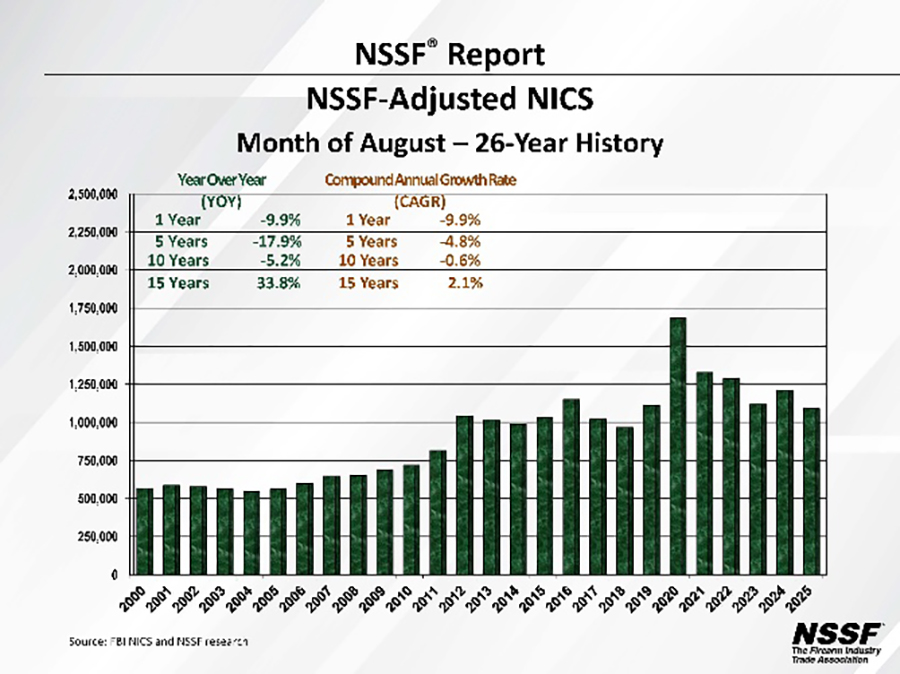
After the first monthly sales dip below 1 million in over five years last month, August gun sales popped back up of the million threshold. August’s total of 1.09 million gun sold, however, was a 9.9 percent decrease over the August 2024 total.
The NSSF’s Mark Oliva tells us that . . .
NSSF is encouraged to see the adjusted NICS background checks top 1 million in the month August once again. We know there is a strong and continued interest in lawful firearm ownership and these figures bear out the truth that Second Amendment rights are valued. These figures are more than data points. They represent Americans from all walks of life who are, quite literally, investing in their safety, security and freedom.
Here’s their press release on the August numbers . . .
The August 2025 NSSF-adjusted National Instant Criminal Background Check System (NICS) figure of 1,091,342 is a decrease of 9.9 percent compared to the August 2024 NSSF-adjusted NICS figure of 1, 210,995.
For comparison, the unadjusted August 2025 FBI NICS figure 1,743,509 reflects a 19.4% percent decrease from the unadjusted FBI NICS figure of 2,163,540 in August 2024.
Please note: Twenty-eight states currently have at least one qualified alternative permit, which under the Brady Act allows the permit-holder, who has undergone a background check to obtain the permit, to purchase a firearm from a licensed dealer without a separate additional background check for that transfer. The number of NICS checks in these states does not include these legal transfers based on qualifying permits and NSSF does not adjust for these transfers.
The adjusted NICS data were derived by subtracting out NICS purpose code permit checks and permit rechecks used by states for CCW permit application checks as well as checks on active CCW permit databases. NSSF started subtracting permit rechecks in February 2016.
Though not a direct correlation to firearms sales, the NSSF-adjusted NICS data provide an additional picture of current market conditions. In addition to other purposes, NICS is used to check transactions for sales or transfers of new or used firearms.
It should be noted that these statistics represent the number of firearm background checks initiated through the NICS. They do not represent the number of firearms sold or sales dollars. Based on varying state laws, local market conditions and purchase scenarios, a one-to-one correlation cannot be made between a firearm background check and a firearm sale.
