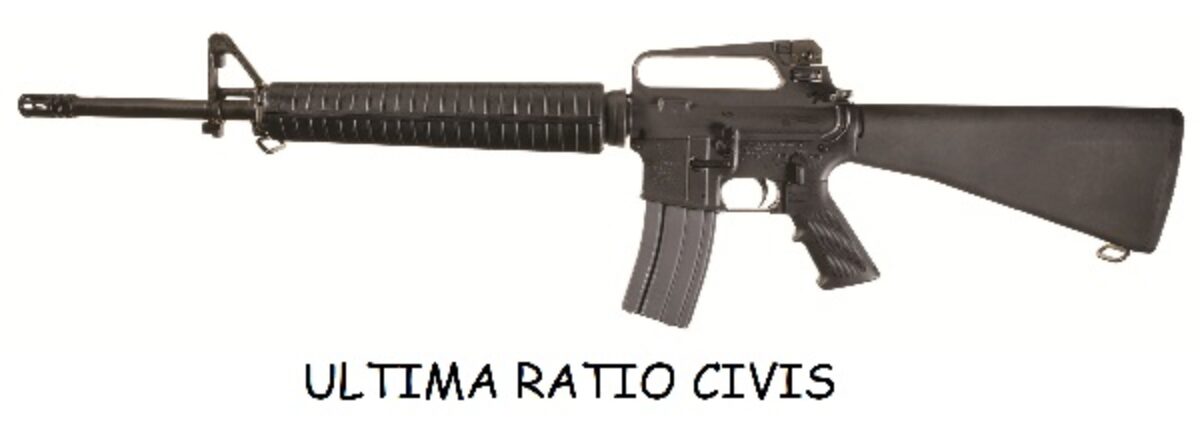
ESSE SINE METU IN FACIE INIMICI TUI. TUENDAM INOPS ET FACERE NON MALI.
Category: Courts
LEGAL ALERT: The Tenth Circuit has DENIED New Mexico’s en banc petition following a 3-judge panel’s ruling that the state’s 7-day firearm waiting period likely violates the Second Amendment. As a result, the panel’s ruling will remain in place. https://t.co/kcoqnP8YBppic.twitter.com/5B8aeYjbEG
Today, the Justice Department sued the District of Columbia’s Metropolitan Police Department (MPD), alleging that the District government and MPD unconstitutionally ban the AR-15 and many other firearms protected under the Second Amendment. The District’s gun laws require anyone seeking to own a gun to register it with D.C. Metro Police. However, the D.C. Code provides a broad registration ban on numerous firearms — an unconstitutional incursion into the Second Amendment rights of law-abiding citizens seeking to own protected firearms for lawful purposes. MPD’s current pattern and practice of refusing to register protected firearms is forcing residents to sue to protect their rights and to risk facing wrongful arrest for lawfully possessing protected firearms.
The Second Amendment Foundation (SAF) and its partners have filed an amicus brief with the Third Circuit Court of Appeals in a case challenging the federal lifetime ban on firearm possession as applied to an individual with a decades-old misdemeanor DUI conviction.The case, Williams v. Attorney General of the United States, will be argued before an en banc panel in February. SAF is joined in the amicus filing by the California Rifle & Pistol Association, Citizens Committee for the Right to Keep and Bear Arms and Second Amendment Law Center.
“The government’s position defies Bruen and Rahimi by seeking to impose a permanent disarmament on a law-abiding citizen based solely on a nonviolent misdemeanor from 20 years ago, with no evidence of ongoing danger,” said SAF Director of Legal Research and Education Kostas Moros. “History shows that Founding-era laws addressed the risks of intoxication and firearms through temporary restrictions on those currently impaired, never by stripping gun rights forever from someone who once drank irresponsibly but has since reformed. We urge the Court to reject this overreach and affirm the district court’s ruling.”
If the Third Circuit rules in favor of Mr. Williams, it could have major implications for many others who are disarmed due to similar convictions.
“This case highlights the unconstitutional overreach of federal disarmament laws that ignore historical limits and present-day realities,” said SAF founder and Executive Vice President Alan M. Gottlieb. “SAF is committed to defending the rights of individuals like Mr. Williams, and we believe this case warrants the Court’s careful consideration.”
SAN JUAN, Puerto Rico (AP) — A Second Amendment clash has erupted between the federal government and the U.S. Virgin Islands.
The U.S. government sued the U.S. territory, its police department and Police Commissioner Mario Brooks on Tuesday, accusing them of obstructing and systematically denying American citizens the right to possess and carry guns.
The U.S. Virgin Islands requires that applicants demonstrate “good reason to fear death or great injury to his person or property,” and to have “two credible persons” to vouch for their need of a firearm. Local law also requires that someone have “good moral character” to obtain a gun permit, which is valid for up to three years and applies to a single weapon.
The lawsuit states that no specific standard has been set or defined for the requirement of character. It also claims that the defendants “regularly” refuse to issue permits to those who by law are “deemed to be an improper person” by the territory’s police commissioner.
The lawsuit states that those in the U.S. territory also must “submit to intrusive and warrantless home searches” as one condition to obtain a gun permit. If an applicant refuses a home inspection, which takes “several months to a year to schedule and complete,” the government will not process their request, according to the lawsuit.
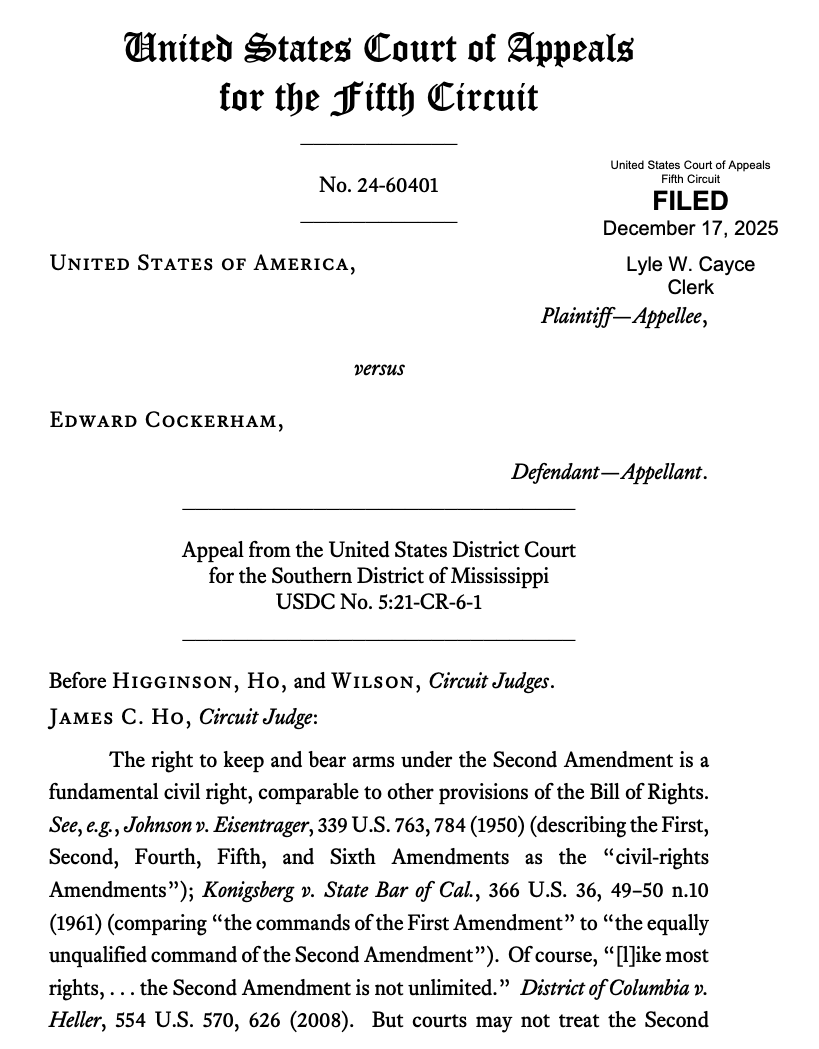
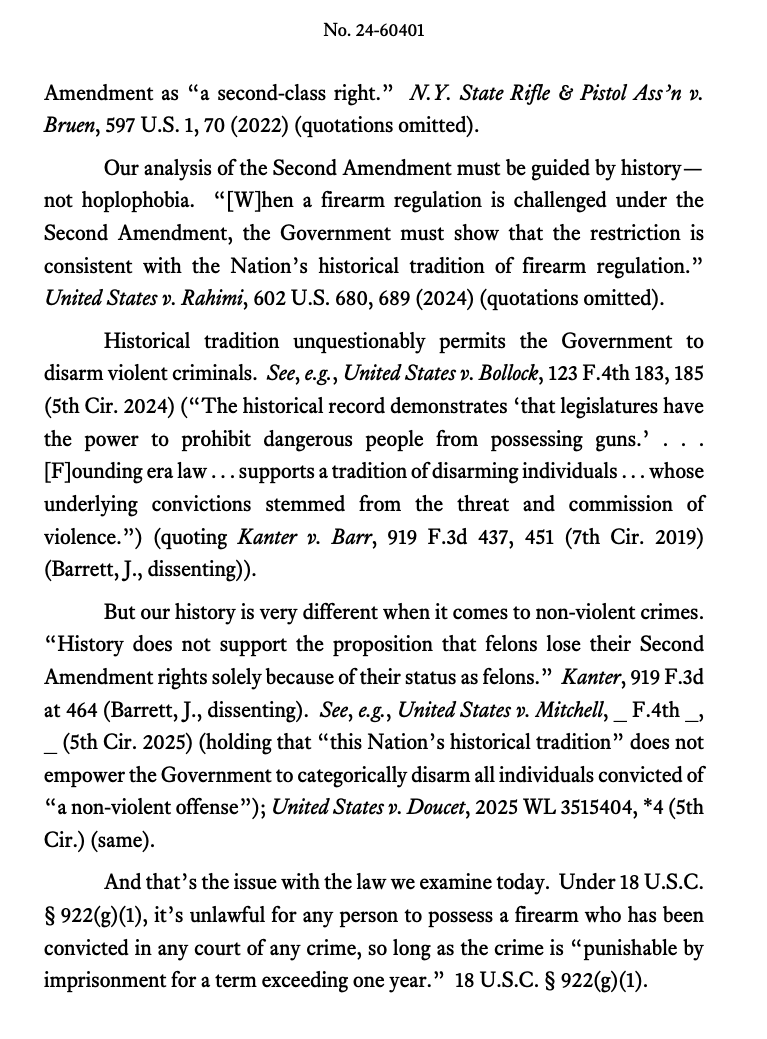
The Fifth Circuit ruled today that the federal felon gun ban is unconstitutional as-applied to a defendant whose “sole predicate offense [was] is his failure to pay child support—an offense for which he was not sentenced to a single day in prison.” https://t.co/Hjp5765RRFpic.twitter.com/zzC0SdGLaL
BLUF
The real question is what will the Court do with the gun and magazine ban cases in the new year? We’re getting to the point in the Court’s term that any case they decide to take up would most likely be heard next fall.
The Supreme Court didn’t grant cert to any Second Amendment cases in its orders list released on Monday, but they did keep ahold of several challenges to state-level gun and magazine bans as well as several prohibited persons cases.
The justices also denied cert to a pair of challenges to the National Firearms Act’s restrictions on short-barreled rifles, as well as the appeal of a Pennsylvania father who was hoping to revive a lawsuit against a gun maker and gun seller holding them civilly liable for the death of his son.
Robinson v. U.S. and Rush v. U.S had drawn attention from a number of Second Amendment groups including Gun Owners of America and Second Amendment Foundation, which filed amicus briefs in support of the cert petitions urging the Court to take one or both cases. The groups obviously were hoping that the Supreme Court would declare that short-barreled rifles are arms protected by the Second Amendment, but also pointed out multiple flaws in the rationale deployed by lower courts in upholding the NFA’s restrictions.
The brief filed by GOA and a number of state-level 2A groups in Robinson, for instance, noted the lower courts’ description of the NFA as a “shall issue” licensing system akin to concealed carry regimes.
Earlier this week a three-judge panel on the Fifth Circuit Court of Appeals issued its third ruling in a case dealing with a Louisiana man’s possession of an unregistered suppressor. Unfortunately, the third time wasn’t the charm for George Peterson, with the panel once again upholding his conviction, as it did in its original opinion in February and its first revised opinion in August.
This time around, the panel assumed without deciding that suppressors are protected by the Second Amendment, but ruled that the National Firearms Act’s taxation and registration scheme is akin to a “shall issue” concealed carry permitting regime and is therefore presumptively constitutional.
The panel essentially agreed with the DOJ, which, under Attorney General Pam Bondi, has recognized that suppressors are protected by the Second Amendment, but still maintains that the NFA taxes and registration are constitutional. As the panel wrote in its unanimous decision:
The NFA provides that the ATF will deny a firearm-making application if the “making or possession of the firearm would place the person making the firearm in violation of law.” This is precisely the “objective and definite” licensing criterion held permissible under Bruen.
Further, we have no reason to doubt on this record that the NFA’s fingerprint, photograph, and background-check requirements are “designed to ensure only that those bearing arms in the jurisdiction are, in fact, ‘law abiding, responsible citizens.’” Peterson’s failure to make any showing as to how the requirement places an unconstitutional burden on his Second Amendment rights alone is dispositive.
It is not even clear he could claim that this requirement posed an unconstitutional burden as applied to him given his explanation that he failed to register because he “forgot” to do so. Finally, the NFA enforces its objective shall-issue licensing requirement through prohibiting suppressor possession by unlicensed persons, as did several of the “shall-issue” licensing regimes that Bruen cited approvingly.
The Fifth Circuit panel avoided any debate on the constitutionality of the $200 tax imposed by the NFA (something the DOJ has described as a “modest burden” on our Second Amendment rights) by declaring that, since Peterson brought an as-applied challenge and he never attempted to pay the $200 tax, the question is not germane to his case.
While the panel left open the possibility that other as-applied challenges to the NFA could be successful, the judges were pretty adamant that the NFA and its requirements are no different than a “shall issue” system for issuing concealed carry licenses. And since the Supreme Court hasn’t said anything about various arms enjoying different levels of protection under the Second Amendment, any restriction imposed on the purchase and possession of suppressors could be imposed on commonly-owned handguns, rifles, and shotguns as well… at least in the states where the Fifth Circuit has jurisdiction.
Those states are Louisiana, Mississippi, and Texas, so I’m not particularly worried about any of them suddenly deciding to apply NFA language to semi-automatic handguns or AR-15s. If the Fifth Circuit’s logic is adopted by other appellate courts, though, it’s not difficult to imagine anti-gun lawmakers in blue states doing just that. We’re already seeing a number of Democrat-controlled states push for permit-to-purchase laws, so adding additional taxes and registration requirements to those statutes wouldn’t be difficult.
The DOJ has been criticized by 2A groups like Gun Owners of America and Firearms Policy Coalition for continuing to defend the constitutionality of the NFA. That is a legitimate concern, and the fact that DOJ is also acknowledging that at least some NFA items are protected by the Second Amendment could also wreak havoc on our 2A rights in statehouses and courtrooms across the country.
As I said, SCOTUS has never suggested that the Second Amendment has tiers of protection for various arms. So when the DOJ says that a $200 tax on suppressors is only a “modest” and constitutionally permissible burden on our right to keep and bear arms, anti-gun politicians (and jurists) can use that to argue that a $200 tax on so-called assault weapons, semi-automatic handguns, or even all firearms is equally compliant with the Second Amendment.
I think the Fifth Circuit panel took some care not to give anti-2A politicians any legal ammunition to that effect, but I’m afraid they’ve opened up a Pandora’s Box by stating that the NFA’s restrictions are no different than a “shall issue” system for concealed carry. Let’s hope that an en banc panel of the Fifth Circuit or the Supreme Court close the lid on this “logic” before the gun control lobby uses it as a cudgel to attack our 2A rights.
This is part of the anti-American legacy of President Auto-Pen
Ketanji lost it today during oral arguments and went on a “No Kings” style rant about President Trump wanting to rule like a monarch, and how we should instead have many issues handled by “the experts and PhDs” like Dr. Fauci, Dr. “Rachel” Levine, and the gay bondage AIDS dude. pic.twitter.com/Z8qFZgZzsR
She actually said: “replacing them with loyalists and people who don’t know anything…”
Anything she ever says again should be ignored forever.
Yes, but this statement is even more dangerous: “these issues should not be in presidential control”
She is placing the bureaucracy above the constitution.
In the great injunction sweepstakes that have followed Donald Trump’s second administration like a shadow, we have seen district court judges with a hankering for executive power attempt to play president in more than a hundred cases from immigration and tariffs to funding various executive branch agencies, so-called trans-rights, DEI and climate change.
Some of these injunctions and temporary restraining orders are still pending. Many, perhaps most, have been resolved by the Supreme Court in ways that favor the Trump administration, not always categorically but usually by affirming the broad scope of executive power envisioned by Article II of the Constitution. “The executive Power,” quoth that magisterial document, “shall be vested in a president of the United States of America.” “A president,” mind you, a single one. Not a president and hundreds of district court judges.
The rousing start to Article II of the Constitution is neatly put, isn’t it? But those judges took it as a challenge. Trump is an affront to what every right-thinking, i.e., left-leaning, person believes. He wants to make America more prosperous, freer and more secure than it has become in the hands of Democrats and other disciples of hegemonic bureaucracy.
He moved quickly to secure the border. Can you believe it? He is deporting scads of people who are here illegally. Outrageous. He outlawed the racist practice of DEI throughout the federal government and made federal funds contingent upon ending the scam. Horrible. He thinks that the military should be an institution specializing in fighting wars, not promoting “social justice.” Clearly he must be stopped.
The Supreme Court has turned away a challenge to the federal statute prohibiting illegal aliens from possessing firearms, but did not take action on two other cert petitions dealing with gun bans for those convicted of crimes punishable by more than a year in prison.
The Court denied cert, without comment, to Carbajal-Flores v. United States in its orders list released on Monday morning. That case, along with Vincent v. Bondi and Duarte v. U.S., were all heard during the justice’s conference last Thursday.In Carbajal-Flores, the Court was asked to consider whether 18 U.S.C. § 922(g)(5)(A), which prohibits firearm possession by all “unlawfully present noncitizens”, was unconstitutional in all respects or, if not, whether the “government must demonstrate that the individual is dangerous before disarmament is permissible.”
The case involved Heriberto Carbajal-Flores, a resident of Chicago who is now a lawful permanent resident, but was apparently not at the time he was arrested for illegally carrying a gun during what his attorneys called “an infamous night of unrestin Chicago after the murder of George Floyd in 2020.”
Though a district court found that Carbajal-Flores “presented none of the indicia of ‘dangerousness’ or disloyalty historically associated with disarmament,” the federal government appealed and the Seventh Circuit overturned the initial ruling. Carbajal-Flores then appealed to the Supreme Court, but now that his case has been rejected prosecutors are free to go after him once more.
Carbajal-Flores’ attorney had argued that there’s a circuit court split on as applied challenges to 922(g)(5)(A), with the Fifth Circuit and Eighth Circuit allowing for individualized review regarding someone’s dangerousness and whether unlawfully present noncitizens fall within “the people” protected by the Second Amendment. Despite that, the Court appears willing to let those circuit court splits develop, even if it means defendants in the Seventh Circuit can’t raise an as-applied challenge to their cases going forward.
Meanwhile, the justices took no action on a pair of cases dealing with a different section on 922(g). Vincent v. Bondi and Duarte v. U.S. both challenge 922(g)(1)’s prohibition on gun ownership for anyone convicted of a crime punishable by more than a year in prison. There are multiple disagreements in the appellate courts over whether that statute is facially constitutional or whether it requires and individualized finding of dangerousness, but the justices are also considering a similar question in the Hemani case, which challenges 922(g)(3)’s prohibition on “unlawful” drug users possessing firearms.
It’s possible, if not likely, that SCOTUS will keep Vincent and Duarte on ice until after Hemani has been decided, and then remand the cases back to the lower courts for a do-over in light of what the Hemani opinion says. The DOJ has encouraged the Supreme Court to simply deny cert to both cases, arguing that Melynda Vincent and Stephen Duarte can apply to the Attorney General to have their rights restored once a proposed rule on rights restoration takes effect, and it’s also possible that the Court will keep ahold of those cases until that rule is officially in place.
The Court won’t hold its weekly conference this week because of the Thanksgiving holiday, but it’s slated to consider several hugely important cases at its December 5 conference; Duncan v. Bonta and Gator’s Custom Guns v. Washington, which deal with state-level bans on commonly owned “large capacity” magazines, and Viramontes v. Cook County, a challenge to the ban on so-called assault weapons put in place by Democrats in Cook County, Illinois. The Court could also re-list Vincent and Duarte for next week’s conference along with several other cases dealing with gun bans for under-21s that have previously been considered in conference but have received no action from the justices.
There are already two Second Amendment cases that will be addressed this term; the Hemani case that I previously mentioned and Wolford v. Lopez, which is a challenge to Hawaii’s default carry ban on all private property. Given the circuit court splits involved in both the under-21 and 922(g)(1) cases, as well as the fundamental importance of addressing bans on commonly owned magazines and firearms, I’m hopeful that we’ll see SCOTUS greenlight at least three others, but the odds of that happening are honestly pretty low.
Missouri prosecutors are concerned that a recent decision by the state Court of Appeals could open self-defense laws so broadly that the slightest threat of a minor attack could justify a person responding with deadly violence.
The Nov. 12 ruling by the Missouri Court of Appeals, Eastern District, would threaten public safety by making it difficult to charge, try or resolve violent crimes, Robert W. Russell, president of the Missouri Association of Prosecuting Attorneys, wrote in an amicus curiae, or “friend of the court,” brief.
“If the opinion becomes law, mere shoving matches could justifiably be escalated to gun battles,” Russell wrote.
The ruling was made on a case that involved a fight between two women outside Anchor House, a veterans’ homeless shelter in Warren County, west of St. Louis, in November 2022.
Danielle Lechocki, a former Marine with several medical issues, said she felt “extremely threatened” after another shelter resident threatened to “mollywock” her, meaning hit her. Lechocki pulled a knife from her backpack, according to court documents, after the other woman lunged at her.
The other woman denied she went after Lechocki, who said she was just trying to show she wasn’t a “pushover.” A third person stepped in between the two women and no one was hurt.
But the county judge denied Lechocki’s request to use self-defense to justify her actions, agreeing with the prosecutor who argued that as a matter of law, deadly force cannot be used to repel a simple assault and battery.
The jury ultimately found Lechocki guilty of attempted unlawful use of a weapon but acquitted her of fourth-degree assault. Lechocki was sentenced to two days in jail and a fine of $1,000, which would be waived if she served 25 hours of community service.
The appellate court ruled that the judge erred in refusing to instruct the jury on self-defense. The lower court’s ruling was reversed and the case was sent back for a retrial.
The Missouri Legislature changed the law on deadly force in 2007, the appeals court ruling said, allowing the use of deadly force when a person reasonably believes it is necessary to protect himself or herself or a third person “against death, serious physical injury, or any forcible felony,” which was defined as “included but not limited to murder, robbery, burglary, arson, kidnapping, assault, and any forcible sexual offense.”
In 2017, under the direction of then-Governor Andrew Cuomo, the state of New York launched a coordinated campaign to cripple the National Rifle Association (NRA) because of its defense of the Second Amendment and protected speech. New York’s Department of Financial Services contacted banks and insurance companies that did business with the NRA and delivered an unmistakable message: Continue associating with the NRA, and the state would investigate, cite, and regulate your business into oblivion. Coming from the state’s top financial regulator, the warning carried real weight – exactly as intended.
The strategy worked. Financial institutions and insurers quickly distanced themselves from the NRA, leaving the organization unable to secure even basic corporate services in the state. If that sounds like an obvious First Amendment violation, that’s because it is. More than 60 years ago, the Supreme Court made clear in Bantam Books v. Sullivan that government “threat[s] of invoking legal sanctions and other means of coercion” against third parties to suppress disfavored speech are flatly unconstitutional.
Because that rule remains as clear today as it was in 1963, the Supreme Court agreed with the ACLJ’s amicus brief and ruled unanimously for the NRA last term. Justice Sotomayor, writing for the Court, put it plainly: “A government official cannot coerce a private party to punish or suppress disfavored speech on her behalf.” When regulators use the power of their office to pressure private actors into isolating or punishing a speaker, they violate the First Amendment just as surely as if they had censored the speech directly.
This case sits squarely at the intersection of the First and Second Amendments. The NRA’s policy views related to the Second Amendment, its speech, its advocacy, and its expression are all protected by the First Amendment. A government that can strangle a gun-rights group through financial coercion can use the same tools to silence pro-life organizations, religious ministries, parental-rights groups, or anyone else who falls out of political favor. That is why the ACLJ fights not just for the substance of constitutional rights, but also against government efforts to punish those who speak about them.
That unanimous ruling should have ended the matter. It should have allowed the NRA’s lawsuit to proceed so a jury could determine the full extent of the constitutional violations. But the Second Circuit had other ideas. In defiance of both the Supreme Court’s clear command and the First Amendment itself, the court held that New York’s officials were entitled to qualified immunity – meaning the case had to be dismissed.
Qualified Immunity Was Never Meant to Shield Deliberate Speech Suppression
While judges act like their restrictive interpretation of the Second Amendment is in accordance with constitutional law, they hypocritically don’t apply the same narrow interpretation to the First Amendment. Courts read the First Amendment to create a presumptive immunity for expression, striking down regulations unless they survive the most stringent review. The First Amendment has always been broadly interpreted.
In contrast, the Second Amendment (even after the landmark District of Columbia v. Heller case in 2008 expanded it beyond a collective right to an individual one) has been treated as a limited individual right hedged by presumptively valid police-power regulations. And after Heller, the courts have continued chipping away at the Second Amendment.
Both amendments make it very clear they cannot be regulated away. The First Amendment states in part, “Congress shall make no law…abridging the freedom of speech.” The Second Amendment provides, “the right…to keep and bear Arms, shall not be infringed.” So why is one treated as if it comes with caveats but not the other?
The Supreme Court applies a rigorous standard of review to the First Amendment, strict scrutiny for content-based restrictions, which requires the government to demonstrate a compelling interest that is narrowly tailored. This is the highest level of scrutiny, and most restrictions fail the test. Laws regulating the First Amendment are presumed unconstitutional unless they have the narrowest possible tailoring — time, place and manner restrictions must be content neutral.
In contrast, longstanding regulations are presumed lawful when interpreting the Second Amendment. There is no requirement that time, place and manner restrictions be content neutral. Even in Heller, the court stated that “dangerous and unusual” weapons could be banned, and firearms could be banned in “sensitive places” such as schools and government buildings.
Instead of applying strict scrutiny to firearms regulations — which would invalidate almost all firearms regulations — lower courts after Heller developed a two-step test: assessing if a law burdens core protected conduct, then applying intermediate scrutiny. This requires an important governmental objective, such as public safety or reducing gun violence, and a reasonable fit between the law and the objective, which doesn’t need to be the least restrictive means.
In a recent case from 2022, New York State Rifle & Pistol Association, Inc. v. Bruen, the Supreme Court backed off from the lower courts’ two-step test, replacing the second step with requiring that the government show how the regulations are “consistent with this Nation’s historical tradition of firearm regulation.” Ruling that a state law which required a reason to obtain a concealed weapons permit was unconstitutional, the court said bans on assault weapons or large-capacity magazines were acceptable if analogized to historical limits, and the court allowed red-flag laws, mental-health prohibitions and domestic-violence restraints.
Courts have upheld laws that impose a 10-round magazine limit, safe-storage mandate, 5-day waiting periods and restricting someone with a stalking conviction from owning a firearm.
The Supreme Court unanimously held in the 1969 case Brandenburg v. Ohio that the First Amendment protects advocacy of illegal conduct unless it incites imminent lawless action. Clarence Brandenburg, a Ku Klux Klan leader, was convicted under Ohio’s Criminal Syndicalism Act for a speech at a rally that included threats against government officials and called for “revengeance“ if suppression continued. SCOTUS ruled that the law was unconstitutional.
Considering much of the justification for restricting the Second Amendment comes down to preventing violence, this distinction is strange.
The Supreme Court’s interpretation of the First Amendment’s protections has expanded over the years. It’s almost impossible for a public person to win a defamation or libel lawsuit, since the Supreme Court ruled in the 1964 case New York Times v. Sullivan that the plaintiff must prove “actual malice,” which means knowledge of falsity or reckless disregard.
Commercial speech used to be unprotected. Now, it receives intermediate scrutiny after SCOTUS’ 1980 ruling in Central Hudson Gas & Electric Corp. v. Public Service Commission.
Hate speech, flag burning, violent video games and lies about military honors are all protected now.
If the Supreme Court applied strict scrutiny to firearms regulations, they would fail due to the lack of historical tradition. Requiring a minimum age of 21 to own a firearm would fail, since 18–20-year-olds served in the 1791 militia. Red flag laws would fail, since there are no pre-deprivation hearings. Magazine limits would fail since there is no founding-era analogue. Many felons are nonviolent, so laws prohibiting their possession would fail as too broad.
Judges justify the hypocrisy by pointing to the need to prevent gun deaths. According to the Centers for Disease Control and Prevention, approximately 44,400 people died from gun-related injuries in the U.S. last year. However, when compared to a similar country, England (and Wales), which bans firearms, the U.S. has lower overall violent crime rates. This reveals that judges are making decisions based on emotion, not relying on a purely constitutional analysis.
New York City residents should keep Bernie Goetz’s travails in mind if they’re going to go armed in public.
A Queens senior citizen who shot dead a man who tried to rob him will spend four years in prison after admitting to toting an unlicensed revolver — as his lawyer ripped the city’s “draconian” gun laws.
Charles Foehner, 67, pleaded guilty to one count of criminal weapons possession Thursday in a deal to end his case more than two years after he fatally shot would-be thief Cody Gonzalez, who charged at him near his Kew Gardens home.
The Queens District Attorney’s Office chose not to prosecute Foehner, a retired doorman, for Gonzalez’s killing after he told cops that he’d defended himself from a mugger who lunged at him late at night holding what looked like a knife — but which turned out to be a pen.
Foehner was not charged with manslaughter after claiming self-defense, but pleaded guilty to a lesser gun charge.Brigitte Stelzer
But prosecutors slapped Foehner with a slew of weapons raps for the unlicensed handgun and for an arsenal of illicit handguns, revolvers and rifles inside his home in the quiet neighborhood.
Foehner took the plea deal to avoid a trial, where he faced 25 years in prison on gun charges that are not hard to prove, said his attorney Thomas Kenniff after Thursday’s hearing in Queens Supreme Court.
Gun rights advocates are reacting to a pivotal hearing that took place yesterday, as the Ninth Circuit weighed whether suppressors qualify as protected “arms” under the Second Amendment. The outcome could either bring California in line with 42 other states or set a troubling precedent for banning common firearm accessories.
The Ninth Circuit Court of Appeals heard oral arguments on November 18, 2025, in the case of Sanchez v. Bonta, which challenges California’s sweeping ban on firearm suppressors. These devices reduce, but do not eliminate, the sound produced when a firearm is discharged.
The case in question pits a pro se plaintiff backed by major gun rights organizations against California’s attorney general in a battle over whether suppressors qualify as constitutionally protected “arms.”
Gary R. Sanchez, a California resident, initiated the lawsuit in April 2024 after the Bureau of Alcohol, Tobacco, Firearms, and Explosives denied his application to fabricate and register a suppressor, citing California Penal Code § 33410, which imposes a blanket prohibition on suppressor possession. Sanchez filed a complaint in the Southern District of California seeking declaratory and injunctive relief, arguing that California’s ban violates the Second Amendment.
The district court dismissed his complaint, ruling that suppressors are not protected by the Second Amendment because they are “only” accessories, not “arms.” Sanchez appealed the decision on September 6, 2024. Recognizing the case’s significance, the California Rifle and Pistol Association enlisted Michel & Associates and Cooper & Kirk to assist Sanchez, and the Ninth Circuit agreed to accept both firms as counsel.
Gun Owners of America has been challenging the Department of Justice over a troubling program where American gun buyers are seeing their purchases monitored by the ATF. There’s no due process involved at all, either. All it takes is for a law enforcement officer to say he suspects someone of not being an ideal citizen, and suddenly, they’ll get a notification whenever that person has a NICS check performed.
Just how bad are things? We don’t know.
It seems GOA knows, but they’re not talking. It’s not because they don’t want to. They’re not allowed to. They’re under a gag order that prevents them from telling what they know.
Unsurprisingly, others have an issue with that.
However, as this video from GOA tells us, what’s surprising is who is standing with them on this.
The fact that we’re being monitored for exercising our Second Amendment rights is far from new information. That doesn’t make it a good thing, only that it’s nothing new.
But for groups like Reuters, the New York Times, the Washington Post, Vox, NPR, and Politico, among others, to stand with gun owners and have a problem with the gag order is very, very new.
As noted in the video, many of these organizations are generally very hostile toward the Second Amendment and Second Amendment organizations like Gun Owners of America.
Yet this isn’t a gun issue. Not really.
Sure, the underlying surveillance is very much a relevant issue for gun rights supporters, but the fact that Gun Owners of America isn’t allowed to speak about information that was given to them, inadvertently, by the Biden Department of Justice, is troubling for anyone in the media. After all, we get information from a variety of sources. Not all of that information was intended for public consumption, which is often the point. It betrays troubling behavior by the government that’s hidden under various laws pertaining to classified material.
And the courts have traditionally understood that and sided with the free press on such things most of the time.
If GOA is unable to speak with material handed to them directly by the DOJ, even if it wasn’t intentional, then what about a reporter who finds out that the government is funding an illegal arms trafficking network via drug sales in our inner cities? Just to name one completely random and not at all historical example.
Will Reuters get slammed with a gag order because a source gives them information on how the CIA is arming cartels so they can fight a different cartel? Again, a hypothetical, though this one is actually one I pulled out of my fourth point of contact.
That’s what this stand is truly about, of course, and I get that. It’s even fair that they’d side with GOA over their personal interests above and beyond any potential intrinsic desire to stand for rights as a whole. They’re not suddenly going to be pro-gun. This is about them and only them. In fact, I doubt they give a damn about the monitoring effort at all.
But politics is said to make strange bedfellows. It seems so do gag orders.
What’s New—SCOTUS: Duarte v. United States—Useful article by Jacob Sullum on this case; Gustafson v, Springfield: PLCAA case; Two “Assault Weapons Ban” cases—National Association for Gun Rights v. Lamont; Case No: 25 – 421, and Viramontes v. Cook County: Case No: 25-238; The Four Boxes Diner interviews Judge VanDyke; District Court:Missouri: Brown v. ATF: Case No. 4:25-cv-01162: Plaintiffs argueargues that because Congress eliminated the making and transfer taxes on most NFA-regulated firearms in 2025, the NFA’s remaining registration and recordkeeping mandates are now unconstitutional: Vermont: Second Circuit:
VT. Fed of Sportsmen’s Clubs v. Matthew Birningham: Case No. 24-2028: An appeal regarding a denied preliminary injunction, and an amicus curiae;New Jersey: Third Circuit: Struck v. Platkin: Case No. 3:24-cv-09479: On Nov. 13, the Firearms Policy Coalition joined the NRA’s lawsuit to challenge New Jersey’s ban on purchasing more than one gun every 30 days.
In response to a question from Judge Lee, California says it could ban recoil pads on gun stocks because they're neither weapons nor required for the gun to function https://t.co/mGPtI1LlWr