Coronavirus up to 20 times more likely than Sars to bind to human cells, study suggests

That means ‘more contagious’.

  • New strain appears to be more readily transmitted from human to human than Sars, Texas researchers find
  • Further studies needed to explore human host cells’ role in spread between people, the report says

The deadly new coronavirus is up to 20 times more likely to bind to human cell receptors and cause infection than severe acute respiratory syndrome (Sars), a new study by researchers at the University of Texas at Austin has found.

The novel coronavirus and Sars share the same functional host-cell receptor, called angiotensin-converting enzyme 2 (ACE2).

The report, published on the website bioRxiv on Saturday, said the new coronavirus had around 10 to 20-fold higher affinity – the degree to which a substance tends to combine with another – for human ACE2 compared with Sars.

But the researchers added that further studies were needed to explore the human host-cell receptor’s role in helping the new virus to spread from person to person.

“Compared with SARS-CoV, 2019-nCoV appears to be more readily transmitted from human to human,” the report of the study said. “The high affinity of 2019-nCoV S for human ACE2 may contribute to the apparent ease with which 2019-nCoV can spread from human to human.”

The disease caused by the new coronavirus, which the World Health Organisation (WHO) has named Covid-19, has killed more than 1,800 people and infected over 70,000 worldwide.

The number of Covid-19 deaths is more than double the global figure of 813 attributed by the WHO to the Sars epidemic of 2002-03.

The new study found that although the novel coronavirus’ receptor-binding domain (RBD) had a relatively similar structure to that of Sars, it did not have appreciable binding to three published Sars RBD-specific monoclonal antibodies (mAbs), which are copies of one type of antibody used to neutralise pathogens.

The researchers said this suggested antibody cross-reactivity – the extent to which different antigens appear similar to the immune system – may be limited between the two virus RBDs, meaning Sars-directed mAbs will not necessarily work against the new virus.

Instead, they identified the spike protein of coronaviruses, which is essential to gain entry into host cells during the infection process, as the most important target for vaccines, therapeutic antibodies and diagnostics.

“Due to the indispensable function of the [spike] protein it represents a vulnerable target for antibody-mediated neutralisation,” the report said. “Knowing the atomic-level structure of the spike will support precision vaccine design and discovery of antivirals, facilitating medical countermeasure development.”

The WHO has declared the outbreak a global public health emergency, making it the sixth incident to date to warrant that designation.

There are currently no specific treatments for the novel coronavirus but the WHO director general Tedros Adhanom Ghebreyesus said last week that the first vaccine may be available in 18 months.

Scientists announce ‘breakthrough’ atomic map of coronavirus

Washington (AFP) – US scientists announced Wednesday they had created the first 3D atomic scale map of the part of the novel coronavirus that attaches to and infects human cells, a critical step toward developing vaccines and treatments.

It came as the death toll from the COVID-19 virus jumped past 2,000, almost all of them in mainland China where 74,185 cases of infection have been confirmed since it first emerged in late December.

The team from the University of Texas at Austin and the National Institutes of Health (NIH) first studied the genetic code of the virus made publicly available by Chinese researchers, and used it to develop a stabilized sample of a key part called the spike protein.

They then imaged the spike protein using cutting-edge technology known as cryogenic electron microscopy, publishing their findings in the journal Science.

“The spike is really the antigen that we want to introduce into humans to prime their immune response to make antibodies against this, so that when they then see the actual virus, their immune systems are ready and loaded to attack,” UT Austin scientist Jason McLellan, who led the research, told AFP.

He added that he and his colleagues had already spent many years studying other members of the coronavirus family including SARS and MERS, which helped them develop the engineering methods required to keep the spike protein stable.

Their engineered spike protein is itself being tested as a potential vaccine by the NIH.

The team is sending the map of its molecular structure out to collaborators around the world so they can improve it by making it provoke a greater immune response.

The model can also help scientists develop new proteins to bind to different parts of the spike and prevent it from functioning, to treat those already infected. These are known as antivirals.

“This is a beautifully clear structure of one of the most important coronavirus proteins — a real breakthrough in terms of understanding how this coronavirus finds and enters cells,” said virologist Benjamin Neuman at the Texas A&M University-Texarkana, who was not involved in the work.

“The structure shows that although the spike is made of the three identical proteins, one flexes out above the rest, effectively giving the virus a longer reach,” he added.

A useful aspect of the structure for vaccine development is that it maps out the size and location of chains of sugar molecules the virus uses in part to avoid being detected by the human immune system, added Neuman.

Cryogenic electron microscopy uses beams of electrons to examine the atomic structures of biomolecules that are frozen to help preserve them.

Three scientists credited with developing the technology were awarded the 2017 Nobel prize in chemistry.

‘Significant breakthrough’ in race for coronavirus vaccine.

I hope it works out as advertised.

The scientist leading the UK’s research into a coronavirus vaccine says his team have made a significant breakthrough by reducing a part of the normal development time from “two to three years to just 14 days”.

Professor Robin Shattock, head of mucosal infection and immunity at Imperial College London, said he is now at the stage to start testing the vaccine on animals as early as next week with human studies in the summer if enough funding is secured.

He told Sky News: “Conventional approaches usually take at least two to three years before you even get to the clinic. And we’ve gone from that sequence to generating a candidate in the laboratory in 14 days.

“And we will have it in animal models by the beginning of next week. We’ve short-tracked that part. The next phase will be to move that from early animal testing into the first human studies.

“And we think with adequate funding we could do that in a period of a few months.”

Yellowstone’s Steamboat Geyser breaks eruption record, stuns scientists

Ah, just in case the scientists forgot. The Yellowstone Caldera is one of the largest volcanoes on the North American continent. Not that anyone can do anything about it, if it erupts again. Just me, but it appears that something’s “heating up” underneath.

If you’re headed to Yellowstone National Park in Wyoming, there’s a good chance that visiting the park’s iconic geysers will be near the top of your to-do list. In 2019, tourists were treated to plenty of activity from the Steamboat Geyser, which is the tallest currently-active geyser on the planet.

That’s great news for parkgoers and perhaps even for the park itself, but with over 45 eruptions in 2019, the geyser’s highly active streak is leaving scientists scratching their heads. The geyser erupted a whopping 32 times in 2018 before ramping up even further this year.

The most famous geyser at Yellowstone, and perhaps the world, is Old Faithful. Old Faithful is famous for its incredibly predictable schedule of eruptions, which makes it perfect for visits from tourists. Steamboat is different, often going quiet for long stretches before eventually roaring back to life.

As NPR reports, Steamboat Geyser didn’t erupt at all in 2015, 2016, or 2017. Park visitors weren’t treated to an eruption for three full years. 2018 was different, and 2019 has seen even more activity from the geyser. But why? Researchers can only guess.

“It’s such a big geyser. And the bigger something is, the easier it is to study,” Michael Manga of the University of California, Berkeley, told NPR. “But it also captures people’s imagination. When it got active again there was lots of press and it reminded people that there are fundamental things about the Earth we don’t understand.”

Of course, you can’t mention Yellowstone’s geysers without also mentioning the suspected supervolcano resting beneath the park. Researchers believe that a massive volcano erupted in Yellowstone around 631,000 years ago. Scientists believe it will eventually erupt again, though estimates of when that might occur often conflict.

‘Child’ gun deaths.

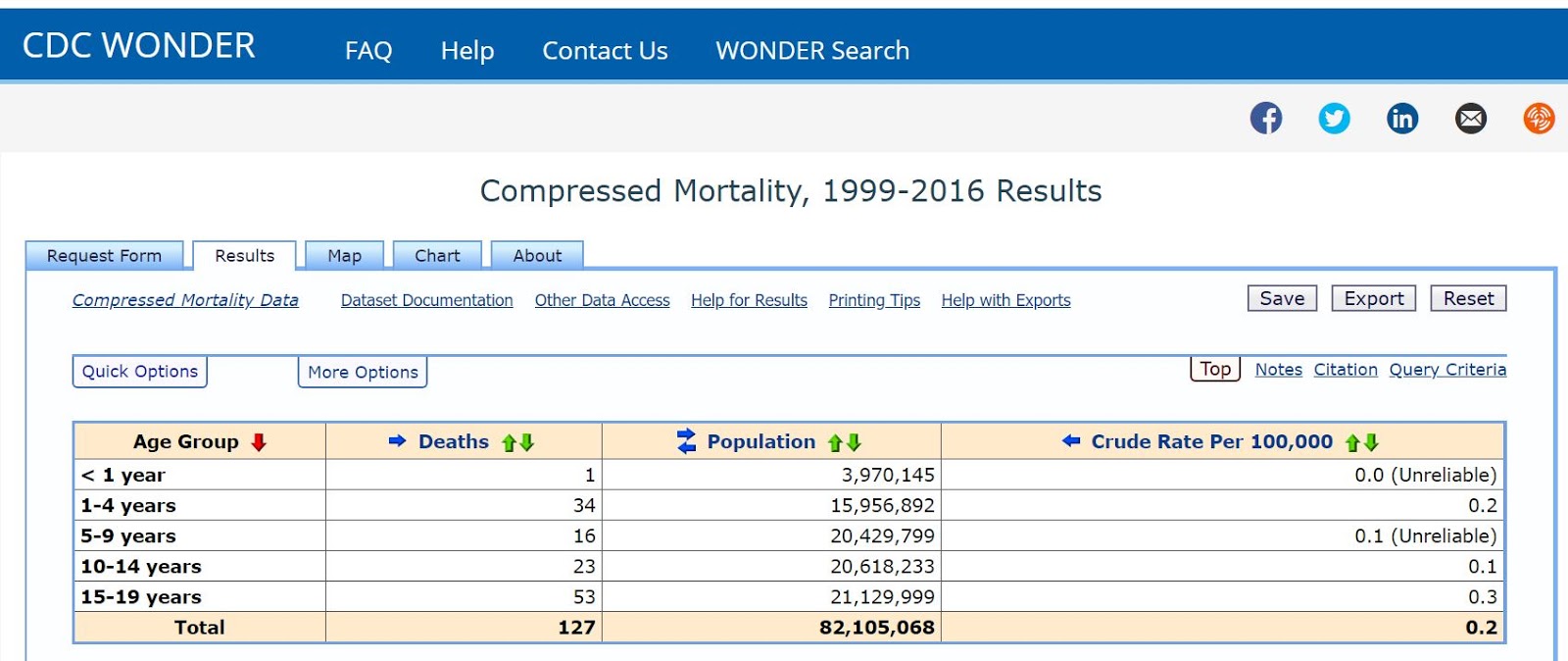
The gun control groups like to include all deaths through age 19 as children.  Here are the 2016 breakdowns by category and age.  Click to enlarge.

Accidental deaths (all firearms types)

Homicides (all firearms)

Suicides (all firearms)

None of these are wonderful, but notice that mostly these include the gang member age range: 15-19

The ‘X17’ particle: Scientists may have discovered the fifth force of nature
A new paper suggests that the mysterious X17 subatomic particle is indicative of a fifth force of nature.

As strange as it may seem, sub atomic particle physics have been of great interest to me.

In 2016, observations from Hungarian researchers suggested the existence of an unknown type of subatomic particle.
Subsequent analyses suggested that this particle was a new type of boson, the existence of which could help explain dark matter and other phenomena in the universe.
A new paper from the same team of researchers is currently awaiting peer review.

Physicists have long known of four fundamental forces of nature: gravity, electromagnetism, the strong nuclear force, and the weak nuclear force.

Now, they might have evidence of a fifth force.

The discovery of a fifth force of nature could help explain the mystery of dark matter, which is proposed to make up around 85 percent of the universe’s mass. It could also pave the way for a unified fifth force theory, one that joins together electromagnetic, strong and weak nuclear forces as “manifestations of one grander, more fundamental force,” as theoretical physicist Jonathan Feng put it in 2016.

The new findings build upon a study published in 2016 that offered the first hint of a fifth force……………

The discovery of a fifth force of nature would provide a glimpse into the “dark sector”, which in general describes yet-unobservable forces that can’t readily be described by the Standard Model. Strangely, the subatomic particles in this hidden layer of our universe hardly interact with the more observable particles of the Standard Model.

A fifth force could scientists better understand how these two layers coexist.

“If true, it’s revolutionary,” Weng said in 2016. “For decades, we’ve known of four fundamental forces: gravitation, electromagnetism, and the strong and weak nuclear forces. If confirmed by further experiments, this discovery of a possible fifth force would completely change our understanding of the universe, with consequences for the unification of forces and dark matter.”