Stopping An Attack: Stopping an attacker as soon as possible is critical to surviving a criminal encounter.

Regardless of your state of residence, the justification for using deadly force is to stop someone who is placing people’s lives in immediate, serious danger. Of course, it is up to you to know the exact wording and particulars of your state law and abide by them. But, essentially, if we hadn’t taken immediate action, an innocent person would have been killed or sustained serious bodily injury.

It is important to understand that killing the bad guy is not, nor should be, our goal. We are acting because we want to stop the attacker right now, before any further damage is done. By the same token, if the bad guy dies because of our defensive response, that is unfortunate, but it is something he should have considered before placing others in danger.

And, in order to get him to stop as quickly as possible, we place our shots in what we call the vital zone. Rounds fired to the upper chest area are the easiest to make because the target is large. And these shots rely on the loss of blood and drop in blood pressure to incapacitate the criminal. As most deer hunters know, even a heart shot is not an instant stopper. Activity stops when fresh blood is no longer getting to the brain.

The more immediate stop comes from a head shot that impacts the brain or brain stem. The problem here is that the head is a much smaller target and is generally a moving target, as any turkey hunter can testify.

The current trends in thinking are that caliber doesn’t matter nearly as much as penetration. The bullet has to drive deep enough to impact the vitals in such a way as to cause the criminal to stop the attack. Okay, I’ll buy that, up to a point. A large hole in the heart or a major blood vessel is going to leak more blood than will a small hole in the same location.

For this reason, I still recommend the minimum defensive round to be 9 mm/.38 Spl. in size. And the defensive handgun should be loaded with premium bullets from a major manufacturer to insure that it will expand and penetrate in an appropriate manner. There is really no justification for going to a smaller caliber unless the person has some sort of physical problem that prevents it.

Essentially, the smaller the caliber and the lighter the load means that it is going to be even more difficult to get the crook to stop right now. And, remember, that is our goal. If your attacker dies from all those .22 bullets next week, or even in a couple of hours, there’s still plenty of time to continue this grievous attack. It is that attack that we want to stop … and we want to stop it right now!

Largest-Ever Survey of Gun Owners Finds Diversity Increasing, Carrying Common, and More Than 1.6 Million Defensive Uses Per Year

A survey of 16,708 gun owners provides updated answers to some of the most pressing questions surrounding guns in America.

The National Firearms Survey, conducted in 2021 and updated earlier this year, examines the breadth of gun ownership and the use of guns throughout the country. It found more minorities and women own guns than previous surveys indicated, half of gun owners report carrying a handgun for self-defense, and nearly a third report having used a firearm to defend themselves–a number that translates to over 1.6 million defensive uses per year. William English, the Georgetown University professor who created the survey, told The Reload it is the most comprehensive look at American gun ownership yet produced.

“The biggest difference between the results of this survey and many earlier ones is that this survey goes into greater depth regarding types of firearms owned, the details of defensive gun uses, and frequency of defensive carry of handguns,” Professor English said. “This survey is also the largest survey of gun owners ever conducted, providing more statistical power than earlier surveys and much more information about the demographics of gun ownership and use. Its results are largely consistent with other recent survey work when it comes to general ownership estimates, which increases the confidence in its accuracy, but it goes into greater depth with regard to many details of interest.”

The sweeping survey will likely influence both the political and legal landscape surrounding firearms. The debate over guns has primarily centered on how common the ownership of guns is and how often they are really used to protect people rather than endanger them. Much of the evidence cited in that debate is decades old. So, the introduction of not just more thorough but more recent evidence may disrupt the decades-old conversation on guns. Its effect may be particularly stark in federal courts where the Supreme Court has placed significant weight on protecting guns in “common use for lawful purposes.”

The survey could also shake up how academics study guns in America. Up to this point, most gun ownership surveys have not been much larger than traditional public opinion polls. That means their samples can not be generalized down from their nationwide scope to more specific areas, such as the state level, without introducing further uncertainty. Most studies have attempted to control for that uncertainty by relying on indicators of gun ownership, including local suicide rates, rather than direct measurements.

However, Professor English’s survey established a representative sample of gun owners in all 50 states. He said the estimates in his survey are similar to the Rand Corporation’s widely-cited estimates on some of the more populous states but vary significantly in smaller states. The new data has the potential to upend the results of many studies that have relied on less straightforward ways of estimating gun ownership in the area they’re studying.

The survey also advances the understanding of defensive gun use. It shows many American gun owners report actually using their firearms to defend themselves.

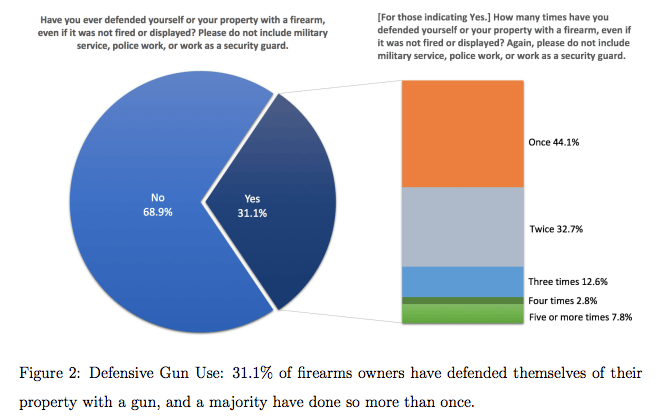
“Given that 31.1% of firearms owners have used a firearm in self-defense, this implies that approximately 25.3 million adult Americans have defended themselves with a firearm,” English wrote in a preprint report on the study published on the Social Science Research Network (SSRN). “Answers to the frequency question suggest that these gun owners have been involved in a total of approximately 50 million defensive incidents. Assuming that defensive uses of firearms are distributed roughly equally across years, this suggests at least 1.67 million defensive uses of firearms per year in which firearms owners have defended themselves or their property through the discharge, display, or mention of a firearm (excluding military service, police work, or work as a security guard).”

However, English noted it also paints a more realistic picture of defensive gun use than what’s often shown in movies or TV. Instead of an altercation with many shots fired and the assailant ending up shot, the vast majority of defensive gun uses did not involve the defender firing any shot at all. Brandishing a gun was enough to end the threat to the gun owner in 81.9 percent of cases.

In cases where defenders did fire, a single shot was enough to end the confrontation in nearly half of the cases. Taking two shots was the next most common outcome, with each additional shot becoming less common.

Gun-control advocates and researchers have critiqued survey-based defensive gun use estimates, including the oft-cited work of criminologists Gary Kleck and Marc Gertz, as overestimates and elevated estimates in the tens-of-thousands range, calling into question the primary practical benefit of gun ownership. English said the paradoxically non-violent nature of most self-defensive use of firearms is why survey-based estimates like his differ significantly from those that use more restrictive metrics, such as the number of justifiable homicides or emergency room visits for gunshot wounds. He said his survey’s estimate aligns well with estimates for the number of emergency room visits once you factor in how few shots defenders say they fire and factor in the likely hit rate of those shots.

“The key to the puzzle is the fact that shots fired in self-defense rarely hit their target,” English told The Reload, citing studies from 2008 and 2018. “Studies of police have found that something like 65-85% of shots fired by officers miss. Note that these are trained professionals, and if they are engaged in a shooting incident, this will typically be pursued at close range until the perpetrator has been apprehended or incapacitated, meaning it’s not sufficient to simply fire a shot to scare an aggressor away. I wouldn’t be surprised if more than 90% of shots fired in self-defense by ordinary people didn’t hit anyone. Ordinary people should be less accurate, on average, than professional police officers. And, in most cases, the spectacle of gunfire is likely enough to get an aggressor to flee, which is sufficient for protecting a victim.”

English said his survey addressed another common critique of previous work in the field. He said previous studies that tried to estimate yearly defensive gun uses relied on respondents not only remembering that they used a gun in self-defense but also that it happened within the previous year. English designed his questions to avoid that pitfall, betting people are more likely to remember if they experienced a traumatic defensive encounter rather than the exact timeframe it happened in.

“My survey took a different approach, asking about defensive use at any time, not simply the last year,” he told The Reload. “The results show that this is not a rare event at all, with something like a third of gun owners reporting having used a gun in self-defense. Because of how the question was asked, I don’t have to engage in the exercise of extrapolating out estimates from measures of rare events in a restricted window of time.”

There are other potential weaknesses of English’s approach, though. He noted the survey only asked questions about defensive gun use to those over 18 years old and those who self-identified as gun owners. He said that might explain why his yearly estimate is on the lower end of Kleck’s previous estimates, which topped out at 2.5 million per year.

“There are also reasons to think that the [defensive gun use] estimates of this survey are conservative,” English said. “Kleck had found that a large proportion of those who had used guns in self-defense did not personally own a gun.”

English also looked at areas beyond what other researchers had attempted to survey at scale before. The survey found that AR-15s and similar rifles are in the hands of a wide swath of American gun owners, as are magazines that hold more than ten rounds of ammunition. What’s more, it found carrying pistols for protection is commonplace as well.

“In sum, about 31.9% of U.S. adults, or 81.4 million Americans, own over 415 million firearms, consisting of approximately 171 million handguns, 146 million rifles, and 98 million shotguns,” English said in his report. “About 24.6 million individuals have owned a up to 44 million AR-15 and similarly styled rifles, and 39 million individuals have owned up to 542 million magazines that hold over ten rounds. Approximately a third of gun owners (31.1%) have used a firearm to defend themselves or their property, often on more than one occasion, and guns are used defensively by firearms owners in approximately 1.67 million incidents per year. A majority of gun owners (56.2%) indicate that they carry a handgun for self-defense in at least some circumstances, and about 35% of gun owners report carrying a handgun with some frequency.”

The survey of over 44,000 Americans, from which 16,708 gun owners were identified for further questioning, was conducted through the internet between February 17th and March 23rd 2021 by the polling firm Centiment. It is part of a larger research project by English on guns in America. He said he plans to publish several more academic papers on it in the coming months, ultimately culminating in a book on the topic.

Gun control fans won’t like lessons of New Zealand

When the Christchurch massacre took place, New Zealand acted. They responded to what happened the same way American anti-gunners would have us react. They banned AR-15s and went on a rampage of stomping on the gun rights of folks there.

Of course, New Zealand doesn’t have a Second Amendment. There’s no protection of gun rights. In fact, gun rights aren’t even acknowledged as rights there, which is a bit of an issue as well.

However, right now, the biggest issue is how the country tripped over itself passing gun control, yet absolutely none of it worked.

Gun control laws disarm victims, not criminals. That’s common sense to everyone but the politicians who promise peace, rainbows and dancing unicorns if only you’ll give up your firearms.

New Zealand’s gun control advocates — including Prime Minister Jacinda Ardern– remain slow on the uptake of that fundamental principle of life. In multiple gun confiscation drives, the Kiwi government grabbed most of the good guys’ guns. And now, a year after the final confiscation push, gun-related violence has reached new, record levels.

Try to suppress your shock and surprise.

Is it really that bad? Are the good folks over at The Truth About Guns spinning things a bit to make a point?

Actually, no, they’re not.

Rates of injury and death caused by firearms are tracking higher than ever before.

Data released by police under the Official Information Act shows 10 murder or manslaughter deaths in 2022, up until 31 July. There were 11 in total in 2021.

Injuries are also running at a record rate, on track to exceed 300 firearm-related injuries for the first time. In 2021, there were 298 gun-related injuries recorded by police, the highest ever.

Now, the numbers aren’t overly impressive, but we have to remember that New Zealand has a total population of just over 5 million people. If you put all of them together in one city, it would only be the second-largest city in the US by population.

Yet those 5 million are spread out over 103,000 square miles, which is enough to drive down the violent crime rates all by itself.

That said, comparing their numbers to ours is silly. Other countries aren’t the United States and vice versa. When looking at the impact of gun control, one thing you have to look at are the trends from before and after its passage.

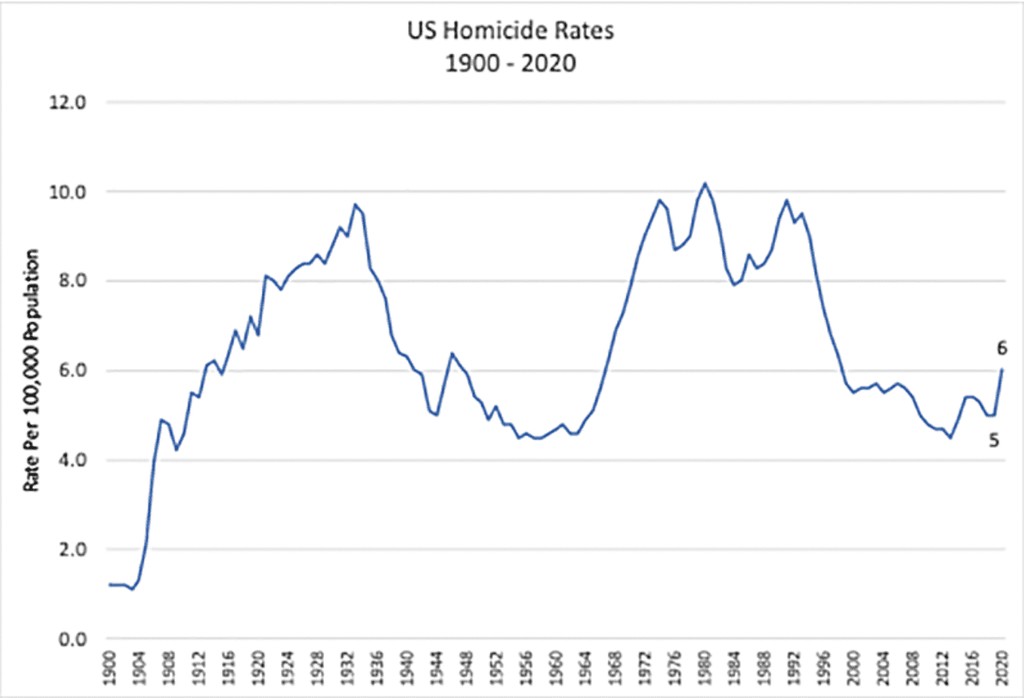
Prior to Christchurch, New Zealand’s homicide rate was pretty low. In fact, the 49 people killed in that massacre were enough to produce a nearly 254 percent increase in the homicide rate that year, which is kind of telling all on its own.

Yet since then, we’re clearly seeing homicides increase as well as violent crime as a whole. That’s likely because criminals no longer have much reason to fear ordinary citizens. They can kill as they want with impunity because no one is there to stop them.

Oh, sure, the police may come looking for them, but few criminals believe they’ll be caught. They tend to think that if no one is there to prevent a crime, no one will know who did it. That’s not quite true, as we know, but that’s how they tend to think.

New Zealand gave those criminals a gift.

What’s more, American gun grabbers want to give our own criminals the same gift. However, the carnage here would be orders of magnitude worse by virtue of this country simply being more violent. Take away good guys’ guns and watch how the bodies pile up.

If it’s happening in New Zealand, there’s not a shred of doubt that it would happen here.

And this is what gun control got them.

Even if you dismiss gun control as causing this issue, you cannot ignore that it did nothing to prevent it, which is par for the course and why it’s so infuriating that people still push it.

Texas private school to allow staff to go about day armed

Armed staff may well be the best way to protect students in our schools. Yes, it’s a shame that we should even need to have this discussion–our schools should be safe from such monsters–and in a perfect world, we wouldn’t have to. Yet we don’t live in a perfect world, though. We live in this one.

As a result, bad things happen in schools, as we’ve seen all too recently. What’s more, armed staff actually can protect our kids.

For one private school in Texas, that fact stands and they’re not going to pretend it doesn’t.

Faith Academy is planning on implementing a program that will allow teachers and staff to carry weapons at school.

The private Victoria Christian school is joining several area school districts in taking advantage of a Texas law that gives school officials the authority to let private individuals have guns on school premises, which is otherwise illegal.

This provision is often called the “guardian plan” or “guardian program,” though that name is not official.

Unlike most of the public school districts that have implemented such a plan, Faith’s teachers and staff will have the guns on their person during the school day, according to Principal Larry Long.

These staff members will be trained and certified, but I’m mostly shocked at the idea that some of the armed staff in the public schools don’t carry the firearm on their persons.

What are they supposed to do, ask the mass shooter for a time-out so they could get their guns? “Excuse me, Mr. Killer? Can we press pause for a moment so I can get my gun, then we can do this all fair-and-square?”

Yeah, let me know how that goes.

Victoria Academy is clearly thinking straight on this. If the teachers have their guns on their person, they can respond in an instant, as opposed to potentially having to run to wherever they’re stored and gaining access under stress.

Look, schools are a favorite target of mass shooters. Part of the reason for that is because they know they’re unlikely to face much in the way of armed resistance. The idea that the supposedly armed staff don’t actually have ready access to their weapons isn’t likely to be much of a deterrent.

Yet this case? Yeah, I can see things going very differently if someone were to pick this school.

However, I also think that it isn’t going to happen. For one thing, mass shootings at a school are very rare, but also because now people know the teachers at Victoria Academy are armed and will have their weapons on them.

The two things combined provide a blanket of protection over this school like few others.

Anti-gun voices can scream about armed staff at schools if they want, but we’ve seen too many instances where a good guy with a gun made the difference. The last thing I want to ever write about again is innocent kids being killed in their classrooms.

Teachers and staff with guns can make sure I never do.

Don’t Believe Anti-Gun Lies About Armed Self-Defense

Most America’s 1st Freedom readers are well aware that anti-gun politicians, gun-ban advocates, and the so-called “mainstream” media tend to play fast and loose with the facts. One specific area where they tend to flat out lie is in the frequency of armed self-defense episodes by law-abiding Americans.

“People very rarely use guns successfully to defend themselves from crimes—both in their homes and in public,” Laura Cutilletta, managing director for the anti-gun Giffords Law Center, wrote in a recent op-ed titled “Debunking the ‘Good Guy with a Gun’ Myth.”

Cutilletta further pontificated: “Having access to a gun doesn’t better protect people from being injured during a crime compared to other protective actions like calling law enforcement or fleeing the scene.”

Of course, she’s completely wrong, as we’ve detailed before. Back in 2013, even the Centers for Disease Control wrote: “Studies that directly assessed the effect of actual defensive uses of guns (i.e., incidents in which a gun was ‘used’ by the crime victim in the sense of attacking or threatening an offender) have found consistently lower injury rates among gun-using crime victims compared with victims who used other self-protective strategies.”

Four Southern gun owners became living proof of that fact during a five-day period in late August.

On Aug. 28, in League City, Texas, a couple was at their home in a trailer park at about 10 p.m. when a man broke into the trailer and threatened them with a knife. Fearing for their lives, one of them fired a shot, hitting the intruder.

Officers responding to the shooting found the home invader dead inside of the trailer. The incident is being investigated as an act of self-defense.

A day earlier, in Loganville, Ga., a 23-year-old man had gone to attend a family event when another man approached him and started an argument. The man told police officers that he retreated and attempted to get away, but the other man pursued. Believing the aggressor to be armed and fearing for his life, the first man shot him.

The attacker was taken to a nearby hospital where he was pronounced dead. While it has been reported that “(e)vidence at the scene corroborated” the claims of the man who said he acted in self-defense, police continue to investigate the case. No charges have been filed.

Three days before that, a Boones Mill, Va., homeowner used his legally owned firearm to defend himself and his family. According to media reports, a man unknown to the homeowner came to the house and an altercation ensued. The homeowner shot 26-year-old Christopher Hill, who died at the scene. Police are still investigating the incident.

That same day, in Hialeah, Fla., a man used his firearm to protect himself during an alleged road rage incident. Police say one man blocked in another man’s car with his own, got out of the vehicle, approached the other car in an aggressive manner, and confronted the other driver.

Fearing for his life, the second man shot the aggressor in the chest, killing him. Police are still investigating the incident and treating it as a case of armed self-defense.

“This case is still open and active but appears to be an act of stand your ground,” the Hialeah Police Department told Local 10 News via email. “The shooter is fully cooperating in the incident and is facing no charges as of this writing.”

The truth of the matter is, armed citizens across the country save their own lives and the lives of others many times every day. The anti-gun narrative that says otherwise is clearly fake news.

Armed Citizen Stops Man Randomly Shooting People in Detroit; 3 Dead 1 Wounded

It took an armed citizen to stop a man that was randomly shooting people in Detroit that spanned over two hours.

This past Sunday, a 19-year-old man started randomly shooting people. He shot and killed three people, including a 28-year-old and a 43-year-old.

The shooter then shot a 4th person, who was an 80-year-old man walking his dog. A neighbor witnessed the incident, grabbed his gun, and fired back at the suspect.

“He saw my weapon, and he went from predator to prey. He had that look of shock,” said the neighbor. via WXYZ

Another neighbor said he saved the 80-year-old man’s life because had he not shot at the suspect, he would have walked up and shot the victim multiple times like he did his other victims.

The suspect was arrested a few hours later and is currently in custody pending charges.

This senseless act of violence was only stopped due to someone else having a gun to stop the threat. And this is why you should always carry and be prepared to use your gun in self-defense. If only someone were there to stop the threat before this coward could take his first victim.

The Deep Concealment Gun: Possibly Your Most Important Personal Weapon

The Deep Concealment Gun: Possibly Your Most Important Personal Weapon

We preach carrying as much gun as possible, but for people who live in the real world in which professional and social obligations do not lend well to dressing around a full-size gun, a deep concealment pistol is needed. When out and about in casual clothing, I carry a double-stack 9mm pistol, but when I need to dress formally for certain social obligations, I usually carry a small revolver. However, this is not the only circumstances in which I use the small gun; when exercising in gym shorts, when working outside in the yard, and when simply lounging around the home, the small gun is either in the waistband or in a pocket. I suspect that many concealed carriers out there are similar in this regard; the small gun gets carried often.

With this in mind, I would submit that for many concealed carriers, the deep concealment option, which is often considered secondary, is likely the most important defensive weapon due to the amount of time it is actually used. Many concealed carriers may feel that they wear their “full-size” gun most of the time, but in fact, they don’t. If one is honest in their self-assessment, they will likely realize that the small gun is getting carried for the occasions that require something small, but likely, far more often than just that.

Is there anything wrong with carrying a small gun more often? The argument to carry “as much gun as you can” is well-intentioned and well-reasoned. With the increase in criminal activity involving multiple aggressors and with the increase in mass killer events, carrying a capable fighting pistol makes good sense. A larger handgun with more ammunition capacity is typically more shootable, and more capacity is a good thing. However, most would agree that a small pocket pistol or small-frame revolver that gets carried all the time is far more valuable than a more capable gun that is carried only part-time. It is human nature to go with the easier solution, so small guns get carried a lot. Thus, for most, it is the most important gun.

Staying Consistent with Deep Concealment

Know the Limitations
Unfortunately, the majority of concealed carriers that use a small gun rarely practice with it. Even if the small gun gets carried ninety percent of the time, the big gun that only gets carried occasionally tends to get all the training time. Again, human nature, big guns are easier to shoot. However, if you are carrying your deep concealment gun most of the time, then it warrants significant training effort.

The first benefit gained through training with your small gun is understanding the limitations. How much do you give up in performance compared to your full-size carry gun? Three constructive elements will emerge from knowing this: first, you will understand the limits of your range, accuracy, and speed with the small gun. Second, you will better determine how often you should be carrying the small gun compared to the more capable pistol. Third, you may well realize that much of the limitation can be overcome through more practice with the limited platform.

Determine the Role of the Small Gun
If you utilize a small revolver or a pocket pistol chambered in 380ACP or the like, then you should acknowledge that you are, indeed, giving up significant capability compared to carrying a full-size or compact autoloader. The new breed of micro guns that are chambered in 9mm, yet have a substantial capacity of ten plus rounds may be a solution that can be carried anywhere, and these guns, indeed, greatly close the gap between service pistols and pocket-sized guns. If one of these tiny but higher-capacity guns works for carrying all of the time, in all circumstances, I would propose not losing sleep over it. Simply maximize your training with it.

But, If you must use something that is even smaller for deep concealment like the aforementioned small revolver or tiny pocket auto, then having an honest assessment of when you can carry more is warranted. Again, if you only carry such a diminutive option, but you carry it all the time, you are ahead of the curve compared to the general public. However, there is probably a great deal of time when you can carry more. While carrying any gun is far better than carrying no gun, I am always inclined to suggest carrying “as much gun as you can” in light of the current state of the world.

When out in public during times that you can be dressed casually, which is probably quite often, there is no reason not to carry a larger, more capable gun. With modern holster options, most people can conceal compact, or even full-size, pistols under an untucked or open-front shirt. Consider the escalation in active killer events, the prevalence of multiple assailants in armed robbery, or the increase in gang activity; an auto loader with duty capacity is in order.

Still, we return to the reality that determines the course of most concealed carriers’ choices, and even for those committed to carrying enough gun, there are many circumstances that limit this choice. The small, deep concealment pistol is likely the one that will get carried most often when combining the need to accommodate non-permissive environment carry, gym or jogging carry, and home carry. Therefore, do not neglect training with your deep concealment gun, which might be your most important defensive tool.

More women bought guns nationwide. These Charlotte experts are training them.

Gun safety posters lined the walls inside the classroom of the Charlotte Gun Club on a recent Saturday morning as two women took their seats behind a long table.

From the gun-shaped hook holding the set of bathroom keys to the stacks of gun magazines, the set-up was about what anyone would expect.

But with LaToya Workman teaching, bras and tight thigh bands made into holsters litter a table. And, she brought a bright green purse specifically made for conceal carry. Facing the two women who signed up for training — one a mother whose youngest child was just 7-weeks-old, the other a single woman wanting a gun for protection — Workman explained how to load, aim and fire a gun.

The two students listened closely as she laid out the basic rules. One of the most important, she said: “Don’t point your gun at anything you aren’t willing to destroy.”

Workman owns Woman with a Weapon, a company designed to encourage more women to get gun permits in North Carolina and to provide training and safety classes.

While Black women are one of the fastest growing demographics of firearm owners in the country, there is still a lack of representation in the gun world, Workman says.

Gun sales reached an all time high in 2020 nationally, especially among women and the Black community, according to the National Shooting Sports Foundation. In North Carolina, the number of people who requested conceal carry permits hit a record high for the state in 2020. Locally, there was a similar trend — and notably a surge in interest among Black women, with nearly 15,000 permit applications, according to Mecklenburg County data on pistol purchasing and conceal carry permits. Since then, the trend has slowed considerably.

WOMEN IN GUN INDUSTRY

When she first moved to Charlotte almost five years ago to be closer to her aunt, Workman was single and wanted to have a gun for personal protection but she wasn’t quite sure where to start.

Growing up, she remembers, her grandmother owned a gun for protection and to shoot snakes at her Arizona home but her exposure to gun ownership stopped there.

In Charlotte, she decided to take one-on-one firearm training before applying for a concealed carry license. At her first class, her instructor was an older man who focused on Workman’s gender: She says he tried to tell her how to dress, the challenges a woman might face using a gun, and that she would need to cut her long, manicured nails.

“I wanted to pursue training from a female and … I was not able to find one in the area,” Workman said.

She decided to become an instructor in 2020 to help encourage other women. It’s part-time and a bit of a hobby for Workman. During the day she works in cybersecurity risk management.

“It takes a lot of courage for women to actually come to class and overcome their fears,” Workman said. “The more you’re able to learn about a subject, the less intimidating it is. At least that’s how it was for me. … I’ve seen that same progress in other women as well.”

Fellow instructor Kisha Kincaid says representation makes a difference.

The owner of Armed and Empowered based in Charlotte, Kincaid used to sell self defense items to women, including pepper spray and stun guns. But, her real interest was with firearms and she enjoyed shooting. Starting from a young age she learned from family members by shooting at cans.

Kisha Kincaid shows her gun for the camera at a gun range in Concord, NC Wednesday August 17, 2022. Makayla Holder mholder@charlotteobserver.com

Often, when Kincaid would set up her booth at gun shows and other locations, women would come up to purchase something and tell her they were really interested in learning how to shoot.

“But they were intimidated by the process, or they had a fear around it, and then there was a lack of women representation in that field,” Kincaid said.

So, Kincaid decided to fill what she describes as a need in her community by becoming a firearm instructor in 2013. Her day job is in tech in the banking industry.

Kincaid said the biggest barrier women face when becoming responsible gun owners is fear and intimidation, and not knowing where to start. She said the number one reason women purchase guns is for personal protection and empowerment. The second most common is if there is already a gun in the house and they want to learn how to use it.

Kisha Kincaid discusses aiming techniques with her student, Taylor Smith, at a gun range in Concord, NC Wednesday August 17, 2022. Makayla Holder mholder@charlotteobserver.com

The recent increase of guns purchased by Black women is partially because of a heightened recognition that they’ll need to defend themselves, says LaShonda Hopkins. Hopkins lives in Fayetteville and is a veteran. Her company LaBleu Tactical Training, also aims to make shooting more accessible.

“… If you look at the statistics, we are also the ones that are being kidnapped, and human trafficked in high numbers and no one’s checking for (us). When we go missing, we’re just gone,” Hopkins said.

She says many women assume their spouse or significant other will protect them.

“But that’s just not reality,” Hopkins said. “… The whole idea of just depending on a man to do that, I feel like we’re so far past that now and women got to step out of their comfort zone, and go ahead and pick up a gun as well and just get properly trained.”

WHAT FIREARM RETAILERS AND RANGES CAN DO FOR SUICIDE PREVENTION MONTH THIS SEPTEMBER

Participating can help save a life!

The majority of firearm-related deaths annually are suicides, not homicides or accidents. Understanding this, the firearm industry can play a role in reducing the rate of suicide by helping to educate employees and firearm owners and their families about mental health, suicide prevention and how to recognize and respond when a person is going through a difficult time.

We all have mental health just as we all have physical health; both need to be cared for. Delivering this and other messages to gun owners is where we all come in. Industry and NSSF serve as trusted messengers to overcome barriers when providing education to gun owners—education developed in collaboration with our partners, the American Foundation for Suicide Prevention and the U.S. Dept. of Veterans Affairs.

Firearm retailers and shooting ranges can help deliver this education during Suicide Prevention Month (September) and also year-round by engaging in one or more of these strategies:

  • USE the AFSP-NSSF Suicide Prevention Toolkit materials at your business. The toolkit is free to order and contains a poster, counter cards, window clings, a brochure for customers and a postvention brochure providing guidance in case your business experiences a suicide.
  • EDUCATE your staff about warning signs, risk factors and intervention techniques by having them watch the SHOT University e-learning module, developed by NSSF and AFSP.
  • PROMOTE discounts and sales of secure firearm storage devices. Storage devices put “time and space” between a person with suicidal thoughts and a method of self-harm.
  • PROMOTE training courses on responsible firearm use and ownership.
  • HOST an AFSP “Talk Saves Lives” presentation at your business or help sponsor one in your community. Talk Saves Lives provides an overview of how individuals can help prevent suicide. NSSF contributed to the content of Talk Saves Lives to ensure it’s respectful of gun owners. Your state’s AFSP chapter can arrange a presentation.
  • HOST a QPR (Question, Persuade, Refer) course at your business or help sponsor one in your community. QPR provides training to individuals so they can help a person in crisis; it can save lives.
  • RUN the VA’s “Space Between Time and Trigger” video ads on your website or social media page. The ads come in 15-, 30- and 60-second versions. The videos can be accessed at Keepitsecure.net.
  • MAKE customers aware of the FirearmLifePlan.org. The website, which NSSF advised on, offers tools to help people think about the disposition of firearms later in life and protects families from the burden of making difficult decisions without guidance.
  • PARTNER with local law enforcement to promote NSSF’s Project ChildSafe program in your community to remind gun owners to securely store firearms when not in use and educate children about gun safety.
  • PROMOTE NSSF’s Parents Guide to Understanding Youth Mental Health and Preventing Unauthorized Access to Firearms—a response to rising youth suicide rates and firearm misuse.

Learn more about these resources and programs by clicking the URL in their descriptions above or reach out to NSSF at membership@nssf.org for assistance.

She Can Shoot: The Rise of Female Gun Ownership
Women are one of the fastest-growing demographics in the firearms industry

Robyn Sandoval is seeing a sea change at the gun range: The executive director of A Girl and A Gun (AGAG) Women’s Shooting League is noticing that women are showing up to shoot more than ever before. “Every week, basically, we’re approached by a new instructor or range that wants to have a women-focused training program in their area,” Sandoval told Discourse.

Her experience is part of a great ongoing transformation in the gun world. Over the past two years, more than 5 million women bought a gun for the first time. That’s about 37% of the 13.8 million new gun owners that the National Shooting Sports Foundation’s dealer surveys identified over that time period. That makes women, alongside minority gun owners, one of the fastest-growing demographics in the firearms industry.

Why Women Are Buying Guns
In just over a decade, A Girl and A Gun has grown to include more than 200 chapters at 300 ranges across the country. And that growth only accelerated as America entered a period of unprecedented gun sales beginning in 2020. It’s no coincidence that period coincided with unprecedented chaos, Sandoval said.

“With the riots and the pandemic, most everything was kind of still fear-based…they’re afraid that they wouldn’t have access to protection,” she said. “That first responders wouldn’t be able to respond. Or they’d be targeted for violence.”

Breaking down barriers. A Girl and a Gun Executive Director Robyn Sandoval: “We’ve broken through a lot of barriers so that people recognize that the everyday moms and women of all walks of life are welcome at the range.”

A 2021 AGAG survey shared with Discourse shows that 45% of its membership were new shooters. The top reason those new shooters gave for buying a gun was concern over rioting and civil unrest. 59% of the new shooters listed a fear of physical safety or new gun bans as a reason they decided to buy.

But those weren’t the only reasons women gave as they began to seek out training and competition. One reason was simply the realization that something like AGAG was available to them.

“Many of them have just learned that training is an option for them,” Sandoval said. “That’s something we’re seeing more and more is that a lot of women thought that you had to be an operator or have law enforcement experience, or that civilian courses were not available to them, or nobody in their social circle had taken them before. Now, at A Girl and A Gun, we’ve broken through a lot of barriers so that people recognize that the everyday moms and women of all walks of life are welcome at the range.”

That may be surprising to many people, but not Sarah Hauptman. She has been involved with gun-rights activism in Minnesota for years and recently started helping to run the holster company Phlster, which her husband founded in 2011. There’s a big difference between when she first started shooting and today, she said: Women are increasingly a fixture at gun ranges.

A path for women. Phlster owner Sarah Hauptman: “When your friends shoot, and you see female faces shooting, and you see people who look like you, it’s a lot more accessible.”

“It used to be you’d go to a shooting class, and you’d be the only girl there,” Hauptman told Discourse. “Now, more often than not, there’s several.”

That kind of representation matters, Hauptman said: It’s created a kind of snowball effect. “When your friends shoot, and you see female faces shooting, and you see people who look like you, it’s a lot more accessible,“ she said. “You don’t have to swim against the current to get into it. There’s a path for you.”

Hauptman said breaking down the barriers to entry also leads many women to embrace what she sees as the empowering nature of gun ownership. Hauptman herself did not grow up with firearms. She only became interested later in life after she and her mother decided to try out shooting and had a proverbial blast. “The fun got me into it and kept me into it,” she said.

But after the fun factor brought her to gun ownership, it was its practical utility that made her want to stay. And it even made her want to advocate for others to get involved.

“You kind of realize, ‘Oh, this actually gives me a lot of capability, and it is a kind of equalizer,’” she said. “Once you realize that you can control that power and make it part of your life and add to your ability with it, you’re not giving that back. You’re not letting anyone take it from you either.”

Hauptman said that’s why more women are turning toward firearms to provide for the safety of their homes—households for which they are more often primarily responsible. “I think more women are taking responsibility for their own self-protection,” she said. “More women are living alone. Whether they’re single moms or whether they’re just single women, more women are solely responsible for their own self-defense.”

That’s borne out in AGAG’s data too, which shows 37% of its members are single. “More women than ever before are actually becoming the first gun owner in their home, as opposed to it being more male-driven in the past,” Sandoval said.

Less Pink, More Practicality
The gun industry has taken note of the increasing prominence of female shooters. Sandoval said the market has evolved for the better in recent years. Gun companies are now doing much more than just making superficial appeals to female shooters.

Ten years ago, it was a “pink it and shrink it” mentality when it came to product development. But now, there are really thoughtful products that women want to use, that are developed for women, that fit women’s hands better, that fit their bodies better, that give them more options for concealed carry. It used to be where women’s choices in concealed carry were pretty limited to really small guns, and now, most women, regardless of their size, can carry a full-size, even decked out with lights and optics.

Sandoval singled out Glock’s introduction of slimline models, such as the Glock 43 a few years ago, and Walther’s recent release of the PDP F-Series as examples of major industry players emphasizing designs that appeal to women. While those guns are also popular with men, their design took the unique needs of women into consideration. Sandoval said Walther consulted with AGAG on the design of the PDP F-Series, and the company’s process included measuring the hands of a thousand women to better tweak the layout of the pistol’s trigger and controls.

Mark Oliva, a spokesman for the National Shooting Sports Foundation, said those kinds of considerations are becoming more and more common in the industry. “Designs of handguns for personal protection are incorporating features long sought by women, including smaller frames, lighter springs, redesigned magazines for easier loading, and shotgun and rifle stocks designed to more readily fit the needs for women with length of pull,” he told Discourse. “The AR-15, due to its easy adaptability and customization, has been a rifle that can easily fit the needs of women gun owners by simple and small adjustments.”

Sandoval also praised the latest innovations in concealed-carry options made with women shooters in mind, including those from Hauptman’s company and its competitor Dene Adams. “The Phlster Enigma has been a game changer in the industry,” Sandoval said. “That’s rocked the training world. Dene Adams also has really great products. I love that [Dene Adams products] have Kydex holsters in them to make everything safer. There’s a lot of activewear and concealment wear out there that don’t have the safety controls in place that instructors want to see.” She said the Kydex inserts help cover the trigger of the firearm to stop the trigger from being pulled unintentionally.

Both Sandoval and Hauptman emphasized that certain gun features that appeal to women, like the thinner grip of the Glock 43 or the Enigma’s beltless holster system, for example, are just as appealing to many men. In fact, while the Enigma has quickly earned a sort of cult status among female concealed carriers, it is even more popular with men.

“Our product is 100% gender neutral,” Hauptman said. “It works on basic physical principles that can be applied to any body type. The reason that it’s popular among women is because women are just less likely to wear belts.”

She said Phlster’s goal is to make it easier for everybody to carry regardless of their gender. However, women have long been underserved in the gun-carry market. So being able to more directly address their needs has helped the company gain an enthusiastic following.

“More women are successfully carrying, and they’re not giving up,” Hauptman said. “They’re not saying, ‘I can’t get it to conceal, so I can’t carry.’ And they’re not saying, ‘I can’t get comfortable, so I can’t carry.’ And they’re not saying, ‘I don’t feel safe.’”

Instead, they’re more easily surmounting the barriers that traditionally kept women from owning firearms. Hauptman hopes that brings more of them into the gun-owning community, and, ultimately, into gun-rights activism. “If we can make it easy for people to carry and have a stake, then those people have a much higher chance of going on to become advocates and preserving the Second Amendment for everyone,” she said.

Polling has consistently shown women are more supportive of gun restrictions than men. Women have also traditionally lagged behind men in gun ownership. As more women become gun owners, though, they may be affected by another long-term polling trend where gun owners are less supportive of gun restrictions. If more women become gun owners, and they become less supportive of gun-control laws, it could have a significant impact on gun laws at every level across the country. These trends are definitely worth watching in the years ahead.

The future of female gun ownership is bright—and it will likely continue to shine, Hauptman maintains. “I don’t know if as many women at their core will ever be as interested in shooting as men,” she said. “But I think the snowball effect is probably going to continue for a while.”

Yessireebob, these ‘red flag’ laws will be just the thing to stop people bent on murder.

Albany murder suspect had guns seized under Red Flag Law

DELAWARE COUNTY, Ind. — An Albany man faces a murder charge after police say he shot his neighbor over a dispute.

The charge comes after police responded to the 9100 block of North County Road 900 East Tuesday. When they arrived, they found Gary Coply had been shot multiple times and was lying up against his house.

A probable cause affidavit filed in the case against Cy Alley details the person who called 911 said they were taking a walk when they saw Cy Alley shoot Coply multiple times before driving away.

When police found Alley, the document said they found a 12-gauge shotgun shell similar to a spent one found at the crime scene in his pocket.

When detectives interviewed Alley, the document said he told them that he has been having trouble with electricity at his home. Alley assumed Coply had been “hacking into his network.”

Alley went to Coply’s home to confront him and the document said he told detectives he got out of his truck with a 12-gague pump shotgun and shot Coply four times, intending to kill him. He told detectives the shotgun was in the back of his truck.

The petition was granted and court records indicate the Muncie Police Department seized a rifle, a shot gun and a revolver from Alley. They are still in police custody.

Along with the murder charge, the court document says the office is seeking an enhanced penalty for use of a firearm in the commission of a crime.

Fact Check: Are Armed Civilians to Blame For Mass Shootings?

USA – -(AmmoLand.com)- Our country has been buried in hoaxes, one after another. Lies have become part of American culture.

They are intended to change our thoughts and actions, even if those changes are not to our benefit. A familiar hoax is that guns and gun owners are dangerous. This hoax is almost invisible; it has become an assumption that politicians use to claim we need more laws to deal with gun violence.

The gun violence hoax is bolstered by pseudo-scientific articles published in medical journals, even in a few criminological journals. A proper scientific article is easily identified because the researcher is honestly searching for truth; unscientific ones use complex scientific language to dress up their biases to prove what they already believe. That’s pseudo-science.

Unfortunately, too many editors and reviewers share this bias against guns, so pseudo-science easily slips through the review process.

Any time journalists need an emotional article about guns, a pseudo-science piece is easily found. It is false but looks convincing. The gun violence hoax gets another boost.

In fact, many articles in scientific journals have been discovered to be fraudulent and unscientific. The problem is even worse in social science and medicine.

Journalists typically ignore complex scientific methodology, so they are easy to fool. Besides, most journalists share the same anti-gun biases.

Fortunately, there are honest, competent academics who can see through the pseudoscientific claptrap and are willing to point out the truth.

A recent dust-up between two researchers in Justice Quarterly is illustrative. For the sake of simplicity, we shall only cite 2 of those feisty articles. First, Emma Fridel, a Florida criminologist, wrote Comparing the Impact of Household Gun Ownership and Concealed Carry Legislation on the Frequency of Mass Shootings and Firearm Homicide. Attempting to clear up her errors, Professor Gary Kleck soon after published a stinging critique, The Continuing Vitality of Flawed Research on Guns and Violence: A Comment on Fridel.

The point to take away from this ‘battle of the boffins’ is that without any math at all, you will be able to understand Fridel’s flaws. It’s that obvious that Fridel fiddled with the books to find the answer she sought, not reality. That’s not science.

Continue reading “”

Of course you can still detect the antigun bias, but this is a surprisingly more balanced article for a main stream media outlet

Why even more Americans are arming up with AR-15 guns

The AR-15 is one of the most controversial weapons in America.

Lightweight and easily customizable AR-15 style weapons have skyrocketed in popularity in recent years, taking center stage at gun ranges and shooting competitions across the country. Advocates say the weapons are a symbol of freedom, and important for personal safety.

“I am smaller and less capable to handle violence, and a firearm is the great equalizer,” said Dianna Muller founder of the DC Project, which advocates for firearm education. “I go to bed comfortably and do not worry about it at all because I have an AR-15 beside my bed.”

As of 2018, there were an estimated 393 million civilian-owned firearms in the U.S., according to the Switzerland-based Small Arms Survey, a government-backed global organization. As of 2020, there were about 20 million AR-15-style weapons in the country, according to the National Shooting Sports Foundation, a trade association.

Firearm manufacturers have seen revenue surge, taking in about $1 billion from the sale of AR-15 style weapons in the past decade.

The weapons have been involved in a number of mass shootings, including at an elementary school in Uvalde, Texas, earlier this year that killed 19 children and 2 teachers. Critics argue the weapons are aggressively marketed by gun companies targeting at-risk young males.

In an effort to stem the flow of mass shootings, the U.S. House of Representatives last month passed legislation that would ban assault weapons. That measure is likely to face defeat in the Senate.

So what’s behind the popularity of the AR-15, and what responsibility do gun makers have when their products are used in mass shootings? Watch the video to learn more.

Iowa Firearms Coalition applauds the Spirit Lake School Board for plans to arm staff

SPIRIT LAKE, I.A. (Dakota News Now) – The Iowa Firearms Coalition has been working to change security policies in public buildings, claiming the current system has left them vulnerable to attacks. As a result, the Spirit Lake School Board decided to allow members of their on-campus staff to carry guns.

The IFC applauds the decision that was made unanimously by the school board during their Monday meeting. According to a press release from the IFC, 10 staff members who agree to carry and undergo training will be allowed to take part in the program.

“The Spirit Lake School Board clearly loves their children enough to ensure, should tragedy strike, a threat can be addressed,” said IFC President Dave Funk. “We strongly encourage all other Iowa school districts to follow in the footsteps of Spirit Lake. Our children are worth protecting.”

Iowa Code 724.4B, which allows school districts to regulate armed personnel on school grounds, paved the way for Spirit Lake’s decision.

“Having this policy in place serves as a deterrent for anyone who might consider entering our schools with the intent to do harm,” said Spirit Lake Schools Superintendent David Smith in a statement to Explore Okoboji.

Audio of the Spirit Lake School Boarding meeting can be found here: https://bit.ly/3QPs7A4

The Iowa Firearms Coalition, an affiliate of the NRA and NSSF, is a 501(c4) nonprofit and is Iowa’s only effective pro-Second Amendment rights organization.

Gun law grounded in bigotry reveals its roots

It’s telling when your best argument for a new law is to cite discredited laws of the past as part of your rationale.

But that’s just what New York State has resorted to in trying to convince a judge that its plethora of new restrictions making a permit to carry a handgun virtually useless should pass muster.

As the clock ticks down to the Sept. 1 implementation date, the misnamed Concealed Carry Improvement Act will do nothing more than create a new class of law-abiding criminals. And if that phrase sounds oxymoronic, you don’t know New York State – where the second half of that word is often the most operative.

Instead of targeting criminals, the new statute targets law-abiding pistol permit holders, many of whom will become felons simply by ignoring a law that will accomplish nothing except to put their lives at risk and put them in handcuffs.

The fact that in defending the law from a legal challenge, the state’s filing contains a footnote practically disavowing its own arguments tells you all you need to know. But that’s what happens when you try to defend the indefensible restrictions pushed through by Gov. Kathy Hochul and a compliant Democratic Legislature.

Continue reading “”

What the Mainstream Media Doesn’t Tell Us About Guns

It’s hard to fool an honest man or woman who wants to know the truth. Unfortunately, many of us depend on the media to bring us much of our news, and lying to us — or withholding key parts of the story — today makes it easier to fool us tomorrow.

Most of us feel horrible when we see news stories about violent crime. Beyond the emotional shock of the story, though, we are seldom told what the story means. Is that newsworthy event a common problem or is it rare? Are there good solutions that make us safer most of the time?

Besides the violence shown in movies and TV dramas, it’s almost as if the news deliberately keeps us in the dark about real violence and its causes. We can’t make good choices unless we have perspective. For a minute, let’s shed some light on the reality of armed citizens and guns

We’re told that guns cause crime. That’s odd because a lot of criminals didn’t seem to have gotten the memo. Only one out of twelve violent crimes are committed with a firearm. If someone says they need to disarm honest people in order to stop violent crime, they are going to leave about 92 percent of those violent crimes untouched. No wonder gun control laws don’t make us any safer.

If guns cause crime, then honest gun owners haven’t gotten the message either. Ordinary citizens like us own a lot of guns. About 40 percent of Americans live with a gun in our homes and we own hundreds of millions of firearms that are never used in crimes.

These are the guns you never seem to hear about. The news media don’t want to admit that firearms are ordinary tools that a huge portion of Americans lawfully own and use on a daily basis.

Continue reading “”

Self-Defense Exercise: Think Like a Criminal
You can improve your situational awareness by putting yourself in a predator’s shoes.

We talk a lot about situational awareness and the color-code system, and for good reason: They are important tools in helping you avoid scenarios that could turn dangerous. Getting out of a situation before things really go sideways is the best possible self-defense option and keeps you from having to resort to your concealed-carry firearm.

Keeping yourself in a constant state of Condition Yellow in public isn’t always easy, though. It doesn’t come naturally to most of us, and it might feel like a lot of work. It’s easy to start in Condition Yellow but gradually drift off into Condition White as you go about whatever you’re doing, lapsing into obliviousness. The good news is that situational awareness is a muscle you can train. You can get better at it by actively practicing it, and one simple way to do so is by deliberately thinking like a criminal.

As you go about your day, try to look at every person, place and situation from the perspective of a predator. This is a little uncomfortable because, of course, you’re not a predator. You’re not used to looking at people as objects and considering the landscape based on how you can use it for nefarious purposes. But give it a shot.

Continue reading “”

Why a national gun registry would not reduce crime

On Aug. 19th, Louisville, Kentucky Metro Chief of Police Erica Shields flashed her tyrannical instincts on local television.

Chief Shields’ sanctimonious comments perfectly illustrate an attitude that habitually pops up throughout the gun rights debate: It is your responsibility, the anti-gunners believe, to surrender your civil rights and other legal protections to make enforcing the law easier.

Louisville, Kentucky Metro Chief of Police Erica Shields

Commenting to a local news channel Shields said that anyone who does not support a new national digital firearms registry is not pro law enforcement, and that all such people “are giving law enforcement the middle finger.”

Her poorly thought-out statement assumes more than a good investigator would dare. The following disclaimer is on the ATF’s website regarding their firearms tracing: “Firearms are normally traced to the first retail seller, and sources reported for firearms traced do not necessarily represent the sources or methods by which firearms in general are acquired for use in crime.”

Tracing fireams

The ATF clearly acknowledges that firearms tracing produces mixed results, because firearms both voluntarily and involuntarily change hands – a fact that would confound a digital registry as much as the current system.

The logistical challenges of tying a name and serial number together for every firearm in the country is astronomical.

It’s also unclear what impact ATF traces have on convictions. Do ATF firearm traces substantially help convict murderers? There is very little data to support that assumption, or the legal validity of a trace report in a court of law.

The idea that a comprehensive digital database of gun owners would affect violent crime is nothing but speculation.

However, we do have recent examples of how local law enforcement and federal agents abuse the data they’ve collected on private citizen’s gun purchases.

While we have no fact-based reasons to believe a gun registry would benefit public safety, we can be certain it would create opportunities for more misconduct.

Policing a free society is necessarily difficult. And our justice system is adversarial for very important reasons.

We can’t have both fast and easy solutions, and real justice. We need law enforcement officials who will do the hard work and not cut corners at the expense of our civil rights.