Inspecting the FN 502™ Tactical Manual Safety

FN America, LLC, has become aware that a very limited number of FN 502 Tactical pistols in the field may have an improperly installed manual safety. In these cases, the external safety lever will not function as designed and may result in unintended firing. To ensure the pistol’s safe operation, FN is asking owners of the FN 502 Tactical to suspend use of their pistol and perform a function check to verify the manual safety is operating correctly, following the inspection procedure below.

This safety bulletin applies to FN 502 Tactical pistols with a serial number range lower than LR007999. If your serial number is above this range, it is not subject to this bulletin.
This safety bulletin provides instructions on how you may check to see if your FN 502 Tactical is affected.
However, if you would like FN to inspect your pistol, please contact FN Customer Service at 1-800-635-1321, ext. 145. You may also take your pistol to your local firearms dealer or gunsmith for inspection.


Before inspecting your FN 502 Tactical, ensure your pistol and magazine are unloaded and that there is no live ammunition in your work area. For more details on safe handling and unloading, please reference your owner’s manual.

Inspection Procedure:

  1. Depress the magazine release to eject the magazine. Remove all ammunition from the magazine and the work area.
  2. With the magazine removed, pull the slide back and lock the slide to the rear by pressing the slide stop up, allowing the slide to rest against the slide stop.
  3. Carefully inspect the chamber both visually and physically to ensure no cartridge is present before continuing to step 4. Do not proceed unless you are certain your pistol is unloaded.
  4. Release the slide by pushing downward on the slide stop or by pulling rearward on the slide to disengage the slide stop and then let the slide move forward under control.
  5. Engage the manual safety and set it to the “SAFE” position (up) as shown in the photo below. Ensure that it is moved all the way into position and remains in place.
  6. With the unloaded pistol pointed in a safe direction, pull the trigger.

Note: Please do not ship any affected product to FN until FN has generated and sent to you a return label. If the firearm is not affected by this safety bulletin, no action is necessary.FN is deeply committed to providing customers with the safest, most reliable firearms possible. Patience and cooperation are appreciated as we receive, inspect and service these firearms. We will make every effort to return the product to customers within 14 days.

For questions about the safety bulletin or assistance in returning a firearm, contact the FN customer service team at 1-800-635-1321, ext. 145, or by email at customerservice@fnamerica.com.
Hours of operation are 10 a.m. to 4 p.m. Eastern time, Monday through Friday.

Continue reading “”

Geez. Elite, Elite, Elite XD-Elite, now SiG Elite.
Everything’s “Elite” these days.
The real deal high speed/low drag ‘Elite’ guys I knew? Carried Glocks.


Quip O’ The Day
“My Gun is Cute” by Michelle Spillane


First Look: SIG Sauer Equinox Elite Family of Pistols
SIG Sauer has launched a new line of pistols, the Equinox Elite.

P226 Equinox Elite Full-Size1911 EQUINOX Full-Size

The Equinox line of pistols is an iconic series of pistols from SIG Sauer with distinctive features which make them stand out from the crowd. The SIG Custom Works team is once again paying homage to the Equinox Series with a new line of Elite Series pistols. The new, limited edition Equinox Series from SIG Custom Works is a modern take on these SIG Sauer classics. Each pistol features the unique Equinox slide design and contrasting nickel-plated controls paired with a black Hogue SL G-10 grip, XRAY Day/Night sights, and an SRT trigger, with the Elite Series extended beavertail, the new Equinox Elite series blends classic styling with modern performance, giving you the best of best of both worlds.

This limited-edition run from Sig Custom Works includes the following models:

  • The Sig Sauer P229 Equinox Elite Compact in 9mm that comes with three 15 round magazines
  • The .45 ACP 1911 Equinox Full Size that has two 8 round magazines
  • The P226 Equinox Full Size 9mm with three 15 round magazines
  • The iconic P220 Equinox Full Size chambered in 45ACP, with three 8 round magazines

A new addition to the Equinox line is the P320 AXG Equinox that is chambered in 9 mm. The pistol ships with three 17-round magazines and includes all the innovative features of the P320 series such as removable Fire Control Unit (FCU) and almost limitless upgrade possibilities. The P320 AXG Equinox also comes with an AXG Grip Module, which combines the look and feel of a classic metal-bodied Sig Sauer pistols with flexibility of the P320 series.

Each pistol comes packaged with two magazines in a Custom Works Negrini case complete with a SIG Custom Works challenge coin and a certified custom certificate.

So FN drops the HiPower a few years ago, then Springfield Armory introduces their version……and now FN decides to reintroduce it…..
*snerk*


New For 2022: FN High Power

Fn America High Power Pistol F

What I like over the SA version? Ambidextrous safety and slide release.
Annnddddd FN has deleted that magazine disconnect as well.

You can’t stop the signal


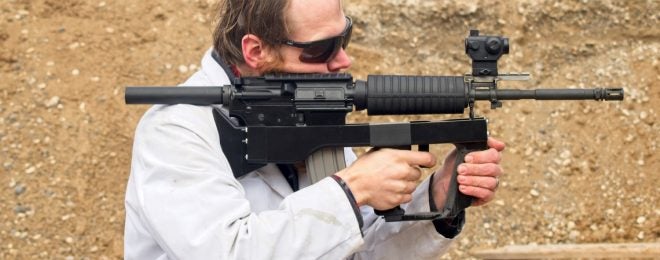
THE FGC-9 IN MYANMAR: 3D GUNS AND THE FUTURE OF GUERILLA WARFARE

February 1st, 2021, is the day the Myanmar military seized power, which immediately led to civil unrest. That unrest began as peaceful, pro-democracy street demonstrations, but in short order, peaceful demonstrations gave way to guerilla warfare. The situation evolved and changed rapidly due to an ever-escalating and violent military-lead government. Now it seems the power of the internet has delivered a Christmas present to Guerilla fighters in Myanmar, in the form of the FGC-9.

Government forces outnumber and out-arm the Myanmar guerillas by a wide margin, and have made use of machine guns, rockets, and tanks over the past year of conflict. The Guerrillas constantly find themselves outclassed by the government’s superior firepower, and have been searching for a means to turn the tide.

Continue reading “”

I got one as swag from Graf & Sons a couple of years ago. Checking it vs. a RCBS beam scale showed it to be very accurate. Mostly we use it for weighing bullets and cases since it’s a lot faster than a beam scale when segregating components.


TFB Armorer’s Bench: Closer Look – Frankford Arsenal DS 750 Scale

The Frankford Arsenal DS 750 Scale is a budget-friendly scale that comes in the typical Frankford Arsenal clamshell packaging. It comes with the scale, powder pan, 50-gram calibration weight, manual, and soft case for the lot of it. The scale is called the DS 750 because its maximum accurate reading capacity is 750 grains or 50 grams. This scale has a grain/gram accuracy of 0.1 grain (0.01 gram).

DS 750

The scale itself is smaller than the average smartphone. It utilizes a plastic flip-over cover that protects the screen from scratches as well as other forms of wear and dust accumulation. Four buttons are present on the scale. You have PCS (counts how many measurements taken), TARE (sets weight to 0.0), UNITS (changes weight measurement), LIGHT (turns the backlight on or off), and ON/OFF.

I personally bought this scale years ago and it has been very useful and hasn’t really presented much as far as quirks. The scale reads accurately but it is good to let your measured weight sit for a good 10-20 seconds to see if the weight fluctuates beyond comfort (usually, it does not). I have since upgraded to the next step up from this scale so it has not been utilized in quite a while but I do not remember having any complaints.

Specifications and Highlights: Frankford Arsenal DS 750 Scale
The MSRP of the Frankford Arsenal DS 750 Scale is $44.99. For the beginner reloader or for an enthusiast on a budget, this scale really is probably one of the best in its category of the price range. I have heard next to no complaint when others have used it only that they hope to upgrade to something that can handle more weight or have better precision. Remember that there is nothing wrong with double-checking your powder charges with another scale if you have one on hand just to get an idea of consistency.

The Frankford Arsenal® DS-750 delivers extreme accuracy for precise measurement of powder, bullets, cases or loaded rounds. Simple controls allow for easy changes of units and calibration. Powder pan, carry bag and calibration weight included.

750 GRAIN (50 GRAM) CAPACITY, 0.1 GRAIN (0.01 GRAM) ACCURACY
LCD DISPLAY WITH BLUE BACKLIGHT
INTEGRATED PROTECTIVE COVER
AUTO CALIBRATION
MEASURES IN: GRAIN, GRAMS, OUNCES AND CARATS
Closing Thoughts: Frankford Arsenal DS 750 Scale
All in all, this is a decent scale for the money and one that has lasted me years in my little shop while exposed to 100 plus summer heat and freezing well below zero. I have not noticed any fluctuation or variation. It does its job and it is very simple to use. In my opinion, it is a great option for someone just starting out reloading.

Federal Premium Releases NEW Force X2 Shorty Shotshells

Federal Premium Releases NEW Force X2 Shorty Shotshells

The Force X2 Shorty shotshells are new from Federal for 2022. These shells are aimed at the personal defense market. Crammed into their small 1 3/4″ hulls are six 00 buck pellets. The segmented pellets are designed to split in half on impact, doubling the number of wound channels left in the target. The buckshot is also designed to lessen the chance of overpenetration through walls. The pellets are copper-plated for increased target penetration, as well, and fly at 1,245 FPS (feet per second). When used in shotguns that are optimized for using shorter shells, the X2 Shorty shotshells offer a much higher tube capacity, giving you even more chances to make sure you’re the one that’s still standing. Each box comes with a total of 10 shells.

SPECS

Gauge: 12
Length: 1 3/4″
Shot size: 00 Buck
Shells per box: 10
MSRP: $28.99

Updated update on the updated Tisas Tanker ‘Commander’ 1911 pistol.

Earlier I figured I had gotten to a stopping point, but as someone once observed. ‘You never know’.

A few weeks ago, I noticed a seller on Ebay advertising manufacturer overrun parts with a stated non-disclosure agreement on source. The prices were quite reasonable, so, I decided to splurge and bought a 416R stainless steel barrel with link & bushing – that to me happens to look a lot like what Springfield Armory uses, but whatever – which pleasingly dropped in with no fitting, locked up tight and cycled dummy rounds with no problems.

Weather and physical conditions of all parties concerned finally intersecting, Dad & I took a day trip Saturday afternoon to the backyard range of a friend to try it – and several other guns – out.

Every type of ammo I shot, factory 230 gr FMJ from several manufacturers and Remington 185gr JHP, which is our standard load when carrying a .45 for self defense,  I was able to keep on 6 inch round steel at 20 yards, standing, off hand, without any sight adjustment. Accuracy has been improved and reliability was not effected, so this appears to have been a worthy endeavor .

M&P®10MM

What’s one millimeter more? 9mm vs 10mm… Number’s wise, it might seem minor at best, like having $9 vs $10, but as far as ammunition calibers are concerned, that increase of one millimeter makes all the difference.

The average grain weight of a 9mm bullet is around 115 grains, and the average 10mm is around 180 grains. Making the 10mm bullet 63% heavier of a round over the 9mm, that one digit millimeter difference, is really the equivalent of 63% more mass.

M&P10mm

Now, you might also be familiar with .45 ACP, a long-standing low velocity, high powered round. Surprisingly enough, the 10mm and the .45 look an awful lot alike when you put them side by side, they’ll pack a similar punch but perform in different ways. The muzzle velocity of .45 is 840 feet per second, versus the 10mm’s 1008 feet per second. With greater muzzle velocity also comes added benefits, such as flatter shooting and better accuracy at further range. Advantages like these are why the 10mm caliber has become widely regarded as the ideal round for personal protection in the backcountry.

The new M&P®10mm M2.0™ pistol was designed to match the M&P®45 M2.0™ pistol frame size, with new aggressive front serrations traditionally only seen on law enforcement M&P® firearms. Working your way back on the slide, you’ll notice that the 10mm comes standard with the C.O.R.E.™ (Competition Optics Ready Equipment) slide and optics mounting kit. But let’s not forget one of the most recognizable changes to the M&P®10mm M2.0™ pistol, the new flat face trigger geometry. Following the success of the Shield™ Plus pistol flat face trigger, the 10mm is the first in the M2.0™ pistol lineup to feature a newly updated trigger.

With a capacity of 15+1, backcountry bears and cougars won’t stand a chance against your M&P®10mm M2.0™ pistol. You can now rest assured that your ideal backcountry sidearm will have your covered.


A little known product is HilCo Lube in aerosol and wipes.
When I was working on the 16th Cavalry officer side of the Armor School, the Marines brought up a tub of them that they had used during OCS at Quantico. Hill Company actually specializes in commercial and industrial cleaning gear, but this product impressed all of us and I have used it ever since.

My Unit Armorer instructor at Fort Lewis – a retired Master Sergeant by the name of  Butterfly – apparently had a standard joke he would roll out for each class when asked if there was something better than CLP.
His answer was;
“Yes, there are better products than CLP, but it has one overriding quality that really can’t be beat….(long pause)…..it’s free.”


Best Gun Oils for All Guns

Shooting is a ton of fun, but it’s also inherently dirty. There’s powder residue, carbon fouling, copper and lead buildup, and more.

Whether it’s your granddad’s single-shot shotgun that you’re going to pass down to your own kids or a brand new long-range shooting rifle that you spent far more on than you care to admit, the goal is to keep them both running smoothly for decades to come. In order to do this, you’ve got to keep your guns clean. Regardless of what it cost or how old it is, the best way to do this is to use the best gun oil.

Continue reading “”

Colt Safety Recall Regarding Modern Sporting Rifles

IMPORTANT SAFETY RECALL NOTICE REGARDING CERTAIN COLT MODERN SPORTING RIFLES

COLT’S MANUFACTURING COMPANY LLC (“COLT”) has recently discovered a potential
safety issue with certain Modern Sporting Rifles (“MSRs”). Colt is voluntarily initiating a recall to protect the safety of its customers because, under certain conditions, it is possible that some of these MSRs may discharge a second round when the trigger is released when there is a live round in the chamber.

Colt is committed to the highest standards of quality and customer satisfaction. In keeping with that commitment, during routine quality testing, Colt discovered that hammers that do not meet Colt’s specifications were installed in certain MSRs that were manufactured beginning on March 5, 2021. The issue will be corrected by replacing the hammers in affected MSRs.

The recall only covers a portion of MSRs manufactured beginning on March 5, 2021, and includes the following models: AR15A4, CR6700A4, CR6920, CR6920-EPR, CR6920MPS-B, CR6921, CR6921-EPR, CR6933, CR6933-EPR, CR6960, LE6920-EPR, LE6920MPS-B, LE6920-OEM1, LE6920-OEM2, LE6920-R, LE6933-EPR, SP633784, LE6920SOCOM.

The following chart lists all the serial numbers for those models that may potentially be subject to
the recall:

Model Marking  Serial Numbers
AR-15 A4: CAR022851 – CAR023250
CARBINE: CR036354 – CR099599
CARBINE: CR713001 – CR722100
M4 CARBINE: CR716801 – CR721500
M4A1 CARBINE: CR021580 – CR022024

To prevent the possibility of death or serious personal injury, Colt advises anyone who has purchased a Colt MSR since March 5, 2021 to stop using it immediately and visit

ColtRepairMSR.com or call Customer Service at 1-800-971-3216 to see if your specific MSR is affected.

Please note: Not all MSRs within the serial number range in the above chart are subject to this recall and this website offers easy, step-by-step instructions to determine if a particular MSR is affected.

Customer service agents will assist anyone who needs additional help. Our expert craftsmen are ready to upgrade all affected MSRs at our West Hartford, CT headquarters

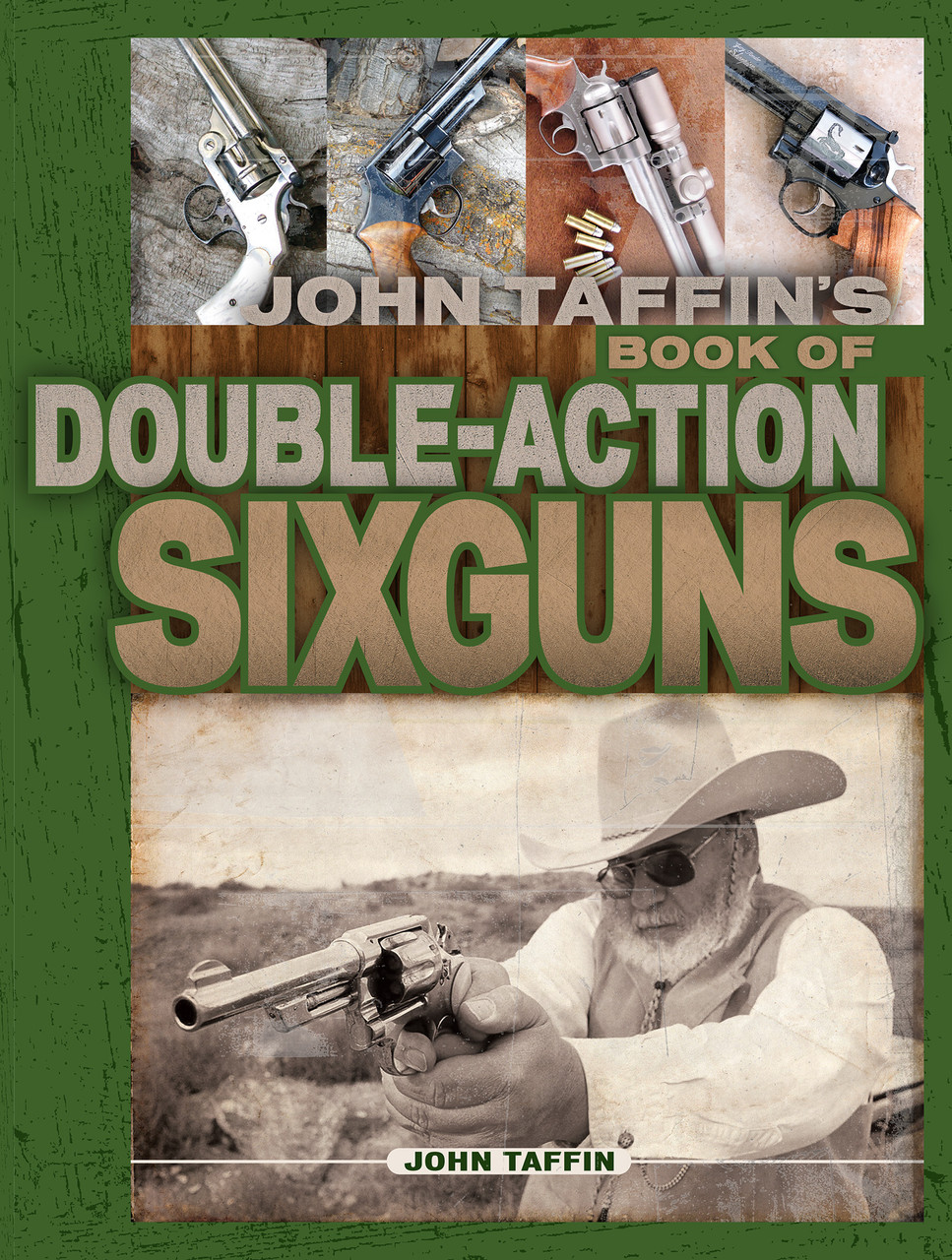
Another one of John Taffin’s Guns magazine articles


CRAZY CARTRIDGE CONFUSION
“A ROSE BY ANY OTHER NAME …”

In the beginning, Oliver Winchester’s company brought forth the first really successful repeating firearm with the .44 Henry levergun. This rimfire cartridge was a true .44 —actually almost .45 — as it used a bullet with a diameter of 0.445″, the outside diameter of the cartridge case. This was accomplished by using a bullet that had a base of a smaller diameter than the rest of the case and this smaller-diameter “heel” fitted inside the cartridge case. When Smith & Wesson brought out the first big-bore cartridge-firing sixgun in late 1869, they followed the same pattern using a bullet with two diameters, a smaller heel and the main part of the bullet being 0.441″. Then along came the Russians.

Smith & Wesson received a large order from the Russian military for their S&W American Model #3 revolver, however, the Russians made two significant changes. One was for the revolver itself changing the grip frame by adding a hump to the top of the curved backstrap and also placing a spur on the bottom of the trigger guard. To this day there is still no common agreement on the purpose of this spur. Was it to give a more solid grip or simply to keep the pistol from sliding down when placed in a sash at the waistband?

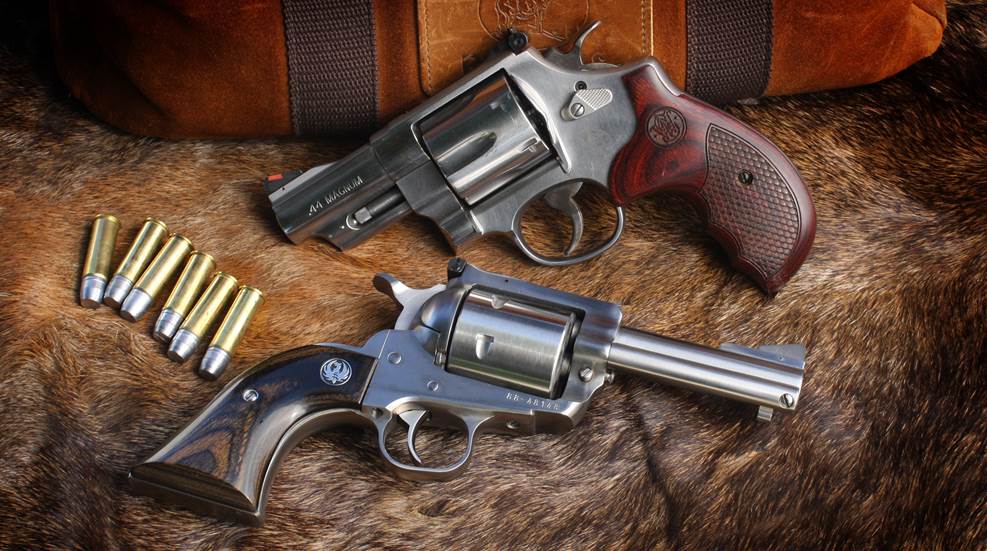
The more important change was the cartridge — the Russians wanted a bullet of uniform diameter. When the bullet was fashioned to fit inside the case (the normal way today), the bullet diameter was shrunk to a standard 0.429″. This has been the case ever since with the ensuing .44 Special, simply a longer .44 Russian, and the .44 Magnum which came about by lengthening the .44 Special case.

Here is also a good spot for making another correction of misinformation both I and others have been guilty of in the past. We gave the Russians credit for coming up with the inside lubricated bullet, that is, a bullet with the lube grooves inside the case. This is not true as the original .44 Russian rounds still used an outside lubricated bullet until 1887 when the Union Metallic Cartridge Company began placing the lube grooves of the .44 Russian cartridge inside the case.

We can purchase sixguns today chambered in .44 Colt but these also have been changed from the original. Colt’s first .44 also used a heeled bullet, however, today’s .44 Colt cartridge is simply the .44 Special shortened and with a smaller rim diameter. The latter was done to fit the first replica sixguns which had cylinders too small in diameter to accept six .44 Russian or .44 Special whose rims would overlap. Today’s .44 Colt replicas, at least some of them, have larger diameter cylinders to also accept .44 Russian and some are also chambered to accept all three of these .44 cartridges.

From left to right, the .44, .38 and .32 Winchester Centerfire cartridges. They are actually .43, .40 and .31 caliber. Confusing, no?

Dash-Something

Many of the rifle cartridges of the 19th century were hyphenated, consisting of two numbers with the first one giving the bullet diameter while the latter was for the powder charge. For example, we have the .45-70 which used a bullet of 0.457″ to 0.459″ diameter over 70 grains of black powder. Notice .45 rifles are actually closer to .46 caliber. Other rifle .45 caliber nomenclature included such as the .45-60, .45-75 .45-90, .45-100, .45-110 and .45-120 with the second number in each case denoting the charge of black powder under the bullet. Then came the Winchester Model 1894 and more confusion.

This now-legendary levergun was first chambered in .38-55 and .32-40, which both follow the original nomenclature pattern. Then in 1895 the first smokeless cartridge arrived in the 1894, the .30 Winchester Centerfire (or .30 WCF) that is now mostly known as the .30-30, the second number having nothing to do with a black powder charge. About 10 years later saw the arrival of first the .30-03 and then the .30-06 with the second numbers having absolutely nothing to do with powder charges but rather the year they were introduced. The .308 Winchester of the 1950s actually was named for the bullet diameter.

Winchester’s original centerfire cartridges for the Model 1873 levergun were the .44 WCF, .38 WCF and .32 WCF. Today these are more commonly known as .44-40, .38-40 and .32-20. The prevailing wisdom is Marlin started this difference in naming the cartridges because they did not want to write “Winchester” on their barrels so the .44 Winchester Centerfire became the .44-40 with the second number denoting the number of grains of black powder. The .32-20 , actually a .31, was loaded with 20 grains of black powder but what of the .38-40? The actual bullet diameter is not 0.38″ but rather 0.401″. There are some who say it actually was a .40-38, however .38-40 sounded better and then there would be the confusion if it was called a .40-40. Perhaps we shall never know. Even more confusing is a so-called .41 Long Colt which uses not a 0.410″ bullet as the later arriving .41 Magnum, but actually a 0.386″ diameter bullet. And both the .38-40 and .41 Long Colt sixguns produced by Colt had a barrel groove diameter of 0.401″ with the latter cartridge designed so the smaller bullet would expand to match the barrel.

All of these are chambered for .38 Long Colt/.38 Special but left-middle and
lower-left examples have been fitted with Conversion Cylinders and require either
true .38 bullets or soft expanding-hollow-base bullets to fit the rifling.

The .38 Saga

When Smith & Wesson introduced a new cartridge in their M&P about the time the 19th century was becoming the 20th century, they called this new cartridge the .38 Smith & Wesson Special, whereas the .38-40 was actually larger in size than the .38, the .38 Special is smaller than .38. There seems to be no end to the confusion. How is it the .38 Special can be fired in a sixgun chambered for .357 Magnum? The answer is the latter is named for the actual bullet diameter used while the .38 Special, although it actually uses the same bullet diameter as the Magnum, is mis-named. Just before the .357 Magnum arrived in 1935, Colt brought out the .38 Super which is also not a true .38 but actually uses bullets of 0.355″ to 0.356″ diameter. So all of these are actually .36 caliber.

Another cartridge surrounded by confusion is the .38 Colt, both the Long and Short of it. I as well as several others have assumed the .38 Short Colt came first followed by the .38 Long Colt. The latter will always be remembered for its failures rather than its successes. When the United States military switched from percussion pistols, they adopted the Smith & Wesson American .44 in the early 1870s and the Smith & Wesson Schofield .45 in 1875; however both were short-lived and the .45 Colt Single Action Army of 1873 was the official sidearm until the 1890s. Colt had introduced the .38 Long Colt for use in their smaller centerfire New Line Revolvers in 1874 and then brought out their first double-action sixgun, the Model of 1877 or as it is more well-known, the Lightning. In 1889 the United States Navy adopted the .38 Colt New Navy Double Action Revolver as its official sidearm and then the Army followed adopting the Model of 1892. This turned out to be one of the worst disasters as far as adopting military cartridge in United States history.

The cartridge, which was weaker than the .38 Special which soon followed, failed miserably in the Philippine campaign. So much in fact the .45 Colt Single Action Army was removed from storage and shipped to the Philippines for use. This turned out to actually be a good thing as it led to the adoption of the .45 Government Model of 1911.

So the .38 Long Colt actually arrived before the .38 Short Colt and to make it even more confusing, we have the .38 Short Colt (Short Case) and the .38 Long Colt (Long Case). The latter also originated about 1874 and was chambered in the Colt New Line Revolver. The former, which we would expect to be the forerunner of all of this, actually was the last to appear, being brought out by Remington-Peters in the 1920s.

I started this piece with the idea of clearing up some confusion. I hope I haven’t just done more to muddy the waters.

Oh my: One dead on Alec Baldwin set over prop-gun “misfire” (Updated)

How could a prop gun loaded with blanks have killed a cinematographer on a Hollywood film location? Investigators in New Mexico want to know that too, and that’s not the only mystery in this story so far. The man who fired the shot(s?) was the star of Rust, Alec Baldwin, who hasn’t been charged in the incident, and appears devastated by it:


The Santa Fe Sheriff’s Department confirmed Thursday night that Alec Baldwin “discharged” the prop gun that killed Rust cinematographer Halyna Hutchins and injured director Joel Souza on the set of the Western feature film on location in New Mexico.

Hutchins, 42, died not long after being transported to a hospital in Albuquerque, NM this afternoon. Souza, 48, remains in a local hospital; his condition is unknown. …

Deadline earlier reported that Criminal Investigators were called to the scene at Bonanza Creek Ranch just outside Santa Fe as sources informing us that a principal castmember cocked a gun, hitting Souza, 48 and Hutchins, 42, on set. The entire location went under lockdown during the investigation. The castmember, now identified as Baldwin, was unaware of the type of ammunition in the gun, we’re told. A rep from the production said that “Production has been halted for the time being” on Rust and that “the safety of our cast and crew remains our top priority.”

Traditionally, the prop master or armorer is responsible for fire arms and fire arms safety on a set such as Rust.

We should be cautious about first reports on this shooting, as we should be with any such incident. We should be doubly cautious about piling on with people whose politics and personality we don’t approve. At the moment, this looks like a completely unintentional accident that has nothing to do with politics or personality, and there’s no reason at this moment to jump to any conclusions otherwise.

There are a couple of puzzling elements to this, however. If the pistol didn’t have live ammunition, it’s tough to understand how two people got wounded on the set from one shot — possible, but strange. Deadline’s initial report that director Joel Souza was wounded has been walked back subtly since the first reports; he’s now being described as hospitalized for unknown reasons, which is a smarter way to approach this. It’s also strange to see it reported as a “misfire,” which would normally indicate either a non-shot or some sort of explosion in the pistol itself.

Continue reading “”

I’ve got one. AK has one, or more, and The Firearm Blog put one through a 505 round test

Mossberg Maverick 88: The Affordable Self-Defense Shotgun

In my home state of Ohio, there was a time when shotguns were a multi-purpose hunting and personal defense tool. We hunted deer, turkey, waterfowl and upland game with our shotgun (oftentimes a single shotgun with multiple interchangeable barrels), and they were the firearm of choice for home defense. Shotguns were the most popular long gun for local law enforcement agencies, and trap, skeet and sporting clay shooting competitions drew huge crowds.

Things have changed since then, but shotguns remain a popular and versatile choice for many hunters and shooters. For those who feel that a scattergun is simply the best option for personal protection, Mossberg’s Maverick 88 remains a popular choice, and with good reason—this reliable and affordable pump-action 12-gauge offers plenty of stopping power when you need it most.

The Maverick 88 is a no-frills cousin of Mossberg’s legendary Model 500 pump-action shotgun, and although the two guns are aesthetically and mechanically similar, they are not identical guns. Both the Maverick 88 and Mossberg 500 come with sturdy dual extractors and twin action bars, anti-jam shell elevators, positive steel-to-steel lockup for added durability. The Maverick 88, however, features a crossbolt safety in front of the trigger guard instead of the tang-mounted safety found on the Model 500. The Maverick 88 is assembled in Mossberg’s Eagle Pass, TX, facility.

Continue reading “”

Six States Boast More than 1 Million Carry Licenses Each

Six Second Amendment friendly states now boast more than one million active concealed carry licenses/permits each, including Florida with more than 2.5 million licenses in circulation, one of several revelations in the updated annual report on Concealed Carry in the United States from the Crime Prevention Research Center.

The other states are Alabama, Georgia, Indiana, Pennsylvania and Texas.

It is the kind of news that sets off alarms in the gun prohibition lobby. Anti-gunners and their allies on Capitol Hill are determined to reduce the number of armed citizens. But the new CPRC report says the exact opposite has happened over the past few years, especially over the last 12 months. Since October 2020, the nation has seen two million additional permits/licenses approved, bringing the number of legally-packing adult Americans to 21.52 million, and that’s not all. Read the report’s abstract here.

Twenty-one states now have so-called “constitutional carry” where no permit is required to carry a firearm. According to the CPRC report, “While permits are soaring in the non-Constitutional Carry states, they fell in the Constitutional Carry ones even though more people are clearly carrying in those states.”

Texas is the newest permitless carry state, yet more than a million Lone Star gun owners still have permits, allowing them to be recognized under reciprocity laws in other states.

In all, the report from CPRC’s founder and President John Lott—the researcher and author—and researcher Rujun Wang lists 15 states in which more than 10 percent of the adult population is licensed to carry. In addition to the states mentioned earlier, the roundup includes are Colorado, Iowa, Kentucky, South Carolina, South Dakota, Tennessee, Utah, Virginia, Washington and West Virginia.

Tennessee, incidentally, is where Smith & Wesson is moving a large part of its current Massachusetts operation, taking hundreds of jobs out of the Bay State and the accompanying revenue to friendlier surroundings.

The 69-page CPRC report offers several other revelations, among them being that “8.3% of American adults have permits. Outside of the restrictive states of California and New York, about 10.0% of adults have a permit.”

The Supreme Court on Nov. 3 will hear oral arguments in a case challenging New York’s “proper cause” requirement to get a carry permit, which officials routinely use to deny permit applications. Only the privileged seem able to show “proper cause” while average citizens cannot. The case is known as New York State Rifle & Pistol Association v. Bruen.

Another CPRC revelation: “In 2021, women made up 28.3% of permit holders in the 14 states that provide data by gender, an increase from the 26.4% last year. Seven states had data from 2012 to 2020/2021, and permit numbers grew 108.7% faster for women than for men.”

Increasing numbers of women are arming up, a pattern that has been building in recent years. With reductions in police manpower as a result of the “defund the police” movement that started in 2020 following the death of George Floyd while being restrained by Minneapolis police.

The CPRC report also notes that in three states where race and gender data is collected, there were “remarkably larger increases in permits for minorities compared to whites.” The report also reveals that four states keeping track of race between 2015-2021, “the number of Asian people with permits increased 93.2% faster than the number of whites with permits. Blacks appear to be the group that has experienced the largest increase in permitted concealed carry, growing 135.7% faster than whites.”


Been there. Done that. Know the family.
The range and gun store will still remain open for business.


Knob Creek Machine Gun Shoot Going Out With A Bang

Twice a year for the past half-century or so, the rolling hills around the small Kentucky town of West Point have echoed with the sounds of full-auto rifles, booming explosions, and the roar of the crowds at the Knob Creek Gun Range’s Machine Gun Shoot. But while the gun range will continue its operations, this weekend will be the last hurrah for the venerable festival of firepower.

That’s right. The Knob Creek Machine Gun Shoot is coming to an end.

The April shoot was canceled because the COVID-19 pandemic, so crowds are expected to be big. WDRB started getting calls about traffic backups on Dixie Highway and Highway 44 before 8 a.m. on Friday, when people started making their way to the site.

Anyone who has ever attended the events over the past 50 years can describe feeling the vibration of the barrage of bullets during the open shoots. Those participating in the shoot take aim at a variety of targets including used appliances, abandoned vehicles, and barrels of fuel with pyrotechnic charges attached. When one of the bullets hits the barrels, there is a huge explosion and flames that last for several minutes.

One of the highlights of the twice-a-year event has been the nighttime shoots, which will thankfully live on in videos that have received hundreds of thousands of views online.

As you can see in the videos above, the Knob Creek Machine Gun Shoot is a big deal, drawing in thousands of attendees for a shooting celebration that’s become a treasured tradition for many gun owners. So why is it going away?

According to a comment on the gun range’s Facebook page, it’s not government intrusion or the rising cost of ammunition that’s to blame. The owners of the range say that they’re just ready to slow down a little.

Continue reading “”

Study: More Than 21-Million Concealed Carry Holders, Up 10.5% In 2020

During the Coronavirus pandemic, the number of concealed handgun permits has soared to over 21.52 million – a 48% increase since 2016. It’s also a 10.5% increase over the number of permits we counted a year ago in 2020. Unlike gun ownership surveys that may be affected by people’s unwillingness to answer personal questions, concealed handgun permit data is the only really “hard data” that we have. This increase occurred despite 21 Constitutional Carry states that no longer provide data on all those legally carrying a concealed handgun because people in those states no longer need a permit to carry.

These numbers are particularly topical given that the U.S. Supreme Court will hear the concealed carry case of New York State Rifle & Pistol Association V. Corlett in November. That case will determine whether those requesting permits need to provide a “proper cause,” which means a good reason for obtaining a permit.

A copy of the report is available here