Murphy has it that there are only 2 times when you have too much ammo.
1 When you’re in water over nose deep.
2 When you’re on fire.


How Much Ammo is Enough?

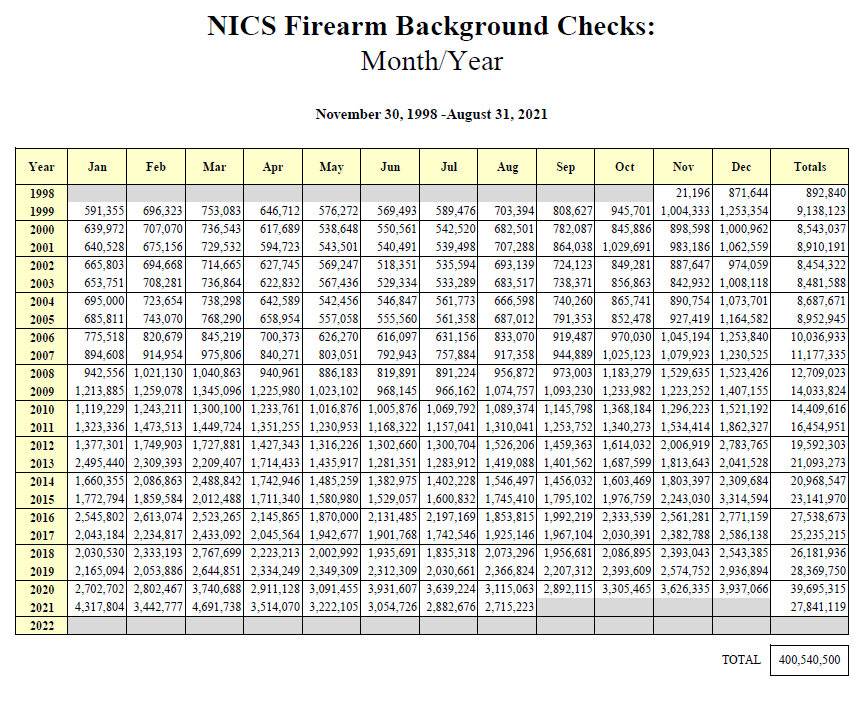
What a loaded question in the year 2021. Due to the perfect storm combination of a pandemic, civil unrest, and election uncertainty, 2020 was a record-breaking year for gun and ammo sales. Not only did the already established tens of millions of gun owners buy more guns and ammo, but over eight million first-time gun buyers joined our ranks. For many millions of Americans the reality that they are on their own, with nobody coming to help them in time, finally set in. Those of us who have been invested in our own self-protection for a long time are bewildered that it took such a year to wake many people up, but here we are.

While there are many benefits to having this enormous influx of new gun owners join our ranks, one of the obvious downsides is the scarcity of ammunition. There is no conspiracy behind the lack of ammo on the shelves currently; demand has skyrocketed and the supply chain simply cannot catch up now, or for the foreseeable future. Ammo is much more expensive than it was a year ago, and that is if you can even find the ammo you need.

With the new normal, the question of “how much ammo is enough” might be quite different for many people than it was a year ago. Before the onset of the pandemic and rioting that took our nation by storm my general advice was to “buy it cheap and stack it deep.” How much ammo does one need? More. Well, obviously, we need to re-calibrate that assessment now.

Continue reading “”

SMART GUNS? DUMB POLICY

President Joe Biden said he’s figured it all out. Guns can be made safe if the firearm industry would just team up with Silicon Valley to create bio-enabled so-called “smart guns.”

This is according to a long-buried interview with the Las Vegas Sun conducted during the presidential campaign. The information contained in it is just now coming to light and some of the findings might show why. President Biden, as a candidate, was making outlandish pie-in-the-sky claims about theoretical, unproven and unreliable firearm technology.

President Biden claimed, according to this interview, “I also dealt with the folks in Silicon Valley; we have the capacity now to build any weapon where it can only be fired with your biometric marker. And that technology doesn’t violate anyone’s Second Amendment right at all. If you pass the background check, you can purchase a weapon which only you can pull the trigger.”

Smart Gun’s Failing Grade

He’s right on one count. As vice president, he did deal with tech leaders to attempt combining authorized-user, or so-called “smart gun” technology into firearms. It didn’t work. It didn’t get to the point where it could even be properly tested.

Continue reading “”

Some Techgeeks develop a case of the vapors when they discover that the signal can’t be stopped. MwwwHAHAHAHAHAHAHAH!


YOU CAN NOW 3D PRINT AN ENTIRE SEMI-AUTOMATIC RIFLE AT HOME.

THE TOTAL COST — INCLUDING THE 3D PRINTER — IS ABOUT $350.

Home Brewing

3D-printed guns, or functional firearms that can be mostly or entirely manufactured at home with a 3D printer, are getting more sophisticated and more dangerous.

For a long time, 3D-printed guns were still quite slapdash. Early homemade handguns would break apart after firing once, and they served as more of a symbolic middle finger to government firearm regulation than a tangible threat. But they’re getting steadily more advanced, Slate reports. Now, a prominent 3D-printed gun community plans to unveil the designs for a functional, upgraded assault rifle early this year.

Deterrence Dispensed

The group, Deterrence Dispensed, has an online community of thousands to which it shares gun blueprints and step-by-step instructions on how to build them, alongside lists of recommended printers and parts. Aside from those flimsy handguns, the group also designed a functional assault rifle called the FGC-9 — that’s an acronym for the crude moniker “fuck gun control 9 mm” — which only costs about $100 to make with the recommended $250 printer, for a total cost starting around $350.

Most chilling? The gun is totally legal. Its barrel is made of metal, meaning it can be spotted by metal detectors, which is the one technicality that prevents the technology from being banned outright, according to Slate. But aside from that, these weapons are untraceable and allow people to circumvent other regulations like background checks — especially in countries with tighter gun control than the United States.

With the upgraded FGC-9 expected within the next few months, it stands to reason that these homemade guns — which Slate reports are favored by neo-Nazis and other extremist groups — will only become more prevalent and more dangerous.

“There is no sign of things stopping,” pseudonymous FGC-9 designer “Ivan” told Slate. “Projects are only getting more ambitious.”

Changing Tactics and Gear for the New Normal

For as long as I can remember, and I have been in this craft a long time, there has been a saying in the self-defense shooting world pertaining to the average gunfight: “three yards, three shots, three seconds.” While that sounds quite nifty, trying to calculate averages as they pertain to human violence is fraught with peril. For every supposed “average” self-defense use of a gun that fits this supposed criteria you can find another that does not. In the current new normal of the world I propose that banking on this “average” is a fool’s errand.

First, let us acknowledge that the majority of defensive gun uses are accomplished without even firing a shot. Second, when shots are fired, criminals usually become late for a different appointment and flee. Therefore, even a small gun with limited ammunition capacity will get the armed citizen out of a jam most of the time, statistically. However, do we want to count on those statistics? The shift in the nature of violence in the past decade should not be ignored. Will a shot from a small pocket pistol send the average carjacker or mugger fleeing? Most likely. However, is such “average” street crime the only concern facing us in contemporary America? Hardly.

Continue reading “”

$400 for a bluetooth/smartphone control on my gun? Naaah.


Comments O’ The Day:

  1. Stupid… Excuse me Mr. Home Invader, I have to find my phone so I can unlock my gun..Okay, got it, oh no, I forgot the charge my gun thingy….. Who the comes up with this nonsense?
  2. Phone 📱 screen in future when CCP wants to shut down all guns:
    “iOS 27.3.2 no longer supports and operates legacy 128-bit apps. SafeOp version 14.3.2 is a legacy 128-bit app that needs to be updated by the developer. Please contact the developer.”
    Siri, call SafeOp, “We’re sorry, you have reached a number that has been disconnected or is no longer in service…”


    Machine, Inc. Announces SafeOp Aftermarket Smart Gun System for GLOCK 19 Pistols

    Aaaaand we have another entry in the smart gun sweepstakes. This one comes from a new player in the space, Machine, Inc., who says their SafeOp system is the “world’s first digital aftermarket safety trigger” and installs in a standard GLOCK 19 Gen4 and Gen5 pistols (they promise versions for other GLOCK pistols down the road).

    Machine, Inc. issued a press release today announcing the SafeOp system, just a week after longtime anti-gun Congresswoman Carolyn Maloney introduced a new bill she calls the Handgun Trigger Safety Act. Among other things, the bill would shell out “grants to develop and improve “personalized” handgun technology to increase efficacy and decrease costs.”

    So that’s a nice coincidence.

    Continue reading “”

“Because you might have to” works for me


Why You Should Practice Drawing From Concealment.

The vast majority of those who legally carry a handgun use concealed carry. However, we rarely see them at the shooting range practicing making their pistol presentation from under a concealing garment. The fact is that drawing from under the concealing garment takes more time than an open draw. It can take even more time if it is a move that is not regularly practiced. Fumbling the draw stroke from under a concealing garment in an actual gunfight can be more than just time consuming; it can also be quite costly.

The smart thing to do is to make drawing from under the concealing clothing a regular part of defensive practice.  If the local range doesn’t allow that sort of thing, then it should be a part of a person’s dry practice at home.

When the decision is made to draw the handgun, the clearing move should not be a hesitant, or tentative one. The garment should be forcefully brushed aside as an integral part of the pistol presentation.

However, in reality, we often wear different kinds of covering garments, often on consecutive days. Some will have buttons. Others will have zippers. And some are of the pull-over variety that have to be lifted up in order to clear the handgun. In that moment when things get real, one might forget just exactly what is need to clear that particular piece of clothing. There may be a better way.

The armed citizen rarely has to deal with an actual threat (Condition Red) but he is often presented with a potential threat (Condition Orange). Once we recognize that we are in the presence of a potential threat, it’s a really good idea to make sure that our shooting hand is free. And it is also an excellent time to get the covering garment unfastened in preparation for the draw stroke, should that become necessary.

We can do these things without looking like we are in full gunfighter mode and even still have a smile on a face during the process. But clearing the garment becomes part of the getting ready process and we will have more time to remember to deal with buttons, zippers, or whatever. Once the potential threat dissolves into nothing, as they generally do, we can fasten back up with no one the wiser.

Give some thought as to how to clear that covering garment. And then be sure to practice it. It saves time and very well could save your life.


The Physics of Machine-Gun Fire.

A machine gun crew weighs many environmental and scientific factors to deliver maximum effective use of the platform in combat, as can be seen above with these Soldiers laying down suppressive fire with an M60 while fighting in Southeast Asia.

Life in the beaten zone is apt to be uncertain, but understanding this old military term is essential to fully appreciating one of the most effective types of firearm ever made. The machine gun has been with us since the turn-of-the-century era (19th to 20th). That’s more than 120 years of reliable service. Made in factories over all the world, in a great variety of sizes, shapes, calibers and operating systems, the machine gun has long been a source of impactful firepower for the infantry of the world. Before we get to the beaten zone, we have to look at the cone of fire.

Machine guns don’t fire a bunch of a shots at a time, but they do fire single shots in rapid succession. As long as the gunner presses the trigger, the gun obediently delivers another shot. Depending on many factors like the ground, stability of the mount and other things, the trajectories of a group of shots form a cone—literally, a cone of fire. All those bullets start at the same spot in the barrel of a machine gun, but the paths vary a bit when they leave the muzzle. Eventually, gravity calls all those shots back to the ground. Their pattern of strikes on the ground is known as the beaten zone. It has been designated thus as least as far back as the late 1950s when this writer was a weapons platoon leader in the 3rd Marines. Actually, “beaten zone” was heard well before World War I.

When a machine gun puts a stream of bullets into the air, the effect sort of resembles a garden hose spraying a stream of water. The pattern of water striking the lawn is somewhat elliptical and becomes longer or wider depending on how you tilt the hose. Essentially, the machine gun does the same thing. When these guns were first introduced to the battlefield, they were often used almost like artillery. Massed machine guns were set up to fire parallel to each other. The cone of fire of each gun was close to its neighbor. If you had enough guns, you could cover a vast expanse of ground with bullets—one massive beaten zone. The organization of infantry units in the Great War included entire battalions of infantry soldiers armed primarily with machine guns. In time, we came to understand that mortars and artillery were a more efficient way to do the same thing.

If the ground on which the fight is taking place is relatively flat, certain aspects of the beaten zone can be used to even greater advantage. When the machine gun is placed so that the cone of fire is nearly parallel with the ground, the beaten zone stretches out in length. If you are shooting over level or uniformly sloping ground, the bullet’s trajectory will not rise above the height of an enemy soldier. This is called grazing fire, and it can extend out to as far as 750 yards. It is an often-sought, seldom-realized condition that maximizes the potential of the machine gun. Infantry tacticians always try to get their machine guns placed to maximize their ability to produce grazing fire. But, in either offensive or defensive fighting, they also try to do something else.

They try to get the long axis of the beaten zone to coincide with the long axis of the target. We already know what the beaten zone is, so the long axis is simply an imaginary line that divides it in half. The target is a group of enemy troops. Invariably, they are going to be in some kind of formation. Draw the same imaginary line and divide the formation in half. If it’s at all possible, get the long axis of the beaten zone right on the long axis of the target. This ideal type of engagement is called enfilade fire.

Consider an incident that was at least rumored and perhaps actually happened in Vietnam. A Marine rifle squad with an M60 machine-gun team attached was on a patrol well into a disputed area of Vietnamese countryside. They stopped along the banks of a shallow river and hunkered down in the undergrowth. In time, a lone North Vietnamese soldier emerged from the trees on the far bank and looked cautiously about. He signaled, and the remainder of his platoon stepped quickly into the river and made ready to cross. Apparently, whoever was in charge wanted to get across as quickly as possible.

He put his troops in a column and hastened to get across. The machine gunner pulled the butt of the M60 into his shoulder and lined up his sights on the closest. He waited until the oncoming column of enemy soldiers was about halfway across before he pressed the trigger. It was over in two or three long bursts.

Now, I think you should understand cone of fire, beaten zone, grazing fire and enfilade fire. It is the essence of the machine gun as fightin’ iron.

MY FIRST GUNS AS AN AMERICAN

Today was a big day. I took ownership of my first guns as an American. I’m blessed and lucky to be living in such a great state and country. For some of you, buying a gun might be a normal everyday thing, but for me, it was a big deal.

Let me explain.

ORIGINALLY FROM CANADA

I recently became a resident of the United States. Originally, I’m from Canada. Yes, you can own guns in Canada, but the laws are getting so strict there that recreational shooting and shooting sports are getting downright tedious. Mag limits, transport laws, and in May of last year, the Liberal government banned upwards of 1,500 different types of semi-automatic rifles. Canada deemed them to be “military-style assault weapons.” There’s also talk of banning handguns.

The beautiful state of Arizona. (Photo: Ben Philippi/Guns.com)

BUTTERFLIES OF EXCITEMENT

Every day that I wake up in the beautiful state of Arizona, I feel blessed. There are so many reasons why I love it here, but one of them is that it’s gun friendly.

The last couple of nights I’ve been having trouble sleeping because I’m so excited to get my guns. I can’t wait to go shoot them, start honing my skills, and getting my aim on point. One of them will become my first personal handgun.

WHAT WILL BE MY FIRST HANDGUN?

Nice set … for starters.  (Photo: Ben Philippi/Guns.com)

Continue reading “”

SIG SAUER Completes Final Delivery of Next Generation Squad Weapon System to U.S. Army

NEWINGTON, N.H., (February 2, 2021) – SIG SAUER, Inc. is proud to announce the final delivery of the Next Generation Squad Weapons (NGSW) systems to the U.S. Army, consisting of the revolutionary 6.8×51 hybrid ammunition, the NGSW-AR lightweight belt-fed machine gun, the NGSW-R rifle, and suppressors.


Continue reading “”

The latest computer controlled, programmable, automatic, milling machine to make gun receivers and other stuff.
But mostly gun receivers to totally mind warp the anti-gun pinheads because you can’t stop the signal.

CMP Guide to TARGET SHOOTING WITH VINTAGE MILITARY RIFLES

Description
Vintage military rifle competitors and collectors alike will be excited to learn the Civilian Marksmanship Program has released a new book, entitled TARGET SHOOTING WITH VINTAGE MILITARY RIFLES, authored by Gary Anderson, Director of Civilian Marksmanship, Emeritus and two-time highpower rifle Olympic gold medalist. The 284-page, soft-bound, fully-illustrated first edition is likely the most comprehensive manuscript ever written about the methods of training and competing with popular American and foreign vintage military rifles. NLU 792 $29.95 plus S&H

“Anyone who knows Gary, and is a fan of vintage military rifle shooting, will find this book to be the most complete coverage of the topic, from a competitor’s and historian’s point of view,” said Christie Sewell, CMP Programs Chief.

Anderson, who stunned his Olympic rivals in Tokyo and Mexico City in the 1960s, is also a multiple U.S. and international record holder. He has poured countless hours into Target Shooting With Vintage Military Rifles for the benefit of both the serious and recreational competitor.

As the originator of the CMP’s wildly-popular competitive vintage rifle program, he set out to present a detailed manual covering all aspects of safely shooting rifles such as the 1903 Springfield, U.S. Krag, 1917 U.S. Enfield, M1 Garand, M1 Carbine, and many more, including rifles from “across the pond.”

Target Shooting With Vintage Military Rifles is comprised of 18 chapters covering:

    • Origins & Fundamental of Marksmanship
    • Firing Rifles in Competition
    • Operation, Cleaning, Loading & Unloading
    • Rifle and Range Safety
    • Sight Adjustment, Zeroing & Fine Tuning
    • Critical Value of the Sling
    • Prone, Sitting and Standing Position Building
    • Highpower Rifle Match Procedures
    • Using a Scorebook/Databook
    • Strategies for Improvement

Although the X in the bullet is metallic and is part of the core, it works just like the polymer insert of the Winchester USA Ready Defense bullets to prevent the hollow point from getting clogged up and basically turning the bullet into  FMJ. Modern tech.


BXP Personal Defense is designed for superior personal defense performance in reliability, expansion and penetration. The X-Point is designed to shield the hollow point through intermediate barriers.

X-POINT TECHNOLOGY
Guards hollow point for consistent expansion and penetration. Rapidly transfers energy to the target. Formed metallic hollow point for consistency, toughness and reliability.

New bullet.


USA READY DEFENSE

Hex-Vent™ Rigid Insert
1
Shields hollow point from obstruction while channeling material flow for positive bullet expansion
2
Match Grade Primer
Built to exacting specifications for trusted reliability
Lot Controlled
Ballistics data for each lot published online at Winchester.com/USAREADYINFO
USA Ready Defense Features

Magpul Unveils Civilian Legal Version of FMG-9 – The FDP-9

Magpul FMG 9 01

U.S.A. -(AmmoLand.com)- In 2008, Magpul introduced a folding concept gun based on the Glock operating system. It deployed single-handedly from a compact, simple form factor into a short-barreled carbine that was easier to handle and easier to employ accurately than many typical handguns. It also provided its own safe storage method by folding into itself to form a case. At the time, this concept firearm was intended to be just that…a concept.

In 2019, ZEV Technologies released their OZ9 modular pistol, which is compatible with Glock-style operating systems, using a unique receiver block that’s independent of the pistol’s grip and allows users to change grip frames to suit their needs.

Continue reading “”