
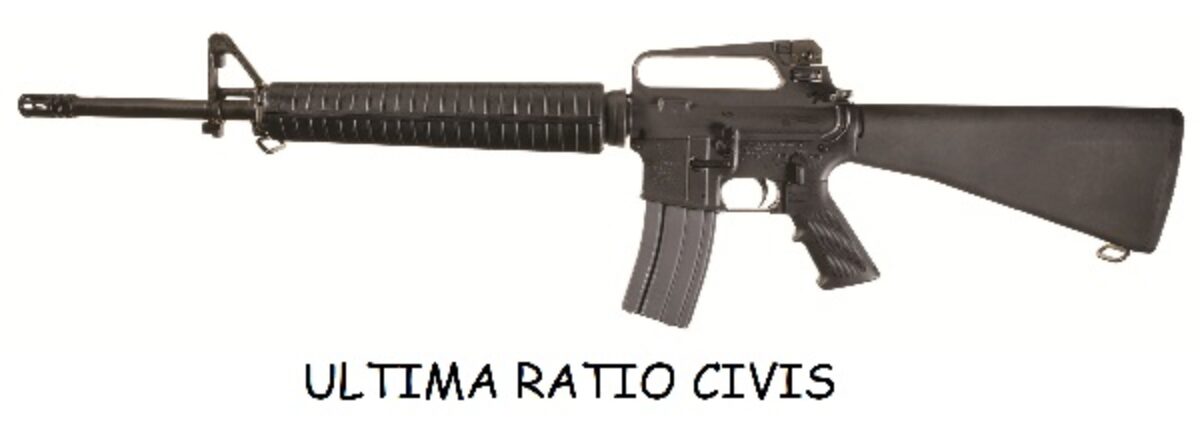
A Brit who, with ingenuity, legally makes a rifle into …..this.
Category: Gun Schtuff
My interest in this article by a person with just enough education about guns to be dangerous has nothing to do with the fact that Dad has one of the S&W Miculek model 25 revolvers………really.
Shootout: Are Semi-Automatics Or Revolvers the Better Gun for Self Defense?
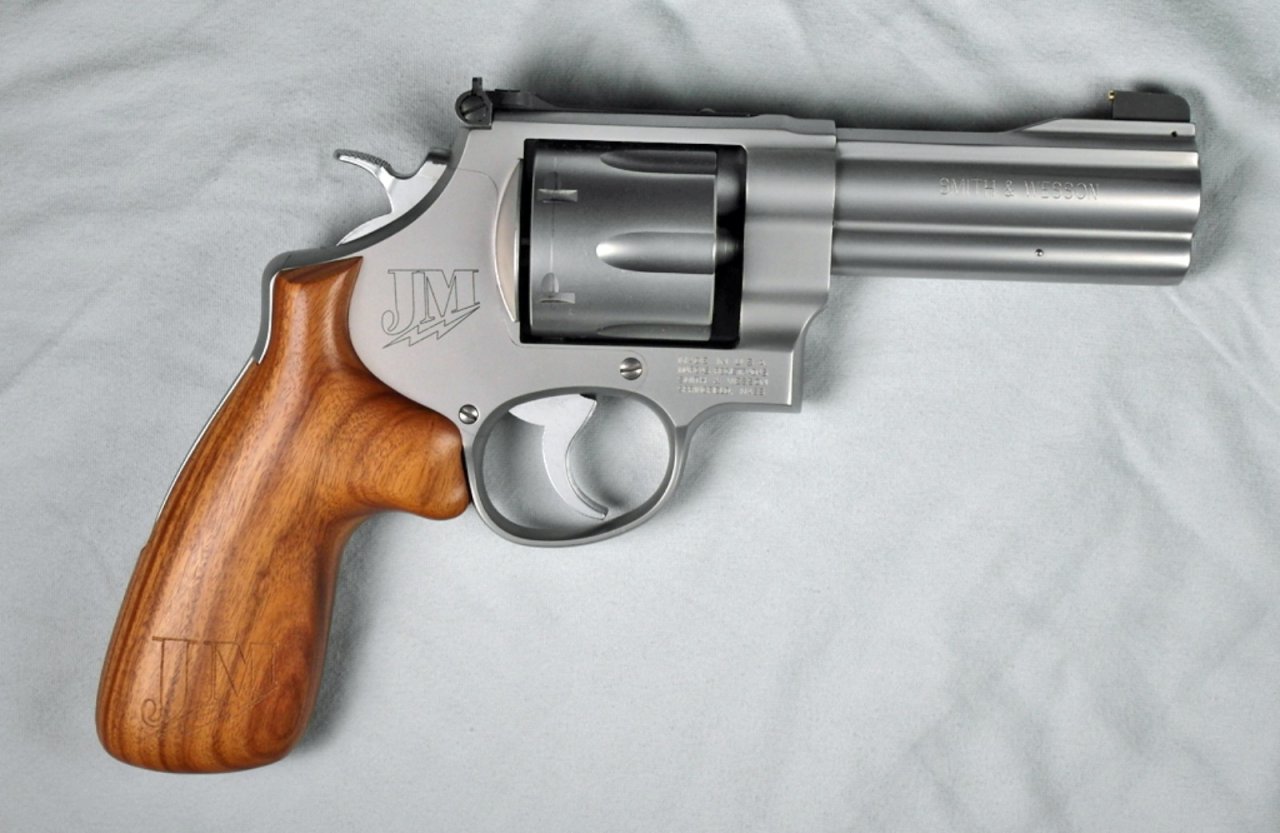
Here’s What You Need To Remember: A handgun is a dangerous weapon designed to kill people. That said, it is also merely a tool, and there are some situations in which it is the only tool that can effectively respond to a dangerous situation. One of the most valuable skills a handgun owner can possess is the ability to think clearly in a stressful situation and refrain from using force.
Glock still makes the Gen3 version, simply due to the fact that it’s the latest one that is allowed to be sold to the general public on California’s ‘safety roster’.
Springfield Armory Hellcat Goes 20,000 Rounds
When Springfield Armory launched its innovative Hellcat micro-compact pistol in 2019, the company took steps to highlight the durability of this dedicated defensive pistol. In the same year, one Springfield Armory Hellcat, Serial No. AT234795, was fired 10,000 times with no parts breakage and minimal cleaning. Now, that same gun did it again, going 20,000 rounds with no gun-related issues. Continue reading “”
Data on the Number of Guns Americans Purchased in June Is Here and…Wowza
The data on how many Americans purchased firearms and went through federal background checks in June has arrived.
According to the National Shooting Sports Foundation, June 2020 saw the highest number of gun purchases since the FBI started keeping track 20 years ago. Further, this year’s June number increased over June 2019 by 135.7 percent. According to the unadjusted number from the FBI’s National Instant Criminal Background Check System, 3,909,502 background checks were conducted.
“These figures represent the highest June on record since the FBI began conducting instant background checks more than 20 years ago. The sharp increase in Americans buying firearms in June continues a trend we saw start in the spring. Civil unrest, rioting, looting and calls to defund police are unquestionably motivating factors of why this trend is increasing. Americans are right to be concerned for their personal safety. It’s entirely reasonable that law-abiding citizens are exercising their Constitutional right to purchase a firearm to protect themselves,” NSSF Director of Public Affairs Mark Olivia released in a statement.
UZI does it.

A student assigned to the U. S. Army John F. Kennedy Special Warfare Center and School who is in the Special Forces Weapons Sergeant Course fires an Uzi submachine gun during weapons training at Fort Bragg, North Carolina May 12, 2020. The Soldiers were trainined to employ, maintain and engage targets with select U.S. and foreign pistols, rifles, shotguns, submachine and machine guns, grenade launchers and mortars and in the utilization of observed fire procedures. (U.S. Army photo by K. Kassens)
NRA Foundation Auctions Firearms for Father’s Day
The NRA Foundation will be running their 2020 Father’s Day Online Auction, featuring 50 firearms, through June 22. The money raised through it will benefit a number of programs and is crucial in the fight this November, as freedom will be on the ballot.
Presumptive Democratic presidential nominee Joe Biden, for example, has made no secret of his desire to lead a crusade against the Second Amendment and events like this allow the NRA to continue its fight against anti-gun politicians seeking to curtail your constitutional rights.
“Your participation helps The NRA Foundation protect our Second Amendment freedoms with activities that promote safe and responsible firearms ownership, and invest in the next generation of America’s leaders. And that’s what this is all about, right? Protecting the future of freedom so our children and grandchildren can have the same rights we enjoy, and keep the shooting sports alive and well,” said Sarah Engeset, director of volunteer fundraising.
The 2020 Father’s Day Online Auction features an impressive array of firearms, including the Smith & Wesson M&P9 Shield EZ, the 2020 Colt Python, the Mossberg 590 Shockwave and many more. Second Amendment-supporting participants who bid on these firearms know their money is going toward the fight to protect their rights to keep and bear arms, especially with the threat that is looming on the ballot in November.
For decades, the NRA Foundation has served the needs of freedom-loving Americans across the country. To participate in the auction, visit NRAFDAD.givesmart.com or text NRAFDAD to 76278 to register. To learn more about the programs, services, events and more offered by the NRA Foundation, please visit NRAFoundation.org.
BLUF: AR 15 pistols & the like are legal.
[Missouri Conservation] Commission updates definition of handguns for deer hunting
he Missouri Conservation Commission approved an updated definition of a pistol/handgun from the Missouri Department of Conservation (MDC) for the Wildlife Code of Missouri at its May 28 meeting in Jefferson City.
The change provides a formal definition of handguns used for hunting during the alternative-methods portion of the fall deer-hunting season.
‘You can’t stop the signal..’
Winnipeg Police Seize AR15 and Glock with 3D Printed Receivers
Changing Your Carry Depending on Your Environment
Change. We’re in the middle of it. Millions of people have purchased their first guns over the last few months. Riots, looting, theft, attacks, murders. We see it daily on the news. Smart people know, or have just realized, that the police can’t be everywhere, and it highly unlikely they will be close when you are attacked.
You are your own first responder. Are you prepared?
Trainers across the country are being flooded with calls asking for private lessons. That’s good.
Let me explain something that’s not obvious to new gun owners, but which can make a big difference in your ability to have a self-defense handgun with you. It requires change. Specifically, it means you have to change your handgun as conditions change.
I’ve been carrying a pistol since about 1976. Big guns and small guns, big calibers and small calibers, double stack and single stack, short barrels and longish barrels, revolvers and autoloaders. Why so many types?
There is no one handgun that works for every situation.
You have many types of footwear so that you can have the right function for each activity. Tennis shoes, dress shoes, casual shoes, hunting boots, rubber boots, slippers, etc.
Once you get into carrying you quickly realize the need for various sizes of handguns.
Let me give examples of what I have carried, using just one gun manufacturer. I have carried Springfield Armory pistols for many years. I recently bought the XDm 4.5-inch barrel model in 10mm. Why? Because sometimes I’m in the woods where bears, mountain lions, and wolves live. I really like the idea of having 15 rounds in the magazine of special (deep-penetrating) 10mm ammo with me. It’s a full-size pistol, and it is not light weight when fully loaded. That’s okay because I use a good gun belt and a good holster to handle the weight.
But that’s not what I would carry in most concealed carry situations. For that, I often have opted for two Springfields. The XDs single stack is a dream. Slim, great trigger, and you can get a 10-round mag. Honestly, it’s just hard to go wrong there. I can conceal it when wearing almost anything, especially when I use a tuckable holster. I’ll admit, though, that I like the idea of more ammo, so I have more often carried my XDm 3.8 Compact (now discontinued). The logical replacement for that pistol is the even smaller Hellcat in 9mm, and I’d use the 13-round mag as standard. It’s incredibly small and easy to carry.
When I’m going to spend several days at a shooting school, I’ll opt for a full-size 9mm. Easier to shoot. Ammo is fairly inexpensive. I would go for the XD-M Elite 4.5 and a bag full of magazines.
Now, if you are into style, you might just want to add a sweet 1911 to the mix. Every serious handgunner needs at least one, and after the first magazine of ammo, you’ll fall in love with the trigger. If I could have only one 1911 from the Springfield line, I just might go for the new Ronin Operator in 9mm.
You match the gun to the situation. Where are you carrying? What kind of clothes? Open carry or concealed carry? Just a cover garment or deep concealment? What’s your body type? Pocket carry?
Experienced gun folks know we must change guns from time to time. This example was just using one brand. You can mix and match, of course. You might want to have a revolver in the mix. Just don’t get locked into the idea that now you have “the” gun you need.
Oh, and put serious time and money (!) into the best training you can afford. A shiny new gun will never replace the vital skills you get from serious instruction.
Be safe. Be kind. Stay dangerous. ~ Tom
Tom Gresham
Meet The USAF AR Style Survival Gun – the GAU-5A
While in the skies above, pilots in modern military aircraft often have no shortage of weapons literally at their fingertips, but a pilot who finds himself on the ground behind enemy lines is worse than a bird with clipped wings. During the First and Second World Wars, the best a pilot could have in the way of a personal defense weapon or survival gun was a sidearm. Later, during the early stages of the Cold War, the United States Air Force relied on what were some rather odd survival weapons. Let’s take a look at the various survival rifles over the years, leading up to the GAU-5A.
Survival Guns Over the Years
M4 Survival Rifle
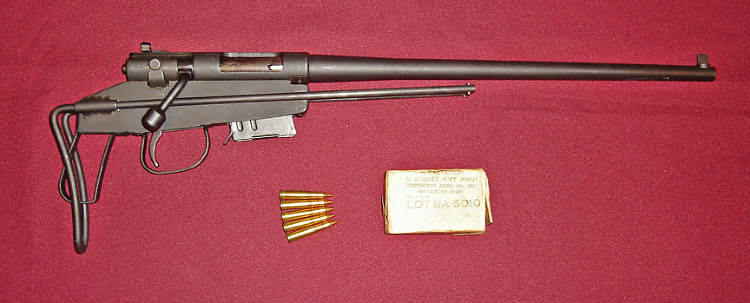
These included the M4 Survival Rifle, a .22 caliber bolt-action rifle that was developed by Harrington & Richardson from their commercial M265 sporting rifle. It featured a sheet metal frame with a telescoping wire buttstock. It was, simply put, “better than nothing,” but it was mainly intended as a survival gun to allow a downed aircrew to forage wild game for food rather than to deal with a hostile enemy.
M6 Air Crew Survival Weapon
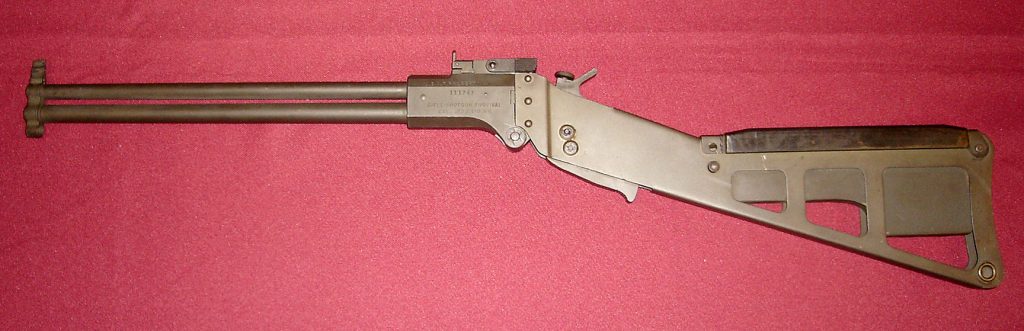
The M6 Air Crew Survival Weapon was another weapon that was developed by the Ithaca Gun Company and the Springfield Armory as rifle/shotgun designed for pilots who flew over the Arctic and other uninhabited areas. Again, it was more for foraging than defending, which prompted the Air Force to explore other options.
AR-5 and AR-7 Explorer
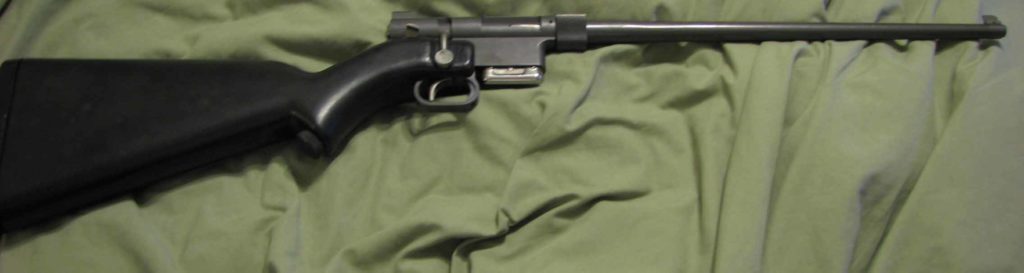
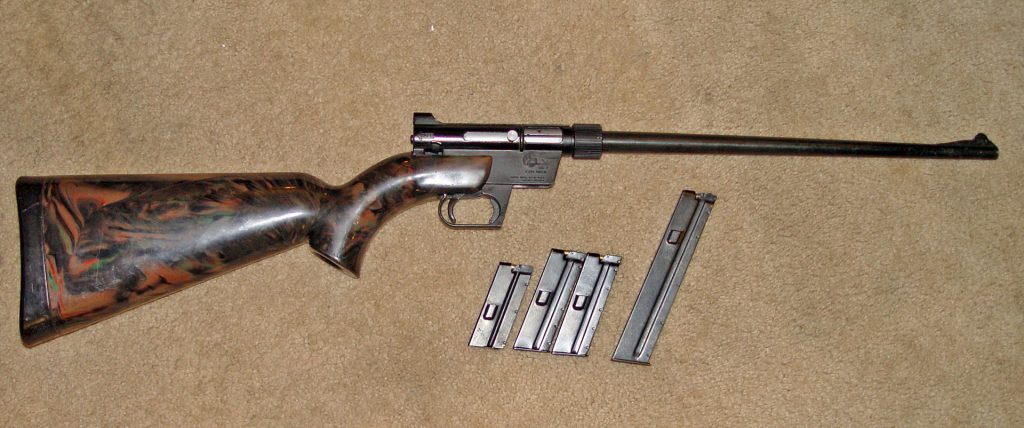
From that came the AR-5, a bolt action takedown rifle that was still chambered for the .22 Hornet cartridge, and that led to the ArmaLite AR-7 Explorer, a semi-automatic firearm in .22 Long Rifle caliber that was developed by Eugene Stoner. Introduced in 1959 it is still in use today as an aircrew as well as civilian survival gun. While a generally reliable firearm – so much so that it has been adopted around the world, including by the Israeli Air Force — the AR-7 was lacking in stopping power.
GAU-5/A
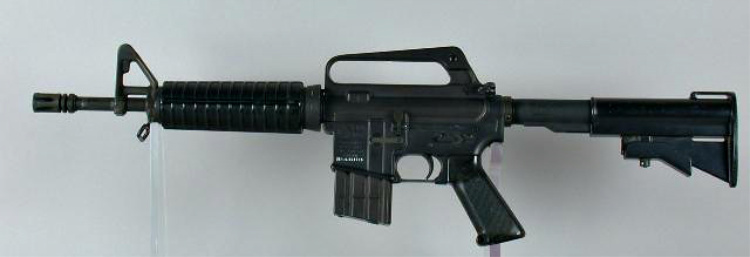
Hence the Air Force turned to another of Stoner’s designs – namely the AR-15 platform that was adopted by the U.S. military as the M-16. The Air Force had been the first branch of the service to adopt the AR-15. They soon decided to adopt a carbine version with a 10.5-inch barrel and 4-inch flash hider. The Air Force, unlike the Army or Marines, had no naming convention for small arms and simply put the weapon in its aircraft gun category. Thus was born the GAU-5/A. It became the standard issue weapon for Security Police dog handlers and other specialized personnel. GA was meant to denote an automatic gun while U was for “unit” hence: “Gun, Automatic, Unit.”
Where it gets confusing is that the U.S. Army adopted a nearly identical version of the weapon, which Colt –then the sole maker of the CAR-15 line of military firearms – called the XM177E1. Both versions select fire with semi- and full-automatic fire modes and each was officially classified by Colt as submachine guns. This was despite the fact that these still were chambered in the .223 Remington cartridge rather than a pistol cartridge that is typically used in submachine guns
GUU-5/P
The Air Force’s GAU-5 was updated as the GUU-5/P, which featured a longer 14.5-inch barrel with a 1-in-12 twist. Otherwise, the firearm kept the modular design that had made the CAR-15s popular with the military.
Model 608 CAR-15 Survival Rifle
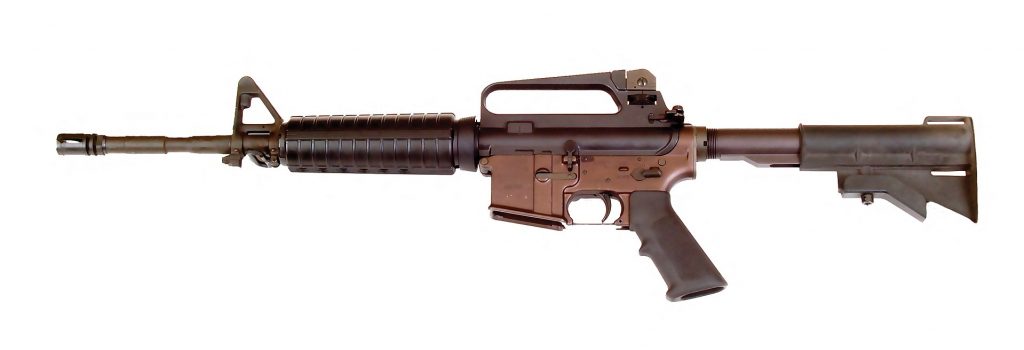
During the Vietnam War, the Air Force also developed the Model 608 CAR-15 Survival Rifle, which was meant for use by downed aircrews. This model, which resembled the Colt Commando, also featured a 10-inch barrel. Its modular design allowed it to be broken down into two subassemblies and stowed in a seat pack.
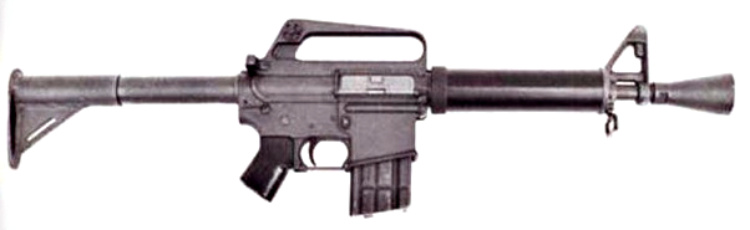
GAU-5A
In recent years the Air Force has again considered the benefits of a modular takedown weapon. This has included the GAU-5A. The new version is a modified M-4 carbine, the same type that is currently used by the U.S. Army and United States Marine Corps, as well as Air Force security personnel. This version is a modified “takedown”. It can break into two major pieces for storage within an aircraft that includes the ACES II ejection seat.
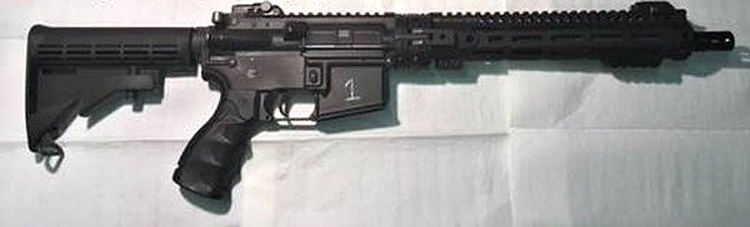
These new versions were designed by the Air Force Gunsmith Shop, which was first formed in 1958 to repair and refurbish small arms for the Air Force. The crafty Airmen at the Gunsmith Shop have made numerous modifications to the M4. One modification was replacing the standard 14.5-inch barrel with a 12.5-inch to reduce the overall length. This was done in part to ensure that it can fit in the aforementioned ejection seat. That is no ordinary barrel but rather the specialized Cry Havoc Tactical Quick Release Barrel (QRB) kit, which allows the gun to neatly break into two pieces.
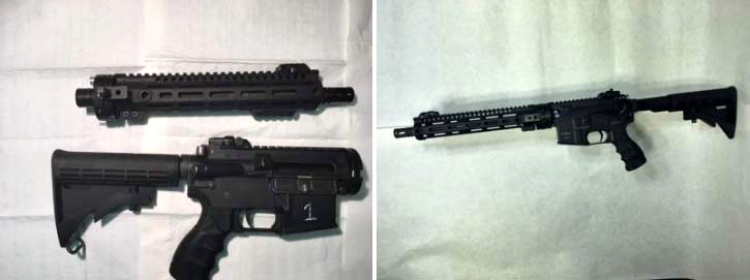
The weapon weighs less than seven pounds and can be put together in just about 30 seconds. That might still be more time than most pilots would like to spend on the ground in hostile territory. Still, it will give those flyers some much-appreciated firepower.
Unlike the original survival weapons that were primarily only good for foraging, the GAU-5A fires the high-velocity 5.56mm round. So it can take down large game. More importantly, it can take down any enemy soldier who finds a pilot with the unfortunate luck of being shot down.
To date, the Air Force’s Gunsmith Shop has built and shipped out some 2,700 of the new weapons. The cost to develop the system was around $2.6 million. So the GAU-5A price tag is less than $1,000 or what a reasonably decent civilian AR-15 would cost.
This Historic Colt 1911 Pistol Carried at Iwo Jima Is About to Go Up for Auction
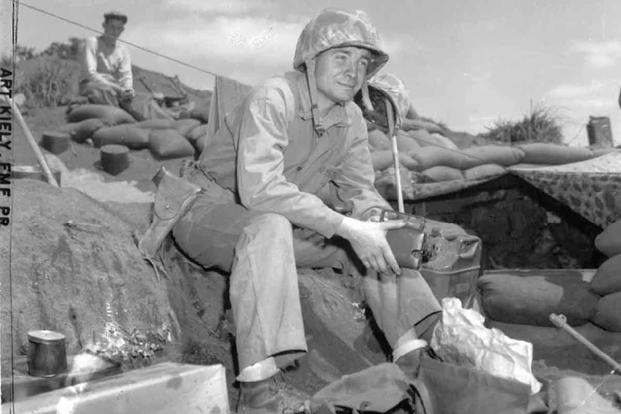
Rock Island Auction Company will soon be taking bids for the 1911 Colt .45 automatic pistol, and other kit, carried by a decorated Marine combat photographer during the Battle of Iwo Jima in World War II.
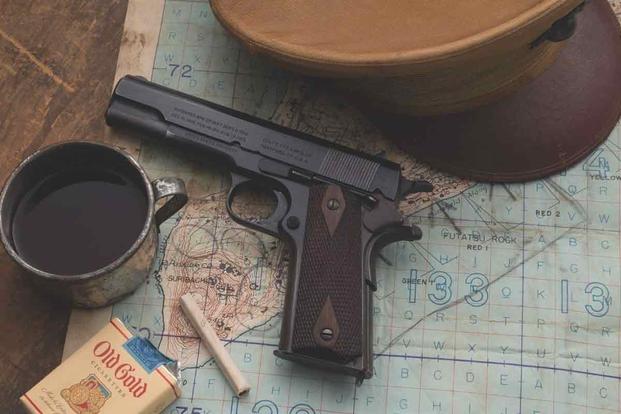
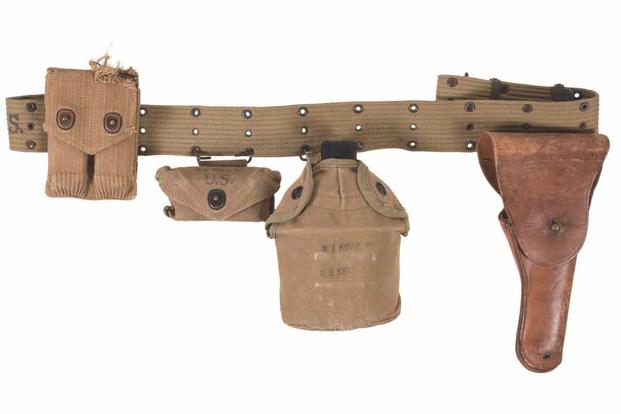

Following the recent 75th anniversary of Iwo Jima — a brutal battle that stretched from February 19 to March 26, 1945 — the Rock Island, Illinois, auction house will hold its Premier Firearms Auction #79, featuring 2,500 lots of firearms and related items June 5-7.
One of the lots, number 1516, will feature items such as the sidearm, pistol belt rig and rare Iwo Jima battle map that belonged to Marine Sgt. Arthur J. Kiely Jr., who passed away in 2005, according to a recent news release from the auction company.
Kiely joined the Marine Corps in 1943 and served as a combat photographer, taking pictures under heavy enemy fire on island engagements such as Iwo, the release states.
Kiely’s Colt 1911 was originally shipped to the Marine Corps in 1917 and features “85% of its original blue finish showing a mixed brown and gray patina on the grip straps and trigger guard, bright edge wear, and mild spotting and handling marks overall,” according to the auction’s website.
The pistol’s refinished grips have some “dents and tool marks on the screws” and the “modified, refinished replacement trigger sticks a bit,” the website states.
Lessons Learned From Col. Jeff Cooper
In Col. Jeff Cooper’s armory, sitting with the legend himself, I suffered a negligent discharge—with words, not bullets.
It was bad enough that I committed a grievous English error, because I had been reading Cooper’s books since the late 60s, riding my Schwinn Varsity a couple of miles from my house to the library in Clovis, Calif. When I bought my first pistol in 1987, it was a Colt 1911 in .45 ACP, just like the colonel carried.
In 1992, working as a TV reporter, I somehow convinced my station to do a story about Gunsite Academy. Bill Jeans, rangemaster at the time, ushered me into the inner sanctum.
Cooper was equally renowned for his precision with language, and he did not tolerate incompetence. In the armory, I asked him about his personal philosophy of self-defense.
He opened his mouth, but no sound came out. It took almost two agonizing seconds—I timed it because I still have the video—for him to speak.
“I am not sure of that sentence, ‘A personal philosophy…’ What’s an impersonal philosophy?”
At that moment, I felt as tall as a .22 Long Rifle cartridge. But like all hard lessons, it stuck. Words are like ammo. Don’t spray and pray.
I continued to learn from the colonel. I bought a used Tikka Scout, a .308 Win. with a Leupold 2.5X scope in front of the action. In his book, “To Ride, Shoot Straight and Speak the Truth,” Cooper praises this setup: “This forward mount, properly used and understood, is the fastest sighting arrangement available to the rifleman.”
In 2017, on my friend’s ranch in central California, I went pig hunting with Col. Craig Boddington. I had been reading his articles for years, and I’d also watched him on TV. I didn’t want to screw up in front of him or my friend, Anthony Lombardo, even though Tony is used to it. So, of course, I missed shot after shot.
In the Jeep, I got pretty lonely in the back when the discussion focused on my rifle. There were two skeptics in the front seats who had me outgunned.
Other shooters disagree with the scout concept, or have abandoned the idea, including the veteran hunter who sold me his Tikka. But an unconventional scope mount wasn’t causing me to jerk the trigger. Surprise Break, I heard Cooper whisper. Surprise Break.
Then I saw three pigs. Not trophies, but we were hunting for meat anyway. I picked the largest of the trio. My handload—45.5 grains of Varget under a Nosler 150-grain E-Tip—staggered the big one. Boddington held off until I connected, then joined me with his .270 Winchester as we cleaned up.
“Great shooting, partner!” Boddington is so polite that I think he was just being kind, but I gratefully accepted the compliment.
I also have a forward-mounted scope on a 30-40 Krag that once belonged to my beloved Uncle Harry. Like the Tikka, this rifle isn’t a true Scout. But Col. Cooper shared my admiration for the Krag, and I hope he would approve. When we rescue vintage guns from the back of our safes, we honor the past. The true innovators, such as Jeff Cooper, live on.
My video of the colonel’s interview includes his famous mindset lecture. I shared it with some Gunsite grads. Wyoming’s Ed Cassidy said it best: “I miss him every day.”
The Fire Control Unit X03
Fire Control Unit first started its work with the XO1 PDW conversion for the SIG P320. Being a drop-in enhancement system for the pistol, much like the CAA Micro Conversion Kit. They’re now working on the X03 project by taking the fire control unit of the SIG and dropping it into an AR platform.
Meet the gun safety instructor holding ‘office hours’ on Zoom
Gun rights advocates are promoting safety training in response to record-breaking numbers of arms sales amid Covid-19
On a recent afternoon in San Jose, California, Chuck Rossi held up his AR-15 in front of his computer camera, talking through how to hold the weapon safely, and how to load it with ammunition.
“AR-15s are modular. They’re like Legos for men,” Rossi said. The man on the other side of the Zoom call chuckled.
Rossi is an activist turned safety instructor, one of the many gun owners across the country who are using Zoom or social media to teach new gun owners how to use their weapons.
The coronavirus pandemic has driven record-breaking numbers of gun sales in the United States, as gun sellers have succeeded in being categorized as “essential businesses”. At least anecdotally, many of the millions of guns sold during the pandemic have gone to first-time gun buyers, sparking concerns about potential increases in domestic violence, gun accidents and child gun deaths. Gun control advocates say the panic-buying during a time of anxiety, uncertainty and economic distress has also made gun suicide a particular concern.
In response, gun rights advocates have focused on safety training, with some offering free sessions to make sure new gun owners understand how to operate their weapons – and feel welcomed to the gun community.
Rossi was an early Facebook employee who left the company in 2018, and still lives in San Jose. He co-founded Open Source Defense, a Silicon Valley gun rights group. The group’s founders live across the country, but many of them are current or former tech workers. Between 20% and 30% of Americans say they personally own a gun, a number that has fallen for decades, and the group aims to grow the base of American gun owners by being friendly, digitally savvy and “zero percent” focused on culture wars. Zoom “office hours” for new owners is one of their initiatives.
When he signed up for a Zoom gun safety session, one new gun owner, a 40-year-old tech company worker from San Jose, said he expected he would be chatting with “some hillbilly NRA guy”.
“Is he even going to be nice to me?” the tech worker, who is black, wondered. Instead he got Rossi, who works in the same industry and lives in the same town. Just a few years ago, the new gun owner, who asked that his name not be used, said he was someone who had believed that AR-15s should be banned.
In early March, as concerns about coronavirus grew, his company told employees not to worry, that “the government has it under control, there’s going to be a vaccine.” Then he went to grocery store, “and there was nothing” so he had to go to his parent’s house to get toilet paper.
He starting thinking about stories of civil unrest during the Los Angeles riots or Hurricane Katrina and said he worried about desperate people, hungry people, who might see homes in his nice San Jose neighborhood as soft targets.
“People take from those who have,” he said. How likely was it that he would ever be a target? “One in a million,” he said. “I consider it an extreme impossibility. But why not be prepared?” In mid-March he went to buy self-defense weapons: a handgun and, because shotguns were sold out, an AR-15, which retails for about $1,000.
The new gun owner’s parents were appalled, and worried about the safety of his young children, ages three and one. His mother tried to get his brother to intervene. Instead, his brother bought himself three guns and thousands of rounds of ammunition.
The new gun buyer said the Zoom session was part of his attempt to be responsible. Rossi, hefting his own high-end AR-15, recapped the principles of gun safety: always keep the weapon’s muzzle pointed in a safe direction. Keep your finger off the trigger until you’re ready to fire. Be aware of what might be behind the target you’re shooting at. Treat every gun as if it’s loaded.
They did some troubleshooting: what should he do if an ammunition round got jammed inside his gun? How long would his military-surplus ammo be usable? Ammo didn’t go bad, Rossi said. He was still “shooting rounds” from the second world war and “surplus from the Korean war”.
While “white Americans tend to be more vocal about their gun ownership”, the new owner said, being a black gun owner didn’t feel special. But it came with different concerns. He was more afraid a police officer might shoot him than that someone else might attack him on the street; he would “never” carry a gun in public.
If he ever had to call the police to his home, he said, he would emphasize: “The black guy with the gun is the homeowner.” Owning guns had already shifted some of his political opinions. He said he still supported limits on larger-capacity ammunition magazines. But when he bought his guns, he said, he had to wait 10 days to get them. “That was an eternity to me,” he said. “Are these really common sense gun laws?”
Rossi was encouraged to hear this, and said he’d try to persuade the new gun owner about why he actually needed larger-capacity magazines next. The two men made a plan to go shooting in person as soon as possible.
From my experience, and from some others I worked with who use guns for the most extreme circumstances, if you go with dot sights on your self defense handguns, you go totally dot sight on them.
Between irons and dots, there’s enough difference on how the gun has to be presented to acquire your sight picture, that switching back and forth will cause you to take extra time to get on target.
And since time is of the essence if you need to use a gun to defend yourself, you can’t afford to waste any chasing the dot down.
So, it’s one or the other. Don’t mix them for your self defense inventory.
A good reasonable argument. I might make the choice between a shotgun and a rifle moot by having both, but that’s just me.
Three Firearms for Emergency Preparation
A firearm that is kept specifically for self-defense is akin to a fire extinguisher: it is life-saving emergency equipment maintained for rapid and unexpected deployment to mitigate a threat. A safe home should have both tools readily available to authorized users, and both should be maintained regularly. For those of us that are firearms and shooting enthusiasts, guns become more than just life-saving equipment; they may be our hobby or even integral to our lifestyle or work. Regardless, let us remember the most essential role of the firearm.
During this current pandemic, which has been declared a national emergency, we are experiencing something rather unique in the lifetimes of most currently living. While civility has, for the most part, been maintained thus far, people are scared. This is manifest by the current panic buying of firearms and ammunition, among many other commodities. First-time gun buyers have stripped the shelves bare of firearms inventory and ammo at a rate we have not witnessed in a while. This current situation has served as a reminder that our stability in firearms supply is as delicate as our supply in any other commodity, perhaps even less so.
The answer to such periods of high demand and low supply should be obvious: we should be sure to have stocked what we need before such catastrophes happen. What we need to keep on hand will vary extensively from one individual to another. Most non-gun enthusiasts are probably well enough served by having a pistol and a box of ammo in the drawer. For those of us that consider firearms an essential part of our preparation, however, we are looking at more equipment than that.
How much is enough?
How many guns and how much ammo should you have on hand? This is an endless debate. If you are relatively new to firearms, or if perhaps you are a hobby shooter but not yet squared away in regards to a dedicated arsenal of personal protection, you might be trying to figure out where to start. Obviously, having a single pistol and a box of ammo may well be all you ever need, but those who are motivated to prepare seek to equip themselves beyond this. While we would all love to have dozens of guns and tens of thousands of rounds of ammo on hand for our preparation and range entertainment, this is not realistic for most, nor necessary.
3-Gun Emergency Setup
I truly believe in a three-gun setup for emergency preparation as a starting point. This is a realistic place to begin and is more obtainable than having a huge safe full of guns. And it will likely fill all self-defense needs for those who never go beyond these three guns. What I suggest is as follows:
#1. Primary Defensive Pistol
First priority: a primary defensive pistol, preferably a full-size service pistol or compact version thereof. Think Glock 17 or Glock 19, Smith and Wesson M&P full size or compact, Sig P320 full size or compact, etc… A double-stack auto loader chambered in 9mm is hard to beat for most. This gun can be carried and is formidable enough to serve as a good home defense pistol as well. While a dedicated concealed carrier may need a smaller option as well to provide deep concealment, the full-size or compact pistol serves as an ideal go-to handgun option.
#2. Duplicate Primary Pistol
Second Priority: A duplicate of your primary pistol. That’s right, a backup to this primary defensive weapon. Perhaps your primary is a full size, and the secondary is the same gun, but the compact version. This would work well as it allows magazine compatibility between the two. A backup to your primary pistol is in order to be truly prepared.
#3. Defensive Long Gun
Third Priority: A defensive long gun. Rifle or shotgun, the choice is yours. The bottom line is that a long gun brings far greater ballistic capability to a fight. So having a dedicated defensive long gun that is ready for home defense makes good sense.
Simplify Your Defensive Arsenal
If you are a new firearms owner and want to acquire a minimum defensive arsenal that will serve your needs, these three weapons should do so quite well. Even if you are a gun person, and perhaps you shoot as a hobby, but you have found that your selection of weaponry is disorganized, then settling on these three options and prioritizing them as your go-to defensive weapons is in order.
Ammo and Magazines
With the selection of these three weapons, you realistically have to stock only two forms of ammunition, and two kinds of magazines (unless your selected long gun is a tube fed weapon such as a shotgun). This will greatly simplify your preparedness for such emergencies, like the one we are currently witnessing, in which firearms and ammunition is now hard to come by due to panic buying. Having only a single pistol caliber and a single long gun cartridge to stock for your defensive purposes will make maintaining a needed supply of ammunition easier. Even if you are a gun collector, with multiple pistols in all of the various chamberings, settle on your primary platform and be sure you have enough magazines and ammunition always on hand for that particular platform.
How much ammo is enough?
Everyone will have a different answer. But I will propose one that I believe is more realistic for most people who live within a budget that must be spread across not only firearms but all other preparation concerns as well. My suggestion for an initial goal to work towards is to have 1,000 rounds on hand for your defensive handguns, and 1,000 rounds on hand for a defensive rifle. Premium defensive ammunition is expensive. So having perhaps 200 rounds of premium hollow point ammo for each is in order. You can back this up with ball ammo. This is not ideal for defensive use, but a lot better than no ammo in a crisis. Always keep your defensive firearms loaded with the premium ammunition. If your long gun is a shotgun, having 200 rounds of buckshot on hand is in order. 1000 rounds of buckshot is quite bulky and expensive.
These weapons and ammunition are for emergency use, be it everyday self-defense or for the event of an extended emergency. If budget allows, keeping a year’s supply of practice ammo on hand makes sense as well. But defensive ammunition is first priority, of course.
Keeping Parts on Hand
Want to go a step further? Maintaining a parts kit with the most likely parts that break for your handguns makes sense. For a long gun, you can do the same. Keep a spare bolt carrier group for an AR15 on hand. This allows you to drop in a replacement for any of the most likely issues.
Prioritize this small, yet capable, assemblage of weaponry for the next emergency. This will give you confidence in at least that part of your preparedness.
Five Key Features of a Good Pocket Pistol
Pocket pistols, or sometimes called backup guns (BUG), are all over the place and are generally really popular. I think there are a couple of reasons for this. They are usually pretty cheap, comparatively speaking, running around $350 or less for the most part. They are also really easy to carry. So easy to carry that people usually don’t have to change anything about how they dress or what they do to be able to carry it. We still rely on these guns to save our lives, though, so here are some things to look for next time you are on the hunt for a new blaster gat to stuff in your pocket.
Sights
Not all pistol sights are created equal, and that is really true when we start talking about pocket guns. Some of them barely even have “sights.” Looking at the Ruger LCP, and almost everyone else who makes a pocket pistol. For most of the pocket-sized guns that do have sights, they are small, and non-adjustable and cannot be changed. If your particular sample of said gun doesn’t shoot to the sights, oh well, too bad. However, there are some exceptions. Seek out those exceptions, and at least give them some consideration. Just because these guns are small doesn’t mean the things we may need them to do are equally small. Having mostly proper sights that can be seen, are adjustable if needed, or can be changed to something closer to our preference, can be a big deal.
Reliable
As guns get smaller, the amount of reliability we expect from them also gets smaller. Or at least it seems that way. Getting an itty bitty machine to run reliably is a difficult job, and sometimes the manufacturers miss. However, we really need these guns to work well because they really only have one purpose, and there are no second chances sometimes. Unfortunately, we can’t tell if a gun will be reliable until after we have bought it and invested enough resources of time and ammunition to find out. It is the way the world is, though.
Manageable Trigger
Most triggers on full-size handguns are manageable. They may not all be to our personal taste, but someone who has a decent grasp of skill can make it work in a pinch. Triggers on pocket guns are not always the same. Again, it comes down to the size of the gun, and getting a decent trigger in that package is apparently a tough thing to do because few seem to pull it off. A good trigger is not the lynchpin that holds good shooting together, but it definitely makes it easier.
Holster Support
Guns that are meant to be carried should be carried in holsters. A gun without holster support is not nearly as useful as a gun with it. There are many pocket holsters out there on the market, but as with most things, they are not all good. In fact, there are probably fewer good ones than bad ones. Before buying a new handgun, I always check to see if holsters are available first.
Parts Support
Everything breaks eventually. Guns are no different. Full-size guns require periodic maintenance. Even more so their smaller counterparts. There are many things that can go wrong on a handgun, especially if it is a small one. Having access to the parts to make it right again, instead of having to send it off to the manufacturer and wait for it to come back, is a worthwhile thing to need a gun
Every handgun also requires periodic maintenance. In larger guns, those intervals are into the thousands of rounds before a gun needs a new spring to as reliable as possible. In pocket-sized guns, those intervals can get really small. As few as 500-1000 rounds in some cases. It is critical that end-users be able to acquire those parts to maintain the highest level of reliability possible.
There you have it. Five things to look for in that new micro-sized handgun. What else do you guys look for in guns that are this size? Hit is in the comments to let us know what we missed
Turbiaux Le Protector Palm Pistol
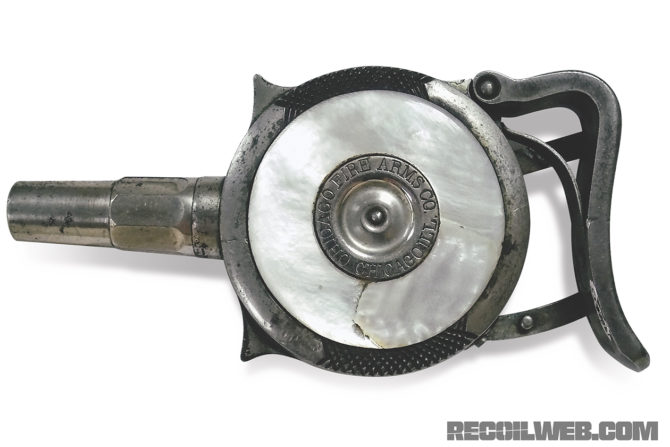
Photo Courtesy Cody Firearms Museum
Over the past few years, smaller and more concealable guns have hit the market — even a gun that simulates the size, shape, and appearance of a smartphone. Whether that’s a good idea or not isn’t for this historian to judge … yet. The idea of concealment in all shapes and sizes isn’t new. Back in the 1800s, many curios items came onto the market, including firearms like the Palm Protector Pistol.
This pistol is a revolver with a small barrel that fits between your fingers, kind of like parents tell their kids to do with their car keys. Instead of the cartridges being arranged in parallel around the cylinder’s axis, they were placed like spokes in a wagon wheel, much like earlier vertical turret revolvers. To fire, a shooter simply squeezes the gun. The design was first patented and sold in France in the early 1880s as the Turbiaux le Protector, but it soon saw production in the United States. Marketed by the Minneapolis Firearms Company as the Protector, it was manufactured in Springfield, Massachusetts. We don’t know of any FBI ballistic gelatin tests, but 32 Extra Short was a centerfire cartridge that made Volcanic Repeating Arms Company’s Rocket Ball ammunition look, well, still not great. Although, before we get too judgmental about the cartridge’s energy, Smith & Wesson got going thanks to sales of its number-one revolver that was chambered in the black powder 22 Short cartridge.
Peter Finnegan, who licensed the design, closed the Minneapolis Firearms Company and created the Chicago Fire Arms Company to sell a slightly different version of the guns. The manufacturing this time was done by the Ames Sword Company. Finnegan intended to have 15,000 ready by the Chicago World’s Fair, but Ames didn’t meet the deadline and a lawsuit ensued. The guns sold into the early 1900s.
Original French guns were 10-shot .22-caliber pieces, while most of the later American ones were .32 caliber, although some .41-caliber examples are reported. Originally, the guns were considered curio and relics but have since moved into the antique category under U.S. law.
TURBIAUX LE PROTECTOR (THE PROTECTOR)
- Date: ca 1882
- Caliber: 32 Extra Short
- Dimensions: The size of a pocket watch
- Action Type: Revolving
- Options: Option for pearl side plate, usually nickel finished