Category: Gun Schtuff
CMP Resumes Surplus M1911/M1911A1 Pistol Sales
The Civilian Marksmanship Program (CMP) is excited to announce the immediate resumption of surplus U.S. Army M1911/M1911A1 pistol sales! These historic firearms, cherished for their role in U.S. military history, are now available to qualified US Citizen customers.

Key Details:
- Pistol Availability: The CMP currently holds a substantial inventory of a variety of Pistol Grades, many ready to ship to consumers, and expects to fulfill a significant quantity of orders.
- Free Shipping: Those purchasing a CMP M1911 pistol will receive free shipping and handling (a $25 value).
- Updated Process: Given the quantity of on-hand pistols, we reorganized our sales fulfillment structure and our staff is ready to process orders in a timely manner without the use of the Random Generated Number (RGN) process, as in past M1911 sales. Additional detail on fulfillment information and sequencing follows below.
Concealed Carry Corner: Self-Defense Ammo Options
Welcome back to another episode of Concealed Carry Corner. Last week, we talked about self-defense ammunition and why it’s important along with a few things to keep in mind. If you happened to miss that article, be sure to click the link here to check it out. This week, I want to take a further look at some great options for self-defense ammo and what each type of ammo offers. Let’s take a closer look at some of the top self-defense ammo options.
Congressman Ben Cline Reintroduces Hearing Protection Act
Washington, January 15, 2025
Today, Congressman Ben Cline (R-VA) reintroduced the Hearing Protection Act (HPA). This legislation reduces the overly burdensome barriers required to purchase a firearm suppressor to ease access for law-abiding citizens simply trying to obtain the hearing protection they need.
“Americans who enjoy hunting and target shooting should be able to do so safely and legally without facing burdensome government regulations,” said Rep. Cline. “The Hearing Protection Act will reclassify suppressors, making it easier for law-abiding gun owners to protect their hearing while enjoying recreational activities. It’s time to ensure that our Second Amendment rights are upheld, allowing responsible citizens to enjoy their freedoms without unnecessary obstacles.”
Congressman Cline was joined by Rep. August Pfluger (R-TX), Rep. Ron Estes (R-KS), Rep. Riley Moore (R-WV), Rep. Aaron Bean (R-FL), Rep. Claudia Tenney (R-NY), Rep. Randy Weber (R-TX), Rep. Barry Moore (R-AL), Rep. Troy Nehls (R-TX), Rep. Burgess Owens (R-UT), Rep. GT Thompson (R-PA), Rep. Rob Wittman (R-VA), Rep. Richard Hudson (R-NC), Rep. Anna Paulina Luna (R-FL), Rep. Kat Cammack (R-FL), Rep. Buddy Carter (R-GA), Rep. Scott Perry (R-PA), Rep. Michael Bost (R-IL), Rep. Jack Bergman (R-MI), Rep. Brad Finstad (R-MN), Rep. Mike Collins (R-GA), Rep. Sam Graves (R-MO), Rep. Chuck Fleischmann (R-TN), Rep. Fulcher (R-ID), Rep. Gus Bilirakis (R-FL), Rep. John McGuire (R-VA), Rep. Robert Aderholt (R-AL), Rep. Addison McDowell (R-NC), Rep. Andy Harris (R-MD), Rep. Tim Burchett (R-TN), Rep. David Kustoff (R-TN), Rep. William Timmons (R-SC), Rep. Barry Loudermilk (R-GA), Rep. Jeff Crank (R-CO), Rep. Morgan Griffith (R-VA), Rep. Kevin Hern (R-OK), Rep. Steve Womack (R-AR), Rep. Brian Babin (R-TX), and Rep. Celeste Maloy (R-UT) as original cosponsors.
The Hearing Protection Act is supported by the American Suppressor Association (ASA), the National Shooting Sports Foundation (NSSF), the National Rifle Association (NRA), the Congressional Sportsmen’s Foundation (CSF), and the Academy of Doctors of Audiology (ADA).
“The Hearing Protection Act is the epitome of commonsense legislation. Law-abiding citizens should not have to pay a tax to protect their hearing when they exercise their Second Amendment rights. The American Suppressor Association applauds Rep. Cline for his leadership and willingness to fight for the rights of gunowners across the United States,” said Knox Williams, ASA President and Executive Director.
“Congressman Cline’s Hearing Protection Act will have the federal government recognize firearm suppressors for what they are. These are accessories to a firearm that make recreational shooting and hunting a safer experience,” said Lawrence G. Keane, NSSF Senior Vice President and General Counsel. “These safety devices reduce the report of a firearm to a level that won’t cause instant and permanent hearing damage. Despite Hollywood’s depictions, they do not mask the sound of a firearm. The focus should be on removing barriers to safe and responsible use of firearms and dedicating resources to ensuring firearms are safeguarded from those who should never possess them. Strict regulatory control of firearm accessories, and the parts of those accessories that have no bearing on the function of a firearm, is unnecessary and not the wisest use of federal resources. NSSF thanks Congressman Cline for his leadership for ensuring safe and responsible use of firearms and dedicating necessary resources where they are most needed.”
“Onerous and unnecessary government regulation shouldn’t prevent America’s hunters and recreational shooters from protecting their hearing while exercising their constitutionally protected freedoms,” said John Commerford, Executive Director of NRA-ILA. “Suppressors do not silence firearms, but they are proven to reduce the severity of hearing loss. On behalf of our millions of members, NRA thanks Representative Ben Cline for introducing the Hearing Protection Act.”
“The Hearing Protection Act has been a longstanding priority for the Congressional Sportsmen’s Foundation (CSF), and we are excited to see this legislation reintroduced. Suppressors are one of the fastest growing and most popular accessories for sportsmen and women, unfortunately, current law makes acquiring suppressors an overly burdensome process, which would be addressed by this legislation. CSF thanks Congressional Sportsmen’s Caucus Member Rep. Ben Cline for introducing this legislation, and we look forward to working with him in the 119th Congress to improve the suppressor purchasing process,” said CSF President and CEO Jeff Crane.
Read the full text of the bill here.
Congressman Ben Cline represents the Sixth Congressional District of Virginia. He previously was an attorney in private practice and served both as an assistant prosecutor and Member of the Virginia House of Delegates. Cline and his wife, Elizabeth, live in Botetourt County with their two children.
Gun sales: lies, damned lies and statistics
With Donald Trump about to regain the White House and Republicans in control—barely—of both houses of Congress, gun owners and Americans who think they might want to be gun owners someday can relax, right? Right? Beginning January 20, 2025, the federal government probably won’t be harassing gun dealers or trying to write extra-constitutional rules to turn millions of Americans into instant felons for possession of guns or accessories that were lawful the day before, right? Let’s review the status quo on the way to an answer.
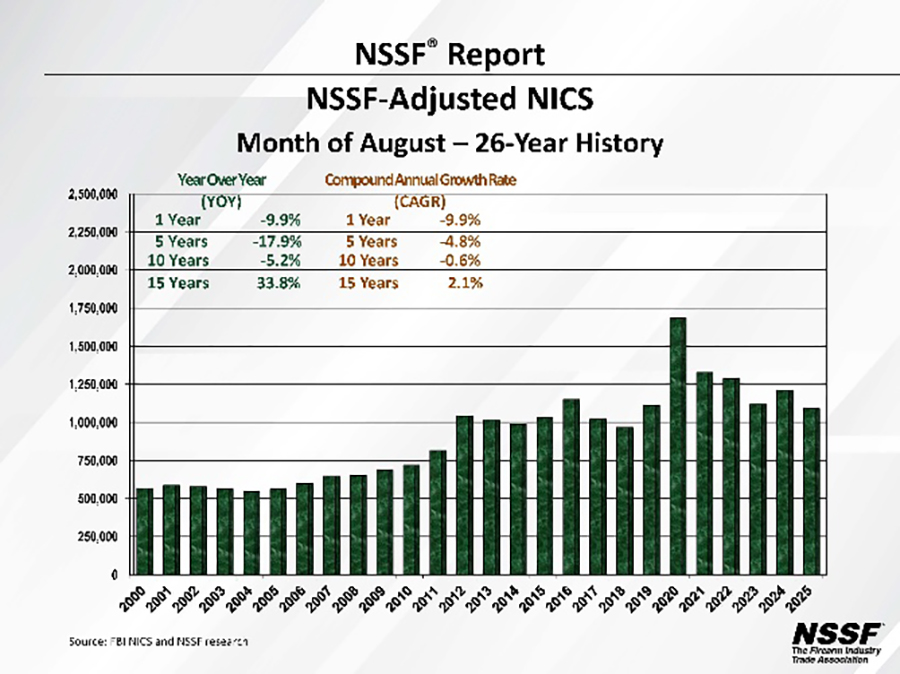
For 65 consecutive months, Americans have bought more than a million guns. That’s measured by NCIC record checks mandatory whenever one buys a gun—or guns—from a federally licensed gun dealer after filling out the standard ATF Form 4473. Private sales surely count for many more, but aren’t recorded.
After 2024 monthly gun sales — as measured by adjusted NICS data — trailing 2023 for most of the year, they started to accelerate in July and jumped even more in August. This may be due, at least in part, to the impending election. Americans tend to hedge their bets every four years by stocking up on firearms and related gear. And then there’s the general state of society that seems to have an increasing number of people concerned about self-defense.

Graphic: FBI data via NSSF. Public Domain.

Wolfe Publishing
John Taffin’s Book of Small-Bore Sixguns, Semiautomatics and Single-Shots
The Machine Gun Win Now Before the 10th Circuit Court of Appeals
United States v. Morgan (24-3141)
Charles Nichols
Last August, Federal District Court Judge John W. Broomes issued two findings. The first was that the two machine guns the defendant was charged with illegally possessing are ““bearable arms within the original meaning of the [Second” amendment.” The second was “the government has failed to establish that this nation’s history of gun regulation justifies the application of 18 U.S.C. § 922(o) to Defendant.”
Judge Broomes then dismissed the charges. The Federal government filed a timely appeal, and filed its opening brief on appeal on December 12th. On December 29th, the Brady Center to Prevent Gun Violence filed an Amicus brief in support of the government. On Monday, January 6th, the Defendant filed a disfavored (but unopposed) motion for a thirty-day extension to file his answering brief on appeal. The motion was granted the same day. I am reliably informed that an Amicus brief will be filed in support of the Defendant.
Judge Broomes also said that some kinds of machine guns are not arms protected by the Second Amendment, and his decision says nothing about what restrictions or prohibitions the government could place on the carrying (bearing) of machine guns because the Federal law only makes it a crime to possess unregistered machine guns, not carry them.
Additionally, this is an interesting case because the case was prosecuted in the district court, and the opening brief on appeal was filed by the Biden administration. The reply brief and all further proceedings from January 20th onward will be by the Trump administration. The Trump DOJ attorney can simply acquiesce in the case, meaning he can concede that the law is unconstitutional but assert that President Trump will continue to enforce the law, including in this case. The latter is particularly important because if the President does not aver that he will continue to enforce the law, including against the Defendant, then the Court of Appeals could simply dismiss the appeal without deciding the case for lack of a “live case or controversy.”
Putting machine guns to the side for the moment, this quote from the Defendant’s motion for an extension of time is particularly telling, “The government’s brief is 36 pages long. The table of authorities is an additional 15 pages long and includes citations to roughly 200 cases, statutes, and legal texts. Many of the sources relied on by the government are hundreds of years old and were not cited by the government in the district court.”
The Federal criminal court system is rigged against defendants. Had the Defendant’s attorney failed to cite authorities or make properly worded objections in the proper manner at the appropriate time(s) in the trial court, then his failure would be subject to what is called “plain error review” on appeal, and he would almost certainly lose.
Will the 10th Circuit Court of Appeals afford the Federal government a more deferential standard of review? Will the Court of Appeals contrive some way around the NYSRPA v. Bruen mandate that the burden of proof lies with the government?
Time will tell. The appeal should be fully briefed in two months, after which the Court of Appeals can make a decision at any time.
You can read many of the briefs for free from CourtListener at the following links.
United States v. Morgan (24-3141) 10th Circuit Court of Appeals Docket.
United States v. Morgan (6:23-cr-10047) District Court, D. Kansas Docket.
Americans Likely Bought More than 15 Millions Guns in 2024
Americans still really love guns, as highlighted by the latest statistics for over-the-counter retail firearm sales from last year.
The year-end data published by the FBI’s National Instant Criminal Background Check System show 28,097,205 checks were logged between Jan. 1 and Dec. 31, 2024, with the busiest single week being that of Black Friday, which saw 613,380 checks.
The National Shooting Sports Foundation analyzed the figures for last year, and after removing checks and rechecks for firearms permits, found that no less than 15,239,011 checks were for likely retail gun sales. Further, 2024 continued a now 65-month trend of consumers purchasing over a million firearms monthly.
“We are proud that NSSF member companies continue to serve the American public that chooses to exercise their Second Amendment rights by the millions each month,” said NSSF President and CEO Joe Bartozzi. “These background check figures show strong sales and that today’s firearm manufacturers are delivering high-quality products. We are proud that our member companies continue to exceed the high standards that law-abiding Americans demand when it comes to the products that allow them to exercise their Second Amendment rights.”
Going past the NICS data, the true number of guns sold nationwide is even higher.
This is because federal background check numbers don’t include private person-to-person gun transfers in most states or cases where a carry permit is used as an alternative to the background check requirements of the 1994 Brady Law, which allows the transfer of a firearm over the counter by a federal firearms license holder without first performing a NICS check. Further, it doesn’t capture homemade firearms unless assembled on serialized frames or receivers, or purposely registered by the builder with local authorities.
New CCW Report Says Decline Reflects ‘Constitutional Carry’ Impact
For the second year in a row, the number of active concealed carry permits and licenses in the U.S. has declined slightly, but the Crime Prevention Research Center (CPRC) suggests the drop reflects the impact of “Constitutional Carry” permitless states, so it’s not as though fewer people are packing heat.
“Last year,” CPRC reported, “the number of permit holders dropped by 0.38 million to 21.46 million – the second year in a row with a decline. It hit a high of 22.01 million in 2022. The main reason for the drop is that the number of permits declined gradually in the Constitutional Carry states even though it is clear that more people are legally carrying.”
CPRC, based in Missoula, Mont., has been tracking concealed carry patterns for several years. Its annual report is published in the fall, typically in late October or early November.
Among this year’s revelations:
- Twenty-nine states have now adopted “Constitutional (permitless) Carry” for their entire state, meaning that a permit is no longer required. Because of these Constitutional Carry states, the concealed carry permits number does not paint a full picture of how many people are legally carrying across the nation. Many residents still choose to obtain permits so that they can carry in other states that have reciprocity agreements, but while permits are increasing in the non-Constitutional Carry states, they fell in the Constitutional Carry ones even though more people are clearly carrying in those states.
- In 2024, women made up 29.1% of permit holders in the 14 states that provide data by gender. Seven states had data from 2012 to 2023/2024, and permit numbers grew 111.9% faster for women than for men.
- Five states now have over 1 million permit holders: Florida, Georgia, Indiana, Pennsylvania, and Texas. Florida is the top states with 2.46 million permits. Alabama has fallen below 1 million permit holders this year, but it has become a Constitutional Carry state since January 1, 2023, meaning that people no longer need a permit to carry.
- Three states that have detailed race and gender data for at least a decade show remarkably larger increases in permits for minorities compared to whites. In Texas, black females saw an 8.4 times greater percentage increase in permits than white males from 2002 to 2023. Oklahoma data from 2002 to 2023 indicated that the increase of licenses approved for Asians was slightly over four times the rate for whites. North Carolina had black permits increase twice as fast as whites from 1996 till 2016.
- From 2015 to 2021/2023/2024, in the four states that provide data by race over that time period, the number of Asian people with permits increased 219.2% % faster than the number of whites with permits. Blacks appear to be the group that has experienced the largest increase in permitted concealed carry, growing 283.9% % faster than whites.
- At least 8.2% of American adults have permits. Outside of the restrictive states of California and New York, about 9.8% of adults have a permit.
In sixteen states, more than 10% of adults have permits. Oregon has fallen slightly below 10% this year. Indiana has the highest concealed carry rate — 23.1%. Alabama is second with 20.5%, and Colorado is third with 17.7%, followed by Pennsylvania (15.88%) and Georgia (13.55%).
The 73-page report said this year saw two more states join the permitless carry column—South Carolina and Louisiana—bringing the total to 29, and that’s a majority of states. By no small coincidence, holdout states are controlled by Democrats.
My Reverse New Year’s Resolutions: Things I Won’t Stop Doing, Despite Leftist Finger-Wagging

Cue Chevy……..
This is the best thing I have ever seen.
Dual mounted American 180.
This thing can shoot 3000 rounds per minute. pic.twitter.com/DOhs0PGmt8
— Gun Lovers Club (@GunloverClub1) December 18, 2024
It means;
1 ‘You can’t stop the signal’
2 Gun control has been dead for years, but the moron wanna-be gun grabbers haven’t yet gotten to the ‘acceptance’ stage of grief.
What Would It Mean if CEO Killer’s Suppressor Was 3D Printed?
In the early days after UnitedHealthcare CEO Brian Thompson’s murder, there was a lot of speculation as to what exactly the killer used. With the arrest of Luigi Magione, though, many of them have been answered. We know that Magione was in possession of a 3D-printed handgun and he had a suppressor.
However, what we’re not seeing in most of these reports is just where the suppressor came from.
I’ve reached out to the NYPD for answers, though they haven’t responded by the time this particular piece has gone live. In fairness to them, I sent that email early this morning before most decent people were awake.
What’s interesting, though, are a lot of reports that this was like a 3D-printed suppressor.
‘I can confirm it is a 3D-printed gun,’ Print Shoot Repeat, who runs the YouTube channel PSR, said. ‘What are the odds it was a 3D-printed suppressor? Well, I think kind of high honestly.’
He explained that a 3D printer suppressor is ‘super light,’ but does not allow the slide the cycle properly.
The shooter of Thompson experienced a similar issue during the murder when he shot and had to recycle the slide to take another shot.
However, another gun expert with more than 30 years of training told Dailymail.com that most guns with a suppressor will behave that way.
‘There are different causes for jamming,’ the expert, who spoke on anonymity, said.
‘Sometimes the ammunition is poor sometimes the firearm is dirty, it’s not maintained. The ammunition is a poor grade. It doesn’t matter what kind of gun it is.
So yeah, there’s debate.
What we don’t have are answers.
3D-printing a suppressor fits what we know about the killer. We know he printed the receiver for his gun–my speculation has been that he knew all the media reporting on “gun tracing” but didn’t understand what that meant, so he wanted to avoid being identified quickly or easily–and that suppressors are more tightly controlled than firearms are. It’s very likely he did print his suppressor.
That brings up all kinds of possibilities and probabilities that a lot of gun control activists aren’t going to like.
First, again, suppressors are tightly controlled. There aren’t “suppressor kits” marketed throughout the internet where you guy buy a kit, print some key parts, and you legally have a suppressor. It doesn’t work like that. One could argue that there are kits available, but they’re not marketed as such and I have yet to find one that requires a 3D-printed part to work.
So that brings us to the idea that the whole thing was 3D printed.
No laws on the books allow just anyone to print themselves a suppressor.
“Yeah, but the files are all over the internet, most likely.”
Sure. However, there’s a problem with that argument. See, while possession of those files might not be illegal, having them on the internet likely is.
The gun files you can find on the internet are generally only there because the State Department has decided that they don’t violate the International Traffic in Arms Regulations or ITAR. That basically says that weapons and weapons technology can’t be exported without federal approval. That includes technical data.
On Monday, a State Department spokesperson confirmed to Bearing Arms that the U.S. Munitions List in Category I does, in fact, include suppressors and the technical data required to make them.
In other words, those files shouldn’t lawfully be on the internet in the first place.
While the State Department wouldn’t comment on any potential investigation, this still blows all the “we should ban ‘ghost guns'” rhetoric out of the water.
In no way are suppressors lawfully produced, and yet Magione allegedly produced one. If such a tightly controlled item can be produced from tightly controlled information, then just how does anyone really think they can stop guns from being made?
Yes, Magione reportedly used a kit, but we’ve covered the FGC-9, which doesn’t require any kits, just parts from the hardware store.
The truth of the matter is that just the possibility that Thompson’s killer used a 3D-printed suppressor illustrates that gun control isn’t a winning strategy. You’re never going to keep things out of the hands of people who want them badly enough. They’ll find a way.
While everyone is going nuts about the gun itself, the suppressor is the bigger issue, which is why no one wants to talk about it.
NBC Falsely Claims Magazine Disconnects Increase Safety
Around 11 people are killed each year because their handguns lacked a magazine disconnect, according to a massive 4,600-word special report by NBC News, which was released Friday.
The story’s title tells you all you need to know about the content: “A simple device could help curb accidental gun deaths, but most firearms don’t have it.”
“Since 2000, at least 277 people have been killed in gun accidents in which the shooter believed the weapon was unloaded because the magazine had been dislodged or removed, an NBC News investigation found. That total – based on federal data collected from states, as well as media reports, lawsuits and public records – is likely a significant undercount since many states only recently began reporting their data, and information on the cases may be incomplete. NBC News found 41 cases that weren’t captured in the data,” the story claims.
Most of the story focuses on those allegedly killed by a handgun that was improperly used – pointed at an innocent person and the trigger pulled.
So, friend A.K. Church comes by today with a couple of his Short Barreled Shotguns to post on a BBS.
Maverick 88 “12 by 12”
Winchester Model 25
Should We Get Ready For a NFA Amnesty?
For the past several weeks, President Trump has been very busy naming his cabinet appointments. One that is still uncertain is his choice to become the new BATFE Director. The current director, Steven Dettelbach, is a clueless anti-gun buffoon who can’t give congressmen a straight answer. Many American gun owners are hopeful that DJT will appoint 07/02 FFL holder, gun designer, and pro-gun pundit Brandon Herrera as the new Director. If that happens, it will surely inspire some boisterous celebration. In addition to his vows to slash the ATF’s budget and operations, Herrera has also promised to begin a series of National Firearms Act (NFA) registration amnesty periods. There was a provision for tax-free amnesty periods written into the Gun Control Act of 1968. But thusfar, just one 30-day amnesty was held, back in 1968. That amnesty was very poorly publicized, and not many gun owners took advantage of it.
Today, there are probably hundreds of thousands of unregistered full autos in the country. And there are parts in civilian hands to quickly make a million or more. What can I say, but: Americans just love to tinker.
Under the Hughes Amendment to the Firearms Owners Protection Act (FOPA) of 1986, the number of Federally transferable machineguns was arbitrarily frozen. As of November 2006, the National Firearms Registration and Transfer Record (NFRTR) held registrations for 1,906,786 weapons. These included 1,186,138 destructive devices, 391,532 machine guns, 150,364 silencers, 95,699 short-barreled shotguns (SBSes), 33,518 short-barreled rifles (SBRs), and 48,443 weapons categorized as “any other weapons,” (AOWs.) Since then, the number of SBRs, SBSes, and suppressors has risen sharply, but the number of registered transferable machineguns has hardly changed at all.
Not only did the Hughes Amendment freeze cause the prices of full auto guns to inflate radically, it also left Americans with no opportunity to legally build and register any new $200 tax stamp machineguns. Many did so in defiance of the law, risking Federal felony prosecution. Most of those guns are kept very well hidden, mostly underground.
I am hopeful that Brandon Herrera will indeed become the new ATF Director. And I am fully confident that he will keep his promise and consult with the new Attorney General to open at least one six-month-long amnesty period, with tax-free registration of machineguns, partly or fully-finished machinegun receivers, autosears, and other NFA-restricted items. Once that amnesty window opens, the clock will begin ticking. So owners of semi-auto firearms who wish to become legal registered full-auto owners will have to get busy. They will need to either drill existing receivers or bring any unfinished receiver blanks or tubes up to a recognizable level of completion and apply serial numbers, so that they can be registered before the amnesty period expires.
“I’m doing my part!”
Despite ATF Roadblocks, Nearly 5 Million Suppressors Legally Owned

The number of legal suppressors in the USA is almost certainly over five million. The National Shooting Sports Federation (NSSF) revealed a Freedom of Information Act request submitted to the Bureau of Alcohol, Tobacco, Firearms and Explosives (ATF), which was finally answered this summer. The total number was 4.86 million at the end of July 2024. From the NSSF:
In a recent Freedom of Information Act request (FOIA), NSSF received from ATF the additional number of silencers from May 2021 to July 2024. An incredible 2,193,123 more suppressors are protecting the hearing of hunters and shooters. That means a whopping 4.86 million silencers and counting are in possession by law-abiding Americans.
The number of tax stamps issued for silencers, also commonly referred to as suppressors, had to be pried out of the ATF with a FOIA. The ATF has gained a reputation for long waits and poor responses to FOIA requests. Before the Biden administration took power, detailed information on all National Firearms Act items was publicly available in an annual report called Firearms Commerce in the United States. Once the Biden administration took control of the ATF, the annual report was, without notice, discontinued. The ATF would not publish the information. They slowly responded to FOIA requests, which is how the NSSF finally obtained the numbers. The numbers show an accelerating demand for legal silencers, with an average of nearly 60,000 tax stamps being issued each month.
The average does not tell the whole story. Demand has been accelerating. Information shows there were 3.5 million silencers through January 2024. Thus, 1.4 million silencers were added in the six months from January 2024 to the end of July 2024. It is virtually certain there are over 5 million legal silencers in the USA today.
Much of the increase has come from the ATF streamlining the tax stamp approval process for commercially made silencers while complicating the process of making your own silencer. Another part of the increase comes from the major inflation created by the Biden administration in the last 3.5 years. While everything else has become more expensive, the tax stamp remains the same as it was when created in 1934: $200. In 1934, $200 was roughly four months wages for a common laborer. Today, it is one or two days wages. In 1934, a silencer might cost $5-10. Today, they can cost $200 – $2,000, so the tax stamp becomes a fraction of the total cost instead of 95% of the cost.
Sales of silencers/suppressors may slump with the election of President Trump. The possibility of something like the Hearing Protection Act is plausible. One of the giants in the silencer/suppressor industry is not worried. Brandon Maddox explained there is such a pent-up demand for silencers that his business will only increase if the regulatory hassles are eliminated.
Elon Musk and Vivek Ramaswamy are looking for programs to cut, to increase efficiency. Moving silencers out of the NFA would take legislation. President Trump could declare an amnesty, as is allowed under federal legislation. An amnesty might incentivize Congress to reform the NFA and pass the Hearing Protection Act.
More incentives to remove items from the NFA exist in the courts. The case in Illinois looks promising.
President Trump is moving much faster this term. He has put together an incredible team, well in advance of taking office. He now understands the treachery inherent in the bureaucracy. Top level bureaucrats have monetary and power incentives to oppose him. They may have significant crimes to hide which may be revealed.
He who cuts the first deal to reveal potential criminal actions usually gets the best deal. There are thousands of people in the bureaucracy who know where good information is to be found about criminal activity. They have jobs, pensions, and perks to protect. Some of them are already talking. Many of them know how practices can be streamlined and where positions can be cut.
FYI, they’re ‘often called silencers’ because 1, the inventor, Hiram P. Maxim called them that and 2, that’s what they’re called in federal law; NFA-34
Major Medical Group Endorses Firearms Silencers to Prevent Hearing Loss
Sound suppressors, often called silencers, help protect gun owners’ hearing.
That’s the conclusion one of the largest ear-doctor organizations, with more than 13,000 members, reached this month. The American Academy of Otolaryngology–Head and Neck Surgery (AAO-HNS) issued a position statement backing the use of the noise-reducing devices. It pointed to three different studies that found suppressors help prevent hearing loss.
“Sound suppressors are mechanical devices attached to the barrel of a firearm designed to reduce harmful impulse noise of firearms at its source,” the group’s statement reads. “CDC research has shown that ‘The only potentially effective noise control method to reduce [shooters’] noise exposure from gunfire is through the use of noise suppressors that can be attached to the end of the gun barrel.’ Suppressors reduce muzzle blast noise by up to 30 dB.”
The backing of a major medical organization could help boost the use of suppressors among gun owners. It could also lend support to efforts to reform the laws governing their purchase and possession. While the Bureau of Alcohol, Tobacco, Firearms, and Explosives (ATF) has opened up online suppressor registration and increased the speed they process those registrations, the devices remain heavily regulated under the same federal law that governs machine guns.
Reform is what Dr. Timothy Wheeler was hoping for when he proposed the statement alongside six colleagues. Wheeler, a board-certified otolaryngologist and AAO-HNS life fellow, is also the founder of Doctors For Responsible Gun Ownership. He said he hopes AAO-HNS’s adoption of the statement leads to a different approach to gun ownership at major medical organizations.
“My personal hope is that this represents maybe a change of heart for at least one small part of academic medicine,” Wheeler told The Reload. “Academic medicine has a very long way to go to climb out of the credibility gap that they have created for themselves in the public eye because they’ve been pretty much taken over by a lot of social and political crusades, including gun control, going way back to the late 1980s.”
He emphasized the AAO-HNS statement doesn’t advocate for any law or policy changes.
“It’s purely a scientifically based observation,” Wheeler said. “They are saying nothing beyond what’s in the statement.”