
Running The Defensive Lever-Action Rifle.

Any firearm has its own manual of arms, and the lever-action rifle is no exception. The armed citizen who chooses to use a lever gun for personal defense should know safe carry techniques and efficient and safe loading and unloading methods. And, just as with any other defensive firearm, we need to practice safe, efficient techniques when firing at the range and during dry practice.

When not carrying the lever gun I prefer that the magazine be loaded and the chamber empty. When encountering a threat or potential threat I have the option of levering a round into the chamber when I pick up the rifle and then lowering the hammer to the safety notch or, in the case of later model guns, engaging the external safety. The other option is to run the lever, chambering a round as I bring the gun to my shoulder and address the threat.

Whether the gun has a safety or not, I don’t like the idea of walking around with the hammer cocked. It is just an added safety measure to lower the hammer unless one is actually about to fire the gun. And no time is lost when the shooter cocks the hammer as he brings the gun to his shoulder and the sights onto the target.

In practice sessions it is important to get into the habit of firing and cycling the action without taking the gun down from the shoulder. The gun stays in the shoulder pocket while we fire our shot, cycle the action with a live round, and get back on target. With practice, one can also top off the magazine (tactical reload) without removing the gun from the shoulder.

Since the majority of lever-action rifles load from the right side of the receiver, the shooter will have to use their right hand to reload, regardless of whether they are right or left-handed. And one will just have to practice a little with a belt-mounted ammo slide or butt cuff on the gun to see what works best for the individual. Obviously, loose cartridges in a pocket should be avoided if at all possible. Just as with our defensive handguns, dry practice with the lever action is important. Dummy rounds can be purchased and used to practice various loading and unloading methods.

With most lever-action rifles the only way to unload them is to cycle the live rounds through the action and eject them. The only safe way to do this is to keep the muzzle pointed in a safe direction and make doubly sure that the trigger finger is nowhere near the trigger. It is critical to pay close attention to the unloading operation, go slowly, and focus on safety.

When firing and cycling a lever action it is important to do it with some force; my friend Richard Mann says, “Do it like you’re killing snakes.”  Running the lever gently can lead to what we call a short stroke, that is when the bolt fails to chamber a round. You run the action with the same forcefulness that you run a pump shotgun.

In short, the lever-action rifle can be an excellent choice for personal defense, but it is critical that the armed citizen learn how to run it safely and efficiently. Those who haven’t grown up hunting with lever guns would be well advised to sign up for one of the several defensive classes that are offered. In fact, professional classes are always a good idea regardless of a person’s experience level.

New FBI rule gives gun dealers access to stolen firearm records; Springfield law enforcement and gun store owners weigh in

SPRINGFIELD, Mo. (KY3) – A new ruling by the FBI gives federal firearm licensees access to FBI records of stolen firearms.

Before this new ruling, firearm dealers had to use their best judgment when buying guns from strangers.

“People that bring in a used gun, I have no way of knowing if it’s stolen or not and if I do purchase it, and it is stolen, I lose the money I put into it and the gun,” 417 Guns owner Brent Ball said.

We asked how he verifies whether a gun is stolen or not without the database tool. Ball said he was in law enforcement for many years and tries to use his best judgement when buying firearms, but there’s not been a way to verify whether it’s stolen or not until now.

“If I’m not comfortable with the situation, I have them leave. I don’t need that business,” Ball said.

Major Tad Peters with the Springfield Police Department said this new ruling is a good thing, especially since the city has experienced issues with stolen firearms before.

Continue reading “”

What with today’s decision reversing Chevron deference, I see no way that the bureaucrap’s rule on unfinished receivers stands.


BLUF
Fortunately, we will not have to wait too long to see if Cargill stands alone or reflects a broader trend of checking ATF claims of authority. On April 22, 2024, the Court granted certiorari in Garland v. VanDerStok, a case challenging the ATF’s “frame or receiver” rule as beyond the scope of the agency’s authority. A decision in VanDerStok will likely come during the Court’s next term.

Garland v. Cargill: The Court’s Textualists Stick to Their Guns

Because it involves guns, Cargill v. Garland has been seen by supporters and opponents alike as a Second Amendment case. That is not really correct. Rather, it presents a question of basic statutory interpretation. And in answering that question, Cargill is a triumph of textualism and separation of powers concerns over purpose-driven interpretation and legislative intent.

For the majority, the words on the paper are what matter, even if the Congress that wrote them might have done things differently. It does not matter if something walks like a duck and quacks like a duck if it doesn’t have the features that Congress used to define a duck.

On the separation of powers front, Cargill is a victory for congressional lawmaking authority. Administrative agencies such as the Bureau of Alcohol, Tobacco, Firearms and Explosives (ATF) cannot step in and rewrite statutes by administrative fiat just because Congress is not acting as quickly as they might wish.

Continue reading “”

CFIUS Clears Sale of The Kinetic Group to CSG

Represents Final Regulatory Approval Required to Close the Transaction

Board of Directors Continues to Recommend Stockholders Vote in Favor of Merger Agreement Proposal at Special Meeting on July 2, 2024

Vista Outdoor Inc. (“Vista Outdoor,” the “Company,” “we,” “us” or “our”) (NYSE: VSTO) and Czechoslovak Group a.s. (“CSG”) announced today that the Committee on Foreign Investment in the United States (“CFIUS”) has cleared CSG’s proposed acquisition of Vista Outdoor’s The Kinetic Group business (the “Transaction”). Vista Outdoor and CSG received written notice from CFIUS that CFIUS has concluded its review and investigation of the Transaction and has determined that there are no unresolved national security concerns. CFIUS clearance was the final regulatory approval required under the merger agreement with CSG for the closing of the Transaction.

Michael Callahan, Chairman of the Board of Directors, said “We are very pleased that CFIUS has carefully vetted the Transaction and, as we expected, determined that there are no unresolved national security concerns.”

CFIUS is an interagency committee of the U.S. government authorized to review certain transactions involving foreign investment in the United States to determine the effect of such transactions on U.S. national security.

“The CFIUS process involved a thorough review and investigation of the Transaction by numerous U.S. Government departments and agencies with a range of national security and other mandates,” Callahan said. “We believe the end result supports our view that CSG—which has deep expertise in supply chain excellence and ammunition manufacturing and strong support for NATO and allied nations—will be an excellent owner of The Kinetic Group. CSG is fully committed to supporting our American workforce, American hunters and domestic and allied military and law enforcement partners.”

The closing of the Transaction remains subject to receipt of the approval of Vista Outdoor’s stockholders and other customary closing conditions. The special meeting of Vista Outdoor stockholders to, among other things, consider and vote on a proposal to adopt the merger agreement with CSG is scheduled to be held virtually on July 2, 2024, at 9:00 a.m. Central Time.

The Board continues to recommend Vista Outdoor stockholders vote in favor of the proposal to adopt the merger agreement with CSG. Vista Outdoor is confident that the Transaction will maximize value for our stockholders by

  • Providing for a $2 billion purchase price, representing a $90 million increase from the original $1.91 billion purchase price,
  • Allowing stockholders to benefit directly from additional excess cash generated by the Company prior to closing,
  • Delivering $18.00 in cash consideration per share at closing, representing a $5.10 increase from the original cash consideration of $12.90 per share, and
  • Enabling stockholders to capture the long-term intrinsic value that is embedded in Revelyst’s business plan as a standalone public company……..

RUGER DEBUTS MARLIN 1894 TRAPPER CARBINE IN .44 MAG

Ruger this week reintroduced a factory stainless big loop Marlin 1894 Trapper model chambered in hard-hitting .44 Magnum/Special and shipping with a 16.1-inch barrel.

Originally patented on Aug. 1, 1893, by L.L. Hepburn, the Model 1894 was the first flat-top lever action with a side eject receiver. However, across its production run, Marlin typically liked to make the 1894 in longer barrel lengths, only making limited runs of short “trapper” carbines. This abbreviated take on the model, in a stainless-steel (1894SS) format, returned to Marlin for brief runs (e.g. 351 guns made for Davidson’s in 2006) and in a stainless big-loop (SBL) variant that popped up in the catalogs for 2011 and 2018.

Now, Ruger has brought it back for 2024.

the new Ruger Marlin 1894 Trapper in .44 shown in a lightbox
Using a stainless-steel barrel and receiver mated to black laminate furniture, the carbine is handy, taping out at just 33.25 inches overall while still keeping a 13.38-inch length of pull. Weight is 6.3 pounds. (Photos: Marlin)
the new Ruger Marlin 1894 Trapper in .44 shown in a lightbox
Chambered in .44 Magnum, the underbarrel magazine tube accepts 8 rounds, or when using shorter .44 Special cartridges, will hold nine. 
the new Ruger Marlin 1894 Trapper in .44 shown in a lightbox
The 1894 Trapper has an adjustable rear and blade front sight made by Skinner, while the cold hammer-forged 1-in-20-inch twist barrel ends with a threaded muzzle (5/8×24 TPI pattern) for muzzle devices and suppressors. 


The ask on the new Ruger Marlin 1894 Trapper in .44 is $1,499, a price generally lower at retail. That price matches the current Model 1895 Trapper in .45-70 and the Model 336 Trapper in .30-30, with each of those carbines having a 5+1 capacity.

One Million Gun Sales for 58 Months Straight.

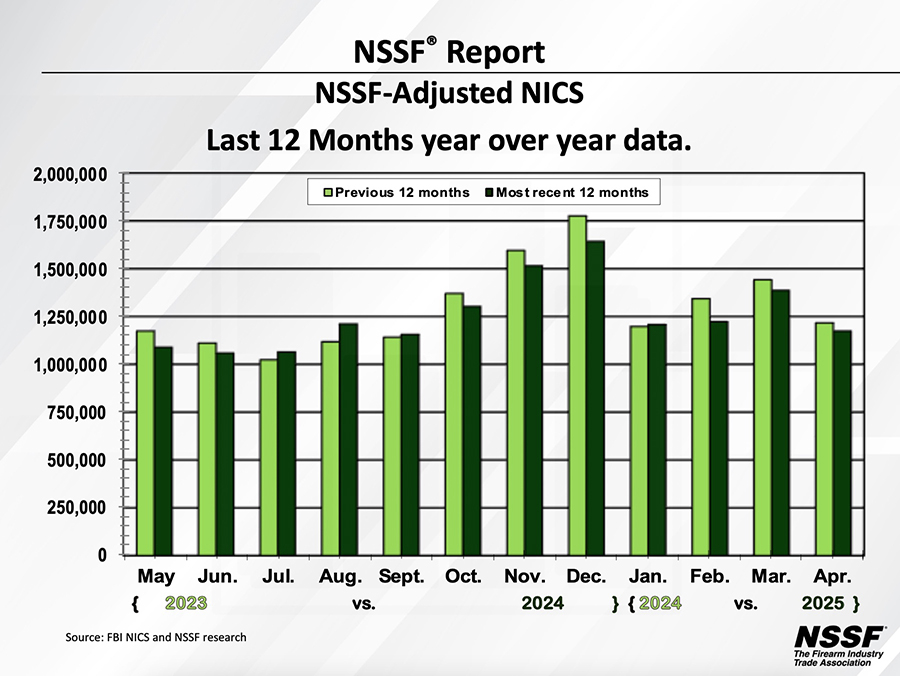
May marked the 58th month in a row that the number of firearms sold—as reflected by the volume of National Instant Criminal Background Check System (NICS) requests processed by the FBI—exceeded one million. The news wasn’t all good, though. The National Shooting Sports Foundation (NSSF) estimates, based on NICS figures, that sales decreased by 7.2 percent when compared to purchases made in May of 2023.

The total number of firearms sold last month nationwide came in at roughly 1,089,117, according to NSSF’s figures. During the same reporting period in 2023 the total was 1,174,142.

Declines in demand are frequent this year as a new normalcy returns after the pandemic buying boom. Comparing April’s 2024 and 2023 figures, for example, the drop was more significant at 11.2 percent, according to NSSF’s calculations. Volumes were estimated at 1,442,061, respectively. In February, however, decline was only .01 percent.

It’s important to keep in mind 24 states currently have at least one qualified alternative permit, which under the Brady Act allows the permit-holder—who has undergone a background check to obtain the permit—to purchase a firearm from a licensed dealer without a separate additional background check for that transfer. The number of NICS checks in these states does not include these legal transfers based on qualifying permits and NSSF does not adjust for these transfers.

The adjusted NICS data were derived by subtracting NICS purpose code permit checks and permit rechecks used by states for CCW permit application checks, as well as checks on active CCW permit databases. Though not a direct correlation to firearms sales, the NSSF-adjusted NICS data provide an additional picture of current market conditions. In addition to other purposes, NICS is used to check transactions for sales or transfers of new or used firearms.

With a contentious Presidential election on the horizon, enthusiasts can expect to see an increase in foot traffic through the doors of their favorite FFLs as sales rebound toward November.

misconstrue:
verb
To interpret erroneously…

erroneously:
adverb
In a way that is wrong or false…

Nothing out of the ordinary for demoncraps


Critics Fundamentally Misconstrue the Supreme Court’s Bump Stock Ruling

After the Supreme Court overturned the Trump administration’s bump stock ban last week, critics complained that the justices had interpreted the Second Amendment in a way that rules out perfectly reasonable gun regulations.

That was an odd complaint, because the case did not involve the Second Amendment.

Sen. Chris Murphy (D-Conn.) saw last week’s decision as a sign that the Supreme Court plans to “fundamentally rewrite the Second Amendment,” which will “make it very hard for Congress or state legislatures to be able to regulate guns.” MSNBC commentator Joyce Vance had a similar objection: “Does the history & tradition of our country really suggest the Founding Fathers meant for the 2nd Amendment to arm Americans with guns that fire 400 to 800 rounds per minute?”

Although Murphy is a lawyer and Vance is a law professor, they completely misconstrued what this case was about. The Supreme Court ruled that the Bureau of Alcohol, Tobacco, Firearms and Explosives exceeded its statutory authority when it tried to ban bump stocks.

The products the ATF targeted are designed to assist bump firing, which involves pushing a rifle forward to activate the trigger by bumping it against a stationary finger, then allowing recoil energy to push the rifle backward, resetting the trigger. As long as the shooter maintains the requisite amount of forward pressure and keeps their finger in place, the rifle will fire repeatedly.

The “interpretive rule” at issue in this case, which was published in Dec. 2018 and took effect three months later, banned stock replacements that facilitate this rapid-firing technique by allowing the rifle’s receiver to slide back and forth. The ATF did that by classifying rifles equipped with bump stocks as machine guns, which contradicted the statutory definition and the agency’s long-standing interpretation of it.

Continue reading “”

Here’s the demoncrap BUMP ACT ‘‘Banning Unlawful Machinegun Parts Act of 2023″ bill that was shot down today, and will keep getting shot down as it’s quite easy to see that it would ban a lot more than ‘bump stocks’.
In fact it would ban simply doing a trigger job that would lighten the trigger pull weight or travel as well as match triggers made by many different companies like Geissele, LaRue, J&T, etc.

bump_act_bill_text

Federal Judge Vacates ATF Rule on Pistol Braces

We’re still waiting to see what the Supreme Court does in Rahimi and Cargill, but gun owners did get some very good news from the federal courts on Thursday. A U.S. District Judge in Texas has vacated the ATF’s rule treating pistols equipped with stabilizing braces as short-barreled rifles; granting relief not only for the named plaintiffs involved in the litigation, but for every gun owner across the country who owns a brace.

In his decision, U.S. District Judge Reed O’Connor ruled that the ATF’s rule treating most pistol braces as accessories that turn pistols into SBRs violated the Administrative Procedures Act in a number of ways.

For close to a decade, the ATF concluded that “attaching the brace to a firearm does not alter the classification of the firearm or subject the firearm to NFA control.” The ATF changed course on this position for the first time in 2023, when it issued the Final Rule reversing the agency’s otherwise long-standing policy.

“When an agency changes course, as [the ATF] did here, it must ‘be cognizant that longstanding policies may have engendered serious reliance interests that must be taken into account.’” Dep’t of Homeland Sec. v. Regents of the Univ. of Cal., 591 U.S. 1, 30 (2020) (quoting Encino Motorcars, LLC v. Navarro, 579 U. S. 211, 222 (2016)). “It would be arbitrary and capricious to ignore such matters” Id. But this is exactly what Defendants did when they inexplicably and fundamentally switched their position on stabilizing braces without providing sufficient explanations and notice.

Under the Final Rule, the ATF estimated about 99% of pistols with stabilizing braces would be reclassified as NFA rifles. The ATF contemporaneously issued approximately sixty adjudications pursuant to the Final Rule that reclassified different configurations of firearms with stabilizing braces as NFA rifles.

The ATF provided no explanations for how the agency came to these classifications and there is no “meaningful clarity about what constitutes an impermissible stabilizing brace.” Mock, 75 F.4th at 585 (5th Cir. 2023). In fact, the Fifth Circuit “[could not] find a single given example of a pistol with a stabilizing brace that would constitute an NFA exempt braced pistol.” Id. at 575. Such “‘unexplained’ and ‘inconsistent’ positions” are arbitrary and capricious. R.J. Reynolds Vapor Co. v. FDA, 65 F.4th 182, 191 (5th Cir. 2023) (quoting Encino Motorcars, 579 U.S. at 222).

The Defendants’ disregard for the principles of fair notice and consideration of reliance interests is further exacerbated by its failure to follow the APA’s procedural requirements for public notice and comment. As discussed above, Defendants failed to follow proper notice-and comment procedures because the Proposed Rule and the Final Rule differed in immense ways.

O’Connor also held that the ATF’s final rule on stabilizing braces was “impermissibly vague”, noting that while the ATF developed a worksheet that ostensibly allows gun owners to see if their brace-equipped pistol falls under the rule, the ATF itself still has “complete discretion to use a subjective balancing test to weigh six opaque factors on an invisible scale” to determine the legality of a brace-equipped pistol.

Consequently, the Court finds that the Final Rule’s six factor test is so impermissibly vague that it “provides no meaningful clarity about what constitutes an impermissible stabilizing brace,” and, thus, that “it is nigh impossible for a regular citizen to determine what constitutes a braced pistol” that “requires NFA registration.” Id. at 584–85. Accordingly, Plaintiffs’ Motion for Summary Judgment is GRANTED and Defendants’ Motion for Summary Judgment is DENIED as to this issue.

This is a big win for the Firearms Policy Coalition and their co-plaintiffs in the case, and it should provide some meaningful protection for the immediate future. The DOJ will almost certainly appeal O’Connor’s decision, but Merrick Garland and company aren’t likely to find a lot of allies in support of the rule at the Fifth Circuit Court of Appeals, which would be the next stop for the case. Garland could try to appeal directly to the Supreme Court on the issue, but SCOTUS has been reluctant to hear interlocutory appeals from gun owners in the two years since Bruen, and there’s no guarantee the Court would take up Mock v. Garland before the Fifth Circuit has a chance to weigh in on O’Connor’s decision.

For the time being, the rule is dead. And depending on what the Supreme Court does with the Cargill case, it might not be the only ATF rule to succumb to court scrutiny this week. SCOTUS is scheduled to release more decisions from this term on Friday, and the challenge to the bump stock ban could be among the cases that are decided this week.

When we were picking up an ammo order,  AK & I had the pleasure of meeting Carlo Fiocchi at the Ozark facility and having him give us a personal tour many years ago.


Fiocchi Ammo Review

When someone starts talking about exquisite Italian engineering, the average person will naturally think of names like Ferrari, Lamborghini, and Ducati. And although Italy is very well known for their luxury car brands, if you’ve ever put any number of rounds of Fiocchi ammo through your favorite Glock, Sig Sauer, or Smith & Wesson, you know that Italian ammo is good stuff!

Although many shooters know Fiocchi for their handgun ammo, the company also has an excellent line of centerfire rifle ammo and has made a huge impact in the world of sporting clays with their shotgun target loads as well as offering a comprehensive line of rimfire ammo as well.

To put it bluntly, Fiocchi makes quality ammo at a price point most every shooter can afford. In this Fiocchi ammo review, we will take a look at what makes Fiocchi an excellent choice for your favorite handgun or rife as well as digging into the storied history of Italy’s oldest ammunition factory.

What is the quality of Fiocchi ammo?

Fiocchi ammunition is good ammo, extremely high-quality, and is perfect for plinking, competitive matches, or long-distance target shooting. I have not experienced any jams of failure to fire (FTF) malfunctions while using Fiocchi ammo. No matter if you enjoy rimfire shooting, sporting clays, or centerfire rifle/pistol, factory Fiocchi loads are perfect for any situation.

Where can I buy Fiocchi Ammo?

Check out our entire selection of Fiocchi Ammo for sale online! Don’t hesitate to purchase rounds like 5.56 NATO in bulk to save even more money on Fiocchi ammunition!

Fiocchi Ammo History and Important Information

Fiocchi Munizioni (Fiocchi Ammunition) was established in 1876 by Giulio Fiocchi in Lecco, Italy. It is one of Italy’s oldest and largest ammo manufacturers and supplies centerfire, rimfire, and shotgun ammunition to civilians, hunters, and law enforcement.

Although Fiocchi is not Europe’s oldest ammo manufacturer (that tile goes to Sellier & Bellot), Fiocchi has developed a reputation as one of the world’s finest loaders of metallic cartridges. In 1989 they received NATO qualifications to produce 9x19mm NATO ammunition to CIP specs, and their 5.56x45mm NATO qualification came 10 years later in 1999.

Although the ammo factory in Italy remains the home of Fiocchi ammo, access to the American market has been a tricky path Fiocchi has had to traverse.

During the 1950’s, Fiocchi in partnership with Smith & Wesson, owned a factory in Alton, Illinois. However, Fiocchi decided to sell their portion of the factory back to Smith & Wesson and it wasn’t until 1980 when Carlo Fiocchi helped put Fiocchi ammunition back into American shooting goods stores.

On his honeymoon, Carlo traveled in the United States with the interest of locating a site for a new Fiocchi ammunition plant. Carlo was able to convince the then president Paolo to build a manufacturing plant in Ozark, Missouri near Springfield.

Continue reading “”

Not-so-Heavy Metal: The Evolution of Lightweight Guns

In the earliest days of concealed carry, it was easy to understand the materials from which firearms were made.

A handgun was simply an iron tube into which powder and shot were packed, and this iron tube was fastened to a wooden handle. Attach some lockwork, usually also largely made of iron, and there’s your pistol.

It wasn’t until the first really popular repeating handgun — the revolver — hit the market that the material of the frame became important. The frame not only held the lockwork but also had two separate pieces attached to it: the cylinder and the barrel, both of which had to contain explosive forces and the passage of the bullet.

Some early revolvers used brass frames, either for reasons of economy or necessity. It was easier to machine-finish a frame from a brass casting than from iron or steel. As for revolvers produced by the Confederacy during the Civil War, iron was needed for more important things, such as warships and cannons. Iron and steel were definitely preferred, as they stood up to extended use with more-powerful charges without a firearm’s frame gradually stretching over repeated firings.

Continue reading “”

April Was 57th Month in a Row With More than 1 Million Firearm Purchases

The National Shooting Sports Foundation (NSSF) reported on Tuesday that more than one million firearms were purchased by Americans in April, marking the 57th consecutive month in which more than a million firearms were purchased by the citizenry.

Said Mark Olive, NSSF’s managing director for public affairs:

Over 1.2 million Americans showed President Biden exactly where they are when it comes to his promises of increased gun control should he be elected for another term.

President Biden has used every tool at his disposal to attack the firearm industry, from publishing Constitutionally dubious and overreaching administrative rules that bypass Congress to create criminal law, to weaponizing the Commerce Department’s Bureau of Industry and Security to throttle firearm and ammunition manufacturers and exporters.

Americans reject these misdirected and politically motivated maneuvers to infringe on their Second Amendment freedoms and punish the industry that makes it possible to exercise the rights to keep and bear arms. By the millions, for 57 months straight, Americans choose to lawfully purchase, keep and use the firearms of their choosing.

What’s remarkable is that the data used by NSSF, the NICS database that tracks background checks, is incomplete. Many states still don’t require background checks for private transfers, and the black market in used or stolen guns is likely more active than ever as the government ramps up its attack on legal ownership.

Two years ago it was revealed that the Bureau of Alcohol, Tobacco, Firearms, and Explosives (ATF) had collected and then stored on its computer network nearly a billion firearms purchase records. These records contain pertinent and personal information on private buyers of firearms, so the ATF knows where the guns are and who owns them.

The ATF is now pushing credit-card companies to track and report on purchasers using a credit card to make a firearm or ammunition purchase. This is ostensibly to help reduce gun violence.

John Lott of the Crime Prevention Research Center pointed out the absurdity of the idea that tracking firearms purchases through credit-card usage will help reducing gun violence:

Continue reading “”

Revelyst Announces Sale of RCBS

ANOKA, Minn.–(BUSINESS WIRE)– Revelyst, a collective of world-class maker brands that design and manufacture performance gear and precision technologies and a segment of Vista Outdoor Inc. (NYSE: VSTO), today announced the sale of RCBS, the company’s Oroville, California-based reloading brand, to Hodgdon Powder Co. Inc., a Shawnee, Kansas-based supplier of smokeless and black powder substitute propellants.

RCBS is a leading manufacturer of ammunition reloading equipment for hunters, competition shooters and sporting enthusiasts. Through this transaction, Revelyst found the right home for RCBS with Hodgdon, a market leader in American manufacturing, smokeless powder, clean black powder substitute and now reloading equipment.

“At Revelyst, each and every day we honor the makers behind our brands and products — from the innovations they create to the cultures they build,” said Eric Nyman, CEO of Revelyst and co-CEO of Vista Outdoor. “For more than 80 years, RCBS has lived this maker-fueled ideal. We are thrilled for RCBS and their new connection with Hodgdon Powder. This transaction joins two iconic brands, and it ensures that RCBS is positioned for success in the next chapter of its history.”

Revelyst received interest from multiple parties looking to acquire RCBS, whose strong culture, 80-year history, value proposition in the market and alignment with the existing Hodgdon portfolio makes this transaction the best path forward for the brand.

“As part of Hodgdon, RCBS is positioned for growth with a company whose deep history in ammunition components, domestic manufacturing, and reputation with core shooting sports enthusiasts will help RCBS flourish,” said Steve Kehrwald, president and CEO of Hodgdon Powder. “Under Hodgdon’s ownership, RCBS can continue its operational excellence, growth and scale across the shooting sports industry.”

The sale is effective immediately. The teams are excited to transition the business and continue to serve valued customers for years to come.

“Selling RCBS allows us to raise cash to create a more dynamic portfolio for our company’s future,” said Andy Keegan, CFO of Revelyst. “Revelyst will use proceeds from the sale to enhance the operational efficiencies of the company’s power brands, evaluate bolt-on acquisitions, and invest in maker-fueled innovation and organic growth.”

Baird served as exclusive financial adviser and Reed Smith LLP served as legal adviser to Revelyst on this transaction.

Continue reading “”

Analysis: Where Will SCOTUS Come Down on ‘Ghost Guns’?

The Supreme Court is set to consider a challenge to the ATF’s unfinished frames and receivers rule, and there are some clues as to how they might rule.

On Monday, the Court agreed to take up Vanderstok v. Garland. The case centers on whether the ATF overstepped its authority by significantly expanding its interpretation of what constitutes a “firearm” under federal law. The outcome will determine the viability of selling unfinished parts, such as “80 percent” AR-15 lowers, without a federal gun dealing license. It will likely have a major impact on the homemade gun market that commonly uses those precursor parts.

The Court’s decision to grant cert is the result of a government appeal against the ruling of a three-judge panel on the Fifth Circuit Court of Appeals. The lower court sided with gun-rights plaintiffs and found the rule was likely “unlawful.”

Taking up a case that went in favor of the gun-rights litigants could be a sign that the Court wants to reverse that lower court decision. In fact, the Court’s tendency to take up cases where it wants to overturn the lower court is one of the main reasons to think it will go in favor of the NRA in the group’s First Amendment case. But that’s probably not what’s going on in this case.

Unlike challenges to state laws or state law enforcement, this case deals with the enforcement of federal law. The federal government requested the Court take it up. It requires the Court to settle an issue to avoid incongruity in how federal law is enforced nationwide.

If the Court didn’t take up this case, it would leave the ATF’s rule in place everywhere but the Fifth Circuit. SCOTUS prioritizes settling these sorts of questions, and it’s a reason to think that granting the case doesn’t say much about why it took it up beyond that.

What does say something about where the justices might come down is the record they’ve already established in this case.

The Supreme Court has already intervened here twice. Both times, it sided with the government. Both times, it blocked lower court injunctions against the ATF’s rule.

That might suggest that the justices will side with them on the merits, but that’s probably not the right read of what happened.

Continue reading “”