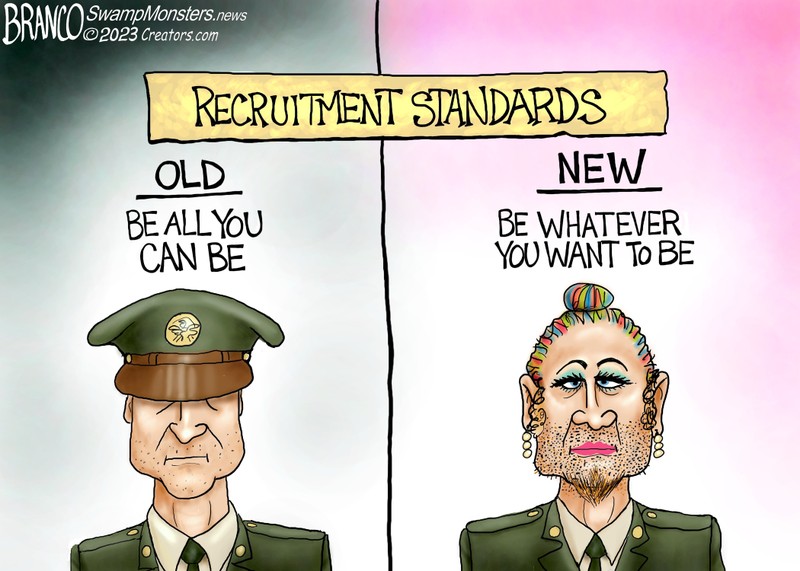
The U.S. Navy confirmed on Tuesday it has discontinued an online recruiting initiative featuring an enlisted drag queen that was aimed at bringing new sailors into the service.
In May, The Daily Caller revealed that the Navy brought on Yeoman 2nd Class Joshua Kelley — an active-duty drag queen who goes by the stage name Harpy Daniels and identifies as non-binary — to be a “Navy Digital Ambassador.” The Digital Ambassador Pilot Program, which ran from October 2022 to March 2023, was reportedly “designed to explore the digital environment to reach a wide range of potential candidates” for military recruitment.
In a letter sent to Sen. Tommy Tuberville, R-Ala., on Tuesday, Erik Raven, the under secretary of the Navy, confirmed that the branch’s Digital Ambassador Pilot Program “will not be continued.”
“The Navy learned lessons from the pilot program that will inform our digital engagement and outreach going forward,” Raven wrote. “Our digital outreach efforts will maintain the important distinction between Sailors’ official activities and their personal lives.”
Tuberville — who sits on the Senate Armed Services Committee — previously sent a letter to Admiral Michael M. Gilday, the chief of Naval Operations, in May, demanding to know the identities of the officers tasked with funding and promoting drag queen shows aboard naval vessels. The letter was sent the same day the Alabama senator and his Republican colleagues submitted a separate communique to Navy Secretary Carlos Del Toro on the branch’s embrace of Daniels and whether Navy leadership is encouraging its “digital ambassadors” and public affairs personnel to use TikTok — which the Pentagon banned its members from using on government-issued devices — “on their personal devices” in order to skirt the agency’s prohibition.
In his Tuesday letter to Tuberville, Raven claimed the Navy followed existing guidelines restricting the use of TikTok and that while some sailors partaking in the digital ambassador program “had [a] personal social media presence on TikTok,” the branch did not issue government devices for purposes of participating in the venture. Raven further contended the branch will “continue to communicate” to its members the “national security risks associated with their use of TikTok on personal devices.”
The Navy’s embrace of Daniels — which generated backlash among many military veterans — comes amid the branch’s failure to meet existing recruiting targets. On Thursday, acting Chief of Naval Operations Adm. Lisa Franchetti confirmed that the Navy is expected to miss its fiscal year 2023 recruiting goals by roughly 7,000 sailors. The revelation came days after the Air Force announced it would miss its “active-duty recruiting goals for the first time since 1999.”
The U.S. Army and Coast Guard are also expected to miss their respective fiscal year 2023 recruiting targets.
MAHE ISLAND, Seychelles — At the height of the Cold War, the U.S. Air Force tracking station that monitored Soviet satellites from this island’s soaring tropical forests was a focus of Seychelles life. The American servicemen and technicians living nearby hosted barbecues and bar nights to which all Seychellois were invited, distributed cookies and milk to local children and taught them basketball.
Then, the Cold War ended, the Soviet Union collapsed and in 1996 the Americans left, dismantling the tracking station and shutting down their embassy — citing budgetary reasons for abandoning what had seemingly become an irrelevant corner of the world.
Today, the compound where Americans and Seychellois partied is home to the Seychelles Tourism Academy, where young islanders training to be tour guides, hoteliers and masseuses take classes, among other subjects, in Chinese — just one small manifestation of a new geopolitical rivalry that has now lured the Americans back.
In June, Seychelles became the latest in a string of small nations around the world in which the United States has established, restored or is planning to open an embassy as part of a broad pushback against the influence China has acquired during more than two decades of neglect or disinterest on the part of the United States.
Two years ago, in 2021, a suicide blast ravaged the streets of Kabul’s international airport, killing 13 American service members.
To this day, the families who lost their loved ones feel President Joe Biden has ignored their pleas for answers on the deadly event. Mark Schmitz’s son, Lance Corporal Jared Schmitz, was killed in the aftermath of the botched U.S. withdrawal from Afghanistan. In a statement to Fox News, he expressed his frustration that Biden has refused to answer whether the bomber could have been counteracted before the attack.
“Nothing yet. In fact, I’ve asked for copies of the SD card footage off of his rifle scope. That would have been recorded, and they would have been able to have that as evidence that this was or was not, in fact, the bomber. That card has been ‘misplaced,’ as they say,” Schmitz replied. “So, I don’t know what the truth is anymore. We can’t seem to get a straight answer out of anybody.”
The father accused Biden of withholding crucial information on the attack that led to his son’s death. On a separate occasion, Schmitz criticized Biden for claiming the botched withdrawal was a success, saying the president refuses to take responsibility for his actions that have caused the country to suffer.
“He’ll never learn from his mistakes; he’s proven that time and time again,” Schmitz said. “He doesn’t even accept responsibility for anything he did. I believe he said that what he did was an ‘extraordinary success.’ He’s the exact polar opposite of a leader.”
This weekend marked the second anniversary of the chaotic withdrawal that caused lives to be forever changed. Despite being one of the darkest days in Biden’s presidency, he has failed to uphold his obligations to Gold Star families.
According to the Daily Mail, the families are accusing Biden of ignoring requests to meet them while demanding him to come forward and admit his mistakes in withdrawing from Afghanistan. The mother-in-law of Marine Sgt. Nicole Gee said, “One of the hardest parts has really been being ignored largely by the administration and official elected officials.”
The parents of Cpl. Hunter Lopez told the Daily Mail that neither the president nor his administration reached out as they mourned the loss of their child. “I would love to sit down with President Biden and have him outline the successes,” one of the parents told the Daily Mail, adding that she believes the Biden Administration did nothing right that day.
Gold Star families are expected to participate in a roundtable hosted by House Foreign Affairs Chairman Michael McCaul (R-TX).
To make it to this level of competition, you have to be really good.
Twelve Soldiers from the U.S. Army Marksmanship Unit will compete in the 2023 International Shooting Sports Federation World Championship in Baku, Azerbaijan August 14 – September 1 as part of USA Shooting’s 40 athlete-team.
The ISSF World Championships includes a number of rifle, pistol and shotgun events where more than 1200 athletes from 101 nations will vie for the title of World Champion in their shooting discipline. It is also an opportunity for shooting sports athletes to earn U.S. Olympic Quotas for the 2024 Paris Games.
Olympic Quotas are essentially tickets, or slots, for a country to compete at the Olympics in a specific event. Each country is eligible for two athletes to compete in each event at the Games.
Currently, USA Shooting athletes have earned 15 Paris quotas. Seven of those quotes were earned at prior international competitions by the USAMU Soldiers stationed at Fort Moore, Georgia.
Amid recruiting shortfalls, the U.S. military is planning a policy change that would make it easier for applicants to qualify for service.
Military applicants taking the Armed Services Vocational Aptitude Battery could soon be allowed to use calculators to help them pass the timed test, which measures aptitude and helps determine the positions in the military one is qualified for.
“We are taking a systematic approach, which will assess the impact of calculator use, and we are developing a way forward for calculator inclusion,” a Pentagon official told Military.com.
The change in the Armed Services Vocational Aptitude Battery, orASVAB, could help relieve an ongoingrecruiting slump, which is attributed to many young Americans not scoring high enough to qualify for enlistment. It would also put the ASVAB on par with how test-taking has evolved in the past decade, with calculators being widely used in math classes and on college entrance exams such as the ACT and SAT. […]
The [recruiting] shortfalls are due to an amalgamation of issues — but at the forefront is a shrinking pool of qualified young Americans, 17- to 24-year-olds, who are eligible to enlist. Many of those applicants are being turned away due to poor performance on the military’s aptitude exam.
Last year, the Army launched its Future Soldier Preparatory Course, a two-track camp for applicants who came just shy of the service’s standards for academic performance or body fat.
There, soldiers have 90 days to come into compliance. The Army can graduate about 12,000 soldiers from that course into basic training, making up much of the recruiting deficit it saw last year with enlistees who otherwise wouldn’t have qualified for service.
The academic track — applicants who struggle to hit education standards necessary for entrance — makes up the lion’s share of that course. (Military.com)
When the use of calculators for the test will be allowed remains to be seen, but already, the move is facing backlash for being yet another example of the “dumbing down” of the military.
Lower scores on the ASVAB test come at a time when the average ACT score fell in 2022 to its lowest levels in 30 years.
The 248-year-old institution that this country depends upon to fight and win our wars has lost its focus, which is, “to win our nation’s wars.” Preparing to do that is one of the most complex tasks on earth. There is no profession more complex, more dangerous, or more crucial to the country’s survival than the United States Army. But its focus on “woke” social solutions has diluted the necessary focus on that duty.
The Army has thousands of magnificent and highly skilled officers and enlisted men and women who perform continuously at the highest levels. Yet, as German General Erwin Rommel said of the British after he captured Tobruk, they are “lions commanded by donkeys.” Today’s donkeys are officers and civilians in the highest levels of the current administration, up to and including the Commander in Chief, Joseph R. Biden and a Secretary of the Army who wants to reduce recruiting from families with a tradition of service because she fears a “warrior caste.” Donkeys indeed. And they set the tone for all their subordinates in the Army.
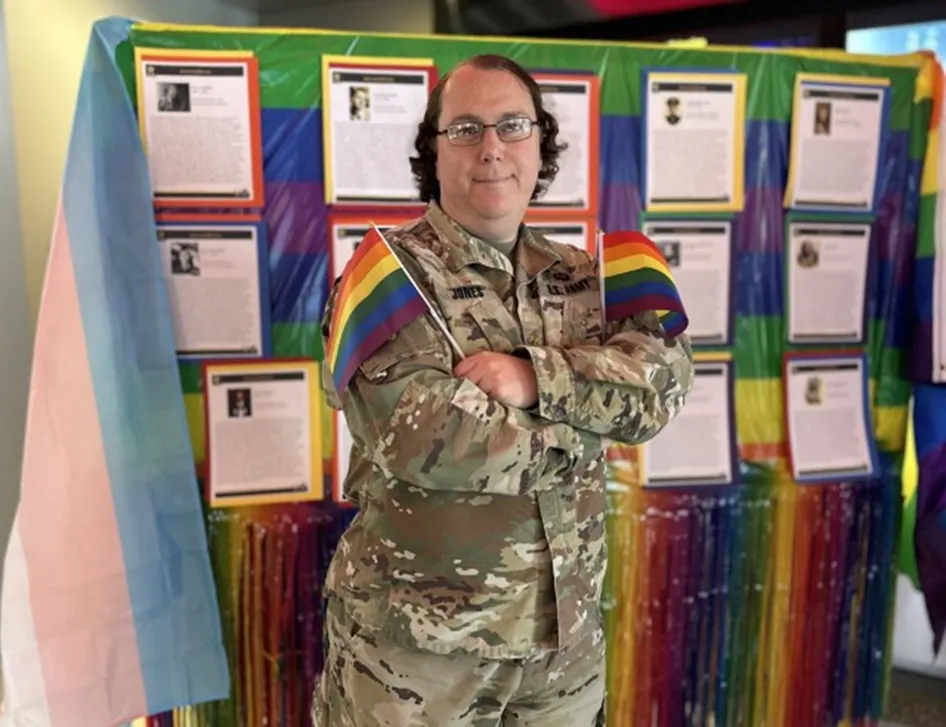
The latest display of the donkeys’ madness is an article on the Army’s official website, lauding another man who claims to be a woman.
U.S. Army photo by Sarah Patterson
The first sentence of the article accompanying the photo pronounces that “Coming out as a transgender female saved Maj. Rachel Jones’ life.” It goes on to describe how an in-the-closet Jones “lived every day deeply depressed and suicidal.” After President Joe Biden lifted the prior ban on transgenders in the military, “Jones was finally able to come out publicly as transgender.” The Army’s article does not state that Jones had any type of so-called “gender affirming surgery,” so presumably “coming out” merely means that he announced that he now prefers to be known as “she.” This allows “her” to “live her truth” and be “so much more comfortable with myself.”
The article claims that any thoughts of suicide are now a thing of the past. It does not explain how an obviously unstable Jones managed to remain in the Army and get promoted to major. Nor does it mention the suicide rate among transgenders who have “come out” or had the life-altering surgery, such as the 30+ year study that concluded that “Ten to 15 years after surgical reassignment, the suicide rate of those who had undergone sex-reassignment surgery rose to 20 times that of comparable peers.”
Now, this author’s quarrel is not with MAJ Jones, who obviously is a person in need of help. No responsible person wishes him or any other human being to suffer depression to the point of potential suicide. No, the proper quarrel is with the donkeys leading the Army who create the command climate that tells subordinates that, in the words of West Point’s Battalion Orders in 1820, Jones is a soldier to be “venerated and emulated.”
FALLS CHURCH, Va. — A federal judge on Tuesday vacated the military conviction of Bowe Bergdahl, a former U.S. Army soldier who pleaded guilty to desertion after he left his post and was captured in Afghanistan and tortured by the Taliban.
The ruling from U.S. District Judge Reggie Walton in Washington says that military judge Jeffrey Nance, who presided over the court-martial, failed to disclose that he had applied to the executive branch for a job as an immigration judge, creating a potential conflict of interest.
Walton noted that former President Donald Trump had strongly criticized Bergdahl during the 2016 presidential campaign. Bergdahl’s lawyers argued that Trump’s comments placed undue command influence on Nance.
Walton rejected the specific argument surrounding undue command influence, but he said a reasonable person could question the judge’s impartiality under the circumstances.
Bergdahl was charged with desertion and misbehavior before the enemy after the then-23-year-old from Hailey, Idaho, left his post in Afghanistan in 2009. He said he was trying to get outside his post so he could report what he saw as poor leadership within his unit, but he was abducted by the Taliban and held captive for nearly five years.
During that time, Bergdahl was repeatedly tortured and beaten with copper wires, rubber hoses and rifle butts. After several escape attempts, he was imprisoned in a small cage for four years, according to court documents.
Several U.S. service members were wounded searching for Bergdahl. In 2014, he was returned to the U.S. in a prisoner swap for five Taliban leaders who were being held at Guantanamo Bay.
The swap faced criticism from Trump, then-Sen. John McCain and others. Both Trump and McCain called for Bergdahl to face severe punishment.
In 2017, he pleaded guilty to both charges. Prosecutors at his court-martial sought 14 years in prison, but he was given no time after he submitted evidence of the torture he suffered while in Taliban custody. He was dishonorably discharged and ordered to forfeit $10,000 in pay.
His conviction and sentence had been narrowly upheld by military appeals courts before his lawyers took the case to U.S. District Court, resulting in Tuesday’s ruling.
The Justice Department declined comment on the ruling Tuesday.
Eugene Fidell, one of Bergdahl’s lawyers, said he was gratified by the ruling and said Walton’s 63-page opinion shows how meticulous he was in rendering the ruling.
Calls and emails to the immigration court in Charlotte, North Carolina, where Nance now serves as an immigration judge, were not returned Tuesday evening.
Thank God that the Joint Chiefs are not in the Chain of Command and are simply ‘advisers’ to the President.
Biden overruled his Sec Defense, who wanted to promote a male admiral with decades of experience in Pacific Ocean strategy, and instead picked a woman with a journalism major…almost certainly so he can say he put the first woman on the Joint Chiefs. https://t.co/2RA41er7rs
— ⓘ Dogs don't have thumbs (@MorlockP) July 22, 2023
It takes a certain amount of brazenness to put the responsibility of defending the nation on a young American and then, in the next breath, demand they forfeit those freedoms they are literally willing to die to protect.
U.S. Sen. Chris Murphy (D-Conn.) is never one to disappoint, though. His latest legislative move is to put a target on the back of every service member as someone who cannot be entrusted to exercise their Second Amendment rights. Military members already sacrifice many of their freedoms to protect the United States. Sen. Murphy, who has never served a day in uniform, doesn’t think that’s enough.
Sen. Murphy thinks Second Amendment freedoms for those in uniform is, well, too much freedom.
Gun control isn’t anything new to Sen. Murphy. He’s made a career of attacking the Second Amendment and the firearm industry. That’s made him the darling of gun control groups but now he’s putting the Second Amendment rights of military gun owners in his crosshairs.
Think about that for a minute. These are the men and women our nation trusts to put a firearm in their hand and stand between our nation and those who wish to do us harm. Sen. Murphy has no problem with that but is proposing these same individuals can’t be trusted with firearms in their personal possession.
Sen. Murphy introduced an amendment to the annual National Defense Authorization Act (NDAA), which empowers our government to fund and support our nation’s military. As a “must-pass” bill, it naturally attracts thousands of amendments for pet projects every year. Most of those are ruled out of order, or not defense related, so they can’t be attached to the bill.
The entire world knows that the United States is low on firepower because President Joe Biden acted on his inexplicable desire to blurt out such information on CNN, telling Fareed Zakaria, “This is a war relating to munitions. And [Ukraine]… is running out of that ammunition, and we’re low on it.”
He also maintained that the shortage was one reason behind the controversial decision to send cluster munitions to Ukraine.
Now the U.S. is scrambling to strengthen stockpiles, according to John Kirby, coordinator for strategic communications at the National Security Council. (By the way, what does that title even mean?)
Appearing with Shannon Bream on “Fox News Sunday,” Kirby described the effort:
We’re working very closely with the defense industry to try to ramp up production, particularly for artillery shells…
You saw that we gave some cluster munitions to Ukraine as a bridging solution here while we ramp up production. We’re having very, very strong conversations with the defense industry and we believe that we’ll be able to get there.
Watch:
WATCH: Part one of our exclusive interview with NSC Communications Coordinator John Kirby on President Biden’s NATO summit and concerns about ammunition shortages. Tune in! pic.twitter.com/lRRHFVpQGM
Bream had brought up a think tank report that estimated it could take years to get back to where we were:
Kirby was responding to a segment reporting that a Center for Strategic and International Studies report found replacing inventories for ammunitions such as 155 mm shells could take between four and seven years. Replacing Javelins could take up to eight years and Stingers up to as many as 18 years, according to the report.
Meanwhile, he has to convince the manufacturers that the administration is in it for the long haul, saying:
The defense industry obviously wants to make sure that if they’re going to increase production, that production rate is going to stay elevated for a period of time. Because that means hiring more workers, it means retooling and adding capacity in their factories and manufacturing capabilities.
So we understand that and that’s sort of the central thesis here of the discussions that we’re having with them, is to get them to increase production and let them know that we’re serious about doing that for some period of time.
RICHMOND, Ky (WTVQ)- A piece of national and world history was made Friday afternoon right here in Central Kentucky when workers at the Blue Grass Army Depot in Madison County destroyed the last of more than 500 tons of chemical agent stored there since the 1940s.
The rockets containing the deadly nerve agent sarin also were the last declared chemical weapons in the United States and the world.
Closure and cleaning up the site will take three or four more years and keep many of the 1500 workers employed. But local leaders already are looking at the opportunities the multi-billion dollar effort offers the army depot and community for the future.
“The workforce here is highly skilled, highly trained, highly security-cleared. They will be looking for work in the next year and a half to two years. We would like to have that work force as an entre’ for corporations that could use those talents to come here. We’re also looking at a number of projects be erected inside the depot fence line that will add to the depots military value and keep it viable,” says Craig Williams, co-chair of the Citizen’s Advisory Board.
The Blue Grass facility is the last of nine across the country and the Pacific Ocean where thousands of tons of obsolete chemical weapons were destroyed since 1990.
Construction of the pilot plant began in 2006. Destruction of chemical weapons began in 2019.
Once the plant is completely closed in 2026, the army depot will continue its mission serving the country.
The U.S. Marine Corps is undergoing its biggest reorganization in decades, slimming down and chopping weapon systems, such as tanks and howitzers, in an effort to become quicker, more agile, and more lethal, while specializing in operating in island chains and coastal areas. It’s all built on the service’s belief that the next war will resemble World War II far more than Iraq or Afghanistan.
In Iraq, the U.S. Marine Corps was virtually indistinguishable from the U.S. Army, operating tanks hundreds of miles inland. This Marines are working to ensure they won’t be used like this again.
After the Cold War, the Marine Corps began to resemble a second American land army; the Marines invaded Iraq over land in 1991 and again in 2003, and were functionally a land army in Afghanistan from 2001 to 2021. While the Marines were successful in this role, it was clear that with an aging U.S. population and rising entitlement spending, defense budgets would soon come under increasing scrutiny. Those inside the Marine Corps believed its role as a second land army would make the service seem redundant, bracing for future cuts.
If the Marines were to survive the coming budget wars, the Marine Corps’ leadership argued, the service would need to be seen as necessary within a well-defined and relevant niche. The result was Force Design 2030, a radical plan to sculpt the Marines to operate against Russia and China in coastal areas, the so-called littorals, and island chains and archipelagos. This included areas such as the Baltic Sea against Russia and the South China Sea against China—both areas where fighting would likely take place if the U.S. and its allies traded blows with Moscow and Beijing. Perhaps most importantly, it is the sort of warfare the U.S. Army has shifted its attention away from, giving the Marines the opportunity to seize it for themselves.
Earlier today, an acquaintance who has a ‘source’ at NOAA had related this: I have a source who shared that NOAA picked up the possible implosion right around the time it disappeared. I was embargoed from sharing that information, but I feel it’s OK to share with you guys at this point and wonder if that will come out in the news conference.
WASHINGTON—A top secret U.S. Navy acoustic detection system designed to spot enemy submarines first heard the Titan sub implosion hours after the submersible began its mission, officials involved in the search said.
The Navy began listening for the Titan almost as soon as the sub lost communications, according to a U.S. defense official.
Shortly after its disappearance, the U.S. system detected what it suspected was the sound of an implosion near the debris site discovered Thursday and reported its findings to the commander on site, U.S. defense officials said.
“The U.S. Navy conducted an analysis of acoustic data and detected an anomaly consistent with an implosion or explosion in the general vicinity of where the Titan submersible was operating when communications were lost,” a senior U.S. Navy official told The Wall Street Journal in a statement.
“While not definitive, this information was immediately shared with the Incident Commander to assist with the ongoing search and rescue mission.”
The Navy asked that the specific system used not be named, citing national security concerns.
SAVANNAH, Ga. — Soldiers of the 9th Infantry Regiment made a desperate retreat as North Korean troops closed in around them. A wounded, 18-year-old Army Pfc. Luther Herschel Story feared his injuries would slow down his company, so he stayed behind to cover their withdrawal.
Story’s actions in the Korean War on Sept. 1, 1950, would ensure he was remembered. He was awarded the Medal of Honor, the nation’s highest military honor, which is now displayed alongside his portrait at the National Infantry Museum, an hour’s drive from his hometown of Americus, Georgia.
But Story was never seen alive again, and his resting place long remained a mystery.
This undated photo shows the late Army Cpl. Luther H. Story. The Army said Friday, May 19, 2023, that the remains of Cpl. Luther H. Story will be buried May 29 at Andersonville National Cemetery near the soldier’s hometown of Americus, Georgia. President Joe Biden announced last month that scientists had positively identified Story’s remains. (U.S. Army via AP)
“In my family, we always believed that he would never be found,” said Judy Wade, Story’s niece and closest surviving relative.
That changed in April when the U.S. military revealed lab tests had matched DNA from Wade and her late mother to bones of an unidentified American soldier recovered from Korea in October 1950. The remains belonged to Story, a case agent told Wade over the phone. After nearly 73 years, he was coming home.
A Memorial Day burial with military honors was scheduled Monday at the Andersonville National Cemetery. A police escort with flashing lights escorted Story’s casket through the streets of nearby Americus on Wednesday after it arrived in Georgia.
Picture shows headstone of Luther Story at Andersonville National Cemetery, Wednesday, May 17, 2023, in Andersonville, Georgia. Army Pfc. Luther Herschel Story was awarded the Medal of Honor after he went missing in battle during the Korean War is being buried on Memorial Day near his hometown in Georgia. Wounded Story was last seen on Sept. 1, 1950, when he stayed behind to cover his infantry unit’s retreat. (Hyosub Shin/Atlanta Journal-Constitution via AP)
“I don’t have to worry about him anymore,” said Wade, who was born four years after her uncle went missing overseas. “I’m just glad he’s home.”
Among those celebrating Story’s return was former President Jimmy Carter. When Story was a young boy, according to Wade, his family lived and worked in Plains on land owned by Carter’s father, James Earl Carter Sr.
Jimmy Carter, 98, has been under hospice care at his home in Plains since February. Jill Stuckey, superintendent of the Jimmy Carter National Historical Park, said she shared the news about Story with Carter as soon as she heard it.
“Oh, there was a big smile on his face,” Stuckey said. “He was very excited to know that a hero was coming home.”
Story grew up about 150 miles (241 kilometers) south of Atlanta in Sumter County, where his father was a sharecropper. As a young boy, Story, who had a keen sense of humor and liked baseball, joined his parents and older siblings in the fields to help harvest cotton. The work was hard, and it didn’t pay much.
“Momma talked about eating sweet potatoes three times a day,” said Wade, whose mother, Gwendolyn Story Chambliss, was Luther Story’s older sister. “She used to talk about how at night her fingers would be bleeding from picking cotton out of the bolls. Everybody in the family had to do it for them to exist.”
Judy Wade, niece of Luther Story, shows memory scrapbook of Luther Story, that her mother put together, Thursday, May 18, 2023, in Americus, Georgia. Army Pfc. Luther Herschel Story was awarded the Medal of Honor after he went missing in battle during the Korean War is being buried on Memorial Day near his hometown in Georgia. Wounded Story was last seen on Sept. 1, 1950, when he stayed behind to cover his infantry unit’s retreat. (Hyosub Shin/Atlanta Journal-Constitution via AP)The family eventually moved to Americus, the county’s largest city, where Story’s parents found better work. He enrolled in high school, but soon set his sights on joining the military in the years following World War II.
In 1948, his mother agreed to sign papers allowing Story to enlist in the Army. She listed his birthdate as July 20, 1931. But Wade said she later obtained a copy of her uncle’s birth certificate that showed he was born in 1932 — which would have made him just 16 when he joined.
Story left school during his sophomore year. In the summer of 1950 he deployed with Company A of the 1st Battalion, 9th Infantry Regiment to Korea around the time the war began.
Judy Wade, niece of Luther Story, points out a Luther Story from a school year book, Thursday, May 18, 2023, in Americus, Georgia. Army Pfc. Luther Herschel Story was awarded the Medal of Honor after he went missing in battle during the Korean War is being buried on Memorial Day near his hometown in Georgia. Wounded Story was last seen on Sept. 1, 1950, when he stayed behind to cover his infantry unit’s retreat. (Hyosub Shin/Atlanta Journal-Constitution via AP)
On Sept. 1, 1950, near the village of Agok on the Naktong River, Story’s unit came under attack by three divisions of North Korean troops that moved to surround the Americans and cut off their escape.
Story seized a machine gun and fired on enemy soldiers crossing the river, killing or wounding about 100, according to his Medal of Honor citation. As his company commander ordered a retreat, Story rushed into a road and threw grenades into an approaching truck carrying North Korean troops and ammunition. Despite being wounded, he continued fighting.
“Realizing that his wounds would hamper his comrades, he refused to retire to the next position but remained to cover the company’s withdrawal,” Story’s award citation said. “When last seen he was firing every weapon available and fighting off another hostile assault.”
Portrait of Judy Wade, niece of Luther Story, with memory scrapbook of Luther Story, that her mother put together, Thursday, May 18, 2023, in Americus, Georgia. Army Pfc. Luther Herschel Story was awarded the Medal of Honor after he went missing in battle during the Korean War is being buried on Memorial Day near his hometown in Georgia. Wounded Story was last seen on Sept. 1, 1950, when he stayed behind to cover his infantry unit’s retreat. (Hyosub Shin/Atlanta Journal-Constitution via AP)
Story was presumed dead. He would have been 18 years old, according to the birth certificate Wade obtained.
In 1951, his father received Story’s Medal of Honor at a Pentagon ceremony. Story was also posthumously promoted to corporal.
About a month after Story went missing in Korea, the U.S. military recovered a body in the area where he was last seen fighting. The unidentified remains were buried with other unknown service members at the National Memorial Cemetery of the Pacific in Hawaii.
Judy Wade, niece of Luther Story, shows memory scrapbook of Luther Story, that her mother put together, Thursday, May 18, 2023, in Americus, Georgia. Army Pfc. Luther Herschel Story was awarded the Medal of Honor after he went missing in battle during the Korean War is being buried on Memorial Day near his hometown in Georgia. Wounded Story was last seen on Sept. 1, 1950, when he stayed behind to cover his infantry unit’s retreat. (Hyosub Shin/Atlanta Journal-Constitution via AP)
According to the Defense POW/MIA Accounting Agency, more than 7,500 Americans who served in the Korean War remain missing or their remains have not been identified. That’s roughly 20% of the nearly 37,000 U.S. service members who died in the war.
Remains of the unknown soldier recovered near Agok were disinterred in 2021 as part of a broader military effort to determine the identities of several hundred Americans who died in the war. Eventually scientists compared DNA from the bones with samples submitted by Wade and her mother before she died in 2017. They made a successful match.
President Joe Biden announced the breakthrough April 26 in Washington, joined by South Korean President Yoon Suk Yeol.
“Today, we can return him to his family,” Biden said of Story, “and to his rest.”