

This is so through the looking glass it's hard to even process. The Left has used the courts to push things they couldn't achieve democratically for decades. Now that's over and most of their anger at the Court now is for its refusal to continue to legislate for them. https://t.co/rO6qp0CIwZ
— Gregg Nunziata (@greggnunziata) May 3, 2023
Category: Politics
THEY WANT A FIGHT
SO LET’S GIVE IT TO ’EM!
It will have been one year on June 23 since the U.S. Supreme Court handed down its landmark ruling in New York State Rifle & Pistol Association v. Bruen and ever since, anti-gun Democrats have been acting like the decision never happened.
A state House representative in Olympia, Wash. may have pegged the reason why during an interview with me back in January. His analysis was matter-of-fact, entirely sensible and a little scary.
The $10,000 Secret
The gun control crowd wants a fight. They are determined to wage a war of perpetual litigation if necessary to have their way — or at least make sure you don’t get your way — at the expense of taxpayers rather than acknowledge they’ve been wrong about the Second Amendment.
Rep. Jim Walsh, from the Evergreen State’s Grays Harbor area along the Pacific Coast has watched them.
“That’s the dangerous thing,” he said about the gun prohibition mindset. “They have a blind spot on this issue. The profound question is whether it’s an ideological position or a political calculation.”
Either way, gun owners cannot allow them to win.
This crap-for-brains is nothing more than petty politics. They’re against it simply because it’s something they see as opposite to their politics
Sen. Bob Menendez (D-N.J.) reintroduced the Help Empower Americans to Respond (HEAR) Act, which would ban the importation, sale, manufacturing, transfer, and possession of gun silencers or suppressors.
Menendez, a founding member of the Senate Gun Violence Prevention Caucus, took to Twitter to tout this gun control effort and in the process proved that he knows very little about that which he seeks to regulate.
“Gun silencers are designed to suppress the sound of gunfire from unknowing victims and reduce the chances they can run, hide, and call the police,” the Democrat said in a statement. “I’m reintroducing the HEAR Act to prevent these deadly devices from making shootings even more dangerous.”
U.S. Rep. Bonnie Watson Coleman (D-NJ) reintroduced the legislation in the House and she was no better informed.
“Silencers are not tools of self-defense, they are tools of murder. They have no legal application, which is why law enforcement officials around the country have called for their elimination,” Coleman said. “The HEAR Act will save lives and is part of the common sense approach to firearms legislation that has widespread support among voters on both sides of the aisle.”
Dana Loesch, a former NRA spokesperson, took to Twitter to call attention to their “level of ignorance.”
“Tell me that you have NO IDEA what silencers do without telling me you have no idea what silencers dSo. Holy wow, this level of ignorance is embarrassing,” she tweeted, before explaining, “They’re literally required for hunting [in] Britain to protect hearing. It merely reduces decibel levels to that of concert PA system. Moron.”
Gabby Giffords says the quiet part out loud
Former Rep. Gabby Giffords saw her political career, as it was going, put to an end by a madman. No one thinks what happened to her was justified, but it happened.
It’s not surprising that she recovered and started a gun control group. I don’t think anyone was overly shocked by that.
However, many of Giffords’ supporters have argued over and over again that people like her respect the Second Amendment, they just want what they term “common sense” gun control.
The problem is that Gabby didn’t get that memo.
As we wrap our interview in her office, I ask how she keeps coming back to a challenge so deeply ingrained in politics. She pauses for 12 pregnant seconds.
“No more guns,” she says.
Ambler, her aide and adviser, tries to clarify that she means no more gun violence, but Giffords is clear about what she’s saying. “No, no, no,” she says. “Lord, no.” She pauses another 32 seconds. “Guns, guns, guns. No more guns. Gone.”
An aide tried to say what she meant was something like Australia, but that’s not what she said.
Further, based on quotes throughout the piece, her mind is sharp enough that if it were, she’d have said it. She didn’t. She never mentioned Australia. No, she said, “No more guns.”
In fact, she apparently said it twice.
What Giffords did was say the quiet part out loud.
We’ve long argued that gun control advocates’ endgame was the complete disarmament of the civilian population. They might not be advocating for that explicitly at the moment, but that’s where the incrementalism was going to invariably lead.
We were called crazy, paranoid, and a few things not fit to print.
Yet here we are, one of the leading voices of the gun control debate–one held up as the perfect spokesperson due to her own personal experiences–saying, “No more guns.”
That puts the Giffords organization in a bad spot. They either agree with “no more guns” or they don’t. No one should accept the claim that the former congresswoman was talking about Australia when she clearly never mentioned it. They need to be pressed and pressed hard over this and any talk of Australia questioned even harder.
They either need to defend Gabby’s comments or disavow them. It’s just that simple.
But they won’t.
Further, it’s not like the media is interested in doing anything except covering for her, as the above-linked Time piece does, just accepting the aide’s explanation as if it’s all that needs to be said. They were given an excuse and they ran with it.
No one else should accept this, though, because either Giffords is cogent enough to speak on behalf of gun control or she’s not. If she is, then her words should be taken at face value as anyone else’s would be.
If not, then she probably doesn’t need to be making the rounds advocating for a policy that she’s not cogent enough to adequately define her position on before a member of the press.
This merely follows Federal Law.
What I always find interesting is that some law that benefits the people, like permitless or shall issue concealed carry, always takes months to become effective, but any criminal law that can be used against a citizen is always effective immediately.
New Indiana law redefines ‘machine gun’ to include conversion switches
A new state law makes it illegal for Hoosiers to attach to their firearms a “switch,” or any similar device, that enables fully automatic shooting with a single pull of the trigger.
Republican Gov. Eric Holcomb approved the revised state definition of “machine gun” in House Enrolled Act 1365 on Thursday after the legislation was endorsed 71-23 by the Republican-controlled House and 45-4 in the Republican-controlled Senate.
Rep. Kendell Culp, R-Rensselaer, and Sen. Lonnie Randolph, D-East Chicago, are the only Northwest Indiana lawmakers to not support the proposal.
The statute took effect upon the governor signing it into law.
Advocates for the measure said the plastic switches, also known as Glock switches, are being purchased or 3-D printed throughout the state and increasingly used to convert regular guns into machine guns — with deadly consequences.
“It’s very difficult to control a firearm with one of these devices attached to it. So our constituents’ homes, businesses, cars and our constituents themselves are being caught in the crossfire,” said sponsor Rep. Mitch Gore, D-Indianapolis.
“These devices allow shooters to fire off dozens of rounds in just a matter of seconds. When police respond to these shootings, they are quite literally being outgunned.”
The mere possession of a switch already was illegal under federal law. The new Indiana law ensures that any person with a switch attached to their gun is subject to a variety of state penalty enhancements for the possession or use of a machine gun.
“As a career law enforcement officer and a representative of a district that has seen several instances of gun violence, I know this bill will save the lives of citizens and cops alike and make our streets safer for Hoosier families,” Gore said.
In a statement, Gore thanked his Statehouse colleagues, especially the strong Second Amendment supporters, for recognizing the importance of holding accountable people who illegally convert their standard firearms into machine guns.
“The significance of passing a piece of bipartisan gun legislation in Indiana is not lost on me,” he said. “I also want to thank Governor Holcomb for signing this bill and helping the General Assembly keep families safe while respecting Hoosiers and their constitutional rights.”
Additional supporters include the Indiana Fraternal Order of Police, Indiana Association of Chiefs of Police, and the Indiana Prosecuting Attorneys Council.
Pence Lays Out Pro-Second Amendment 4-Step Plan to Stop ‘Scourge of Mass Shootings’
INDIANAPOLIS, Indiana — Former Vice President Mike Pence told Breitbart News exclusively here at the National Rifle Association (NRA) annual gathering earlier this month he has a four-step plan that is pro-Second Amendment to combat the “scourge of mass shootings” plaguing society right now.
“I think under the Biden Administration we’ve seen a steady assault on all the God-given liberties enshrined in our Constitution—freedom of religion, freedom of speech—but there’s no question that this administration has set its sights on the Second Amendment enshrined in the Constitution,” Pence told Breitbart News. “Now more than ever people that cherish the right to keep and bear arms need their voices to be heard. We need to elect leaders who will stand by our Constitution and stand by our God-given rights. We need to be educating the rising generation on the importance of all of our Bill of Rights’ freedoms including the Second Amendment, but I think we’ve got to lean into how to address this scourge of mass shootings.”
In his speech the NRA gathering moments later, Pence laid out some of these ideas—but in his interview with Breitbart News backstage he went in depth explaining how gun control does not work and there are policies that American leaders can pursue both at the federal and at the state level that will work.
Does Colorado Show the State ‘Assault Weapon’ Ban Resurgence Starting to Fizzle Out?
Despite enjoying a recent resurgence in deep-blue states, “assault weapon” ban proponents are starting to confront the political and legal constraints to the policy’s continued expansion.
On Wednesday, the Colorado House of Representatives voted to kill a long-awaited proposal to ban the sale of dozens of semi-automatic rifles, pistols, and shotguns with certain targetted features, such as a pistol grip or telescoping stock, in its first committee hearing. Three Democrats joined the four Republicans on the committee in voting to reject the bill, as well as a proposed amendment to limit the ban to just bump stocks.
That an assault weapon ban failed to even make it out of committee in a legislative chamber where Democrats have a supermajority speaks to the tricky politics gun-control advocates still face for gun bans, even in states with trifecta Democratic control. The fact that bills to raise the minimum age to purchase firearms, impose a three-day waiting period, expand who can file a red flag petition, and impose civil liability on the gun industry all easily cleared the Colorado General Assembly this session highlights how much more difficult going after popular guns, such as the AR-15, really is.
A hardware ban is simply a different animal, politically speaking. That fact alone could do a lot to limit the ban’s potential to reach more than a handful of the most progressive-leaning states.
Colorado House panel kills ‘assault weapons’ ban
Four Democrats joined the Colorado House Judiciary Committee’s Republicans to indefinitely postpone the bill.
DENVER — Legislation that sought to ban so-called “assault weapons” died early Thursday morning after three Democrats joined the Colorado House Judiciary Committee’s Republicans to kill the bill on a 7-6 vote.
Shortly before 1 a.m. Thursday, Democratic Reps. Bob Marshall of Highlands Ranch, Said Sharbini of Westminster and Marc Snyder of Colorado Springs voted down the legislation along with their Republican colleagues after a pair of amendments to ban bump stocks and rapid-fire trigger activators were lost.
A subsequent vote to postpone the bill indefinitely drew one additional Democratic vote from Rep. Lindsay Daugherty of Arvada.
The nearly 15-hour hearing, which kicked off Wednesday morning, drew a 2023 record 522 witnesses seeking to testify.
The bill — sponsored by Rep. Elisabeth Epps, D-Denver — has divided the Democrats’ Gun Violence Prevention Caucus, with leading members, such as Sen. Tom Sullivan, D-Centennial, believing other measures, such as his proposal to improve the red flag law, are better solutions to gun violence.
The final reading of the Nebraska permitless carry bill is the first thing on the legislature's agenda for tomorrow: https://t.co/GeE7wCIQbu pic.twitter.com/pv9nj3ro5m
— Firearms Policy Coalition (@gunpolicy) April 19, 2023
There Is Zero Reason For Republicans To Cooperate With Dianne Feinstein’s Request.
There’s zero reason Republicans should cooperate with Schumer and the president on their judicial agenda, either tactically, politically, or even morally.
Sen. Dianne Feinstein is no longer able to perform her duties as a U.S. senator. That is, at least, the reality according to her staff, who asked the Senate majority leader to temporarily replace her on the Judiciary Committee as she approaches two months of absence over health issues.
This isn’t surprising, of course: Dianne Feinstein is 89 years old. While Americans used to joke about the fossils who ran the Soviet Union in the 1980s, Feinstein was already a full decade older than the oldest Soviet premier to ever die in office when she ran for re-election — a full five years ago.
Her mental decline has been known on Capitol Hill for years, with staff guiding her around the halls, and yet still just this year Sen. Chuck Schumer decided to let her remain on the Senate committee responsible for accomplishing the president’s judicial agenda.
She served on that committee until early March. Then finally, after six weeks away recovering from shingles, her California colleague, Rep. Ro Khanna, publicly called for her resignation. Democrats like Khanna had grown weary — between Feinstein and Pennsylvania Sen. John Fetterman, the party’s judicial agenda had been stalled since the top of March.
Hours after Khanna’s tweet, she asked to be temporarily replaced in her duties on the essential committee. Democrats are eager to comply.
But are Republicans so eager? They shouldn’t be. There’s zero reason — zero — that Republicans should cooperate with Schumer and the president on their judicial agenda, either tactically, politically, or even morally.
Republicans have the power, too: Committee assignments are decided at the beginning of the session, either by unanimous consent or, if contested, by the vote of at least 60 senators. Democrats certainly hope they can just brush this through under the former, but what reason does Sen. Josh Hawley, or maybe Sen. Mike Lee, or Sen. J.D. Vance have to let that one pass them by?
Then if one senator says no, the whole thing’s got to come to a vote, and while people like Sen. Mitt Romney might be happy to fill benches with left-wing judges in the name of “decency” or some other principle long ago extinguished by left-wing activists, getting nine other Republicans to join him might prove more difficult.
The task of persuading 10 Republicans to cooperate with the president’s judicial agenda will prove even more difficult if Sen. Mitch McConnell — himself just out of the hospital (and seven years older than Josef Stalin was when he died) — holds the line. While populist conservatives may have little love for the minority leader, they must give him credit for hard-nosed judiciary tactics.
No one’s talking about government funding here, or defense, or some other thing sacred to the old guard of the GOP. At issue is an essentially lawless administration seeding the court with the types of judges who will uphold their lawlessness. Why cooperate in that?
Weak-kneed Republicans might suggest not cooperating with the Democrats on this issue would be poor form or set a bad precedent. Those Republicans might need reminding that mild-mannered Brett Kavanaugh was falsely accused of being a serial rapist in front of the entire country. Poor form? Bad precedents? In the context of today’s political battles, those ideas hold little sway.
And let no man mention “normalcy.”
There are no more “live pairs,” wherein past senators have refrained from voting themselves to give opposing colleagues the courtesy of a necessary absence. That tradition has passed on.
Yes, senators have died in office or resigned mid-Congress before and their replacements have often been accomplished by simple consent, but first, no senator has ever asked to be temporarily replaced, and second, those were normal times. We’re beyond those now; and not only because of Kavanaugh or the sexual accusations against Clarence Thomas or even the religious interrogation of Justice Amy Coney Barrett, but because this Democratic Senate has declined to even deliberate on judicial nominees. There’s been no debate, no regular order, on the White House’s list of new judges — just a simple vote to move them through.
With what evidence can any Republican claim they would be given the same quarter if one of them threw themselves upon their colleagues’ mercy? The party that voted to impeach President Donald Trump twice was disciplined and committed in its opposition to his judicial nominees.
Even today, if left-wing activists and their allies in the press had their way, the courteous tradition of the “blue slip” (which allows senators to hold up nominees from their own states) would be abolished.
Congressional observers might point to the previous Senate, which was tied and so voted to allow for nominees to be discharged from committee even if the vote was locked in a tie, but that rule was agreed to only for that Congress and is no longer in effect. Because of this, Democrats need a majority to work the committee.
Without any procedural normalcy, returned comitatus, or shared judicial philosophies, there are no reasons to continue to cooperate with the president’s judicial agenda. And without Republican collaboration, that agenda will stall.
Politico’s liberal D.C. newsletter, Playbook, predicted Republican intransigence could lead to two different outcomes: pressure for Feinstein’s resignation, or Democrats rallying “to her defense.”
To that, a casual observer of the past seven years of vicious Democratic politics might respond: “let them rally.” The reality is Republicans have nothing to lose from resisting Democrats’ push to replace Feinstein, and everything to gain. This battle is far too deep in the weeds for independent voters to care, Democratic voters are already motivated against Republicans enough, and Republican voters are inclined to reward a little courage in the fight.
The GOP didn’t make this situation: The Democrats put an 89-year-old woman and an emotionally and mentally traumatized man into the U.S. Senate in the name of pure power politics. That play is not working out for them. Republicans can let them rally away, but they’d be fools to let them confirm.
Iowa House votes to let Iowans have guns in parking lots of schools, public buildings
Iowans could keep guns in their locked cars in the parking lots of schools, city and county buildings, state universities and prisons, under a bill passed Wednesday by the Iowa House.
Lawmakers approved House File 654 on a vote of 62-37 after two hours of emotional debate. Most Republicans voted yes but two — Reps. Gary Mohr, R-Bettendorf, and Chad Ingels, R-Randalia — joined Democrats in voting no.
The bill must still pass the Iowa Senate before it can become law.
It’s the latest expansion of gun rights by the Republican-controlled Iowa Legislature, which has passed several laws loosening or repealing gun regulations in recent years, including a 2021 law eliminating the requirement for Iowans to have a permit to carry or possess handguns.
Charged debate on Oregon gun bills reflects national divide
SALEM, Ore. (AP) — An emotionally charged debate over Oregon’s gun-related legislation recently brought lawmakers on different sides of the issue near tears, reflecting a passionate divide over gun rights that is also playing out nationwide.
One of the most sweeping bills being proposed in the politically diverse state — the one that led to highly personal speeches from both Republican and Democratic lawmakers at a committee hearing last week — would increase the purchasing age to 21 for AR-15s and similar types of guns, impose penalties for possessing undetectable firearms and allow for more limited concealed-carry rights.
Republican lawmakers in Oregon said community safety depends on access to firearms, while Democrats conversely called for greater restrictions in the name of safety.
HAHAHAHAHAHAHAHAHAHAHAHAHAHAHAHAH
aaaaaHAHAHAHAHAHAHAHAHAHAHAHAHAHAH
He’s wrongheaded about why – quite normal for a leftist bordering on full commie – but I don’t care as long as they give up and shut up.
The Grim Truth: The War on Guns Is Lost
…..That’s something that people who support gun control measures need to understand: The war is lost. There is no conceivable way for things to change for the better within the next 20 to 30 years, short of a national divorce. There is no way to change hearts and minds of Republicans or the courts. There is no way to change who is in office in most states. There is no way to replace who sits on the courts quickly or change conservative disdain for stare decisis……
Bruen, represent.
Assault weapon ban passes Washington Senate, will go back to House for concurrence
House Bill 1240 bans the sale, manufacture and import of assault weapons in Washington state.
WASHINGTON, USA — A bill that would ban the manufacture and sale of guns defined as assault weapons passed the state Senate Saturday.
The bill bans the sale, manufacture and import of assault weapons in our state. It does not ban the possession of an assault weapon and it allows for ownership by law enforcement and military service members and an exception in cases of inheritance.
House Bill 1240 passed 27-21. Senate Republicans pushed back against the bill with 20 amendments, but as the minority, only two passed.
A floor amendment allows for gun manufacturers to sell inventory already in stock prior to Jan. 1, 2023, and only to out-of-state clientele, for 90 days after the bill goes into effect.
“I wasn’t able to support today’s legislation, because I think that we took away from some of the important things that we need in everyday life, which is additional treatment facilities. We need more mental health available resources for everybody,” said Sen Jeff Wilson, (R ) 19th District, Longview.
Because the bill was amended in the Senate, it must return to the House for further consideration. The 2023 legislative session is scheduled to adjourn on Sunday, April 23.
“We are the only country in the world that grapples with the horror of mass shootings, and today we took a critical step forward — and took the weapon of choice away from those who would do innocent people harm,” said Sen. Patty Kuderer (D-Bellevue) sponsor of the Senate companion bill, SB 5265.
Emily Cantrell, a survivor of the Las Vegas mass shooting, the worst in U.S. modern history now dedicates her life to preventing gun violence and has been fighting for this in Washington State.
“It was surreal. It’s hard to believe that it finally happened and it’s just an overwhelming feeling of joy. Hopefully, it means that other people won’t have their own stories to tell this bill will save lives. It’s been proven and nine other states that have similar bans like this that it will save lives,” said Cantrell.
If the bill receives final passage, Washington will join nine other states and Washington, D.C., in banning assault weapons.
Some advocates against the proposed gun reforms want the Supreme Court of the United States to weigh in on the constitutionality of these bills that will soon become law. SCOTUS, with its 6-3 conservative majority, has signaled its willingness to expand gun rights. In 2022, the court ruled Americans have a right to carry a gun in public for self-defense. Legal challenges are likely if House Bills 1240 and 1143 become law.
House Bill 1240, which passed out the House earlier in March, marking the first time the bill passed off a chamber floor in the Washington Legislature.
A bill that would require a 10-day waiting period and gun safety training for anyone buying a firearm also passed off the Senate floor on Friday, April 7.
House Bill 1143 would prevent a gun dealer from transferring any firearm until the purchaser or transferee provides proof of completion of a safety training program, passes a background check and waits 10 days.
In 2018, Washington voters approved Initiative 1639. That set a requirement of a 10-day waiting period and safety training for people purchasing semi-automatic rifles. House Bill 1143 extends similar measures to all firearm purchases.
The Only Way to Restore the Norms Is to Finish Them Off.
BLUF
For a long time, we had a norm about trying not to prosecute political opponents even when we could. You beat them at the ballot box. But then they got more brazen, and there was no ambiguity about their crimes. They were actual crimes, and they rubbed them in our face. The Felonia Milhouse von Pantsuit toilet server stuff struck a nerve because so many of us knew what a big deal treating classified materials like her husband treated interns is (or was) – if we had done that, we’d be charged and in some fed pen converting large rocks to tiny ones. But she did not get charged. That looming doofus James Comey invented a new legal requirement for the statute that never existed before and never would exist if it was us. And there’s the First Crackhead buying a gun when he’s a drug addict – again, you know that if we lied on a Form 4473 the AFT would be SWATing us in our cribs. They took the sensible norm of reluctance and mocked us with it.
So, let’s not do that anymore. Let’s not bend over backwards to avoid charging our political enemies with their crimes. And if we have to be creative about the crimes and create novel new theories to ensnare our opponents, so be it. Alvin Bragg was creative. That’s the New Rule. Let’s see how they like being served up a dose of that kind of legal suppository.
“BUT THE RULE OF LAW!!!!”
Yeah, what rule of law is that?……………….
Tennessee House Expels Two Democrats Who Led Floor Protest Against Guns.
Tennessee House Republicans made good on their threat to expel two of three Democrats who interrupted the legislative session after making their way to the front of the chamber and using a bullhorn to lead anti-gun chants with the gallery.
It was an unprecedented violation of House rules that Republicans say needed to be punished with the most severe penalty possible to discourage other members from following suit.
Reps. Justin Jones and Justin Pearson were ousted on a party-line vote while a third member, Rep. Gloria Johnson, survived her expulsion vote. Both Pearson and Jones are black while Johnson is white, allowing Democrats to claim that racism was the reason for the members being kicked out. Johnson wasn’t expelled because she wasn’t using a bullhorn when leading chants with the gallery.
Ironically, the two Democrats are likely to be back at work next week. Under Tennessee law, county commissioners will appoint temporary replacements until a special election can be held and are likely to be named. Both expelled legislators are eligible to run in the special election as well.
Thousands of people flocked to the Capitol to support Jones, Pearson and Johnson on Thursday, cheering and chanting outside the House chamber loudly enough to drown out the proceedings.
The trio held hands as they walked onto the floor and Pearson raised a fist during the Pledge of Allegiance.
Offered a chance to defend himself before the vote, Jones said the GOP responded to the shooting with a different kind of attack.
“We called for you all to ban assault weapons, and you respond with an assault on democracy,” he said.
Does anyone believe that if given the opportunity in the future, Democrats won’t continue to disrupt democratic proceedings on the House floor? It’s simple; all you need are a couple of hundred rabid, leather-lunged supporters to cram the galleries and a bullhorn. The prospect of protests without end bringing the people’s business to a standstill because a minority disagrees with a decision of the majority is enough to apply the harshest sentence possible on the guilty.
There are ways to protest and express your disagreement with the majority that don’t involve disrupting the decorum of the chamber or interrupting the business of the House. Jones and Pearson chose to turn the House into gun control theater. What other punishment would have been appropriate?
In Washington, President Joe Biden also was critical of the expulsions, calling them “shocking, undemocratic, and without precedent.”
“Rather than debating the merits of the issue (of gun control), these Republican lawmakers have chosen to punish, silence, and expel duly-elected representatives of the people of Tennessee,” Biden said in a statement.
Pearson and Jones had no intention of “debating” anyone. They were screaming into a bullhorn in order to silence any opposition to their own protest. And there was no gun control bill before the House to debate so what is the old man talking about?
What Biden and the Democrats fail to mention is that there are two sides to the gun control issue and the other side has perfectly legitimate concerns about giving the government too much power in the matter of Second Amendment rights.
Jones and Pearson will be welcomed back as heroes when they return. No doubt they’ll try to pull the same stunt again. And when they do, the rights of the opposition will once again fall victim to the theatrical tactics of the left.
Only state left that only allowed residents to carry without a permit.
Blame the usual dense minded politicians who didn’t want to specifically bar non-residents, but wrote the law such that it did. Hopefully their goobernor will sign it.
NEW: North Dakota Senate passes bill extending permitless carry to non-residents with 44-3 vote, sending it to the governor. https://t.co/k5WFRiN0jk pic.twitter.com/0HSH4de6VP
— Rob Romano (@2Aupdates) April 5, 2023
Cue Captain Renault
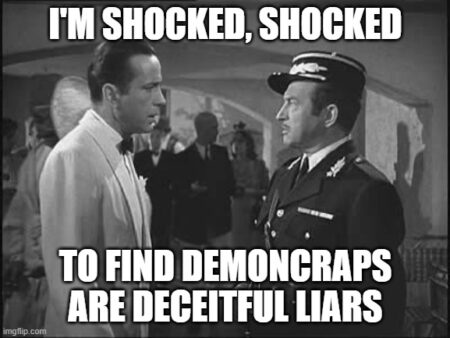
Fact check: Democrats distort the record on guns after Nashville shooting
One week after a shooter opened fire in a Nashville, Tennessee, Christian school and killed six people, including three children, Democrats have continued to press for an assault-style weapons ban they have sought for years.
Democrats accused their Republican counterparts of blocking legislation that would protect children at school from mass shootings, while GOP lawmakers insisted that further limits on gun ownership would not have stopped the Nashville attack or others like it.
And while Democrats still don’t have the votes yet to advance an assault-style weapons ban, they have relied on occasionally misleading rhetoric to push for one anyway.
Here is a fact check of some of the latest Democratic gun arguments.
“[We’ve had] more school shootings than days in the year so far in 2023.” — Sen. Chris Murphy (D-CT), CBS’s Face the Nation, April 2
This is a misleading claim from Murphy.
The Connecticut Democrat has long served as a voice for gun control advocacy due to the painful history of his home state, where a school shooter claimed the lives of more than two dozen people, most of them children under 7 years old, in 2012. Murphy was the congressman representing the district of the school at the time.
He appeared to cite statistics from the K-12 School Shooting Database, a data resource compiled by the Violence Project.
That database claims 95 shooting incidents have taken place at schools so far in the 93 days of this year.
But the claim is misleading because of just how broadly the group defines a shooting incident. The total includes any incident “when a gun is fired, brandished (pointed at a person with intent), or bullet hits school property, regardless of the number of victims, time, day, or reason,” according to the Violence Project.
That means, for example, that a gang-related shooting near a school during which a bullet strikes a sidewalk on a weekend, with no students present, would still count toward the total number of school shootings for the year.
Most people would provide a very different definition of a school shooting, and the type of shooting that occurred in Nashville is much rarer. According to the same dataset, only 105 school shooting incidents since the 1970s have involved “indiscriminate shooting.”
Colorado: Assault Weapon Ban Pulled from Committee Agenda
Earlier this week, the House Judiciary Committee pulled House Bill 23-1230 (“HB 23-1230”) from the agenda thanks to the strong opposition of NRA members and Second Amendment supporters. The committee received thousands of messages opposing HB 23-1230, a bill that bans the manufacturing, importing, purchasing, selling, offering to sell, or transferring ownership of what the drafters have defined as an “assault weapon.” No hearing is scheduled at this time, but the fight is not over yet. They are still likely to take action on this bill at some point this session, so we must remain vigilant!
Democrats’ Knee-Jerk Gun-Control Demands Ignore The Most Basic Facts About Human Nature
The difficult truth is, stopping these shootings is not just a matter of policy — it’s a matter of the heart.
The elementary school shooting in Nashville, Tennessee, is a tragedy no community should ever have to endure. As fathers, our hearts break for those innocent children and their parents, as well as the brave and selfless teachers. The heroic police officers, who sprang into action with total disregard for their own safety, saved countless lives. The shooter, whose name should not be made famous by the media, reminds us there is evil in this world, that every moment with our families is precious, and that something in our country must change.
Unfortunately, the radical left has once again rushed to demand new laws and policy changes that would have done nothing to stop this tragedy — or any tragedy.
The renewed call to expand background checks to cover even private gun sales between friends and family members ignores the fact that most mass shooters who bought guns legally — including radical Islamic terrorists — passed background checks anyway. And no law will stop criminals from getting guns illegally by stealing them or acquiring them on the black market, because they’re criminals.
The Nashville tragedy has also reignited calls to implement so-called “red-flag laws” in which American citizens can have their firearms confiscated without due process, even as a result of baseless accusations or innuendo. Research shows such laws have no effect on violent crime, and it’s possible they could actually increase suicide rates by making troubled individuals fear discussing their issues with friends or family members because their ability to defend themselves and their loved ones could be taken away.
All 50 states already have laws on the books — often referred to as “Baker Act” statutes — regulating how to handle individuals who could be a danger to themselves or others and allowing medical professionals to intervene when necessary. In the case of the Nashville shooter — a transgender-identifying 28-year-old reportedly receiving treatment for mental illness — if police had been made aware that the shooter was hiding guns, they said they would have seized them.
As with so many similar tragedies, the cowardly Covenant School shooter chose a soft target, shooting through the school’s locked doors and counting on it taking time for armed law enforcement to respond. In fact, police said the shooter had mentioned another potential target, “but because of threat assessment by the suspect, too much security, they decided not to” attack it.
If you think criminals don’t consider this when planning an attack, then you haven’t read last year’s Buffalo, New York shooter’s manifesto in which he wrote that areas where concealed carrying of a weapon is “outlawed or prohibited may be good areas of attack” and that “areas with strict gun laws are also great places of attack.”