John Cornyn learns not to mess with Texas

“Don’t mess with Texas” is a homespun aphorism that expresses a genuine sentiment. Texans, and to a slightly lesser degree, Wyomingites, are independent cusses. They’re proud of their states and their beliefs, and pushed too far don’t whine about why government isn’t making things right. They handle it themselves and vote the useless weasels out at the next electoral opportunity.

One such weasel is long-serving Texas Senator John Cornyn. Once thought a reliable Republican, he forgot which state he represents and stepped on a known Texas land mine: gun control. In Texas, weakness on the Second Amendment and cruelty to animals are two things among many guaranteed to provoke political death. Cornyn was thought among the most untouchable politicians in Texas until he went wobbly during the Biden’s Handler’s years and crossed the aisle to pass a 2022 gun control bill, the “Bipartisan Safer Communities Act (BSCA).” Cornyn wasn’t the only line crosser, but he crossed a Texas line, which Texans don’t forget or forgive. The Garland DOJ bragged about it in 2024:

June 25 marks the second anniversary of the enactment of the Bipartisan Safer Communities Act (BSCA) – a landmark law focused on reducing and protecting communities from gun violence. The Justice Department has pursued a cross-department approach with the new tools provided in BSCA, from enhanced background checks to grantmaking.


Accordingly, Cornyn is being primaried by Texas AG Ken Paxton, who has been leading Cornyn in the polls. As one might imagine, the media are doing all they can to try to negate Paxton’s lead. Both are Republicans, but they hate Paxton more:

The TSU poll shows Paxton leading Cornyn in a two-person Republican primary race by 5 percentage points. A similar poll conducted by TSU in May found Paxton leading by 9 percentage points.

“Cornyn has substantially narrowed the gap both related to our prior surveys but especially related to many of the surveys that were circulating earlier in the summer that had him down by 10, 15, 20 points or so,” said Mark Jones, a Rice University political scientist who co-directed the study.

Paxton has a variety of personal and professional issues dogging him, but that anyone could be so far ahead of Cornyn is a reflection of how ticked off Texans are. This kind of politically convenient memory lapse isn’t helping:

Cornyn apparently forgot the Internet, including his own website, is forever:
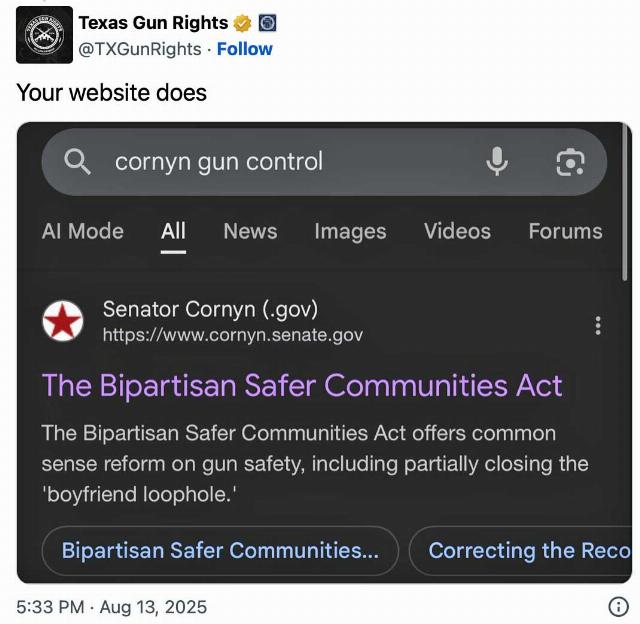
 

Shooting News Weekly’s headline is pertinent:  “Is John Cornyn Cognitively Impaired Or Is He Just Lying About His Role in Passing Biden’s Gun Control Bill?”

I can’t vouch for cognitive impairment, but lying? As Texans might say: yup. They’re not fond of that either.

Texas Senator John Cornyn shocked gun owners across the country this week after denying any involvement in helping pass Biden’s signature gun control bill—the Bipartisan Safer Communities Act (BSCA)—despite his well-documented leadership role in getting it across the finish line in 2022. [skip]

The backlash was immediate and fierce.

“Perhaps at 73, Cornyn is starting to share more than just policy blunders with Biden,” said TXGR President Chris McNutt. “That creeping forgetfulness might explain why he’s also in denial about those abysmal polls showing AG Paxton wiping the floor with him. Texas Gun Rights is happy to remind Cornyn — and all pro-gun Texans — of his blunders.”

Just how mad are Texans at Cornyn?  This mad:

Cornyn was booed by more than 8,000 delegates at the 2024 Texas GOP convention, and now faces rising grassroots opposition heading into the 2026 Republican primary. Both Texas Gun Rights PAC and National Association for Gun Rights PAC have already endorsed Paxton for U.S. Senate.

“Gun owners don’t forget betrayal,” said McNutt. “And they’re ready to make sure Cornyn never forgets 2026.”

Plenty can happen between now and the mid-terms, but Cornyn damned well knows how badly he screwed up and he’s fiercely backpedaling, trying to look like a solid Republican. Texans aren’t going to forget, and it looks like they’re not in a forgiving mood. If Trump endorses Paxton, Cornyn is likely toast and it will be his own fault.
 

Well, he’s nothing but a stooge, grandstanding again.

Murphy Tries to Re-Impose (and Hike) NFA Taxes After Congress Zeroed Them Out

We’ve been reporting on a rider inserted in the House Financial Services and General Government appropriations bill that would force Washington, D.C. to recognize valid concealed carry permits from all U.S. states and territories (as well as end the District’s “no guns allowed” policy for public transportation, but pro-gun Republicans aren’t the only ones trying to use the appropriations process to change gun laws.

Murphy’s trying to insert a rider into the Military Construction, Veterans Affairs, and Related Agencies appropriations bill with language to undo the NFA reform included in the OBBB and instead raise the transfer tax on NFA items from $200 to $4,709 for each transfer.

As Brady indicates, the nearly $5,000 that Murphy wants to impose essentially indexes the original $200 transfer tax imposed in 1934 to the rate of inflation over the past 90 years. Still, that’s much higher than what we’ve heard proposed from other anti-gun Democrats in Congress, who’ve talked about tripling the $200 tax once they have hte numbers to do so.

And therein lies the problem for Murphy. He can propose any kind of tax increase he wants, but he basically has zero chance of seeing his proposal included in the MCVARA appropriations bill (which has already passed the House). The Republican majority that voted to zero out transfer taxes on suppressors, short-barreled firearms, and “any other weapons” a couple of weeks ago isn’t going to turn around and vote in favor of dramatically hiking the taxes instead.

Murphy’s offered a couple of other amendments to the appropriations bill as well.

Amendment 2972 would require the Secretary of Veterans Affairs to issue a quarterly report on “the number of veterans who should have been reported to the national instant criminal background check system… if such reporting by the Secretary was permitted, and of those veterans, the number of suicides by firearm that occurred in the previous quarter”.

That amendment is a response to another rider that would extend the VA’s prohibition on submitting the names of those veterans who’ve had a fiduciary appointed to handle their affairs to NICS.

A temporary provision in the Consolidated Appropriations Act of 2024 and its extensions (including the Full-Year Continuing Appropriations and Extensions Act of 2025) prohibited the VA from making these NICS reports without a judicial finding. That provision, though, is set to expire on September 30 unless Congress includes similar language in this year’s appropriations bill.

And Congress has included that language. Section 412 of the MCVARA bill states:

None of the funds made available by this Act may be used by the Secretary of Veterans Affairs under section 5502 of title 38, United States Code, in any case arising out of the administration by the Secretary of laws and benefits under such title, to report a person who is deemed mentally incapacitated, mentally incompetent, or to be experiencing an extended loss of consciousness as a person who has been adjudicated as a mental defective under subsection (d)(4) or (g)(4) of section 922 of title 18, United States Code, without the order or finding of a judge, magistrate, or other judicial authority of competent jurisdiction that such person is a danger to himself or herself or others.

Murphy’s also offered an amendment that would simply strike that language from the appropriations bill so that veterans who’ve had a fiduciary appointed to help manage their financial affairs to be deemed a prohibited person without a judicial finding of dangerousness.

I doubt those amendments are going to fare any better than Murphy’s attempt to jack up NFA taxes by more than 2,000 percent, but gun owners should still be in contact with their Senators to encourage their opposition; both to these amendments and any others that would negatively impact our Second Amendment rights that might be introduced by anti-2A senators.

NC Senate will vote to override Stein’s vetoes on concealed guns, DEI and immigration next week

Republicans in the North Carolina Senate will vote to override Gov. Josh Stein’s vetoes next week, Senate leader Phil Berger (R-Rockingham) said Monday.

The governor, a Democrat, has issued seven vetoes on bills that originated in the Senate. Among them are one to allow permitless carry of handguns, two new immigration enforcement measures, two banning diversity, equity and inclusion practices in schools and a rollback of an emissions goal for Duke Energy.

Berger, in a news release, said Stein’s vetoes indicate “that he is out of touch with the people of North Carolina.”

“I look forward to leading Senate Republicans in overriding these harmful vetoes and putting North Carolina families first,” Berger said.

Veto overrides require approval from three-fifths of members in both chambers. Senate Republicans, who hold a 30-20 veto-proof supermajority, will meet that threshold if all members are present and voting.

The vote counting is more precarious in the House, where the GOP holds a 71-49 advantage. Speaker Destin Hall (R-Caldwell) has said the override motions can be called up at any time when the House is in session. But all Republicans, as well as one Democrat, will need to vote yes to confirm an override, if all members are present and voting.

Stein has also vetoed several prominent House bills. Those include a ban on DEI within state agencies and a bill that recognizes exclusively male and female sexes and restricts changes to birth certificates for transgender people. If the House overrides Stein’s vetoes on those bills, they will go to the Senate for final action.

Both chambers are set to come into session next week.

Musk’s ‘America Party’ Long on Exploiting Disgruntlement, Short on Specifics for Gun Owners

“If this insane spending bill passes, the America Party will be formed the next day,” Elon Musk posted on X. “Our country needs an alternative to the Democrat-Republican uniparty so that the people actually have a VOICE.”

The bill has passed, and many MAGA supporters, particularly activist gun owners, are feeling betrayed, angry, and demoralized after a perceived commitment to remove suppressors and short-barrel firearms from the purview of the National Firearms Act was rejected by the Democrat Senate Parliamentarian. That’s because the rebuff was not overruled by Republican Senate Majority Leader John Thune with administration backing by Vice President/President of the Senate JD Vance.

Instead, despite previously using procedural tricks to get around the Parliamentarian on California’s electric vehicle mandate, Republicans allowed the NFA ruling to stand, settling for no fees but leaving the registration requirement intact. And sentiments from some disgusted gun owners, feeling like they’d been sold a bill of goods — including by “gun rights leaders” portraying GOP fecklessness as the “next best win” — indicate receptivity to a third-party alternative at a time when critical midterms are fast approaching.

One prominent influencer went so far as to equate the “great victory” with D-Day (disregarding that over 100,000 American soldiers were killed in action in the European theater after the Normandy invasion up to the end of the war in Europe). One of the best rebuttals is in a comment by NRA Board reform member Dennis Fusaro, with this perceptive observation that too few are making:

“[W]hat was lost was the opportunity to build grassroots political power and an outside movement that tells the politicians what they must do for us. And that is the winning long-term strategy. It was the opportunity to educate the Republicans  – ‘our friends’ – how to behave, but now instead the Republicans have ended up educating us how to behave telling us what we must settle for in terms of policy.”

Continue reading “”

Women for Gun Rights Takes The Fight To Washington D.C.

Women for Gun Rights (WGR), a pro-Second Amendment organization formerly known as The DC Project, has taken its fight to the capital, with representatives from over 40 states descending on Washington, D.C., to advocate on behalf of what is arguably the fastest-growing demographic of gun owners in America: women.

WGR refers to these events as “Fly-Ins,” and this particular Fly-In, which took place on June 22, was the most successful to date, according to the group. The event looked nothing like the rabid, masked, sloppy, violence-ridden “mostly peaceful protests” from the left, however, as these proud patriots came with a focused and cogent agenda. That plan included equipping women to lead in the fight for their rights through a comprehensive training conference meant to empower them with the clarity, credibility, and confidence necessary to effectively advocate for the God-given liberty recognized and enshrined in the United States Constitution.

The conference, rooted in education rather than setting fires and looting, covered Second Amendment history, legislation, and major court rulings that have shaped the gun rights landscape into what it is today. It also included training in how to communicate effectively with those who have yet to become familiar with firearm ownership, and lessons on digital advocacy, enabling them to combat the rampant misinformation spread by politicians, the media, and the sycophantic sheep who can’t bother to take part in civil discourse and would rather be marched into their own demise like well trained cattle.

Continue reading “”

This is the closest anyone has ever gotten to undoing much of the NFA. I don’t get how gun rights groups are responsible for the GOP refusal to fire or overrule the Parliamentarian (which affected much more than just this issue). They clearly pushed for that, hard. Given they couldn’t get it, they took the consolation prize of zeroing the tax, which itself would be the only blow against the NFA that has ever landed. That isn’t selling anyone out.

Nobody was “gaslit.” The plan was originally just to zero out the tax. Progun groups pushed for (and got) scrapping of registration too in the House’s bill. They took a big swing, but got screwed by the Democrat Parliamentarian and the GOP’s refusal to stop her. I’m not mad at them for trying.

You should be demanding of the groups you support, I don’t begrudge anyone that. But at the same time, I think a lot of grifters who have never accomplished anything of note are taking cheap shots right now with bs accusations.

The author’s last paragraph makes a valid point. The only reason the NFA & NFRTR (the registry) was found to be legal – and by SCOTUS first in 1937 and several times later in cases that followed – was that Congress had the power to tax and the registry was ‘simply’ to confirm that the tax had been paid, or was covered under one of the very few exemptions.

Here’s the deal. Back in 1986 with the Firearms Owners Protection Act, an actual ban on a gun registry was included. 18 U.S. Code § 926 (a) (3) :

No such rule or regulation prescribed after the date of the enactment of the Firearms Owners’ Protection Act may require that records required to be maintained under this chapter or any portion of the contents of such records, be recorded at or transferred to a facility owned, managed, or controlled by the United States or any State or any political subdivision thereof, nor that any system of registration of firearms, firearms owners, or firearms transactions or dispositions be established.

What with the adjudicated reason making the NFRTR avoid the ban eliminated by law, my bet is that within weeks, if not days after the law-if passed-goes into effect, some people in several of the different court circuits will file suit that the tax free part of the NFRTR is illegal, per that

New Senate Budget Language Would Scrap Taxes on Suppressors, Short Barrel Firearms

After Senate Parliamentarian Elizabeth MacDonough ruled that the language repealing the taxes and registration requirements for NFA items like suppressors, short barreled firearms, and “any other weapons” could not be included in the One Big Beautiful Bill, Sen. John Cornyn (R-TX) and others quickly floated an alternative: zeroing out the making and transfer taxes, while keeping the registration requirements in place.

That language has now been included in the text of the budget bill that’s slated for a preliminary procedural vote in the Senate later today (you can find it on page 491).

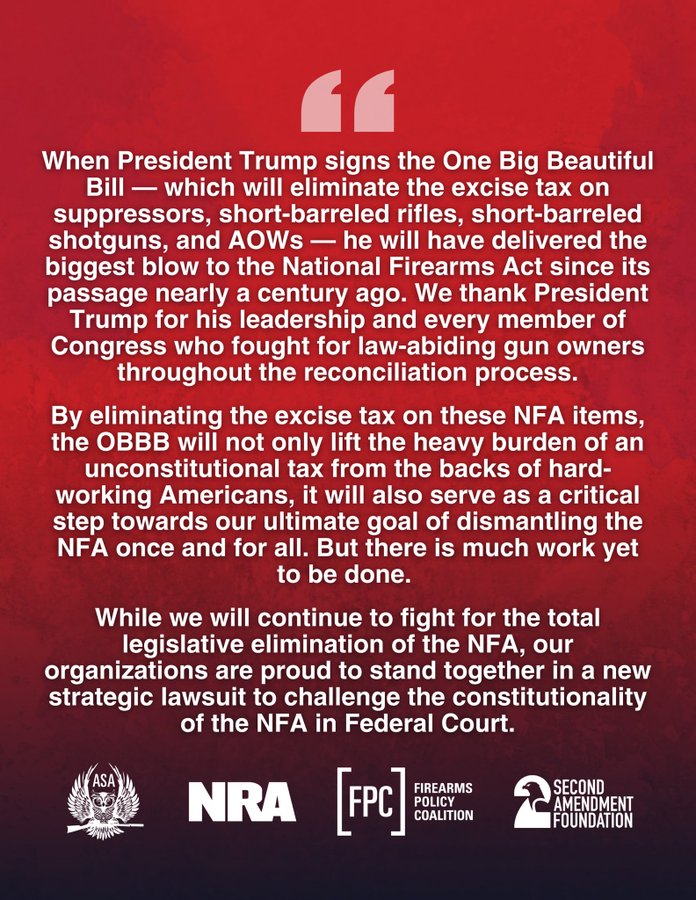
The new language would zero out the making and transfer taxes on suppressors, short barrel rifles and shotguns, as well as “any other weapons”, which should satisfy the demands of Second Amendment organizations NRA, GOA, SAF, FPC, American Suppressor Association, F.A.I.R. Trade Group, and the National Association of Sporting Goods Wholesalers; who released a joint statement on the reconciliation bill Friday night.

The American Suppressor Association, Gun Owners of America, Firearms Policy Coalition, Second Amendment Foundation, National Rifle Association, National Association of Sporting Goods Wholesalers, and F.A.I.R. Trade Group strongly disagree with the weaponized procedural maneuvering used by the unelected parliamentarian to block the removal of suppressors and short barreled firearms from the NFA tax scheme in the One Big Beautiful Bill.

Unless the Senate chooses to overrule her egregious decision or the Senate Majority Leader removes the existing parliamentarian, which is well within their rights, immediate action must be taken to ensure law-abiding Americans are able to exercise their Second Amendment rights without the draconian NFA tax.

Though not the full tax repeal it should have been, there is still an opportunity to use well-established precedent to lower the NFA’s unconstitutional excise tax on suppressors and short-barreled firearms to zero dollars.

Our organizations stand united on behalf of millions of law-abiding gun owners in calling on Congress to immediately make this revision. This is a critical step in our fight against the unconstitutional NFA tax scheme and for the rights of all Americans.

Democrats will undoubtably object to the new language as well, and MacDonough will have to make another ruling once the bill hits the Senate floor, but folks I’ve spoken with on the Hill and within the 2A community have expressed confidence that by limiting the language solely to taxation and leaving the registration requirements in place the parliamentarian will rule in favor of the amendment.

Some groups, including Gun Owners of America, are still calling on MacDonough to be fired or overruled by Senate Majority Leader John Thune.

Thune has repeatedly said that isn’t going to happen, and over at The Reload, Stephen Gutowski has a pretty good explainer about why the Senate Majority Leader isn’t likely to oust MacDonough, even with some Republican senators demanding she be fired.

Gutowski’s piece is behind a member’s paywall, so I’d encourage you to subscribe to The Reload and read the entire piece for yourself, but the gist of it is this line:

To many in the Senate, firing or overruling the parliamentarian during reconciliation is akin to ending the filibuster. If you can nuke the parliamentarian on one question in this process, you can nuke them on any. What goes around comes around, or so the thinking goes.

If MacDonough was fired or overruled in order to repeal the taxation and registration requirements for NFA items with just 51 votes, Republicans would be giving Democrats the precedent to expand the NFA the same way the next time they have control of the chamber. Imagine AR-15s and other semi-automatic firearms treated like machine guns, and large capacity magazines treated like suppressors, all because there were 51 Democrats willing to include that language in a budget bill.

That’s just one 2A-specific example, but there would likely be dozens of items on the Democrats’ wish list that would be enacted by disregarding the parliamentarian when they’re in charge. It’s the same rationale for keeping the filibuster in place: what goes around comes around, and any short-term advantage to destroying the filibuster or the tradition of adhering to the parliamentarian’s rulings wouldn’t be worth the long-term damage.

Thune could bend to the demands and dismiss MacDonough or decide her rulings don’t matter, but I really don’t think that’s likely. And if he did do that, we could see provisions that 2A groups don’t like get inserted back into the One Big Beautiful Bill; like the language that would require courts to impose financial bonds before issuing temporary restraining orders or preliminary injunctions against the federal government, which would cripple the ability of Second Amendment groups and individuals to file lawsuits challenging federal gun laws.

I still think MacDonough’s ruling was ridiculous given that the registration aspect of the NFA is directly tied to the taxing elements. But if the tax goes away, the same coalition that issued its statement on Friday night could always try to challenge the NFA registry in court, arguing that it’s no longer necessary or even moot once the taxes have been zeroed out. It might take a little longer, but we could see the registration requirements disappear… so long as the narrower language survives a second round of parliamentarian scrutiny.

Well, apparently we were misled earlier.
The partisan hack demoncrap appointed parliamentarian says that a tax law (so specified as such by the writes back in 1934 and so ruled as such by SCOTUS themselves isn’t a tax law that can be dealt with under reconciliation.

End to Taxes, Registration on Most NFA Items Faces a Weekend Byrd Bath

Donald Trump has said he wants to see his One Big Beautiful Bill hit the Resolute desk in the Oval Office by July 4th, and though it remains to be seen whether Republicans in the House and Senate will be able to meet that deadline, Senate Majority Leader John Thune has set an aggressive schedule in the upper chamber, with a goal of having the full Senate cast its first procedural vote on the bill by the middle of next week.

For gun owners, the biggest question is whether the language removing the tax and registration requirement on suppressors, short-barreled firearms, and “any other weapons” will survive the Senate parliamentarian’s scrutiny of the bill. Politico reports the Byrd bath, as it’s colloquially known, will begin in earnest this weekend.

Senate rule-keeper Elizabeth MacDonough is scrubbing the final draft of the megabill in a “big beautiful” Byrd bath. Her rulings on which provisions will fly under the filibuster-skirting budget reconciliation process are expected to roll in through the middle of next week, when Thune wants to schedule the first procedural vote related to the package.

Republicans are bracing for an answer to one consequential question they punted on earlier this year: whether they can use an accounting maneuver known as “current policy baseline” to make it appear that extending Trump’s 2017 tax cuts would cost nothing.

Senate Finance Republicans and Democrats will make a joint presentation to MacDonough this weekend about which provisions to keep or scrap. And there’s no shortage of GOP priorities under Byrd scrutiny — from tax cuts on certain gun silencers to a plan to raise taxes on foreign companies known as the “revenge tax.”

Other outstanding issues before the parliamentarian: whether Commerce has to tweak language to prohibit states from regulating AI over the next decade; whether Judiciary can block judges’ ability to issue preliminary injunctions; and whether Agriculture can use the megabill to pay for pieces of the stalled farm bill.

Punchbowl News reports that Democrats are planning on challenging about 60 provisions in the text offered by the Senate Finance Committee, and the language that would remove the taxation and registration requirements for most NFA items is among their their targets. Supporters of the language have expressed confidence that the measures will survive the Byrd Bath, with Rep. Andrew Clyde of Georgia telling Fox News that the “taxation and registration of firearms under the draconian NFA are inseparably linked,” and therefore should easily fit within the reconciliation guidelines.

Over at The Reload, Stephen Gutowski isn’t quite as confident. Gutowski notes that while the Senate language is more expansive than what was approved by the House, which only dealt with suppressors, it’s likely more “vulnerable to an adverse ruling from the parliamentarian” because the language from the Finance Committee doesn’t separate the elimination of the tax requirement from the provisions delisting the NFA items.

On Friday morning, Politico reported that MacDonough has given the thumbs down to several pieces of the Senate Banking Committee’s OBBB language, including measures meant to “zero out funding for the Consumer Financial Protection Bureau, slash some Federal Reserve employees’ pay, cut Treasury’s Office of Financial Research and dissolve the Public Company Accounting Oversight Board.” Hopefully that’s not a sign of things to come when the parliamentarian takes her red pen to the Finance Committee’s language this weekend.

In his piece, Gutowski also brings up a long-term issue with using reconciliation to remove items from the NFA. If the parliamentarian gives the green light to changing the NFA through a budget bill, there would be nothing to stop Democrats from using the same maneuver to put items onto the NFA list of restricted items, and even jack up the taxes beyond the $200 currently required. Imagine a budget bill that raises the NFA tax to $400, $600, or even $1,000, while also placing AR-15s and other semi-automatic long guns on the list of restricted firearms.

I don’t think that is reason enough for Republicans to back down and voluntarily strip these provisions from the OBBB, but it’s something to keep in mind, and it’s another reason why the various lawsuits challenging aspects of the NFA are still incredibly important. There aren’t enough votes in the Senate to fully repeal or even modify the NFA in a standalone bill, but if we can weaken the NFA through litigation it will be far more difficult, if not impossible, for Democrats to use future budget bills to raise NFA taxes or add to the list of restricted arms. If MacDonough rules the NFA language out of order, we won’t have to worry as much about Democrats using reconciliation to impose new gun controls, but the ongoing litigation will become an even more important tool for Second Amendment advocates to use against the NFA going forward.