
BLUF:
From what I can gather, the problem in cities is usually not that the police department itself is unwilling to assist, but that they are under orders from the mayor, afraid of upsetting far left constituents, to stand down.
Well, of course that’s what’s going on. Police usually do exactly what their city’s management tells them to do. Geez……
DAVID BERNSTEIN
Hans Bader on Selective Law Enforcement
Police in some major cities are refusing to enforce the law against protest “encampments”
I have been increasingly aware of, and disturbed by, instances of local police declining the requests of universities to help the universities–which generally do not have law enforcement officers capable of dealing with hundreds of people resisting arrest–arrest protestors and remove their protest encampments. I was preparing to write a blog post about this, but Hans Bader beat me to it. So rather than reinvent the wheel, with permission, below is a shortened version of Hans’ post:
You have a right to free speech, but that doesn’t give you a First Amendment right to camp out on my lawn with protest signs. That’s trespassing. But government officials sometimes allow trespassing when they sympathize with the trespasser’s viewpoint. Baltimore, Philadelphia, and Washington, DC have refused to remove progressive anti-Israel protesters camping out at private universities — Johns Hopkins University, the University of Pennsylvania, and George Washington University.
Law professor David Bernstein notes that “Baltimore police will not assist in removing illegal encampment at Johns Hopkins University. Worse, they actually praise the illegal encampment as a valid exercise of First Amendment rights, which is complete nonsense. It’s especially nonsensical because most of the protesters are trespassers with no connection to the university.”
“The City of Baltimore strongly stands with every person’s First Amendment rights. Barring any credible threat of violence or similarly high threshold to protect public safety, BPD currently has no plans to engage solely to shut down this valid protest or remove protesters,” said the Baltimore police department in a statement apparently dictated by the mayor’s office.
Contrary to what this statement claims, there is no “First Amendment” right to camp out on public property, much less private property like the campus of Johns Hopkins University, which can tell trespassers to leave regardless of whether they are engaged in First Amendment activity. Camping out on someone else’s property is not a “valid protest,” even if the protesters have not yet made any “threat of violence.” The Supreme Court ruled that protesters do not have a right to camp out even on public property devoted to public use, like national parks, in Clark v. Community for Creative Non-Violence (1984).
Yet Neetu Arnold of the National Association of Scholars notes that Philadelphia is similarly refusing to clear out a protest camp at the University of Pennsylvania, a private Ivy League university: “Philadelphia Police ignores Penn’s request to disband unauthorized encampment. The university has to provide proof that the encampment poses an imminent danger. Penn students have received multiple warnings to avoid the immediate area.” The Daily Pennsylvanian reports that the “Philadelphia Police Department declines to disband encampment after Penn requests immediate help.”
As a University of Pennsylvania alumnus notes, these illegal protests are only being allowed by progressive officials because of the viewpoint they are expressing. If the protesters were “white nationalists waving nazi flags and telling black people they should go back to Africa I’m sure [police] would be out there pretty quickly” to remove them.
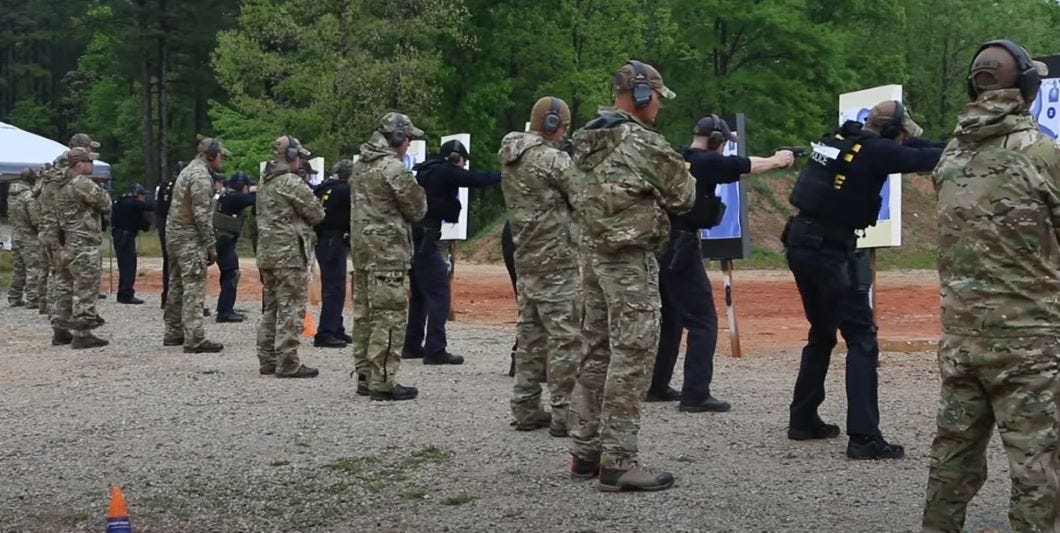 ATF Agents qualify with handguns during the two-week course to become member of ATF’s Special Response Team. (Screenshot courtesy ATF.gov)