Category: Goobermint
Oregon Measure 114 gun law faces federal court test Monday
PORTLAND, Ore. (AP) — A federal trial over Oregon’s voter-approved gun control measure opened Monday in Portland, marking a critical next step for one of the toughest gun control laws in the nation after months of being tied up in the courts.
The trial, which is being held before a judge and not a jury, will determine whether the law violates the U.S. Constitution.
It comes after a landmark U.S. Supreme Court decision on the Second Amendment that has upended gun laws across the country, dividing judges and sowing confusion over what firearm restrictions can remain on the books. It changed the test that lower courts had long used for evaluating challenges to firearm restrictions, telling judges that gun laws must be consistent with the “historical tradition of firearm regulation.”
The Oregon measure’s fate is being carefully watched as one of the first new gun restrictions passed since the Supreme Court ruling last June.
The legal battle over in Oregon could well last beyond the trial. Whatever the judge decides, the ruling is likely to be appealed, potentially moving all the way up to the U.S. Supreme Court.
NJ is Playing a Game of Chicken with Supreme Court & 2nd Amendment
BELLEVUE, WA – The Second Amendment Foundation and its partners in a legal challenge of New Jersey’s “sensitive places” concealed carry statute have filed a response to the state’s motion for a stay in the Third U.S. Circuit Court of Appeals. The case is now known as Koons v. Platkin.
Second Amendment Foundation opposes the stay, arguing the state “did not meet its burden before the district court, and it cannot meet it in this Court. Thus a stay pending appeal should be denied.”
“The state is struggling with all its might,” said SAF founder and Executive Vice President Alan M. Gottlieb, “in a stubborn effort to retain a literal stranglehold on the rights of New Jersey citizens.
We’re challenging the ban on legal carry in parks, on beaches, and at recreation facilities, publicly owned museums and libraries, bars and restaurants where alcohol is served, entertainment facilities, airports (before TSA security), public transportation hubs, and the presumptive ban on private property.
“There is no established historical tradition that could justify the restrictions included in the new law. New Jersey simply cannot criminalize licensed concealed carry virtually everywhere in the state by designating everything as a ‘sensitive area,’ nor should it be allowed to continue enforcing these restrictions pending appeal.”
SAF Executive Director Adam Kraut said the state is playing a game of chicken with the Supreme Court and the Second Amendment.
“The state is burdened with showing the carry restrictions are consistent with the nation’s historical tradition of firearms regulation, and we don’t see how that is possible,” Kraut said.
“The state has not provided any evidence of Founding era restrictions like it wants to enforce today, and is essentially trying to stall the inevitable for as long as possible.”
California Wants Gun Mag BAN Case to Go Away, Not So Fast Freedom Haters
BELLEVUE, WA – Attorneys for the Second Amendment Foundation and its partners in a long-running legal challenge of California’s magazine ban statute have filed a memorandum in support of their motion for summary judgment and opposition to the state’s counter-motion for a summary judgment. The case is known as Wiese v. Bonta, originally filed in 2017.
SAF is joined by the Calguns Foundation, Firearms Policy Coalition, Firearms Policy Foundation, and several private citizens. They are represented by attorneys George M. Lee at Seiler Epstein LLP in San Francisco and Raymond M. DiGuiseppe at DiGuiseppe Law Firm in Southport, N.C. The case is in the U.S. District Court for the Eastern District of California.
“California has been stubbornly defending what amounts to a confiscatory effort to deprive state residents of magazines which are commonly owned by millions of citizens across the country,” said SAF founder and Executive Vice President Alan M. Gottlieb. “Following the Supreme Court’s Bruen ruling last year, the state has doubled down with its gun control efforts, and defending this indefensible magazine ban is a major component of what amounts to a campaign of resistance which the courts should not allow.”
“We’ve been in this fight for six years,” noted SAF Executive Director Adam Kraut. “The state has now resorted to absurd arguments that concede an inherent operating part of a firearm is an ‘arm’ only so long as it holds an arbitrarily determined number of rounds, but suddenly becomes something else if it holds more. As we explain in the text of our memorandum, nothing in the Second Amendment supports the state’s position on drawing these random lines to determine whether something is an ‘arm’ or not.
“Last summer’s Supreme Court ruling in the Bruen case established a new directive for handling Second Amendment cases, which now require that challenged gun laws must be supported by historical traditions, and the state cannot do that in this case,” he added.
The 28-page memorandum also notes;
“Therefore, the common use of an arm overrides any decrees or policy judgments of the State as to what its citizens ‘really need’ for purposes of exercising their constitutional right to keep and bear protected arms for self-defense and other lawful purposes. And it is beyond any reasonable dispute that the magazines at issue are commonly owned, both here in California and throughout the United States.”
Most Gun Control Laws Render Us More Unsafe
Every time Democrats unveil a new gun control proposal, their message is the same: their bill, if enacted, will save lives. Actually the exact opposite is true.
States have recently rushed to pass new laws in response to a decision the U.S. Supreme Court made last year in New York State Rifle and Pistol Association vs. Bruen.
It held that the Second Amendment prohibits government requiring applicants to prove a “special need” in order to be issued a concealed carry permit.
States that included this requirement are called “may issue” states; others, which comprise the majority, are called “shall issue” states.
Maryland was one of those “may issue” states, and concealed carry applications there soared in response to Bruen.
“The Maryland State Police has received 11 times the usual number of new permit applications since the court struck down state provisions requiring gun owners to demonstrate a special need for carrying a firearm for self-defense,” The Washington Post reported.
However, to paraphrase a verse in the Book of Job: “the government giveth, the government taketh away.”
Many “may issue” jurisdictions, including Maryland, scrambled to change their concealed carry laws to comply with Bruen, while still limiting the right to carry, despite the plain language of the Second Amendment that states “the right of the people to keep and bear arms shall not be infringed.”
So while newly-elected Gov. Wes Moore, a Democrat, eased restrictions to obtain a permit, he simultaneously tightened them — by limiting the places where one may carry.
“Gun violence is tearing apart the fabric of our communities, not just through mass shootings but through shootings that are happening in each of our communities far too often,” Moore said at a bill-signing ceremony. “We will act, and that’s exactly what today represents.”
But by signing Maryland’s new law, he only made Baltimore’s “mean streets” even meaner.
New Oregon gun law, Measure 114, to face federal court test next week
Oregonians passed Measure 114 in November. It would ban the manufacture, purchase or sale of magazines capable of holding more than 10 rounds of ammunition. It would also require people to take a safety course and pass a background check to get a permit allowing them to purchase firearms. But before the law went into effect, it ran into a flurry of legal challenges at the state and federal levels.
The state case is expected to pick up again in September. And several bills meant to tighten Oregon’s gun laws are among the legislation sidelined by the Republican-led walkout in the Oregon Senate.
In the meantime, the federal bench trial — no jury — starts next week in Portland and will be heard by U.S. District Court Judge Karin Immergut, a Trump appointee. The federal trial, which is slated to run for five days, will result in a first ruling about whether the new law is legal under the U.S. Constitution. No matter what Immergut decides, the ruling will likely be appealed, possibly all the way up to the U.S. Supreme Court.
A lawyer for one of the groups hoping to overturn the law declined an invitation to come on Think Out Loud this week, citing the pending case. But a lawyer for the state, Michael Kron, did agree to come on the show and spoke to host Dave Miller on Wednesday. Kron is special counsel to the State Attorney General and is part of the legal team defending the voter-passed law.
This conversation has been edited for length and clarity.
Gun rights advocates ask judges to uphold ruling in fight over gun law
Attorneys for Second Amendment advocates fighting New Jersey’s new gun law are urging a federal appeals court to uphold a recent ruling blocking most of the law from taking effect.
State attorneys failed to prove anyone would be irreparably harmed by U.S. District Court Judge Renée Marie Bumb’s order earlier this month affirming people’s right to carry guns in many places state lawmakers banned them, the lawyers wrote in two briefs filed Tuesday in response to the state attorney general’s appeal of Bumb’s order.
Attorneys representing New Jersey gun owners Ronald Koons and Aaron Siegel filed separate challenges the day Gov. Phil Murphy signed the law in December. The cases were later consolidated.
In two briefs totaling almost 60 pages, the attorneys repeatedly refer to Bruen, the U.S. Supreme Court case that struck down restrictions on gun carry, as a reason why the state’s bid to halt Bumb’s preliminary injunction is “flawed from start to finish,” as Siegel’s attorneys put it.
“Governments may bar the carrying of firearms in only ‘exceptional circumstances,’” Koons’ attorneys noted, citing Bruen. “The exception cannot become the rule.”
In defending lawmakers’ decision to ban guns in about 25 “sensitive places,” the state failed to prove such prohibitions are “historically justified,” as Bruen requires, Koons’ attorneys added.
“The state is left with speculative public-safety and public-confusion arguments,” they wrote.
But any ruling further altering the status quo would just add to public confusion, they added.
Both briefs take aim at the new law’s “anti-carry default,” in which lawmakers banned guns on government and private property that is open to the public, such as stores, and guns loaded and within reach in vehicles. Private property owners have the right to forbid guns on their property, but the government can’t make that decision for them, the attorneys argue. Bumb had enjoined both the private property and vehicle restrictions.
“To the extent there is any ambiguity, it must be interpreted in favor of the Second Amendment,” Koons’ attorneys wrote.
A spokeswoman from the Attorney General’s Office declined to comment.
A national gun rights group has asked a federal judge to immediately halt the state’s longstanding ban on assault weapons and high-capacity magazines while the court decides whether the law should stand at all.
The National Association for Gun Rights, a Colorado-based Second Amendment advocacy group, on Tuesday was heard by First Circuit U.S. District Judge F. Dennis Saylor IV in their attempt to overturn a 1998 assault weapons weapon ban made a permanent law in 2004 by then-Gov. Mitt Romney.
“Massachusetts has been directly violating the Second Amendment for decades,” NAGR President Dudley Brown said. “Under Bruen, there is no doubt in my mind the days of Romney’s Assault Weapons Ban are numbered. The National Association for Gun Rights will see to it that the rights of the people of Massachusetts are restored.”
The gun rights group says that their lawsuit comes following the U.S. Supreme Court’s decision in New York State Rifle & Pistol Association, Inc. v. Bruen, which struck down certain licensing conditions in New York State and elsewhere, including Massachusetts.
The Great COVID Ventilator Death Cover-up.
Tens of thousands of Americans died after being placed on mechanical ventilators in spring 2020. It’s long past time we got real answers as to how many were killed this way.
It’s long been something of a mystery why there have been no major studies on how many COVID patients were killed by mechanical ventilators in spring 2020. Early data from China had suggested that ventilators would need to be used widely in the treatment of COVID patients, and this led to a major rush to procure ventilators on the part of politicians and hospital systems all over the world.
A small sample of the hundreds of headlines from that period features ones such as:
“Cuomo refutes Trump, insists NY needs up to 40,000 ventilators,”
“NY may need 24,000 more ventilators to fight COVID-19. Here’s how it could get them,”
“Amid Ongoing COVID-19 Pandemic, Governor Cuomo Announces 1,000 Ventilators Donated to New York State,”
“A New York hospital is treating two patients on a device intended for one.”
However, it soon became clear that ventilators were being vastly overused, and the medical community gradually ceased this practice of mass intubation. Dr. Cameron Kyle-Sidell acted as an early whistleblower, sounding the alarm in a widely-shared video:
We are operating under a medical paradigm that is untrue… I fear that this misguided treatment will lead to a tremendous amount of harm to a great number of people in a very short time… This method being widely adopted at this very moment at every hospital in the country…is actually doing more harm than good.
In interviews with major media outlets, several practitioners later disclosed that patients had often been put on ventilators not for their own benefit, but in order to stop the virus from spreading. As one doctor later told the Wall Street Journal:
We were intubating sick patients very early. Not for the patients’ benefit, but in order to control the epidemic and to save other patients. That felt awful.
Big win for homesick sailor forced to surrender guns
If someone feels a little down because they miss their family, is that alarming? So alarming that people should be forced to give up their guns?
That was the question at the heart of the matter in a case involving a Navy sailor stationed in Hawaii who was denied a gun permit and required to turn in his firearms because he acknowledged seeing professional help to deal with that depression.
Some would argue that missing one’s family is a good sign, a sign that they have people who love them and whose love is reciprocated.
Hawaii didn’t really get that.
The state stomped on the rights of Michael Santucci and Santucci responded with a lawsuit.
On Thursday, he scored a big win.
Today marks another significant victory for the Second Amendment in Hawaii, all thanks to a homesick sailor.
The case of Santucci V. City and County of Honolulu saw a preliminary injunction become permanent today. The lawsuit was initiated by Michael Santucci, an officer serving… pic.twitter.com/RKhUn2qE09
— hawaii firearms coalition (@hificoorg) May 25, 2023
Santucci did everything right and by the book. He sought to register his firearms with the state as required and acknowledged getting help for his depression.
As a result, he was told to hand in his guns and forfeit one of the rights he serves in our military to protect for the rest of us.
It was idiotic.
Luckily, the judge agreed.
The court agreed with Mr. Santucci that he was not disqualified from registering his firearms based on Section 134-7. It determined that Mr. Santucci’s affirmative response to Question 11 of the Firearm Application Questionnaire, which inquired about behavioral, emotional, or mental disorders, did not render him ineligible for firearm registration or ownership under the statute. The court concluded that Mr. Santucci should not have been required to provide a doctor’s letter or compelled to surrender his firearms solely based on his affirmative response to Question 11.
Honolulu argued that it was obligated by law to request a doctor’s letter in accordance with Section 134-3, which mandates firearm registration using forms prescribed by the Attorney General. However, the court found no basis for requiring a doctor’s letter after an affirmative response to Question 11, as neither the statute nor the prescribed form supported such a requirement.
The court granted the preliminary injunction, ordering the return of Mr. Santucci’s firearms, and enjoined Honolulu from demanding specific certifications solely based on an affirmative response to Question 11. It also stipulated legal fees to be paid in the matter, with Honolulu paying $102,500 and the State paying $28,000 more.
So, in other words, it wasn’t just a win for Santucci, but also for gun owners in general.
Look, while I disagree with it entirely, I get the desire to keep guns out of the hands of people suffering from mental disorders. Some people are dangerous, either to themselves or others, and many figure that’s a good enough reason to curtail the rights of others.
Yet most people who seek counseling aren’t a threat to anyone, including themselves. They’re just feeling down and don’t want to anymore, or they’re processing a rough childhood or some other kind of trauma so they can live a better, more fulfilling life.
For authorities to swoop in and decide such people cannot be trusted with guns is wrong.
Moreover, it’s likely to prevent people from seeking help in the first place.
The truth is that if Santucci was dangerous, he’d have just lied on the form. If he was planning to kill himself, he wouldn’t worry about a perjury charge. If he were planning something far, far worse than that, I’m pretty sure perjury would have been the least of his concerns.
Instead, Santucci just wanted to obey the law, and he got screwed for it.
Now, things are being set to right.
New Jersey Politicians Enact Largest Gun Ban in U.S. History
When Governor Murphy and the New Jersey Democrats rushed a flurry of gun laws through the legislature last June of 2022, one of the laws rammed through was under the guise of banning guns with no serial numbers.
This law banned millions of rifles, shotguns, handguns, hunting guns, target shooting guns, military surplus guns, and virtually ALL muzzleloaders, black powder guns, antique guns, air guns and BB guns.
There are NO exceptions and there is NO grandfathering. This was the largest gun ban ever passed in the history of the United States.
The law bans ALL firearms with a “…firearm frame or firearm receiver …which is not imprinted with a serial number registered with a federally licensed manufacturer…”
The term “firearm frame or firearm receiver” means the part of a firearm that provides housing for the internal components.
For ANY firearm to be legal in New Jersey, it must now meet two criteria established by this law:
Last month I wrote about a case that the Pacific Legal Foundation was arguing before the Supreme Court.
At issue in the case, Tyler v. Hennepin County was the outright theft of Geraldine Tyler’s home equity. Geraldine is 94 years old, and currently living in a nursing home, having been driven out of her condo due to high crime (caused by the failure of the city and the county to enforce the law).
She fell behind in her property taxes, and the county sold her condo and kept all the money, including equity that remained after paying her tax bill.
It was an appalling act of government theft, but of course, appalling and government are often found in the same sentence.
Well, the Supreme Court ruled on the case today, and the news, for once, is good. The good guys won by a unanimous decision. Every single Justice agreed that Hennepin County is a bunch of lying, thieving, greedy, and tyrannical bunch of MFers.
Uh, maybe that last part is hyperbole. They only said lying, thieving and greedy. None of the Justices would swear in an opinion.
Governments are very big on seizing property. And in this case, the seizure was particularly galling because much of the money owed was due to penalties, not taxes. A small GoFundMe would have gotten the taxes paid off in a few days, but at 94 such things don’t generally occur to a person, and she had nobody to think of such matters.
The Court’s decision seems like a no-brainer, but then again it should have been for lower courts. The fact that she won in the Supreme Court is great news, but the fact that it had to be decided there is very bad news indeed. The county in which I live–and in many others around the country–have been stealing money from taxpayers without remorse.
Like Vermont has a problem.
Vermonters, lawmakers await decisions on contentious gun reform bills
MONTPELIER, Vt. — One year after the tragic school shooting in Uvalde, Texas, Vermont lawmakers looked back on firearm-related bills passed in the 2023 session that they believe will make Vermont a safer state.
One of those will implement a mandatory 72-hour waiting period from the time you purchase a gun to when it enters your possession.
“When somebody has the impulse to buy a gun and use it for a sinister purpose like maybe a school shooting or something like that, or if they intend on harming themselves, those 72 hours can be so vital,” Rep. Conor Caser, Executive Director of GunSense Vermont, said.
Some believe the bill violates the Second Amendment and is unconstitutional. Gov. Phil Scott has not said he will veto the bill but has expressed strong concerns in recent weeks.
“I don’t doubt that if this goes into law that there will be a constitutional challenge,” said Scott.
However, the governor is expected to sign off on a bill that strengthens penalties on straw purchases and the defacing of serial numbers on firearms, which lawmakers believe will reduce crime in and out of state.
“They go in and buy them [guns] and then trade them for drugs, and the folks who can’t possess obviously have the firearm. And we’ve seen them used in crimes in other states,” Sen. Richard Sears said.
It remains clear that lawmakers will not agree on the policies of all the bills, but both sides of the aisle say the fact that three firearm reform bills made it to the governor’s desk this session is something they have never seen before.
“Passing three is a first, I must say, but the dynamics have changed also in the last 15-20 years. The makeup of the body, the numbers in the body, you’ll see on most of those bills they are predominately supported by Democrats,” Rep. Patrick Brennan, a Republican, said.
Sears believes public tragedies such as what happened in Uvalde also played a role.
“I think Vermonters’ views of firearms have changed dramatically due to the mass shootings we’ve seen in other states such as Uvalde a year ago,” Sears said.
Most bills passed by the Senate and House within the last two weeks of the session, including the two firearm bills, have still not officially made it to the governor’s desk as the legislative council finishes the process of looking them over.
Once they do, Scott will have five days to make a decision on whether to sign them or not.
Michigan’s fourth-largest school district is having “significant” performance issues with its expensive electric buses, issues that come after the Biden administration spent $1 billion to “transform America’s school bus fleet” with electric models.
During an April 19 presentation to the Ann Arbor Public Schools Board of Education, the district’s environmental sustainability director, Emile Lauzzana, highlighted a number of issues with the district’s electric bus fleet. Those buses, Lauzzana said, have “a lot of downtime and performance issues” and aren’t “fully on the road,” despite the fact that they are “approximately five times more expensive than regular buses.” The infrastructure upgrades required to use the buses, meanwhile, were “originally estimated to be only about $50,000” but “ended up being more like $200,000,” according to Lauzzana. “I have a number of colleagues in different states who are facing similar challenges,” the district official lamented. “For the school bus market, it’s been challenging for us.”
![]()
Just months before Lauzzana’s admission, President Joe Biden’s Environmental Protection Agency announced it awarded nearly $1 billion in taxpayer funds to “transform America’s school bus fleet” with “over 2,400 clean school buses that will accelerate the transition to zero emission vehicles.” But problems with electric buses occurred long before the agency’s announcement.
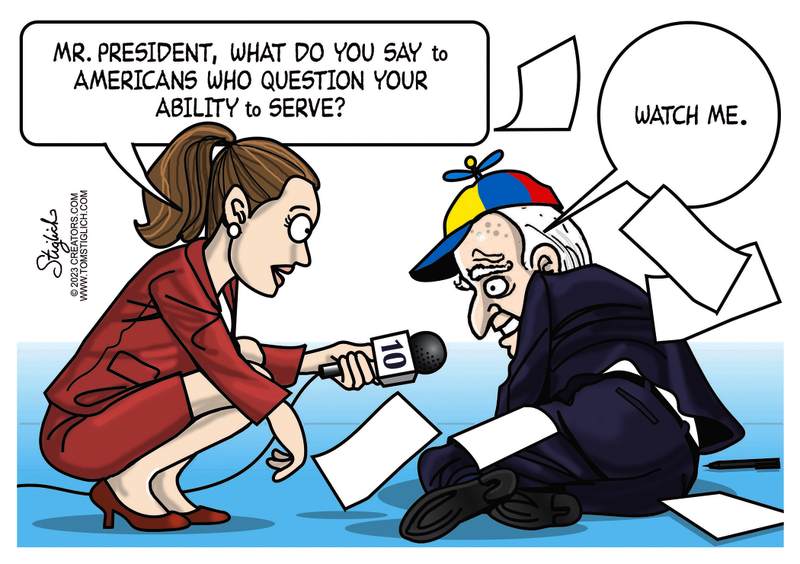
Joe Biden isn’t speaking coherently enough to fact-check him
If he didn’t bear the title of president of the United States and you met Old Joe Biden in any social setting, you’d smile and nod and not try to make any sense of what he was saying, because it would be abundantly clear that this is a man who is not in full possession of his faculties. But the poor WhiteHouse.gov transcript wonks have to try to turn Old Joe’s dementia-addled ramblings into something remotely approaching sense and accuracy, and he had them working overtime at a G7 Summit press conference on Sunday.
President Biden rambles unintelligibly for 40 seconds… pic.twitter.com/eaMZB0OQzo
— The First (@TheFirstonTV) May 21, 2023
Observation O’ The Day
It’s clear this crook cannot function, which begs the question, who is running things & making decisions? Kamala? Um, no. Nancy’s gone. Klain is gone. Jill? Maybe. Either way, it’s clear nobody elected the actual boss(s), whomever that may be & the press remains uninterested
Remember all the “Stop Asian Hate” posturing? That went away when people started pointing out where the violence was coming from.
No prison time for black man who set Asian Berkeley students on fire with homemade blowtorch
Prosecutor funded by George Soros gets criminal sent to ‘diversion program.’
A black man found guilty of setting two Asian University of California Berkeley students on fire will face no jail time as part of a plea deal with a prosecutor who ran on an agenda of ending “mass incarceration.”
Brandon McGlone “was found guilty of lighting UC Berkeley students on fire at a boba shop near the Cal campus in 2020 has been released from custody without prison time or probation after agreeing to participate in a diversion program for veterans,” according to The Berkeley Scanner, which reviewed the court records.
But he reached a plea deal with the Alameda County District Attorney’s office, which is run by Pamela Price, who “has taken hundreds of thousands of dollars from the progressive billionaire George Soros,” according to The Washington Free Beacon.
The two students were not the first victims of McGlone, who earlier in the day had said he “wanted to light someone on fire” and then proceeded to carry out his wishes.
He first chased one man down the street and tried to light him on fire after spraying him with WD-40. “Another man also ran from McGlone to escape being set on fire after being sprayed with a liquid while waiting in line at Taco Bell Cantina, according to testimony,” the Berkeley Scanner reported.
The paper further reported:
McGlone’s next stop was Feng Cha Tea House, at 2528 Durant Ave., where he found students waiting in line to order food and drinks.
He sprayed two of them with WD-40 and used a lighter to ignite the gas, creating a massive fireball, witnesses said.
The students managed to pat out the flames and escape injury. Members of their group then confronted McGlone and fought with him in the street.
During the fight, according to testimony, McGlone first pulled out a knife and then pulled out a hatchet.
Student senators also cited the incident in 2020 when it passed a resolution that called for mandatory xenophobia training.

Dër GrëtchënFührër® is at it again.
Michigan governor signs red flag gun law, questions linger over enforcement
ROYAL OAK, Mich. (AP) — Michigan Gov. Gretchen Whitmer gave final approval Monday afternoon to a red flag law that aims to keep firearms away from those at risk of harming themselves or others as the state grapples with ways to slow gun violence in the wake of its second mass school shooting.
Michigan joined Minnesota as the second state in under a week to implement a red flag law after Democrats in both states won control of both chambers and the governor’s office in November. New Mexico previously was the last state to pass a red flag law in 2020.
Whitmer signed the legislation just outside of Detroit, flanked by state lawmakers and individuals affected by gun violence. Former Arizona Congresswoman Gabby Giffords, who began campaigning for gun safety after she was shot in the head in 2011, was also in attendance.
“We have heard too many times from those who knew a mass shooter who had expressed concern in advance about that mass shooter’s intentions,” Whitmer said Monday. “With extreme risk protection orders, we have a mechanism to step in and save lives.”
The new law, also known as extreme risk protection orders, is expected to go into effect next spring. It will allow family members, police, mental health professionals, roommates and former dating partners to petition a judge to remove firearms from those they believe pose an imminent threat to themselves or others.
The judge would have 24 hours to decide on a protection order after a request is filed. If granted, the judge would then have 14 days to set a hearing during which the flagged person would have to prove they do not pose a significant risk. A standard order would last one year.
Michigan became the 21st state to implement a red flag law. Questions remain of whether the state will have better success in enforcing it than others have. An Associated Press analysis in September found that in the 19 states with red flag laws, firearms were removed from people 15,049 times since 2020, fewer than 10 per 100,000 adult residents.
Some local sheriffs in Michigan have told The Associated Press that they won’t enforce the law if they don’t believe it’s constitutional. Over half of the state’s counties have passed resolutions declaring themselves Second Amendment sanctuaries, opposing laws they believe infringe on gun rights.
US Senator Tries to Undermine Branch of Government Intended as a Check on HIS Branch of Government
As anyone who has an elementary school level education understands, our Founders established our federal government to have three branches—the Executive, Legislative, and Judiciary—each designed with their own duties, and also designed to act as a check on the others from trying to assert too much power.
In a fairly simplistic breakdown, Congress determines what laws should be in place, the President makes sure the laws are put into place and enforced, and the Supreme Court determines if the laws comport with the US Constitution.
Sadly, some politicians simply ignore this dynamic, and hate being less powerful than they believe they should be.
Case in point: US Senator Chris Murphy (D-Conn.).
Murphy has long been a staunch advocate of diminishing the Second Amendment. He has supported virtually every anti-gun proposal that has come before him for consideration, including banning guns. But, thus far, he has failed to achieve much success in imposing the Draconian restrictions on law-abiding gun owners he would like to see passed at the federal level.
There are, however, a handful of states that are under the political control of anti-gun zealots; states such as California, Illinois, New Jersey, and New York. These states have, as our readers know, passed laws that infringe on our rights protected under the Second Amendment; ranging from annoying bureaucratic impediments to exercising the right to arms to actual bans on some of the most popular firearms people choose for self-defense.
That said, while our Founders may have given deference to the states to manage their own affairs, it has been long established that there are certain things that are sacrosanct—like individual rights—and states can be limited as to their authority on establishing laws in certain areas.
So, after a trio of Second Amendment-affirming decisions handed down by the US Supreme Court based on challenges to laws at the state and city level—in the cases of District of Columbia v. Heller (2008), McDonald v. City of Chicago (2010), and New York State Rifle & Pistol Association, Inc. v. Bruen—the days of anti-gun states and localities being able to violate Second Amendment rights with no accountability may be numbered.
This seems to terrify Sen. Murphy, and so much so that he has taken up the tactic of making thinly-veiled threats towards the US Supreme Court and questioning our nation’s very foundations of government.
“No one is trying to take your guns.”
— SAF (@2AFDN) May 22, 2023