CDC quietly lowers the bar for early childhood speech development.

This is a story that first surfaced earlier in the week but hasn’t gained a lot of traction yet. (This is perhaps understandable given the situation in Ukraine, but also likely by intention.) For the first time in decades, the CDC has changed many of the recognized milestones for childhood development in terms of speech and cognitive functions.

These markers are considered important in terms of recognizing when children aren’t progressing quickly enough, suggesting the potential need to determine if some sort of impairment is being observed and if the child may require greater medical attention. The curious thing about the changes instituted by the CDC is that in a majority of the cases, they have lowered the standards rather than raising them. I first noticed this news on Twitter, as so often happens these days.

You can read the new guidelines here. One of the big changes that many critics are focusing on is the former guideline saying that children should normally know approximately fifty words by 24 months or two years of age. That benchmark has now been stealthily raised to 30 months. That’s not insignificant at all. It’s a 25% increase from the previous standard.

The Postmillennial examines the context in which these changes are taking place. It’s hard to ignore the growing body of reports showing that childhood development has been suffering as a result of various COVID protocols, raging from “virtual learning” environments to forcing children to wear face masks.

Continue reading “”

Arizona House Approves Measure That Would Amend [State] Constitution to Ban Critical Race Theory

PHOENIX (AP) — Republicans in the Arizona House approved a measure Thursday that would ask voters to amend the state constitution to ban the teaching of so-called “critical race theory” in schools and bar any preferential treatment based on race.

A ban on teaching critical race theory has become a major political talking point for Republicans nationwide. It is not taught in Arizona’s schools, but that did not stop lawmakers from enacting a ban last year. The state Supreme Court struck that law down because it was unconstitutionally included in the budget………….

Texas Now Requires New Charter Schools to Ensure They Won’t Teach Critical Race Theory

The Texas Education Agency confirmed this week it now requires new charter schools to submit a “statement of assurance” that the school will follow so-called “critical race theory” laws before opening its doors to the public.

Last year, Texas lawmakers passed two laws designed to limit how teachers could discuss issues of race in the classroom. The state’s current law, Senate Bill 3, replaced an earlier measure, House Bill 3979. Both have been labeled by conservatives as anti-critical race theory laws although the term is not included in either law.

Continue reading “”

5th-graders learn to shoot guns by using school gym as target range

A school district in Wyoming posted pictures of 5th and 6th grade students shooting targets with air rifles in a school gym.

A school district in Wyoming recently used a gymnasium as a shooting range, training fifth and sixth grade students in marksmanship during PE. Hot Springs County School District #1, in the small town of Thermopolis, shared photos of the sharpshooting session in a Feb. 2 Facebook post, and it quickly caught the attention of thousands.

McClatchy News has obtained a screengrab of the Facebook post, which is no longer publicly available. In the pictures, the children are seen aiming air rifles across the gym at a set of targets propped up against the bleachers with what appears to be plywood.

Often a child’s introduction to the world of firearms, air rifles generally use gas stored in a small canister to propel a BB or pellet out of the barrel at relatively high speed. While far less lethal than true firearms, they can cause serious harm in some circumstances. “All students passed their safety test and have been sharpening their skills,” the post said.

As of the morning of Feb. 8, the post had garnered 13,000 reactions and 5,700 comments and had been shared over 60,000 times. For perspective, the population of Thermopolis is around 2,700.

“This is what America needs more of,” one comment read.
“Education and responsible firearm ownership.”
“This is so awesome! Probably one of the safest schools in the country too,” a commenter wrote.
“I need to find a school like this for my son once he’s old enough!”
“CA masks their kids, Wyoming teaches marksmanship,” said another.

Of the nearly 6,000 comments, most are in support of the district.

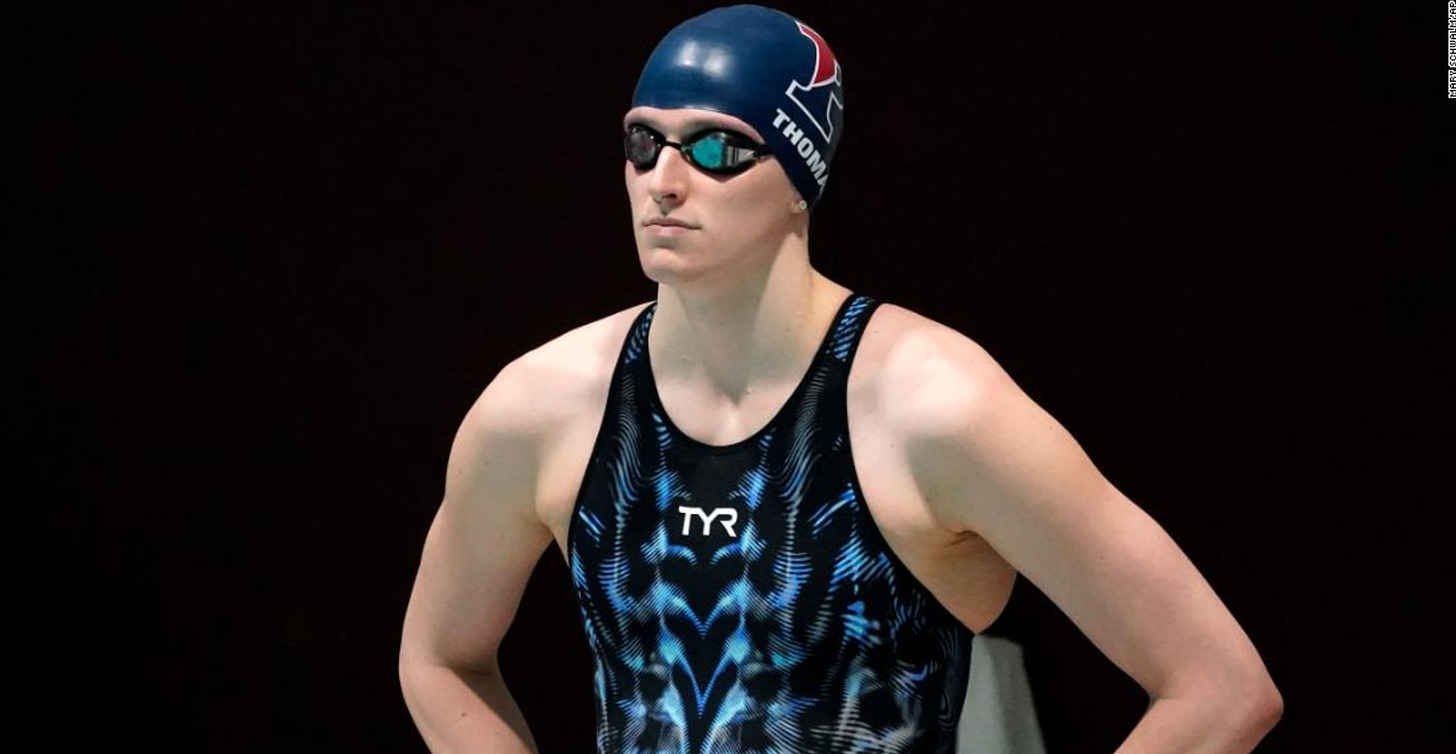
This ‘trans’ thing is a bunch of mentally ill people, the ‘athletes’ of which couldn’t make the cut with whatever sport they want to compete in on the male side, and found a way to cover up their lack of ability.


South Dakota governor signs 2022’s first trans athlete ban into law
Gov. Kristi Noem had previously issued executive orders banning trans girls and women from competing on female sports teams in the state.

South Dakota Gov. Kristi Noem signed a bill Thursday that bans transgender girls and women from playing on female sports teams, making the state the first this year — and the 10th nationwide — to enact such a bill into law.

“This bill has been an important priority for a lot of the people behind me,” Noem said as she signed the bill at a news conference, “and I appreciate all of their hard work in making sure that girls will always have the opportunity to play in girls sports in South Dakota and have an opportunity for a level playing field, for fairness, that gives them the chance to experience success.”

Noem vetoed a similar bill in March because she said the legislation wouldn’t survive legal challenges. Later that month, she issued two executive orders that restricted participation on female sports teams to those assigned female at birth.

Continue reading “”

Tiger shooters take state title

The Ozark High School JROTC battalion rifle team earned a clean sweep of the championship trophies at the Civilian Marksmanship Program (CMP) State Championship on Jan. 15.

The Tigers came in first place in both the precision and sporter rifle divisions of the team competition that was held in Washington, Missouri.

“We continue to work hard day in and day out and I’m very proud to see this team rewarded for all of their hard work,” said 1st Sgt. William Crawford, Ozark High School JROTC instructor and rifle team coach. “There were roughly 15 schools with over 25 teams, which made for a highly-competitive field. Consistency is accuracy and accuracy is consistency.”

Ozark’s triumphs also extended to the individual competition, as the Tigers claimed the top three spots in both the precision and sporter divisions.

“As a team, we have worked very diligently and put in many long hours to better ourselves as shooters, competitors and fellow teammates,” said Ozark rifle team captain Elijah Glenn. “Our performance at the state championship was a reflection of our dedication to each other and our commitment to representing Ozark JROTC to the best of our abilities.”

The state meet marked the first competition of the new calendar year for the Ozark rifle team. The shooting Tigers are headed into the home stretch of their 2021-22 season, and will compete next at the CMP Army Service National Championship in Anniston, Alabama, Feb. 2-6.

Continue reading “”

Comment O’ The Day
As taxpayers tire of funding things like this, we’re told it’s because of “anti-intellectualism.”


University assignment has students record themselves accusing someone of racism or homophobia.

An assignment shows an instructor directing students to locate someone that they can accuse of ‘racism,’ ‘ableist racist or homophobic use of language,’ or ‘micro-aggressions.’

The Twitter account Libs of TikTok tweeted a screenshot of a similar assignment Wednesday, likely from another iteration of the course.

Article image

An assignment obtained by Campus Reform from a University of New Hampshire course shows an instructor directing students to locate someone that they can accuse of “racism,” “ableist racist or homophobic use of language,” or “micro-aggressions.”

Students in the “Introduction to Language and Social Interaction” course were told to “Call in someone on their ableist racist or homophobic use of language, for micro aggressions (or an act of racism) towards a person of color, homophobia against LGBTQI+ or ableism against a disabled person.”

The assignment for the course, specifies that students must also record the interaction “in order to get credit,” while clarifying to get permission before doing so.

“Remember to say you know they mean well and are a good person,” reads the assignment.

Students are instructed to give their target “an alternate way of expressing themselves that doesn’t marginalise [sic] or oppress,” and warned to “Research your proposed alternative to make certain its [sic] not oppressive itself!!” because “You will fail if you tell someone to say something racist or sexist or homophobic.”

Continue reading “”

But, of course, demoncraps want to for more access to your children……….. to indoctrinate them into being good little serfs.

reQuote O’ The Day
If a foreign nation forced this kind of education system on us,
it would considered an act of war.


Shovel More Dirt on Pre-K

I would ordinarily shy away from doing an old-school blog post that simply links to something else, but this feels like a study that calls out for an exception. I’ve just been reading a paper in the journal Developmental Psychology1, thanks to a friend’s library access. It’s a pre-K study that has many virtues, including

  1. Large n (2990 kids)
  2. Genuine random assignment
  3. Longitudinal design
  4. Confirms my priors

… and it says kids who were assigned to the pre-K condition actually did worse than kids who were not.

VPK = Tennessee Voluntary Pre-K

Pre-K advocates tend to fixate on non-academic indicators as a way to justify pre-K programs. But attendance was mildly worse for the pre-K group:

Attendance rates in sixth grade (proportion of instructional days without a recorded absence) were high for both TN-VPK participants and nonparticipants. Nonetheless, the difference between groups was statistically significant with a slightly higher rate for nonparticipants (97.5% vs. 97.1%, p = .013 for the ITT analysis with observed values). Supplemental Table S11 provides model details for each year (see also Supplemental Figure S3). Sixth grade was the first academic year with a significant attendance difference between conditions, although there were marginally significant effects in kindergarten and first grade.

Continue reading “”

‘Free Speech Advocates’ Panic Over Parents’ Push for More Curriculum Transparency

Teachers, unions and “free speech advocates” argue that more school curriculum transparency would be equivalent to “educational gag orders,” experts told NBC News.

State lawmakers in at least 12 states across the U.S. have introduced legislation to promote more school transparency by requiring teachers to post educational materials online, NBC News reported. Conservatives see more transparency as a way to prevent controversial curricula such as race-based education, Critical Race Theory (CRT) and sexually graphic books.

Continue reading “”

Glenn Youngkin Defends Ban on ‘Racially Divisive’ Critical Race Theory in Virginia

Virginia Gov. Glenn Youngkin defended his decision to outlaw critical race theory in public schools — slamming the controversial philosophy as “racially divisive.”

Youngkin made the remarks following a decision to issue an executive order banning school lessons that define racism as an institutional problem deeply embedded in American society.

“There’s not a course called critical race theory,” Youngkin said on “Fox News Sunday.”………………….

THE DARTMOUTH REVIEW
The Right to Bear Arms: A Review

It took until 2008, in District of Columbia v. Heller, for the Supreme Court to affirm that the Second Amendment, which states “the right of the people to keep and bear Arms, shall not be infringed,” does indeed protect an individual’s right to do so, outside of militia service and for non-criminal purposes.

This divergence between the right to possess and carry around a weapon as expressed in the Constitution and its recognition (or lack thereof) by individual states serves as the topic of The Right to Bear Arms: A Constitutional Right of People or a Privilege of the Working Class?, the newest analysis of Second Amendment history by noted appellate lawyer and scholar Stephen Halbrook.

From the very beginning of the book, it is clear that Halbrook, a Senior Fellow at the Independent Institute and winner of three Supreme Court cases, commands voluminous legal experience. In the preface, Rothschild Research Professor of Law at George Washington University Law School Renée Lettow Lerner even goes so far as to say Halbrook’s work in the 1980s represented “a new birth of freedom” by single-handedly establishing the field of Second Amendment scholarship.

Continue reading “”

Comment O’ The Day
Taibbi has a point. Politicians can falsely claim to be a climate, crime, or economics expert and the average voter isn’t going to offer stiff resistance to that claim. But if a politician claims high school graduation shouldn’t depend upon proficiency in reading, writing, and arithmetic you are going to get their attention. It’s something everyone capable of reading is going to have a fair amount of expertise in. And the ruination of our education system has reached the point where it’s impossible to ignore.
The remarkable thing is that when called out on this the politicians don’t admit they were wrong. They double down.

The Democrats’ Education Lunacies Will Bring Back Trump
Terry McAuliffe lost the Virginia governor’s race by saying, “I don’t think parents should be telling schools what to teach.” If that was no gaffe, Democrats have a lot more significant losing ahead.


(it was no gaffe. It was a ‘freudian slip’ where you inadvertently tell a truth about yourself you wanted kept concealed)


On Meet the Press Daily last week, Chuck Todd featured a small item about the 23 Democrats not planning on running for re-reelection to congress next year. Todd guessed such a high number expressed a lack of confidence in next year’s midterms, and his guest, University of Virginia Center for Politics Director Larry Sabato, agreed. “This is just another indicator that Democrats will probably have a bad year in 2022,” said Sabato, adding, “They only have a majority of five. It’s pretty tough to see how they hold on.”

On the full Meet the Press Sunday, Todd in an ostensibly unrelated segment interviewed 1619 Project author and New York Times writer Nikole Hannah-Jones about Republican efforts in some states to ban teaching of her work. He detoured to ask about the Virginia governor’s race, which seemingly was decided on the question, “How influential should parents be about curriculum?” Given that Democrats lost Virginia after candidate Terry McAuliffe said, “I don’t think parents should be telling schools what to teach,” Todd asked her, “How do we do this?”

Hannah-Jones’s first answer was to chide Todd for not remembering that Virginia was lost not because of whatever unimportant thing he’d just said, but because of a “right-wing propaganda campaign that told white parents to fight against their children being indoctrinated.”
This was standard pundit fare that for the millionth time showed a national media figure ignoring, say, the objections of Asian immigrant parents to Virginia policies, but whatever: her next response was more notable. “I don’t really understand this idea that parents should decide what’s being taught,” Hannah-Jones said. “I’m not a professional educator. I don’t have a degree in social studies or science.”

I’m against bills like the proposed Oklahoma measure that would ban the teaching of Jones’s work at all state-sponsored educational institutions. I think bans are counter-productive and politically a terrible move by Republicans, who undercut their own arguments against authoritarianism and in favor of “local control” with such sweeping statewide measures. Still, it was pretty rich hearing the author of The 1619 Project say she lacked the expertise to teach, given that a) many historians agree with her there, yet b) she’s been advocating for schools to teach her dubious work to students all over the country.

Even odder were her next comments, regarding McAuliffe’s infamous line about parents. About this, Hannah-Jones said:

We send our kids to school because we want our kids to be taught by people with expertise in the subject area… When the governor, or the candidate, said he didn’t think parents should be deciding what’s being taught in school, he was panned for that, but that’s just a fact.

In the wake of McAuliffe’s loss, the “I don’t think parents should be telling schools what to teach” line was universally tabbed a “gaffe” by media. I described it in the recent “Loudoun County: A Culture War in Four Acts” series in TK as the political equivalent of using a toe to shoot your face off with a shotgun, but this was actually behind the news cycle. Yahoo! said the “gaffe precipitated the Democrat’s slide in the polls,” while the Daily Beast’s blunter headline was, “Terry McAuliffe’s White-Guy Confidence Just Fucked the Dems.”

However, much like the Hillary Clinton quote about “deplorables,” conventional wisdom after the “gaffe” soon hardened around the idea that what McAuliffe said wasn’t wrong at all. In fact, people like Hannah-Jones are now doubling down and applying to education the same formula that Democrats brought with disastrous results to a whole range of other issues in the Trump years, telling voters that they should get over themselves and learn to defer to “experts” and “expertise.”

Continue reading “”

This is the kind of academic we should always be on guard to watch for.
This is a real, actual ‘enemy domestic’ of the Constitution and Bill of Rights.
And, they infest the schools and universities, filling our children’s mind with this collectivist, authoritarian statist, mush.

Read – carefully- what she wants. Her revisions are what’s called ‘positive rights‘. What she wants the government to do, in effect granting rights from goobermint power.

Her definition of how the 1st and 2nd amendment were written are defined by her and her ilk as ‘negative rights‘. Rights already possessed by the people, that the goobermint is restricted from abridging or infringing.

Remember, when more than one politician down through history has said: ‘Any government that’s large enough to give you everything is powerful enough to take it all away.‘ One should believe them.


REDO THE FIRST TWO AMENDMENTS

BY MARY ANNE FRANKS
Speech and guns: two of the most contentious issues in America today, with controversies fueled not only by personal passions and identity politics but by competing interpretations of the Constitution. Perhaps more than any other parts of the Constitution, the First and Second Amendments inspire religious-like fervor in many Americans, with accordingly irrational results.

As legal texts go, neither of the two amendments is a model of clarity or precision. More important, both are deeply flawed in their respective conceptualizations of some of the most important rights of a democratic society: the freedom of expression and religion and the right of self-defense. These two amendments are highly susceptible to being read in isolation from the Constitution as a whole and from its commitments to equality and the collective good.

The First and Second Amendments tend to be interpreted in aggressively individualistic ways that ignore the reality of conflict among competing rights. This in turn allows the most powerful members of society to reap the benefits of these constitutional rights at the expense of vulnerable groups. Both amendments would be improved by explicitly situating individual rights within the framework of “domestic tranquility” and the “general welfare” set out in the Constitution’s Preamble.

Making such an edit to the First Amendment would provide stronger and fairer protections for the right of expression, including by acknowledging, as many state constitutions do, that every person remains responsible for abuses of that right. (Such a modification would, for example, help undo the damage caused by the Supreme Court’s decision in Citizens United and remove constitutional barriers to reasonable campaign-finance laws that promote democratic legitimacy.) In addition, the implicit principle of the separation of church and state should be made explicit:

Every person has the right to freedom of expression, association, peaceful assembly, and petition of the government for redress of grievances, consistent with the rights of others to the same and subject to responsibility for abuses. All conflicts of such rights shall be resolved in accordance with the principle of equality and dignity of all persons.

Both the freedom of religion and the freedom from religion shall be respected by the government. The government may not single out any religion for interference or endorsement, nor may it force any person to accept or adhere to any religious belief or practice.

Both amendments would be improved by explicitly situating individual rights within the framework of “domestic tranquility” and the “general welfare” set out in the Constitution’s Preamble.

The Second Amendment’s idiosyncratic and anachronistic focus on militias and “arms” degrades the concept of self-defense. The right to safeguard one’s life should not be conflated with or reduced to the right to use a weapon, especially a weapon that is so much more likely to inflict injury and death than to avoid it. Far better would be an amendment that guarantees a meaningful right to bodily autonomy and obligates the government to implement reasonable measures to protect public health and safety:

All people have the right to bodily autonomy consistent with the right of other people to the same, including the right to defend themselves against unlawful force and the right of self-determination in reproductive matters. The government shall take reasonable measures to protect the health and safety of the public as a whole.

Mary Anne Franks is the Michael R. Klein Distinguished Scholar Chair at the University of Miami School of Law and the author of “The Cult of the Constitution: Our Deadly Devotion to Guns and Free Speech.”

Idealism is Killing Our Kids at School

Imagine this scenario for a moment. Pretend that we’re at a parent-teacher conference and the child is having problems at school.

T- I’m concerned that your child doesn’t study.
P- Children shouldn’t have to study.

T- I’m concerned about your child’s musical ability. Your child doesn’t practice his instrument for music class.
P- Children shouldn’t have to practice in order to make music.

T- I’m concerned about your child’s physical development. Your child doesn’t put in any effort in PE.
P- Children shouldn’t have to put in effort in their physical education class.

To most of us, this parent is such a naïve idealist that the exchange sounds ridiculous. If this discussion were real then we would be seriously concerned about this child’s future.

I don’t want to be the one who tells you the truth about Santa Claus, but we can agree that the world isn’t the way we want it. Sure, I wish there were a way we could build insightful minds and athletic bodies without effort. We all want that, but Utopia isn’t an option. Refusing to do the work hasn’t moved us toward that ideal. Refusing to do the work has only left us weak and ignorant. That wastes lives.

Now let me add another line to the dialogue, a conversation that I’ve actually heard.

T- I’m concerned about your child’s physical safety at school. We want to train school staff so they can stop violent attacks in school and then treat the injured.
P- Staff and students shouldn’t have to worry about violent attacks in school.

I wish this was a fantasy story, but that summarizes the complaints I’ve read about protecting our children.

Continue reading “”

For your consideration…………..

Charles Cooke:
I’ll be teaching an online course: The History of the Second Amendment

Hullo, everyone. I’m just popping in to let you all know about an online course I’m teaching early next year called The History of the Second Amendment. It’s with a new startup called Chapter, which noticed that pretty much every course they were offering was either progressive or progressive-adjacent, decided that it didn’t want to become an echo chamber, and so asked me to teach one, too. I suggested the history of the right to keep and bear arms as a topic, they agreed, and here were are.

Chapter describes its system as “like a book club, but way more fun.” Each week, I’ll provide a reading list (which could be articles, reviews, videos, podcasts, or primary source documents), along with insights and tips on each one. There will be a community forum in which you can discuss each topic, as well as a rolling Q&A in which I will answer questions — both on their website and, if the topic warrants it, by video. Because people are busy, everything will be “asynchronous” — that is, you can take part whenever you’re free, rather than at times that are set by me. The course will last four weeks, it will cost $40 (actually: $35 for Ricochet members), and it will run the gamut.

— Week One will be on pre-Revolutionary America. We’ll explore how the right to keep and bear arms came over with the colonists from Britain, before making its way into the heart of American law.

Week Two will be on the Founding Era. We’ll ask why the Second Amendment was added to the federal constitution, what were the Founders’ intentions in including it, and what did militias have to do with a right “of the people”?

— Week Three will be on the post-Civil War period, during which the Second Amendment took on a new meaning — especially during the era of Jim Crow — and was changed by the 14th Amendment.

— Week Four will be on the Second Amendment as it exists today. We’ll cover contemporary American jurisprudence, the Heller decision, and the political rebirth of the right.

The course will start on January 24th, 2022. If it interests you, can sign up here: https://getchapter.app/@cooke/guns. And if it doesn’t? Well, I shall cry into my golf cart batteries. Chapter has agreed to knock $5 off the price for Ricochet members if you use the code RICOCHET when checking out, so if you do sign up, make sure you do that.

Next Step for the Parents’ Movement: Curriculum Transparency.
Parents have a right to know what’s being taught to their children.

In 2021, public school parents vaulted to the forefront of America’s fractured political landscape. Around the country, parents objected both to Covid-related school closures and to racially divisive curricula. Parental frustration helped secure sweeping GOP wins last month in Virginia, highlighted by Glenn Youngkin’s victory over former governor Terry McAuliffe. Youngkin has promised to rein in public-school radicalism and “ban critical race theory” on his first day in office.

Perhaps the central moment in the Virginia gubernatorial race was McAuliffe’s comment during a debate: “I don’t think parents should be telling schools what they should teach.” Like most Virginia voters, we couldn’t disagree more. Research shows that greater academic success follows when parents actively engage in their children’s education. To be sure, this doesn’t mean that we should decide the finer points of curricular design by plebiscite; nor does it mean that a minority of objecting parents should dictate school pedagogy. But public schools are institutions created by “We the People” and should be responsive to the input of parents and the broader voting public at the state and local level.

At a minimum, parents should be able to know what’s being taught to their children in the classroom. Transparency is a virtue for all of our public institutions, but especially for those with power over children. To that end, we have drafted a template—building on one of our earlier efforts at the Manhattan Institute and the work of Matt Beienburg at the Goldwater Institute—to inform state legislatures seeking to foster school transparency. The policy proposal is designed to provide public school parents with easy access—directly on school websites—to materials and activities used to train staff and teachers and to instruct children.

The last year and a half has demonstrated the need for transparency measures. As many public schools migrated to “virtual only” learning in response to the pandemic, parents received a first-hand look at the divisive, racialist curricula being taught to their children. They learned that public schools were forcing third-graders to deconstruct their racial and sexual identities, showing kindergarteners dramatizations of dead black children and warning them about “racist police,” and telling white teachers that they were guilty of “spirit murdering” minorities. These were not isolated incidents.

These revelations prompted parents to demand to know exactly what was being taught to their children. They felt that the public-school bureaucracies had been hiding controversial materials and exerting undue influence over their children, all in the service of fashionable left-wing ideologies.

Continue reading “”

Harvard Study: Homeschoolers Generally Become ‘Well-Adjusted, Responsible’ Young Adults

Results of a study conducted by researchers at Harvard University found homeschoolers grow to be young adults who are generally “well-adjusted,” particularly showing characteristics of “responsibility” and social engagement.

Researchers Brendan Case and Ying Chen of the Harvard Human Flourishing Program discussed Chen’s analysis of data on more than 12,000 children of nurses in a recent column at the Wall Street Journal.

The researchers used the data gathered on the nurses, who had all responded to surveys from 1999 to 2010, to examine how school type, estimated independently through factors such as socioeconomic status, race, and region, affected adolescents on various long-term outcomes, including educational attainment, mental health, and social integration.

Case and Chen found that while the homeschooled students in their sample were 23 percent less likely to attend college than public school students, they were “33 percent more likely to volunteer, 31 percent more forgiving, and 51 percent more likely to attend religious services” as young adults than students in public schools.

Continue reading “”