
Category: RKBA
BLUF
The only way to address gun violence is to do so head-on, with legislation that will actually protect our school children and encourage safe and responsible firearms ownership. We urge Congress to consider a more effective approach, such as hardening schools, allowing teachers to carry firearms in schools, and passing laws that support responsible gun ownership. The safety of all Americans depends on it.
Preventing responsible gun ownership will not make America safer
It has been an important few weeks for the public’s Second Amendment rights. In the first major gun rights decision since 2008, the U.S. Supreme Court affirmed the right to carry a concealed firearm by striking down a New York state law that made it more difficult for law-abiding citizens to carry a concealed weapon outside their home legally, and wrongfully required individuals to demonstrate a “special need” for self-protection to qualify for a carry license. This was a major victory that will affect at least six other states with similar restrictive licensing requirements, also known as “may issue” laws.
Unfortunately, Congress took advantage of the recent school shooting tragedy in Uvalde, Texas, to pass gun control legislation even though that meant ignoring most voters who believe more gun control is not the path forward . The result is the Bipartisan Safer Communities Act, the first package of gun control legislation in decades.
While this bill makes significant and encouraging investments in school safety programs and our nation’s mental health system, it doesn’t fundamentally address the root causes of gun violence, and it even goes so far as to award taxpayer dollars to states that implement red flag laws.
Unsuspecting and well-meaning citizens might think these “pre-crime” laws, which would allow law enforcement to take away the firearms of someone deemed psychologically unfit to carry one, are a good idea. But in practice, they would target citizens before a crime has even been committed and deprive people of their right to due process.
But it hasn’t stopped there. President Joe Biden and Vice President Kamala Harris recently campaigned for a ban of assault-style weapons, which are most commonly used for hunting, and high-capacity magazines. Biden’s White House has also proposed enacting storage restrictions and banning “ghost guns,” among other things.
All this despite the fact that Biden is on record saying that he “never believed that additional gun control or federal registration of guns would reduce crime.”
‘Active Shooter Alert’ Bill, Designed to Scare, Draws in GOP Traitors and Suckers
“H.R. 6538, the Active Shooter Alert Act of 2022, is not a public safety tool, but rather an anti-gun propaganda program intended to further public hysteria by hyper-inflating the authentic number of ‘active shooter’ incidents to expand support for unconstitutional gun control measures,” Gun Owners of America advised members in a mid-July alert. “Under the Active Shooter Alert Act of 2022, justified self-defense shootings, gang violence, drug violence, or accidental shootings will be used to send alerts to the American people about the presence of an ‘active shooter’ to intentionally misguide the public and create mass hysteria.”
I imagine an uninterrupted night’s sleep would be damn near impossible on an average weekend in Chicago.
You’ll note whenever GOA uses the term on its own (as opposed to citing what the bill is named) they put the words “active shooter” in quotation marks. There’s a reason why that’s appropriate, and something gun owners should emulate. Per Firearms Coalition Managing Director and “proud active shooter” Jeff Knox:
“It is inaccurate because it does not include any direct suggestion of criminality, using ‘shooter’ to infer that, and it is insulting because by doing this, it implies that shooting is a criminal activity.”
Rep. Thomas Massie describes the bill more bluntly.
“House Democrats are trying to condition Americans to repeal the Second Amendment,” he warns, and he’s not using hyperbole. Any longtime gun owner who doesn’t recognize by now that yes, the prohibitionists really do want to take your guns, is either an oblivious fool or in the enemy camp. (There are also citizens new to owning guns who have never given the matter much thought to see how they’ve been lied to, who are ripe for manipulation and the subjects of another analysis.)
House Democrats are trying to condition Americans to repeal the Second Amendment. pic.twitter.com/MSOdkKbTBO
— Thomas Massie (@RepThomasMassie) July 13, 2022
Two points:
Repealing the Second Amendment would not invalidate the right to keep and bear arms, which the Supreme Court has recognized, first in Cruikshank and later cited in Heller:
“The right to bear arms is not granted by the Constitution; neither is it in any manner dependent upon that instrument for its existence.”
Massie knows that. He also knows the Democrats want us to believe rights come from them, using the term “bill of rights” to propose government-mandated privileges that are generally dependent on dragooning (that is, enslaving) others to provide the “granted” services. (See “FDR’s ‘Second Bill of Rights’ and UN Declaration Show How ‘Progressives’ View You.”)
The second point is addressed directly to Donald Trump in the (admittedly improbable) hope that someone who knows him will call it to his attention: Don’t you think it’s past time you to publicly apologize to Rep. Massie and admit that he was right for putting the Constitution over GOP Democrat Lite politics?
As for the “Active Shooter” Alert bill, it passed in the House of Representatives with 43 “Republicans” either knowingly signing on with or being suckered in by a confirmed enemy of the Second Amendment, bill sponsor David Cicilline (D-RI). He’s the professional worm tongue who out of one corner of his mouth professes, “We all respect the Second Amendment but…” and out of the other corner snarls, “Spare me the bulls*** about Constitutional rights.”
First Time Gun Ownership Continues To Soar
Who is buying all of the guns? The answer might surprise gun control activists…
According to The National Shooting Sports Foundation (NSSF) nearly 30%, or 5.4 million of the 18.5 million firearms purchased in the United States in 2021, went to first time gun owners. This number is down slightly from 2020’s record breaking gun sales numbers that saw 40%, or 8.4 million of the 21 million total firearms sold, going to first timers. Retailers report that 23% of customers who bought their first gun in 2020 returned to purchase another in 2021, and that nearly half of first time buyers inquired about professional firearms training, meaning many first time buyers quickly became enthusiasts who are serious about gun safety and self-defense.
For decades, gun control groups have attempted to paint gun enthusiasts as “rednecks” living in rural areas, but the data suggests that this is not the case. The NSSF survey found that 33% of first time gun buyers in 2021 were women, and that the number of African Americans purchasing firearms increased by 44%. Hispanic Americans also increased their gun purchases by 40% in 2021. Mark Olivia, NSSF Director of Public Affairs, notes: “Gun owners no longer fit into the tiny little boxes gun control groups wish to put us in. Today’s gun owner is younger, more urban, and more representative of the different demographic groups we see across America.”
The surge in gun sales in recent years is not confined to “red states” or areas with lenient gun ownership laws. Michigan and New Jersey top the list of states that saw the largest increase in firearm sales from January 2020 to January 2021 with 306% and 248% increases, respectively. Even Washington D.C, which has some of the nation’s strictest gun laws, saw an increase in gun purchases of over 200% during the same time period. Year over year, blue-state Minnesota and red-state Alaska saw nearly identical increases in gun sales, over 100%.
Eleven Fewer Dead People
A deep dive on the Greenwood Park Mall shooting shows a clear path to even fewer dead people than that
On Sunday July 17, 2022, some dork with two rifles and a handgun attempted to shoot up the Greenwood Park Mall food court in Greenwood Indiana. In the span of only fifteen seconds he was shot eight times by private citizen Elisjsha Dicken, an 80% hit rate from forty yards with a double stack nine millimeter handgun, whereupon the dork decided to flee to the bathroom and do us all the favor of dying there. We have much to unpack about this instance, but five key points with mathematical backing show a clear path to saving hundreds of future lives, and further show why the media doesn’t want to save them. Let’s begin.
This entire engagement transpired in a gun free zone. If Mr. Dicken had followed the rules on the sign, then 11.29 additional people (by averages) would be dead. The gun free zone sign did not deter the shooter, and eleven people in that food court owe their lives to the fact that Dicken also ignored the sign. This is indisputable.
While the local Greenwood Police Department has been glowing over the efforts of Mr. Dicken, the Indiana effort to pass this law was opposed most publicly by law enforcement officials, such as Indiana State Police Superintendent Doug Carter who testified against it. If Doug Carter had gotten his way 11.29 additional people would be dead. This is indisputable.
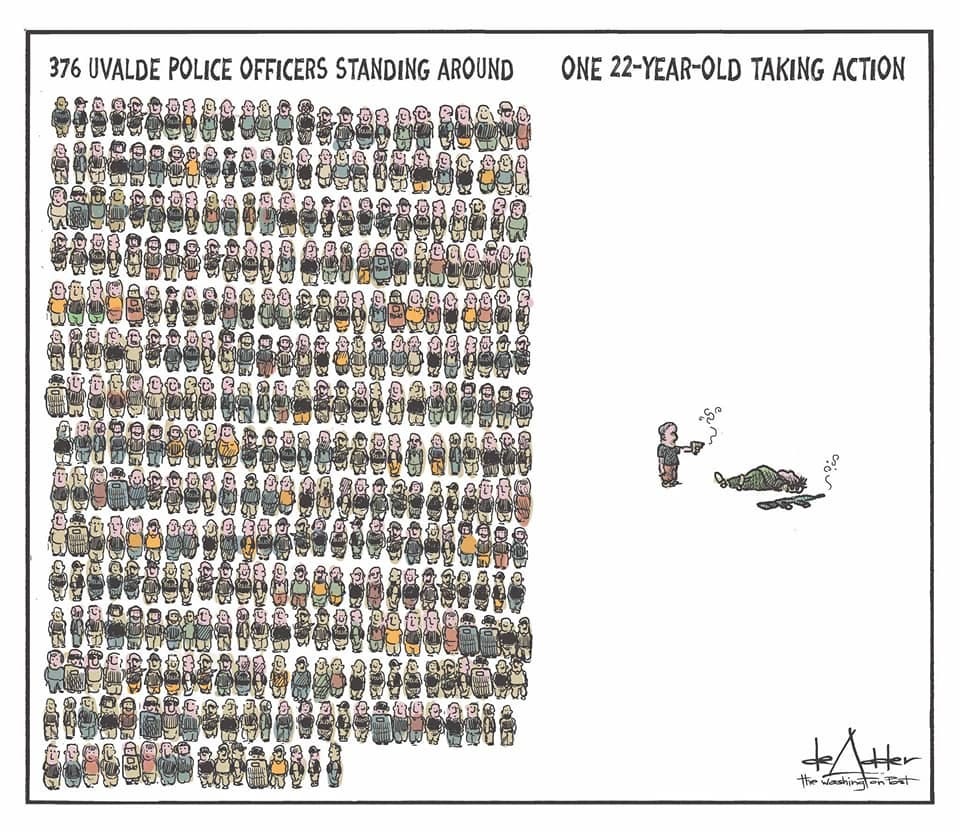
The official inquiry into Uvalde is not complete as of the writing of this piece. It could be that the Uvalde failure was due to chicken shit cops. It could be due to the fact that all government of all kinds moves at the speed of molasses infused mud. It could be some secret tinfoil hat conspiracy. It could be something else, or some or all of the above. We don’t know. But what we do know is response time differences matter, and we know that 11.96 people are saved when the cops aren’t involved, 11.29 in this case.
I am not someone who lives in fear of rampage shootings. I understand the statistics, which show that these things are as rare as shark attacks, and I do not live in fear of sharks. But some people do live with this fear, because different people have different risk tolerances. It seems to me that some people who live with this fear have some significant overlap with ACAB (“all cops are bastards”) messaging. If you are a rational person within either or both of those groups, and compare Uvalde to Greenwood, you must conclude that absent a non-existent magic gun evaporation fairy the best alternative is ubiquitous citizen concealed carry. This is indisputable.
I will not claim that CNN’s stated goal is to glorify rampage shooters, but that’s the exact effect CNN’s behavior has in the mind of a potential rampage shooter. If CNN reversed its behavior and gave twenty five times more coverage to Dicken instead of Uvalde, then the psychological effects would dampen rampage shooters instead of inciting them. This very rampage shooter may have been spurred on by CNN’s behavior, and CNN gets 30% more rampage shootings to farm for clickbait money because of their behavior.
If the United States were to string together three consecutive incidents of rampage shooters getting plugged by private citizens within seconds, as happened in Greenwood Park Mall, and CNN were to give each of them the sorts of coverage they give to Uvalde, the rampage shooter dorks would be too scared to try it. They’d stay in their basement playing XBox instead of shooting people, and the second order effects of constitutional carry would exceed 11.96 saved per incident, because there would be fewer incidents. CNN not covering rampage shootings at all would reduce rampage shootings by one third. If they elevated coverage of failed rampage shootings stopped by citizens, they’d probably reduce them by an additional third.
But they don’t want to do that, because they’re hemorrhaging money. They need as many of these things to transpire as possible to make their bottom line. They are beholden to Moloch, trapped in a cycle that gets people killed, and the only way I can figure out of this cycle is to produce a lot more citizen shooters like Dicken.
The only way out is to shoot our way out and it’s CNN’s fault.
Gun industry sounds off on House gun ban, ATF chief, and more
It’s a busy time for the firearms industry at the moment, and I’m pleased that National Shooting Sports Foundation senior vice president and general counsel Larry Keane could spend a some quality time with Bearing Arms’ Cam & Co today to hit on a number of different topics ranging from the House Democrats’ push for an “assault weapons” ban to the new installation of anti-gun politician and former U.S. Attorney Steve Dettelbach as director of the Bureau of Alcohol, Tobacco, Firearms, and Explosives….
LAPD Stops Enforcing California’s ‘High-Capacity’ Magazine Ban
The Los Angeles Police Department has stopped enforcing California’s state law banning “high-capacity” magazines, according to an internal LAPD email obtained by the Second Amendment Foundation’s Investigative Journalism Project.
The email was sent Wednesday morning to all LAPD personnel by Commander Ernest Eskridge, assistant commanding officer of the department’s Detective Bureau.
Eskridge noted that on June 23, the “United States Supreme Court vacated the ruling in Duncan v. Bonta and remanded the case back to the 9th Circuit Court of Appeal for further consideration in light of its recent decision in New York State Rifle and Pistol Association v. Bruen.”
Because of this ruling, Eskridge said in the email, all sworn LAPD personnel shall not “investigate, detain or arrest” anyone for possessing a magazine capable of holding more than ten rounds unless they are already legally barred from possession of ammunition in the state.
There were three issues in Duncan v. Bonta: whether a law prohibiting law-abiding citizens from possessing magazines in common use violates the Second Amendment, whether confiscating legally obtained magazines violated the “takings clause,” and whether the “two-step” approach of the 9th Circuit and other courts applied to Second Amendment cases is constitutional and meets Supreme Court precedents.
In Bruen, the Supreme Court held that the Second and Fourteenth Amendments protect an individual’s right to carry a handgun for self-defense outside the home and that New York’s “special need” requirement for a concealed-carry permit violates those protections.

‘That’s The Point’
Rep. Nadler Admits Bill Will Confiscate Guns In ‘Common Use’
Democratic New York Rep. Jerry Nadler admitted a Democrat-led bill intends to confiscate guns in “common use” during a Wednesday House Judiciary Committee hearing.
Republican North Carolina Rep. Dan Bishop asked House Democrats if they dispute the fact that the proposed legislation H.R. 1808, titled “Assault Weapons Ban of 2021,” bans firearms in “common use” throughout the country.
“Would anyone on the other side dispute that this bill would ban weapons that are in common use in the United States today?” Bishop asked.
“That’s the point of the bill,” Nadler replied.
“So, to clarify, Mr. Chairman, you’re saying it is the point of the bill to ban weapons that are in common use in the United States today,” the Republican representative pressed.
“Yes,” Nadler clarified. “The problem is that they’re in common use.”
The bill, introduced by Democratic Rhode Island Rep. David Cicilline, would ban a so-called “semi-automatic assault weapon,” including all AK types of weapons and AR-15s. The legislation, if passed, would ban semi-automatic weapons that contain a magazine, a pistol or forward grip and a “folding, telescoping, or detachable stock.” It also intends to ban weapons that can fire more than 10 rounds or contains a threaded barrel or second pistol grip.
The representative then told Cicilline that he has used his advanced legal skills to “obfuscate” the Supreme Court’s ruling in the case, District of Columbia v. Heller, which deemed a ban on handguns a violation of the Second Amendment. The decision further protected a citizen’s right to keep and bear arms that are in common use.
“What you suggest that this order can possibly comply with what the Supreme Court has held in now three separate cases is absolutely absurd. You defy the Supreme Court of the United States in the same way the Democrats mounted massive resistance to Brown v. Board of Education,” Bishop said. “We’re going to explain that for the American people in the course of this hearing. The Democrats of the 1960s are the Democrats of the 2020s.”
The Court ruled that “self-defense is a basic right recognized by many legal systems” in the case, McDonald v. City of Chicago, which struck down the city of Chicago’s ban on handguns in 2010. The decision further ruled that the Second Amendment applies to the states.
He cited the recent Court decision in the case, New York State Rifle Association v. Bruen, that the state implementing “proper cause” to obtain a conceal carry permit violates a citizen’s Fourteenth Amendment right to practice their Second Amendment protection to self-defense.
“This bill bans many types of weapons that are in common use in the United States today,” Bishop said.
Approximately 20 million AR-15 style rifles are in circulation in the United States and continue to be one of the “most popular rifles sold in America,” according to the National Shooting Sports Foundation.
House committee approves first assault weapons ban bill in decades
The House Judiciary Committee approved the Assault Weapons Ban of 2021 in a 25-18 vote following an hours-long markup
The House Judiciary Committee on Wednesday moved a bill banning assault weapons forward but it’s unclear if the legislation has enough support to pass a floor vote.
Democratic Reps. Jared Golden, D-Maine, and Henry Cuellar, D-Texas have said they won’t support the bill while Republican Reps. Chris Jacobs, R-N.Y., and Adam Kinzinger, R-Ill., have said they are open to voting for a ban, according to The Hill. House Democrats have a four-vote margin.
The Assault Weapons Ban of 2021 was advanced in a 25-18 vote but a date for a vote on the House floor has not been set.
“As we have learned all too well in recent years, assault weapons — especially when combined with high-capacity magazines — are the weapon of choice for mass shootings,” committee Chairman Jerry Nadler, D-N.Y., said during the bill’s markup. “These military-style weapons are designed to kill the most people in the shortest amount of time. Quite simply, there is no place for them on our streets.”
Ranking member Jim Jordan, R-Ohio, argued the bill would take away upstanding gun owners’ rights.
“Democrats know this legislation will not reduce violent crime or reduce the likelihood of mass shootings, but they are obsessed with attacking law-abiding Americans’ Second Amendment liberties,” he said.
Rep. Matt Gaetz, R-Fla., said, “They’re coming for your guns.”
The bill would make it a crime to “import, sell, manufacture, transfer, or possess a semiautomatic assault weapon (SAW) or large capacity ammunition feeding device,” according to the bill’s summary. A few exceptions would be made.
It would not include any “firearm that is (1) manually operated by bolt, pump, lever, or slide action; (2) permanently inoperable; (3) an antique; or (4) a rifle or shotgun specifically identified by make and model.”
The bill was first introduced in March of last year.
Chairman Jerry Nadler, D-N.Y., looks on during a hearing of the House Judiciary Committee on Capitol Hill on July 14, 2022, in Washington, DC.
Chairman Jerry Nadler, D-N.Y., looks on during a hearing of the House Judiciary Committee on Capitol Hill on July 14, 2022, in Washington, DC. (Tasos Katopodis/Getty Images)
The bill comes on the heels of the most sweeping gun control bill to pass the Senate in 30 years following a series of mass shootings, including an elementary school shooting in Uvalde, Texas, that left 19 students and two teachers dead.
President Biden and Vice President Kamala Harris have also been calling for an assault weapons ban.
“Assault weapons need to be banned,” Biden said last week at the White House while celebrating the signing of the bipartisan gun law. “They were banned. I led the fight in 1994. And then under pressure from the NRA and the gun manufacturers and others, that ban was lifted in 2004. In that 10 years it was law, mass shootings went down.”
Former President Bill Clinton signed an assault weapons ban in 1994 that expired in 2004.
Many of our elected officials are complete morons. Not the funny kind of morons like cable news hosts, but the terrifying kind of morons that irreparably destroy nations. Mr. Cicilline is one of those morons. https://t.co/2IGH0d2GGp
— Assault Clip, Enhanced (@assaultclip) July 21, 2022
The Good Samaritan With A Gun In Indiana Serves To Refute Four Common Gun Control Myths
On Monday, a good samaritan with a gun averted a catastrophe at an Indiana mall. Douglas Sapirman, a 20-year old man brought more than 100 rounds of ammunition and three rifles: a Sig Sauer M400 rifle he bought in March 2022; an M&P15 rifle that was found in the mall bathroom and bought in March 2021; and a Glock 33 pistol discovered on his body. In the span of a few minutes, Sapirman fired 24 rounds, killed three people, and injured two others.
But Elisjsha Dicken, a 22-year old man, was shopping at the mall with this girlfriend. And he was carrying a concealed pistol. The New York Times describes his heroics:
Chief Jim Ison of the Greenwood Police Department called the bystander’s actions “nothing short of heroic,” identifying him as Elisjsha Dicken of Seymour, Ind.
He engaged the gunman from quite a distance with a handgun, was very proficient in that, very tactically sound, and, as he moved to close in on the suspect, he was also motioning for people to exit behind him,” Chief Ison said at a news conference where he described surveillance video footage of the shooting. . . .
All the victims were shot by Mr. Sapirman, who fired 24 rounds, Chief Ison said. Mr. Dicken fired 10 rounds, killing the gunman as he tried to retreat to a mall bathroom where he had spent an hour apparently preparing for the attack. . . . .
Over the past two years, the relatives told the police, the gunman had frequently practiced shooting at a range in Greenwood, which is roughly 15 miles south of Indianapolis. . . .
When the police arrived, they handcuffed Mr. Dicken and took him to a station for questioning, where security camera footage confirmed his description of the events. Chief Ison said that the police could not determine whether Mr. Dicken had a gun permit, but that he was carrying his Glock 9-millimeter handgun legally under the state’s constitutional carry law.
“This young man, Greenwood’s good Samaritan, acted within seconds, stopping the shooter and saving countless lives,” Mayor Mark Myers said on Monday.
This amazing story is simply one data point, but it serves to refute four myths about gun control.
First, a good guy with a gun can stop a bad guy with a gun. Recently, Eugene catalogued other similar instances of defensive gun use.
Second, constitutional carry ensures that good samaritans can carry, even if they do not satisfy onerous carry regimes. I imagine that if this incident happened in New York, the good samaritan would be indicted for illegal possession of a firearm.
Third, a common argument in favor of “high capacity” magazine bans is that defensive gun use never needs more than a few bullets. Here, the good samaritan used ten bullets, and he could have needed even more. In California, for example, magazines are limited to ten rounds. Had the good samaritan needed one more bullet to drop the assailant, he would have been out of luck in California.
Fourth, it is commonly argued that a person armed with a handgun cannot take down a person armed with larger rifles. This incident proves that myth is wrong.
It is difficult to generalize from a single incident, but the situation in Indiana serves to push back against many of the common gun control myths.
Update: I didn’t realize that Indiana’s constitutional carry went into effect on July 1, 2022. Had this event happened a month earlier, the good samaritan may have been in violation of the state’s carry law. The NY Times has some more details:
Mike Wright, manager of the Luca Pizza di Roma in the mall’s food court, remembers taking shelter when the firing started and then emerging when it stopped to see the bystander behind a low-slung wall with his handgun trained on the assailant he had shot to death.
“He stood there maybe 25 or 30 feet from the body and held that pistol pointed at him until law enforcement arrived,” Mr. Wright remembered on Tuesday. “The good Samaritan guy seemed poised and under control. He appeared to be very disciplined.” Jim Ison, the local police chief, went further, saying that his engagement with the gunman, who had killed three people, was “nothing short of heroic.”
But along with the horror, drama and acclaim came a roaring and rekindled controversy in a country united in revulsion over its ceaseless plague of gun violence, yet bitterly divided over a loosening of gun restrictions like the Indiana law, passed this year, that allowed the bystander, Elisjsha Dicken, 22, to carry his 9-millimeter handgun in the first place. . . .
Chief Ison said the police found no indication that Mr. Dicken had a permit for the handgun. But the chief said he was carrying it legally under the new law. In a brief interview, Mr. Dicken’s lawyer, Guy A. Relford, described his client as an “all-American Indiana boy,” and declined to provide any specific information about him or the mall encounter.
Update 2: The Greenwood Police now report that the Good Samaritan acted quickly. In the span of 15 seconds (not 2 minutes), he fired 10 rounds, eight of which hit the assailant. And his first shot hit the assailant from 40 yards!
That is some top-level accuracy.
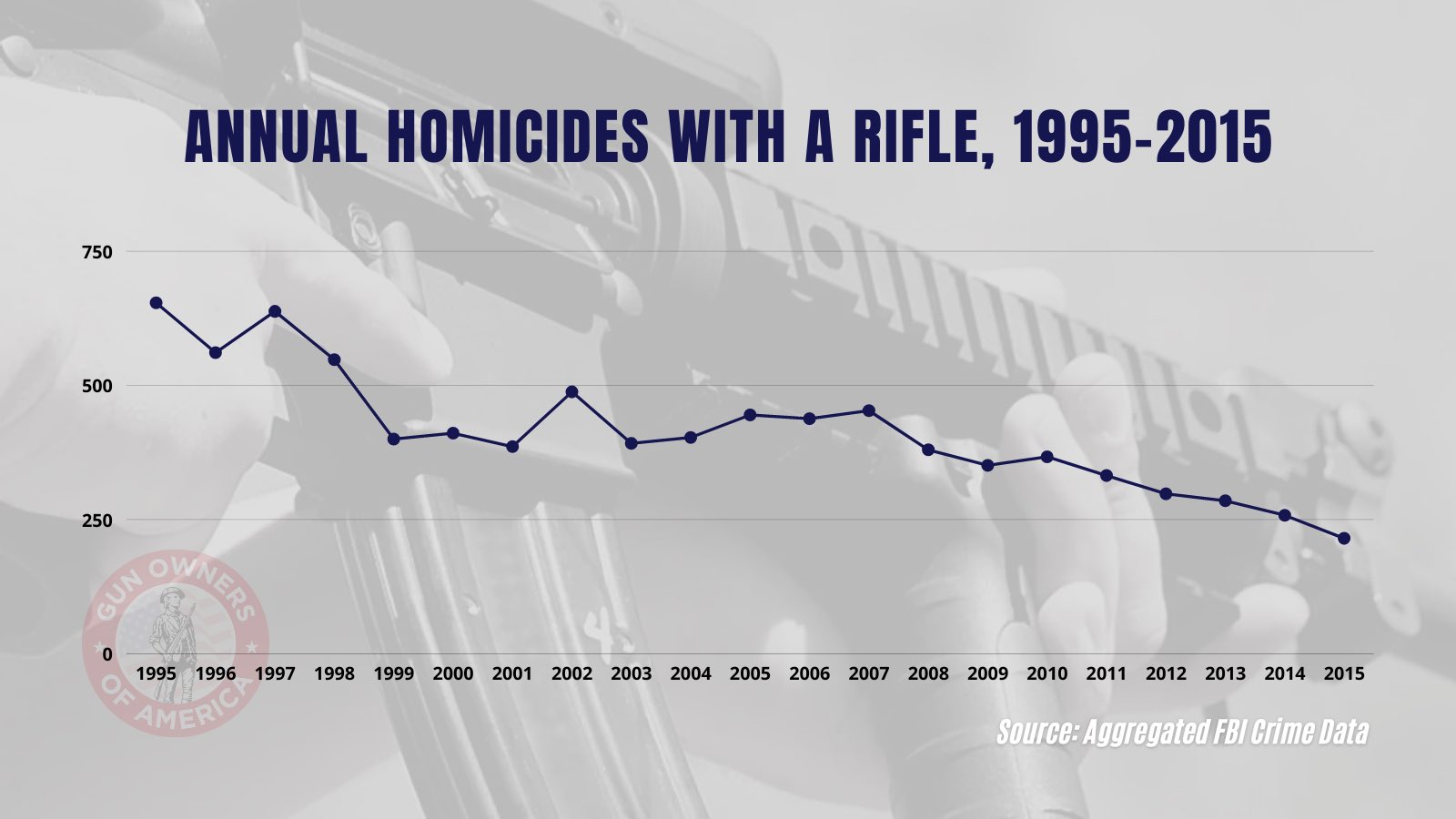
With the expiration of the federal assault weapons ban in 2004, millions of common AR-15 style rifles hit the market, yet annualized homicides by rifle continued to trend downward. GOA opposes any new bans on these commonly owned weapons.
Well, to be honest, in a ‘free country’, I’ve never thought that the police could prevent any crime. That requires an authoritarian Police State the likes of which would be on par with North Korea. The poor people who always believed this, were always wrong, and that’s what’s sad; they were delusional
Confidence in Law Enforcement to Prevent Mass Shootings Plummets
A new poll from Convention of States Action and the Trafalgar Group shows Americans no longer trust local and federal law enforcement to stop mass shootings. This outcome should be no surprise after a long string of mass shootings where law enforcement knew the perpetrator before the tragedy.
The tragic school shooting in Uvalde, Texas, is the latest example. However, school officials and law enforcement were aware of the risks posed by the shooter in Parkland, Fla., and the other mass shooting tragedies since then. It seems the left’s preoccupation with social justice rather than criminal justice prevents law enforcement at all levels from taking proactive action to prevent violence. The social justice push ended stop and frisk in New York City and ensured red flag laws in Illinois and New York were useless.
These examples may explain why a majority of voters report they are not confident local authorities can prevent a mass shooting before it happens. Sixty-two percent of voters say they are not sure their local law enforcement or federal agents could identify and stop a violent person before they started a mass shooting. More than a quarter (26.9%) report they are not confident at all. Only 9.8% indicated they are very confident in their local authorities’ ability to prevent a mass shooting.
Uvalde officers not immediately and aggressively confronting the gunman in the elementary school was reminiscent of law enforcement failures in the Parkland shooting. “Americans watched in horror as an active shooter was permitted to rampage through a school while the police stood outside and did absolutely nothing. Over and over again, citizens are given the clear message that—when it comes to protecting loved ones—you’re on your own,” said Mark Meckler, President of Convention of States Action.
Americans are painfully aware of the tragic results in these situations and believe in the “good guy with a gun” more than the gun grabbers would like. According to the poll, a plurality believes their fellow citizen with a firearm is the best protection for them and their family in a mass shooting situation. Almost 42% of voters believe that an armed citizen would be their best protection if they were caught in a mass shooting event. Local police retained the confidence of 25.1%, and 10.3% had the most faith in federal agents. Almost one-quarter said none of the above.
Results indicating how many respondents feel they will best protect themselves and their families would be an interesting supplement. Democrats appear the most fatalistic, with a plurality of 33.9% saying they do not trust anyone to protect them and their family in a mass shooting event. But, they are still the party pushing for strict gun control. Meanwhile, 70.4% of Republicans trust armed citizens the most, while only 16.8% and 1.6% trust local or federal law enforcement.
Yet, somehow, our leaders in Congress think more gun laws are the answer. The recent bi-partisan gun law does little to prevent these tragedies, especially in an environment where citizens are losing trust in law enforcement. “At the same time, we’re told guns are the problem, and we should give up our right to self-defense,” Meckler noted. “Voters are not stupid. They understand that responsible citizens offer the best means of protecting our schools, homes, and communities in this country. Pursuing such policies is not only bad politics, it puts all of us at risk.”
As if to prove the point made by a plurality of voters, an armed citizen stopped a mass shooter in a mall food court in Indiana yesterday. According to law enforcement, the gunman shot three people fatally and injured two Sunday evening before a good guy with a gun shot and killed him. The shooter entered the mall with a rifle and several magazines. Greenwood Police Dept. Chief Jim Ison said, “The real hero of the day is the citizen that was lawfully carrying a firearm in that food court and was able to stop the shooter almost as soon as he began.” The poll ended before reports of this shooting appeared in the news cycle.
A legally armed citizen recently thwarted another mass shooting in West Virginia. A woman used her pistol to shoot a man who had returned to a graduation party with a rifle. He had been in a verbal altercation with the partygoers earlier in the day. “This lady was carrying a lawful firearm,” Lt. Tony Hazelett of the Charleston Police Department said. “A law-abiding citizen who stopped the threat of probably 20 or 30 people getting killed. She engaged the threat and stopped it. She didn’t run from the threat. She engaged it preventing a mass casualty event here in Charleston.”
Examples like these may be why states like Texas, Georgia, and others are passing open and constitutional carry laws. Indiana Gov. Eric Holcomb signed constitutional carry in March of this year. As of July 1, no legal gun owner in Indiana is required to have a carry permit after passing the required background check. That law may have made all the difference for the Hoosiers in the mall on Sunday.
The Greenwood Mall Shooting Should End Claims of the Danger of Permitless Concealed Carry.
During the recent attempted mass shooting at the Greenwood Park Mall in Indiana, a 22-year old man who was lawfully carrying a pistol stopped the killing. For this heroic action, he’s been called “good Samaritan” by local law enforcement. Even the owners of the mall, (who ban guns on their properties praised his actions. That got under the skin of anti-gun activists.
Why? If they were forced to be honest about it like the main character in the 1997 film Liar Liar, they’d have to admit that a quintessential case of a good guy with a gun stopping a bad guy with a gun is utterly devastating to their case against civilian gun rights.
Sadly (for them) the facts keep coming in, and they continue to be very bad for the gun control industry’s agenda. Not only does Greenwood Park clearly demonstrate that permitless carry (a.k.a. constitutional carry) saves lives, but one of the key arguments against permitless carry was also destroyed.
Constitutional Carry Allowed Lives To Be Saved
Recent reporting from WRTV News sheds light on an important detail in how this mass shooting was stopped . . .
According to [Greenwood Police Chief James] Ison, [Eli] Dicken did not have a permit for his handgun, but due to the passage of the “Constitutional Carry” bill in Indiana, he was legally carrying the weapon.
“I am 100% certain that many more people would have died last night if it wasn’t for his heroism,” Ison said.
If there’s a more devastating message for the forces of gun control, I don’t know what it would be.
A New Report Casts Doubt on the Assumption That Gun Law Violators Are a Public Menace
The vast majority of federal firearm offenses involve illegal possession, often without aggravating conduct or a history of violence.
A new report on federal firearm offenses shows that the vast majority involve illegal possession, often without aggravating circumstances or a history of violence. The data undermine the assumption that people who violate gun laws are predatory criminals who pose a serious threat to public safety. They also highlight the racially disproportionate impact of such laws, which is especially troubling given their excessive breadth.
In FY 2021, the U.S. Sentencing Commission (USSC) reports, 89 percent of federal firearm offenders were legally disqualified from owning guns, typically because of a felony record. Half of those cases involved “aggravating criminal conduct.” But in the other half, the defendant’s “status as a prohibited person solely formed the basis of the conviction.”
The aggravating conduct, which triggered sentencing enhancements under the USSC’s guidelines, covered a wide range.
In 11 percent of the cases involving aggravating conduct, “an offender or co-participant discharged a firearm.” In 4 percent of the cases where a gun was fired, someone was killed; someone was injured in 18 percent of those cases.
Some cases involved a stolen gun, a gun with an “altered or obliterated serial number,” or a prohibited weapon, such as a machine gun or a sawed-off shotgun. Some defendants were engaged in gun trafficking. In more than a quarter of the cases, “the firearm facilitated, or had the potential to facilitate, another felony offense (most commonly drug trafficking).” That last category would include drug dealers who never threatened or injured anyone but kept or carried guns for self-defense.
As you would expect, aggravating factors resulted in relatively long prison sentences. The average was 55 months for cases involving stolen firearms or guns with altered serial numbers, 58 months in cases involving a prohibited weapon, 62 months in cases involving gun trafficking, and 119 months—nearly 10 years—in cases involving “the use of, or conspiracy to use, a firearm in connection with a crime of violence or drug trafficking crime.” In other words, the combination of drug possession and gun possession can be enough to put someone behind bars for a decade, which starkly illustrates the interaction between those two kinds of prohibitions.
In half of the cases involving “prohibited persons,” the defendant “did not engage in additional aggravating conduct.” The average sentence for such defendants was about three years. Even in those cases, you might surmise, the defendants’ prior criminal records probably indicated violent tendencies that justified sending them to prison for possessing a gun. But that is not necessarily true.
17 days after permitless carry goes into effect in Indiana and a young man decides it’s up to him to TCOB.
In case it slipped anyone’s mind, I’ll reiterate that I’m not ‘anti-cop’, I’m anti stupid, and in this case, coward cops.
Uvalde Shooting Report Undermines Calls To Ban Guns and ‘Back the Blue’
Only you can be relied upon to protect you and your loved ones.
Ignore anybody who claims otherwise.
If you really need further evidence of how foolish it is to surrender your right to protect yourself and defer to government employees who are supposed to assume that responsibility, the record of police non-response during the Uvalde mass murder should do the job. Those who, in the future, continue to insist that we disarm ourselves and venerate government enforcers who are tasked to protect us should be unceremoniously kicked to the curb.
“At Robb Elementary, law enforcement responders failed to adhere to their active shooter training, and they failed to prioritize saving the lives of innocent victims over their own safety,” finds a devastating report published July 17 by the Texas House of Representatives Investigative Committee on the Robb Elementary Shooting. “The first wave of responders to arrive included the chief of the school district police and the commander of the Uvalde Police Department SWAT team. Despite the immediate presence of local law enforcement leaders, there was an unacceptably long period of time before officers breached the classroom, neutralized the attacker, and began rescue efforts.
That delay (73 minutes in the report, or 77 minutes according to news stories) was documented in excruciating detail in video of police response published last week in both edited and full form by the Austin American-Statesman and KVUE before it was formally screened by authorities.
“We know now…that some students quietly called 911 from inside the classrooms for help, a critically wounded teacher could hear officers just outside the classroom, and that 911 dispatchers were fielding their calls of desperation,” Manny Garcia, executive editor, wrote for the Austin American-Statesman in explaining the decision to publish the video. “We also know that exasperated parents, family members and bystanders standing outside the school begged authorities to do something. After 77 minutes, the video shows the officers breach the classroom.”
Before the release of the Texas lawmakers’ report documenting failures not just by police, but by school officials who ignored their own security measures, some Uvalde families and government officials criticized the media for publishing the video before a carefully planned screening by Texas lawmakers.
Sen. Chris Murphy Strangely Silent After His ‘Good Guy With a Gun’ Theory Goes Down in Flames
As we previously reported, Sen. Chris Murphy (D-Conn.) appallingly declared in a tweet last Tuesday that the fact that it took the Uvalde police so long to respond to the horrific Robb Elementary School mass shooting “puts to bed, forever” the “good guy with a gun” scenario often cited by Second Amendment defenders in their arguments.
“We’ve always known it was a gun industry created lie, designed to sell more guns,” he also wrote. “Now we just have the gut wrenching proof”:
While the chilling 77-minute police response video from Uvalde was indeed gut-wrenching, it in no way proved Murphy’s point – in fact, it proved just the opposite for reasons I and thousands of others explained to him in response to his remarks.
In the aftermath of the deadly Greenwood, Indiana mall mass shooting Sunday where three were killed and two were injured, Murphy has gone silent on his “good guy with a gun” theory – perhaps because Greenwood Police Chief James Ison noted in a press conference that the shooter was shot dead “almost as soon as he began” by a “good Samaritan,” a 22-year-old unidentified man who Ison said was “lawfully carrying” his firearm:
“The real hero of the day is the citizen that was lawfully carrying a firearm in that food court and was able to stop that shooter almost as soon as he began,” Ison told reporters during a press conference on Sunday night.
Greenwood Mayor Mark Myers also confirmed that the suspect was “shot by an armed individual,” whom he called a “good Samaritan.”
“This person saved lives tonight,” Myers said in a statement late Sunday. “On behalf of the City of Greenwood, I am grateful for his quick action and heroism in this situation.”
Silence from Gun Prohibitionists After Armed Citizen Stops Mall Shooter
Once again, gun prohibition lobbying groups are locked in silence after a legally-armed 22-year-old intervened quickly to fatally shoot a would-be mass killer who opened fire at the Greenwood Park Mall in Greenwood, Ind., in an action police are hailing as heroic.
“The real hero of the day is the citizen that was lawfully carrying a firearm in that food court and was able to stop the shooter almost as soon as he began,” Greenwood Police Chief Jim Ison told a press briefing Sunday evening.
Reuters quoted Greenwood Mayor Mark Meyers, who said in a prepared statement, “We do know that someone we are calling a ‘Good Samaritan’ was able to shoot the assailant and stop further bloodshed. This person saved lives tonight. I am grateful for his quick action and heroism.”
It is not the first time an armed private citizen has killed a killer. According to the FBI, last year armed citizens stopped six “active shooters.” In four of those cases, the perpetrator was killed. In each case, the gun ban lobby was mum.
CNN noted in its coverage of the shooting, “It’s rare to have an armed bystander attack an active shooter, according to a data analysis published by The New York Times.”
“There were at least 433 active shooter attacks in the US from 2000 to 2021, according to the data analysis,” CNN added. “Active shooter attacks were defined as those in which one or more shooters killed or attempted to kill multiple unrelated people in a populated place.”
“Of those 433 active shooter cases, an armed bystander shot the attacker in 22 of the incidents. In 10 of those, the ‘good guy” was a security guard or an off-duty police officer, the Times reported.”
Three people were killed and two others wounded before the unidentified armed citizen intervened. However, authorities have suggested things could have been much worse if the killer had been able to continue his mayhem.
There is a small bit of irony reported by Reuters, which notes the mall is owned by the Simon Property Group, and they have a “no guns” policy. Here is the mall’s Code of Conduct found online:
While visiting this mall, the following general activities will not be accepted:
- Violations of the law
- Any activity that threatens the safety of our guests, tenants and/or employees
- Any activity that threatens the well-being of the property
- Any activity that disrupts our pleasant, family-oriented shopping environment
- Any activity inconsistent with the general purpose of the property, which is shopping, dining, visiting theaters or offices for business purposes
- Any activity that would disrupt the legitimate business of the property and its tenants
Examples of specific activities that are prohibited include but are not limited to:
- Disruptive profanity, vulgar or threatening language
- Unnecessarily blocking walkways, roadways or storefronts
- Running, horseplay or disorderly conduct of any nature
- Excessive loitering
- Operating unauthorized recreational and/or personal transportation devices in the shopping center
- No firearms or illegal weapons
“The center is a privately owned property. Guests who do not act responsibly may be asked to leave. If they refuse to leave the property, they may be arrested and prosecuted for criminal trespass.”
Clearly, the dead gunman violated virtually all of these rules, while the armed citizen apparently violated only the last tenet.
Greenwood Park Mall posted this statement on its website:
“We grieve for the victims of yesterday’s horrific tragedy at Greenwood Park Mall. Violence has no place in this or any other community. We are grateful for the strong response of the first responders, including the heroic actions of the Good Samaritan who stopped the suspect.”
BBC asks what’s next for gun control in the US
The United States has just passed a gun control bill. It doesn’t do all that much, though it’s still an infringement on our right to keep and bear arms.
However, for many, it’s nothing but a first step, a good start toward still more regulations imposing on our right to keep and bear arms.
Over at the BBC, they ask
what’s next for gun control here in the US.
Last month, US President Joe Biden signed a landmark gun-control bill into law.
While the legislation, which was passed with bipartisan support, has many limits, it was a step in America’s efforts to tackle escalating gun violence. Meanwhile, the Supreme Court issued a decision that cast the future of more strict limits on gun ownership in doubt.
So where does gun control go from here? Here’s a look at some solutions that gun-control advocates and gun-rights proponents say could help stop escalating gun violence – and our North America correspondent Anthony Zurcher assesses their chances.
The future of red flag laws
Red flag laws, also known as Extreme Risk Protection Orders, allow police to temporarily seize legally owned guns from people who a judge has ruled to be a danger to themselves or others.
A judge’s emergency order can be issued even in cases where a gun owner has no criminal record or history of mental illness.
Opponents say this violates the right to due process, as the orders can be issued by a judge without the subject present to object.
They go on to bring up things like assault weapon bans, gun buybacks, new rules for younger gun buyers, and a bunch of other things.
Now, in fairness, they also mention arming teachers and hardening schools as well, but not until the very end and even then, the story drips with bias and disdain.
However, all of this ignores the political realities gun control measures face here in the United States.
In other words, it’s easy for the BBC to ask what’s next, but the truth is that the Biden administration has gotten all they’re going to get. You know the gun control side asked for much more, but what they got was the totality of what they were going to get. There’s nothing left on the table.
Even Sen. John Cornyn, who sold us out, has said there’s nothing more that will be done.
So while the BBC can ponder the future of gun control, it’s nothing more than journalistic navel-gazing. It’s an exercise in what might have been and nothing else, because we’re not interested in giving up more ground and the gun control side is only interested in gun control. They don’t care about kids, they care about taking away our rights.
If they were, they’d at least be open to hardening schools. The fact that they’re not tells you they don’t care about dead kids, they care about taking away your guns.
The BBC can ask the question all they want, but we all know the real answer here.