
You want to see what gun control looks like? Study every genocide in modern history.
— Black Guns Matter (@blkgunsmattr) March 9, 2026

You want to see what gun control looks like? Study every genocide in modern history.
— Black Guns Matter (@blkgunsmattr) March 9, 2026
Senate President Responds To Criticism Of Bill Killed ‘In The Dark’
Senate President Randy Smith, R-Preston, responded Friday to criticism from the chamber floor about the lack of action on legislation loosely referred to as “the machine gun bill.”
Senate Bill 1071 would have created the state’s Office of Public Defense, to require the West Virginia State Police to sell machine guns to qualified citizens of the state. There was no fiscal note attached to the bill and it stipulated that the state police would have to take on this responsibility with no additional staff. The bill was approved by the Senate Judiciary Committee, but never made it to the chamber floor.
Sen. Laura Chapman, R-Ohio, was openly angered.
“It was killed without transparency and without consensus,” Chapman said Tuesday on the Senate floor. “The decision was made in the dark, despite the fact that this bill had overwhelming support by this body. This is exactly why the public doesn’t trust politicians.”
Smith said in a statement Friday that he alone decided not to take the bill up and said he did so without reservation. He called it a “poorly drafted piece of legislation” that was unlikely to pass the House of Delegates and would face numerous legal challenges if it did.
“With an issue as critical as the protection of our Second Amendment rights, we must ensure the legislation we pass will survive legal challenge. This would not have,” Smith said.
“My record with the NRA (National Rifle Association) and WVCDL (West Virginia Citizens Defense League) is unquestioned, and West Virginians unquestionably trust the judgment of these groups on Second Amendment issues. And, further, I trust them,” he added.
He said the behavior of an out-of-state group behind the bill had been disappointing but welcomed the Gun Owners of America to consider legislation next year – preferably earlier in the session.
California’s Anti-Gun AG Wants to Dictate Law to Rest of Nation
California Attorney General Rob Bonta is a piece of work. We thought Kamala Harris was bad in that role, but the truth is that Harris was always going to be held back by her inability to form actual sentences.
Bonta, though, can. Unfortunately, he uses those actual sentences to repeatedly attack the rights of law-abiding Americans.
His latest target, though, isn’t someone within his own state. He’s going after people who engage in perfectly legal activity elsewhere, all because some Californians break the law.
A lawsuit filed by Calif. Att. Gen. Rob Bonta and San Francisco City Attorney David Chiu is targeting the Gatalog Foundation Inc. and CTRLPEW LLC.
California claims that Gatalog and CTRLPEW are providing prohibited persons with plans to make “ghost guns” (3D printed firearms without serial numbers).
Matthew Larosiere, who is an attorney in Florida and is loosely connected to hobby gunsmiths via Gatalog, is one of the people California is suing. He explains in this video interview that what they call “Gatalog” is just hobbyists who found each other on the internet. They are not selling guns. They are talking about and toying with concepts for guns digitally.
“If California can regulate access to the instructions,” said Larosiere. “Not just by California, but with this lawsuit, [then] what they’re saying is they want to regulate the entire internet worldwide. That would mean that you’d be cut off at the heels from making a gun at home. And I think most of us can agree that if you have a right to keep and bear something, it necessarily subsumes the right to acquire it.”
When asked about Gatalog, Larosiere explained that it is not a group “like the NRA. There’s no member that has a card; there’s no board of directors; there’s no nothing. It’s kind of just a group of hobbyists associating around an idea. And the idea is home gunsmithing.”
In other words, Bonta wants to shut down access to this information, not just for people in California, but throughout the nation. If we can’t share the information freely, then it might as well not exist from a lawful perspective.
But it should be remembered that files are just computer code, and computer code has long been ruled as a form of speech.
As I wrote about on Wednesday, we don’t stifle access to The Anarchist Cookbook or P.A. Luty’s book on making your own submachine gun with things you can get from Home Depot. Those books contain information every bit as deadly as what one might find in 3D printing files, if not more so, and yet, as books, you cannot lawfully ban them.
Bonta is taking it a step further, though, by attacking everyone who he can who shares this information via the internet.
He’s trying to use his authority as the attorney general of California to dictate to the rest of the nation what it can and cannot do with regard to 3D printing guns.
As it is, California has a long history of trying to dictate to the country what it should and shouldn’t do. They create standards that industries are obliged to follow, even if the rest of us want nothing to do with them, and we’ve accepted it because the companies are the ones making the decision to use those standards throughout the nation.
We don’t want it, but it’s easier for them.
This is different. This is them attacking our rights because they don’t want the American people to be able to do something they’ve already forbidden the small percentage of the population living there from doing.
If ever there were an example of statehood being a mistake…
Gun Rights Turncoat John Cornyn Can’t Seal the Deal in the Texas GOP Senate Primary.
In Tuesday’s primary in Texas, Republican voters delivered a stinging slap to long-time incumbent U.S. Senator John Cornyn. Despite drowning in establishment cash, wielding decades of name recognition, and boasting endorsements from the old guard, Cornyn couldn’t seal the deal in the three-way race.
He finished with barely over 40% of the vote, just ahead of Texas Attorney General Ken Paxton. Meanwhile Rep. Wesley Hunt came in a distant third. No outright winner, but the message was clear: Cornyn’s Senate throne, thought to be untouchable, is perilously close to being lost. A May 26 runoff with Paxton now looms as quite possibly his political funeral.
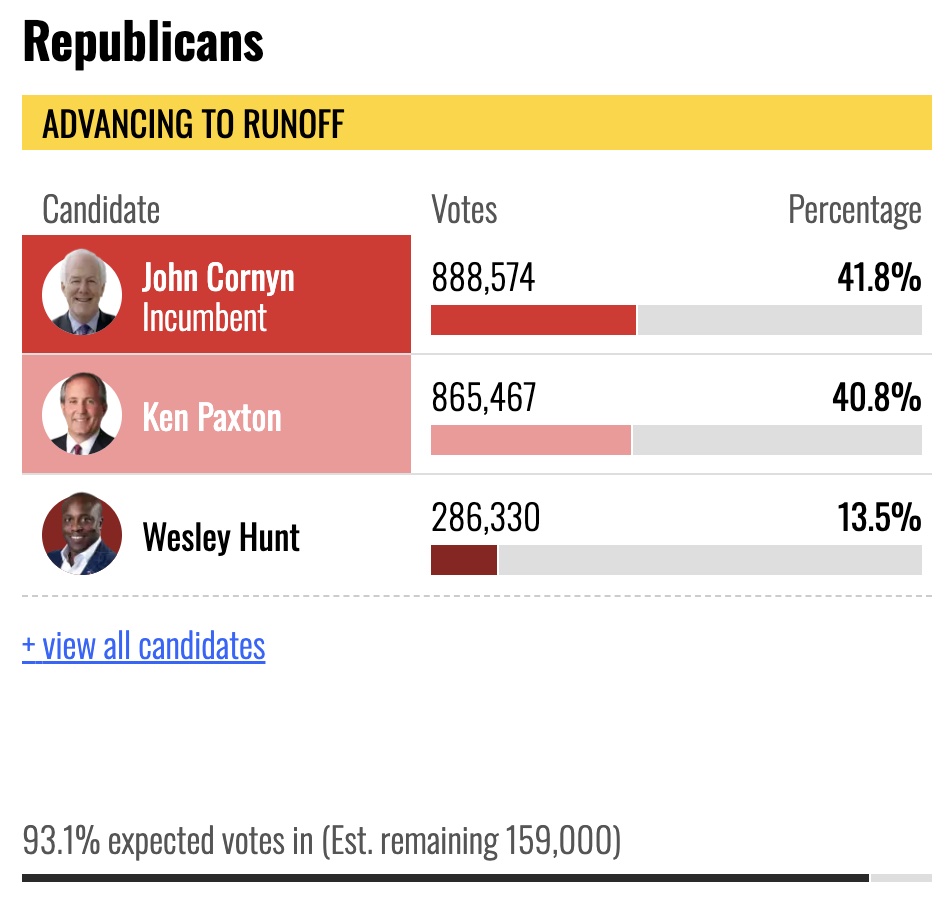
What hurt him most? In addition to his GOPe reputation, his stance on guns has been his Achilles heel. Cornyn’s unforgivable 2022 betrayal of gun owners was top of mind for Texas GOP voters. After Uvalde, he threw in with prominent gun-hater Chris Murphy to co-author the disastrous Bipartisan Safer Communities Act.
Virginia House Passes Amended Version of Senate’s ‘Assault Weapons’ Ban
Virginia Democrats continue to advance a number of gun control bills, with the House of Delegates approving an amended version of the Senate’s ban on so-called assault weapons and large capacity magazines on Wednesday.
The major change to the legislation is the new definition of “large capacity” magazines, which is now arbitrarily set at 15 rounds instead of 10. The House version of the gun and magazine ban was also modified in a Senate committee on Wednesday, and it looks to me like the two bills are now compatible with each other, which would avoid the need for a conference committee to negotiate on the final language for the bills once they’ve been approved by both chambers.
The Senate’s vote on HB 217 could come as early as today, and Gov. Abigail Spanberger could conceivably sign the bill into law next week. Interestingly, Spanberger has yet to sign any of the gun control bills that have passed out of the General Assembly, including a gun storage mandate and an expansion of the state’s “red flag” law.
With the legislature set to adjourn on March 14, my guess is that Spanberger will wait until the Democrats entire anti-2A package is ready for her to sign, and then she’ll make a big press event complete with representatives from all the major gun control organizations. So what else is likely to pass between now and next Saturday?
Based on the Virginia Citizens Defense League’s legislation tracker, I think we can expect the following infringements to be enacted into law:
– legislation allowing gun makers, distributors, and sellers to be sued for the actions of criminals under a public nuisance standard and for violating a vague “code of conduct” imposed on the industry.
– a ban on the possession and manufacture of unserialized firearms
– a $500 penalty and the towing of any vehicle where a firearm is left visible inside
– an end to Virginia’s universal reciprocity for concealed carry licenses and a much more restrictive standard put in place by the anti-gun Attorney General
– the creation of the Virginia Center for Firearm Violence Intervention and Prevention, which will serve as a job placement program for the gun control lobby as well as creating and pushing junk research aimed at promoting gun control efforts.
– turning all state-owned or leased buildings into “gun-free zones”
– a firearm “give back” program allowing people to turn their firearms over to the state police
– a ban on openly carrying most long guns in places open to the public
– creating a new “gun free zone” starting 100 feet outside of any polling place or outside a building where a local electoral board is meeting
– new requirements for mandated concealed carry training courses, including instructor certification by the Department of Criminal Justice Services
Some items, like a proposed “permit-to-purchase,” an 11% excise tax on the sale of firearms and ammunition, and a $500 tax on the sale of suppressors, have been pushed back until 2027, but Democrats haven’t entirely given up on those ideas.
Earlier today I noted the effect that these gun control bills are having on Virginia gun sales, but they’re also having an impact on local politics. On Wednesday the Virginia Citizens Defense League provided an update on the resurgence of the Second Amendment Sanctuary movement in the Commonwealth, and reported there are now 48 localities and sheriffs that have reaffirmed their stances. I’m happy to say that includes my home county. The full list can be found here, and VCDL has also provided links to comments made by some sheriffs, like this from Campbell County Sheriff Whit Clark.
Considering the proposed Virginia Firearms legislation, the Campbell County Sheriff’s Office reaffirms its unwavering support for the 2nd Amendment rights of law-abiding citizens.
The Campbell County Sheriff’s Office will not infringe upon the constitutional rights of citizens to legally possess obtained firearms, magazines, ammunition, or related equipment.
It is the heritage of citizens of Campbell County to bear arms for hunting and sport and to have for their protection for the use for self-defense. The residents of Campbell County are responsible gun owners who value safety, liberty and the rule of law.
As your Sheriff, I remain committed to ensuring public safety while steadfastly defending your constitutional right to keep and bear arms. Our office will continue to serve this community with integrity, respect and dedication.
I’d like to see every sheriff in the Commonwealth go on the record as Clark has, and I encourage Virginia gun owners to reach out to their county supervisors and sheriffs and encourage them to take a public stand in support of our Second Amendment rights and against the flagrant attack on those rights by the Democrat majority in Richmond. We aren’t going to be able to defeat many of these infringements at the statehouse, but we can and will fight them in court… and we can also press our local law enforcement to exercise their discretion not to enforce any laws that trample on our civil liberties.
Brandon is an utterly rabid pro-RKBA person who advised if he was made head of ATF, he would – among other antibureaucrap things – institute continuing amnesties for any and all NFA firearms
Gun Rights Activist Brandon Herrera Forces Rep. Gonzales Into Texas GOP Runoff
One of the most closely watched Republican primaries in the country has turned into a political earthquake in South Texas. Gun-rights activist and firearms manufacturer Brandon Herrera has forced incumbent Rep. Tony Gonzales (R-TX) into a runoff election in Texas’ 23rd Congressional District, signaling deep dissatisfaction among grassroots conservatives and Second Amendment voters.
With nearly all votes counted in the March 3 Republican primary, Gonzales and Herrera each captured enough of the vote, leaving neither candidate above the 50-percent threshold required to win outright under Texas election law.
The result sends the race to a May 26 runoff, where Republican voters will decide whether to renominate the incumbent or replace him with one of the most recognizable gun-rights voices in the country.
For many gun owners, the race has become a referendum on the direction of the Republican Party—and whether Congress will have members willing to unapologetically defend the Second Amendment.
But as Kentucky’s goobernor is a democrap, the legislature will need a veto-proof majority to override his expected idiocy.
Second State Seeks to Run Its Own Machine Gun Sales to Residents
Following a roadmap drawn by gun rights advocates to end-run around the Hughes Amendment, Kentucky could soon be a very select-fire-friendly state.
As previously reported by Guns.com, a bill in the West Virginia Senate would establish an Office of Public Defense tasked with selling machine guns to interested members of the public who can legally possess such a firearm. Unlike the massively inflated prices seen for “Pre-86” transferable and highly collectible machine guns that were grandfathered under the Hughes Amendment to the Firearm Owners’ Protection Act signed by President Reagan, these could be “Post-86” guns at much more affordable prices.
Taking the West Virginia bill – which was written by Gun Owners of America – as a template, Kentucky state Rep. TJ Roberts (R) last week introduced HB 749 to the legislature in the Bluegrass State.
As detailed by Roberts, who is a practicing attorney, a Kentucky Colonel, and a member of the Federalist Society:
Through our history, Americans have armed themselves in case of invasion, but the NFA has significantly overburdened this practice through an unconstitutional tax and registration regime that has not defended public safety but only harmed essential liberty.
But there is a way out!
Since 1986, Federal Law has allowed for state governments to transfer machine guns to their citizens who are otherwise allowed to possess a firearm. HB 749 would create a process to sell machine guns to legal gun owners.
Kentucky House Bill 749, co-sponsored by six fellow Republicans, has been referred to the House Committee on Committees.
Gun Control Groups Mum After Hemani Oral Arguments
The Supreme Court’s decision in U.S. v. Hemani is likely to have major implications for millions of Americans who own firearms, use marijuana, or both (in violation of current federal law). And it’s not like the gun control lobby has completely ignored the case. Both Brady and Everytown for Gun Safety submitted amicus briefs supporting the Trump administration’s position that Section 922(g)(3) can be used to prohibit any and all “unlawful” drug users, regardless of what drug it is, how much of it is taken, or whether that individual drug user has ever shown themselves to be a danger while under the influence.
Yet, at least as of mid-afternoon on Monday, none of the anti-gun groups have made a peep about today’s oral arguments, which doesn’t seem to have gone well for the government. The closest commentary that I’ve been able to find comes from Duke Center for Firearms Law, which is run by an attorney who has worked extensively with groups like Everytown in the past. At least Duke’s willing to acknowledge what happened.
Hemani debrief: overall, justices seemed very skeptical of the govt’s argument. Only Alito and the Chief are clearly on the govt’s side. A lot of skepticism about how habitual drunkard statutes are sufficiently relevant to 922g3’s restriction on unlawful users.
— Duke Center for Firearms Law (@DukeFirearmsLaw) March 2, 2026
Pepperdine University law professor Jake Charles, who helped author a brief in support of the government’s decision, was also following along to the oral arguments, and he too struggled to find a positive takeaway from the “MOAR GUN LAWZ” point of view.
I think the Chief & Alito are very skeptical of the challenger here; they seem to think Congress can of course disarm drug users. But…it’s hard for me to see many other justices clearly on that side. I’m sure the govt will get more than 2 votes, but not sure it’ll be a majority.
I wouldn’t be surprised if it’s 7-2, though I could also see Justice Clarence Thomas joining Alito and Roberts in voting to uphold 922(g)(3) as it applies to Ali Danial Hemani.
I don’t think Charles fairly describes the challenger’s position, though. Hemani’s attorney Erin Murphy repeatedly stated that Congress could categorically deny firearm possession to some drug users, so long as it its rationale was grounded in the national tradition of firearm regulation and was based on a factual finding of a particular drug’s dangerousness. What it can’t do, however, is look at historical statutes that regulated the behavior of “habitual drunkards” and assume it has the power to treat all “unlawful users” of drugs in roughly the same fashion.
Murphy did an excellent job of pointing out that “drunkards” weren’t just people who regularly imbibed alcohol. If that was the definition, then most American adults could have been stripped of their Second Amendment rights. It was the fact that their alcohol use rendered them a danger to themselves or others that gave the state the authority to step in and impose sanctions on their individual liberties. That argument can and does certainly apply to some habitual drug users, but it’s hard to argue with a straight face that it applies to every one of them.
I was a little nervous about where a majority of the justices would come down before oral arguments began, but I feel much more confident after listening to two hours of questioning. It may be 7-2, 6-3, or even 5-4 if Kavanaugh or Barrett throws us a curveball, but I believe there’ll be a majority ruling in Hemani’s favor. How broad or narrow it is I’d say is still very much undecided, and we will likely see some of the justices in the majority use very different arguments and rationales before they end up in the same place.
Which brings us back to today’s silence of the gun control groups. Yes, Everytown and Brady submitted briefs in favor of the DOJ’s position, but no anti-2A group has really been talking heavily about Hemani, because they know that as much as most Democrats despite our right to keep and bear arms, they’re also not generally fans of putting people behind bars… even for serious, violent offenses. Moreover, most Democrats support legalizing marijuana, and aren’t really keen on using its federal status as a Schedule 1 drug as an excuse to go after people, gun owners or not.
If I’d been advising Everytown or Brady I would have told them to side with Murphy and her client. Even if they had argued that yes, the statute is confusing, vague, and unconstitutional as it applies to this individual, but it still has merit in other criminal cases, that would be a defensible position (at least depending on where they drew the line). By declaring that the law is valid in all applications, though, the anti-gun groups have positioned themselves on the wrong side of history and a large number of the Democrats they depend on as their base of support.
Trump’s ‘wishy-washy’ is him shooting off his mouth “NOO YAWK” style with the first thing that pops into his head. No, I don’t trust him, but he’s 10,000 times better than any demoncrap would be.
Trump’s Wishy-Washy Support of Second Amendment Drawing Mainstream Media Attention
President Donald Trump has, without a doubt, done more for gun rights than any prior administration, at least within my lifetime. Even the great Ronald Reagan managed to take us a step backward with the 1986 machine gun ban, so Trump has that going for him.
The problem, as I’ve already hinted at, is that the bar was so low, an amoeba couldn’t limbo under it even with the help of a shovel.
It didn’t really take all that much.
Which is why I can acknowledge where he stands in gun rights history and still have a problem with the wishy-washy nature of how the Department of Justice looks at gun rights.
The problem is that now, it’s not just us noticing. NBC News is seeing it, too.
WASHINGTON — Soon after President Donald Trump took office last year, he issued an executive order proclaiming his steadfast support for the right to bear arms, but a year later, gun rights advocates say the administration has failed to live up to his promises.
Even as the administration has challenged some state firearms laws, it is also defending long-standing federal gun restrictions in court, including one being considered by the Supreme Court on Monday. That case concerns whether users of illegal drugs can be barred from possessing guns.
Gun rights advocates who are challenging those laws say they are frustrated to see the Trump administration defending the restrictions.
“The Trump administration has been very good on gun rights issues that are coming up in the states. The same isn’t true at the federal level,” said Cody Wisniewski, president of the Firearms Policy Coalition Action Foundation.
While the federal government generally has a duty to defend federal law, there have historically been exceptions when the Justice Department concludes a particular measure is unconstitutional.
Wisniewski expressed some bafflement at the government’s strategy, adding: “I haven’t received an explanation.”
Aidan Johnston, director of federal affairs at Gun Owners of America, similarly praised Trump for taking some actions to further gun rights, but criticized the Justice Department for a “very mixed record on the Second Amendment” overall.
Honestly, Johnston is putting it mildly, to say the least.
While I applaud every step the DOJ has taken to address state and local infringements on the right to keep and bear arms, they seem unwilling to look at any federal measure with a critical eye. In fact, every federal law has gotten a vigorous defense from the DOJ, regardless of how stupid it might be.
The latest is defending the law prohibiting marijuana users from owning guns.
The DOJ could go out today and shut down all the dispensaries throughout the country. They could end the idea of legalized marijuana usage on any level, at least outside of the medical field–the Department of Health and Human Services plays a role in where a drug is scheduled, after all–and put all of this to rest.
They haven’t and they won’t.
But they’ll allow it to be used openly for recreational purposes in several states and do nothing but defend the law prohibiting the right of those who do so to even own a firearm.
That’s the inconsistency that bothers me.
What’s more, though, is that while NBC News isn’t particularly trustworthy–it’s just part of the mainstream media, after all–the fact that they’ve seen this and are amplifying it means that some of those who like the Second Amendment but aren’t the die-hard pro-2A advocates are going to see how lukewarm the Trump administration really is on our gun rights.
Is this an artifact of Pam Bondi being in charge? She defended Florida’s post-Parkland gun control laws, after all, and we all know she didn’t have to.
So yeah, this could be a Bondi issue.
However, she still works for Trump. If he tells her to stop, she’ll either stop or be looking for work.
He hasn’t.
President Harry Truman had a plaque on his desk that said, “The buck stops here.”
That applies to any president. The buck stops in the Oval Office, which means even if Trump isn’t completely in favor of what Bondi is doing, he’s still ultimately responsible.
With the midterms coming up, Republicans need every vote they can get. Rallying Second Amendment supporters by actually accomplishing something is the best option.
But NBC News figures that’s not going to happen, which is why I think they’re running this. Since they didn’t have to make all that much up, so much the better.
New Coalition Claims It’s Found Common Ground on Gun Laws
Not every gun owner is a Second Amendment advocate; a fact that major anti-gun groups like Giffords, Brady, Everytown and smaller outfits like 97 Percent know very well. The gun control lobby doesn’t approve of too many gun owners, but those who are willing to endorse restrictions on their right to keep and bear arms are what the Communist Party used to call “useful idiots”; naive people working against their own interests while believing they are fighting for a righteous cause.
Now there’s a new group on the scene claiming to have found common ground between gun owners, Second Amendment advocates, and gun control activists… and they’re viewing Wisconsin as a laboratory for their experiment.
The result is a package of eight proposals that, when taken together, would reduce firearms injuries and deaths while protecting gun owners’ rights, the group asserts.
“We are here to deliver a message of hope,” said Dr. Michael Siegel of Tufts University School of Medicine in Boston, who launched the coalition, during an online news conference on Feb. 26.
“It is possible to break through polarization and achieve a consensus on contentious policy issues,” he said.
The group’s policies include extreme risk protection orders, also called ‘Red Flag Laws,’ gun storage laws, background checks, firearms education in schools, gun dealer oversight, and suicide prevention.
It’s noteworthy what’s not included. There’s no effort to limit the sale of certain guns, such as assault-style rifles or higher-capacity ammunition magazines.
Well, gee, how big of them. Is there anything that actually strengthens the right to keep and bear arms in their proposals, other than perhaps firearms education in schools? It doesn’t sound like it. Instead, the group seems to be offering a smattering of non-objectionable ideas (at least in theory) along with a much longer list of restrictions on the right to keep and bear arms.
Kentucky HB 749 Follows West Virginia in Expanding Citizens’ Access to Modern Machine Guns
In a decisive move that reaffirms Kentucky’s proud heritage as a constitutional carry state and a bulwark for unalienable rights, Rep. TJ Roberts (R-Burlington) introduced House Bill 749 on February 25, 2026. This landmark legislation establishes an Office of Public Defense within the Kentucky State Police, tasked with acquiring and transferring modern, select-fire machine guns directly to law-abiding citizens. HB 749 is nothing short of revolutionary: it weaponizes a clear federal exemption to dismantle the artificial, unconstitutional barriers erected by the 1986 Hughes Amendment, restoring to Kentuckians the very arms the Founding Fathers intended for a well-regulated militia and the security of a free state.
Rep. Roberts, a steadfast defender of the Second Amendment who just days ago voted against HB 299, the GOP-backed bill criminalizing Glock switches, has long argued that law-abiding citizens deserve parity with the very tools carried by law enforcement and the military. “Federal law explicitly allows states to sell machine guns to their citizens,” Roberts declared upon filing the measure. His bill does exactly that, sidestepping the Hughes Amendment’s post-1986 registration ban through 18 U.S.C. § 922(o)(2)(A), which carves out transfers “to or by” a state or under its authority. No more overpaying for pre-1986 “transferables” that now fetch $25,000 to $60,000 on the collector market.
Kentucky residents who pass a standard background check may soon be able to purchase true military-pattern full-auto firearms at reasonable prices, AR-15/M16 platforms, squad automatic weapons (SAW), submachine guns, and the arms “in common use” for militia purposes.
Firearm industry ‘responsible controls’ legislation is existential threat to gun owners
Anti-gun activists think they have figured out a way around the Second Amendment, democratic accountability, and the federal Protection of Lawful Commerce in Arms Act (PLCAA) to impose a limitless raft of gun control on the American people.
The strategy is to enact what civilian disarmament advocates term “firearm industry responsibility” laws in anti-gun states. These laws impose a duty on members of the firearms industry to institute “reasonable controls” over the sale and distribution of their products, on top of the mountains of explicit state and federal statutes and regulations they are tasked to comply with, lest they face ruinous civil liability.
The term “reasonable controls” is vague and ill-defined, resulting in the decidedly unreasonable circumstance where gun industry members can’t know how to comply with the law. These statutes empower anti-gun government officials to abuse the vague language in a manner that imposes ever-expanding restrictions on the industry and its customers, limited only by the officials’ imagination. Moreover, this legislation impacts not just firearms dealers, manufacturers, and distributors as they would be understood under federal law, but includes any business involved in the stream of commerce for ammunition or any other firearm-related products.
The goal is to use the threat of devastating civil liability to force the firearms industry to restrict the rights of themselves and their customers by instituting gun controls that were not enacted (and often rejected) through the democratic process and may be found unconstitutional if imposed directly by government. The entire enterprise is a grotesque and cynical evasion of democratic accountability and constitutional review.
Thus far, 10 states have enacted versions of this legislation, with extremist gun control advocates in Virginia also seeking to enact a variant (HB21) at present.
Brady in 2022: "(Bruen) will assuredly result in more gun violence immediately".
Brady in 2026: "Violent crime has been declining since 2022."
Bwaa haa haa haa haa haa… 🤡🤡🤡🤡🤡🤡 https://t.co/jmX9moWfd5 pic.twitter.com/hVkKfeEiig
— 2A History (@2aHistory) February 25, 2026
Oh look…a Robert Spitzer op-ed. Let’s take a look and see what kind of brilliant insights this very respected expert has for us. He is, after all, an academic that antigun courts take super-seriously. The article’s headline itself — What Happens When the Second Amendment Collides With Public Safety? — is based on a false premise. The reality is, the Second Amendment right to carry need not ever collide with “public safety.”
Especially in the context of the Pretti shooting, Spitzer seems to implicitly accept the argument made by some administration officials (and Trump himself) that the mere act of carrying at a protest means you are asking to be shot by police.
This fraught political moment has thus found the Trump administration in the uncomfortable position of taking criticism from both liberals who blame heavy-handed federal agent tactics and conservatives who bristle at the administration’s seeming abandonment of public gun carry rights.
On the one hand, civilian gun carry is indeed a right under the Second Amendment according to the Supreme Court’s 2022 decision in the Bruen case where the high court said that individuals have a “right to carry a handgun for self-defense outside the home.” The court proposed no exception for doing so in a public gathering.
Spitzer says carry is indeed a right “according to the Supreme Court.” Interesting. I thought it was because the plain text of the Second Amendment says we have a right to bear arms, which all relevant historical sources confirm is a reference to public carry.
If you ever wondered why an “expert” like Spitzer (and the other usual suspects) always takes the side of the government in gun rights litigation, you can start with the fact that they clearly don’t believe the Second Amendment protects an individual right at all.
On the other hand, the consequences of such action are clear. Public gun carrying, especially in the context of a public demonstration or similar gathering is, no matter the intentions of the carrier, a terrible idea.
I should have included the very next paragraph. He basically concedes carry is a right (because SCOTUS said so), but then says it’s a terrible idea to exercise that right.
Missouri? Well, yes.
As West Virginia Machine Gun Sales Bill Makes Waves, Who Else Might Pass Similar Measure?
As we noted on Monday, a bill from Gun Owners of America introduced in West Virginia would allow political entities to sell machine guns to the public. There’s nothing I can think of that would be illegal in this measure, and it would do a whole lot to increase the number of full-auto weapons in the market, thus potentially driving down prices.
But my question is, just who else might go down this road?
I’m sure a lot of pro-gun legislators may look at this and think about introducing it in their states, but introducing bills is the easy part. Getting them passed is where it gets tricky.
So, assuming that it’ll pass in West Virginia–and looking at their makeup, that’s a strong possibility–where else might it pass?
At the top of the list would have to be Missouri. They’ve tried nullifying all gun control laws from the federal government, which would include the National Firearms Act. Clearly, they don’t mind lawful citizens owning machine guns.
Because this doesn’t violate federal law, at least so far as I can see, I could see an enterprising Missouri lawmaker introducing a version of this bill and it actually passing. It’s not like they’re not looking for more ways to be pro-gun, and this is a great way to make that happen.
Wyoming seems to be doing all it can to follow in similar footsteps, so I could see them passing this as well. The same is true of both Dakotas, which seem to be pretty pro-gun.
Montana would be another possibility.
An interesting prospect would be New Hampshire. Its “live free or die” motto is often reflected in its gun laws. It’s one of the best in the nation as things currently stand, so I couldn’t rule out this one making the cut there. However, I also see it being a much tougher fight than we’re likely to see in West Virginia.
Then, of course, let’s look at some ostensibly pro-gun states where there’s not a snowball’s chance in Lucifer’s living room of it passing.
One is, unfortunately, my home state of Georgia.
While we’ve gotten some pro-gun measures passed of late, the tide may well be shifting on that. Plus, we have a lot of Republican lawmakers who are way too squishy on gun rights. They might not want to pass gun control, but they’re not interested in upsetting the status quo, either, and selling machine guns to Georgia residents is probably enough to give them an aneurysm.
Let’s not even talk about Florida. “The Gunshine State” won’t even let legal adults under 21 buy a shotgun for home defense, so there’s no way they’ll sell machine guns to law-abiding citizens.
I can also see it not quite making the cut in Alabama, which recently passed a law that mirrored the feds on illegal machine guns. It’s likely untenable for those lawmakers to decry machine guns one year, then a couple of years later, start selling them to people. It’s a different matter entirely, of course, but politics is often more about perception than reality.
So I’m going to be watching what happens in West Virginia going forward, and it’ll be interesting to see who else jumps to follow.
So, what else is new
SCOTUS Kicks 2A Can Down Road Again
By Dave Workman
Editor-in-Chief
Once again, the U.S. Supreme Court has kicked the proverbial can down the road when it comes to important Second Amendment cases which have been submitted for high court review, leaving another conference session this coming Friday, Feb. 27, to possibly take up one or more of these cases.
As noted by SCOTUSBlog, several high-profile cases are waiting for a decision, one way or the other, on whether they will be accepted. This delay has become a familiar problem with the John Roberts Court, which seems content to not take some cases dealing with semi-auto rifles, original capacity magazines and restoration of rights for years-old non-violent felony convictions.
Minnesota Dems Push Bill Allowing Law Enforcement to Enter Homes to Check Gun Storage
Minnesota Democrats are pushing to allow law enforcement to enter homes to check compliance with semiautomatic gun storage requirements.
On February 20, 2026, Breitbart News reported that Democrats in the Minnesota House were pushing a ban on the ownership or transfer of AR-15s and numerous other semiautomatic rifles.
The legislation, HF 3433, bans the mere possession of a Colt AR-15 and at least 25 other specific semiautomatic rifles and pistols. It then goes beyond those specific guns to ban “any firearm that is another model made by the same manufacturer as one of the firearms listed…and has the same action design as one of the listed firearms, and is a redesigned, renamed, or renumbered version of one of the firearms listed.”
If passed and signed into law, HF 3433 would take effect January 1, 2027. It contains a grandfather clause allowing the current owner of what will be a prohibited firearm to obtain a “certificate of ownership” from law enforcement in order to keep the gun.
However, anyone keeping a prohibited gun must “safely and securely store the device pursuant to the regulations adopted by the Bureau of Criminal Apprehension.” And to be sure the gun is stored as mandated, owners of prohibited guns must “agree to allow the appropriate law enforcement agency to inspect the storage of the device to ensure compliance[.]”