Can the Republican Senate protect the 2nd Amendment?

Donald Trump needs to protect the Second Amendment with Senate leadership choices who won’t negotiate our rights away.

Trump has already put forward a plan that, in the words of Robert F. Kennedy, Jr., should earn him a space on Mount Rushmore.  But there is another problem with our ever persistent RINOs who insist on snatching defeat from the jaws of victory.  Although the First Amendment is being shored up, we have to be concerned with the prospects of the Second, simply because all of our rights are mutually supportive.

The best analogy for this is fortifications with interwoven fields of fire — a case where a gun emplacement can fire to cover another part of the fortification for mutual support.  These were prevalent during the time of the masterful development, writing, and ratification of the founding documents.

In other words, the First Amendment protects the Second, and the Second protects the First.  All the amendments are vitally important, and when one is weakened, the rest are weakened as a result.

The current problem is that Mitch McConnell has scheduled a vote for the Senate leadership this week, attempting to get this under the radar, while everyone is still celebrating the win and no one is paying attention to RINO shenanigans.  Unfortunately for them, many pro-freedom patriots are aware of this and are voicing their opinions on the matter, and it seems as though our politicians are “aghast at the effort.”  Braden from Langley Outdoors Academy has the latest rundown on this issue.

Part of the problem is that the three choices are insufficient, to say the least.  Thus, it’s up to pro-freedom patriots to offer alternatives to the current slate of RINOs, such as Kentucky senator Rand Paul, Texas senator Ted Cruz, Utah senator Mike Lee, or Missouri senator Josh Hawley.  This is why people are calling the U.S. capital switchboard to have the RINOs removed in favor of the far superior alternatives.

We had a fantastic victory last week.  There’s no reason to water it down by putting in place GOP RINOs who have a history of negotiating our rights away for absolutely no benefit.  Senate leadership is vitally important for implementing the Trump agenda, so there is no reason to go “wobbly” within a few days of defeating the Undemocratic party.

Seventh Circuit Hears Oral Arguments in ‘Assault Weapon’ Ban Challenge

No, not the challenge to the gun and magazine ban that U.S. District Court Judge Stephen McGlynn found unconstitutional last Friday. The almost half-dozen lawsuits taking on the Protect Illinois Communities Act will be heard by the Seventh Circuit as well, but not for several months. Instead, today’s oral argument is in a case called Viramontes v. Cook County, which is seeking to undo the “assault weapons” ban first put in place by Cook County lawmakers in the early 1990s.

The ordinance, which was revised in 2006 and again in 2013, makes it “unlawful for any person to manufacture, sell, offer or display for sale, give, lend, transfer ownership of, acquire, carry or possess any assault weapon or large capacity magazine in Cook County.” Earlier this year U.S. District Judge Rebecca Pallmeyer, a Clinton appointee, ruled in favor of Cook County and dismissed the claims brought by the plaintiffs.

Pallmeyer’s decision was based almost entirely on the Seventh Circuit’s denial of an injunction in yet another challenge to a semi-auto ban in Illinois. In Bevis v. Naperville, the appellate court ruled that both local and statewide bans on so-called assault weapons and large-capacity magazines are likely to withstand constitutional scrutiny because the arms in question are  “more like military weapons than those useful for self-defense.”

That decision was authored by Judge Frank Easterbrook; a Reagan appointee with a long history of upholding Illinois gun laws. In 2009, Easterbrook ruled that Chicago’s ban on handguns didn’t violate the Second Amendment because the Second Amendment’s protections didn’t extend to state and local laws. In 2015 Easterbrook ruled in favor of Highland Park, Illinois and its ban on “assault weapons”, arguing that even if arms that were in common use were prohibited, gun owners had other options available to them if they wanted a firearm for self-defense.

But Easterbrook is not a part of the three-judge panel that’s considering the constitutionality of Cook County’s gun and magazine ban today. Instead, Judge Diane Sykes (who’s authored a good ruling for gun owners), Judge Michael Brennan, and Judge Amy St. Eve will determine whether the county’s prohibition on modern sporting rifles and ammunition magazines that can hold more than ten rounds violate the Second Amendment.

Continue reading “”

Well, he wants a whole lot more than that, view that video, and I’m not sure he should what all he wants.


Trump Reaffirms Push for National Concealed Carry Reciprocity.

In a decisive message released this weekend, President-elect Donald Trump reaffirmed his commitment to protecting Second Amendment rights, announcing his intent to implement national concealed carry reciprocity once he takes office. This proposed legislation would require all 50 states to recognize concealed carry permits issued by any individual state, enabling gun owners to carry firearms legally across state lines without fearing discrepancies in local regulations.

Trump addressed the nation with a promise to uphold the right to self-defense, stating, “I will protect the right of self-defense wherever it is under siege, and I will sign concealed carry reciprocity. Your Second Amendment does not end at the state line.”

The announcement quickly gained traction, with the president’s son, Donald Trump Jr., a diehard hunter and shooter, enthusiastically sharing his father’s message on social media, writing, “Boom! My father just announced concealed carry reciprocity. The Second Amendment will stay and remain protected.”

This policy has long been part of Trump’s platform. Since his 2015 campaign, he has voiced support for a nationwide reciprocity measure, arguing that if a driver’s license can be universally recognized, so too should a concealed carry permit, which he describes as a “right, not a privilege.” During his 2020 campaign, he reiterated his stance, expressing readiness to sign a national reciprocity act if brought to his desk.

For gun owners and Second Amendment advocates, Trump’s pledge represents a significant step in ensuring that state borders do not interfere with their rights to self-defense. Many argue that reciprocity would eliminate unnecessary bureaucratic barriers, allowing law-abiding citizens to exercise their right to carry consistently across the country, and also help avoid ensnaring them in unwitting legal blunders because of different laws that follow no consistent standard from state to state.

As Trump prepares to take office, his announcement on reciprocity underscores a commitment to preserving gun rights nationwide, promising a potentially significant shift in the landscape of Second Amendment protections, a sea change from the current administration in the White House. While this is great news for gun owners, don’t expect national reciprocity to become the law of the land easily. Democratic state’s attorneys and anti-gun groups are already gearing up to fight every action Trump proposes to take even without knowing everything he plans to push legislatively. Expect the courts to become a rife battleground over gun laws for the next four years. That much will likely not change in the political landscape for the foreseeable future.

Below is Donald Trump’s entire statement shared on his website at DonaldJTrump.com.

Extract from a letter from Thomas Jefferson to John Cartwright

Monticello in Virginia. June 5. 1824.
…the constitutions of most of our states assert that all power is inherent in the people; that they may exercise it by themselves, in all cases to which they think themselves competent, (as in electing their functionaries executive and legislative, and deciding by a jury of themselves, both fact and law, in all judiciary cases in which any fact is involved) or they may act by representatives, freely and equally chosen; that it is their right and duty to be at all times armed…

NSSF Celebrates Major Legal Victory as District Court Strikes Down Illinois’ MSR Ban

WASHINGTON, D.C.— NSSF®, The Firearm Industry Trade Association, celebrated today the decision by U.S. District Court Judge Stephen P. McGlynn of the U.S. District Court for the Southern District of Illinois striking down as unconstitutional the Illinois law that bans most semiautomatic firearms including Modern Sporting Rifles (MSRs), certain models of semiautomatic handguns and standard capacity magazines. The decision is a significant victory for the millions of law-abiding gun owners and the firearm industry in Illinois.

Illinois Gov. J.B. Pritzker signed into law HB 5471, the “Protect Illinois Communities Act (PICA),” in January 2023. HB 5741 is among the nation’s most expansive gun control laws and banned the sale of hundreds of models of rifles including commonly-owned MSRs, certain semiautomatic handguns and rifle magazines with a capacity greater than 10 cartridges and pistol magazines with a capacity greater than 15 cartridges.

NSSF, along with several co-plaintiffs, filed a legal challenge seeking to strike down this unconstitutional law and prevailed. Notably, in his decision Judge McGlynn wrote, “PICA is an unconstitutional affront to the Second Amendment and must be enjoined. The Government may not deprive law-abiding citizens of their guaranteed right to self-defense as a means of offense.” More specifically, the court held that MSRs and standard capacity magazines are in common use and have legitimate self-defense purposes.

“This decision handed down by Judge McGlynn is welcomed and what we in the firearm industry have known all along: commonly-owned firearms and standard capacity magazines are protected by law-abiding Americans under the Second Amendment,” stated Lawrence G. Keane, NSSF Senior Vice President and General Counsel. “The U.S. Supreme Court has already recognized that semiautomatic rifles ‘traditionally have been widely accepted as lawful,’ and with over 28 million of these rifles in circulation today, they are clearly commonly-owned for lawful purposes, meeting the threshold set by the Supreme Court in its Heller decision.

Semiautomatic handguns are overwhelmingly the choice of firearm for personal self-defense. This law was clearly unconstitutional and did nothing to punish criminals who choose to break the law. It only deprives law-abiding Americans from being able to exercise their full spectrum of Second Amendment rights.”

While the court struck down the law, it did stay its permanent injunction for 30 days to give the State the opportunity to appeal and seek an emergency stay from the Seventh Circuit, which means that the law temporarily stays in effect.

NSSF will continue to monitor.

Gun Owners Made a Difference in the 2024 Election Results.

The Citizens Committee for the Right to Keep and Bear Arms is today congratulating the nation’s gun owners—especially those in critical “battleground” states—for obviously making a difference in the outcome of Tuesday’s presidential election.

“America’s gun owners saw the threat of a Kamala Harris presidency and took action,” said CCRKBA Chairman Alan Gottlieb. “Millions of ‘gun voters’ turned out to reverse the nation’s course on firearms rights, and keep Kamala out of the Oval Office. It was gun owners who also made the difference in Montana, re-electing pro-gun Gov. Greg Gianforte and replacing Democrat Sen. Jon Tester with Republican Tim Sheehy, thus shifting the Senate majority to GOP control.

“In this election,” Gottlieb observed, “the Democrats shot blanks and the voters buried their gun ban agenda. 

“But,” he cautioned, “I bet they will double down on gun prohibition because they know that it was gun owners that removed them from power and they are gunning to get even. The fight to defend gun rights is not over and every gun owner who helped win this battle must remember that the war on gun rights is ongoing.”

Gottlieb said Trump’s triumphant return to public office “will become the stuff of legend.” He added that the importance of gun owner participation in this historic achievement cannot be overstated. 

“Here is a man who endured four years of turmoil while he was in office,” Gottlieb noted, “and he suffered from Democrat-engineered ‘lawfare,’ and survived two assassination attempts including one which nearly cost him his life. Yet, despite his wound, he refused to call for more gun control, and encouraged his supporters to fight. And that is exactly what we intend to do, because the right to keep and bear arms is what protects this nation from tyranny, and frustrates the enemies of liberty.”

A well regulated Militia’ is Alive and Well

Tactical shooting, sometimes known as action pistol or practical shooting, is a firearms discipline that involves shooting at targets in simulated self-defense or combat scenarios. The United States Practical Shooting Association (USPSA) is the largest tactical shooting organization in the United States with over 37,000 active members. At USPSA competitions, members “engage in dynamic and challenging courses of fire, where speed, accuracy, and power are equally tested” (USPSA). The International Defensive Pistol Association (IDPA), based in Bogata, Texas, is an organization that emphasizes the skills associated with self-defense and concealed carry scenarios. IDPA boasts a membership of over 25,000, representing all 50 states and over 70 nations.

Both of these organizations function as the governing bodies of countless firearms competitions and training classes that occur weekly in the United States and, in the case of IDPA, around the world. There is a wide array of organized shooting sports (skeet, trap, long-range rifle, cowboy quick-draw, Steel Challenge, to name just a few) and associated organizations which cater to those activities, but it is the tactical shooting sports that have exploded in popularity in the United States over the past ten to fifteen years.

The current craze in the tactical shooting world is “3-gun,” which requires competitors to use a modern sporting rifle (a rifle built on an AR platform), a handgun, and a tactical shotgun, and where the target distances might vary between one and 500 yards: “Just as it is with the practical pistol matches, 3-gun simulates combat or self-defense situations” (NSSF).

One might reasonably ask why, with all the various shooting sports available, it is the tactical shooting sports that have grown exponentially in recent years. The answer is simple: There is a growing recognition in the United States that average citizens may, in the not-too-distant future, have to defend themselves against ungovernable crime — or tyranny. These are the two primary reasons that over a million guns per month are sold in the U.S.

Most of us grow up believing that the only place to access expert firearms training is in the military or law enforcement, but that is not the case. In fact, many shooters from those backgrounds use USPSA and IDPA training and competitions to enhance the sometimes-perfunctory training they receive in their professional capacity. While it is true that many members of USPSA and IDPA are active/retired military or law enforcement, they are in the minority. The overwhelming majority of shooters come from civilian backgrounds, representing every conceivable profession and demographic. Most competitors are male, to be sure, but there is a large and growing cadre of female shooters, many of them spectacularly talented and accomplished.

The point is this: There are currently tens of thousands of highly-skilled, civilian tactical shooters in the United States. Some of those skilled civilians include Hollywood actors such as Keanu Reeves, Jennifer Garner, Micheal B. Jordan, Colin Farrell, Chris Hemsworth and many others who have trained with 3-Gun guru Taran Butler, founder of Taran Tactical Innovations and frequent guest on History Channel’s Top Shot. There is even a small but growing subset of tactical shooters who are also dedicated to extreme fitness (CrossFit, powerlifting, Krav Maga, Brazilian jiu-jitsu, distance running, etc.) — a kind of civilian special forces, if you will.

Unsurprisingly, the political mood at IDPA and USPSA matches is decidedly right-of-center and unapologetically patriotic. Pro-American, pro-Second Amendment, and “Don’t Tread on Me” T-shirts abound, as do camo truckers’ caps advertising a favorite gun or ammo manufacturer. Perhaps the degree of patriotism is best illustrated by relating an incident that occurred the first time I attended an IDPA match at a particular gun club in Northern California.

My shooting partner and I had arrived early to help with the set-up, and, as is common practice prior to any tactical pistol or rifle competition, we were called to a shooters’ meeting by the match director who, in this case, was a retired drill sergeant right out of Central Casting. As the forty or fifty shooters settled into a semi-circle around the director, I was completely unprepared for what happened next. Below is a word-for-word account of how the shooters’ meeting started and what [in brackets] was going through my mind at the time:

(The match director speaking to the group in a booming, commanding voice.)

“Take off your hat.” [What? Why?]

“Put your hand over your heart.” [Wait, what?]

“Face the flagpole.” [Huh?]

“I pledge allegiance to the Flag….” [Oh.]

No preliminaries. No dissembling. No introductory remarks along the lines of “we’re going to recite the ‘Pledge of Allegiance’ for those of you who wish to join.” And the subtext was crystal clear:  If you have a problem removing your hat, if you have a problem placing your hand over your heart, if you have a problem showing some respect, if you have a problem publicly declaring your allegiance to the symbol of this great country dedicated to liberty and justice and founded under the care and protection of God, you’re probably in the wrong place.

At the time of this shooters’ meeting, I had not recited “the Pledge of Allegiance” in decades. But on this particular morning, as the sun peeked above the Sierra Nevada mountains, providing the backdrop for the Stars and Stripes, I was deeply moved. Reciting the “Pledge” for the first time as an adult, understanding for the first time the gravity and responsibility of taking such a pledge, standing among a group of unapologetic patriots with a Glock 17 on my hip, the light bulb illuminated.  It was at this exact moment when I realized I was willing to fight in defense of my country and its founding principles.

The many activities required of any shooter to become a competent tactical pistol or 3-gun competitor — dry fire drills, live fire drills, safety workshops, trips to the range, training classes, Concealed Carry Permit renewals (optional), videos, competitions, equipment purchases, and endless reloading (optional) — all came together in an instant. I realized that my willingness to defend my country was directly related to my ability to handle a firearm.

Of course, competitive shooting is not the only path to firearm proficiency, but it is a rewarding path to follow. It provides the shooter with measurable goals and a way to chart his or her progress. I am by no means an elite competitor; I usually finish my matches with a score placing me squarely in the middle of the pack.  What I am is a safe, responsible, competent gun owner and handler who is willing and able to defend his family, his country, and himself.

In the United States, there are tens of thousands of patriotic, competitive shooting enthusiasts from every walk of life: from teenage girls with pink Glocks, to octogenarian veterans carrying an ancient, army-issue Colt 1911. They can be found at the hundreds of firearms competitions that take place every weekend in the United States and practicing at the thousands of gun ranges that dot the landscape. So, sleep well America. Your well-regulated militia is alive and well and in training.  And it is seeking new recruits.

Country Singer Jay Allen Robbed at Gunpoint in East Nashville

Country singer Jay Allen has reconsidered his stance on gun ownership after being the victim of an armed robbery at an East Nashville grocery store.

The singer and former The Voice contestant opened up about the scary experience on social media, assuring fans that he’s “ok (besides being out a few bucks.)”

But what really distressed him wasn’t the loss of the money — it was the feeling of vulnerability and terror that stuck with him, even after the danger had passed.

“Even with having a muscular stature and being covered in tattoos, it didn’t matter,” Allen reflects. “He had a gun, and I didn’t. I felt helpless, taken advantage of, and mad at myself more than anything.”

In the wake of the incident, Allen says he made a big decision: To purchase a firearm for protection.

“I’ve always been on the fence about guns, but today I’m a proud new gun owner,” he continues. “It’s strictly for self-defense, and I will NEVER feel that way again.”

Allen also shared a closeup shot of his new pistol, as well as video of himself at a gun learning to use it.

I have only been to Minnesota twice. The first on a summer family vacation decades ago, and second, on a layover when flying to Alaska. Other than necessity required by the latter, I have no plans to ever visit that tyrant run state again


Is Your Private Vehicle a ‘Public Space’ When There’s a Gun Involved?

It’s an odd question stemming from an equally strange case, but that’s the question the Minnesota Supreme Court will soon answer after hearing oral arguments on Monday.

Back in 2022, a guy named Kyaw Be Bee was arrested for the misdemeanor charge of carrying a BB gun, rifle, or shotgun in a public place after police discovered a BB gun underneath the driver’s seat of Bee’s car. The deputy had become suspicious of Bee and another man when he spotted them standing near a vehicle in a parking lot around 2 a.m. Bee and his companion strolled back to their own vehicle when they became aware of the deputy, and once they drove away the deputy pulled them over, which is when he discovered the BB gun.

Bee’s attorney argued in a pre-trial hearing that a private vehicle should not be considered a public place and a judge agreed; dismissing the misdemeanor charge after reasoning that a private vehicle is not a public place, even when it’s on a public road.

Prosecutors appealed that decision and the Minnesota Court of Appeals found in their favor, ruling that private cars on public roads should be considered public spaces. Bee’s attorneys then appealed to the state Supreme Court, which heard from both sides yesterday.

“To focus the law on the method of transportation upon a public roadway, instead of the geographic area of the roadway itself, ignores the clear statutory text, renders portions of the statute ineffective, leads to absurd results and is therefore not reasonable,” Saint Paul city attorney Lyndsey Olson, who argued for the state, told justices Monday.

However Drake Metzger, an attorney for Bee, said the statute is “unambiguous” about what makes a space public.

The law defines public space as “property owned, leased, or controlled by a governmental unit and private property that is regularly and frequently open to or made available for use by the public.”

Lawmakers included exceptions for hunters; target shooters; people’s homes or business; and gun shows and shops.

What the law doesn’t address is whether or not a private vehicle is considered a public place; it simply says that if a gun is being transported in compliance with the law, the statute does not apply.

“At the end of the day, the inside of a motor vehicle is not a public space under this definition,” Metzger said Monday.

Metzger also argued that his client could have been charged with carrying without a license based on how the BB gun was stored in the vehicle, but accusing Bee of having a gun in a public place when it was in his car just doesn’t make sense given the language of the statute.

Olson, arguing for the state, saw it differently.

“I don’t think that this is saying that being in a motor vehicle inherently means that you’re in a public place,” Olson said. “It depends on the geographical place that the vehicle is on.”

Bee could have been charged with another crime as well, Olson said, public safety is at the root of gun laws.

“The consequences of a particular interpretation excluding vehicles on public roadways from public space could risk public safety by allowing the gun possession within vehicles without restriction,” she said.

The problem with Olson’s argument, at least from my perspective, is that it requires “interpreting” the statute instead of simply reading and adhering to the text. As Metzer says, the law in question defines what constitutes a public space, and while it does include some private property, that property must be “regularly and frequently open or made available for use by the public”. Your car, my truck, and (presumably) Bee’s vehicle aren’t open for use by the public, even when they’re on a public road, so how could they reasonably be considered public spaces?

Even if the Minnesota Supreme Court finds in favor of Bee (which, given the makeup of the court, is probably unlikely), as his own attorney pointed out, the state could still have charged Bee with improper storage of the BB gun. Whether that statute is constitutional under the text, history, and tradition of the Second Amendment is another question for another day, but when it comes to the question of whether a private vehicle is a public space, I think the answer is and should obviously be “no.”

Polls Are Now Open. The Fate of the 2nd Amendment Rests in Your Vote Today

If you are reading this, and you have not yet voted, stop what you are doing and go vote. And if it isn’t clear to you yet, Harris is not the one to vote for.

The “Freedom From Fear” Ticket for Tyranny

The Democratic Party is championing presidential candidate Kamala Harris as a born-again champion of freedom. Earlier this year, Democrats shifted their focus from democracy to freedom, convinced that the latter word would enthrall voters on Election Day. Providing “freedom from fear” has become one of their most frequent political promises this past century.

Politicians routinely portray freedom from fear as the apex of freedom, higher than the initial freedoms buttressed by the Bill of Rights. While presidents have defined “freedom from fear” differently, the common thread is that it requires unleashing government agents. Reviewing almost a century of bipartisan scams on freedom from fear provides good cause to doubt the latest geyser of promises.

“Freedom from fear” first entered the American political lexicon thanks to a January 1941 speech by President Franklin Roosevelt. In that State of the Union address, he promised citizens freedom of speech and freedom of worship—two cornerstones of the First Amendment—and added socialist-style “freedom from want” and “freedom from fear.” FDR’s revised freedoms did not include freedom to dissent, since he said the government would need to take care of the “few slackers or trouble makers in our midst.” Nor did FDR’s improved freedoms include the freedom not be rounded up for concentration camps, as FDR ordered for Japanese-Americans after Pearl Harbor. Three years later, FDR amended his definition of freedom by championing a Universal Conscription Act to entitle government to the forced labor of any citizen.

Richard Nixon, in his acceptance speech at the 1968 Republican National Convention, promised, “We shall re-establish freedom from fear in America so that America can take the lead in re-establishing freedom from fear in the world.” Nixon asserted, “The first civil right of every American is to be free from domestic violence, and that right must be guaranteed in this country.” But with the Nixon scorecard, government violence didn’t count. He perpetuated the war in Vietnam, resulting in another 20,000 American soldiers pointlessly dying. On the homefront, he created the Drug Enforcement Administration and appointed the nation’s first drug czar. The FBI perpetuated its COINTELPRO program, carrying out “a secret war against those citizens it considers threats to the established order,” as a 1976 Senate report noted.

President George H.W. Bush told the National Baptist Convention on September 8, 1989, “Today freedom from fear…means freedom from drugs.” To boost public fear, a DEA informant arranged for a knucklehead to sell crack cocaine to an undercover narc in Lafayette Park across from the White House. Bush invoked the sell a few days later to justify a national crackdown. He informed the American Legion, “Today I want to focus on one of those freedoms: freedom from fear—the fear of war abroad, the fear of drugs and crime at home. To win that freedom, to build a better and safer life, will require the bravery and sacrifice that Americans have shown before and must again.”

Foremost among the sacrifices that Bush demanded was that of traditional liberties. His administration vastly expanded federal power to arbitrarily seize Americans’ property and increased the role of the U.S. military for domestic law enforcement. In a 1992 speech dedicating a new DEA office building, Bush declared, “I am delighted to be here to salute the greatest freedom fighters any nation could have, people who provide freedom from violence and freedom from drugs and freedom from fear.” The DEA’s own crime sprees, corruption, and violence were not permitted to impede Bush’s rhetorical victory lap.

On May 12, 1994, President Bill Clinton declared, “Freedom from violence and freedom from fear are essential to maintaining not only personal freedom but a sense of community in this country.” Clinton banned so-called assault weapons and sought to ban thirty-five million semi-automatic firearms. Gun bans in response to high crime rates mean closing the barn door after the horse has escaped. Citizens would presumedly have nothing to fear after they were forced to abjectly depend on government officials for their own survival. During Clinton’s first term, public housing authorities began mass warrantless searches of apartments to confiscate guns and other banned items. Clinton slammed a federal court ruling blocking the unconstitutional raids. When he visited the Chicago housing projects, Clinton declared, “The most important freedom we have in this country is the freedom from fear. And if people aren’t free from fear, they are not free.” In Clinton’s view, public housing residents had no right to fear the federally-funded housing police storming into their apartments.

In February 1996, Clinton, seeking conservative support for his reelection campaign, endorsed forcing children to wear uniforms at public schools. Clinton justified the fashion dictate: “Every one of us has an obligation to work together, to give our children freedom from fear and the freedom to learn.” But, if mandatory uniforms were the key to ending violence, Postal Service employees would have a lower homicide rate.

Senator Bob Dole, the 1996 Republican presidential nominee, repeatedly promised voters “freedom from fear” via crackdowns on crime. How did Dole intend to provide “freedom from fear”? By proclaiming that “we must…untie the hands of the police.” Dole did not specify exactly how many no-knock raids would be necessary to restore domestic tranquility.

George W. Bush, like his father, alternated promises of “freedom from fear” with shameless fearmongeringPrior to election day 2004, the Bush administration continually issued terror attack warnings based on flimsy or no evidence. The New York Times derided the Bush administration in late October for having “turned the business of keeping Americans informed about the threat of terrorism into a politically scripted series of color-coded scare sessions.” Yet each time a terror alert was issued, the president’s approval rating rose temporarily by roughly three percent, according to a Cornell University study. The Cornell study found a “halo effect”: the more terrorists who wanted to attack America, the better job Bush was supposedly doing. People who saw terrorism as the biggest issue in the 2004 election voted for Bush by a 6-to-1 margin.

The most memorable Bush campaign ad, released a few weeks before the election, opened in a thick forest, with shadows and hazy shots complementing the foreboding music. After vilifying Democratic candidate John Kerry, the ad showed a pack of wolves reclining in a clearing. The voiceover concluded, “And weakness attracts those who are waiting to do America harm” as the wolves began jumping up and running toward the camera. At the end of the ad, the president appeared and announced, “I’m George W. Bush and I approve this message.” One liberal cynic suggested that the ad’s message was that voters would be eaten by wolves if Kerry won. The Bush ad spurred protests by the equivalent of the Lobo Anti-Defamation League. Pat Wendland, the manager of Wolves Offered Life and Friendship, a Colorado wolf refuge, Colorado, complained, “The comparison to terrorists was insulting. We have worked for years, teaching people that Little Red Riding Hood lied.”

Bush’s campaign to terrify voters into granting him four more years to rule America and much of the world did not deter him from announcing a few months later in his State of the Union address, “We will pass along to our children all the freedoms we enjoy, and chief among them is freedom from fear.” This was back when the mainstream media was continuing to hail Bush as a visionary idealist, prior to the collapse of his credibility on the Iraq war, torture, and other debacles.

President Joe Biden milked “freedom from fear” in a Pennsylvania speech earlier this year on what he labeled “the third anniversary of the Insurrection at the United States Capitol.” Biden revealed plans to turn the November election into a referendum on Adolf Hitler, accusing Donald Trump of “echoing the same exact language used in Nazi Germany.” CNN reported that Biden campaign aides planned to go “full Hitler” on Trump. Biden spent half an hour fearmongering and then closed by promising “freedom from fear.” This was the famous Biden two-step—demagoguing to his heart’s content and then closing with a few schmaltzy uplift lines, entitling the media to re-christen him as an idealist.

Biden did not survive the Democrats’ version of the Night of the Long Knives and Vice President Kamala Harris has been designated the party’s presidential flagbearer. Harris painted with an even broader brush than most politicians. At a Juneteenth Concert this summer, she condemned Republicans for “a full-on attack” on “the freedom from fear of bigotry and hate.” Harris implied that politicians could wave a psychological magic wand to banish any bias in perpetuity. How can anyone have “freedom from fear of bigotry” unless politicians become entitled to perpetually control everyone’s thoughts?

In August, the Democratic National Convention whooped up freedom in ways that would qualify as “authentic frontier gibberish,” as the 1974 movie Blazing Saddles would say. A campaign video promised “freedom from control, freedom from extremism and fear.” So Americans won’t have true freedom until politicians forcibly suppress any idea they label as immoderate? The Democratic Party platform warned, “Reproductive freedom, freedom from hate, freedom from fear, the freedom to control our own destinies and more are all on the line in this election.” But the whole point of politics nowadays is to preempt individuals from controlling their own destinies. Regardless, a Time magazine headline hailed “How Kamala Harris Took ‘Freedom’ Back from the GOP.”

“Freedom from fear” is the ultimate political blank check. The more people government frightens, the more legitimate dictatorial policies become. Pledging “freedom from fear” entitles politicians to seize power over anything that frightens anyone. Giving politicians more power based on people’s fears is like giving firemen pay raises based on how many false alarms they report.

Politicians’ promises of “freedom from fear” imply that freedom properly understood is a risk-free, worry-free condition. It is the type of promise that a mother would make to a young child. Freedom is now supposedly something that exists only in the womb of government paternalism. “Freedom from fear” is to be achieved by trusting everything that politicians say and surrendering everything that politicians demand. New Mexico Governor Michelle Grisham epitomized that mindset when she proclaimed at the Democratic National Convention, “We need a president who can be Consoler-in-Chief. We need a president capable of holding us in a great big hug.” And continuing to hold us until we formally become psychological wards of the state?

“Freedom from fear” offers freedom from everything except the government. Anyone who sounds the alarm about excessive government power will automatically be guilty of subverting freedom from fear. Presumably, the fewer inviolable rights the citizen has, the better government will treat him. But as John Locke warned more than 300 years ago, “I have no reason to suppose, that he, who would take away my Liberty, would not when he had me in his Power, take away everything else.”

Why not simply offer voters “freedom from the Constitution”? “Freedom from fear” means security via mass delusions about the nature of political power. Painting the motto “freedom from fear” on shackles won’t make them easier to bear. Perhaps our ruling class should be honest and replace the Bill of Rights with a new motto: “Political buncombe will make you free.”

Massachusetts grapples with fallout from landmark Supreme Court gun ruling

A landmark 2022 Supreme Court ruling involving a New York gun law has begun to undermine Massachusetts’ gun laws, with a Boston Municipal Court judge recently ordering the Police Department to provide a concealed carry license to a man it had deemed a public safety risk.

At issue is the Supreme Court’s 6-3 ruling in what is known as the Bruen case, which cited the Second Amendment to overturn a New York law that required applicants for licenses to carry concealed handguns to show proper cause for why they needed one.

The ruling prohibited states from requiring gun owners to have a “good reason” to carry, unraveling gun regulations in Massachusetts, New York, and four other states with so called may-issue laws that gave local authorities sweeping discretion over who receives licenses.

Boston Municipal Court Judge Richard Sinnott cited the ruling in August in ordering Police Commissioner Michael Cox to grant a concealed carry license for East Boston resident Jordan Lebedevitch, who wrote in his application that he hoped to work in the firearms industry and needed to carry a gun for his job at a security company. Earlier this month, Cox sued in Suffolk Superior Court to overturn Sinnott’s decision. That lawsuit is still pending.

Police had found Lebedevitch unsuitable, a legal determination fordenying the license, citing a 2023 police report from his then-wife claiming he threatened to kill himself during an argument. State law gives gun licensing authority to local police leaders.

Lebedevitch disputed the threat of suicide in a letter to the department, writing that the situation had been a “misunderstanding.” He filed a legal petition in Municipal Court, which landed before Sinnott. The judge initially ruled in favor of the Police Department but reversed his decision the next day, ordering the department to issue the license, according to court filings.

Continue reading “”

Federal Appeals Court Upholds DC Magazine Ban

Gun owners in the nation’s capital will continue to face ammunition magazine capacity limits, a federal appeals court ruled Tuesday.

A divided three-judge panel for the DC Circuit Court of Appeals affirmed a lower court decision upholding DC’s ban on the possession and sale of what it called “extra-large capacity magazines” (ELCMs). The panel ruled the city’s ten-round limit for magazines fit within the nation’s historical tradition of regulating “particularly dangerous weapons” and those “capable of unprecedented lethality,” even though there weren’t similar bans when the Second Amendment was ratified.

“Because ELCMs implicate unprecedented societal concerns and dramatic technological changes, the lack of a ‘precise match’ does not preclude finding at this preliminary juncture an historical tradition ‘analogous enough to pass constitutional muster,’” the majority wrote in an unsigned opinion in Hanson v. District of Columbia. “Therefore, we hold Hanson is not sufficiently likely to succeed on the merits of his claim to warrant the entry of a preliminary injunction against enforcement of the magazine cap.”

The ruling deals a significant blow to gun-rights advocates in their decades-long quest to undo DC’s restrictive gun laws. It comes as appeals courts across the country have routinely upheld similar bans in recent years despite the Supreme Court raising the bar modern gun laws have to clear to pass muster in 2022’s New York State Rifle and Pistol Association v. Bruen.

Continue reading “”

Hawkins: Self-Defense Is the ‘Central Component’ of the Second Amendment

The Second Amendment references a militia, “the security of a free State,” and two specific rights–the right to possess arms and the right to carry them–and all of this is bound together by a general, overarching right to self-defense.

To put it simply, the Second Amendment is multi-faceted.

It is multi-faceted in the following ways: It makes clear the importance of the people being able to come together in militia, noting that such a militia must be “well regulated.” In other words, that militia must be well ordered. It warns that “the security of a free state” rests on the reality and performance of such a militia and then points specifically to the people’s right to “keep” arms and to “bear” arms, that is, the right to possess arms and to carry them.

Despite the numerous and different aspects of the Second Amendment, it remains simple to understand because all the aspects of it are held together by a central component, and that component is self-defense.

In the majority opinion for McDonald v. Chicago (2010), United States Supreme Court justice Samuel Alito wrote, “Self-defense is a basic right, recognized by many legal systems from ancient times to the present day, and in Heller, we held that individual self-defense is ‘the central component’ of the Second Amendment right.”

I like to present it this way when speaking to groups and organizations around the country: “Self-defense is the hinge on which the door of the Second Amendment swings.”

What does this mean for the American people? It means that while the Second Amendment protects guns, it protects other tools that can be used for self-defense as well. The “central component” of the Second Amendment is not a 9mm pistol or a .357 Magnum revolver, but the right to defend one’s own life and liberty with whatever tools are in common use for such defense in each period of America’s existence.

For example, the Massachusetts Supreme Court recently struck down that state’s ban on switchblades and issued an opinion which said, in part, “While both Heller and Bruen involved handguns, Second Amendment protections subsume more than just firearms.”

Your life is your most valuable possession, and the Founding Fathers put the Second Amendment in place to protect your right to defend that life. The vast majority of Americans believe a firearm is the best way to protect their lives, and the Second Amendment has them covered. A number of other Americans believe a knife or other tool is the best means for protecting their lives, and the Second Amendment has them covered as well.

FPC Files New Lawsuit Challenging Texas Gun Carry Bans

FORT WORTH, TX (October 29, 2024) – Today, Firearms Policy Coalition (FPC) announced that it has filed a new Second Amendment lawsuit challenging laws prohibiting individuals from carrying firearms at certain locations in the State of Texas. The complaint for Ziegenfuss v. McCraw can be viewed at firearmspolicy.org/ziegenfuss.

Through the case, Plaintiffs seek to end enforcement of Texas laws that restrict firearm carry in three locations: (1) in any business where alcohol comprises 51% or more of sales (even if the individual is not consuming alcohol), (2) racetracks, and (3) sporting events. These locations “are not so-called ‘sensitive places’ where Texas can disarm people such as Plaintiffs; indeed, the challenged locations cannot be analogized to the very few—and very different—locations where bearing arms was prohibited under constitutionally relevant American history (at and around the time of the Founding),” Plaintiffs say in their Complaint.

“FPC already struck down Texas’s ban on firearm carry for adults under the age of 21. We now set our sights on ending enforcement of these locational bans so that all peaceable adults may carry firearms in public places without fear of criminal prosecution. This case is one of dozens we are litigating to help us achieve our strategic objectives and eliminate unconstitutional and immoral carry restrictions throughout the United States,” explained FPC President Brandon Combs. ……………

What the Media Won’t Tell You About Guns in This Election

Undoubtedly, most Americans are aware of the mainstream media’s bias when it comes to reporting the “facts.” A recent Gallup Poll revealed that only 31% of Americans say they have a “great deal” or “fair amount” of confidence in the media to report the news “fully, accurately and fairly.”

Two topics where the mainstream media is most biased are private gun ownership and the upcoming presidential election. Combine skewed gun and election coverage, and you get media reporting only what they want you to know regarding firearms and your rights.

So, here are a bunch of things they don’t want you to know.

Continue reading “”

FPC Pushes Forward In Post Office Gun Ban Challenge

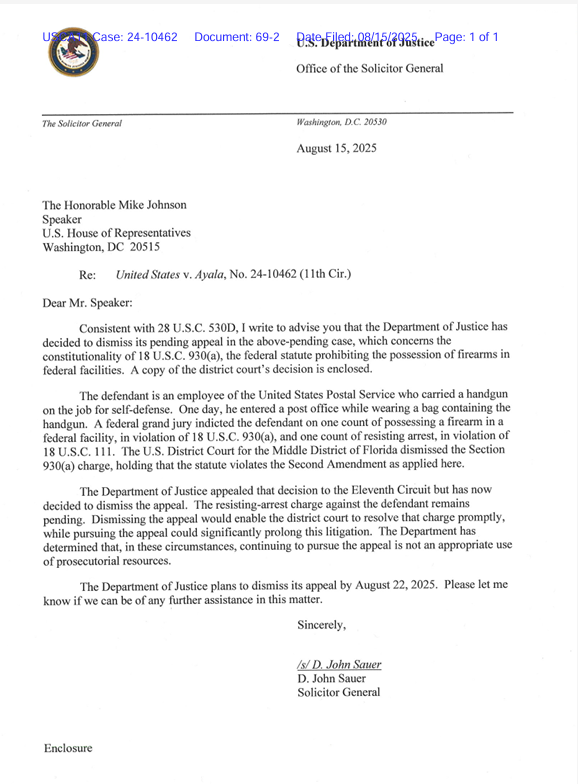
The Firearms Policy Coalition (FPC) has filed a motion for summary judgment in its case pending before a U.S. District Court in Texas challenging the Post Office gun ban.

The lawsuit FPC v. Garland challenges federal gun control laws prohibiting firearm possession, storage and carry at United States Post Offices and related properties, including post office parking lots. The plaintiffs are two law-abiding citizens licensed to carry in Texas and two non-profit membership associations—FPC and the Second Amendment Foundation (SAF).

Brandon Combs, FPC president, said the lawsuit is one in a long line of challenges designed to restore Second Amendment rights.

“Your right to carry weapons for armed self-defense does not end at the Post Office,” Combs said in a release announcing the action. “We look forward to eliminating this immoral ban and further restoring the People’s right and ability to protect themselves in public.”
In its motion for summary judgment, plaintiffs argue that the post office gun ban fails both of the standards set by the Supreme Court in New York Rifle & Pistol Association v. Bruen
Continue reading “”