
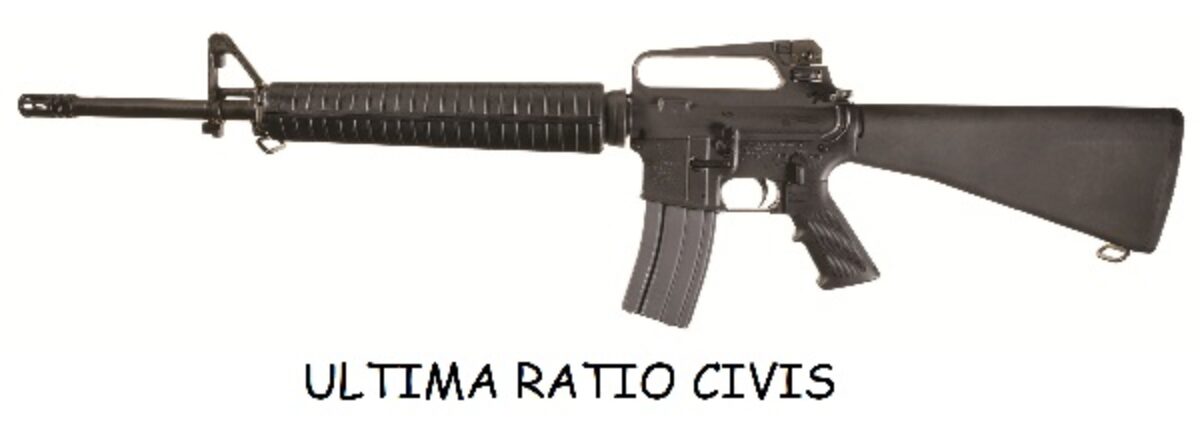
What you’re seeing in LA right now is the reason the communists use every opportunity to disarm you.
They dream of the day they can send the animals to your door to hurt you.
Your guns are the only thing that will stop them and they know this.
– Jesse Kelly
Category: RKBA
Vox Misses the Plot Entirely on SCOTUS Decision In Smith & Wesson v. Mexico
Take Vox, for example. Please. Seriously, please.No takers? Not surprising.
Anyway, Vox…
It’s unsurprising that they wrote a piece on the Mexican lawsuit against Smith & Wesson. It’s not surprising they’re displeased by the result. It’s also unsurprising that they were idiotic in their writing about it.
But Kagan’s opinion concludes that the mere fact that US gun companies likely knew that some of their guns were being resold in the illegal market, much less that some of their guns are designed to appeal to Mexicans, is not enough to overcome PLCAA. As Kagan explains, this conclusion largely flows from the Court’s fairly recent decision in Twitter v. Taamneh (2023).
Twitter concerned an attack by the terrorist group ISIS that killed 39 people at a nightclub in Istanbul, including a man with American relatives. Those relatives sued several social media companies in US court, claiming that the companies aided and abetted the Istanbul attack by allowing ISIS to post content which promotes ISIS’s ideology and that attempts to recruit people to the terrorist organization’s cause.
But Twitter warned against a legal regime where “ordinary merchants could become liable for any misuse of their goods and services, no matter how attenuated their relationship with the wrongdoer.” As a general rule, someone who provides a good or service to all comers is not legally responsible if a bad actor uses their product for a wicked purpose. If Ford sells a truck to a man who intentionally uses it to run over and kill his wife, Ford normally will not be responsible for this homicide.
And so Kagan concludes that it’s not enough for Mexico to show that gunmakers could have taken additional steps to prevent their products from winding up in the hands of drug cartels. Instead, “the merchant becomes liable only if, beyond providing the good on the open market, he takes steps to ‘promote’ the resulting crime and ‘make it his own.’”
Of course, one thing that distinguishes Smith & Wesson from Twitter is that social media platforms are not weapons whose entire purpose is to injure people. If PLCAA did not exist, Mexico might have argued that the gun companies’ decision to make and sell an inherently dangerous product should make them liable for the consequences of selling such a product.
The author does acknowledge that the PLCAA does exist, but that’s kind of beside the point.
See, the Twitter decision is still applicable, if for no other reason than the fact that the product is still sold for lawful purposes. That’s not even touching on the nonsense claim that “weapons…entire purpose is to injure people.” Hunting rifles are intended to kill animals, for example, and many people really don’t expect to ever shoot a person, but buy guns because they love the act of shooting. It’s something of a martial art in and of itself.
But getting back to the Twitter decision, the point is that a company that creates a product that’s intended for lawful use cannot be held liable because someone does something unlawful with it.
Even without the PLCAA’s existence, Mexico could try to make the claim, but the Twitter decision still stands. Its legal reasoning is still a thing. The idea that you could or should hold a company responsible for making products designed for lawful purposes that later get misused by other parties is asinine.
It was always asinine.
I wasn’t always a pro-gun guy. I liked guns as a much younger man, but I was pretty liberal in my beliefs back then. Even at the time, I thought the idea of holding gun companies responsible for what third parties did with the firearms they made was ridiculous. Nothing has changed on that front in the last 40 years or so.
Not that anyone who is writing on gun-related issues at Vox has a damn clue on any of that. They’re too absorbed in their “guns are bad” thinking to ever comprehend how mentally deficient their animosity toward firearms actually is.
Well, at least we’re finally getting a firm idea of exactly where a majority of this court stands on the 2nd amendment’s restriction on goobermint powers when it comes to those nasty icky guns.
US Supreme Court rebuffs challenge to Washington, DC’s high-capacity gun magazine ban
WASHINGTON (Reuters) -The U.S. Supreme Court declined on Friday to hear a challenge to the legality of a restriction imposed by Washington, D.C., on large-capacity ammunition magazines in a case that gives the justices a chance to further expand gun rights.
The justices turned away the challengers’ appeal of a lower court’s ruling that upheld the Democratic-governed city’s ban on virtually all ammunition-feeding devices holding more than 10 rounds. The lower court rejected arguments that the measure violates the U.S. Constitution’s Second Amendment right to “keep and bear arms.”
The four men who challenged the law had asked the Supreme Court to consider whether the Second Amendment allows a categorical ban on arms that are commonly used throughout the United States for generally lawful purposes such as self-defense. The challengers all hold concealed-carry pistol licenses for the District of Columbia and regularly carry a pistol there.
The Supreme Court has dramatically expanded the Second Amendment in recent decades, including in a landmark 2008 ruling that struck down a strict gun control law in Washington and declared that individuals have a right to own guns for such lawful purposes as self-defense in the home.
In 2022, powered by its 6-3 conservative majority, the court made it harder to defend gun restrictions under the Second Amendment, requiring that such limits be “consistent with the nation’s historical tradition of firearm regulation.”
The District of Columbia’s government makes it illegal to possess or sell any ammunition-feeding device that holds more than 10 rounds, with only a narrow exception. The city’s lawyers in court papers wrote that it has restricted the capacity of gun magazines “in some form for close to a century.”
Washington-based U.S. District Judge Rudolph Contreras in 2023 ruled in favor of the city, finding that large-capacity magazines are not “typically possessed for self-defense,” citing evidence showing that around two shots on average are fired in self-defense situations. The judge also found the city was likely to prevail in the case because it had demonstrated that its law is consistent with firearms regulation grounded in the “historical tradition” of the United States.
The U.S. Court of Appeals for the District of Columbia Circuit in a 2-1 decision upheld the judge’s ruling in October 2024, prompting the challengers to appeal to the Supreme Court.
The Supreme Court on June 2 declined to hear a similar challenge to Rhode Island’s ban on large-capacity magazines, as well as a challenge to a ban in Maryland on powerful semiautomatic rifles such as AR-15s, after lower courts upheld these restrictions.
The court on March 26 upheld a federal regulation targeting largely untraceable “ghost guns.” In two rulings last year, it upheld a federal law that makes it a crime for people under domestic violence restraining orders to have guns but rejected a federal rule banning “bump stocks” – devices that enable semiautomatic weapons to fire rapidly like machine guns.
Friday’s action by the court was unexpected. The court had planned to release it on Monday along with its other regularly scheduled orders, but a software glitch on Friday prematurely sent email notifications concerning the court’s decision in the case.
“As a result, the court is issuing that order list now,” said court spokesperson Patricia McCabe.
It is not the first time the court has inadvertently disclosed action in sensitive cases. Last year, an apparent draft of a ruling in a case involving emergency abortion access in Idaho was briefly uploaded to the court’s website before being taken down. That disclosure represented an embarrassment for the top U.S. judicial body, coming two years after the draft of a blockbuster ruling rolling back abortion rights was leaked.
This time, it’s not in a dissent, but as dicta in the actual decision.
Kagan Echoes Sotomayor and Accepts That AR-15s Are ‘In Common Use’
Last year, in the case of Garland v. Cargill, Justice Sotomayor wrote a dissent that included the following description of the AR-15:
Within a matter of minutes, using several hundred rounds of ammunition, the shooter killed 58 people and wounded over 500. He did so by affixing bump stocks to commonly available, semiautomatic rifles.
At the time, I noted that this was an odd concession to make, given a) that Sotomayor is reflexively hostile to Second Amendment challenges, and b) that one of the most important challenges the Court is likely to hear in the coming years will revolve around precisely that claim:
. . . those who wish to ban the AR-15 have taken to claiming that the rifle is not, in fact, “in common use,” and that, as a result, it is not protected under the Second Amendment. Remarkably, Justice Sotomayor just pulled the rug from underneath that argument — and, to make matters worse, did so in an official Supreme Court opinion on the subject of firearms law. [. . .] Sotomayor even uses the word “common”! Not “everyday” or “universal” or “normal” or “usual,” but common — the very word that was used in Heller.
This morning, in her majority opinion in Smith and Wesson Brands, Inc v. Estados Unidos Mexicanos, Justice Kagan did pretty much the same thing:
Finally, Mexico’s allegations about the manufacturers’ “design and marketing decisions” add nothing of consequence. Brief for Respondent 23. As noted above, Mexico here focuses on the manufacturers’ production of “military style” assault weapons, among which it includes AR–15 rifles, AK–47 rifles, and .50 caliber sniper rifles.
See supra, at 6; App. to Pet. for Cert. 121a. But those products are both widely legal and bought by many ordinary consumers. (The AR–15 is the most popular rifle in the country. See T. Gross, How the AR–15 Became the Bestselling Rifle in the U. S., NPR (Apr. 20, 2023.)
The manufacturers cannot be charged with assisting in criminal acts just because Mexican cartel members like those guns too. The same is true of firearms with Spanish-language names or graphics alluding to Mexican history. See supra, at 6. Those guns may be “coveted by the cartels,” as Mexico alleges; but they also may appeal, as the manufacturers rejoin, to “millions of law-abiding Hispanic Americans.”
Note the language here. “Widely legal and bought by many ordinary consumers.” “The AR–15 is the most popular rifle in the country.” “They also may appeal, as the manufacturers rejoin, to ‘millions of law-abiding Hispanic Americans.’”
Under Heller, all firearms that are “in common use” are presumptively protected. At some point — and relatively soon — we are going to get a case in which the plaintiffs contend that the ban on AR-15s in their state is illegal under Heller. I have no doubt that, when that happens, Kagan and Sotomayor will find some convoluted reason to uphold the ban, but, having twice conceded such a key claim, that reason will need to be much, much more radical than it would otherwise have been.
By the way, just in case it needs repeating;
The Second Amendment isn’t about hunting.
BLUF
Like many in rural Berkshire County, guns are a part of his life and he has opinions about firearms: He looks down on hunters that use big automatic weapons — “Those guns are for law enforcement,” he said — and he’s not a big fan of handguns, either. He owns four guns: a 12-gauge, a .22 rifle, and two muzzleloaders.”
‘Everybody on our street owns a weapon’: An 800-resident Mass. town has the state’s highest rate of licenses to carry
There are towns that voted Democratic last fall where not only are guns a part of a way of life, but they are also ubiquitous.
PERU, Mass. — By at least one metric, here is the gun capital of Massachusetts, a hamlet that shares its name with a South American nation and is home to about 800 residents nestled in the hill country of the Berkshires, just under three hours from downtown Boston.
The center of town consists of a few nondescript buildings along Route 143. There is a tiny library and an unremarkable-looking town office building that sometimes is unlocked even when no one is there. As in many New England communities, there is a church painted white, and a patch of grass memorializing the town’s war dead. There are no gas stations, convenience stores, restaurants, or bars. There is a single blinking traffic light in Peru’s 26-miles-square.
But there are guns. Many guns. According to a Globe analysis, Peru has the highest per capita rate of licenses to carry in Massachusetts. Nearby Savoy, with a population of about 645 people, according to the 2020 census, is No. 2. (The Globe did not count communities with a population of less than 500 in its review.)
“Everybody on our street owns a weapon,” said Dave Drosehn, a 65-year-old retired machine tender and Peru resident.
The politics around firearms and gun control remain bitterly divisive, both nationally and locally, but even inblue Massachusetts, which has one of the most strict gun-control lawsin the nation, there are towns that voted Democratic last fall where not only are guns a part of a way of life, but they are also ubiquitous.
Places where rural culture and gun culture are inextricably linked. Places, residents say, that people in Boston just don’t understand.
To find them, all you have to do is head west.
Inside Ozzie’s Steak and Eggs, a greasy spoon in Hinsdale, a town over from Peru, Drosehn was about to tuck into a turkey wrap on a recent day. He has hunted all his life, he said. There is a camaraderie in the sport, particularly hunting deer.
Like many in rural Berkshire County, guns are a part of his life and he has opinions about firearms: He looks down on hunters that use big automatic weapons — “Those guns are for law enforcement,” he said — and he’s not a big fan of handguns, either.He owns four guns: a 12-gauge, a .22 rifle, and two muzzleloaders.
Indeed, hunting is the oft-cited explanation for the gun ownership rate in this part of the state, and perhaps the most obvious.
Continue reading “”
Tiananmen Square Anniversary: Chinese-American Warns U.S. to Protect Gun Rights
Today is the anniversary of Chinese Communist Party (CCP) troops storming Tiananmen Square to massacre the freedom protesters who had gathered there. A survivor of the CCP’s tyranny who now lives in the U.S. has a message for Americans this anniversary: Don’t give up your guns.
Lily Tang Williams is an American citizen now, an entrepreneur who is running for Congress in New Hampshire. But the self-described “Survivor of Mao’s Cultural Revolution” remembers all too well the nightmare of Communist rule in China, and on the anniversary of the Tiananmen Square massacre, she emphasized how vitally important the right to keep and bear arms is in preventing such massacres by dictatorial regimes.
Williams took to X to commemorate the anniversary and reaffirm the United States’ Second Amendment. She included a screenshot of her previous post, which warned that the “champion of all the mass killings in this world is always a tyrannical government.”
Her previous post referred to the slaughter by the CCP troops of thousands of students at Tiananmen Square, and expressed regret that the students in 1989 did not have guns like the ones she is able to own now in America. “I am a Chinese immigrant and an American citizen by choice. I once was a slave before and I will never be one again,” Williams wrote.
The U.S. State Department and Secretary Marco Rubio put out a statement, too, honoring the “bravery” of the Chinese freedom protesters and explaining:
In the spring of 1989, tens of thousands of students gathered in Beijing’s largest public square to mourn the passing of a Chinese Communist Party (CCP) leader who tried to steer China toward a more open and democratic system. Their actions inspired a national movement.
Hundreds of thousands of ordinary people in the capital and throughout China took to the streets for weeks to exercise their freedoms of expression and peaceful assembly by advocating for democracy, human rights, and an end to rampant corruption.
The CCP responded with a brutal crackdown, sending the People’s Liberation Army (PLA) to open fire in an attempt to extinguish the pro-democracy sentiments of unarmed civilians gathered on Beijing’s streets and in Tiananmen Square.
The fact that the civilians were unarmed is precisely what Williams was warning about in her statements.
On her website, Williams says, “I grew up under Mao’s cultural revolution in China and fled communism for the freedom of the United States. Now, I fear the country I love is becoming the country I left.” It is a fear that many of us have experienced in recent years as we witnessed the attacks on our rights by the Biden administration, and now the increasing dictatorial activism of the judiciary. But one way to deter government tyranny is to exercise our Second Amendment right to keep and bear arms, to be ready always to stand up for ourselves and our liberties, as the Founding Fathers were.
Georgia Supreme Court Upholds Carry Ban For Young Adults Under 21 Years Of Age
We’ve reported a number of times in recent years about the battle for Second Amendment rights for 18-, 19- and 20-year-old Americans. It seems anti-gun advocates think all the other enumerated rights in the U.S. Constitution are fine for young adults, just not the right to keep and bear arms.
In the latest court action concerning that particular subset of American adults, the Georgia Supreme Court on May 28 ruled that the state’s law banning possession or carry of firearms by adults under 21 does not violate the state’s constitution.
In the case, 20-year-old Thomas Stephens, along with gun-rights advocacy group Georgia 2nd Amendment, sued the state to overturn the law after a probate court denied him a weapons carry license. Stephens had argued the court should overturn its rulings in past cases related to the statute, “holding that the Georgia right to keep and bear arms is subject only to a ‘reasonable exercise of police power’ test.”
The court ruling stated: “In sum, Stephens has not offered a compelling argument that the original public meaning of Paragraph VIII is meaningfully different from the construction developed through our Court’s consistent precedent addressing the language of that provision over more than a century. Because he has not established that our precedent construing this language is clearly wrong, we decline his invitation to reconsider it. And because his only argument that the statute he has challenged violates Paragraph VIII requires that we reconsider that precedent, his constitutional challenge to the statute fails.”
Incidentally, the statute in question does have some exemptions, including those under 21 who have received military training or who possess or carry handguns on their property, in their vehicle or place of business, or for hunting, fishing or sport shooting with a license.
Of course, both laws do violate the Second Amendment, as numerous gun-rights groups have been trying to prove in court over the past several years. However, the results have been mixed.
In January 2024, a three-judge panel of the United States Court of Appeals for the 3rd Circuit, based in Philadelphia, ruled the state’s ban on adults 18-20 from carrying a handgun during an emergency to be unconstitutional under the new standards prescribed by the 2022 Supreme Court ruling in Bruen.
“We understand that a reasonable debate can be had over allowing young adults to be armed, but the issue before us is a narrow one,” U.S. Circuit Court Judge Kent A. Jordan wrote in the majority opinion. “Our question is whether the (state police) commissioner has borne his burden of proving that evidence of founding-era regulations supports Pennsylvania’s restriction on 18-to-20-year-olds’ Second Amendment rights, and the answer to that is no.”
The Second Amendment Foundation (SAF) recently filed its tenth such suit, this one challenging Connecticut’s ban on adults under 21 purchasing, owning or carrying handguns.
Lombardo vetoes bill banning under 21s from owning certain guns
CARSON CITY, Nev. (KOLO) – Nevada Governor Joe Lombardo has vetoed a bill that would have prevented people under the age of 21 from owning semiautomatic shotguns and rifles.
The law would have stipulated that any person found in possession of such guns despite being under 21 would be guilty of a gross misdemeanor for a first offense.
For any second or second or subsequent offense, the offender would have been guilty of a category B felony.
Assembly Bill 245 was sponsored by Assembly Floor Leader Sandra Jauregui, who released this statement following the veto of the bill:
“It is disheartening that Governor Lombard chose to put politics above public safety by vetoing AB245. Raising the minimum age to purchase assault weapons is a straightforward, commonsense step to protect our communities and save lives. Time and again, we’ve seen the tragic consequences when individuals obtain assault-style weapons as soon as they turn 18. Despite today’s veto, my priority will continue to be putting forth policies that help end gun violence.”
Lombardo did not give a reason for the veto of the bill.
Alaska must reject infringement that is presented as ‘gun safety’
By KEVIN MCCABE
The Second Amendment is not a footnote in our Constitution; it is a promise. “A well regulated Militia, being necessary to the security of a free State, the right of the people to keep and bear Arms, shall not be infringed.” These are deliberate words from our Founders. They meant what they wrote. They understood that the right to bear arms was not granted by government, but a natural right of men that must be recognized by that government. It is a natural, God-given right, fundamental to liberty and self-governance.
Alaskans know this instinctively. We live in a place where self-reliance is not a slogan but a way of life. Firearms are not symbols; they are tools of survival and security. Yet even in Alaska, legislation has emerged that seeks to undercut this right, not through outright bans, but through clever language and incremental encroachment. This year, two bills in the Thirty-Fourth Legislature, HB 134 and HB 89, are nibbling at the edges.
HB 134, introduced by Representative Carrick, is titled the “Alaska Child Access Prevention and Secure Storage of Firearms Act.” While it seems to promote responsible gun storage, it goes further. It amends existing laws and creates a new criminal offense that holds gun owners legally accountable if a minor or prohibited person uses their firearm to commit a crime. Though it stops short of confiscation, it lays the foundation for a legal structure that mirrors so-called “Red Flag” laws. It moves responsibility away from the individual committing the crime and places it on the law-abiding gun owner, a significant and dangerous precedent.
HB 89, introduced by Representative Josephson, creates “gun violence protective orders” that allow law enforcement or family members to petition a court to remove firearms if someone is deemed a threat. These orders can be issued without the gun owner’s presence and require the surrender of firearms within 24 hours. Twenty-four hours, in Alaska? Violations carry stiff penalties, including jail time and heavy fines. This firearm confiscation without due process is not safety, it is big government control.
The Founding Fathers warned us about such measures. Thomas Jefferson wrote in 1776, “No free man shall ever be debarred the use of arms within his own land.” Patrick Henry declared at the Virginia Ratifying Convention, “The great object is that every man be armed. Everyone who is able may have a gun.” They did not believe the right to bear arms should be handed out selectively by the state. They believed it was inherent to the dignity and sovereignty of a free citizen.
George Mason, also at the Virginia Convention, stated plainly, “To disarm the people is the best and most effectual way to enslave them.” John Adams, quoting Cesare Beccaria, considered the father of modern criminal law and criminal justice, warned that laws forbidding arms “disarm only those who are neither inclined nor determined to commit crimes.” He added that such laws “make things worse for the assaulted and better for the assailants.” These are warnings written in blood and experience.
The American Revolution began with British efforts to disarm the colonies. In 1775, General Gage ordered the seizure of weapons in Boston, with thousands of muskets and pistols taken from the people. The Founders never forgot that. They lived the reality that a disarmed populace is a controlled populace. Their solution was clear: the citizen must be armed, both for self-defense and as a check on government power.
That dual purpose is embedded in the Second Amendment. James Madison, in Federalist No. 46, wrote of “the advantage of being armed, which the Americans possess over the people of almost every other nation.” He understood the link between personal liberty and national sovereignty.
These are the principles that shaped our nation. They should be the same principles that guide Alaska’s Legislature today. Yet HB 134 and HB 89 disregard them. They prioritize theoretical safety over constitutional certainty and open the door to abuse, placing power in the hands of judges and petitioners without the presence or knowledge of the accused. They presume guilt and seize property before any crime has occurred.
In rural Alaska, the implications are even more severe. Law enforcement may be hours or days away. Court systems are distant, and legal representation is scarce. The practical result of these bills is not increased safety; it is the criminalization of responsible firearm ownership and the erosion of liberty for those who live farthest from government services.
History is full of warnings. In the 20th century alone, governments that disarmed their citizens:
Turkey in 1911,
Russia in 1929,
Germany in 1938
All paved the way for atrocities that cost millions of lives. The pattern is always the same: disarm, then dominate. While we often assume that such tragedies cannot happen here, the Founders knew better. Their solution for this eventuality was the Second Amendment.
In 2008, the United States Supreme Court ruled in District of Columbia v. Heller that the Second Amendment protects an individual’s right to possess firearms for lawful purposes, including self-defense within the home. That ruling, like the Amendment itself, is not subject to Alaska reinterpretation or legislative dilution.
The right to bear arms is not something to be balanced against the whims of political pressure or temporary fears. It is a bedrock of a free society. As Jefferson wrote in a letter to his nephew in 1785, “Let your gun therefore be the constant companion of your walks. Not because violence is inevitable, but because freedom must be preserved.”
In Alaska, where isolation and wilderness are part of life, that right is essential. HB 134 and HB 89 may appear measured and moderate, but they start us down a path we cannot afford to walk. They represent a retreat from the vision of our Founders, from the realities of our state, and from the rights of our people.
We must reject them.
The Constitution is not a suggestion.
The Second Amendment is not conditional.
In Alaska, we will not be disarmed.
Despite what you may hear from Alaska Gun Rights, Representative McCabe is an ardent supporter of the second amendment, he is a shooter, a reloader and a hunter. He serves in the Alaska House where he represents District 30.
Justice Kavanaugh to Second Amendment: We’re Really Busy Now, Come Back In A Year Or Two
On December 1, 2020, the Maryland ban on AR-15s was challenged. The plaintiffs lost in the District Court and before the Fourth Circuit. In August 2024, a cert petition was filed in Snope v. Brown. The petition sat in purgatory for nearly a year with fourteen relists.
Today, the Supreme Court finally put the petition out of its misery and denied cert. Justices Thomas, Alito, and Gorsuch would have granted. Justice Barrett, as usual said nothing. Justice Kavanaugh wrote a very unusual statement respecting the denial of the petition. The first two paragraphs explain why the Maryland decision was “questionable.” If you read these parts, you would expect a grant. Indeed, Kavanaugh as circuit judge had found that the District of Columbia’s ban on AR-15s was unconstitutional. But then, we get to the last paragraph:
In short, under this Court’s precedents, the Fourth Circuit’s decision is questionable. Although the Court today denies certiorari, a denial of certiorari does not mean that the Court agrees with a lower-court decision or that the issue is not worthy of review.
The AR–15 issue was recently decided by the First Circuit and is currently being considered by several other Courts of Appeals…..
Opinions from other Courts of Appeals should assist this Court’s ultimate decision making on the AR–15 issue.
Additional petitions for certiorari will likely be before this Court shortly and, in my view, this Court should and presumably will address the AR–15 issue soon, in the next Term or two.
My mouth nearly hit the floor when I read this. Kavanaugh all-but signals that he will be a fourth vote to grant cert. He does not identify any vehicle problems, or reasons why the Maryland petition should not be granted. Does he really think that rulings from the Ninth Circuit will help much in the deliberations? These courts will all rule against the Second Amendment. Nothing is in doubt. The upshot is that the Court is really busy with other stuff right now, and you all should just come back later. The Second Amendment could take a sabbatical for a year or two until the docket lightens up. Indeed, this case has been pending for nearly four years. Maryland gun owners will just have to chill.
Of late I’ve been praiseworthy of some of Kavanaugh’s actions, but this is the sort of Kavanaugh opinion that infuriates me. And where is Justice Barrett on these issues? A decade ago in 2015, Justice Scalia dissented from denial of cert in Friedman v. Highland Park, a challenge to an assault weapon ban.
This issue isn’t new. I think this term will be remembered as the term in which Justice Barrett’s slide became indisputable. I started tracking it years ago, but it is hard to ignore now.
May as well do a proper thread on this. Read for my analysis/cope.

Snope denied. The Supreme Court has forsaken us.
Kavanaugh says they want more percolation, apparently.

First up is Kavanaugh, in a statement respecting the denial of cert. (Basically a concurrence in denying it) Not that it will matter until SCOTUS actually polices the antigun circuits, but Kavanaugh confirms we are right that: a. there is a “common use” test. Antigun states have denied this, arguing there is no such test, or if there is, it’s only “commonly used for self-defense.” b. it is historically-based (i.e., not part of the phony “plain text” analysis). Antigun states have argued it’s at the plain text step.
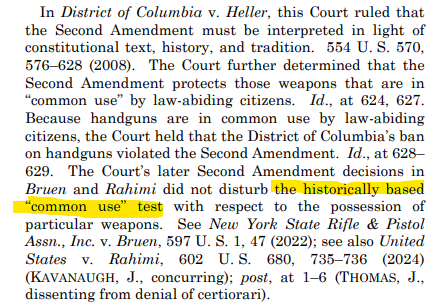
Not strong enough to get granted cert now though, I guess?

Sure, but the antigun circuits will absolutely take this as an affirmance of the terrible Fourth Circuit ruling. SCOTUS needs to accept that it must actively police those circuits, or just admit it has no interest in protecting the Second Amendment so we stop wasting our time.

While they didn’t join this statement, this is Barrett and Roberts speaking too, it’s pretty clear. Kavanaugh wouldn’t write with such confidence (i.e. “presumably”) if he didn’t think they – or at least one of them – was on board to hear such a case soon. You are free to think I am coping – I can’t blame you for having zero confidence in the Court after this. It’s just how I read it. Even if I am correct, that wouldn’t make it okay. Another year or two of denied rights is incredibly damaging. As I have pointed out before, our lives are not that long, and not having our Second Amendment right fully realized for another year or two is a real loss. Moreover, there is absolutely nothing to be gained from percolation. Only antigun circuits ever here AWB cases, and their rulings are all very similar to each other.

We love you Justice Thomas, thanks for always being a real one.

I don’t like Justice Thomas embracing the plain text “step.” I guess I now have to concede there is such a step, bummer.

That said, the plain text is not hard to meet in an arms ban case, as Thomas points out.

Now that Thomas has confirmed I was wrong and there is a “plain text” step, I now urge the Supreme Court to gut it and make Bruen the one-step test it should be. Antigun circuits will always place “too high a burden” on Plaintiffs to avoid the historical analysis. The plain text step, if it is too exist, should be no more than a simple qualifier, not some rigorous analysis.

to* exist.
So while Thomas does reject my view that there is no meaningful plain text step, he does agree that it isn’t a hard step to meet.

Beautifully written. Too bad it is in a dissent from denial of cert, and not the first line of a per curiam ruling.

Thomas deals with the 4th Circuits dumb slippery slope argument.

Thomas agrees that percolation has no value.

He concludes by pointing out the Court’s logic in VanDerStok could allow for the federal government to declare AR-15s to be “machineguns” and ban them. A future Dem administration will no doubt try this.

So, what’s my speculation?
I think there was clearly a lot of negotiating behind the scenes, and Roberts/Barrett or one of them just doesn’t want another controversial issue on their plate right now.
They promised Kavanaugh they’d take up the issue soon, but who knows if they will keep that promise (no doubt the stream of Trump admin cases will continue for the whole four years). Hopefully the USDOJ will support the Duncan cert petition to add some pressure for a grant. If they deny Duncan, then the next best candidate is probably the Illinois cases about to be heard on final judgment by the Seventh Circuit.
It is interesting that Kavanaugh had no similar statement for Ocean State Tactical. As a judge on the DC Circuit, he dissented from an opinion (Heller II) upholding an AWB, but said as to magazines he would have remanded for further proceedings. It’s possible Kavanaugh is against AWBs, but would be accepting of a magazine capacity limit. I certainly hope that isn’t the case. I can’t blame anyone for dooming at this point, but we’ll keep doing the best we can. We need Justices Thomas and Alito replaced by fire-breathers like VanDyke who don’t care about suffocating decorum traditions and will openly call out their colleagues when they are being hacks. Thomas and Alito are the best justices on the Court, but they are aging and it is critical they be replaced with equally-strong but younger judges.
Finally, the percolation excuse must be especially frustrating for the Snope plaintiffs. Let’s say in a best case scenario, Kavanaugh is being truthful, and SCOTUS does grant a similar case and strikes down AWBs. The Snope plaintiffs are still out all of their legal fees, which do not get reimbursed if you are vindicated two years later. You only win back fees if your case wins. So they are just SOL.
Very cool SCOTUS, thanks.
If you are willing to paint people who disagree with you as monsters who are “pro dead school children”, I can’t begin to imagine the state sponsored violence you could rationalize being used against them.
We’ll keep our guns, thanks.
Backer of Hawaii’s Failed ‘Assault Weapon’ Ban Won’t Bring It Back Next Year
Given the large Democratic majority in the Hawaii legislature and the state’s longstanding hostility towards the right to keep and bear arms, the demise of a proposed ban on the vast majority of semi-automatic rifles on May 1 was a welcome surprise for Second Amendment advocates.
Hawaii gun owners got even more good news this week when Senate Judiciary Chair Karl Rhoads, who was one of the leading proponents of SB 401, told Honolulu Civil Beat that he has no plans to revive the bill next session, calling it “a waste of time,” to bring it up during an election year.
That in itself is an unexpected twist, since Democrats have adopted expansive “gun-free zones” and other restrictions on the right to keep and bear arms in recent years. But according to Civil Beat reporter Kevin Dayton, further gun control efforts could be stymied by a coalition of Republicans and Democrats representing more rural parts of the state.
The ban on those guns was effectively blocked at the last minute by Democratic Sen. Lynn DeCoite, who said she wanted to exclude rural residents, subsistence hunters and conservation workers who use those weapons to combat invasive species such as axis deer and feral pigs.
Experts in firearms laws say the language DeCoite offered in her proposed amendment would have diluted the proposed restrictions in Senate Bill 401 so completely that the new law would have been largely unenforceable.
Senate Judiciary Chair Karl Rhoads, a leading advocate for the bill, said as much during the debate before the pivotal vote on the Senate floor. “This amendment creates a huge carve-out for the sale of assault weapons,” he told his colleagues. “If we pass it, it basically eviscerates the underlying bill.”
According to Republican Sen. Brenton Awa that was the whole point. “Essentially what this amendment does, if you don’t get caught up in everything that’s in it, is allows us to kill the bill,” he said.
None of the other senators bothered to argue with Awa, and minutes later he proved to be correct. The amendment passed 13-12, with Senate President Ron Kouchi from Kauaʻi casting the tie-breaking vote. He then announced the bill was shelved for the year.
That vote was a strikingly rare example of Senate Democrats joining with their Republican colleagues to muster a majority. It also suggests Hawaiʻi’s longstanding political consensus on firearms may be fracturing as senators from mostly rural districts join forces with a handful of Republicans to push back on the issue.
Dayton’s full piece details the “convoluted” politics that led to the defeat of SB 401 and is well worth a read. The big takeaway is that while Hawaii isn’t going to adopt Constitutional Carry or other pro-2A measures anytime soon, there does appear to be a growing reluctance to pass the kind of sweeping gun controls that groups like Everytown have been lobbying for.
SB 401 had the support of anti-gun groups, as well as the backing of Gov. Josh Green. And DeCoite’s amendment would likely have been defeated were it not for the “yes” vote by Senate President Ron Kouchi. The Democrat told the Civil Beat that he supported the carveouts because he represents a “large hunter and fisher group on Kauaʻi, and they are putting food on their table as part of the subsistence in meeting some of the challenging economic times.”
Kouchi also expressed concerns that the magazine ban portion of SB 401, which contained no grandfather clause, would have turned constituents into felons for keeping ahold of the magazines that they had lawfully purchased.
While I’d much rather Kouchi and DeCoite oppose a gun ban on principle instead of citing concerns about invasive species and the impact on subsistence hunting, at the end of the day they were still responsible for defanging and defeating a top priority for the gun control lobby this year; not only in Hawaii but across the country. I certainly hope this is the start of a new coalition that will defend the right to keep and bear arms in what’s traditionally been hostile territory, and that this is just the first of many gun control bills to get swatted down by a bipartisan group of Hawaiian legislators.
New Poll Has Bad News for Anti-Gun Democrats
As recently as 2010, a quarter of Democrats in Congress were “A” rated by the National Rifle Association. But over the past fifteen years the gun control lobby and Democratic leadership have purged the party of Second Amendment-supporting politicians. Oh sure, Kamala Harris claimed to own a Glock, even though she backed San Francisco’s ban on handguns when was the city’s District Attorney.
Despite his support for “red flag” laws, bans on modern sporting rifles, and support for depriving young adults of their right to keep and bear arms, Tim Walz was billed as a Democrat that gun owners could get behind because he owned a shotgun and like to shoot clays. Those pathetic attempts to portray the 2024 Democratic ticket as friendly to Second Amendment supporters were abject failures, but the party hasn’t learned any lessons from their disastrous performance last year. Instead, they voted to put gun control activist David Hogg in a leadership position at the DNC, introduced bills banning almost every semi-automatic rifle and shotgun on the market, and are now trying to ban the sale of Glock handguns in states like New York and Illinois.
So how’s that working out for them? According to a new YouGov survey, not well at all.
A new YouGov survey asked Americans whether they think the Democratic Party or the Republican Party does a better job handling each of 20 issues. Both Democrats and Republicans have changed their views since last year on several key issues. For example, Democrats are less likely now than they were in August 2024 to say the Democratic Party does a better job at handling guns (69%, down from 80%). Meanwhile, Republicans are less likely now than they were last summer to say the Republican Party does a better job handling inflation (80%, down from 87%).
On the question of who does a better job of handling “guns” as an issue, 36% of all survey respondents picked Republicans, 31% picked Democrats, 16% said they were about the same (which is flabbergasting to me), and 16% said they were unsure. YouGov says that’s the one issue where there’s been “notable” movement among the American electorate, which should be ringing alarm bells for Democrats across the country.
I doubt it will, though. The YouGov survey shows more than 2/3rds of Democrats still believe their party is better on the gun issue than Republicans, and even though that number has plunged from 80% to 69% in the past year, the gun control lobby is so entrenched within the party itself that it will take a lot more than one survey and one terrible election cycle before we could start to see any genuinely pro-Second Amendment Democrats running for Congress or statewide office.
I’d love to see both major political parties embrace and support our Second Amendment rights, but I just don’t see that happening in the near future. Some Democrats might try to disguise their animosity towards the right to keep and bear arms by dropping their attempts to ban gas-operated semi-automatic rifles and shotguns until the 2026 election cycle is over, but there’ll be plenty of others in the party who will continue their crusade to turn a fundamental civil right into a privilege subject to the whims of anti-gun politicians.
When a state goobermint, even one supposedly as ‘gun friendly’ as Tennessee, is the point of contact for NICS, (when the system was designed for individual FFLs to query) it means that no matter how much they may disclaim, they are recording the transactions for their own state police registry.
GOODLETTSVILLE, Tenn. (WKRN) — Tennessee’s Instant Check System was down for days, causing sales losses for gun store owners across the state.
The firearm purchase login page for Tennessee FlexCheck, which is the system used across the Volunteer State, displayed an error message reading, “We are currently unable to run background checks. We are working quickly to resolve it. Please check your emails for more information and updates.”
The Tennessee Bureau of Investigation, which helps oversee the system, told News 2 that the agency had been troubleshooting an outage. The TBI said that the outage was related to a “planned system change” from the agency’s vendor, which was outside of the organization’s control.
The vendor told the TBI they were working as quickly as possible to resolve the issue. It was tentatively restored around midnight Friday.
Phillip Arrington, who owns Goodlettsville Gun Shop and has been in the business for about 30 years, told News 2 the store had experienced about five or six outages so far this year — each lasting more than 24 hours — with other shorter outages throughout the year as well.
This outage lasted for about three days.
“It’s getting to a point where we can’t tell customers, ‘Yeah, we’ll get your background check! It’s an instant check!” Arrington told News 2. “It’s no longer an instant check because there is no pattern to when it’s going to be reliable.”
The TBI told News 2 that in 2024, TICS had been fully operational 99.46% of the time and is only closed on the Fourth of July, Thanksgiving Day and Christmas Day. The agency did not provide outage statistics for this year.
No firearms could be sold in the state of Tennessee due to the outage, Arrington said, nor could firearms be taken in on consignment or any pawned. Some customers have been unhappy and even angry as a result of the outage.
“We’ve lost quite a bit [of money], but nothing compared to what some of the bigger stores have lost,” Arrington added. “…We have nothing to tell our customers. It basically stops everything we’re doing. There’s no sense in advertising because we can’t sell anything.”
Additionally, the TBI confirmed that some agencies lost access to the National Crime Information Center as a result of the outage. Law enforcement agencies utilize the NCIC to input information about missing children as well as information about crimes and criminals — like apprehending fugitives.
Goobermints still want to gatekeep the means to confront and deal with tyranny
The number of residents in Poland applying for a permit to own a firearm set a record in 2024 at nearly 46,000. The previous highwater mark, set in 2023, was roughly 41,000. The total number of guns owned by civilians in the nation now stands at 930,100, a figure that is twice what it was in 2017.
Requirements to own a gun in Poland are stringent and include passing an exam, acquiring a certificate of health from a doctor and another from a psychologist. With a few exceptions, all applicants must be at least 21 years old, have a clean criminal record and not be addicted to drugs or alcohol. Issued permits fall into distinct categories that identify the gun’s intended use, including possession for self-defense, training, hunting, etc.
Between medical checks, courses that offer the exams and the sometimes-required sporting-club membership, it is expensive. The government’s fee for applying for a Polish gun-ownership permit is the bargain in the time-consuming process, 242 zltoys (about $65 U.S.), according to a summary from Hartmann Tresore—a highly renowned Polish manufacturer that began offering gun safes in 1983.
Poland relaxed its firearm ownership laws in 2011, although permit applications trickled in until 2022—the year Russia invaded Ukraine. Since that conflict began the nation also made gun safety and marksmanship education mandatory in its school systems.
Elsewhere
Patricia Bulrich, Argentina’s Minister of Security, used X (formerly Twitter) to post an update to that nation’s gun laws in December. She wrote, “From now on, those over 18 can be legitimate gun owners. This measure, promoted by the National Government, updates an outdated 1975 law and respects the 2015 Civil Code reform, which set the age of majority at 18. At 16, they have the right to vote. At 18, they can go to war, start a family, or join a security force. And, incredible as it may seem, at any age they can choose a sex change that will affect them for life. So, why can’t they be legitimate users or bearers of a gun at 18? For years, no one dared to make this decision. We didn’t hesitate. While we disarm narco-terrorist gangs and organized crime, we celebrate the fact that good citizens can access weapons as legitimate users. Empty speeches are a thing of the past. In this government, we are making the right of Argentines to protect themselves and live in freedom a reality.”
Prior to the announcement the minimum age for an Argentinian to own a gun was 21. The change, however, did not remove the nation’s other stringent requirements to secure a permit, which are similar to those in Poland.
The Good, Bad, and Ugly News on the Fight to De-Regulate Suppressors
The fight over removing suppressors from the National Firearms Act has primarily moved to the Senate for the moment, but there are legal and political battles still being fought over the devices in courthouses and committee chambers, and the Trump administration has given both sides some ammunition in its latest filing in a case called U.S. v. Peterson.
Louisiana resident George Peterson was charged with possession of an unregistered suppressor in 2022, and was found guilty in U.S. District Court. Earlier this year a three-judge panel on the Fifth Circuit upheld that conviction, ruling that suppressors aren’t protected by the Second Amendment because they’re not “arms”.
Peterson has hired a team of seasoned Second Amendment attorneys including David H. Thompson, Peter A. Patterson, and Cody J. Wisniewski to represent him as he seeks an en banc review of the panel’s decision, but in its latest filing the DOJ is still advocating against a broader review by the entire appellate court.
The good news is that the DOJ has, for the first time that I’m aware of, adopted the position that suppressors are, in fact, protected arms under the Second Amendment. In a filing last Friday, Acting U.S. Attorney for the Eastern District of Louisiana Michael M. Simpson noted that the federal government as “re-evaluated” its previous position.
In the view ofthe United States, the Second Amendment protects firearm accessories and components such as suppressors. As a result, restrictions on the possession of suppressors burden the right to bear arms, and a ban on the possession of suppressors or other similar accessories would be unconstitutional. The government’s earlier argument to the contrary was incorrect.
The bad news is that in that same filing the DOJ contends that the inclusion of suppressors in the National Firearms Act, and indeed the NFA itself, is not an infringement on the right to keep and bear arms.
But the National Firearms Act’s registration and taxation requirement is constitutional because it imposes a modest burden on a firearm accessory that is consistent with this Nation’s historical tradition because suppressors are specially adaptable to criminal misuse. For this reason, the panel correctly affirmed Peterson’s conviction.
Gun control groups are going to have a field day with the Trump administration’s position that suppressors are “specially adaptable to criminal misuse” at the same time Republicans are trying to de-regulate them. And Second Amendment advocates should be up in arms (so to speak) over Simpson’s contention that the registration and taxing of a constitutionally-protected item are just “modest” burdens on the right to keep and bear arms.
Simpson’s argument that the NFA’s registration requirement is no big deal is extraordinarily bad. Current federal statute bars the government from establishing or maintaining a list of gun owners, but now the DOJ (or at least one U.S. Attorney) is essentially arguing that requiring gun owners to register their arms with the federal government wouldn’t violate the Second Amendment. Simpson takes pains to stress that taxing suppressors is okay because they’re supposedly “pose a special danger of misuse”, but he never really explains why or if registration would apply only to those arms that are especially dangerous (at least in the eyes of the goverment).
Simpson’s take on NFA taxes is also wildly inaccurate. The NFA’s tax requirement was meant to pose a substantial burden on buyers of restricted items, and while a $200 transfer tax and $200 making tax isn’t as cost-prohibitive as it was back in 1934, tacking an additional $400 on the price of a suppressor does mean that some folks will be unable to afford one. But Simpson maintains that those taxes (again, at least when it comes to arms that pose a “special danger of misuse”) “are no more burdensome than a variety of other constitutional regulations, such as the requirements that a firearm purchaser obtain a background check or that a person licensed to carry a firearm undergo safety training and pay a reasonable fee.”
Simpson argues that the $200 transfer tax is “modest”, but he fails to set a threshold for an immodest or unreasonable tax, which gets us to the ugly news surrounding suppressors.
On May 22, during an early morning floor debate over the legislation, Rep. Nancy Pelosi (D-Calif.) registered her opposition to the bill. In reference to the suppressor tax reduction, she stated, “then, of course, as we mentioned about the silencers, it’s just beyond comprehension.”
According to the former speaker of the House, it is incomprehensible that lawmakers want to eliminate a prohibitory tax scheme on harmless devices that help their constituents lawfully exercise their Second Amendment rights with reduced risk of hearing damage.
Yet the longtime representative from San Francisco still didn’t manage to provide the worst take of the week. That dubious distinction belongs to Rep. Madeleine Dean (D-Pa.) who argued the current tax on suppressors doesn’t go far enough, and law-abiding Americans already enjoy too much freedom.
In a meeting of the House Rules Committee, Dean claimed to be shocked by the level to which Americans are already exercising their right to keep and bear arms. The congresswoman stated,
You know what the dollars are? It’s $1.4 billion over 10 years. I did the math. That means something like 700,000 silencers are sold in this country a year. That baffles me. I don’t know if that’s accurate, but by the numbers and by the math, that’s what we’re talking about.
Dean took issue with the fact that the suppressor tax has not kept up with inflation and acknowledged its infringing nature: “the tax was used to try to discourage the purchasing of silencers.”
The congresswoman went on to elaborate her preferred scenarios. She said,
If we doubled it, if we just went to $400, you could sell only half as many and not lose a penny in revenue. If we tripled it, you might actually discourage some sales of silencers. Wouldn’t that be a good thing for us to be doing in this committee?
Dean seems to have a better grasp of history than Simpson does, unfortunately. The NFA taxes were absolutely meant to discourage the purchase and possession of restricted items, which is one of the reasons why 2A advocates argue that the National Firearms Act is unconstitutional.
Dean and her fellow Democrats will jack up the transfer and making taxes at the first given opportunity, so it’s critical that the Trump administration not only recognize that suppressors (and I would argue, other NFA items) are protected by the Second Amendment, but that the National Firearms Act cannot be reconciled with our Second Amendment rights.
The DOJ has taken some historic steps to protect and preserve the the right to keep and bear arms under President Trump’s watch, but this is a huge misstep, and one that needs to be rectified going forward. Removing suppressors from the NFA through Trump’s big, beautiful bill would be a big help, but ultimately the administration needs to revise its position on the NFA itself. If not, some of the arguments the DOJ makes over the next four years could prove to be a huge gift to the gun control lobby.