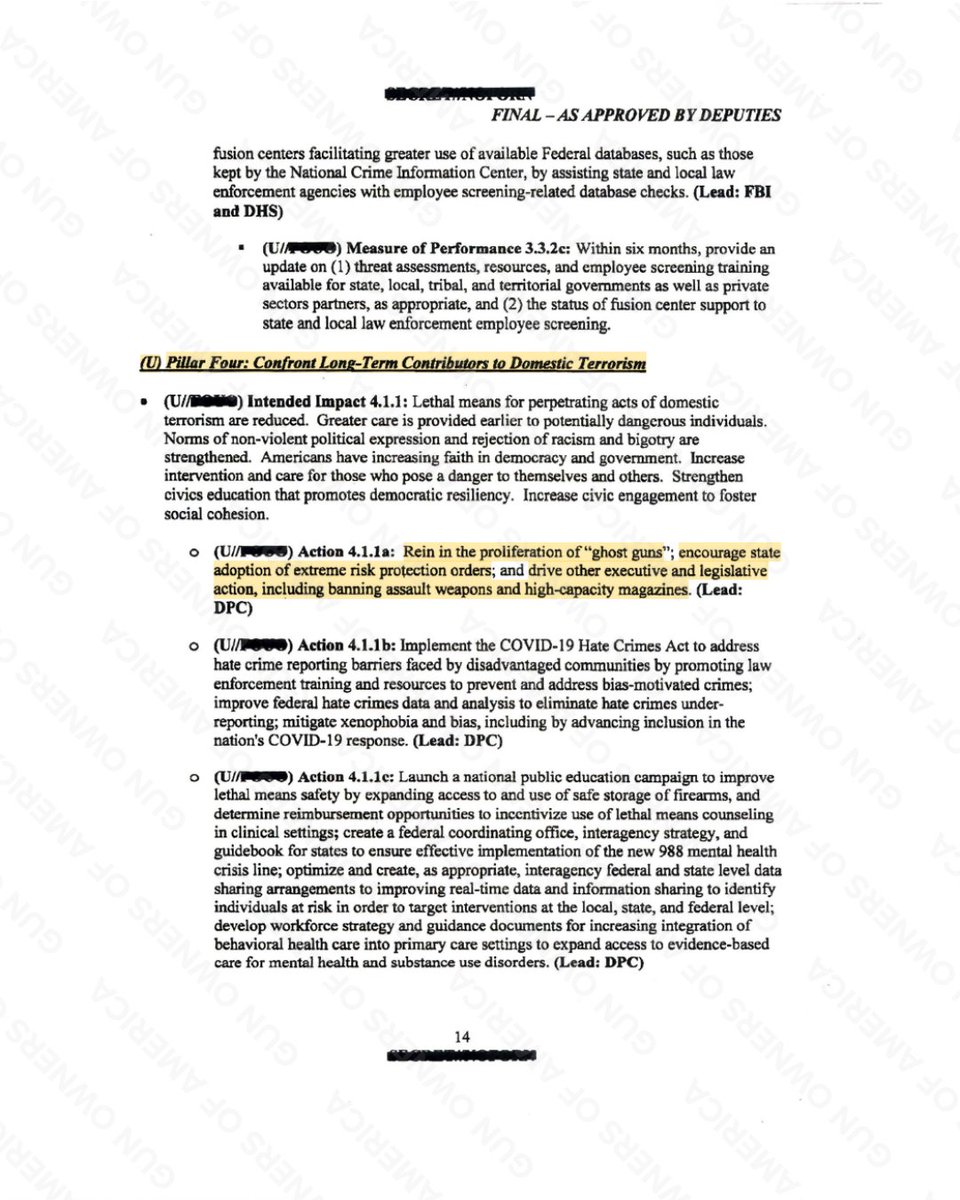
As promised, I have declassified the Biden Administration’s Strategic Implementation Plan for Countering Domestic Terrorism.
– DNI Tulsi Gabbard
Salient page for violating RKBA
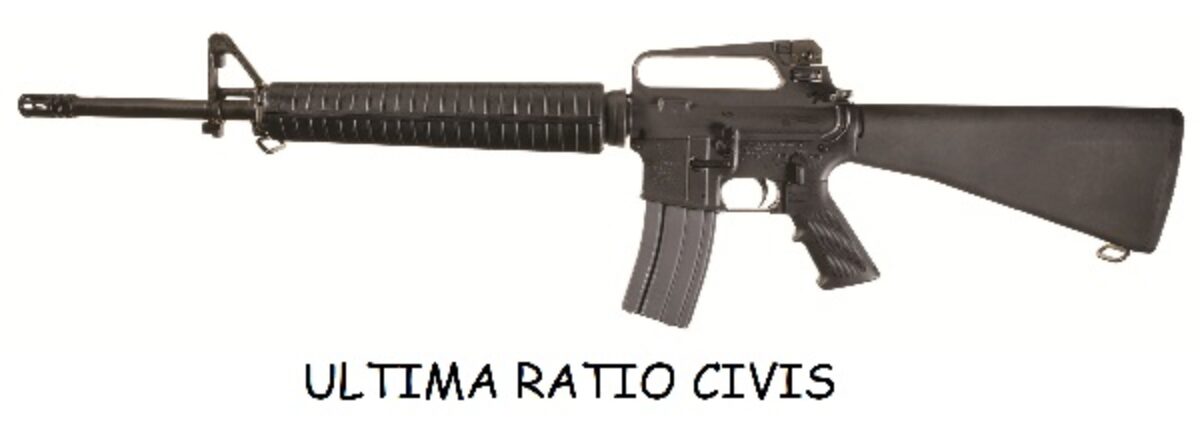
As promised, I have declassified the Biden Administration’s Strategic Implementation Plan for Countering Domestic Terrorism.
– DNI Tulsi Gabbard
Salient page for violating RKBA
Missouri House Votes to Allow Guns on Public Transit, Lower Concealed Carry Age
The Missouri House just sent a clear message: gun rights shouldn’t stop at the bus stop.
In a 106-45 vote on Thursday, lawmakers passed House Bill 328, a measure that would legalize concealed carry on public transit and lower the minimum age for a concealed carry permit from 19 to 18. The bill now heads to the Missouri Senate for consideration.
Currently, even Missourians with valid concealed carry permits are barred from bringing firearms onto public transportation. But that could soon change if HB 328 becomes law.
“It’s about time that we allow those people who use public transportation to exercise the same rights as everyone else in our state,” said Rep. Tim Taylor (R-Bunceton), the bill’s sponsor. For many gun rights advocates, the current law forces permit holders to disarm just because they choose to ride the bus or train.
Opposition to the bill was sharp, with critics arguing that expanding where guns can legally go won’t improve public safety.
“More access to guns does nothing to improve public safety,” claimed Rep. Yolanda Young (D-Kansas City).
House Minority Leader Ashley Aune (D-Kansas City) also criticized the measure, especially the portion lowering the permit age to 18.
“That means high school kids could legally carry concealed weapons,” she said. “What could go wrong with that?”
But under current Missouri law, 18-year-olds serving in the military can already obtain a concealed carry permit. This bill would expand that access to all 18-year-olds, not just those in uniform.
Supporters argue that if an 18-year-old is legally an adult and can vote, sign contracts, and serve in the armed forces, they should also be trusted to carry concealed—especially in environments like public transit where law enforcement may not be readily available.
As the bill moves to the Senate, it’s expected to generate even more debate over where the line should be drawn between public safety and Second Amendment rights.
Gun Rights Group to Bondi: Target 2A Violations in 12 Specific States
Six days after U.S. Attorney General Pam Bondi announced creation of the Department of Justice “Second Amendment Task Force” to protect Americans’ gun rights, the Citizens Committee for the Right to Keep and Bear Arms sent a letter urging her to immediately focus the task force’s attention on 12 specific states where alleged “egregious violations” are occurring.
Those states are California, Colorado, Connecticut, Hawaii, Illinois, Maryland, Massachusetts, New Jersey, New Mexico, New York, Oregon and Washington. The common denominator in all these states is a Democrat-controlled legislature and governor’s office.
As reported earlier by Ammoland, activists energized by Bondi’s announcement are calling for action in their states, many of which coincidentally happen to be on the above list.
Colorado Enacts Sweeping Gun Law: What SB25-003 Means for Firearm Owners
On April 10, 2025, Colorado’s Senate Bill 25-003 was signed into law by Governor Jared Polis on April 10, 2025. The passage of this bill represents one of the most significant changes to gun regulations in the state’s history. This legislation establishes a first-of-its-kind permit-to-purchase system for certain semiautomatic firearms while prohibiting rapid-fire conversion devices.
SB25-003, officially titled “Semiautomatic Firearms & Rapid-Fire Devices,” fundamentally changes how Coloradans can purchase certain types of firearms. The law criminalizes the manufacture, distribution, transfer, and purchase of specific semiautomatic weapons without proper permitting. It specifically covers the following firearms:
Importantly, the legislation does not affect most handguns (which are typically recoil-operated), shotguns with fixed magazines, or semiautomatic firearms with fixed magazines holding 15 rounds or less.
Rather than imposing an outright ban, Colorado’s SB25-003 introduces a detailed permitting process for individuals seeking to purchase certain semiautomatic firearms. Under the new law, prospective buyers must first apply to their county sheriff for a course eligibility card. This application requires a government-issued photo ID, a name-based background check, and a signed affirmation that the applicant complies with all relevant firearm laws.
Once eligibility is established, applicants must complete a firearms safety course. Those who already hold hunter education certification may take a basic four-hour course. Those without such certification must complete an extended 12-hour course conducted over at least two days. After completing the training, applicants are required to pass a final examination with a minimum score of 90 percent.
Permits issued under this process are valid for five years. Once expired, individuals must repeat the entire application, training, and testing process to obtain a new permit.
Lawsuits Inbound After Colorado Governor Signs Semi-Auto Ban
The original version of the semi-auto ban was pretty simple: gas-operated semi-automatic long guns capable of accepting a detachable magazine would be prohibited for sale and manufacture in the state of Colorado, and though residents who possessed one before the law could take effect could keep theirs, it would be a criminal offense for anyone else to acquire or keep on in their home.
Polis said the measure would help push Colorado toward its goal of becoming one of the top 10 safest states. He also advocated for the legislators to look at creating scholarship opportunities for the training, which would be run through Colorado Parks and Wildlife, and permits would be maintained by county sheriff’s offices. He said the current goal is to ensure CPW’s firearm training costs are under $200.
He also advocated for legislators to find a way to ensure prior firearm training and experience, such as peace officer or military training, to allow that training to qualify the citizens for purchase.
Colorado’s violent crime rate has soared since 2012, when the state enacted its first real gun control measures, including a ban on “high capacity” magazines. Polis is deluding himself if he believes that SB 3 is going to make the state a safer place. Any criminal who wants to obtain a firearm for illicit or evil purposes can either steal one, go through the state-mandated training and be approved for purchase, or simply head out of state and buy a rifle or shotgun there.
It will be lawful residents who feel the brunt of SB 3s impact, with Polis essentially admitting that the permit-to-purchase process will add hundreds of dollars to the price of a modern sporting rifle. Firearm retailers will feel the pinch as well, since many Coloradans who want to purchase one of these guns will likely head to FFLs across the border in states like Wyoming and Kansas to do so.
Immediately following the signing on Thursday afternoon, the Colorado State Shooting Association, which is the official state association of the National Rifle Association, said it would be filing a lawsuit against the new law.
“This legislation, which imposes unprecedented restrictions on the purchase of semi-automatic firearms through a burdensome permit-to-purchase scheme, represents a direct assault on the Second Amendment rights of law-abiding Coloradans,” CSSA said in a release.
The group has contended that the measure will create a “de facto gun registry” that is maintained by state or local authorities. CSSA also noted that it had presented a petition with over 40,000 signatures urging Polis to veto the bill.
The NRA also vocalized its opposition to the bill.
“Behind closed doors, Governor Polis cowardly signed into law the most anti-gun, anti-freedom bill in Colorado’s history. Instead of respecting the individual liberties of gun owners and hunters in his state, he bent the knee to the radical gun control element of his party,” the NRA said in a release. “In Jared’s Colorado, you need a ‘Polis Permission Slip’ to exercise your constitutional rights. If this proposal was popular with his citizens, it would not need to be enacted in secret.”
The preparation for the inevitable lawsuits has already begun, but don’t be surprised if nothing is filed immediately. The law won’t take effect until August 1, 2026, and any litigation filed now might be dismissed because the issue isn’t ripe for court review.
That extended deadline also gives Coloradans more than a year to continue to purchase the most commonly sold and popular rifles in the country, and in the short term, Polis’s ban is likely to lead to a spike in sales for the rifles and shotguns he and gun control activists want to restrict.
Bill to bar giving guns to certain mental health patients stalls until 2026
A bill that would criminalize knowingly giving firearms to someone who recently received inpatient mental health treatment was pushed to 2026 on Wednesday amid questions about its language.
Rep. Shaundelle Brooks, a Hermitage Democrat, named the bill “Akilah’s Law” in honor of her son Akilah Dasilva, who was killed in a mass shooting at a Nashville Waffle House in 2018.
The shooter, Travis Reinking of Morton, Illinois, had a history of schizophrenia and delusions. Prior to the shooting, Illinois State Police had revoked his firearm owner identification card, forcing him to surrender his guns to his father. His father then returned the guns to Reinking, breaking Illinois state law.
Tennessee bars giving firearms to juveniles or intoxicated people, but not those who have been committed for mental health evaluation.
Brooks said her bill intends to bring Tennessee in line with the Illinois law that prohibits someone from giving or selling a firearm to a person who has been a patient in a mental health institution within five years.
Brooks’ bill passed the House Criminal Justice Subcommittee in late March, but questions over the bill’s scope and language arose in the Senate Judiciary Committee on April 8.
Sen. Paul Rose, a Southwest Tennessee Republican, asked for clarity on what the bill defines as a “mental health institution” and what it means to be “admitted.” Rose questioned whether a person who makes routine visits to a mental health provider for medication would be considered a patient of a mental health institution under the bill’s definition.
The bill’s Senate sponsor, Memphis Democrat Raumesh Akbari, said she did not believe the bill would apply in that case.
Elliot Pinsly, president and CEO of the Behavioral Health Foundation, said the way the legislation is written could have a “chilling effect on people’s willingness to seek mental health treatment in Tennessee.” Pinsly, a licensed clinical social worker, founded the policy-focused nonprofit in 2020.
“The actual bill makes it a crime punishable by up to one year imprisonment to sell, give or otherwise transfer a firearm to a person who has received just about any kind of mental health care or addiction treatment in the past five years, voluntary or involuntary, outpatient or inpatient,” Pinsly said.
Facing uncertainty on the outcome of a committee vote, Akbari chose to move the bill to the general subcommittee, essentially putting it on ice until it can be resurrected in 2026.
“I look forward to Representative Brooks continuing to move this through the House … I will be working with all members on this committee so that we can reach a solution so we can really protect folks in Tennessee,” Akbari said.
Colorado Governor Signs Semi-Auto Permit-to-Purchase Scheme into Law
It will soon be much harder for Colorado gun owners to continue purchasing modern semi-automatic firearms.
In a closely guarded ceremony Thursday, Colorado Governor Jared Polis (D.) signed SB25-003 into law. The “Semiautomatic Firearms & Rapid-Fire Devices” bill criminalizes the manufacture, distribution, transfer, and purchase of any semi-automatic rifle, shotgun, or gas-operated handgun that accepts a detachable magazine. The law also carves out an exception from the ban for those who undergo an extensive permitting and training process—the first of its kind for purchasing firearms in Colorado.
“This legislation builds on our commitment to improve public safety, reduce gun violence, uphold our freedom,” Polis said in a statement.
The bill enacts some of the most sweeping gun regulations ever considered in the Centennial State, even compared to the few dozen restrictions Colorado lawmakers have been stacking up over the last decade. It fulfills gun-control advocates’ longstanding goal of cracking down on the availability of certain semi-automatic firearms and is almost sure to draw legal challenges from gun-rights groups.
The Colorado State Shooting Association (CSSA), the state’s NRA affiliate, threatened as much in a statement blasting the Governor’s decision to sign the bill.
“We are resolute in our response,” Ray Elliott, CSSA president, said. “The Colorado State Shooting Association is actively exploring every legal option to challenge this unconstitutional law. Our legal team is preparing to contest Senate Bill 3, and we are committed to pursuing justice through every available avenue.”
The group said it submitted 40,000 petition signatures to the Governor urging a veto earlier this week.
The bill’s controversial nature could explain its unceremonious entry into law. Polis, a Democrat with a libertarian streak, kept his opinions on the policy close to the vest throughout the legislative process. He did not publicly indicate whether he would sign the bill until Thursday, even as he faced immense outside pressure from groups on either side of the issue.
His office did not respond to a request for comment.
While he hesitated to increase public scrutiny of the measure, his office was heavily involved in making the final product less restrictive than its original form. As introduced, the bill envisioned an outright ban on semi-automatic firearms that did not have a permanently affixed magazine capable of holding 15 or fewer rounds—a policy even broader than typical “assault weapon” bans that Polis has expressed skepticism of in the past.
Working closely with the Governor’s office, the bill’s sponsors added several pages to its provisions to craft an entirely novel process for Coloradans to continue purchasing the weapons in question. It includes a prospective buyer having to first obtain a newly established “firearms safety course eligibility card” from their local sheriff, which requires paying a fee, submitting fingerprints, and going through a background check.
Once issued, a firearms safety course eligibility card would be valid for five years. The issuing sheriff would be required to submit cardholders’ data to a newly created “Firearms Safety and Training Course Record System” administered by the Colorado Division of Parks and Wildlife, an agency that currently does not handle anything involving firearm sales.
With a valid eligibility card, a prospective buyer could enroll in either a “basic firearms safety course” or an “extended firearm safety course.” The basic firearms safety course is open to eligible cardholders with a hunter education certification and requires four hours of in-person instruction. Prospective buyers without hunter education training will be required to attend the extended firearm course, which must include at least 12 hours of in-person instruction spread across at least two days.
The bill requires both courses to include curricula on safe weapons handling, secure storage and child access prevention, firearms deaths and mental illness, extreme risk protection orders, and “victim awareness and empathy.” Completing each course would be contingent on receiving a score of at least 90% on a final test.
If a cardholder wants to continue buying the affected firearms, they must undergo the process again after five years.
In addition to restricting the availability of certain guns, the measure also contains provisions going after bump stocks, binary triggers, and similar accessories. It bans the possession of any “rapid-fire device,” defined broadly as any combination of parts that has the effect of “increasing the rate of fire of a semiautomatic firearm above the standard rate of fire.” It also codifies increased criminal penalties for violating the state’s twelve-year-old ammunition magazine ban, now a class 1 misdemeanor punishable by up to a year in jail.
The law’s provisions are set to go into effect on August 1, 2026.
Missouri House lawmakers vote to allow guns on public transit and lower concealed carry age
A bill passed by the Missouri House Thursday would make it legal to bring guns on public transportation and lower the minimum age for a concealed carry permit.
House Bill 328 passed the House 106-45. It now goes to the Senate.
Currently, it’s illegal to bring guns on public transit even with a concealed carry permit. Supporters of the bill say it would allow passengers to protect themselves and safeguard Second Amendment rights.
“It’s about time that we allow those people who use public transportation to exercise the same rights as everyone else in our state,” said bill sponsor Tim Taylor, R-Bunceton.
However, opponents say that the bill would only endanger passengers, not make them safer.
“More access to guns does nothing to improve public safety,” said Rep. Yolanda Young, D-Kansas City. “More access to guns doesn’t decrease gun deaths. It does the opposite.”
The bill would also lower the minimum age to acquire a concealed carry permit from 19 to 18. Currently, 18-year-olds can only get permits if they are members of the military.
“That means high school kids could legally carry concealed weapons,” said House Minority Leader Ashley Aune, D-Kansas City. “What could go wrong with that?”
Ohio enacts new law impacting purchasing guns
COLUMBUS, Ohio (WSYX) — A new law which took effect Wednesday in Ohio is poised to significantly impact gun owners’ rights.
Senate Bill 58, signed into law by Governor Mike DeWine in January, is being hailed by gun advocates as a victory for Second Amendment supporters.
Eric Delbert, owner of LEPD Firearms and Range, expressed relief over the new legislation.
“Giving people the ability to have that Second Amendment and purchase firearms comes with a lot,” Delbert said. “Taking this out of the mix is really a headache we were concerned about for the last couple of years now knowing that going forward that’s something we don’t have to worry about.”
The law introduces two major changes: it prevents financial institutions from tracking transactions made at gun stores and prohibits the requirement of firearm liability insurance for gun owners.
Just to make it clear, ever since 1570 when the Regent of Scotland, James Stewart Earl of Moray, was assassinated by a man using a rifle, those in political power have been scared to death of the idea that the mere lowly peasantry could possess the very thing to simply take care of a government they saw as not ruling in their best interest, and one decide to do just that.
This Supreme Court Is Woefully Weak On The Second Amendment
When firearms are involved, originalism is ignored and basic principles of statutory interpretation are overlooked.
The Supreme Court just issued a decision allowing the Bureau of Alcohol, Tobacco, Firearms and Explosives (ATF) to rewrite the nation’s gun laws. It appears that the seven justices have contracted a bad case of “Gun Derangement Syndrome,” or GDS — a serious infection that afflicts many on the federal bench.
The symptoms are this: when firearms are involved, the judicial rulebook goes out the window. Originalism is ignored, basic principles of statutory interpretation overlooked, and new rules of law invented. What’s left is nothing that passes for reasoned decision-making; it’s the implementation of judges’ personal policy predilections.
Until recently, the Supreme Court seemed immune to this illness. After nearly all federal circuits mused that the Second Amendment did not so much as protect an individual right to bear arms, District of Columbia v. Heller set the record straight. And after lower courts devised “judge-empowering interest-balancing tests” to circumvent Heller, The New York State Bar Association v. Bruen course-corrected.
But recently, cracks have begun to show. Chief Justice John Roberts’ opinion in United States v. Rahimi, for example, arguably waters down Bruen’s rigorous requirement that governments must justify firearms laws with historical analogues — directing courts merely to follow the “principles that underpin the Nation’s regulatory tradition,” whatever that means. So wishy-washy was the Rahimi opinion that Justice Neil Gorsuch wrote a concurrence to remind everyone that Bruen is still good law.
In recent decades, the US government has been doing its best to find a way to limit the ability of its people to bear arms. And, in turn, the people respond vehemently that their Constitution guarantees them the right to bear arms.
Regardless of which side of the argument any particular American is on, I’ve almost never met one who knows what caused this right to be written in the Constitution.
Countless Americans believe that they have the right to bear arms, so that they can protect themselves and their homes from burglars or other miscreants. Others, particularly those who live in rural areas, believe in the right to go hunting if they wish.
Whilst both of these concerns are reasonable, they’re not by any means the reason why the founding fathers were so adamant that the right to bear arms is critical.
The Bill of Rights, including the Second Amendment, was passed by the US Congress in 1791, some eighteen months after the ratification of the Constitution in 1790. The reason why it was considered essential by the framers leads directly back to the Gunpowder Incident in 1776.
In 1774, in Boston, a meeting of the First Continental Congress took place to discuss the introduction of the Intolerable Acts by Britain, including the seizure by the British of gunpowder that was stored in Charlestown. In addition, Lord Dartmouth, Secretary of State for the Colonies, prohibited the importation of further supplies of gunpowder.
In Boston, this generated discussion, but no action. But in Williamsburg, then the capitol of Virginia, the reaction was quite different. There, the colonists, in early 1776, began to form armed militias. Governor Dunmore (the ruling British representative in the colony) decided to repeat the Boston seizure in Virginia. Just down the street from the Governor’s mansion, in the House of Burgesses, Patrick Henry had just delivered an impassioned speech in which he proclaimed, “Give me liberty or give me death.”
Around the corner from the Governor’s mansion was the Magazine (pictured above), where gunpowder and armaments were stored by the Crown for the protection of the colony from Indian attacks or other disturbances.
Governor Dunmore ordered that the gunpowder be removed from the Magazine to limit the colonists’ ability to resist official diktat. As it was being removed to a British ship anchored in the James River, a few colonists discovered the fact and alerted others.
The city council demanded its return, stating that it was the property of the colony and not the Crown. Patrick Henry led the Hanover County Militia – about 150 men – to Williamsburg to reclaim the gunpowder.
A wealthy (and loyalist) plantation owner paid £330 for the powder, to calm Henry, who was then charged with extortion by Lord Dunmore. Dunmore’s popularity quickly waned. He left Williamsburg and attempted to continue his rule from a British ship, offshore.
Virginia’s government was taken over by a Committee of Safety and Henry became the now-independent state’s first governor in July, three months after the seizure.
The Gunpowder incident not only led directly to the creation of the Second Amendment. It led directly to the independence and liberty of the American people.
Think that over for a moment, with regard to the present times.
Now, as I’m British, it would be fair (though possibly incorrect) to suggest that I cannot be trusted to comment on the independence of the American colonies from Britain.
So, let’s ask the American founding fathers for their views. Although very few Americans can actually name them, there were seven, and they all had something to say about what they learned from the Gunpowder Incident.
George Washington – “A free people ought not only to be armed, but disciplined…” — First Annual Address, to Congress, 8th January, 1790
John Adams – “To suppose arms in the hands of citizens, to be used at individual discretion, except in private self-defense, or by partial orders of towns, counties or districts of a state, is to demolish every constitution, and lay the laws prostrate, so that liberty can be enjoyed by no man; it is a dissolution of the government.” – Stated during the drafting of the Second Amendment, 1780.
Thomas Jefferson – “No free man shall ever be debarred the use of arms.” – Virginia Constitution, Draft 1, 1776
“The Constitution of most of our states (and of the United States) assert that all power is inherent in the people; that they may exercise it by themselves; that it is their right and duty to be at all times armed.” – Letter from Jefferson to John Cartwright, 5th June, 1824.
James Madison – “The right of the people to keep and bear arms shall not be infringed. A well regulated militia, composed of the body of the people, trained to arms, is the best and most natural defense of a free country.” – Annals of Congress 434, 8th June, 1789.
Benjamin Franklin – “They that can give up essential liberty to obtain a little temporary safety deserve neither liberty nor safety.” – Historical Review of Pennsylvania, 1759
Alexander Hamilton – “[I]f circumstances should at any time oblige the government to form an army of any magnitude that army can never be formidable to the liberties of the people while there is a large body of citizens, little, if at all, inferior to them in discipline and the use of arms, who stand ready to defend their own rights and those of their fellow-citizens.” – Federalist #28, 10th January, 1788.
John Jay – “Government that wants away citizens right to bear arms is unworthy of trust.” – Date unknown
And a final one from Thomas Jefferson, from a letter to James Madison in 1787:
“What country can preserve its liberties if their rulers are not warned from time to time that their people preserve the spirit of resistance. Let them take arms.”
But perhaps the most succinct quote from that time is from George Mason, stating in the Debates on the Adoption of the Federal Constitution, 14th June, 1788,
“To disarm the people… [i]s the most effectual way to enslave them.”
These are indeed words to be remembered. Just as all governments will do their utmost to prevent their citizens from being armed, so too should those citizens do their utmost to be armed.
Editor’s Note: Unfortunately, most people have no idea what really happens when a government goes out of control, let alone how to prepare…
Rutgers study reveals assassination culture.
Among Americans identifying themselves as left-of-center:
48.6% say that murdering Elon Musk is justified.
55.2% say that murdering President Trump is justified.https://t.co/k5UORBLY0y pic.twitter.com/REETGOnNfZ
— J Michael Waller (@JMichaelWaller) April 8, 2025
I haven’t wanted to be so grim and say it out loud, but the results of this survey raises another separate reason I’ve been hoping Snope, the Maryland “assault weapons” ban case the Supreme Court is thinking about taking, is a per curiam decision despite the long odds of that happening.
If SCOTUS grants cert, I deeply fear unhinged anti-gunners will commit mass shootings to try and sway the Court in the months between a grant and a ruling.
This isn’t a farfetched fear. We’ve already had at least two high profile mass shooters say in their manifestos they were motivated in part by wanting to advance gun control.
In an environment where some of the left seems to be embracing political violence, committing terrible crimes to influence a Court ruling wouldn’t be all that surprising. Better to decide Snope instantly on a per curiam and deny them that motivation. And it should be decided per curiam anyway, given Heller should have settled any hardware issues as to commonly used arms.
Colorado Republicans Urge Polis To Veto Gun Control
Colorado’s Republican congressional delegation is urging Governor Jared Polis to veto recent legislation that forces residents who wish to exercise their Second Amendment rights to submit to a training program and an illegal gun owner registry. Senate Bill 003 was introduced to ban the sale of all semi-automatic magazine-fed firearms. Those plans changed quickly when it became apparent that Polis was uncomfortable with such a sweeping ban. More accurately, the governor was worried about recall petitions and voter backlash as experienced during the state’s 2013 gun control debacle.
A spokeswoman for the governor tried to absolve him of responsibility and appeal to Constitutionally-minded Americans by pointing out that the bill’s revision wouldn’t include any bans on firearms, carving a path by which residents may continue to exercise their rights so long as they participate in the licensing and registry scam. Polis’ office also put Republicans on notice, presenting SB 003 as veiled negotiation leverage to prevent Medicaid cuts and provide support for his opposition to President Trump’s sweeping tariffs.
“We appreciate hearing from members of Congress, and this goes both ways… For example, the governor strongly requests that they don’t make devastating cuts to Medicaid that will throw Coloradans off of health care and raise costs for everyone, and that they stop the president’s tariff tax hike – one of the largest in history — which is raising costs on Coloradans and businesses across the state,” said the governor’s press secretary, Shelby Wieman.
I hope people can see the forest through the bureaucratic trees here. Governor Polis’ office ultimately telling Americans that he is willing to spend their tax dollars to compromise their civil rights so that he can then use the suppression of those rights as a bargaining chip to get something else he wants, which will, of course, also come at an expense to the taxpayer. Furthermore, offering consolation prizes like unlawful licensing and registry scams in the place of an illegal ban is about as smarmy and villainous as it gets. Tell me you’re a criminal scumbag without telling me you’re a criminal scumbag.
Efforts urging Polis to, at least, pretend to be American, were organized by Representative Jeff Crank, and signed by fellow Republicans Lauren Boebert, Gabe Evans, and Jeff Hurd in a letter pointing out to the governor that the changes made to the bill do not make it any more appealing or any less of an infringement on the right to bear arms.
“Colorado has a proud history of safeguarding its citizens’ constitutional right to bear arms. Yet, for the past decade, the Colorado State Legislature has relentlessly pursued ever-increasing restrictions on responsible gun owners. If you fail to take a firm stance against these radical attempts to undermine our rights, you will only serve to empower criminals at the expense of law-abiding citizens,” the letter reads.
The letter also clarifies that SB 003 is inconsistent with United States Supreme Court rulings in Heller and Bruen, which protect firearms in common use and set guidelines for historical analysis as a basis for regulation and restriction.
While Judge Kozinski had a personally problematic career on the bench, he was a pro-RKBA jurist, holding his own alongside Justice Thomas in his jurisprudence. It may be hoped that some of this judicial view has rubbed off onto the Secretary
Judge Kozinski’s dissent in Silveira v. Lockyer:
Judges know very well how to read the Constitution broadly when they are sympathetic to the right being asserted. We have held, without much ado, that “speech, or . . . the press” also means the Internet, and that “persons, houses, papers, and effects” also means public telephone booths.
When a particular right comports especially well with our notions of good social policy, we build magnificent legal edifices on elliptical constitutional phrases–or even the white spaces between lines of constitutional text.
But, as the panel amply demonstrates, when we’re none too keen on a particular constitutional guarantee, we can be equally ingenious in burying language that is incontrovertibly there.
It is wrong to use some constitutional provisions as spring-boards for major social change while treating others like senile relatives to be cooped up in a nursing home until they quit annoying us.
As guardians of the Constitution, we must be consistent in interpreting its provisions. If we adopt a jurisprudence sympathetic to individual rights, we must give broad compass to all constitutional provisions that protect individuals from tyranny.
If we take a more statist approach, we must give all such provisions narrow scope. Expanding some to gargantuan proportions while discarding others like a crumpled gum wrapper is not faithfully applying the Constitution; it’s using our power as federal judges to constitutionalize our personal preferences.
The able judges of the panel majority are usually very sympathetic to individual rights, but they have succumbed to the temptation to pick and choose. Had they brought the same generous approach to the Second Amendment that they routinely bring to the First, Fourth and selected portions of the Fifth, they would have had no trouble finding an individual right to bear arms.
Indeed, to conclude otherwise, they had to ignore binding precedent. United States v. Miller (1939) did not hold that the defendants lacked standing to raise a Second Amendment defense, even though the government argued the collective rights theory in its brief.
The Supreme Court reached the Second Amendment claim and rejected it on the merits after finding no evidence that Miller’s weapon–a sawed-off shotgun–was reasonably susceptible to militia use. We are bound not only by the outcome of Miller but also by its rationale.
If Miller’s claim was dead on arrival because it was raised by a person rather than a state, why would the Court have bothered discussing whether a sawed-off shotgun was suitable for militia use? The panel majority not only ignores Miller’s test; it renders most of the opinion wholly superfluous. As an inferior court, we may not tell the Supreme Court it was out to lunch when it last visited a constitutional provision.
The majority falls prey to the delusion–popular in some circles–that ordinary people are too careless and stupid to own guns, and we would be far better off leaving all weapons in the hands of professionals on the government payroll.
But the simple truth–born of experience–is that tyranny thrives best where government need not fear the wrath of an armed people.
Our own sorry history bears this out: Disarmament was the tool of choice for subjugating both slaves and free blacks in the South. In Florida, patrols searched blacks’ homes for weapons, confiscated those found and punished their owners without judicial process. In the North, by contrast, blacks exercised their right to bear arms to defend against racial mob violence.
As Chief Justice Taney well appreciated, the institution of slavery required a class of people who lacked the means to resist. See Dred Scott v. Sandford, (1857) (finding black citizenship unthinkable because it would give blacks the right to “keep and carry arms wherever they went”). A revolt by Nat Turner and a few dozen other armed blacks could be put down without much difficulty; one by four million armed blacks would have meant big trouble.
All too many of the other great tragedies of history–Stalin’s atrocities, the killing fields of Cambodia, the Holocaust, to name but a few–were perpetrated by armed troops against unarmed populations.
Many could well have been avoided or mitigated, had the perpetrators known their intended victims were equipped with a rifle and twenty bullets apiece, as the Militia Act required here.
If a few hundred Jewish fighters in the Warsaw Ghetto could hold off the Wehrmacht for almost a month with only a handful of weapons, six million Jews armed with rifles could not so easily have been herded into cattle cars.
My excellent colleagues have forgotten these bitter lessons of history. The prospect of tyranny may not grab the headlines the way vivid stories of gun crime routinely do. But few saw the Third Reich coming until it was too late.
The Second Amendment is a doomsday provision, one designed for those exceptionally rare circumstances where all other rights have failed–where the government refuses to stand for reelection and silences those who protest; where courts have lost the courage to oppose, or can find no one to enforce their decrees. However improbable these contingencies may seem today, facing them unprepared is a mistake a free people get to make only once.
Fortunately, the Framers were wise enough to entrench the right of the people to keep and bear arms within our constitutional structure. The purpose and importance of that right was still fresh in their minds, and they spelled it out clearly so it would not be forgotten. Despite the panel’s mighty struggle to erase these words, they remain, and the people themselves can read what they say plainly enough:
A well regulated Militia, being necessary to the security of a free State, the right of the people to keep and bear Arms, shall not be infringed.
The sheer ponderousness of the panel’s opinion–the mountain of verbiage it must deploy to explain away these fourteen short words of constitutional text–refutes its thesis far more convincingly than anything I might say.
The panel’s labored effort to smother the Second Amendment by sheer body weight has all the grace of a sumo wrestler trying to kill a rattlesnake by sitting on it–and is just as likely to succeed.
Antonyuk denied without any dissent even though there is a clear circuit split on 1791 vs 1868. And they GVR'd it after Rahimi.
Guess they really wanna make clear they will never grant an interlocutory case on 2A. So Wolford is probably getting denied too, though maybe it has…
— Kostas Moros (@MorosKostas) April 7, 2025
(Yes this is absolutely cope, I admit)
— Kostas Moros (@MorosKostas) April 7, 2025
Well, how about you just get rid of the who NFA scheme anyway, since the FOPA ’86 banned federal gun registries (except for guns regulated by the NFA)?
Rep. Hinson & Sen. Cotton Reintroduce Bill to Repeal Firearm Transfer Tax
On April 1, 2025, Representative Ashley Hinson (R-IA-02) and Senator Tom Cotton (R-AR) reintroduced the Repealing Illegal Freedom and Liberty Excises Act, or the RIFLE Act. These bills (H.R. 2552 and S.1224 respectively) would remove a $200 excise tax that is imposed on law-abiding gun owners when they purchase certain firearms and accessories that are governed by the National Firearms Act.
Repealing Illegal Freedom and Liberty Excises Act, or the RIFLE Act
Since 1934, gun owners wishing to purchase items such as suppressors and short-barreled rifles have been forced to pay a $200 “sin tax” to the federal government.
This tax is, according to the ATF, intended to “curtail, if not prohibit, transactions” of these lawful items. But this legislation would remove that imposing financial barrier.
Speaking on this important legislation, Representative Ashley Hinson said, “The Second Amendment is a Constitutional right that is not to be infringed. Law-abiding gun owners should not be forced to pay an unconstitutional firearm tax. This bill will remove unnecessary financial barriers on lawful gun owners from the antiquated 1934 National Firearms Act and protect the Second Amendment rights of Iowans and Americans.”
“Law-abiding Americans who exercise their Second Amendment rights should not be subject to unnecessary taxes and restrictions preventing them from doing so. Passed into law in 1934, the National Firearms Act needs to be amended. Our legislation will remove the red tape that places an undue financial burden on would-be gun owners,” said Senator Cotton.
“The National Rifle Association applauds Representative Hinson and Senator Cotton on their leadership on the Second Amendment and their reintroduction of the RIFLE Act,” said John Commerford, Executive Director of NRA-ILA. “This $200 punitive tax has only ever served as a financial barrier for law-abiding Americans to exercise their Second Amendment rights.”
Representative Hinson has been joined by 28 of her colleagues in the U.S. House of Representatives, and Senator Cotton has been joined by 12 of his colleagues in the U.S. Senate. NRA-ILA will continue to update you as this important legislation makes its way through the legislative process.
Have They Even Read the Second Amendment?
I understand not everyone has read the U.S. Constitution in its entirety. It’s not overly long, but it’s not exactly the most riveting work of literature in history. But the Bill of Rights is so short and succinct that there’s no excuse for anyone not to have read it.
So when people say baffling stuff about, say, gun control, it’s hard to believe any of them have read it.
This isn’t some nebulous complaint, either. There was a specific example recently:
“ On Tuesday, Moms Demand Action members fanned out across the capital to ask lawmakers not to pass the age change. The group’s executive director, Angela Ferrell-Zabala, says she remembers how, after Parkland, then-Gov. Rick Scott and a bipartisan group of legislators worked to prevent what she calls, quote, “another senseless tragedy.”
“To actually roll that back right now is just a slap in the face to survivors and advocates that worked so hard for this change to ensure public safety,” she said.
The House easily passed the bill dropping the age of purchase to 18. The vote was 78-34 with Republicans largely in support. Many of the arguments for lowering the age of purchase center around the Second Amendment — which enshrines the right to own weapons in the U.S. Constitution. However, Ferrell-Zabala disagrees with that stance.
“One thing that I often hear that is very frustrating is pitting this against the Second Amendment. That is absolutely ridiculous,” she said. “We have many gun owners amongst us that advocate right alongside us and even gun owners that are survivors of gun violence themselves.
Responsible gun ownership is something that we should be really making sure that we have in this state and across the country. Not anything that’s going to be reckless or endanger public safety.”
I get that it’s frustrating for her, but nothing she says addresses the constitutionality of what she wants.
“A well regulated militia being necessary to the security of a free state, the right of the people to keep and bear arms shall not be infringed.”
Where in all of that is there any mention of “the right of the people if they’re above a certain age beyond the age of majority” or anything of the type?
The fact that there are supposedly gun owners who back gun control doesn’t negate the fact that what they are demanding strips the Second Amendment rights for many lawful, law-abiding adults simply because they’re deemed too young. Considering that these same jackwagons tend to want to lower the voting age to 16 or younger, I find their arguments unconvincing.
One has to wonder if they’ve even read the Second Amendment. I know that despite their protestations to the contrary, they don’t support it, but have they even read it in the first place? Ferrell-Zabala’s comments sure suggest she doesn’t have the first clue as to what it says, that’s for sure.
Then again, when you’re trying to override a fundamental, constitutionally protected right, one wouldn’t expect you’d get hung up on key details like what the rights actually are or anything else.
VA Dems Unsuccessful in Gun Control Veto Override
Perhaps unsurprisingly, Democrats in the Virginia House of Delegates unsuccessfully focused on gun control bills vetoed by Gov. Glenn Youngkin out of a reported 157 bills he nixed in what was his final veto session as the Old Dominion chief executive.
The Washington Examiner is reporting that Democrats were unable to override Youngkin’s veto of HB 1607 which would have prohibited the importation, sale, manufacturing, purchasing, or transferring of so-called assault weapons.
Virginia limits its governors to a single term at a time. They may not serve consecutive terms. Republican Lieutenant Gov. Winsome Earle-Sears, a Marine Corps veteran, is running hard to succeed him, and she is also considered pro-rights when it comes to the Second Amendment.
According to the Courthouse News, gun control joined voting rights and raising the state’s minimum wage as top-of-the-heap priorities with Democrats, who have a slight majority, as they come back in session. However, the CN acknowledged the slim majority might not play in their favor entirely, and they were right.
Youngkin came into office as a breath of fresh air after Democrats under former Gov. Ralph Northam rammed through several restrictive measures five years ago.
Courthouse News illustrated the divide between Republicans and Democrats in the commonwealth where guns are concerned, by quoting two delegates.
Democrat Dan Helmer, a veteran, complained about Youngkin’s veto of a ban on so-called “assault weapons.”
“These firearms were designed for the battlefield, not for our streets,” Helmer reportedly declared, mouthing an argument that has been made repeatedly by the gun prohibition lobby and its legislative allies.
Republican Nick Freitas, a former Green Beret combat veteran reportedly countered, “The only people in this room terrified of something are apparently our Democrat colleagues, of our own law-abiding citizens. The reason why we have the Second Amendment is not because the founders got back from an especially rigorous hunting trip. The reason why we have the Second Amendment is because our founders recognize that free citizens have to have the means to be able to provide for their own security.”
Voters in Northern Virginia strongly vote Democrat, primarily because many work in government. The south and west parts of the state are traditionally more conservative.
Lawsuit challenges constitutionality of Prop KK guns and ammunition tax.
COLORADO SPRINGS — An El Paso County resident, a Colorado licensed firearms dealer and several gun rights advocacy organizations are asking for an injunction in Denver District Court to halt a new state excise tax on guns and ammunition.
Zachary Langston along with the National Rifle Association, the Colorado State Shooting Association (CSSA), the Firearms Policy Coalition (FPC), the Second Amendment Foundation (SAF), and Magnum Shooting Center of Colorado Springs are asking a judge to stop Proposition KK from taking effect.
The defendants named in the case are Heidi Humphreys, the Executive Director of the Department of Revenue, who is required by statute to “administer and enforce the tax,” and Michael J. Allen, the District Attorney of El Paso County, who is charged with prosecuting the criminal penalties imposed by Proposition KK.
Proposition KK — passed in November with 54 percent of the vote — will add a 6.5 percent excise tax on the manufacture and sale of firearms and ammunition. It will be imposed on firearms dealers, manufacturers and ammunition vendors, with the exception of those selling less than $20,000 per year as well as law enforcement agencies and active-duty military.
The lawsuit was filed on the basis that the tax is unconstitutional because it does not pass a “means-end” test handed down by the U.S. Supreme Court in the 2022 Bruen decision, which says gun rights restrictions must be consistent with the nation’s historical tradition of firearm regulations.